http://wrap.warwick.ac.uk
Original citation:
Wright, Steven A. and Jarvis, Stephen A., 1970- (2015) Quantifying the effects of
contention on parallel file systems. In: 16th IEEE International Workshop on Parallel and
Distributed Scientific and Engineering Computing, Hyderabad, India, 29 May 2015.
Published in: 2015 IEEE 29th International Parallel and Distributed Processing
Symposium Workshops & PhD Forum (IPDPSW)
Permanent WRAP url:
http://wrap.warwick.ac.uk/67500
Copyright and reuse:
The Warwick Research Archive Portal (WRAP) makes this work by researchers of the
University of Warwick available open access under the following conditions. Copyright ©
and all moral rights to the version of the paper presented here belong to the individual
author(s) and/or other copyright owners. To the extent reasonable and practicable the
material made available in WRAP has been checked for eligibility before being made
available.
Copies of full items can be used for personal research or study, educational, or not-for
profit purposes without prior permission or charge. Provided that the authors, title and
full bibliographic details are credited, a hyperlink and/or URL is given for the original
metadata page and the content is not changed in any way.
Publisher’s statement:
“© 2015 IEEE. Personal use of this material is permitted. Permission from IEEE must be
obtained for all other uses, in any current or future media, including reprinting
/republishing this material for advertising or promotional purposes, creating new
collective works, for resale or redistribution to servers or lists, or reuse of any
copyrighted component of this work in other works.”
A note on versions:
The version presented here may differ from the published version or, version of record, if
you wish to cite this item you are advised to consult the publisher’s version. Please see
the ‘permanent WRAP url’ above for details on accessing the published version and note
that access may require a subscription.
Quantifying the Effects of Contention on Parallel File Systems
Steven A. Wright, Stephen A. Jarvis
Performance Computing and Visualisation Department of Computer Science
University of Warwick, UK
Email:[email protected]
Abstract—As we move towards the Exascale era of super-computing, node-level failures are becoming more common-place; frequent checkpointing is currently used to recover from such failures in long-running science applications. While compute performance has steadily improved year-on-year, parallel I/O performance has stalled, meaning checkpointing is fast becoming a bottleneck to performance. Using current file systems in the most efficient way possible will alleviate some of these issues and will help prepare developers and system designers for Exascale; unfortunately, many domain-scientists simply submit their jobs with the default file system configuration.
In this paper, we analyse previous work on finding optimality on Lustre file systems, demonstrating that by exposing paral-lelism in the parallel file system, performance can be improved by up to 49×. However, we demonstrate that on systems where many applications are competing for a finite number of object storage targets (OSTs), competing tasks may reduce optimal performance considerably. We show that reducing each job’s request for OSTs by 40% decreases performance by only 13%, while increasing the availability and quality of service of the file system. Further, we present a series of metrics designed to analyse and explain the effects of contention on parallel file systems. Finally, we re-evaluate our previous work with the Parallel Log-structured File System (PLFS), comparing it to Lustre at various scales. We show that PLFS may perform better than Lustre in particular configurations, but that at large scale PLFS becomes a bottleneck to performance. We extend the metrics proposed in this paper to explain these performance deficiencies that exist in PLFS, demonstrating that the software creates high levels of self-contention at scale.
Keywords-Data storage systems; File servers; File systems; High performance computing; Optimization; Performance analysis; Supercomputers;
I. INTRODUCTION
Historically, the optimisation of I/O performance has been the responsibility of application developers, configuring their own software to achieve the best performance – a respon-sibility that has often been ignored. Software solutions to achieving better performance, such as custom-built MPI-IO drivers that target specific file systems, are often not installed by default. For instance, on the systems installed at the Open Compute Facility (OCF) at the Lawrence Livermore National Laboratory (LLNL), an optimised Lustre-specific driver is not installed despite the software being readily available with most implementations of the Message Passing Interface (MPI) library.
Many previously published works show optimised mid-dlewares outperforming MPI-IO in its default configuration considerably, and make no attempt to compare the software to an optimised MPI-IO installation [1]–[3]. In this paper, an MPI library with a custom Lustre driver is built and utilised on the Cab machine (see Section III for details) at LLNL. The research presented by Behzad et al. [4], [5] suggests that performance can be improved by as much as two orders of magnitude using this Lustre-specific driver with tuned parameters.
In this paper we perform a parameter sweep in order to find a more optimal Lustre configuration for a small test with IOR. Through this, we demonstrate a performance improve-ment of up to 49×. While performance is vastly improved by tweaking the Lustre settings, optimal performance for one application can reduce the quality of service (QoS) provided to other users on a large shared system. This paper investigates these potential issues, demonstrating that with the introduction of contention, optimal performance may be reduced considerably. Further, we demonstrate that reducing the demand on resources increases QoS at relatively little expense to performance. Finally, this paper compares the approach of Behzad et al. to the Parallel Log-structured File System (PLFS) from the Los Alamos National Laboratory (LANL) and EMC2, showing that PLFS at scale acts much like several contended jobs.
Specifically this paper makes the following contributions:
• We utilise the Lustre MPI driver and an exhaustive
pa-rameter search to find an optimal Lustre configuration for a small I/O intensive test application, demonstrating a 49×performance improvement over the default MPI-IO performance. We then demonstrate the effect of this optimised configuration on a contended file sys-tem. Specifically, we show that with four simultaneous I/O intensive applications, each using the previously discovered optimalconfiguration, the performance for each task is decreased by a factor of 4. Reducing the amount of resources demanded by each task is shown to improve the system’s availability, while having a minimal effect on each job’s performance;
• We introduce a series of metrics designed to predict
file systems. With these equations we can predict the average load of the file system’s Object Storage Targets (OSTs) and thus quantify the level of contention being experienced by competing jobs. Additionally, we use a benchmark to predict how a single OST behaves under contention. Our analysis suggests that for three simultaneous tasks or more, OST contention begins to produce a noticeable performance overhead;
• Finally, we re-evaluate our previous work with PLFS
in order to explain the deficiencies experienced at scale [6]. By extending our contention metrics to de-scribe PLFS-based applications, we demonstrate that at scale PLFS creates high levels of self-contention on Lustre file systems.
The remainder of this paper is structured as follows: Section 2 summarises related work in the area of I/O optimisation and parallel file systems; Section 3 outlines the system used in the experiments in this paper; Section 4 describes our search for an optimal Lustre configuration for a simple I/O benchmark application; Section 5 shows how contended jobs may affect the performance achieved when using previously discovered tuned Lustre configurations, providing metrics and results that demonstrate that when contended, jobs can request lesser resources to achieve a similar level of perfor-mance; Section 6 extends this analysis to PLFS, showing that at scale PLFS introduces heavy self-contention; Section 7 concludes this paper.
II. RELATEDWORK
As supercomputers have grown in compute power, so too have they grown in complexity, size and component count. With the push towards Exascale computing (estimated by 2022 at the time of writing [7]), the explosion in machine size will result in an increase in component failures. To combat these reliability issues, long running scientific simu-lations require checkpointing to reduce the impact of a node failure. Periodically, during a time consuming calculation, the system’s state is written out to persistent storage so that in the event of a crash, the application can be restarted and computation can be resumed with a minimal loss of data. Writing out this data to a parallel file system is fast becoming a bottleneck to science applications at scale.
Just as MPI has become the de facto standard for the development of parallel applications, so too has MPI-IO be-come the preferred method for coordinating parallel I/O [8]. The ROMIO implementation [9], common to OpenMPI [10], MPICH2 [11] and various other vendor-based MPI solu-tions [12], [13], offers a series of potential optimisasolu-tions. Us-ing an abstract API such as MPI-IO allows optimisations to be made to particular implementations. Specifically, ROMIO implements collective buffering [14] and data-sieving [15] in order to increase the potential bandwidth available. Through understanding the I/O demands of an application, and
tun-ing which of these optimisations to make use of, modest performance improvements can be achieved [16], [17].
In addition to file system agnostic optimisations, ROMIO provides an Abstract Device I/O Interface (ADIO) [18] for developers to implement custom drivers for their file systems. Many supercomputers today utilise the Lustre file system [19], which splits files into blocks that are then distributed across a number of object storage targets (OSTs). While Lustre does provide a POSIX-compliant interface, the
ad_lustreADIO driver allows users to specify MPI-IO hints in order to control the data layout of a file [20].
Using the configuration parameters made available by the ad_lustreADIO driver, Behzad et al. [4], [5] have demonstrated a100×increase in performance over using the system’s stock configuration options, something that is all too often left unchanged. Similar performance improvements have been reported by Lind [21] and You et al. [22] suggest-ing that configursuggest-ing the Lustre file system correctly prior to its use can produce a considerable boost in performance.
However, in a system with a small number of OSTs and a large number of concurrent jobs, optimising performance in the manner suggested by Behzad [5], Lind [21] and You [22] may induce large amounts of contention due to overlapping OSTs. It is this issue that this paper aims to address.
Another approach to handling substandard I/O in parallel applications has been to designvirtual file systems. PLFS [1] is one such example that was developed at LANL and combines file partitioning and a log-structure to improve I/O bandwidth. In an approach that is transparent to an application, a file access fromnprocessors to1file is trans-formed into an access ofnprocessors tonfiles. The authors demonstrate speed-ups of between 10×and 100×for write performance. Furthermore, due to the increased number of file streams, they report an increased read bandwidth when the data is being read back on the same number of nodes used to write the file [23].
Although PLFS has been shown to provide increases in performance that are in-line with those of using
ad_lustrewith optimal configuration options, it has also been shown that at large scale, PLFS may harm performance, such that it performs worse than even an unoptimised MPI-IO installation (using the UNIX file system, POSIX-compliant driver ad_ufs) [6].
Cab
Processor Intel Xeon E5-2670
CPU Speed 2.6 GHz
Cores per Node 16
Memory per Node 32 GB
Nodes 1,200
Interconnect QLogic TrueScale 4×QDR InfiniBand
File System Lustre 2.4.2
I/O Servers 32
Theoretical Bandwidth ≈30 GB/s Storage Metadata Number of Disks 4,800 30 (+2)a
Disk Size 450 GB 147 GB
[image:4.612.376.495.69.147.2]Spindle Speed 10,000 RPM 15,000 RPM RAID Configuration Level 6 (8 + 2) Level 1+0
Table I: Configuration for thelscratchc Lustre File System installed at LLNL.
aThe MDS used by OCF’slscratchcfile system uses 32 disks: two
configured in 1 for journalling data, 28 disks configured in RAID-1+0 for the data volume itself and a further two disks to be used as hot spares.
III. COMPUTINGPLATFORMS
For the experiments in this paper, the results were all collected on the Cab supercomputer installed in the OCF at LLNL. Cab is a Cray-built Xtreme-X cluster with 1,200 batch nodes, each containing two oct-core Xeon E5-2670 processors clocked at 2.6 GHz. An InfiniBand fat-tree connects each of the nodes. Cab is connected to LLNL’s islanded I/O network, which provides Lustre (version 2.4.2) file systems to a number of large clusters. For all exper-iments, the Intel compiler (version 13.0) and OpenMPI (version 1.4.3) were used. The experiments with PLFS were performed using OpenMPI 1.4.3 built with the PLFS 2.0.1 ADIO driver. More information can be found in Table I.
IV. EFFECTIVEUSE OFUNCONTENDEDPARALLELFILE
SYSTEMS
As we have previously demonstrated [6], [17], the large parallel file systems connected to some of the most powerful supercomputers in the world are currently being under utilised – partially due to a lack of available software drivers, partially due to lack of optimisation in the applications themselves. The work presented by Behzad et al. [5] shows how using the Lustre-specific MPI-IO driver (ad_lustre) distributed with most MPI implementations can lead to performance improvements of up to 100×over the default installation. The authors utilise a genetic algorithm to search the parameter space for an optimal configuration [5], varying the stripe factor (the number of OSTs to use), the stripe size, the number of collective buffering nodes and the collective buffer size (as well as some HDF-5 specific options).
Using the same approach as Behzad et al. (but with reduced complexity due to the absence of a genetic algo-rithm), we performed a parameter sweep on a small IOR
Option Value
API MPI-IO
Write file On Read file Off Block Size (bytes) 4 MB Transfer Size (bytes) 1 MB Segment Count 100
Table II: IOR configuration options for experiments.
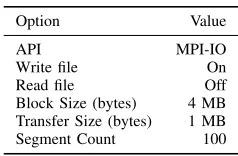
execution running on 64 nodes (64×16 = 1,024cores). The configuration used for IOR can be found in Table II. The collective buffer size was set to the default value (16 MB) and each node contributed one collective buffer process, meaning there was a total of 64 buffering processes. To reduce the search space, a linear search was conducted with a stripe count between 1 and 160 (as there is a 160 OST limit in the Lustre version 2.4.2, which is used on OCF machines) and a stripe size between 1 and 256 MB.
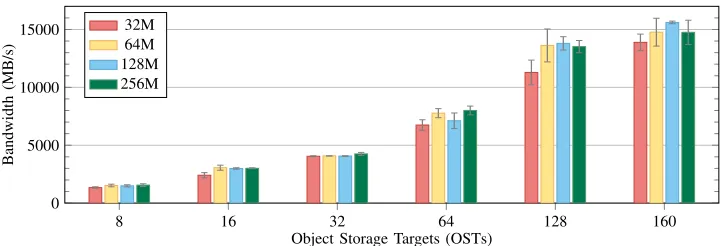
The results of this parameter search are shown in Figure 1. Using the default Lustre configuration (stripe count = 2, stripe size = 1 MB), the application achieves an average bandwidth of 313 MB/s. Through varying the stripe size, performance can be increased from this baseline bandwidth up to 395 MB/s, and by varying the stripe count perfor-mance can be increased much further, up to a maximum of 4,075 MB/s.
Figure 1 shows that through varying both parameters the maximum bandwidth is found when using 160 stripes of size 128 MB; performance increases from the baseline 313 MB/s, up to 15,609 MB/s, representing a 49×improvement in write performance. This result largely echoes those reported by previously [5], where the greatest performance is usually found by striping across the maximum number of OSTs and writing stripes that are a multiple of the application’s I/O block size.
That the optimal performance is found when exploiting the maximum amount of available parallelism may seem obvious, but on many systems, it is simply not possible to achieve this without a rebuilt software stack. Exploiting a larger proportion of the available file servers and storage targets may be optimal on a quiet system, however when there are many tasks requiring I/O simultaneously, the per-formance may decrease to the OST contention,
V. QUANTIFYING THEPERFORMANCE OFCONTENDED
FILESYSTEMS
[image:4.612.61.289.71.224.2]8 16 32 64 128 160 0
5000 10000 15000
Object Storage Targets (OSTs)
Bandwidth
(MB/s)
[image:5.612.127.491.69.192.2]32M 64M 128M 256M
Figure 1: Write bandwidth achieved over 1,024 processors by varying both the stripe count and the stripe size.
each using 160 OSTs, would fully occupy the file system if the assignment had no overlaps. However, as OSTs are assigned randomly, for two jobs (of which the first uses
160/480of the available OSTs) approximately one third of the OSTs assigned to the second job will also be in use by the first job.
Dinuse(n) =Dinuse(n−1) +
rj−
Dinuse(n−1)
Dtotal
rj
(1)
If each job (j ∈ {1. . . n}) requests rj OSTs, the total number of OSTs in use (Dinuse) after each job starts is described by Equation 1, where Dinuse(0) = 0. Each time a new job starts, the number of OSTs in use increases by the size of the request, minus the average number of OST collisions that occur. If each job is requesting the same num-ber of resources (R) – which may be the case if a parameter sweep has determined that the optimal configuration is when the maximum number of OSTs are used – then the number of OSTs in use can be simplified to:
Dinuse =Dtotal−
Dtotal×
1− R Dtotal
n (2)
With these two equations the average load of each OST (Dload) can be calculated, for any particular workload, by taking the number of stripes requested in total, and dividing it by the number of OSTs in use. A load of 1 would imply that each OST is, on average, only in use by a single job, whereas a higher number would indicate that there are a number of collisions on some OSTs, potentially resulting in a job switching overhead.
Dreq=R×n (3)
Dload=
Dreq
Dinuse
(4)
Table III demonstrates this for the lscratchc file system where each job is requesting the previously discovered optimal number of stripes (160). With 10 simultaneous
Dtotal= 480,R= 160
Jobs Dinuse Dreq Dload
[image:5.612.378.496.399.513.2]1 160.00 160 1.00 2 266.67 320 1.20 3 337.78 480 1.42 4 385.19 640 1.66 5 416.79 800 1.92 6 437.86 960 2.19 7 451.91 1120 2.48 8 461.27 1280 2.78 9 467.51 1440 3.08 10 471.68 1600 3.39
Table III: The average number of OSTs in use and their av-erage load based on the number of concurrent I/O intensive jobs with 160 stripes requested by each job.
Dtotal= 480,R= 64
Jobs Dinuse Dreq Dload
1 64.00 64 1.00 2 119.47 128 1.07 3 167.54 192 1.15 4 209.20 256 1.22 5 245.31 320 1.30 6 276.60 384 1.39 7 303.72 448 1.48 8 327.22 512 1.57 9 347.59 576 1.66 10 365.25 640 1.75
Table IV: The average number of OSTs in use and their av-erage load based on the number of concurrent I/O intensive jobs with 64 stripes requested by each job.
I/O intensive jobs each using 160 OSTs, an average of 4 collisions will occur on each OST, though a small subset of OSTs may well incur all 10 potential collisions (and some may incur none), reducing the performance of the file system for every job. Table IV shows that by reducing the size of the stripe requests to 64, the OST load is decreased significantly, possibly avoiding many of the bottlenecks associated with OST contention.
1 2 3 4 5 6 7 8 9 10 11 12 13 14 15 16 9
18 36 72 144 288
Contended Jobs
Bandwidth
(MB/s)
[image:6.612.126.490.72.239.2]Estimated Upper and Lower Bounds Actual Bandwidth
Figure 2: The performance per-processor of the lscratchc file system under contention, with the ideal upper and lower bounds.
write its own file in a single MPI application. The benchmark opens a number of files, with the same Lustre configuration (a single 1 MB stripe). Using the stripe_offset MPI hint, the OST to use is specified such that every rank writes to its own file that is stored on the same target. Figure 2 shows the per-process bandwidth achieved with a varying number of contended file writes.
In Figure 2, the shaded area indicates idealised scaling behaviour, where the upper and lower limits are calculated from the 95% confidence intervals from the single job exper-iment and scaled linearly; aslscratchc is already a shared-user file system, there is some variance in performance with noforced contention. The graph shows that, as the number of jobs is increased, the performance diverges from the top of the ideal scaling line, illustrating the performance degradation associated with high OST load.
To investigate this on the whole file system, a job was submitted to Cab that created four identical IOR executions each running simultaneously with the configuration stated in Table II. Each task utilised 64 nodes (1,024 processes) and thus the total job consumed 4,096 cores, and the MPI hints were specified according to the previously discovered optimal values (Figure 1). As can be seen in Figure 3, each individual application achieved approximately 4,500 MB/s – a 3.44×reduction from the peak value (15,609 MB/s) seen in Figure 1.
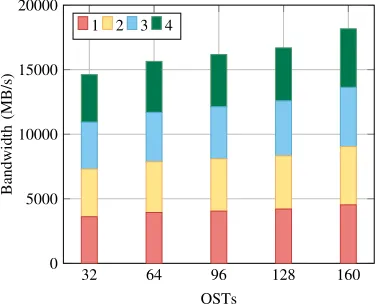
Using the mean of five experiments, Table V and Figure 4 demonstrate how reducing the number of stripes per job increases the OST availability to the rest of the system while having a minimal effect on performance. Using as few as 32 stripes per file, the average bandwidth achieved by each of the four applications is 3,500MB/s, but by Equation 2, only 115 OSTs will be in use in the average case, providing an average OST load of≈1.1.
Furthermore, Table V shows that when using a stripe
32 64 96 128 160
0 5000 10000 15000 20000
OSTs
Bandwidth
(MB/s)
1 2 3 4
Figure 4: Graphical representation of the data in Table V, showing optimal performance at 160 stripes per file, but very minor performance degradation at just 32 stripes per file.
count of 160, there are 42 OSTs that are being contended by 3 of the 4 jobs and there are 7 OSTs being contended by all 4. By reducing the demand to 64 stripes, the performance is reduced by ≈14% while the number of OSTs in use is reduced by ≈37%, leaving more resources available for a larger number of tasks, while also reducing the number of collisions significantly. Although it is unlikely that many simultaneous jobs will request such a large number of OSTs each, we seek only to demonstrate a worst case scenario and demonstrate the potentially harmful nature of auto tuning without consideration for the QoS of a shared file system.
[image:6.612.344.533.294.446.2]1 2 3 4 5 0
1000 2000 3000 4000 5000
Repetition
Bandwidth
(MB/s)
1 2
[image:7.612.127.491.70.222.2]3 4
Figure 3: Performance of each of 4 tasks over 5 repetitions where all tasks are contenting the file system.
Average Total OST Usage Predicted Actual
R Bandwidth Bandwidth Dreq 1 2 3 4 Dinuse Dload Dinuse Dload
[image:7.612.116.236.373.485.2]32 3654.06 14616.24 128 103.2 11.2 0.8 0.0 115.76 1.11 115.20 1.11 64 3910.51 15642.03 256 172.6 35.8 3.4 0.4 209.20 1.22 212.20 1.21 96 4042.98 16171.92 384 199.4 76.4 9.8 0.6 283.39 1.36 286.20 1.34 128 4172.17 16688.66 512 211.6 111.4 22.4 2.6 341.18 1.50 348.00 1.47 160 4541.37 18165.46 640 191.8 147.0 41.8 7.2 385.19 1.66 387.80 1.65
Table V: Average and total bandwidth achieved across four tasks for a varying stripe size request, along with values for the average number of tasks competing for 1, 2, 3 and 4 OSTs respectively.
Dtotal= 160,R= 128
Jobs Dinuse Dreq Dload
1 128.00 128 1.00 2 153.60 256 1.67 3 158.72 384 2.42 4 159.74 512 3.21 5 159.95 640 4.00 6 159.99 768 4.80 7 160.00 896 5.60 8 160.00 1024 6.40 9 160.00 1152 7.20 10 160.00 1280 8.00
Table VI: Predicted OST usage and average load for the Stampede I/O setup described in [5] with contended jobs.
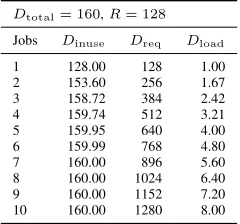
performance and may be detrimental to the rest of the system. To demonstrate this further, the equations presented in this paper have been applied to the configuration of the Stampede supercomputer [5]. Table VI shows our predicted OST load for Stampede’s file system using the optimal stripe count found by Behzad et al. for the VPIC-IO application (128 stripes on a file system with 58 OSSs and 160 OSTs). Our analysis demonstrates that with only three simultaneous tasks with a similar I/O demand, the OSTs on Stampede could be in use by as many as two or three simultaneous tasks in the average case. This may potentially cause a significant performance degradation.
VI. THEINFLUENCE OFPLFSONCONTENTION
In our previous work PLFS was shown to produce a noticeable performance increase on LLNL systems under certain conditions [6], [17]. However, this paper has already demonstrated that the performance gap is reduced when using a tuned Lustre-specific MPI-IO driver. Furthermore, some of our previous work has shown that at scale, PLFS performs worse than even the unoptimised UFS MPI-IO file system driver (ad_ufs) [6].
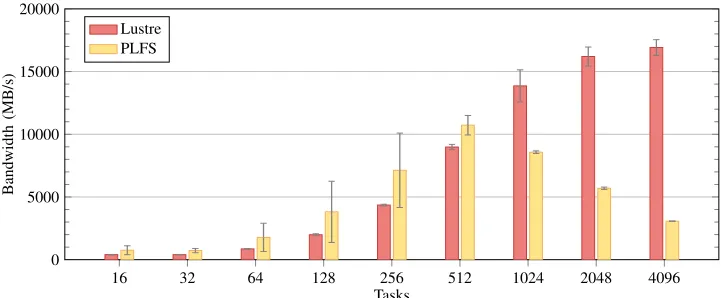
Figure 5 shows the performance of the lscratchc file system when running the IOR problem described in Table II on Cab. PLFS operates by creating a separate data and index file for each rank, in directories controlled by a hashing function; this increases the number of file streams available and consequently increases the number of Lustre stripes in use. As the files are written by PLFS through POSIX file system calls, each file is created with the system default configuration of two 1 MB stripes per file (unless otherwise specified using the lfscontrol program).
16 32 64 128 256 512 1024 2048 4096 0
5000 10000 15000 20000
Tasks
Bandwidth
(MB/s)
Lustre PLFS
Figure 5: Achieved write bandwidth achieved for IOR through an optimised Lustre configuration and through the PLFS MPI-IO driver.
ad_lustre ad_plfs
Processors B/W 95% CI B/W 95% CI
16 403.75 (390.73, 416.77) 752.96 (398.41, 1107.51) 32 404.71 (393.09, 416.34) 727.33 (558.95, 895.70) 64 857.35 (832.82, 881.88) 1776.70 (648.90, 2904.50) 128 1987.51 (1908.24, 2066.78) 3814.62 (1375.19, 6254.05) 256 4354.98 (4288.69, 4421.27) 7126.88 (4159.66, 10094.10) 512 8985.14 (8777.61, 9192.66) 10723.42 (9947.06, 11499.77) 1024 13859.58 (12582.68, 15136.47) 8575.13 (8474.06, 8676.21) 2048 16200.16 (15441.57, 16958.74) 5696.41 (5604.86, 5787.97) 4096 16917.11 (16291.58, 17542.64) 3069.05 (3052.82, 3085.28)
Table VII: Numeric data for Figure 5, showing the performance of IOR through Lustre and PLFS.
background machine noise it is difficult to know what the load is on each OST at any given time, but generally PLFS performs better when the number of OSTs experiencing a high number of collisions is minimised.
Table VIII shows the number of OST collisions in the PLFS backend directory for the 512 cores case – the highest core count for which PLFS produces a speed-up over the
ad_lustredriver. At 512 cores, the performance of PLFS reaches its peak before Lustre begins to provide better performance. Although PLFS has been designed to target unaligned accesses, the scaling issues in PLFS will still be present at scale due to the number of files being created. However, unaligned accesses may be detrimental to the performance of Lustre.
Using the equations introduced earlier to quantify the number of OST collisions for contended jobs, but amending the equations to deal with the contention created by PLFS we can analyse the average OST load for PLFS. To modify the equations, we instead treat each rank as a separate task with 2 stripes (i.e.R= 2) and set the number of tasks (n) to the number of ranks in use. This mimics the behaviour of PLFS on a single application run (wherenfiles are created, instead of a single file).
Dinuse =Dtotal−
Dtotal×
1− 2 Dtotal
n (5)
Experiment
Collisions 1 2 3 4 5
0 121 135 122 116 129
1 134 126 134 129 133
2 97 88 85 94 82
3 49 55 56 45 54
4 21 22 21 20 28
5 6 6 6 12 2
6 1 1 2 1 1
7 0 0 0 0 1
8 0 0 0 1 0
Dinuse 429 433 426 418 430
Dload 2.39 2.36 2.40 2.45 2.38
[image:8.612.127.491.73.222.2]BW (MB/s) 12062.68 10469.38 10234.97 9768.07 11081.99
Table VIII: Stripe collision statistics for PLFS backend directory running with 512 processors.
Dload=
2×n Dinuse
(6)
Experiment
Collisions 1 2 3 4 5
0 0 0 0 0 0
1 0 0 0 0 0
2 1 0 0 0 0
3 0 0 1 0 0
4 0 0 0 0 0
5 0 1 1 1 0
6 1 2 2 2 4
7 2 4 2 10 2
8 8 7 5 3 7
9 9 10 13 16 15
10 15 13 21 18 18
11 26 18 30 21 25
12 33 38 34 37 29
13 48 46 36 33 37
14 45 48 38 40 48
15 28 33 45 51 46
16 51 49 32 44 46
17 42 42 46 41 36
18 30 35 34 29 33
19 44 46 39 34 29
20 28 21 27 20 25
21 24 18 21 22 26
22 17 14 14 12 17
23 10 9 14 11 10
24 6 12 4 8 9
25 1 3 8 11 7
26 5 5 8 9 5
27 4 5 4 3 2
28 0 0 1 1 3
29 2 1 0 2 0
30 0 0 0 0 0
31 0 0 0 0 0
32 0 0 0 1 0
33 0 0 0 0 0
34 0 0 0 0 0
35 0 0 0 0 1
Dinuse 480 480 480 480 480
Dload 17.07 17.07 17.07 17.07 17.07
[image:9.612.66.287.74.417.2]BW (MB/s) 3042.06 3077.16 3083.26 3084.89 3057.90
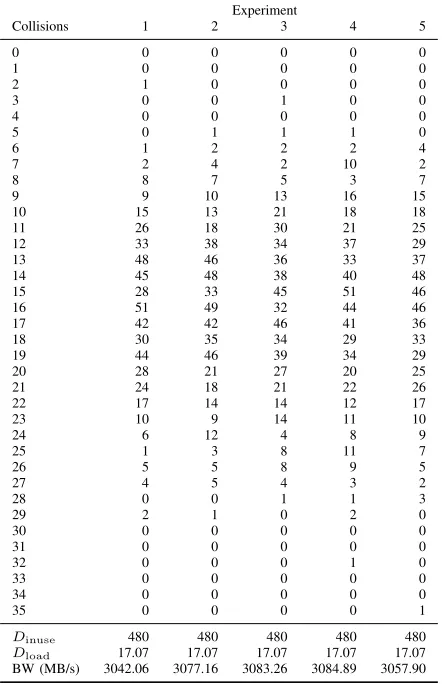
Table IX: Stripe collision statistics for PLFS backend direc-tory running with 4,096 processors.
respectively, which begins to saturate the file system and decreases performance not just for the host application, but for all other users of the file system too. Tables VIII and IX show the observed collision statistics for two of these application configurations. Table IX specifically shows that at 4,096 cores, most OSTs are being used for the stripe data of between 10 and 23 files and in one of the five repeated experiments, a single OST is being used by 35 competing ranks, placing a large overhead on its potential performance.
VII. CONCLUSION
In this paper it has been shown that current-day I/O sys-tems perform much better than some literature suggests [1]– [3]. However, this level of performance can only be achieved if the file system is being used correctly. Behzad et al. [4], [5] suggest that on Lustre file systems, a good level of performance can be found by adjusting particular file layout settings. They show that, with an optimised configuration, the file system scales almost linearly. However, due to restrictions in the version of Lustre used for the experiments in this paper, the maximum number of OSTs that can be used
is only 160; this suggests that when problems are scaled up to hundreds of thousands of nodes (as may be the case for Exascale), the I/O performance will not scale. Particular versions of Lustre already scale beyond this OST limit [24], but they are not currently being used by some of the biggest supercomputing centres (such as the OCF at LLNL).
We have utilised an exhaustive search algorithm to per-form a parameter sweep to find an optimal configuration for the Lustre file system connected to the Cab supercomputer. After finding an optimal configuration for a small IOR problem, this paper analyses the effect of I/O contention on the achievable bandwidth. A series of metrics have also been proposed that aim to quantify the contention that is created by several jobs competing for this shared resource. Section V shows that when jobs are run with the optimal configuration on a contented resource, performance drops considerably, and using less resources vastly improves system availability with a minor performance degradation.
We have previously explored the work of LANL and EMC2 in creating PLFS, which has been shown to provide significant speed-ups at mid-scale [6], [17]. However, this paper shows that PLFS may be harmful to performance on Lustre file systems at large-scale. The work in this paper provides an explanation for the performance degradation experienced previously, within the framework of the Lustre contention metrics provided.
Using the equations given, the load of each OST can be calculated for both competing I/O intensive applications and for PLFS-based applications. With the results from these equations, various file system purchasing decisions can be made; for instance, the number of OSTs can be increased in order to reduce the OST load for a theoretically “average” I/O workload. Furthermore, the benefits PLFS may have on an application can be calculated based on the scale at which it will be run, as well as on the number of OSTs available for the task.
While, at the time of writing, the I/O backplanes in mod-ern day systems are being under-utilised, with the correct configuration options and some optimisation by application developers, acceptable performance can be achieved with relatively little effort. Making these changes to applications and file system configurations will not only improve current scientific applications, but will also benefit future systems and inform future I/O system developers on how to best proceed towards Exascale-class storage.
REFERENCES
[2] J. Cope, M. Oberg, H. M. Tufo, and M. Woitaszek, “Shared Parallel Filesystems in Heterogeneous Linux Multi-Cluster Environments,” in Proceedings of the 6th LCI International Conference on Linux Clusters. Chapel Hill, NC: Linux Clusters Institute, NM, 2005, pp. 1–21.
[3] Y. Chanel, “Study of the Lustre File System Performances Before its Installation in a Computing Cluster,” http://upcommons.upc.edu/pfc/bitstream/2099.1/5626/1/49964.pdf (accessed June 20, 2011), 2008.
[4] B. Behzad, S. Byna, S. M. Wild, and M. Snir, “Improving Par-allel I/O Autotuning with Performance Modeling,” Argonne National Laboratory, Argonne, IL, Tech. Rep. ANL/MCS-P5066-0114, January 2014.
[5] B. Behzad, H. V. T. Luu, J. Huchette, S. Byna, Prabhat, R. Aydt, Q. Koziol, and M. Snir, “Taming Parallel I/O Complexity with Auto-tuning,” in Proceedings of the 25th ACM/IEEE International Conference for High Performance Computing, Networking, Storage and Analysis (SC’13). Den-ver, CO: IEEE Computer Society, Washington, DC, Novem-ber 2013, pp. 1–12.
[6] S. A. Wright, S. D. Hammond, S. J. Pennycook, I. Miller, J. A. Herdman, and S. A. Jarvis, “LDPLFS: Improving I/O Performance without Application Modification,” in Pro-ceedings of the 26th IEEE International Parallel & Dis-tributed Processing Symposium Workshops & PhD Forum (IPDPSW’12). Shanghai, China: IEEE Computer Society, Washington, DC, 2012, pp. 1352–1359.
[7] Department of Energy, “Department of Energy Exascale Strategy – Report to Congress,” United States Department of Energy, Washington, DC 20585, Tech. Rep., June 2013.
[8] Message Passing Interface Forum, “MPI: A Message Passing Interface Standard Version 2.2,”High Performance Comput-ing Applications, vol. 12, no. 1–2, pp. 1–647, 2009.
[9] R. Thakur, E. Lusk, and W. Gropp, “Users Guide for ROMIO: A High-Performance, Portable MPI-IO Implementa-tion,” Mathematics and Computer Science Division, Argonne National Laboratory, Argonne, IL, Tech. Rep. ANL/MCS-TM-234, October 1997.
[10] E. Gabriel, G. E. Fagg, G. Bosilca, T. Angskun, J. J. Dongarra, J. M. Squyres, V. Sahay, P. Kambadur, B. Barrett, A. Lums-daine, R. H. Castain, D. J. Daniel, R. L. Graham, and T. S. Woodall, “Open MPI: Goals, Concept, and Design of a Next Generation MPI Implementation,”Lecture Notes in Computer Science (LNCS), vol. 3241, pp. 97–104, September 2004.
[11] W. Gropp, “MPICH2: A New Start for MPI Implementa-tions,”Lecture Notes in Computer Science (LNCS), vol. 2474, p. 7, October 2002.
[12] G. Alam´asi, C. Archer, J. G. Casta˜nos, C. C. Erway, P. Heidel-berger, X. Martorell, J. E. Moreira, K. Pinnow, J. Ratterman, N. Smeds, B. Steinmacher-burrow, W. Gropp, and B. Toonen, “Implementing MPI on the BlueGene/L Supercomputer,” Lec-ture Notes in Computer Science (LNCS), vol. 3149, pp. 833– 845, August–September 2004.
[13] Bull,BullX Cluster Suite Application Developer’s Guide, Les Clayes-sous-Bois, Paris, April 2010.
[14] B. Nitzberg and V. M. Lo, “Collective Buffering: Improving Parallel I/O Performance,” in Proceedings of the 6th IEEE International Symposium on High Performance Distributed Computing (HPDC’97). Portland, OR: IEEE Computer Society, Washington, DC, August 1997, pp. 148–157.
[15] R. Thakur, W. Gropp, and E. Lusk, “Data-Sieving and Col-lective I/O in ROMIO,” inProceedings of the 7th Symposium on the Frontiers of Massively Parallel Computation (FRON-TIERS’99). Annapolis, MD: IEEE Computer Society, Los Alamitos, CA, February 1999, pp. 182–191.
[16] S. A. Wright, S. D. Hammond, S. J. Pennycook, and S. A. Jarvis, “Light-weight Parallel I/O Analysis at Scale,”Lecture Notes in Computer Science (LNCS), vol. 6977, pp. 235–249, October 2011.
[17] S. A. Wright, S. D. Hammond, S. J. Pennycook, R. F. Bird, J. A. Herdman, I. Miller, A. Vadgama, A. H. Bhalerao, and S. A. Jarvis, “Parallel File System Analysis Through Application I/O Tracing,” The Computer Journal, vol. 56, no. 2, pp. 141–155, February 2013.
[18] R. Thakur, W. Gropp, and E. Lusk, “An Abstract-Device Interface for Implementing Portable Parallel-I/O Interfaces,” inProceedings of the 6th Symposium on the Frontiers of Mas-sively Parallel Computation (FRONTIERS’96). Annapolis, MD: IEEE Computer Society, Los Alamitos, CA, October 1996, pp. 180–187.
[19] P. Schwan, “Lustre: Building a File System for 1,000-node Clusters,” inProceedings of the Linux Symposium. Ottawa, Ontario, Canada: The Linux Symposium, July 2003, pp. 380– 386.
[20] P. M. Dickens and J. Logan, “A High Performance Implemen-tation of MPI-IO for a Lustre File System Environment,” Con-currency and Computation: Practice & Experience, vol. 22, no. 11, pp. 1433–1449, August 2010.
[21] B. Lind, “Lustre Tuning Parameters,” in Proceedings of the 2013 Lustre User Group (LUG’13). San Diego, CA: OpenSFS, LUG, April 2013, pp. 1–12.
[22] H. You, Q. Liu, Z. Li, and S. Moore, “The Design of an Auto-Tuning I/O Framework on Cray XT5 System,” inProceedings of the 2011 Cray Users Group Conference (CUG’11). Fair-banks, AK: Cray Inc., May 2011, pp. 1–10.
[23] M. Polte, J. F. Lofstead, J. Bent, G. Gibson, S. A. Klasky, Q. Liu, M. Parashar, K. Schwan, and M. Wolf, “... And Eat It Too: High Read Performance in Write-Optimized HPC I/O Middleware File Formats,” inProceedings of the 4th Annual Workshop on Petascale Data Storage (PDSW’09). Portland, OR: ACM, New York, NY, November 2009, pp. 21–25.