Time Mapping with Hypergraphs
J a n W . A m t r u p V o l k e r W e b e r C o m p u t i n g Research L a b o r a t o r y University of H a m b u r g ,
New Mexico S t a t e University C o m p u t e r Science D e p a r t m e n t ,
Las Cruces, N M 88003,USA Vogt-K611n-Str. 30, D-22527 H a m b u r g , G e r m a n y email: j a m t r u p ~ c r l . n m s u , e d u email: w e b e r @ i n f o r m a t i k . u n i - h a m b u r g . d e
A b s t r a c t
Word graphs are able to represent a large num- ber of different utterance hypotheses in a very compact manner. However, usually they con- tain a huge amount of redundancy in terms of word hypotheses that cover almost identi- cal intervals in time. We address this problem by introducing hypergraphs for speech process- ing. Hypergraphs can be classified as an ex- tension to word graphs and charts, their edges possibly having several start and end vertices. By converting ordinary word graphs to hyper- graphs one can reduce the number of edges considerably. We define hypergraphs formally, present an algorithm to convert word graphs into hypergraphs and state consistency proper- ties for edges and their combination. Finally, we present some empirical results concerning graph size and parsing efficiency.
1 I n t r o d u c t i o n
The interface between a word recognizer and language processing modules is a crucial issue with m o d e r n speech processing systems. Given a sufficiently high word recognition rate, it suf- fices to transmit the most probable word se- quence from the recognizer to a subsequent module (e.g. a parser). A slight extension over this best chain mode would be to deliver n-best chains to improve language processing results.
However, it is usually not enough to deliver just the best 10 or 20 utterances, at least not for reasonable sized applications given todays speech recognition technology. To overcome this problem, in most current systems word graphs are used as speech-language interface. Word graphs offer a simple and efficient means to rep- resent a very high number of utterance hypothe- ses in a extremely compact way (Oerder and Ney, 1993; Aubert and Ney, 1995).
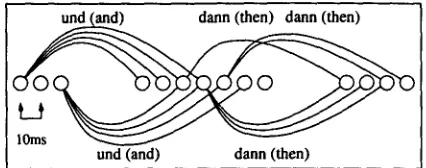
und (and) dann (then)
Figure 1: Two families of edges in a word graph Although they are compact, the use of word graphs leads to problems by itself. One of them is the current lack of a reasonable measure for word graph size and evaluation of their contents (Amtrup et al., 1997). T h e problem we want to address in this paper is the presence of a large number of almost identical word hypotheses. By almost identical we mean that the start and end vertices of edges differ only slightly.
Consider figure 1 as an example section of a word graph. There are several word hypothe- ses representing the words und (and) and dann (then). The start and end points of them differ by small numbers of frames, each of them 10ms long. The reasons for the existence of these fam- ilies of edges are at least twofold:
* Standard HMM-based word recognizers try to start (and finish) word models at each individual frame. Since the resolution is quite high (10ms, in many cases shorter than the word onset), a word model may have boundaries at several points in time. • Natural speech (and in particular spon-
[image:1.612.321.534.225.309.2]of word boundaries by containing several meeting points between und and dann, em- phasized by the fact that b o t h words end resp. start with the same consonant. Thus, for most words, there is a whole set of word hypotheses in a word graph which re- sults in several meets between two sets of hy- potheses. Both facts are disadvantageous for speech processing: Many word edges result in a high number of lexical lookups and basic op- erations (e.g. b o t t o m - u p proposals of syntactic categories); many meeting points between edges result in a high number of possibly complex op- erations (like unifications in a parser).
T h e most obvious way to reduce the number of neighboring, identically labeled edges is to reduce the time resolution provided by a word recognizer (Weber, 1992). If a word edge is to be processed, the start and end vertices are m a p p e d to the more coarse grained points in time used by linguistic modules and a redun- dancy check is carried out in order to prevent multiple copies of edges. This can be easily done, b u t one has to face the drawback on in- troducing many more paths through the graph due to artificially constructed overlaps. Fur- thermore, it is not simple to choose a correct resolution, as the intervals effectively appearing with word onsets and offsets change consider- ably with words spoken. Also, the introduction of cycles has to be avoided.
A more sophisticated schema would use in- terval graphs to encode word graphs. Edges of interval graphs do not have individual start and end vertices, but instead use intervals to denote the range of applicability of an edge. The major problem with interval graphs lies with the com- plexity of edge access methods. However, many formal statements shown below will use interval arithmetics, as the argument will be easier to follow.
The approach we take in this paper is to use hypergraphs as representation m e d i u m for word graphs. W h a t one wants is to carry out oper- ations only once and record the fact that there are several start and end points of words. Hy- pergraphs (Gondran and Minoux, 1984, p. 30) are generalizations of ordinary graphs that al- low multiple start and end vertices of edges.
We extend the approach of H. Weber (Weber, 1995) for time mapping. Weber considered sets
of edges with identical start vertices b u t slightly different end vertices, for which the notion
fam-
ily
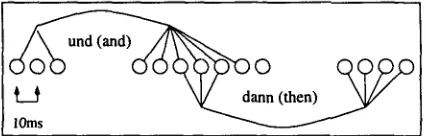
was introduced. We use full hypergraphs as representation and thus additionally allow sev- eral start vertices, which results in a further de- crease of 6% in terms of resulting chart edges while parsing (cf. section 3). Figure 2 shows the example section using hyperedges for the two families of edges. We adopt the way of dealing with different acoustical scores of word hypotheses from Weber.(then) lOms
Figure 2: Two hyperedges representing families of edges
2 W o r d G r a p h s a n d H y p e r g r a p h s As described in the introduction, word graphs consist of edges representing word hypotheses generated by a word recognizer. T h e start and end point of edges usually denote points in time. Formally, a word graph is a directed, acyclic, weighted, labeled graph with distinct root and end vertices. It is a quadruple G = (V, g, YV,/:) with the following components:
• A n o n e m p t y set of graph vertices Y --
{ v l , . . . , V n } .
To associate vertices withpoints in time, we use a function t : 1) > N that returns the frame number for a given vertex.
• A n o n e m p t y set of weighted, labeled, di- rected edges g = { e l , . . . , e m } C_ V x ~2 x 14) × E. To access the components of an edge e = (v, v', w, l), we use functions a, ~3, w and l, which return the start vertex (~(e) = v), the end vertex (/~(e) = v'), the weight
(w(e) = w)
and the label(l(e) = l)
of an edge, respectively.
[image:2.612.320.533.230.298.2]• A n o n e m p t y set of Labels £ = { t l , . . . ,lo}, which represents information a t t a c h e d to an edge, usually words.
We define the relation of teachability for ver- tices (--r) as Vv, w E V : v --+ w ~ 3e E $ :
= v ^ = w
T h e transitive hull of the reachability relation ---r is denoted by -~.
We already stated t h a t a word graph is acyclic and distinctly rooted and ended.
2.1 I - I y p e r g r a p h s
Hypergraphs differ from graphs by allowing sev- eral start and end vertices for a single edge. In order to apply this p r o p e r t y to word graphs, the definition of edges has to be changed. T h e set of edges C becomes a n o n e m p t y set of weighted, la- beled, directed hyperedges $ = { e l , . . . , e m } C_ V*\O x V*\O x W x £.
Several notions and functions defined for ordi- n a r y word graphs have to be a d a p t e d to reflect edges having sets of start and end vertices.
• T h e accessor functions for start and end vertices have to be a d a p t e d to r e t u r n sets of vertices. Consider an edge e = (V, V', w , / ) , t h e n we redefine
a : c > : = v (1)
E > : = v ' (2)
• Two hyperedges e, e' are adjacent, if t h e y share a c o m m o n vertex:
fl(e) A a ( e ' ) # ~ (3) • T h e reachability relation is now Vv, w E )2 :
v - + w ~ 9e e $ : v e a(e) ^ w e ~(e) Additionally, we define accessor functions for the first and last start and end vertex of an edge. We recur to the association of vertices with frame numbers, which is a slight simplifi- cation (in general, there is no need for a total ordering on the vertices in a word graph) 1. Fur- thermore, the intervals covered by start and end vertices are defined.
a < ( e ) := argmin{t(v)lv E V} (4)
1The total ordering on vertices is naturally given through the linearity of speech.
a>Ce) := a r g m a x { t ( v ) l v e V} (5) /3<(e) := argmin{t(v)lv e V'} (6) /3>(e) := a r g m a x { t ( v ) l v E V'} (7) au(e ) := [t(a<(e)),t(a>(e))] (8) ~D(e) := [t(~<(e)),t(~>(e))] (9) In contrast to interval graphs, we do not re- quire the sets of start and end vertices to be con- tiguous, i.e. there m a y be vertices t h a t fall in the range of the start or end vertices of an edge which are not m e m b e r s of t h a t set. If we are not interested in the individual m e m b e r s of a(e) or ~(e), we merely talk about interval graphs. 2.2 E d g e C o n s i s t e n c y
J u s t like word graphs, we d e m a n d t h a t hyper- graphs are acyclic, i.e. Vv -5, w : v # w. In terms of edges, this corresponds to Ve :
t ( a > C e ) ) <
2.3 A d d i n g E d g e s t o H y p e r g r a p h s
Adding a simple word edge to a h y p e r g r a p h is a simplification of merging two hyperedges bear- ing the same label into a new hyperedge. There- fore we are going to explain the more general case for hyperedge merging first. We analyze which edges of a h y p e r g r a p h m a y be merged to form a new hyperedge without loss of linguistic information. This process has to follow three main principles:
• Edge labels have to be identical
• Edge weights (scores) have to be combined to a single value
• Edges have to be compatible in their start and end vertices and must not introduce cycles to the resulting graph
S i m p l e R u l e S e t f o r E d g e M e r g i n g
Let ei, e2 E E be two hyperedges to be checked for merging, where el = (V1, VI', wt, 11) and e2 = (V2, V~, w2,/2). T h e n el and e2 could be merged into a new hyperedge e3 = (V3, V~, w3,/3) iff
t ( e l ) = t ( e 2 ) ( 1 0 )
min(t(/3< (el)), t(/3< (e2))) >
m a x ( t ( a > (el)), t ( a > (e2))) (11) where e3 is:
V3 = VI UV2 (14)
= Vl' u (15)
el and e2 have to be removed from the hyper- graph while e3 has to be inserted.
S u f f i c i e n c y o f t h e R u l e - S e t
W h y is this set of two conditions sufficient for hyperedge merging? First of all it is clear t h a t we can merge only hyperedges with the same label (this is prescribed by condition 10). Con- dition 11 gives advice which hyperedges could be combined and prohibits cycles to be intro- duced in t h e hypergraph. An analysis of the occuring cases shows t h a t this condition is rea- sonable. W i t h o u t loss of generality, we assume t h a t t ( ~ > ( e l ) ) ~ t(;3>(e2)).
1. aO(el)n
13D(e2 )#
0 Va0(e2 )
n~0(el)
#
0:
This is the case where either the start ver- tices of el and the end vertices of e2 or the start vertices of e2 a n d end vertices of el overlap each other. T h e merge of two such hyperedges of this case would result in a hyperedge e3 where t(a>(e3)) )> t(~< (e3)). This could introduce cycles to the hyper- graph. So this case is excluded by condi- tion 11.2.
aD(el ) n ~B(e2)
= OA a[l(e2 )
¢3 ;3[](el) =O:
This is the c o m p l e m e n t a r y case to 1.
(a)
t(a<(e2)) >_
t(~>(el))
This is t h e case where all vertices of hyperedge el occur before all vertices of hyperedge e2 or in other words the case where two individual i n d e p e n d e n t word hypotheses with same label oc- cur in the word graph. This case must also not result in an edge merge since
~H(el) C_ [t(a<(el)),t(a>(e2))]
in the merged edge. This merge is prohib- ited by condition 11 since all vertices of ~ ( e l ) have to be smaller t h a n all vertices of a(e2).(b) t ( a < ( e 2 ) ) < t ( ~ > ( e l ) )
This is the c o m p l e m e n t a r y case to (a). i. t ( o ~ < ( e l ) ) ~ t ( ~ > ( e 2 ) )
This is only a theoretical case be-
cause
tC <(el)) < << _<
2Examples for the scorejoin operation are given later in the paragraph about score normalization.
is required
(e2
contains the last end vertex).ii. t ( a < ( e l ) ) < t(;3>(e2))
This is the c o m p l e m e n t a r y case to i. As a result of the e m p t y in- tersections and the cases (b) and ii we get t(c~>(el)) < t(~<(e2)) and t(oz>(e2)) < t ( ~ < ( e l ) ) . T h a t is in other words Vta E a 0 ( e l ) U
~n(e2),t~
e ;3U(el)u~D(e2) : t~ <
t~ and just the case d e m a n d e d by condition 2.
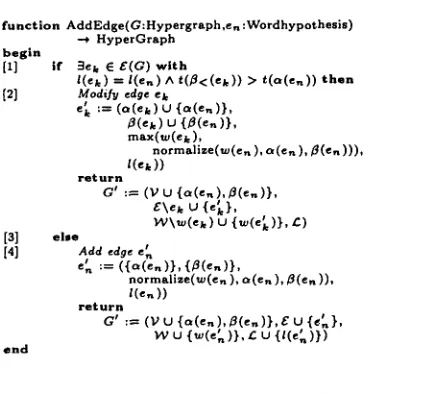
After analyzing all cases of merging of inter- sections between start and end vertices of two hyperedges we t u r n to insertion of word hy- potheses to a hypergraph. Of course, a word hypothesis could be seen as interval edge with trivial intervals or as a hyperedge with only one start and one end vertex. Since this case of adding an edge to a h y p e r g r a p h is r a t h e r easy to depict a n d is heavily used while parsing word graphs incrementally we discuss it in more de- tail.
e g e I
) (
~
+
e
3
C
)
(
)
(
)
(
)
~
e
5
[image:4.612.314.526.383.581.2]f u n c t i o n AddEdge(G:Hypergraph,en :Wordhypothesis) -~ HyperGraph
b e g i n
[1] if 3e~ E £(G) w i t h
l ( e k ) = l ( e n ) A t ( ~ < ( e l c ) ) > t ( a ( e n ) ) t h e n
(2] Modify edge e& e t := (aCek) u ( a ( e . ) } ,
~(ek) u (/~(e.)),
max(t~(ek),
n o r m a l i z e ( w ( e n ), a ( e n ) , ~ ( e n ))),
l(e~))
r e t u r n
C' := ( r U {a(en),~(en)),
e I
[3] else
[4] Add edge e' n
eln : = ( { c ~ ( e n ) } , { ~ ( e n ) } ,
normalize(w(en ), Q(en ), ~ ( e n )),
l ( e n ) )
r e t u r n
G' := (1) U { ~ ( e n ) , ~ ( e n ) } , E U {e~}, w u ( w ( e ' ) } , L u ( t ( e ' ) ) )
,and
Figure 4: An algorithm for adding edges to hy- pergraphs
of a matching hyperdege. In practice this is not needed and we could check a smaller a m o u n t of vertices. We do this by introducing a m a x i m a l t i m e gap which gives us advice how far (in mea- sures of time) we look backwards from the start vertex of a new edge to be inserted into the hy- pergraph to determine a compatible hyperedge of the hypergraph.
Additional Paths
C
C
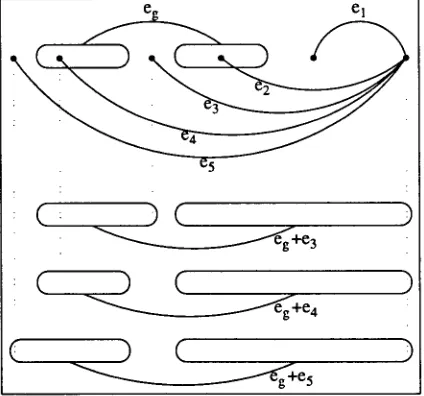
Figure 5: Additional paths by time mapping It is not possible to add el and e2 to the hy-
peredge eg since they would introduce an over- lap between the sets of start and end vertices of the potential new hyperedge. The resulting hyperedges of adding e3 -- e5 are depicted below. S c o r e N o r m a l i z a t i o n
Score normalization is a necessary means if one wants to compare hypotheses of different lengths. Thus, edges in word graphs are as- signed normalized scores that account for words of different extensions in time. T h e usual mea- sure is the score per .frame, which is computed
Score per word by taking Length of word in frames"
When combining several word edges as we do by constructing hyperedges, the combina- tion should be assigned a single value that re- flects a certain useful aspect of the originating edges. In order not to exclude certain hypothe- ses from consideration in score-driven language processing modules, the score of the hyperedge is inherited from the best-rated word hypothe- sis (cf. (Weber, 1995)). We use the m i n i m u m of the source acoustic scores, which corresponds to a highest recognition probability.
I n t r o d u c i n g a M a x i m a l T i m e G a p
The algorithm depicted in figure 4 can be speeded up for practical reasons. Each vertex between the graph root and the start vertex of the new edge could be one of the start vertices
It is possible to introduce additional paths into a graph by performing time mapping. Con- sider fig. 5 as an example. Taken as a normal word graph, it contains two label sequences, namely a - c - d and b - c - e . However, if time mapping is performed for the edges labelled c, two additional sequences are introduced: a - c - e and b - c - d . Thus, time mapping by hyper- graphs is not information preserving in a strong sense. For practical applications this does not present any problems. T h e situations in which additional label sequences are introduced are quite rare, we did not observe any linguistic dif- ference in our experiments.
2.4 Edge C o m b i n a t i o n
Besides merging the combination of hyperedges, to construct edges with new content is an impor- tant task within any speech processing module, e.g. for parsing. The assumption we will adopt here is that two hyperedges el, e2 E £ may be combined if they are adjacent, i.e. they share a common vertex: /~(el) N ol(e2) ~ 0. The label of the new edge en (which may be used to rep- resent linguistic content) is determined by the component building it, whereas the start and end vertices are determined by
Qc(en)
c (el)
(16)
[image:5.612.71.289.80.277.2] [image:5.612.315.525.214.306.2]This approach is quite analogous to edge com- bination m e t h o d s for normal graphs, e.g. in chart parsing, where two edges are equally re- quired to have a meeting point. However, score c o m p u t a t i o n for hyperedge combination is more difficult. T h e goal is to determine a score per frame by selecting the smallest possible score under all possible meeting vertices. It is de- rived by examining all possible connecting ver- tices (all elements of I := f~(el) CI a(e2)) and computing the resulting score of the new edge: If w(el) < w(e2), we use
w(e,~)
:= WC~l)(t< -t(~> (~1)))+~(~2).(t(~> (e2))-t<)tC~>(e2))-t(~>(~l))
where t< =
min{t(v)lv e I}.
If, on the other hand, w(el) > w(e2), we usew(el).(t>-t(~<(~l)))+~C~2).(t(~<(~2))-t>)
w(en)
:= t(~< (e:))-t(~< (~1)) 'where t> = max{t(v)[v e I}.
3 Experiments with Hypergraphs
T h e m e t h o d of converting word graphs to hy- pergraphs has been used in two experiments so far. One of t h e m is devoted to the study of connectionist unification in speech applications (Weber, forthcoming). T h e other one, from which the performance figures in this section are drawn, is an experimental speech transla- tion system focusing on incremental operation and uniform representation (Amtrup, 1997).
1000
0 . . .
# E d g e s
graphs produced by the Hamburg speech recog- nition system (Huebener et al., 1996). T h e test data consisted of one dialogue within the Verbmobil domain. There were 41 turns with an average length of 4.65s speaking time per turn. T h e word graphs contained 1828 edges on the average. Figure 6 shows the a m o u n t of reduction in the number of edges by converting the graphs into hypergraphs. On the average, 1671 edges were removed (mapped), leaving 157 edges in hypergraphs, approximately 91% less t h a n the original word graphs.
Next, we used b o t h sets of graphs (the orig- inal word graphs and hypergraphs) as input to the speech parser used in (Amtrup, 1997). This parser is an incremental active chart parser which uses a typed feature formalism to describe linguistic entities. The g r a m m a r is focussed on partial parsing and contains rules mainly for noun phrases, prepositional phrases and such. The integration of complete utterances is ne- glected. Figure 7 shows the reduction in terms of chart edges at completion time.
Figure 6: Word edge reduction
We want to show the effect of hypergraphs re- garding edge reduction and parsing effort. In or- der to provide real-world figures, we used word
lO000 -
IO00-
- 4 - Maximum gaps 100
# E d g e s
Figure 7: Chart edge reduction
are many instances of edges which are not in- serted into the chart at all, because identical hypotheses are already present.
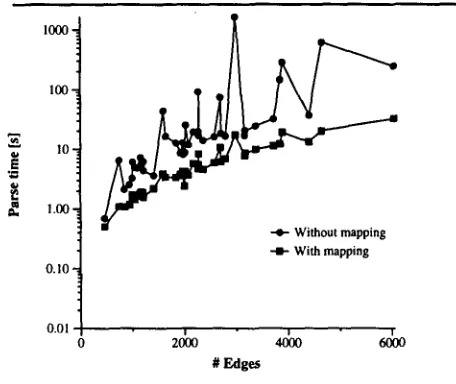
Consequently, the amount of reduction in parse time is within the same bounds. Pars- ing ordinary graphs took 87.7s, parsing of hy- pergraphs 6.4s, a reduction of 93%. There are some extreme cases of word graphs, where hy- pergraph parsing was 94 times faster than word graph parsing. One of the turns had to be ex- cluded from the test set, because it could not be fully parsed as word graph.
I000
100
1~ 1.617
--II- With mapping 0.10
o.ol I
o 4&o
# Edges
Figure 8: Parsing time reduction
4 C o n c l u s i o n
In this paper, we have proposed the application of hypergraph techniques to word graph pars- ing. Motivated by linguistic properties of spon- taneously spoken speech, we argued that bun- dles of edges in word graphs should be treated in an integrated manner. We introduced interval graphs and directed hypergraphs as representa- tion devices. Directed hypergraphs extend the notion of a family of edges in that they are able to represent edges having several start and end vertices.
We gave a formal definition of word graphs and the necessary extensions to cover hyper- graphs. The conditions that have to be fulfilled in order to merge two hyperedges and to com- bine two adjacent hyperedges were stated in a formal way; an algorithm to integrate a word hypothesis into a hypergraph was presented.
We proved the applicability of our mecha- nisms by parsing one dialogue of real-world spo- ken utterances. Using hypergraphs resulted in a 91% reduction of initial edges in the graph and a 79% reduction in the total number of chart edges. Parsing hypergraphs instead of ordinary word graphs reduced the parsing time by 93%.
R e f e r e n c e s
Jan W. Amtrup, Henrik Heine, and Uwe Jost. 1997. What's in a Word Graph - - Evaluation and Enhancement of Word Lattices. In Proc. of Eurospeech 1997, Rhodes, Greece, Septem- ber.
Jan W. Amtrup. 1997. Layered Charts for Speech Translation. In Proceedings of the Seventh International Conference on Theo- retical and Methodological Issues in Machine Translation, TMI '97, Santa Fe, NM, July. Xavier Aubert and Hermann Ney. 1995. Large
Vocabulary Continuous Speech Recognition Using Word Graphs. In ICASSP 95.
Michel Gondran and Michel Minoux. 1984. Graphs and algorithms. Wiley-Interscience Series in Discrete Mathematics. John Wiley & Sons, Chichester.
Kai Huebener, Uwe Jost, and Henrik Heine. 1996. Speech Recognition for Spontaneously Spoken German Dialogs. In ICSLP96, Philadelphia.
Martin Oerder and Hermann Ney. 1993. Word Graphs: An Efficient Interface Be- tween Continuous-Speech Recognition and Language Understanding. In Proceedings of the 1993 IEEE International Conference on Acoustics, Speech ~ Signal Processing, ICASSP, pages II/119-II/122, Minneapolis, MN.
Hans Weber. 1992. Chartparsing in ASL-Nord: Berichte zu den Arbeitspaketen P1 bis P9. Technical Report ASL-TR-28-92/UER, Uni- versit/it Erlangen-Niirnberg, Erlangen, De- cember.
Hans Weber. 1995. LR-inkrementelles, Prob- abilistisches Chartparsing yon Worthypothe- sengraphen mit Unifikationsgrammatiken: Eine Enge Kopplung yon Suche und Analyse. Ph.D. thesis, Universit/it Hamburg.
[image:7.612.66.294.238.430.2]