Profiting from Mark-Up: Hyper-Text Annotations for Guided Parsing
Valentin I. Spitkovsky Computer Science Department Stanford University and Google Inc.
Daniel Jurafsky
Departments of Linguistics and Computer Science, Stanford University
Hiyan Alshawi Google Inc. [email protected]
Abstract
We show how web mark-up can be used to improve unsupervised dependency pars-ing. Starting from raw bracketings of four common HTML tags (anchors, bold, ital-ics and underlines), we refine approximate partial phrase boundaries to yield accurate parsing constraints. Conversion proce-dures fall out of our linguistic analysis of a newly available million-word hyper-text corpus. We demonstrate that derived con-straints aid grammar induction by training Klein and Manning’s Dependency Model with Valence (DMV) on this data set: pars-ing accuracy on Section 23 (all sentences) of the Wall Street Journal corpus jumps to 50.4%, beating previous state-of-the-art by more than 5%. Web-scale exper-iments show that the DMV, perhaps be-cause it is unlexicalized, does not benefit from orders of magnitude more annotated but noisier data. Our model, trained on a single blog, generalizes to 53.3% accuracy out-of-domain, against the Brown corpus — nearly 10% higher than the previous published best. The fact that web mark-up strongly correlates with syntactic structure may have broad applicability in NLP.
1 Introduction
Unsupervised learning of hierarchical syntactic structure from free-form natural language text is a hard problem whose eventual solution promises to benefit applications ranging from question an-swering to speech recognition and machine trans-lation. A restricted version of this problem that tar-gets dependencies and assumes partial annotation — sentence boundaries and part-of-speech (POS) tagging — has received much attention. Klein and Manning (2004) were the first to beat a sim-ple parsing heuristic, the right-branching baseline;
today’s state-of-the-art systems (Headden et al., 2009; Cohen and Smith, 2009; Spitkovsky et al., 2010a) are rooted in their Dependency Model with Valence (DMV), still trained using variants of EM. Pereira and Schabes (1992) outlined three ma-jor problems with classic EM, applied to a related problem, constituent parsing. They extended clas-sic inside-outside re-estimation (Baker, 1979) to respect any bracketing constraints included with a training corpus. This conditioning on partial parses addressed all three problems, leading to: (i) linguistically reasonable constituent boundaries and induced grammars more likely to agree with qualitative judgments of sentence structure, which is underdetermined by unannotated text; (ii) fewer iterations needed to reach a good grammar, coun-tering convergence properties that sharply deterio-rate with the number of non-terminal symbols, due to a proliferation of local maxima; and (iii) better (in the best case, linear) time complexity per it-eration, versus running time that is ordinarily cu-bic in both sentence length and the total num-ber of non-terminals, rendering sufficiently large grammars computationally impractical. Their al-gorithm sometimes found good solutions from bracketed corpora but not from raw text, sup-porting the view that purely unsupervised, self-organizing inference methods can miss the trees for the forest of distributional regularities. This was a promising break-through, but the problem of whence to get partial bracketings was left open. We suggest mining partial bracketings from a cheap and abundant natural language resource: the hyper-text mark-up that annotates web-pages. For example, consider that anchor text can match lin-guistic constituents, such as verb phrases, exactly:
..., whereas McCain is secure on the topic, Obama
<a>[VPworries about winning the pro-Israel vote]</a>.
To validate this idea, we created a new data set, novel in combining a real blog’s raw HTML with tree-bank-like constituent structure parses,
ated automatically. Our linguistic analysis of the most prevalent tags (anchors, bold, italics and un-derlines) over its 1M+
words reveals a strong con-nection between syntax and mark-up (all of our examples draw from this corpus), inspiring several simple techniques for automatically deriving pars-ing constraints. Experiments with both hard and more flexible constraints, as well as with different styles and quantities of annotated training data — the blog, web news and the web itself, confirm that mark-up-induced constraints consistently improve (otherwise unsupervised) dependency parsing.
2 Intuition and Motivating Examples
It is natural to expect hidden structure to seep through when a person annotates a sentence. As it happens, a non-trivial fraction of the world’s pop-ulation routinely annotates text diligently, if only partially and informally.1 They inject hyper-links, vary font sizes, and toggle colors and styles, using mark-up technologies such as HTML and XML.
As noted, web annotations can be indicative of phrase boundaries, e.g., in a complicated sentence:
In 1998, however, as I<a>[VPestablished in
<i>[NPThe New Republic]</i>]</a>and Bill Clinton just<a>[VPconfirmed in his memoirs]</a>, Netanyahu changed his mind and ...
In doing so, mark-up sometimes offers useful cues even for low-level tokenization decisions:
[NP[NPLibyan ruler]
<a>[NPMu‘ammar al-Qaddafi]</a>]referred to ...
(NP (ADJP(NP (JJ Libyan) (NN ruler)) (JJ Mu))
(‘‘ ‘) (NN ammar) (NNS al-Qaddafi))
Above, a backward quote in an Arabic name con-fuses the Stanford parser.2 Yet mark-up lines up with the broken noun phrase, signals cohesion, and moreover sheds light on the internal structure of a compound. As Vadas and Curran (2007) point out, such details are frequently omitted even from manually compiled tree-banks that err on the side of flat annotations of base-NPs.
Admittedly, not all boundaries between HTML tags and syntactic constituents match up nicely:
..., but[S[NPthe<a><i>Toronto
Star</i>][VPreports[NPthis][PPin the
softest possible way]</a>,[Sstating only that ...]]]
Combining parsing with mark-up may not be straight-forward, but there is hope: even above,
1
Even when (American) grammar schools lived up to their name, they only taught dependencies. This was back in the days before constituent grammars were invented.
2
http://nlp.stanford.edu:8080/parser/
one of each nested tag’s boundaries aligns; and
Toronto Star’s neglected determiner could be
for-given, certainly within a dependency formulation.
3 A High-Level Outline of Our Approach
Our idea is to implement the DMV (Klein and Manning, 2004) — a standard unsupervised gram-mar inducer. But instead of learning the unan-notated test set, we train with text that contains web mark-up, using various ways of converting HTML into parsing constraints. We still test on WSJ (Marcus et al., 1993), in the standard way, and also check generalization against a hidden data set — the Brown corpus (Francis and Kucera, 1979). Our parsing constraints come from a blog — a new corpus we created, the web and news (see Table 1 for corpora’s sentence and token counts).
To facilitate future work, we make the final models and our manually-constructed blog data publicly available.3 Although we are unable to share larger-scale resources, our main results should be reproducible, as both linguistic analysis and our best model rely exclusively on the blog.
Corpus Sentences POS Tokens
WSJ∞
49,208 1,028,347
Section 23 2,353 48,201
WSJ45 48,418 986,830
WSJ15 15,922 163,715
Brown100 24,208 391,796
BLOGp 57,809 1,136,659
BLOGt45 56,191 1,048,404
BLOGt15 23,214 212,872
[image:2.595.323.510.384.520.2]NEWS45 2,263,563,078 32,119,123,561 NEWS15 1,433,779,438 11,786,164,503 WEB45 8,903,458,234 87,269,385,640 WEB15 7,488,669,239 55,014,582,024
Table 1: Sizes of corpora derived from WSJ and Brown, as well as those we collected from the web.
4 Data Sets for Evaluation and Training
The appeal of unsupervised parsing lies in its abil-ity to learn from surface text alone; but (intrinsic) evaluation still requires parsed sentences. Follow-ing Klein and MannFollow-ing (2004), we begin with ref-erence constituent parses and compare against de-terministically derived dependencies: after prun-ing out all empty subtrees, punctuation and ter-minals (tagged # and $) not pronounced where they appear, we drop all sentences with more than a prescribed number of tokens remaining and use automatic “head-percolation” rules (Collins, 1999) to convert the rest, as is standard practice.
3
Length Marked POS Bracketings Length Marked POS Bracketings
Cutoff Sentences Tokens All Multi-Token Cutoff Sentences Tokens All Multi-Token
0 6,047 1,136,659 7,731 6,015 8 485 14,528 710 684
1 of 57,809 149,483 7,731 6,015 9 333 10,484 499 479
2 4,934 124,527 6,482 6,015 10 245 7,887 365 352
3 3,295 85,423 4,476 4,212 15 42 1,519 65 63
4 2,103 56,390 2,952 2,789 20 13 466 20 20
5 1,402 38,265 1,988 1,874 25 6 235 10 10
6 960 27,285 1,365 1,302 30 3 136 6 6
[image:3.595.80.522.60.163.2]7 692 19,894 992 952 40 0 0 0 0
Table 2: Counts of sentences, tokens and (unique) bracketings for BLOGp, restricted to only those
sentences having at least one bracketing no shorter than the length cutoff (but shorter than the sentence).
Our primary reference sets are derived from the Penn English Treebank’s Wall Street Journal por-tion (Marcus et al., 1993): WSJ45 (sentences with fewer than 46 tokens) and Section 23 of WSJ∞
(all sentence lengths). We also evaluate on Brown100, similarly derived from the parsed portion of the Brown corpus (Francis and Kucera, 1979). While we use WSJ45 and WSJ15 to train baseline mod-els, the bulk of our experiments is with web data.
4.1 A News-Style Blog: Daniel Pipes
Since there was no corpus overlaying syntactic structure with mark-up, we began constructing a new one by downloading articles4 from a news-style blog. Although limited to a single genre — political opinion,danielpipes.orgis clean, consis-tently formatted, carefully edited and larger than WSJ (see Table 1). Spanning decades, Pipes’ editorials are mostly in-domain for POS taggers and tree-bank-trained parsers; his recent (internet-era) entries are thoroughly cross-referenced, con-veniently providing just the mark-up we hoped to study via uncluttered (printer-friendly) HTML.5
After extracting moderately clean text and mark-up locations, we used MxTerminator (Rey-nar and Ratnaparkhi, 1997) to detect sentence boundaries. This initial automated pass begot mul-tiple rounds of various semi-automated clean-ups that involved fixing sentence breaking, modifying parser-unfriendly tokens, converting HTML enti-ties and non-ASCII text, correcting typos, and so on. After throwing away annotations of fractional words (e.g., <i>basmachi</i>s) and tokens (e.g., <i>Sesame Street</i>-like), we broke up all mark-up that crossed sentence boundaries (i.e., loosely speaking, replaced constructs like <u>...][S...</u> with <u>...</u> ][S <u>...</u>) and discarded any
4
http://danielpipes.org/art/year/all
5http://danielpipes.org/article print.php?
id=. . .
tags left covering entire sentences.
We finalized two versions of the data: BLOGt,
tagged with the Stanford tagger (Toutanova and Manning, 2000; Toutanova et al., 2003),6 and BLOGp, parsed with Charniak’s parser (Charniak,
2001; Charniak and Johnson, 2005).7 The rea-son for this dichotomy was to use state-of-the-art parses to analyze the relationship between syntax and mark-up, yet to prevent jointly tagged (and non-standardAUX[G]) POS sequences from interfer-ing with our (otherwise unsupervised) traininterfer-ing.8
4.2 Scaled up Quantity: The (English) Web
We built a large (see Table 1) but messy data set, WEB — English-looking web-pages, pre-crawled by a search engine. To avoid machine-generated spam, we excluded low quality sites flagged by the indexing system. We kept only sentence-like runs of words (satisfying punctuation and capitalization constraints), POS-tagged with TnT (Brants, 2000).
4.3 Scaled up Quality: (English) Web News
In an effort to trade quantity for quality, we con-structed a smaller, potentially cleaner data set, NEWS. We reckoned editorialized content would lead to fewer extracted non-sentences. Perhaps surprisingly, NEWS is less than an order of magni-tude smaller than WEB (see Table 1); in part, this is due to less aggressive filtering — we trust sites approved by the human editors at Google News.9 In all other respects, our pre-processing of NEWS pages was identical to our handling of WEB data.
6
http://nlp.stanford.edu/software/ stanford-postagger-2008-09-28.tar.gz
7
ftp://ftp.cs.brown.edu/pub/nlparser/ parser05Aug16.tar.gz
8However, since many taggers are themselves trained on
manually parsed corpora, such as WSJ, no parser that relies on external POS tags could be considered truly unsupervised; for a fully unsupervised example, see Seginer’s (2007) CCL parser, available athttp://www.seggu.net/ccl/
9
5 Linguistic Analysis of Mark-Up
Is there a connection between mark-up and syn-tactic structure? Previous work (Barr et al., 2008) has only examined search engine queries, show-ing that they consist predominantly of short noun phrases. If web mark-up shared a similar char-acteristic, it might not provide sufficiently dis-ambiguating cues to syntactic structure: HTML tags could be too short (e.g., singletons like “click<a>here</a>”) or otherwise unhelpful in re-solving truly difficult ambiguities (such as PP-attachment). We began simply by counting vari-ous basic events in BLOGp.
Count POS Sequence Frac Sum
1 1,242 NNP NNP 16.1%
2 643 NNP 8.3 24.4
3 419 NNP NNP NNP 5.4 29.8
4 414 NN 5.4 35.2
5 201 JJ NN 2.6 37.8
6 138 DT NNP NNP 1.8 39.5
7 138 NNS 1.8 41.3
8 112 JJ 1.5 42.8
9 102 VBD 1.3 44.1
10 92 DT NNP NNP NNP 1.2 45.3
11 85 JJ NNS 1.1 46.4
12 79 NNP NN 1.0 47.4
13 76 NN NN 1.0 48.4
14 61 VBN 0.8 49.2
15 60 NNP NNP NNP NNP 0.8 50.0
[image:4.595.74.290.260.431.2]BLOGp +3,869 more with Count≤49 50.0%
Table 3: Top 50% of marked POS tag sequences.
Count Non-Terminal Frac Sum
1 5,759 NP 74.5%
2 997 VP 12.9 87.4
3 524 S 6.8 94.2
4 120 PP 1.6 95.7
5 72 ADJP 0.9 96.7
6 61 FRAG 0.8 97.4
7 41 ADVP 0.5 98.0
8 39 SBAR 0.5 98.5
9 19 PRN 0.2 98.7
10 18 NX 0.2 99.0
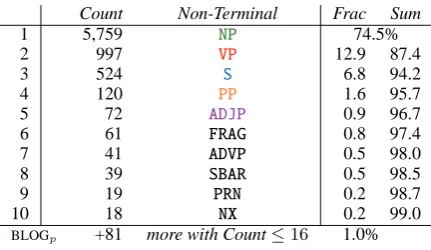
BLOGp +81 more with Count≤16 1.0%
Table 4: Top 99% of dominating non-terminals.
5.1 Surface Text Statistics
Out of 57,809 sentences, 6,047 (10.5%) are anno-tated (see Table 2); and 4,934 (8.5%) have multi-token bracketings. We do not distinguish HTML tags and track only unique bracketing end-points within a sentence. Of these, 6,015 are multi-token — an average per-sentence yield of 10.4%.10
10A non-trivial fraction of our corpus is older (pre-internet)
unannotated articles, so this estimate may be conservative.
As expected, many of the annotated words are nouns, but there are adjectives, verbs and other parts of speech too (see Table 3). Mark-up is short, typically under five words, yet (by far) the most frequently marked sequence of POS tags is a pair.
5.2 Common Syntactic Subtrees
For three-quarters of all mark-up, the lowest domi-nating non-terminal is a noun phrase (see Table 4); there are also non-trace quantities of verb phrases (12.9%) and other phrases, clauses and fragments. Of the top fifteen — 35.2% of all — annotated productions, only one is not a noun phrase (see Ta-ble 5, left). Four of the fifteen lowest dominating non-terminals do not match the entire bracketing — all four miss the leading determiner, as we saw earlier. In such cases, we recursively split internal nodes until the bracketing aligned, as follows:
[S[NPthe<a>Toronto Star][VPreports[NPthis] [PPin the softest possible way]</a>,[Sstating ...]]]
S→NP VP→DT NNP NNP VBZ NP PP S
We can summarize productions more compactly by using a dependency framework and clipping off any dependents whose subtrees do not cross a bracketing boundary, relative to the parent. Thus,
DT NNP NNP VBZ DT IN DT JJS JJ NN
becomes DT NNP VBZ, “the <a>Star reports</a>.” Viewed this way, the top fifteen (now collapsed) productions cover 59.4% of all cases and include four verb heads, in addition to a preposition and an adjective (see Table 5, right). This exposes five cases of inexact matches, three of which involve neglected determiners or adjectives to the left of the head. In fact, the only case that cannot be ex-plained by dropped dependents is #8, where the daughters are marked but the parent is left out. Most instances contributing to this pattern are flat NPs that end with a noun, incorrectly assumed to be the head of all other words in the phrase, e.g.,
...[NPa 1994<i>New Yorker</i>article]...
As this example shows, disagreements (as well as agreements) between mark-up and machine-generated parse trees with automatically perco-lated heads should be taken with a grain of salt.11
11
[image:4.595.73.289.469.594.2]Count Constituent Production Frac Sum
1 746 NP→NNP NNP 9.6%
2 357 NP→NNP 4.6 14.3
3 266 NP→NPPP 3.4 17.7
4 183 NP→NNP NNP NNP 2.4 20.1
5 165 NP→DTNNP NNP 2.1 22.2
6 140 NP→NN 1.8 24.0
7 131 NP→DTNNP NNP NNP 1.7 25.7
8 130 NP→DTNN 1.7 27.4
9 127 NP→DTNNP NNP 1.6 29.0
10 109 S →NPVP 1.4 30.4
11 91 NP→DTNNP NNP NNP 1.2 31.6
12 82 NP→DT JJNN 1.1 32.7
13 79 NP→NNS 1.0 33.7
14 65 NP→JJNN 0.8 34.5
15 60 NP→NP NP 0.8 35.3
BLOGp +5,000 more with Count≤60 64.7%
Count Head-Outward Spawn Frac Sum
1 1,889 NNP 24.4%
2 623 NN 8.1 32.5
3 470 DT NNP 6.1 38.6
4 458 DT NN 5.9 44.5
5 345 NNS 4.5 49.0
6 109 NNPS 1.4 50.4
7 98 VBG 1.3 51.6
8 96 NNP NNP NN 1.2 52.9
9 80 VBD 1.0 53.9
10 77 IN 1.0 54.9
11 74 VBN 1.0 55.9
12 73 DT JJ NN 0.9 56.8
13 71 VBZ 0.9 57.7
14 69 POS NNP 0.9 58.6
15 63 JJ 0.8 59.4
[image:5.595.76.525.60.233.2]BLOGp +3,136 more with Count≤62 40.6%
Table 5: Top 15 marked productions, viewed as constituents (left) and as dependencies (right), after recursively expanding any internal nodes that did not align with the bracketing (underlined). Tabulated dependencies were collapsed, dropping any dependents that fell entirely in the same region as their parent (i.e., both inside the bracketing, both to its left or both to its right), keeping only crossing attachments.
5.3 Proposed Parsing Constraints
The straight-forward approach — forcing mark-up to correspond to constituents — agrees with Char-niak’s parse trees only 48.0% of the time, e.g.,
... in[NP<a>[NP an analysis]</a>[PP of perhaps the most astonishing PC item I have yet stumbled upon]].
This number should be higher, as the vast major-ity of disagreements are due to tree-bank idiosyn-crasies (e.g., bare NPs). Earlier examples of in-complete constituents (e.g., legitimately missing determiners) would also be fine in many linguistic theories (e.g., as N-bars). A dependency formula-tion is less sensitive to such stylistic differences.
We begin with the hardest possible constraint on dependencies, then slowly relax it. Every example used to demonstrate a softer constraint doubles as a counter-example against all previous versions.
•strict — seals mark-up into attachments, i.e.,
inside a bracketing, enforces exactly one external arc — into the overall head. This agrees with head-percolated trees just 35.6% of the time, e.g.,
As author of<i>The SatanicVerses</i>, I ...
•loose — same as strict, but allows the
bracket-ing’s head word to have external dependents. This relaxation already agrees with head-percolated de-pendencies 87.5% of the time, catching many (though far from all) dropped dependents, e.g.,
. . . the<i>TorontoStar</i>reports . . .
•sprawl — same as loose, but now allows all
words inside a bracketing to attach external de-pendents.12 This boosts agreement with head-percolated trees to 95.1%, handling new cases, e.g., where “Toronto Star” is embedded in longer mark-up that includes its own parent — a verb:
. . . the<a>Toronto Starreports. . .</a>. . .
• tear — allows mark-up to fracture after all,
requiring only that the external heads attaching the pieces lie to the same side of the bracketing. This propels agreement with percolated dependencies to 98.9%, fixing previously broken PP-attachment ambiguities, e.g., a fused phrase like “Fox News in Canada” that detached a preposition from its verb:
... concession ... has raised eyebrows among those waiting[PPfor<a>Fox News][PPin Canada]</a>.
Most of the remaining 1.1% of disagreements are due to parser errors. Nevertheless, it is possible for mark-up to be torn apart by external heads from
both sides. We leave this section with a (very rare)
true negative example. Below, “CSA” modifies “authority” (to its left), appositively, while “Al-Manar” modifies “television” (to its right):13
The French broadcasting authority,<a>CSA, banned ... Al-Manar</a>satellite television from ...
12
This view evokes the trapezoids of theO(n3
)recognizer for split head automaton grammars (Eisner and Satta, 1999).
13But this is a stretch, since the comma after “CSA”
6 Experimental Methods and Metrics
We implemented the DMV (Klein and Manning, 2004), consulting the details of (Spitkovsky et al., 2010a). Crucially, we swapped out inside-outside re-estimation in favor of Viterbi training. Not only is it better-suited to the general problem (see§7.1), but it also admits a trivial implementation of (most of) the dependency constraints we proposed.14
5 10 15 20 25 30 35 40 45 4.5
5.0 5.5
WSJk bpt
lowest cross-entropy (4.32bpt) attained at WSJ8
[image:6.595.326.510.175.239.2]x-Entropyh(in bits per token) on WSJ15
Figure 1: Sentence-level cross-entropy on WSJ15 for Ad-Hoc∗
initializers of WSJ{1, . . . ,45}.
Six settings parameterized each run:
•INIT:0— default, uniform initialization; or 1 — a high quality initializer, pre-trained using Ad-Hoc∗
(Spitkovsky et al., 2010a): we chose the Laplace-smoothed model trained at WSJ15 (the “sweet spot” data gradation) but initialized off WSJ8, since that ad-hoc harmonic initializer has the best cross-entropy on WSJ15 (see Figure 1).
•GENRE:0— default, baseline training on WSJ; else, uses1— BLOGt;2— NEWS; or3— WEB. • SCOPE: 0— default, uses all sentences up to length 45; if1, trains using sentences up to length 15; if 2, re-trains on sentences up to length 45, starting from the solution to sentences up to length 15, as recommended by Spitkovsky et al. (2010a).
• CONSTR: if 4, strict; if 3, loose; and if 2,
sprawl. We did not implement level1, tear. Over-constrained sentences are re-attempted at succes-sively lower levels until they become possible to parse, if necessary at the lowest (default) level0.15
•TRIM: if1, discards any sentence without a sin-gle multi-token mark-up (shorter than its length).
• ADAPT: if1, upon convergence, initializes re-training on WSJ45 using the solution to <GENRE>, attempting domain adaptation (Lee et al., 1991).
These make for 294 meaningful combinations. We judged each one by its accuracy on WSJ45, using standard directed scoring — the fraction of correct dependencies over randomized “best” parse trees.
14
We analyze the benefits of Viterbi training in a compan-ion paper (Spitkovsky et al., 2010b), which dedicates more space to implementation and to the WSJ baselines used here.
15
At level4,<b>X<u>Y</b>Z</u>is over-constrained.
7 Discussion of Experimental Results
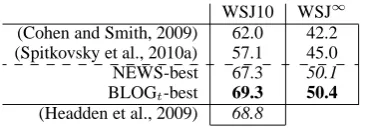
Evaluation on Section 23 of WSJ and Brown re-veals that blog-training beats all published state-of-the-art numbers in every traditionally-reported length cutoff category, with news-training not far behind. Here is a mini-preview of these results, for Section 23 of WSJ10 and WSJ∞
(from Table 8):
WSJ10 WSJ∞
(Cohen and Smith, 2009) 62.0 42.2 (Spitkovsky et al., 2010a) 57.1 45.0 NEWS-best 67.3 50.1
BLOGt-best 69.3 50.4
(Headden et al., 2009) 68.8
Table 6: Directed accuracies on Section 23 of WSJ{10,∞} for three recent state-of-the-art
sys-tems and our best runs (as judged against WSJ45) for NEWS and BLOGt(more details in Table 8).
Since our experimental setup involved testing nearly three hundred models simultaneously, we must take extreme care in analyzing and interpret-ing these results, to avoid fallinterpret-ing prey to any loom-ing “data-snooploom-ing” biases.16 In a sufficiently large pool of models, where each is trained using a randomized and/or chaotic procedure (such as ours), the best may look good due to pure chance. We appealed to three separate diagnostics to con-vince ourselves that our best results are not noise.
The most radical approach would be to write off WSJ as a development set and to focus only on the results from the held-out Brown corpus. It was ini-tially intended as a test of out-of-domain general-ization, but since Brown was in no way involved in selecting the best models, it also qualifies as a blind evaluation set. We observe that our best models perform even better (and gain more — see Table 8) on Brown than on WSJ — a strong indi-cation that our selection process has not overfitted. Our second diagnostic is a closer look at WSJ. Since we cannot graph the full (six-dimensional) set of results, we begin with a simple linear re-gression, using accuracy on WSJ45 as the depen-dent variable. We prefer this full factorial design to the more traditional ablation studies because it allows us to account for and to incorporate every single experimental data point incurred along the
16In the standard statistical hypothesis testing setting, it
Corpus Marked Sentences All Sentences POS Tokens All Bracketings Multi-Token Bracketings
BLOGt45 5,641 56,191 1,048,404 7,021 5,346
BLOG′
t45 4,516 4,516 104,267 5,771 5,346
BLOGt15 1,562 23,214 212,872 1,714 1,240
BLOG′
t15 1,171 1,171 11,954 1,288 1,240
NEWS45 304,129,910 2,263,563,078 32,119,123,561 611,644,606 477,362,150 NEWS′
45 205,671,761 205,671,761 2,740,258,972 453,781,081 392,600,070 NEWS15 211,659,549 1,433,779,438 11,786,164,503 365,145,549 274,791,675 NEWS′
15 147,848,358 147,848,358 1,397,562,474 272,223,918 231,029,921 WEB45 1,577,208,680 8,903,458,234 87,269,385,640 3,309,897,461 2,459,337,571 WEB′
45 933,115,032 933,115,032 11,552,983,379 2,084,359,555 1,793,238,913 WEB15 1,181,696,194 7,488,669,239 55,014,582,024 2,071,743,595 1,494,675,520 WEB′
[image:7.595.85.515.61.195.2]15 681,087,020 681,087,020 5,813,555,341 1,200,980,738 1,072,910,682
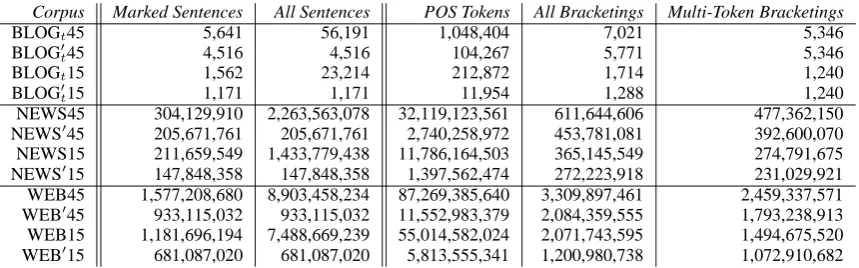
Table 7: Counts of sentences, tokens and (unique) bracketings for web-based data sets; trimmed versions, restricted to only those sentences having at least one multi-token bracketing, are indicated by a prime (′
).
way. Its output is a coarse, high-level summary of our runs, showing which factors significantly con-tribute to changes in error rate on WSJ45:
Parameter (Indicator) Setting βˆ p-value
INIT 1 ad-hoc @WSJ8,15 11.8 ***
GENRE 1 BLOGt -3.7 0.06
2 NEWS -5.3 **
3 WEB -7.7 ***
SCOPE 1 @15 -0.5 0.40
2 @15→45 -0.4 0.53
CONSTR 2 sprawl 0.9 0.23
3 loose 1.0 0.15
4 strict 1.8 *
TRIM 1 drop unmarked -7.4 ***
ADAPT 1 WSJ re-training 1.5 **
Intercept (R2
Adjusted= 73.6%) 39.9 *** We use a standard convention: *** forp <0.001; ** forp <0.01(very signif.); and * forp <0.05(signif.).
The default training mode (all parameters zero) is estimated to score 39.9%. A good initializer gives the biggest (double-digit) gain; both domain adap-tation and constraints also make a positive impact. Throwing away unannotated data hurts, as does training out-of-domain (the blog is least bad; the web is worst). Of course, this overview should not be taken too seriously. Overly simplistic, a first order model ignores interactions between parame-ters. Furthermore, a least squares fit aims to cap-ture central tendencies, whereas we are more in-terested in outliers — the best-performing runs.
A major imperfection of the simple regression model is that helpful factors that require an in-teraction to “kick in” may not, on their own, ap-pear statistically significant. Our third diagnostic is to examine parameter settings that give rise to the best-performing models, looking out for com-binations that consistently deliver superior results.
7.1 WSJ Baselines
Just two parameters apply to learning from WSJ. Five of their six combinations are state-of-the-art, demonstrating the power of Viterbi training; only the default run scores worse than 45.0%, attained by Leapfrog (Spitkovsky et al., 2010a), on WSJ45:
Settings SCOPE=0 SCOPE=1 SCOPE=2
INIT=0 41.3 45.0 45.2
1 46.6 47.5 47.6
@45 @15 @15→45
7.2 Blog
Simply training on BLOGtinstead of WSJ hurts:
GENRE=1 SCOPE=0 SCOPE=1 SCOPE=2 INIT=0 39.6 36.9 36.9
1 46.5 46.3 46.4
@45 @15 @15→45
The best runs use a good initializer, discard unan-notated sentences, enforce the loose constraint on the rest, follow up with domain adaptation and benefit from re-training —GENRE=TRIM=ADAPT=1:
INIT=1 SCOPE=0 SCOPE=1 SCOPE=2 CONSTR=0 45.8 48.3 49.6 (sprawl)2 46.3 49.2 49.2 (loose)3 41.3 50.2 50.4
(strict)4 40.7 49.9 48.7
@45 @15 @15→45
The contrast between unconstrained learning and annotation-guided parsing is higher for the default initializer, still using trimmed data sets (just over a thousand sentences for BLOG′
t15 — see Table 7):
INIT=0 SCOPE=0 SCOPE=1 SCOPE=2 CONSTR=0 25.6 19.4 19.3 (sprawl)2 25.2 22.7 22.5 (loose)3 32.4 26.3 27.3 (strict)4 36.2 38.7 40.1
@45 @15 @15→45
7.3 News
Training on WSJ is also better than using NEWS:
GENRE=2 SCOPE=0 SCOPE=1 SCOPE=2 INIT=0 40.2 38.8 38.7
1 43.4 44.0 43.8
@45 @15 @15→45
As with the blog, the best runs use the good initial-izer, discard unannotated sentences, enforce the
loose constraint and follow up with domain
adap-tation —GENRE=2;INIT=TRIM=ADAPT=1:
Settings SCOPE=0 SCOPE=1 SCOPE=2
CONSTR=0 46.6 45.4 45.2 (sprawl)2 46.1 44.9 44.9 (loose)3 49.5 48.1 48.3 (strict)4 37.7 36.8 37.6
@45 @15 @15→45
With all the extra training data, the best new score is just 49.5%. On the one hand, we are disap-pointed by the lack of dividends to orders of mag-nitude more data. On the other, we are comforted that the system arrives within 1% of its best result — 50.4%, obtained with a manually cleaned up corpus — now using an auto-generated data set.
7.4 Web
The WEB-side story is more discouraging:
GENRE=3 SCOPE=0 SCOPE=1 SCOPE=2 INIT=0 38.3 35.1 35.2
1 42.8 43.6 43.4
@45 @15 @15→45
Our best run again uses a good initializer, keeps
all sentences, still enforces the loose constraint
and follows up with domain adaptation, but per-forms worse than all well-initialized WSJ base-lines, scoring only 45.9% (trained at WEB15).
We suspect that the web is just too messy for us. On top of the challenges of language iden-tification and sentence-breaking, there is a lot of boiler-plate; furthermore, web text can be difficult for news-trained POS taggers. For example, note that the verb “sign” is twice mistagged as a noun and that “YouTube” is classified as a verb, in the top four POS sequences of web sentences:17
POS Sequence WEBCount
Sample web sentence, chosen uniformly at random.
1 DT NNS VBN 82,858,487
All rights reserved.
2 NNP NNP NNP 65,889,181
Yuasa et al.
3 NN IN TO VB RB 31,007,783
Sign in to YouTube now!
4 NN IN IN PRP$ JJ NN 31,007,471
Sign in with your Google Account!
17Further evidence: TnT tags the ubiquitous but
ambigu-ous fragments “click here” and “print post” as noun phrases.
7.5 The State of the Art
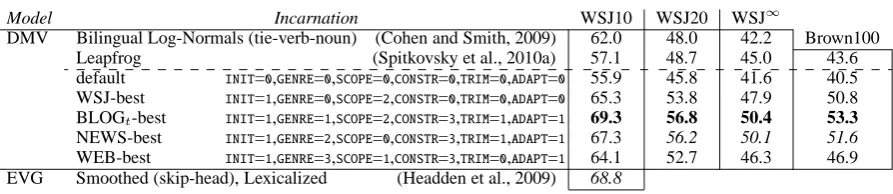
Our best model gains more than 5% over previ-ous state-of-the-art accuracy across all sentences of WSJ’s Section 23, more than 8% on WSJ20 and rivals the oracle skyline (Spitkovsky et al., 2010a) on WSJ10; these gains generalize to Brown100, where it improves by nearly 10% (see Table 8).
We take solace in the fact that our best mod-els agree in using loose constraints. Of these, the models trained with less data perform better, with the best two using trimmed data sets, echo-ing that “less is more” (Spitkovsky et al., 2010a), pace Halevy et al. (2009). We note that orders of magnitude more data did not improve parsing per-formance further and suspect a different outcome from lexicalized models: The primary benefit of additional lower-quality data is in improved cover-age. But with only 35 unique POS tags, data spar-sity is hardly an issue. Extra examples of lexical items help little and hurt when they are mistagged.
8 Related Work
The wealth of new annotations produced in many languages every day already fuels a number of NLP applications. Following their early and wide-spread use by search engines, in service of spam-fighting and retrieval, anchor text and link data enhanced a variety of traditional NLP tech-niques: cross-lingual information retrieval (Nie and Chen, 2002), translation (Lu et al., 2004), both named-entity recognition (Mihalcea and Csomai, 2007) and categorization (Watanabe et al., 2007), query segmentation (Tan and Peng, 2008), plus semantic relatedness and word-sense disambigua-tion (Gabrilovich and Markovitch, 2007; Yeh et al., 2009). Yet several, seemingly natural, can-didate core NLP tasks — tokenization, CJK seg-mentation, noun-phrase chunking, and (until now) parsing — remained conspicuously uninvolved.
Model Incarnation WSJ10 WSJ20 WSJ∞
DMV Bilingual Log-Normals (tie-verb-noun) (Cohen and Smith, 2009) 62.0 48.0 42.2 Brown100 Leapfrog (Spitkovsky et al., 2010a) 57.1 48.7 45.0 43.6 default INIT=0,GENRE=0,SCOPE=0,CONSTR=0,TRIM=0,ADAPT=0 55.9 45.8 41.6 40.5 WSJ-best INIT=1,GENRE=0,SCOPE=2,CONSTR=0,TRIM=0,ADAPT=0 65.3 53.8 47.9 50.8 BLOGt-best INIT=1,GENRE=1,SCOPE=2,CONSTR=3,TRIM=1,ADAPT=1 69.3 56.8 50.4 53.3
NEWS-best INIT=1,GENRE=2,SCOPE=0,CONSTR=3,TRIM=1,ADAPT=1 67.3 56.2 50.1 51.6
[image:9.595.77.524.58.155.2]WEB-best INIT=1,GENRE=3,SCOPE=1,CONSTR=3,TRIM=0,ADAPT=1 64.1 52.7 46.3 46.9 EVG Smoothed (skip-head), Lexicalized (Headden et al., 2009) 68.8
Table 8: Accuracies on Section 23 of WSJ{10,20,∞} and Brown100 for three recent state-of-the-art
systems, our default run, and our best runs (judged by accuracy on WSJ45) for each of four training sets.
be helpful in constraining grammar induction. Following Pereira and Schabes’ (1992) success with partial annotations in training a model of (English) constituents generatively, their idea has been extended to discriminative estimation (Rie-zler et al., 2002) and also proved useful in mod-eling (Japanese) dependencies (Sassano, 2005). There was demand for partially bracketed corpora. Chen and Lee (1995) constructed one such corpus by learning to partition (English) POS sequences into chunks (Abney, 1991); Inui and Kotani (2001) usedn-gram statistics to split (Japanese) clauses.
We combine the two intuitions, using the web to build a partially parsed corpus. Our approach could be called lightly-supervised, since it does not require manual annotation of a single complete parse tree. In contrast, traditional semi-supervised methods rely on fully-annotated seed corpora.18
9 Conclusion
We explored novel ways of training dependency parsing models, the best of which attains 50.4% accuracy on Section 23 (all sentences) of WSJ, beating all previous unsupervised state-of-the-art by more than 5%. Extra gains stem from guid-ing Viterbi trainguid-ing with web mark-up, the loose constraint consistently delivering best results. Our linguistic analysis of a blog reveals that web an-notations can be converted into accurate parsing constraints (loose: 88%; sprawl: 95%; tear: 99%) that could be helpful to supervised methods, e.g., by boosting an initial parser via self-training (Mc-Closky et al., 2006) on sentences with mark-up. Similar techniques may apply to standard word-processing annotations, such as font changes, and to certain (balanced) punctuation (Briscoe, 1994). We make our blog data set, overlaying mark-up and syntax, publicly available. Its annotations are
18A significant effort expended in building a tree-bank
comes with the first batch of sentences (Druck et al., 2009).
75% noun phrases, 13% verb phrases, 7% simple declarative clauses and 2% prepositional phrases, with traces of other phrases, clauses and frag-ments. The type of mark-up, combined with POS tags, could make for valuable features in discrimi-native models of parsing (Ratnaparkhi, 1999).
A logical next step would be to explore the con-nection between syntax and mark-up for genres other than a news-style blog and for languages other than English. We are excited by the possi-bilities, as unsupervised parsers are on the cusp of becoming useful in their own right — re-cently, Davidov et al. (2009) successfully applied Seginer’s (2007) fully unsupervised grammar in-ducer to the problems of pattern-acquisition and extraction of semantic data. If the strength of the connection between web mark-up and syntactic structure is universal across languages and genres, this fact could have broad implications for NLP, with applications extending well beyond parsing.
Acknowledgments
Partially funded by NSF award IIS-0811974 and by the Air Force Research Laboratory (AFRL), under prime contract no. FA8750-09-C-0181; first author supported by the Fannie & John Hertz Foundation Fellowship. We thank Angel X. Chang, Spence Green, Christopher D. Manning, Richard Socher, Mihai Surdeanu and the anonymous reviewers for many helpful suggestions, and we are especially grateful to Andy Golding, for pointing us to his sample Map-Reduce over the Google News crawl, and to Daniel Pipes, for allow-ing us to distribute the data set derived from his blog entries.
References
S. Abney. 1991. Parsing by chunks. Principle-Based
Pars-ing: Computation and Psycholinguistics.
J. K. Baker. 1979. Trainable grammars for speech recogni-tion. In Speech Communication Papers for the 97th
Meet-ing of the Acoustical Society of America.
C. Barr, R. Jones, and M. Regelson. 2008. The linguistic structure of English web-search queries. In EMNLP.
T. Briscoe. 1994. Parsing (with) punctuation, etc. Technical report, Xerox European Research Laboratory.
E. Charniak and M. Johnson. 2005. Coarse-to-finen-best parsing and MaxEnt discriminative reranking. In ACL.
E. Charniak. 2001. Immediate-head parsing for language models. In ACL.
H.-H. Chen and Y.-S. Lee. 1995. Development of a partially bracketed corpus with part-of-speech information only. In
WVLC.
S. B. Cohen and N. A. Smith. 2009. Shared logistic nor-mal distributions for soft parameter tying in unsupervised grammar induction. In NAACL-HLT.
M. Collins. 1999. Head-Driven Statistical Models for
Nat-ural Language Parsing. Ph.D. thesis, University of
Penn-sylvania.
D. Davidov, R. Reichart, and A. Rappoport. 2009. Supe-rior and efficient fully unsupervised pattern-based concept acquisition using an unsupervised parser. In CoNLL.
G. Druck, G. Mann, and A. McCallum. 2009. Semi-supervised learning of dependency parsers using general-ized expectation criteria. In ACL-IJCNLP.
J. Eisner and G. Satta. 1999. Efficient parsing for bilexical context-free grammars and head-automaton grammars. In
ACL.
J. R. Finkel and C. D. Manning. 2009. Joint parsing and named entity recognition. In NAACL-HLT.
W. N. Francis and H. Kucera, 1979. Manual of Information
to Accompany a Standard Corpus of Present-Day Edited American English, for use with Digital Computers.
De-partment of Linguistic, Brown University.
E. Gabrilovich and S. Markovitch. 2007. Computing seman-tic relatedness using Wikipedia-based Explicit Semanseman-tic Analysis. In IJCAI.
D. Gildea. 2001. Corpus variation and parser performance. In EMNLP.
A. Halevy, P. Norvig, and F. Pereira. 2009. The unreasonable effectiveness of data. IEEE Intelligent Systems, 24.
W. P. Headden, III, M. Johnson, and D. McClosky. 2009. Improving unsupervised dependency parsing with richer contexts and smoothing. In NAACL-HLT.
S. Holm. 1979. A simple sequentially rejective multiple test procedure. Scandinavian Journal of Statistics, 6.
N. Inui and Y. Kotani. 2001. RobustN-gram based syntactic analysis using segmentation words. In PACLIC.
D. Klein and C. D. Manning. 2004. Corpus-based induction of syntactic structure: Models of dependency and con-stituency. In ACL.
C.-H. Lee, C.-H. Lin, and B.-H. Juang. 1991. A study on speaker adaptation of the parameters of continuous den-sity Hidden Markov Models. IEEE Trans. on Signal
Pro-cessing, 39.
W.-H. Lu, L.-F. Chien, and H.-J. Lee. 2004. Anchor text mining for translation of Web queries: A transitive trans-lation approach. ACM Trans. on Information Systems, 22.
M. P. Marcus, B. Santorini, and M. A. Marcinkiewicz. 1993. Building a large annotated corpus of English: The Penn Treebank. Computational Linguistics, 19.
D. McClosky, E. Charniak, and M. Johnson. 2006. Effective self-training for parsing. In NAACL-HLT.
R. Mihalcea and A. Csomai. 2007. Wikify!: Linking docu-ments to encyclopedic knowledge. In CIKM.
M. Mintz, S. Bills, R. Snow, and D. Jurafsky. 2009. Distant supervision for relation extraction without labeled data. In
ACL-IJCNLP.
J.-Y. Nie and J. Chen. 2002. Exploiting the Web as paral-lel corpora for cross-language information retrieval. Web
Intelligence.
F. Pereira and Y. Schabes. 1992. Inside-outside reestimation from partially bracketed corpora. In ACL.
A. Ratnaparkhi. 1999. Learning to parse natural language with maximum entropy models. Machine Learning, 34.
S. Ravi, K. Knight, and R. Soricut. 2008. Automatic predic-tion of parser accuracy. In EMNLP.
J. C. Reynar and A. Ratnaparkhi. 1997. A maximum entropy approach to identifying sentence boundaries. In ANLP.
S. Riezler, T. H. King, R. M. Kaplan, R. Crouch, J. T. Maxwell, III, and M. Johnson. 2002. Parsing the Wall Street Journal using a lexical-functional grammar and dis-criminative estimation techniques. In ACL.
M. Sassano. 2005. Using a partially annotated corpus to build a dependency parser for Japanese. In IJCNLP.
Y. Seginer. 2007. Fast unsupervised incremental parsing. In
ACL.
V. I. Spitkovsky, H. Alshawi, and D. Jurafsky. 2010a. From Baby Steps to Leapfrog: How “Less is More” in unsuper-vised dependency parsing. In NAACL-HLT.
V. I. Spitkovsky, H. Alshawi, D. Jurafsky, and C. D. Man-ning. 2010b. Viterbi training improves unsupervised de-pendency parsing. In CoNLL.
B. Tan and F. Peng. 2008. Unsupervised query segmenta-tion using generative language models and Wikipedia. In
WWW.
K. Toutanova and C. D. Manning. 2000. Enriching the knowledge sources used in a maximum entropy part-of-speech tagger. In EMNLP-VLC.
K. Toutanova, D. Klein, C. D. Manning, and Y. Singer. 2003. Feature-rich part-of-speech tagging with a cyclic depen-dency network. In HLT-NAACL.
D. Vadas and J. R. Curran. 2007. Adding noun phrase struc-ture to the Penn Treebank. In ACL.
Y. Watanabe, M. Asahara, and Y. Matsumoto. 2007. A graph-based approach to named entity categorization in Wikipedia using conditional random fields. In
EMNLP-CoNLL.