A M A R K O V L A N G U A G E
L E A R N I N G M O D E L
F O R F I N I T E P A R A M E T E R
S P A C E S
P a r t h a Niyogi and R o b e r t C. Berwick
Center for Biological and Computational Learning
Massachusetts Institute of Technology
E25-201
Cambridge, MA 02139, USA
Internet: [email protected], [email protected]
A b s t r a c t
This paper shows how to formally characterize lan- guage learning in a finite parameter space as a Markov structure, h n p o r t a n t new language learning results fol- low directly: explicitly calculated sample complexity learning times under different input distribution as- sumptions (including CHILDES database language in- put) and learning regimes. We also briefly describe a new way to formally model (rapid) diachronic syntax change.
B A C K G R O U N D M O T I V A T I O N :
T R I G G E R S A N D L A N G U A G E
A C Q U I S I T I O N
Recently, several researchers, including Gibson and Wexler (1994), henceforth GW, Dresher and Kaye (1990); and Clark and Roberts (1993) have modeled language learning in a (finite) space whose grammars are characterized by a finite number of parameters or n- length Boolean-valued vectors. Many current linguistic theories now employ such parametric models explicitly or in spirit, including Lexical-Functional G r a m m a r and versions of HPSG, besides GB variants.
With all such models, key questions a b o u t sample complexity, convergence time, and alternative model- ing assumptions are difficult to assess without a pre- cise mathematical formalization. Previous research has usually addressed only the question of convergence in the limit without probing the equally i m p o r t a n t ques- tion of sample complexity: it is of not much use that a learner can acquire a language if sample complexity is extraordinarily high, hence psychologically implausible. This remains a relatively undeveloped area of language learning theory. T h e current paper aims to fill that gap. We choose as a starting point the G W Triggering Learning Algorithm (TLA). Our central result is that the performance of this algorithm and others like it is completely modeled by a Markov chain. We explore the basic computational consequences of this, including some surprising results about sample complexity and convergence time, the dominance of r a n d o m walk over
actual child language acquisition and possibly language change.
B a c k g r o u n d . Following Gold (1967) the basic frame- work is that of identification in the limit. We assume some familiarity with Gold's assumptions. The learner receives an (infinite) sequence of (positive) example sen- tences from some target language. After each, the learner either (i) stays in the same state; or (ii) moves to a new state (change its parameter settings). If after some finite number of examples the learner converges to the correct target language and never changes its guess, then it has correctly identified the target language in the limit; otherwise, it fails.
In the G W model (and others) the learner obeys two additional fundamental constraints: (1) the single.value constraint--the learner can change only 1 parameter value each step; and (2) the greediness constraint--if the learner is given a positive example it cannot recog- nize and changes one parameter value, finding that it can accept the example, then the learner retains that new value. The T L A essentially simulates this; see Gib- son and Wexler (1994) for details.
THE M A R K O V F O R M U L A T I O N
Previous parameter models leave open key questions ad- dressable by a more precise formalization as a Markov chain. T h e correspondence is direct. Each point i in the Markov space is a possible parameter setting. Transi- tions between states stand for probabilities b that the learner will move from hypothesis state i to state j. As we show below, given a distribution over L(G), we can calculate the actual b's themselves. Thus, we can picture the T L A learning space as a directed, labeled graph V with 2 n vertices. See figure 1 for an example in a 3-parameter system. 1 We can now use Markov theory to describe TLA parameter spaces, as in lsaacson and
Madsen (1976). By the single value hypothesis, the sys- tem can only move 1 Hamming bit at a time, either to- ward the target language or 1 bit away. Surface strings can force the learner from one hypothesis state to an- other. For instance, if state i corresponds to a gram- mar that generates a language that is a proper subset of another grammar hypothesis j, there can never be a transition from j to i, and there must be one from i to j . Once we reach the target grammar there is noth- ing that can move the learner from this state, since all remaining positive evidence will not cause the learner to change its hypothesis: an A b s o r b i n g S t a t e (AS) in the Markov literature. Clearly, one can conclude at once the following i m p o r t a n t learnability result:
T h e o r e m 1 Given a Markov chain C corresponding to a G W TLA learner, 3 exactly 1 A S (corresponding to the target grammar/language) iff C is learnable.
Proof. ¢::. By assumption, C is learnable. Now assume for sake of contradiction that there is not exactly one AS. Then there must be either 0 AS or > 1 AS. In the first case, by the definition of an absorbing state, there is no hypothesis in which the learner will remain for- ever. Therefore C is not learnable, a contradiction. In the second case, without loss of generality, assume there are exactly two absorbing states, the first S correspond- ing to the target parameter setting, and the second S ~ corresponding to some other setting. By the definition of an absorbing state, in the limit C will with some nonzero probability enter S I, and never exit S I. T h e n C is not learnable, a contradiction. Hence our assump- tion that there is not exactly 1 AS must be false.
=¢.. Assume that there exists exactly 1 AS i in the Markov chain M. T h e n , by the definition of an absorb- ing state, after some number of steps n, no m a t t e r what the starting state, M will end up in state i, correspond- ing to the target grammar. |
C o r o l l a r y 0.1 Given a Markov chain corresponding to a (finite) family of grammars in a G W learning sys- tem, if there exist 2 or more AS, then that family is not learnable.
D E R I V A T I O N
O F T R A N S I T I O N
P R O B A B I L I T I E S
F O R T H E
M A R K O V
T L A S T R U C T U R E
We now derive the transition probabilities for the Markov TLA structure, the key to establishing sam- ple complexity results. Let the target language L~ be L~ = {sl, s2, s3, ...} and P a probability distribution on these strings. Suppose the learner is in a state corre- sponding to language Ls. With probability P ( s j ) , it receives a string sj. There are two cases given current parameter settings.
C a s e I. The learner can syntactically analyze the re- ceived string sj. Then parameter values are unchanged. This is so only when sj • L~. T h e probability of re- maining in the state s is P ( s j ) .
C a s e I I . T h e learner cannot syntactically analyze the string. T h e n sj ~ Ls; the learner is in state s, and has n neighboring states (Hamming distance of 1). The learner picks one of these uniformly at random. If nj of these neighboring states correspond to languages which contain sj and the learner picks any one of them (with probability n j / n ) , it stays in that state. If the learner picks any of the other states (with probability ( n - n j ) / n ) then it remains in state s. Note that nj could take values between 0 and n. Thus the probability that the learner remains in state s is P ( s j ) ( ( n - n j ) / n ) . T h e probability of moving to each of the other nj states is P ( s j ) ( n j / n ) .
The probability that the learner will remain in its original state s is the sum of the probabilities of these two c a s e s :
~,jEL,
P ( s j ) + E , j C L , ( 1 - n j / n ) P ( s j ) .To compute the transition probability from s to k, note that this transition will occur with proba- bility 1/n for all the strings sj E Lk but not in L~. These strings occur with probability P ( s j ) each and so the transition probability is:P[s ~ k] = ~ , j e L , , , j ¢ L , , , j e L k ( 1 / n ) P ( s i ) •
Summing over all strings sj E ( Lt N Lk ) \ L, (set dif- ference) it is easy to see that sj • ( Lt N Lk ) \ Ls ¢~ sj • (L, N nk) \ (L, n Ls). Rewriting, we have P[s ---* k] = ~ , j e ( L , n L k ) \ ( L , n L . ) ( 1 / n ) P ( s j ) . Now we can compute the transition probabilities between any two states. Thus the self-transition probability can be given as, P[s --, s] = 1-~-'~ k is a neighboring state o f , P[s ---, k].
Example.
Consider the 3-parameter natural language system de- scribed by Gibson and Wexler (1994), designed to cover basic word orders (X-bar structures) plus the verb- second phenomena of Germanic languages, lts binary parameters are: (1) Spec(ifier) initial (0) or final (1); (2) Compl(ement) initial (0) or final (1); and Verb Sec- ond (V2) does not exist (0) or does exist (l). Possi- ble "words" in this language include S(ubject), V(erb), O(bject), D(irect) O(bject), Adv(erb) phrase, and so forth. Given these alternatives, Gibson and Wexler (1994) show that there are 12 possible surface strings for each ( - V 2 ) grammar and 18 possible surface strings for each (+V2) grammar, restricted to unembedded or "degree-0" examples for reasons of psychological plau- sibility (see Gibson and Wexler for discussion). For in- stance, the parameter setting [0 1 0]= Specifier initial, Complement final, and - V 2 , works out to the possi- ble basic English surface phrase order of S u b j e c t - V e r b - Object (SVO).
j:.-.-
i
\
i
i
":':':!i
<::::::.:: . . . .:::.~-.~-':~
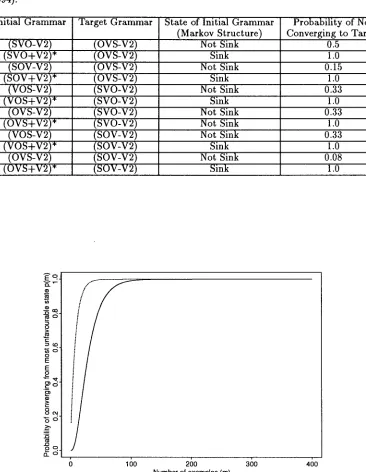
[image:3.612.150.425.238.491.2]Plainly there are exactly 2 absorbing states in this Markov chain. One is the target grammar (by defini- tion); the other is state 2. State 4 is also a sink that leads only to state 4 or state 2. G W call these two nontarget states local maxima because local gradient ascent will converge to these without reaching the de- sired target. Hence this system is not learnable. More importantly though, in addition to these local maxima, we show (see below) that there are other states (not detected in GW or described by Clark) from which the learner will never reach the target with (high) positive probability. Example: we show that if the learner starts at hypothesis V O S - V 2 , then with probability 0.33 in the limit, the learner will never converge to the SVO target. Crucially, we must use set differences to build the Markov figure straightforwardly, as indicated in the next section. In short, while it is possible to reach "En- glish"from some source languages like "Japanese," this is not possible for other starting points (exactly 4 other initial states).
It is easy to imagine alternatives to the T L A that avoid the local maxima problem. As it stands the learner only changes a parameter setting if that change allows the learner to analyze the sentence it could not analyze before. If we relax this condition so that under unanalyzability the learner picks a random parameter to change, then the problem with local m a x i m a disap- pears, because there can be only 1 Absorbing State, the target grammar. All other states have exit arcs. Thus, by our main theorem, such a system is learnable. We discuss other alternatives below.
C O N V E R G E N C E
T I M E S F O R T H E
M A R K O V
C H A I N M O D E L
Perhaps the most significant advantage of the Markov chain formulation is that one can calculate the number of examples needed to acquire a language. Recall it is not enough to demonstrate convergence in the limit; learning must also be feasible. This is particularly true in the case of finite parameter spaces where convergence might not be as much of a problem as feasibility. Fortu- nately, given the transition m a t r i x of a Markov chain, the problem of how long it takes to converge has been well studied.
S O M E T R A N S I T I O N M A T R I C E S A N D T H E I R C O N V E R G E N C E C U R V E S
Consider the example in the previous section. The tar- get grammar is S V O - V 2 (grammar ~ 5 in GW). For simplicity, assume a uniform distribution on L5. Then the probability of a particular string sj in L5 is 1/12 be- cause there are 12 (degree-0) strings in L~. We directly compute the transition matrix (0 entries elsewhere):
L1 L2 L3 L4 L5 L6 L7 Ls L1 J. 2
L2 L3 L4 L5 L6 L7 Ls
± £
6 3
3_ Z !
4 ~ 6
!
12 12
1
1_ 5
2_ 1__
12 36 9
States 2 and 5 are absorbing; thus this chain contains local maxima. Also, state 4 exits only to either itself or to state 2, hence is also a local maximum. If T is the transition probability matrix of a chain, then the corresponding i, j element of T m is the probability that the learner moves from state i to state j in m steps. For learnability to hold irrespective starting state, the probability of reaching state 5 should approach 1 as m goes to infinity, i.e., column 5 of T m should contain all l's, and O's elsewhere. Direct computation shows this to be false:
L1 L2 L3 L4 Ls L6 L7 Ls
L1 L2 L3 L4 L5 L6 L7 Ls
! 3 1 1 3 1
We see that if the learner starts out in states 2 or 4, it will certainly end up in state 2 in the limit. These two states correspond to local maxima grammars in the G W framework. We also see that if the learner starts in states 5 through 8, it will certainly converge in the limit to the target grammar.
Figure 2 shows a plot of the quantity p ( m ) = min{pi(rn)} as a function of m, the n u m b e r of exam- ples. Here Pi denotes the probability of being in state 1 at the end of m examples in the case where the learner started in state i. Naturally we want
lim p i ( m ) = 1
and for this example this is indeed the case. T h e next figure shows a plot of the following quantity as a func- tion of m, the number of examples.
p(m) = m i n { p i ( m ) }
T h e quantity p(m) is easy to interpret. Thus p(m) =
0.95 rneans t h a t for every initial state of the learner the probability that it is in the target state after m examples is at least 0.95. Further there is one initial state (the worst initial state with respect to the target, which in our example is Ls) for which this probability is exactly 0.95. We find on looking at the curve t h a t the learner converges with high probability within 100 to 200 (degree-0) example sentences, a psychologically plausible number.
We can now compare the convergence time of T L A to other algorithms. Perhaps the simplest is r a n d o m walk: s t a r t the learner at a r a n d o m point in the 3 - p a r a m e t e r space, and then, if an input sentence cannot be ana- lyzed, move 1-bit randomly from state to state. Note that this regime cannot suffer from the local m a x i m a problem, since there is always some finite probability of exiting a non-target state.
C o m p u t i n g the convergence curves for a r a n d o m walk algorithm (RWA) on the 8 state space, we find t h a t the convergence times are actually faster than for the TLA; see figure 2. Since the RWA is also superior in t h a t it does not suffer from the same local m a x i m a problem as TLA, the conceptual s u p p o r t for the T L A is by no means clear. Of course, it m a y be t h a t the T L A has empirical support, in the sense of independent evidence that children do use this procedure (given by the pat- tern of their errors, etc.), but this evidence is lacking, as far as we know.
D I S T R I B U T I O N A L A S S U M P T I O N S : P A R T I
In the earlier section we assumed t h a t the d a t a was uni- formly distributed. We c o m p u t e d the transition m a t r i x for a particular target language and showed t h a t con- vergence times were of the order of 100-200 samples. In this section we show t h a t the convergence times depend crucially upon the distribution. In particular we can choose a distribution which will make the convergence time as large as we want. T h u s the distribution-free convergence time for the 3 - p a r a m e t e r s y s t e m is infinite. As before, we consider the situation where the target language is
L1.
There are no local m a x i m a problems for this choice. We begin by letting the distribution bep a r a m e t r i z e d by the variables a, b, c, d where
a = P ( A = { A d v ( e r b ) P h r a s e V S})
b = P ( B = {Adv V O S, Adv Aux V S})
c = P ( C = { A d v V O1 O 2 S , A d v A u x V O S , Adv Aux V O1 0 2 S})
d = P ( D = { V S } )
T h u s each of the sets A, B , C and D contain different degree-O sentences of L1. Clearly the probability of the set L, \ { A U B U C U D } is 1 - ( a + b + c + d ) . The elements of each defined subset of La are equally likely with re- spect to each other. Setting positive values for a, b, c, d such t h a t a + b + c + d < 1 now defines a unique prob- ability for each degree(O) sentence in L1. For example, the probability of A d v V O S is b/2, the probability of
A d v A u x V O S is c/3, t h a t of V O S is ( 1 - ( a + b + c + d ) ) / 6 and so on; see figure 3. We can now obtain the tran- sition m a t r i x corresponding to this distribution. If we compare this m a t r i x with t h a t obtained with a uniform distribution on the sentences of La in the earlier section. This m a t r i x has non-zero elements (transition proba- bilities) exactly where the earlier matrix had non-zero elements. However, the value of each transition prob- ability now depends upon a,b, c, and d. In particular if we choose a = 1/12, b = 2/12, c = 3/12, d = 1/12 (this is equivalent to assuming a uniform distribution) we obtain the a p p r o p r i a t e transition matrix as before. Looking more closely at the general transition matrix, we see t h a t the transition probability from state 2 to state 1 is ( 1 - ( a + b + c ) ) / 3 . Clearly if we make a arbitrarily close to 1, then this transition probability is arbitrarily close to 0 so t h a t the number of samples needed to converge can be m a d e arbitrarily large. T h u s choosing large values for a and small values for b will result in large convergence times.
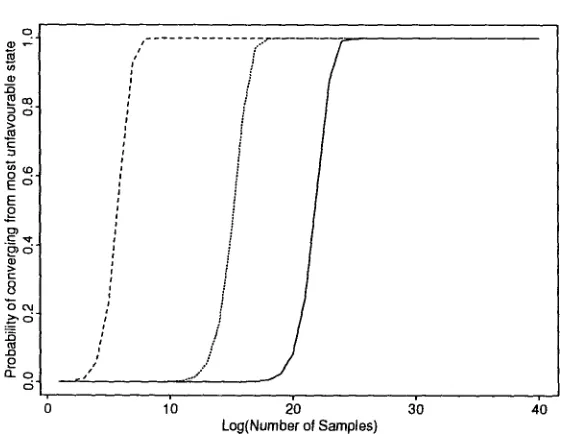
This means t h a t the sample complexity cannot be b o u n d e d in a distribution-free sense, because by choos- ing a highly unfavorable distribution the sample com- plexity can be m a d e as high as possible. For example, we now give the convergence curves calculated for dif- ferent choices of a, b,c, d. We see that for a uniform distribution the convergence occurs within 200 sam- ples. By choosing a distribution with a = 0.9999 and b = c = d = 0.000001, the convergence time can be pushed up to as much as 50 million samples. (Of course, this distribution is p r e s u m a b l y not psychologically re- alistic.) For a = 0.99, b = c = d = 0.0001, the sample complexity is on the order of 100,000 positive examples.
Remark. T h e preceding calculation provides a worst- case convergence time. We can also calculate average
convergence times using s t a n d a r d results from Markov chain theory (see Isaacson and Madsen, 1976), as in table 2. These s u p p o r t our previous results.
Table 1: Complete list of problem states, i.e., all combinations of starting grammar and target grammar which result in non-learnability of the target. The items marked with an asterisk are those listed in the original paper by Gibson and Wexler (1994).
Initial Grammar Target Grammar
[image:6.612.125.491.141.613.2] [image:6.612.165.455.359.618.2](svo-v2)
(svo+v2)*
(soy-v2)
(SOV+V2)*(VOS-V2) (VOS+V2)*
(OVS-V2)
(ovs+v2)*
(vos-v2)
(VOS+V2)*(OVS-V2) (OVS+V2)*
(OVS-V2)
(ovs-v2)
(ovs-v2)
(ovs-v2)
(svo-v2)
(svo-v2)
(svo-v2)
(svo-v2)
(sov-v2)
(soy-v2)
(soy-v2)
(sov-v2)
State of Initial Grammar (Markov Structure)
Not Sink
Probability of Not Converging to Target
Not Sink Sink
0.5
Sink 1.0
0.15
Not Sink Sink Not Sink Not Sink Not Sink
1.0
Not Sink Sink
0.33 1.0 0.33
1.0 0.33
Sink 1.0
0.08 1.0
~ f f ...
~ m
~ o
;°1
-@6
16o
260
360
460
Number of examples (m}
O
E
8
O - o
d"
, ....
I
i t t I
t t
t t
, /
' [
• . . . .
= , r " . . . .
o lo 2'o 3o 4o
Log(Number of Samples)
Figure 3: Rates of convergence for T L A with L1 as the target language for different distributions. The probability of converging to the target after m samples is plotted against log(m). The three curves show how unfavorable distributions can increase convergence times. The dashed nine assumes uniform distribution and is the same curve as plotted in figure 2.
Table 2: Mean and s t a n d a r d deviation convergence times to target 5 (English) given different distributions over the target language, and a u n i f o r m distribution over initial states. T h e first distribution is uniform over the target language; the other distributions
Learning Mean abs.
scenario time
TEA (uniform) 34.8
TLA (a = 0.99) 45000 TLA (a = 0.9999) 4.5 × 10⁶
RW 9.6
alter the value of a as discussed in the m a i n text. Std. Dev.
of abs. time 22.3 33000 3.3 × l06
[image:7.612.152.436.143.360.2]T h e o r e m 2 Let T be an n x n transition matrix with n linearly i n d e p e n d e n t left eigenvectors x l . . . . x n cor- responding to eigenvalues .~l , . . . , .~n. Let x0 (an n- d i m e n s i o n a l vector) represent the starting probability of being in each state of the chain and r be the limiting probability o f being in each state. T h e n after k transi- tions, the probability of being in each state x 0 T k can be described by
n
I1 x0T k-~ I1=11 ~ mfx0y~x, I1~<
maxI~,lk ~ II x0y,x, II
2 < i < ni = 1 - - i = 2
where the Y i ' s are the right eigenvectors o f T .
This theorem bounds the convergence rate to the limiting distribution 7r (in cases where there is only one absorption state, 7r will have a 1 corresponding to that state and 0 everywhere else). Using this result we bound the rates of convergence (in terms of num- ber k of samples). It should be plain that these results could be used to establish standard errors and confi- dence bounds on convergence times in the usual way, another advantage of our new approach; see table 3.
D I S T R I B U T I O N A L A S S U M P T I O N S , P A R T I I
The Markov model also allows us to easily determine the effect of distributional changes in the input. This is important for either computer or child acquisition studies, since we can use corpus distributions to com- pute convergence times in advance. For instance, it can be easily shown that convergence times depend cru- cially upon the distribution chosen (so in particular the TLA learning model does not follow any distribution- free PAC results). Specifically, we can choose a distribu- tion that will make the convergence time as large as we want. For example, in the situation where the target language is L1, we can increase the convergence time arbitrarily by increasing the probability of the string {Adv(verb) V S}. By choosing a more unfavorable dis- tribution the convergence time can be pushed up to as much as 50 million samples. While not surprising in it- self, the specificity of the model allows us to be precise about the required sample size.
C H I L D E S D I S T R I B U T I O N S
It is of interest to examine the fidelity of the model us- ing real language distributions, namely, the CHILDES database. We have carried out preliminary direct ex- periments using the CHILDES caretaker English input to "Nina" and German input to "Katrin"; these consist of 43,612 and 632 sentences each, respectively. We note, following well-known results by psycholinguists, that both corpuses contain a much higher percentage of aux- inversion and wh-questions than "ordinary" text (e.g., the LOB): 25,890 questions, and 11,775 wh-questions; 201 and 99 in the German corpus; but only 2,506 ques- tions or 3.7% out of 53,495 LOB sentences.
To test convergence, an implemented system using a newer version of deMarcken's partial parser (see deMar- cken, 1990) analyzed each degree-0 or degree-1 sentence as falling into one of the input patterns SVO, S Aux V, etc., as appropriate for the target language. Sentences not parsable into these patterns were discarded (pre- sumably "too complex" in some sense following a tradi- tion established by many other researchers; see Wexler and Culicover (1980) for details). Some examples of caretaker inputs follow:
this is a book ? what do you see in the book ?
how many rabbits ?
what is the rabbit doing ? ( . . . )
is he hopping ? oh . and what is he playing with ?
red mir doch nicht alles n a c h !
ja , die schw~tzen auch immer alles nach ( . . . )
When run through the TLA, we discover that con- vergence falls roughly along the T L A convergence time displayed in figure 1-roughly 100 examples to asymp- tote. Thus, the feasibility of the basic model is con- firmed by actual caretaker input, at least in this simple case, for both English and German. We are contin- uing to explore this model with other languages and distributional assumptions. However, there is one very i m p o r t a n t new complication that must be taken into account: we have found that one must (obviously) add patterns to cover the predominance of auxiliary inver- sions and wh-questions. However, that largely begs the question of whether the language is verb-second or not. Thus, as far as we can tell, we have not yet arrived at a satisfactory parameter-setting account for V2 acqui- sition.
V A R I A N T S O F T H E L E A R N I N G M O D E L A N D E X T E N S I O N S
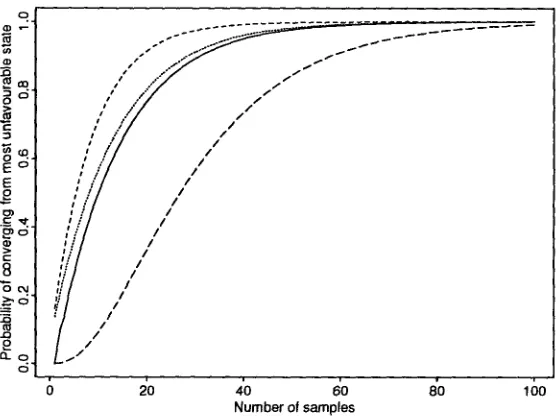
The Markov formulation allows one to more easily ex- plore algorithm variants. Besides the TLA, we consider the possible three simple learning algorithm regimes by dropping either or both of the Single Value and Greed- iness constraints. T h e key result is that ahnost any other regime works faster than local gradient ascent and avoids problems with local maxima. See figure 4 for a representative result. Thus, most interestingly, param- eterized language learning appears particularly robust under algorithmic changes.
E X T E N S I O N S , D I A C H R O N I C C H A N G E A N D C O N C L U S I O N S
Learning scenario TLA (uniform) TLA(a = 0.99) TLA(a = 0.9999)
RW
Table 3: Convergence rates derived from eigenvalue calculations.
Rate of Convergence 0(0.94 ~)
o((1- lo-~) ~)
o((1 - 10-6) k)
o(0.89 k)
q
~, d
d
,/
/
i//
/'
////
L.~,
2'0
4'o
6'0
s'o
6o
Number of samples
[image:9.612.161.441.383.593.2]T h e o r e m 3 If the learner draws more than M = 1 In(l/b) samples, then it will identify the tar-
ln(l/(1-bt))
get with confidence greater than 1 - 6. ( Here bt = P(Lt \ Uj~tLj)).
Finally, the Markov model also points to an intrigu- ing new model for syntactic change. One simply has to introduce two or more target languages that emit posi- tive example strings with (probably different) frequen- cies: each corresponding to difference language sources. If the model is run as before, then there can be a large probability for a learner to converge to a state different from the highest frequency emitting target state: that is, the learner can acquire a different parameter setting, for example, a - V 2 setting, even in a predominantly +V2 environment. This is of course one of the histor- ical changes that occurred in the development of En- glish. Space does not permit us to explore all the con- sequences of this new Markov model; we remark here that once again we can compute convergence times and stability under different distributions of target frequen- cies, combining it with the usual dynamical models of genotype fixation. In this case, the interesting result is that the TLA actually boosts diachronic change by or- ders of magnitude, since as observed earlier, it can per- mit the learner to arrive at a different convergent state even when there is just one target language emitter. In contrast, the local maxima targets are stable, and never undergo change. Whether this powerful "boost" effect plays a role in diachronic change remains a topic for fu- ture investigation. As far as we know, the possibility for formally modeling the kind of saltation indicated by the Markov model has not been noted previously and has only been vaguely stated by authors such as Lightfoot (1990).
In conclusion, by introducing a formal mathematical model for language acquisition, we can provide rigor- ous results on parameter learning, algorithmic varia- tion, sample complexity, and diachronic syntax change. These results are of interest for corpus-based acquisition and investigations of child acquisition, as well as point- ing the way to a more rigorous bridge between modern computational learning theory and computational lin- guistics.
A C K N O W L E D G M E N T S
We would like to thank Ken Wexler, Ted Gibson, and an anonymous ACL reviewer for valuable discussions and comments on this work. Dr. Leonardo Topa pro- vided invaluable programming assistance. All residual errors are ours. This research is supported by NSF grant 9217041-ASC and ARPA under the HPCC pro- gram.
R E F E R E N C E S
Clark, Robin and Roberts, Ian (1993). "A Compu- tational Model of Language Learnability and Lan- guage Change." Linguistic Inquiry, 24(2):299-345.
deMarcken, Carl (1990). "Parsing the LOB Corpus." Proceedings of the 25th Annual Meeting of the As- sociation for Computational Linguistics. Pitts- burgh, PA: Association for Computational Linguis- tics, 243-251.
Dresher, Elan and Kaye, Jonathan (1990). "A Compu- tational Learning Model For Metrical Phonology."
Cognition, 34(1):137-195.
Gibson, Edward and Wexler, Kenneth (1994). "Trig- gers." Linguistic Inquiry, to appear.
Gold, E.M. (1967). "Language Identification in the Limit." Information and Control, 10(4): 447-474. Isaacson, David and Masden, John (1976). Markov
Chains. New York: John Wiley.
Lightfoot, David (1990). How to Set Parameters. Cam- bridge, MA: MIT Press.