A Polynomial-Time Algorithm for Statistical Machine Translation
D e k a i W u
H K U S T
D e p a r t m e n t of C o m p u t e r Science U n i v e r s i t y of Science a n d
Technology
C l e a r W a t e r B a y , H o n g K o n g
dekai©cs, ust. hk
A b s t r a c t
We introduce a polynomial-time algorithm for statistical machine translation. This algorithm can be used in place of the expensive, slow best-first search strate- gies in current statistical translation ar- chitectures. The approach employs the stochastic bracketing transduction gram- mar (SBTG) model we recently introduced to replace earlier word alignment channel models, while retaining a bigram language model. The new algorithm in our experi- ence yields major speed improvement with no significant loss of accuracy.
1
M o t i v a t i o n
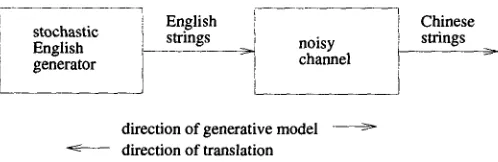
The statistical translation model introduced by IBM (Brown et al., 1990) views translation as a noisy channel process. Assume, as we do throughout this paper, that the input language is Chinese and the task is to translate into English. The underlying generative model, shown in Figure 1, contains a stochastic English sentence generator whose output is "corrupted" by the translation channel to produce Chinese sentences. In the IBM system, the language model employs simple n-grams, while the transla- tion model employs several sets of parameters as discussed below. Estimation of the parameters has been described elsewhere (Brown et al., 1993).
Translation is performed in the reverse direction from generation, as usual for recognition under gen- erative models. For each Chinese sentence c that is to be translated, the system must attempt to find the English sentence e* such that:
(1) e* = argmaxPr(elc ) e
(2) = argmaxPr(cle ) Pr(e) e
In the IBM model, the search for the optimal e* is performed using a best-first heuristic "stack search" similar to A* methods.
One of the primary obstacles to making the statis- tical translation approach practical is slow speed of
translation, as performed in A* fashion. This price is paid for the robustness that is obtained by using very flexible language and translation models. The lan- guage model allows sentences of arbitrary order and the translation model allows arbitrary word-order permutation. The models employ no structural con- straints, relying instead on probability parameters to assign low probabilities to implausible sentences. This exhaustive space, together with massive num- ber of parameters, permits greater modeling accu- racy.
But while accuracy is enhanced, translation ef- ficiency suffers due to the lack of structure in the hypothesis space. The translation channel is char- acterized by two sets of parameters: translation and alignment probabilities3 The translation probabil- ities describe lexical substitution, while alignment probabilities describe word-order permutation. The key problem is that the formulation of alignment probabilities a(ilj, V, T) permits the Chinese word in position j of a length-T sentence to map to any po- sition i of a length-V English sentence. So V T align- ments are possible, yielding an exponential space with correspondingly slow search times.
Note there are no explicit linguistic grammars in the IBM channel model. Useful methods do exist for incorporating constraints fed in from other pre- processing modules, and some of these modules do employ linguistic grammars. For instance, we previ- ously reported a method for improving search times in channel translation models that exploits bracket- ing information (Wu and Ng, 1995). If any brackets for the Chinese sentence can be supplied as addi- tional input information, produced for example by a preprocessing stage, a modified version of the A*- based algorithm can follow the brackets to guide the search heuristically. This strategy appears to pro- duces moderate improvements in search speed and slightly better translations.
stochastic English generator
English i Chinese
strings I noisy strings [ channel
i J k
d i r e c t i o n of generative model ---~-~ < - - d i r e c t i o n of translation
Figure 1: Channel translation model.
also be used with the new model described below, but the issue is independent of our focus here. In this paper we address the underlying assumptions of core channel model itself which does not directly use linguistic structure.
A slightly different model is employed for a word alignment application by Dagan et al. (Da- gan, Church, and Gale, 1993). Instead of alignment probabilities, offset probabilities o(k) are employed, where k is essentially the positional distance between the English words aligned to two adjacent Chinese words:
(3) k = i - (A(jpreo) + (j - jp~ev)N)
where jpr~v is the position of the immediately pre- ceding Chinese word and N is a constant that nor- malizes for average sentence lengths in different lan- guages. The motivation is that words that are close to each other in the Chinese sentence should tend to be close in the English sentence as well. The size of the parameter set is greatly reduced from the lil x IJl x ITI x I v I parameters of the alignment probabilities, down to a small set of Ikl parameters. However, the search space remains the same.
The A*-style stack-decoding approach is in some ways a carryover from the speech recognition archi- tectures that inspired the channel translation model. It has proven highly effective for speech recognition in both accuracy and speed, where the search space contains no order variation since the acoustic and text streams can be assumed to be linearly aligned. But in contrast, for translation models the stack search alone does not adequately compensate for the combinatorially more complex space that results from permitting arbitrary order variations. Indeed, the stack-decoding approach remains impractically slow for translation, and has not achieved the same kind of speed as for speech recognition.
The model we describe in this paper, like Dagan
et al.'s model, encourages related words to stay to-
gether, and reduces the number of parameters used to describe word-order variation. But more impor- tantly, it makes structural assumptions that elimi- nate large portions of the space of alignments, based on linguistic motivatations. This greatly reduces the search space and makes possible a polynomial-time optimization algorithm.
2 I T G a n d B T G O v e r v i e w
The new translation model is based on the recently introduced bilingual language modeling approach. Specifically, the model employs a bracketing trans-
duction grammar or B T G (Wu, 1995a), which is
a special case of inversion transduction grammars
or ITGs (Wu, 1995c; Wu, 1995c; Wu, 1995b; Wu, 1995d). These formalisms were originally developed for the purpose of parallel corpus annotation, with applications for bracketing, alignment, and segmen- tation. This paper finds they are also useful for the translation system itself. In this section we summa- rize the main properties of B T G s and ITGs.
An I T G consists of context-free productions where terminal symbols come in couples, for example x / y ,
where z is a Chinese word and y is an English trans- lation of x. 2 Any parse tree thus generates two strings, one on the Chinese stream and one on the English stream. Thus, the tree:
(1) [~/I liST/took [--/a $:/e ~t/book]Np ]vP
[,,~/for ~/you]pp ]vP Is
produces, for example, the mutual translations:
(2)
a. [~ [[ST [--*~]NP ]vP [ ~ ] P P ]vP Is
[W6 [[nA le [yi b~n shfi]Np ]vp [g@i ni]pp ]vP
]s
b. [I [[took [a book]Np ]vP [for you]pp ]vP Is
An additional mechanism accommodates a con- servative degree of word-order variation between the two languages. With each production of the gram- mar is associated either a straight orientation or an
inverted orientation, respectively denoted as follows:
VP --~ [VP PP] VP ---* (VP PP)
[image:2.612.174.423.74.155.2]BTG all matchings ratio
1 1 1.000
1 1 1 1200
2 2 2 1.000
3 6 6 1.000
4 22 24 0.917
5 90 120 0.750
6 394 720 0.547
7 1806 5040 0.358
8 8558 40320 0.212
9 41586 362880 0.115
10 206098 3628800 0.057
11 1037718 39916800 0.026
12 5293446 479001600 0.011
13 27297738 6227020800 0.004 14 142078746 87178291200 0.002 15 745387038 1307674368000 0.001 16 3937603038 20922789888000 0.000
Figure 2: Number of legal word alignments between sentences of length f , with and without the BTG restriction.
right-hand-side symbols are visited left-to-right for Chinese and right-to-left for English. Thus, the tree: (3) [ ~ / I ([,.~/for ~ / y o u ] p p [ $ ~ ' / t o o k [ - - / a ak/e
~idt/book]Np ]vp )vP ]s
produces translations with different word order: (4) a. [~J~ [[,,~*l~]pp
[~Y
[--2[~-~]Np ]VP ]VP ]Sb. [I [[took [a book]Np ]vP [for you]pp ]vP ]s In the special case of BTGs which are employed in the model presented below, there is only one un- differentiated nonterminal category (aside from the start symbol). Designating this category A, this means all non-lexical productions are of one of these two forms:
A ---+ [ A A . . . A ]
A ---+ ( A A . . . A }
The degree of word-order flexibility is the criti- cal point. BTGs make a favorable trade-off between efficiency and expressiveness: constraints are strong enough to allow algorithms to operate efficiently, but without so much loss of expressiveness as to hinder useful translation. We summarize here; details are given elsewhere (Wu, 1995b).
With regard to efficiency, Figure 2 demonstrates the kind of reduction that BTGs obtain in the space of possible alignments. The number of possible alignments, compared against the unrestricted case where any English word m a y align to any Chinese position, drops off dramatically for strings longer
than four words. (This table makes the simplifica- tion of counting only 1-1 matchings and is merely representative.)
With regard to expressiveness, we believe that al- most all variation in the order of arguments in a syntactic frame can be accommodated, a Syntac- tic frames generally contain four or fewer subcon- stituents. Figure 2 shows t h a t for the case of four subconstituents, BTGs permit 22 out of the 24 pos- sible alignments. The only prohibited arrangements are "inside-out" transformations (Wu, 1995b), which we have been unable to find any examples of in our corpus. Moreover, extremely distorted alignments can be handled by BTGs (Wu, 1995c), without re- sorting to the unrestricted-alignment model.
The translation expressiveness of BTGs is by no means perfect. They are nonetheless proving very useful in applications and are substantially more fea- sible than previous models. In our previous corpus analysis applications, any expressiveness limitations were easily tolerable since degradation was graceful. In the present translation application, any expres- siveness limitation simply means t h a t certain trans- lations are not considered.
For the remainder of the paper, we take advantage of a convenient normal-form theorem (Wu, 1995a) that allows us to assume without loss of generality that the BTG only contains the binary-branching form for the non-lexicM productions. 4
3 B T G - B a s e d S e a r c h f o r t h e O r i g i n a l M o d e l s
A first approach to improving the translation search is to limit the allowed word alignment patterns to those permitted by a BTG. In this case, Equation (2) is kept as the objective function and the translation channel can be parameterized similarly to Dagan et
al. (Dagan, Church, and Gale, 1993). The effect of the BTG restriction is just to constrain the shapes of the word-order distortions. A BTG rather than ITG is used since, as we discussed earlier, pure channel translation models operate without explicit gram- mars, providing no constituent categories around which a more sophisticated ITG could be structured. But the structural constraints of the BTG can im- prove search efficiency, even without differentiated constituent categories. Just as in the baseline sys- tem, we rely on the language and translation models to take up the slack in place of an explicit grammar. In this approach, an O(T 7) algorithm similar to the one described later can be constructed to replace A* search.
3Note that these points are not directed at free word- order languages. But in such languages, explicit mor- phological inflections make role identification and trans- lation easier.
[image:3.612.83.295.78.285.2]However we do not feel it is worth preserving off- set (or alignment or distortion) parameters simply for the sake of preserving the original translation channel model. These parameterizations were only intended to crudely model word-order variation. In- stead, the B T G itself can be used directly to proba- bilistically rank alternative alignments, as described next.
4 R e p l a c i n g t h e C h a n n e l M o d e l w i t h a S B T G
The second possibility is to use a stochastic brack- eting transduction g r a m m a r (SBTG) in the channel model, replacing the translation model altogether. In a SBTG, a probability is associated with each pro- duction. Thus for the normal-form B T G , we have: T h e translation lexicon is encoded in productions of
a T ]
g
[AA]
a O
A -+ (A A)
b ( x , y )
A ~ x / y
5(~ e)
A ~ z / e
b(qu)
A --+ ely
for all x, y lexical translations for all x Chinese vocabulary for all y English vocabulary
the third kind. The latter two kinds of productions allow words of either Chinese or English to go un- matched.
The SBTG assigns a probability Pr(c, e, q) to all generable trees q and sentence-pairs. In principle it can be used as the translation channel model by normalizing with Pr(e) and integrating out P r ( q ) to give P r ( c l e ) in Equation (2). In practice, a strong language model makes this unnecessary, so we can instead optimize the simpler Viterbi approximation (4) e* = a r g m a x P r ( c , e, q) Pr(e)
e
To complete the picture we add a bigram model
ge~-lej = g(ej lej_l) for the English language model
Pr(e).
Offset, alignment, or distortion parameters are entirely eliminated. A large part of the im- plicit function of such p a r a m e t e r s - - t o prevent align- ments where too m a n y frame arguments become separated--is rendered unnecessary by the B T G ' s structural constraints, which prohibit many such configurations altogether. Another part of the pa- rameters' ~urpose is subsumed by the S B T G ' s prob- abilities at] and a 0 , which can be set to prefer straight or inverted orientation depending on the language pair. As in the original models, the lan- guage model heavily influences the remaining order- ing decisions.
Matters are complicated by the presence of the bi- gram model in the objective function (which word- alignment models, as opposed to translation models,
do not need to deal with). As in our word-alignment model, the translation algorithm optimizes Equa- tion (4) via dynamic programming, similar to chart parsing (Earley, 1970) but with a probabilistic ob- jective function as for HMMs (Viterbi, 1967). But unlike the word-alignment model, to accommodate the bigram model we introduce indexes in the recur- rence not only on subtrees over the source Chinese string, but also on the delimiting words of the target English substrings.
Another feature of the algorithm is that segmen- tation of the Chinese input sentence is performed in parallel with the translation search. Conven- tional architectures for Chinese NLP generally at- t e m p t to identify word boundaries as a preprocess- ing stage. 5 Whenever the segmentation preprocessor prematurely commits to an inappropriate segmenta- tion, difficulties are created for later stages. This problem is particularly acute for translation, since the decision as to whether to regard a sequence as a single unit depends on whether its components can be translated compositionally. This in turn often depends on what the target language is. In other words, the Chinese cannot be appropriately seg- mented except with respect to the target language of t r a n s l a t i o n - - a task-driven definition of correct seg- mentation.
The algorithm is given below. A few remarks about the notation used: c~..t denotes the subse- quence of Chinese tokens cs+t, cs+2, • • • , ct. We use
E(s..t) to denote the set of English words that are
translations the Chinese word created by taking all tokens in c,..t together. E ( s , t ) denotes the set of English words that are translations of any of the Chinese words anywhere within c,..t. Note also that we assume the explicit sentence-start and sentence- end tokens co = <s> and CT+l = </s>, which makes the algorithm description more parsimonious. Fi- nally, the argmax operator is generalized to vector notation to accomodate multiple indices.
1. I n i t i a l i z a t i o n
o • O < s < t < T
6~trr(~) = b~(c~..t/Y), :~ ~ E(s..-t)
2. R e c u r s i o n For all s , t , y , z such that { -1_<s<t_<T+1
~E(8,t) z E E ( s , t )
6,~v~
maxrx[l
xO
x0 1 = ==~ t V s t y z ~ V s t y z ~ VstyzJ2 [] if 6 [1 ~ty~ - "-6 0 s t ~ and 6 [] ,tyz > 6sty~ 0
Ostyz : if 6 0 s t y z ! "~6 [] " and 6 0 s t y z styz > 6styz o
otherwise
C a t e g o r y Correct Incorrect
O r i g i n a l A* B r a c k e t A * B T G - C h a n n e l
67.5 69.8 68.2
32.5 30.2 31.8
Figure 3: Translation accuracy (percentage correct).
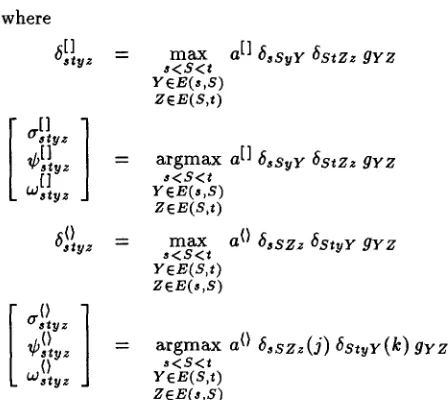
where
6[] ,iv. = m a x a [ ] ,~sSyY 6StZz gYZ
s<S<t
YeE(s,S) ZEE(S,t)
[
[1]
~bstyz
[1
uJ styz
6O styz
argmax s<S<t Y f E ( s , S )
ZEE(S,t)
m a x
s<S<t YeE(S,t)
ZEE(s,S)
a[] 6 , s y Y 6stz~ g v z
a 0 ~,sz~ 6StyY g Y Z
styz
0
Cstvz = argmax a 0 ~ s s z z ( j ) 6 s t y y ( k ) g Y z
0 s < s < t
Wstyz YEE(S,t)
z e E ( , , s )
3. R e c o n s t r u c t i o n Initialize by setting the root of the parse tree to q0 = ( - 1 , T - 1, <s>, </s>). The remaining descendants in the optimal parse tree are then given recursively for any q = ( s , t , y, z) by:
a probabilistic optimization problem. But perhaps most importantly, our goal is to constrain as tightly as possible the space of possible transduction rela- tionships between two languages with fixed word- order, making no other language-specific assump- tions; we are thus driven to seek a kind of language- universal property. In contrast, the I D / L P work was directed at parsing a single language with free word-order. As a consequence, it would be neces- sary to enumerate a specific set of linear-precedence (LP) relations for the language, and moreover the immediate-dominance (ID) productions would typi- cally be more complex than binary-branching. This significantly increases time complexity, compared to our BTG model. Although it is not mentioned in their paper, the time complexity for I D / L P pars- ing rises exponentially with the length of produc- tion right-hand-sides, due to the number of permuta- tions. ITGs avoid this with their restriction to inver- sions, rather than permutations, and BTGs further minimize the grammar size. We have also confirmed empirically t h a t our models would not be feasible under general permutations.
LEFT(q)
R I G H T ( q )
N I L if t - s < 1
( s , a [1 " ,,,[1~ ifOq []
= q , ,Y, ~Yq ) ~ -
( s , a 0q,w 0q,z~j i f 0 q = 0
N I L otherwise
N I L if ~ - , < 1
= (g~],t,w~],z) if0q = []
(a~),t, y, ¢~)) if Oq = 0
N I L otherwise
Assume the number of translations per word is bounded by some constant. Then the m a x i m u m size
of E ( s , t ) is proportional to t - s. The asymptotic
time complexity for the translation algorithm is thus bounded by O(T7). Note that in practice, actual performance is improved by the sparseness of the translation matrix.
An interesting connection has been suggested to direct parsing for I D / L P grammars (Shieber, 1984), in which word-order variations would be accommo- dated by the parser, and related ideas for genera- tion of free word-order languages in the TAG frame- work (Joshi, 1987). Our work differs from the I D / L P work in several important respects. First, we are not merely parsing, but translating with a bigram lan- guage model. Also, of course, we are dealing with
5 R e s u l t s
The algorithm above was tested in the SILC transla- tion system. The translation lexicon was largely con- structed by training on the HKUST English-Chinese Parallel Bilingual Corpus, which consists of govern- mental transcripts. The corpus was sentence-aligned statistically (Wu, 1994); Chinese words and colloca- tions were extracted (Fung and Wu, 1994; Wu and Fung, 1994); then translation pairs were learned via an EM procedure (Wu and Xia, 1995). The re- sulting English vocabulary is approximately 6,500 words and the Chinese vocabulary is approximately 5,500 words, with a many-to-many translation map- ping averaging 2.25 Chinese translations per English word. Due to the unsupervised training, the transla- tion lexicon contains noise and is only at about 86% percent weighted precision.
[image:5.612.76.300.162.362.2]Input:
Output:
C o r p u s :Input:
Output:
Corpus:
Input:
Output:
Corpus:
Input:
Output:
C o r p u s :Input:
Output:
C o r p u s :
(Xigng g~mg de ~n dlng f~n r6ng shl w6 m~n sh~ng hu6 fgmg shi de zhi zh~.)
Hong Kong's stabilize boom is us life styles's pillar.
Our prosperity and stability underpin our way of life.
(B6n g~ng de jing ji qian jing yfi zhSng gu6, t~ bi~ shl gu~ng dSng shrug de ring jl qi£n jing xi xi xi~ng gu~n.)
Hong Kong's economic foreground with China, particular Guangdong province's economic foreground vitally interrelated.
Our economic future is inextricably bound up with China, and with Guangdong Province in particular.
(W6 wgm qu£n zhi chi ta de yl jign.)
I absolutely uphold his views.
I fully support his views.
(Zh~ xi~ gn pdi k~ ji~ qi£ng w6 m~n rl hbu w~i chi jin r6ng w6n ding de n~ng li.)
These arrangements can enforce us future kept financial stabilization's competency.
These arrangements will enhance our ability to maintain monetary stability in the years to come.
(Bh gub, w6 xihn zhi k~ yi k6n ding de shuS, w6 m~n ji~ng hul ti gSng w~i d£ d~o g~ xihng zhfi yho mfl biao su6 xfi de jing f~i.)
However, I now can certainty's say, will provide for us attain various dominant goal necessary's current expenditure.
The consultation process is continuing but I can confirm now that the necessary funds will be made available to meet the key targets.
Figure 4: Example translation outputs.
translation accuracy was performed on a random sample drawn from Chinese sentences of fewer than 20 words from the parallel corpus, the results of which are shown in Figure 3. We have judged only whether the correct meaning (as determined by the corresponding English sentence in the parallel cor- pus) is conveyed by the translation, paying particu- lar attention to word order, but otherwise ignoring morphological and function word choices. For com- parison, the accuracies from the A*-based systems are also shown. There is no significant difference in the accuracy. Some examples of the output are shown in Figure 4.
On the other hand, the new algorithm has indeed proven to be much faster. At present we are unable to use direct measurement to compare the speed of the systems meaningfully, because of vast implemen- tational differences between the systems. However, the order-of-magnitude improvements are immedi- ately apparent. In the earlier system, translation of single sentences required on the order of hours (Sun Sparc 10 workstations). In contrast the new algo- rithm generally takes less than one minute--usually
substantially less--with no special optimization of the code.
6 C o n c l u s i o n
We have introduced a new algorithm for the run- time optimization step in statistical machine trans- lation systems, whose polynomial-time complexity addresses one of the primary obstacles to practicality facing statistical MT. The underlying model for the algorithm is a combination of the stochastic BTG and bigram models. The improvement in speed does not appear to impair accuracy significantly.
We have also implemented a generalized version that accepts arbitrary grammars not restricted to normal form, with two motivations. The pragmatic benefit is that structured grammars become easier to write, and more concise. The expressiveness ben- efit is that a wider family of probability distribu- tions can be written. As stated earlier, the normal form theorem guarantees that the same set of shapes will be explored by our search algorithm, regardless of whether a binary-branching BTG or an arbitrary BTG is used. But it may sometimes be useful to place probabilities on n-ary productions that vary with n in a way that cannot be expressed by com- posing binary productions; for example one might wish to encourage longer straight productions. The generalized version permits such strategies.
Currently we are evaluating robustness extensions of the algorithm that permit words suggested by the language model to be inserted in the output sen- tence, which the original A* algorithms permitted. A c k n o w l e d g e m e n t s
Thanks to an anonymous referee for valuable com- ments, and to the SILC group members: Xuanyin Xia, Eva Wai-Man Fong, Cindy Ng, Hong-sing Wong, and Daniel Ka-Leung Chan. Many thanks Mso to Kathleen McKeown and her group for dis- cussion, support, and assistance.
R e f e r e n c e s
Barton, G. Edward, Robert C. Berwick, and Eric Sven Ristad. 1987. Computational Complex-
ity and Natural Language. MIT Press, Cambridge,
MA.
Brown, Peter F., John Cocke, Stephen A. DellaPi- etra, Vincent J. DellaPietra, Frederick Jelinek, John D. Lafferty, Robert L. Mercer, and Paul S. Roossin. 1990. A statistical approach to machine translation. Computational Linguistics, 16(2):29- 85.
Brown, Peter F., Stephen A. DellaPietra, Vincent J. DellaPietra, and Robert L. Mercer. 1993. The mathematics of statisticM machine translation: Parameter estimation. Computational Linguis-
tics, 19(2):263-311.
Dagan, Ido, Kenneth W. Church, and William A. Gale. 1993. Robust bilingual word alignment for machine aided translation. In Proceedings of
the Workshop on Very Large Corpora, pages 1-8,
Columbus, OH, June.
Earley, Jay. 1970. An efficient context-free pars- ing algorithm. Communications of the Associa-
tion for Computing Machinery, 13(2):94-102.
Fung, Pascale and Dekai Wu. 1994. Statistical aug- mentation of a Chinese machine-readable dictio-
nary. In Proceedings of the Second Annual Work-
shop on Very Large Corpora, pages 69-85, Kyoto,
August.
Joshi, Aravind K. 1987. Word-order variation in natural language generation. In Proceedings of AAAI-87, Sixth National Conference on Artificial
Intelligence, pages 550-555.
Shieber, Stuart M. 1984. Direct parsing of ID/LP grammars. Linguistics and Philosophy, 7:135- 154.
Viterbi, Andrew J. 1967. Error bounds for convolu- tional codes and an asymptotically optimal decod- ing Mgorithm. IEEE Transactions on Information
Theory, 13:260-269.
Wu, Dekai. 1994. Aligning a parallel English- Chinese corpus statistically with lexical criteria.
In Proceedings of the 32nd Annual Conference
of the Association for Computational Linguistics,
pages 80-87, Las Cruces, New Mexico, June. Wu, Dekai. 1995a. An algorithm for simultaneously
bracketing parallel texts by aligning words. In
Proceedings of the 33rd Annual Conference of the
Association for Computational Linguistics, pages
244-251, Cambridge, Massachusetts, June. Wu, Dekai. 1995b. Grammarless extraction of
phrasal translation examples from parallel texts.
In TMI-95, Proceedings of the Sixth International
Conference on Theoretical and Methodological Is-
sues in Machine Translation, volume 2, pages
354-372, Leuven, Belgium, July.
Wu, Dekai. 1995c. Stochastic inversion trans- duction grammars, with application to segmen- tation, bracketing, and alignment of parallel cor- pora. In Proceedings of IJCAL95, Fourteenth In- ternational Joint Conference on Artificial Intelli-
gence, pages 1328-1334, Montreal, August.
Wu, Dekai. 1995d. Trainable coarse bilingual gram- mars for parMlel text bracketing. In Proceed- ings of the Third Annual Workshop on Very Large
Corpora, pages 69-81, Cambridge, Massachusetts,
June.
Wu, Dekai and Pascale Fung. 1994. Improving Chinese tokenization with linguistic filters on sta- tistical lexicM acquisition. In Proceedings of the Fourth Conference on Applied Natural Language
Processing, pages 180-181, Stuttgart, October.
Wu, Dekai and Cindy Ng. 1995. Using brackets to improve search for statistical machine transla- tion. In PACLIC-IO, Pacific Asia Conference on
Language, Information and Computation, pages
195-204, Hong Kong, December.
Wu, Dekai and Xuanyin Xia. 1995. Large-scale au- tomatic extraction of an English-Chinese lexicon.