A Method for Relating Multiple Newspaper Articles by Using
Graphs, and Its Application to Webcasting
N a o h i k o U r a m o t o a n d K o i c h i T a k e d a I B M R e s e a r c h , T o k y o R e s e a r c h L a b o r a t o r y
1 6 2 3 - 1 4 S h i m o - t s u r u m a , Y a m a t o - s h i , K a n a g a w a - k e n 242 J a p a n { u r a m o t o , t a k e d a } @trl. i b m . co.j p
A b s t r a c t
This paper describes methods for relating (thread- ing) multiple newspaper articles, and for visualizing various characteristics of them by using a directed graph. A set of articles is represented by a set of word vectors, and the similarity between the vec- tors is then calculated. T h e graph is constructed from the similarity matrix. By applying some con- straints on the chronological ordering of articles, an efficient threading algorithm that runs in
O(n)
time (where n is the number of articles) is obtained. T h e constructed graph is visualized with words that rep- resent the topics of the threads, and words that rep- resent new information in each article. The thread- ing technique is suitable for Webcasting (push) ap- plications. A threading server determines relation- ships among articles from various news sources, and creates files containing their threading information. This information is represented in eXtended Markup Language (XML), and can be visualized on most Web browsers. The XML-based representation and a current prototype are described in this paper.1 I n t r o d u c t i o n
The vast quantity of information available today makes it difficult to search for and understand the information that we want. If there are many related documents about a topic, it is important to capture their relationships so t h a t we can obtain a clearer overview. However, most information resources, in- cluding newspaper articles do not have explicit re- lationships. For example, although documents on the Web are connected by hyperlinks, relationships cannot be specified.
Webcasting ("push") applications such as Point- cast i constitute a promising solution to the prob- lem of information overloading, but the articles they provide do not have links, or else must be manually linked at a high cost in terms of time and effort.
This paper describes methods for relating news- paper articles automatically, and its application for a Webcasting application. A set of article on a par-
I htt p : / / w w w . p o i n t c a s t . c o m
ticular topic is ordered chronologically, and the re- sults are represented as a directed graph. There are various ways of relating documents and visualizing their structure. For example, U S E N E T articles can be accessed by means of newsreader software. In the system, a label (title) is attached to each posted mes- sage, specifying whether it deals with a new topic or is a reply to a previous message. A chain of articles on a topic is called a
thread.
In this case, the rela- tionships between the articles are explicitly defined. This post/reply-based approach makes it possible for a reader to group all the messages on a particular topic. However, it is difficult to capture the story of the thread from its thread structure, since appropri- ate titles are not added to the messages.This paper aims to provide ways of relating mul- tiple news articles and representing their structure in a way that is easy to understand and computa- tionally inexpensive. A set of relationships is defined here as a directed graph. A node indicates an arti- cle, and an arc from node X to Y indicates that the article X is followed by Y (or t h a t X is adjacent to Y). An article contains both known and unknown (new) information. Known information consists of words shared by the beginning and ending points of an arc. When node X is adjacent to Y, the words are represented by (X fq Y). T h e known information is called
genus words
in this paper. Even if an article follows another one, it generally contains some new information. This information can be represented by subtraction ( Y - X ) (Damashek, 1995), and is calleddifferentia words,
by analogy with definition sentences in dictionaries, which contain genus words and differentia. In this paper, genus and differentiae words are used to calculate the similarities between two articles, and to visualize topics in a set of arti- cles.Since articles are ordered chronologically, there are some time constraints on the connectivity of nodes. A graph is created by constructing an ad- jacency matrix for nodes, which in turn is created
from a similarity matrix for nodes.
d2 d3
od5 .od6
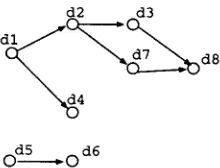
Figure 1: Example of a Directed G r a p h G
corresponding graph. For example, the paths in the graph show the stories of the nodes they contain. Multiple paths for a node (article) show t h a t there are multiple stories associated with it. Furthermore, if the node has a long path, it is in the "main stream" of the topic represented by the graph. An efficient algorithm for finding such paths is described, later in the paper.
Application of the threading m e t h o d to docu- ments on the Web would be very useful because, al- though such documents are connected by hyperlinks, their relationships cannot be specified. In this paper, generated threads by this m e t h o d are represented in eXtended Markup Language (XML) (XML, 1997), which is the proposed standard for exchange of in- formation on the Web. XML-based threads can be used by webcasting or push services, since various tools for parsing and visualizing threads are avail- able.
In Section 2, a directed graph structure for arti- cles is defined, and the procedure for constructing a directed graph is described in Section 3. In Section 4, some features of the created graph are discussed. Section 5 introduces a webcasting application by us- ing the threading technique, and Section 6 concludes the paper.
2
D e f i n i t i o n o f a G r a p h S t r u c t u r e
A set of articles is represented as an ordered set V: V = { d x , d 2 , . . . , d , } .
T h e suffix sequence 1, 2 , . . . , n represents the pas- sage of time. Article di is older than di+l. T h e order is obtained from the publication dates of the articles. Different time points arbitrarily are assigned to ar- ticles published on the same day.
Related articles are represented as a directed graph (V,A). V is a set of nodes. A is a set of ordered pairs (i, j), where i and j are members of V. Figure 1 shows an example of a directed graph. In this case, the graph is represented as follows:
V = {dl,d2,d3,d4,ds,d6,d6,d7}, A = {(dl,d2), (d2, d3), (dl, d4), (d5, d6), (d2, dT), (d3, ds), (dT, ds)}
T h e nodes are ordered chronologically. T h e fol- lowing constraint is introduced into the graph:
M = dl d2 d3 d4
45
d6
d7 ds
dx d2 d3 d4 d5 d6 d7 ds
0 1 0 1 0 0 0 0
0 0 1 0 0 0 1 0
0 0 0 0 0 0 0 1
0 0 0 0 0 0 0 0
0 0 0 0 0 1 0 0
0 0 0 0 0 0 0 0
0 0 0 0 0 0 0 1
0 0 0 0 0 0 0 0
Figure 3: Adjacency Matrix M c of G
Constraint 1
For (di,dj) 6 A, i < j
The constraint simply shows t h a t an old article cannot follow a new one.
3 C r e a t i n g a G r a p h S t r u c t u r e f o r A r t i c l e s
This section describes how to construct a directed graph structure from a set of articles. Any directed graph can be represented by a matrix. Figure 3 shows the adjacency m a t r i x MG of the graph G in Figure 1.
For example, a value of "1" for the (1, 2) element in M indicates t h a t dx is adjacent to d2. Since an article cannot follow itself, the value of (i, i) elements is "0". From the time constraint defined in Section 3, MG is an upper triangle matrix.
The following is a procedure for constructing a directed graph for related articles:
1. Calculate the similarity and difference between articles.
2. Construct a similarity matrix.
3. Convert the matrix into an adjacency matrix.
In the next section, each step is illustrated by us- ing the set of articles V in Figure 2 on the subject of nuclear testing taken from the Nikkei Shinbun. 2
3.1 Calculating the similarities and
differences b e t w e e n articles
T h e function sim(di,dj) calculates the word-based similarity between two articles. It is defined on the basis of Salton's Vector Space Model (Salton, 1968). Words are extracted from an article by using a mor- phological analyzer. Next, nouns and verbs are ex- tracted as keywords.
_ di w d i
sim(di,dj) = ~-,k,,, wkw k~
k W k w ) k k w ]
[image:2.612.137.247.54.138.2] [image:2.612.324.541.62.171.2]dl: T h e prime minister of France says that it is necessary to restart nuclear testing. d2: The Defense Minister suggests restarting nuclear testing.
d3: At a summit conference, the Prime Minister will adopt a policy of requesting the French Government to halt nuclear testing.
d4: China's latest nuclear test will hold up negotiations on a t r e a t y to abolish such testing.
d5: T h e Minister of Foreign Affairs, Mr. Youhei Kohno, takes a critical a t t i t u d e toward China, and asks France to understand Japan's position.
d6: The prime minister of New Zealand asks the French Government not to restart nuclear testing.
dT: President of France states that nuclear testing will restart in September, and that France will conduct eight tests between now and next May.
d8: France states t h a t it will restart nuclear testing. This will h a m p e r nuclear disarmament.
dg: France states t h a t it will restart nuclear testing. Australia halts defense cooperation with France. dlo: France states that it will restart nuclear testing. T h e U.S. expresses regret at the decision.
Figure 2: V: Articles about nuclear testing
Here, Wkw di is the weight given to the keyword kw in article di. Modification of the T F . I D F value (Robertson et al., 1976) is used for the weight- ing. 9d, kw is the weight assigned to the keyword kw, which is a differentia word for di.
Cdl (kw) k dl
= . u - ( k w l . g w,
d, r 1.5 kw E d i f f e r e n t i a ( d i ) gkw = ~ 1 otherwise.
Other parameters are defined as follows:
k: constant value
Cd,(kw): frequency of word kw in d(i) Cd, : number of words in d(i)
Nk(kw): number of articles that contain the word kw in k articles d i - k , . . . ,di
T h e function differentia(d{) returns a set of key- words that appear in dj but do not appear in the last k articles.
di.fferentia(di) = { k w [ C d , ( k w ) > 0, and for all dt,
where i - k < l < i, Cd,(kw) = O}
3.2 C o n s t r u c t i n g a s i m i l a r i t y m a t r i x
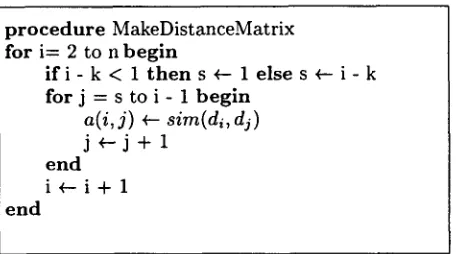
A similarity matrix for a set of articles is constructed by using the sim function. In a conventional hierar- chical clustering algorithm, a similarity for any com- bination of two articles is required in order to con- struct a hierarchical tree of the set of articles. This causes ~ calculations of the similarity func- tion, for n articles, with a consequent complexity of O(n2). This is very expensive when n is large. In our algorithm for constructing a similarity ma- trix, shown in Figure 4, the complexity of construct- ing a graph structure for an article set by using a constraint is O(n). The following constraint, which
p r o c e d u r e MakeDistanceMatrix f o r i= 2 to n b e g i n
i f i - k < 1 t h e n s + - 1 e l s e s + - - i - k f o r j = s t o i - l b e g i n
a(i,j) +- sim(di,dj) j ~ - j + l
e n d i + - i + l e n d
Figure 4: Procedure for Constructing Similarity Ma- trix
includes Constraint 1, is used for in threading algo- rithm.
C o n s t r a i n t 2
For (di,dj) E A, j - (k + l) < i < j
This constraint means that an article can only fol- low the last k articles. As the result, the number of times the similarity matrix needs to be calculated is reduced by kn, giving a complexity of O(n).
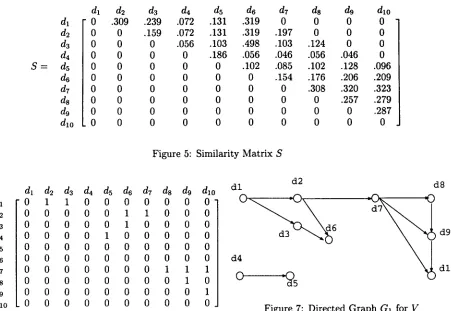
By using the algorithm, each similarity between nodes is calculated, and the similarity matrix in Fig- ure 5 shows a similarity matrix S of V. In this case, keywords are extracted from title sentences, and k is set to five.
[image:3.612.306.534.242.369.2]S =
dl
d2
d3
d4
ds
d~
d7
d8
d9
dlodl
d2
d3
d4
d5
d6
d7
ds
d9
dio0 .309 .239 .072 .131 .319 0 0 0 0
0 0 .159 .072 .131 .319 .197 0 0 0
0 0 0 .056 .103 .498 .103 .124 0 0
0 0 0 0 .186 .056 .046 .056 .046 0
0 0 0 0 0 .102 .085 .102 .128 .096
0 0 0 0 0 0 .154 .176 .206 .209
0 0 0 0 0 0 0 .308 .320 .323
0 0 0 0 0 0 0 0 .257 .279
0 0 0 0 0 0 0 0 0 .287
0 0 0 0 0 0 0 0 0 0
Figure 5: Similarity Matrix S
dl
d~
d3
d4
ds d6
d7
ds
d9 dlo
dl d2 ds d4 ds d6 d7 ds d9 d,o
0 1 1 0 0 0 0 0 0 0
0 0 0 0 0 1 1 0 0 0
0 0 0 0 0 I 0 0 0 0
0 0 0 0 I 0 0 0 0 0
0 0 0 0 0 0 0 0 0 0
0 0 0 0 0 0 0 0 0 0
0 0 0 0 0 0 0 1 1 1
0 0 0 0 0 0 0 0 1 0
0 0 0 0 0 0 0 0 0 I
0 0 0 0 0 0 0 0 0 0
d2 dl
d4
o
,C s
d8
d9
dlO
Figure 7: Directed G r a p h G1 for V
Figure 6: Adjacency Matrix
SS
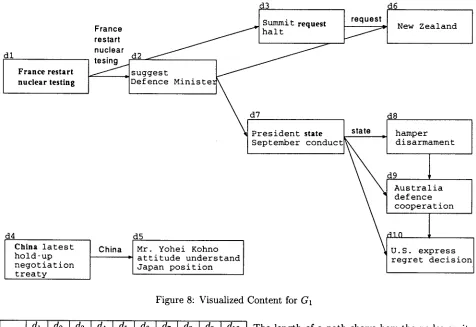
Converted from SThere are two threads in the graph. One concerns for France's restarting of nuclear testing. The other concerns China's latest nuclear test. T h e "France" thread contains two sub-threads. One concern re- quests by other countries for France to reconsider its stated intension of restarting nuclear testing, and the other concerns responses by other countries to the France government's official statement on testing. Some articles are followed by multiple articles. For example, d7 is the first official statement on France's restarting of nuclear testing, and many related arti- cles on this topic follow.
Each rectangle in Figure 8 represents an article. Words in a rectangle are differentia words for the articles. These words show new information in the article, and make it easy to understand t h e content of the articles. If a word in an article appears in the differentia words for its parent article, the word may represent a "turning point" in the story of the articles. For example, the word "state" is the dif- ferentia word for
dT,
and is in its adjacent articlesds, dg, anddlo.
This means thatd7
is a starting point of the new topic "state." Such words are calledtopic
words,
and are represented in Figure 8 by bold type.Several features of the graph visualize the charac-
teristics and relationships of the articles: these fea- tures will be discussed in the next section.
It is difficult to evaluate the result of threading. We are implementing it in a webcasting (push) ap- plication so t h a t it can be evaluated by the many people who use ordinary web browsers. The a t t e m p t is described in Section 5.
4 F e a t u r e s o f a G r a p h
This section describes how the features of a con- structed graph represent the characteristics of arti- cles.
4.1 In-degree and Out-degree
[image:4.612.94.545.62.373.2]dl
France restart nuclear testing
d4
China
latest
hold-up
negotiation
treaty
d3
d6
halt
Summit request
France
~
New Zealand
restart nuc,ear
l /
_Isuggest
[
/
~Defence M
i
n
i
s
t
e
~
~dd/r
d8esident state [state ,[ hamper
c o n d u c t ~
1
[September
[disarmament
\ \ d9
\ ~ Australia
\ ] defence
[
cooperation
China
, Mr. Yohei Kohno
~
~ U . S .
express
attitude understand
~
regret decision
Japan position
Figure 8: Visualized Content for G1
dl d2 d3 d4 d5 d6 d7 d8 d9 dl0
in 0 1 1 0 1 2 1 1 2 2
out 2 2 1 1 0 0 3 1 1 0
Figure 9: In-degree/Out-degree of the Graph G1
degree for the node increases. The contribution of reference nodes is not clear in V (d6, ds, and d9 have max in-degrees). Nodes that have high in-degree have two characteristics. The first is that when the articles contain multiple topics, they have many in- bound arcs, each representing a different topic. The second is that when the articles are closely related for a particular topic, the in-degrees of related nodes increase, since these articles are connected to each other.
4.2 P a t h
A path from one node to another node shows the "story flow" of articles. Multiple paths between two nodes show different stories about the nodes. For example, there are three paths between dl, which is a first node, and dl0. The shortest path (dl, d2,, dT, dl0) gives a simple outline of the articles. The longest path (d,, d2, d7,
ds,
dg, dl0) contains all related information on the topic. By extracting long paths from the graph and combining them, various stories can be created.The length of a path shows how the nodes on it [ along to the "main stream" of the story. For ex- mple, the maximum length of a path through d6, is three, while that of a path through d7 is five. This means that a path that contains d7 is on a main stream of the thread and is likely to be continued.
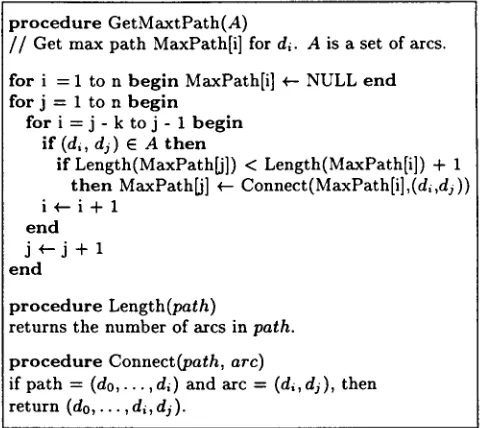
The longest paths for nodes can be calculated by using the algorithm shown in Figure 11. Its com- plexity is
O(n),
since the maximum number of arcs is at mostnk
for n nodes, from Constraint 2, defined in Section 3.2.4.3 C y c l e
A cycle 3 shows the existence of a topic. In V, {dT,
ds, dg,
dl0} is a cycle for the topic "statement." By recognizing cycles, we can extract topics from the whole graph. Furthermore, we can abstract articles by reducing cycles to single nodes.5 X M L - b a s e d R e p r e s e n t a t i o n f o r T h r e a d s
It is important that the threading information be ex- changeable when we apply our method to Web docu- ments. Extended Markup Language (XML) is a pro- posed standard (XML, 1997) specified by the World Wide Web Consortium (W3C). In XML, tags and
[image:5.612.61.537.58.385.2]attributes can be defined, whereas in H T M L they are fixed. XML documents can be used to exchange information that has various d a t a structure. For example, Channel Definition Format ( C D F ) ( C D F , 1997) is a standard to offer frequently u p d a t e d col- lections of information (channels) on Web. A CDF document can contains a collection of articles that have tree structure. In this paper, graph structures of created threads are represented in XML. Figure 10 shows a part of the thread in Figure 8.
T h e < t h r e a d > tag shows the beginning of the thread. It contains a set of deceptions for arti- cles, each marked < a r t i c l e > . Each instance of the < a r t i c l e > tag has a reference to its source document, an identifying id, genus and differentia words, and other information on the article. T h e tag < f o l l o w s > is used to denote arcs from the ar- ticle to related articles.
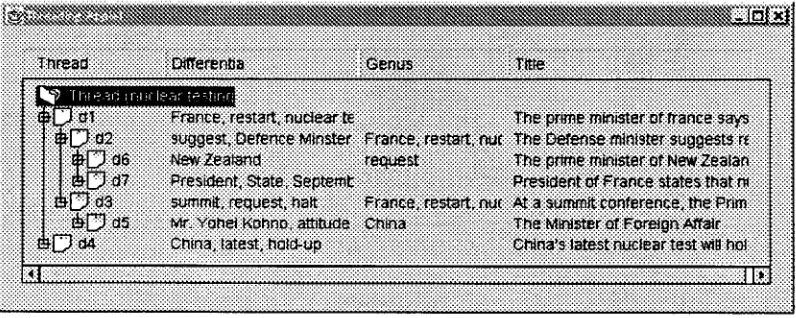
T h e XML documents can be separate from the source articles. T h e y can be provided as part of a "push" service for Internet users, offering a solution to the problem of information overloading. In such a service, gatherer collects articles from Web sites and threader makes threads for them. T h e results are stored in XML, and then pushed to subscribers who can capture the flow of topics by following the threads. In another scenario, when a user gets an article, and wants to see its origin or the next re- lated article, he or she gets the thread containing the article by consulting the threading server. T h e advantage of using XML is t h a t it will be supported by various tools, including Web browsers. Now we are prototyping the threading service system by us- ing a XML processor developed at our laboratory. Figure 12 shows a Java applet for viewing threads, which can run on major Web browsers. A XML doc- ument is parsed and visualized as tree-like structure.
6 R e l a t e d W o r k
T h e r e have been several studies how to relate arti- cles (McKeown et al., 1995; Yamamoto et al., 1995; Mani et al., 1997). McKeown et al. reported a m e t h o d for summarizing news articles (McKeown et al., 1995). In their approach, templates, which have slots and their values (for example, incident- l o c a t i o n = " N e w York"), are extracted from the ar- ticles. S u m m a r y sentences are constructed by com- bining the templates. Although this approach can capture topics contained in the articles, the relation- ships between articles are not visualized.
Clustering techniques make it possible to visual- ize the contents of a set of documents. Hearst et al. proposed the s c a t t e r / g a t h e r approach for facil- itating information retrieval (Hearst et al., 1995). Maarek et al. related documents by using an hier- archical clustering algorithm t h a t interacts with the user. Although these clustering algorithms impose a
p r o c e d u r e GetMaxtPath(A)
/ / G e t max path MaxPath[i] for di. A is a set of arcs.
for i = 1 to n b e g i n MaxPath[i] +- NULL e n d for j = 1 to n b e g i n
f o r i = j - k t o j - l b e g i n if (di, dj) E A t h e n
if Length(MaxPath[j]) < Length(MaxPath[i]) + 1 t h e n MaxPath[j] e-- Connect(MaxPath[i],(di,dj)) i + - - i + 1
e n d j + - j + l e n d
p r o c e d u r e Length(path)
returns the number of arcs in path.
p r o c e d u r e Connect(path, arc)
if path = (do,..., di) and arc = (di, dj), then return (do,..., di, dj).
Figure 11: Procedure for Finding the Longest P a t h
heavy computation cost, our threading algorithm is efficient, because it uses a chronological constraint.
7 C o n c l u s i o n
We have described methods for threading multiple articles and for visualizing various characteristics of them by using directed graphs. An efficient thread- ing algorithm whose complexity is O(n) (where n is the number of articles) was introduced with some constraints on the chronological ordering of articles. Some further work can be done to improve our method. T h e r e are sonie strategies for constructing an adjacency matrix from a distance matrix. Differ- ent strategies give different graphs. We are now eval- uating our m e t h o d by testing it with various strate- gies.
T h e development of a technique for visualizing di- rected graphs is another task for the future. Al- though directed graphs show more useful informa- tion t h a n tree structures, they are difficult to display in a readily understandable way. Software tools for handling graphs are also required.
Formal features of graphs can express the under- lying characteristics of articles. More efficient and useful algorithms are needed to overcome the prob- lem of information overload.
R e f e r e n c e s
R. Botafogo, E. Rivlin, and B Shnederman. 1992. Structural Analysis of Hypertexts: Identifying Hi- erarchies and Useful Metrics. A CM Transaction on Information Science, pages 143-179, Vol. 10, No. 2.
[image:6.612.320.560.55.269.2]<thread id="threadl">
<article id="dl" HKEF="foo.bar.com/article/dl.html">
<title>The prime minister of France says that it is necessary to restart nuclear testing.</title>
<genus></genus>
<dill>France, restart, nuclear testing</diff> <follows HREF="#d2"/>
<follows HKEF="#d3"/> </article>
<article id="d2" H~EF="foo.bar. com/article/d2.html">
<title>The Defense Minister of France suggests restarting nuclear testing.</title> <genus>nuclear testing, restart, France</genus>
<dill>suggest, Defense minister</diff> <follows HKEF="#d6"/>
<follows HREF="#d7"/> </article>
</thread>
F i g u r e 10: X M L - B a s e d P r e s e n t a t i o n of t h e T h r e a d
:::::::::::::::::::::::::::::::::::::::::::::::::::::::::::::::::::::::::::::::::::::::::::::::::::::::::::::::::::::::::::::::::::::::::::::::::::::::::::::::::::::::::::::::::::::::::::::::::::::::::::::::::::::::::::
iii:: :::::::::::::::::::::::::::::::::::::::::::::::::::::::::::::::::::::::::::::::::::::::::::::::::::::::::::::::::::::::::::::::::::::::::::::::::::::::::::::::::::::::::::::::::::::::::::::::::::::::::::::::::::::
::::::::::::::::::::::::::::::::::::::::::::::::::::::::::::::::::::::::::::::::::
:::::::::::::::::::::::::::::::::::::::::::::::::::::::::::::::::::::::::::::::::::: .:.:.:.:.:.:.:.:.:.ii:ii:iii:ii ili ii~ ilili iii i i i i i i i i i i i i i i i ii i i i i i i i i i i : : : : : : : ::: : : : : : : :: : : : : : : : : : ! : : : : : : ! : :: : : : : : : : : i i ! ! i i i i i i i i i iii:J i ii i iiii :::i:::::: ii~i~iii~i : : ~ ======================================================================================================================================================================================================================= :.:.:.:-: [i~i~i~ill ::::~ ?1 . . . :::::::::::::::::::::::::::::::::::::::::::::::::::::::::::::::::::::::::::::::::::::::::::::::::::::::::::::::::::::::::::::::::::::::::::::::::::::::::::::::::::
~ ~i::i::~ :::::::::::::::::::::::::::::::::::::::::::::::::::::::::::::::::::::::::::::::::::::::::::::::::::::::::::::::::::::::::::::::::::::::::::::::::::::::::::::::::::::::::::::::::::::::::::::::::::::::::::::::::::::::::::
::::::i::i::::::::
i}}i}ii
}iii}iiiiii~D
ii~}iiiiiiiii{i}iii}ii~i}i~i ~
ii~iii
~i~{~}}i~i~ii~}~i~i~i~}~i~}~i~iiiiiii~iii~iiiii~ii~i~}~ ~i}iiiil i i i i i :: ::
iiiiiiiiii ~::::::::::::::::::::::::::::::::::::::::::::::::::::::::::::::::::::::::::::::::::::::::::::::::::::::::::::::::::::::::::::::::::::::::::::::::::::::::::::::::::::::::::::::::::::::::::::::::::
iiiiii!iii iii i~:~ ?:::::::i i iiiii i iii ~iii;i;i~i} [!i iiiiiiiii ~ ~ ~ ~ ~ ~ ~ ~ ~ ~ ~:~ ~ ~ ~ ~ ~ ~ ~ ~ [ ~ ~ ; ~ 3 ~ } ~ } ~ } ~ } ~ } ~ ~ { ~ ; ~ } ~ :::::::::
F i g u r e 12: T h r e a d Viewer A p p l e t
Channel Definition Format (CDF).
h t t p : / / w w w . m i c r o s o f t . c o m / s t a n d a r d s / c d f . h t m . M. D a m a s h e k . 1995. Gauging Similarity with n-
Grams: Language Independent Categorization of Text. Proc. of Science, p a g e s 843-848, Vol. 267. M. A. H e a r s t , D. R. K a r g e r , a n d J. O. P e d e r s o n .
1995. Scatter/Gather as a Tool for Navigation of Retrieval Results. Proc. of A A A I Fall Symposium on AI Applications in Knowledge Navigation and Retrieval.
N. J a r d i n e , a n d R. Sibson. 1968. The Construction of Hierarchic and Non-Hierarchic Classifications. Computer, p a g e s 177-184.
I. M a n i a n d E. Bloedorn. 1997. Multi-document Summarization by Graph Search and Matching Proe. of AAAI'97, pages. 622-628.
Y. M a a r e k a n d A. Wecker. 1994. The Librarian As- sistant: Automatically Assemblin 9 Books into Dy-
namic Bookshelves. Proc. of RIAO.
K. M c K e o w n a n d D. R a d e v . 1995. Generating Summaries of Multiple News Articles. Proc. of SI- GIR, p a g e s 74-82.
S. E. R o b e r t s o n a n d K. S. Jones. 1976. Relevance Weighting of Search Terms. JASIS, pages 129- 146, Vol. 27.
G. Salton. 1968. Automatic Information Organiza- tion and Retrieval. N e w York, NY: McGraw-Hill. T. Bray, J. Paoli, a n d C. M. S p e r b e r g - M c Q e e n . 1997 Extensible Markup Language (XML). P r o p o s e d R e c o m m e n d a t i o n . World W i d e W e b C o n s o r t i u m . h t t p : / / w w w . w 3 . o r g / T R / P R - x m l /
[image:7.612.98.496.291.450.2]