An Annotation Framework for Dense Event Ordering
Taylor Cassidy IBM Research
Bill McDowell Carnegie Mellon University [email protected]
Nathanael Chambers US Naval Academy [email protected]
Steven Bethard
Univ. of Alabama at Birmingham [email protected]
Abstract
Today’s event ordering research is heav-ily dependent on annotated corpora. Cur-rent corpora influence shared evaluations and drive algorithm development. Partly due to this dependence, most research fo-cuses onpartial orderingsof a document’s events. For instance, the TempEval com-petitions and the TimeBank only annotate small portions of the event graph, focusing on the most salient events or on specific types of event pairs (e.g., only events in the same sentence). Deeper temporal reason-ers struggle with this sparsity because the entire temporal picture is not represented. This paper proposes a new annotation pro-cess with a mechanism to force annotators to label connected graphs. It generates 10 times more relations per document than the TimeBank, and ourTimeBank-Dense cor-pus is larger than all current corpora. We hope this process and its dense corpus en-courages research on new global models with deeper reasoning.
1 Introduction
The TimeBank Corpus (Pustejovsky et al., 2003) ushered in a wave of data-driven event ordering research. It provided for a common dataset of re-lations between events and time expressions that allowed the community to compare approaches. Later corpora and competitions have based their tasks on the TimeBank setup. This paper ad-dresses one of its shortcomings: sparse annotation. We describe a new annotation framework (and a
TimeBank-Densecorpus) that we believe is needed to fulfill the data needs of deeper reasoners.
The TimeBank includes a small subset of all possible relations in its documents. The annota-tors were instructed to label relations critical to the document’s understanding. The result is a sparse la-beling that leaves much of the document unlabeled. The TempEval contests have largely followed suit and focused on specific types of event pairs. For instance, TempEval (Verhagen et al., 2007) only labeled relations between events that syntactically dominated each other. This paper is the first attempt to annotate a document’s entire temporal graph.
A consequence of focusing on all relations is a shift from the traditionalclassificationtask, where the system is given a pair of events and asked only to label the type of relation, to anidentificationtask, where the system must determine for itself which events in the document to pair up. For example, in TempEval-1 and 2 (Verhagen et al., 2007; Verha-gen et al., 2010), systems were given event pairs in specific syntactic positions: events and times in the same noun phrase, main events in consecutive sentences, etc. We now aim for a shift in the com-munity wherein all pairs are considered candidates for temporal ordering, allowing researchers to ask questions such as: how must algorithms adapt to label the complete graph of pairs, and if the more difficult and ambiguous event pairs are included, how must feature-based learners change?
We are not the first to propose these questions, but this paper is the first to directly propose the means by which they can be addressed. The stated goal of TempEval-3 (UzZaman et al., 2013) was to focus on relation identification instead of classifica-tion, but the training and evaluation data followed the TimeBank approach where only a subset of event pairs were labeled. As a result, many systems focused on classification, with the top system clas-sifying pairs in only three syntactic constructions
There were four or five people inside, and they just started firing
Ms. Sanders was hit several times and was pronounced dead at the scene.
The other customers fled, and the police saidit did not appearthat anyone else was injured.
There were four or five people inside, and they just started firing
Ms. Sanders was hit several times and was pronounced dead at the scene.
The other customers fled, and the police saidit did not appearthat anyone else was injured.
[image:2.595.110.496.69.207.2]Current Systems & Evaluations
This Proposal
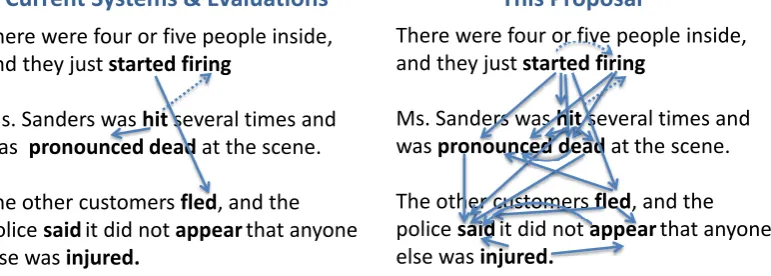
Figure 1: A TimeBank annotated document is on the left, and this paper’s TimeBank-Dense annotation is on the right. Solid arrows indicateBEFORErelations and dotted arrows indicateINCLUDED INrelations.
(Bethard, 2013). We describe the first annotation framework that forces annotators to annotate all pairs1. With this new process, we created a dense
ordering of document events that can properly eval-uate both relation identification and relation anno-tation. Figure 1 illustrates one document before and after our new annotations.
2 Previous Annotation Work
The majority of corpora and competitions for event ordering contain sparse annotations. Annotators for the original TimeBank (Pustejovsky et al., 2003) only annotated relations judged to be salient by the annotator. Subsequent TempEval competitions (Verhagen et al., 2007; Verhagen et al., 2010; Uz-Zaman et al., 2013) mostly relied on the TimeBank, but also aimed to improve coverage by annotating relations between all events and timesin the same sentence. However, event tokens that were men-tioned fewer than 20 times were excluded and only one TempEval task considered relations between events in different sentences. In practical terms, the resulting evaluations remained sparse.
A major dilemma underlying these sparse tasks is that the unlabeled event/time pairs are ambigu-ous. Each unlabeled pair holds 3 possibilities:
1. The annotator looked at the pair of events and decided that no temporal relation exists. 2. The annotator did not look at the pair of
events, so a relation may or may not exist. 3. The annotator failed to look at the pair of
events, so a single relation may exist. Training and evaluation of temporal reasoners is hampered by this ambiguity. To combat this, our
1As discussed below, all pairs in a given window size.
Events Times Rels R TimeBank 7935 1414 6418 0.7 Bramsen 2006 627 – 615 1.0 TempEval-07 6832 1249 5790 0.7 TempEval-10 5688 2117 4907 0.6 TempEval-13 11145 2078 11098 0.8 Kolomiyets-12 1233 – 1139 0.9 Do 20122 324 232 3132 5.6
[image:2.595.297.497.72.205.2]This work 1729 289 12715 6.3
Table 1: Events, times, relations and the ratio of relations to events + times (R) in various corpora.
annotation adopts theVAGUErelation introduced
by TempEval 2007, and our approach forces anno-tators to use it. This is the only work that includes such a mechanism.
This paper is not the first to look into more dense annotations. Bramsen et al. (2006) annotated multi-sentence segments of text to build directed acyclic graphs. Kolomiyets et al. (2012) annotated “tem-poral dependency structures”, though they only focused on relations between pairs of events. Do et al. (2012) produced the densest annotation, but “the annotator was not required to annotate all pairs of event mentions, but as many as possible”. The current paper takes a different tack to annotation byrequiringannotators to label every possible pair of events/times in a given window. Thus this work is the first annotation effort that can guarantee its event/time graph to be strongly connected.
Table 1 compares the size and density of our corpus to others. Ours is the densest and it contains the largest number of temporal relations.
3 A Framework for Dense Annotation Frameworks for annotating text typically have two independent facets: (1) the practical means of how to label the text, and (2) the higher-level rules about when something should be labeled. The first is often accomplished through a markup language, and we follow prior work in adopting TimeML here. The second facet is the focus of this paper: when
should an annotator label an ordering relation? Our proposal starts with documents that have al-ready been annotated with events, time expressions, and document creation times (DCT). The following sentence serves as our motivating example:
Police confirmed Fridaythat the body
foundalong a highway in San Juan be-longedto Jorge Hernandez.
This sentence is represented by a 4 node graph (3 events and 1 time). In a completely annotated graph it would have 6 edges (relations) connecting the nodes. In the TimeBank, from which this sentence is drawn, only 3 of the 6 edges are labeled.
The impact of these annotation decisions (i.e., when to annotate a relation) can be significant. In this example, a learner must somehow deal with the 3 unlabeled edges. One option is to assume that they are vague or ambiguous. However, all 6 edges have clear well-defined ordering relations:
belongedBEFOREconfirmed belongedBEFOREfound foundBEFOREconfirmed belongedBEFOREFriday
confirmedIS INCLUDED INFriday foundIS INCLUDED INFriday3
Learning algorithms handle these unlabeled edges by making incorrect assumptions, or by ig-noring large parts of the temporal graph. Sev-eral models with rich temporal reasoners have been published, but since they require more con-nected graphs, improvement over pairwise classi-fiers have been minimal (Chambers and Jurafsky, 2008; Yoshikawa et al., 2009). This paper thus proposes an annotation process that builds denser graphs with formal properties that learners can rely on, such as locally complete subgraphs.
3.1 Ensuring Dense Graphs
While the ideal goal is to create a complete graph, the time it would take to hand-labeln(n−1)/2
for accurate comparison to other corpora.
3Revealed by the previous sentence (not shown here).
edges is prohibitive. We approximate completeness by creating locally complete graphs over neigh-boring sentences. The resulting event graph for a document is strongly connected, but not complete. Specifically, the following edge types are included: 1. Event-Event, Event-Time, and Time-Time
pairs in the same sentence
2. Event-Event, Event-Time, and Time-Time pairs between the current and next sentence 3. Event-DCT pairs for every event in the text 4. Time-DCT pairs for every time expression in
the text
Our processrequires annotators to annotate the above edge types, enforced via an annotation tool. We describe the relation set and this tool next. 3.1.1 Temporal Relations
The TimeBank corpus uses 14 relations based on the Allen interval relations. The TempEval contests have used a small set of relations (TempEval-1) and the larger set of 14 relations (TempEval-3). Pub-lished work has mirrored this trend, and different groups focus on different aspects of the semantics.
We chose a middle ground between coarse and fine-grained distinctions for annotation, settling on 6 relations:before, after, includes, is included, si-multaneous, andvague. We do not adopt a more fine-grained set because we annotate pairs that are far more ambiguous than those considered in previ-ous efforts. Decisions between relations likebefore
andimmediately beforecan complicate an already difficult task. The added benefit of a corpus (or working system) that makes fine-grained distinc-tions is also not clear. We lean toward higher an-notator agreement with relations that have greater separation between their semantics4.
3.1.2 Enforcing Annotation
Imposing the above rules on annotators requires automated assistance. We built a new tool that reads TimeML formatted text, and computes the set of required edges. Annotators are prompted to assign a label for each edge, and skipping edges is prohibited.5 The tool is unique in that it includes
a transitive reasoner that infers relations based on the annotator’s latest annotations. For example, 4For instance, a relation likestartsis a special case of in-cludesif events are viewed as open intervals, andimmediately beforeis a special case ofbefore. We avoid this overlap and only useincludesandbefore
if event e1 IS INCLUDED in t1, and t1 BEFORE e2, the tool automatically labels e1 BEFORE e2.
The transitivity inference is run after each input label, and the human annotator cannot override the inferences. This prohibits the annotator from entering edges that break transitivity. As a result, several properties are ensured through this process: the graph (1) is a strongly connected graph, (2) is consistent with no contradictions, and (3) has all required edges labeled. These 3 properties are new to all current ordering corpora.
3.2 Annotation Guidelines
Since the annotation tool frees the annotators from the decision ofwhento label an edge, the focus is nowwhatto label each edge. This section describes the guidelines for dense annotation.
The 80% confidence rule: The decision to label an edge as VAGUEinstead of a defined temporal
relation is critical. We adopted an80%rule that in-structed annotators to choose a specific non-vague relation if they are 80% confident that it was the writer’s intent that a reader infer that relation. By not requiring 100% confidence, we allow for alter-native interpretations that conflict with the chosen edge label as long as that alternative is sufficiently unlikely. In practice, annotators had different inter-pretations of what constitutes 80% certainty, and this generated much discussion. We mitigated these disagreements with the following rule.
Majority annotator agreement: An edge’s la-bel is the relation that received a majority of an-notator votes, otherwise it is markedVAGUE. If a
document has 2 annotators, both have to agree on the relation or it is labeledVAGUE. A document
with 3 annotators requires 2 to agree. This agree-ment rule acts as a check to our 80% confidence rule, backing off toVAGUEwhen decisions are
un-certain (arguably, this is the definition ofVAGUE).
We also encouraged consistent labelings with guidelines inspired by Bethard and Martin (2008). Modal and conditional events: interpreted with a possible worlds analysis. The core event was treated as having occurred, whether or not the text implied that it had occurred. For example,
They [EVENT expect] him to [EVENT cut] costs throughout the organization. This event pair is ordered (expectbeforecut) since the expectation occurs before the cutting (in the
possible world where the cutting occurs). Negated events and hypotheticals are treated similarly. One assumes the event does occur, and all other events are ordered accordingly. Negated states like “is not anticipating” are interpreted as though the antici-pation occurs, and surrounding events are ordered with regard to its presumed temporal span. Aspectual Events: annotated as IS INCLUDED
in their event arguments. For instance, events that describe the manner in which another event is per-formed are considered encompassed by the broader event. Consider the following example:
The move may [EVENT help] [EVENT prevent] Martin Ackerman from making a run at the computer-services concern. This event pair is assigned the relation (helpIS IN -CLUDEDin prevent) because the help event is not
meaningful on its own. It describes the proportion of the preventing accounted for by the move. In TimeBank, theintentional actionclass is used in-stead of theaspectualclass in this case, but we still consider it covered by this guideline.
Events that attribute a property: to a person or event are interpreted to end when the entity ends. For instance, ‘the talk is nonsense’ evokes a non-sense event with an end point that coincides with the end of the talk.
Time Expressions: the words now and today
were given “long now” interpretations if the words could be replaced withnowadaysand not change the meaning of their sentences. The time’s dura-tion starts sometime in the past andINCLUDESthe
DCT. If nowadays is not suitable, then the now was
INCLUDED INthe DCT.
Generic Events: can be ordered with respect to each other, but must be VAGUE with respect to
nearby non-generic events.
4 TimeBank-Dense: corpus statistics We chose a subset of TimeBank documents for our new corpus:TimeBank-Dense. This provided an initial labeling of events and time expressions. Us-ing the tool described above, we annotated 36 ran-dom documents with at least two annotators each. These 36 were annotated with 4 times as many relations as the entire 183 document TimeBank.
Annotated Relation Count
BEFORE 2590 INCLUDES 836
AFTER 2104 INCLUDED IN 1060
SIMULTAN. 215 VAGUE 5910
[image:5.595.321.512.61.133.2]Total Relations: 12715
Table 2: Relation counts in TimeBank-Dense.
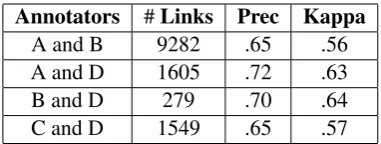
and guidelines were updated accordingly. The rest of the documents were then annotated indepen-dently. Document annotation was not random, but we mixed pairs of authors where time constraints al-lowed. Table 2 shows the relation counts in the final corpus, and Table 3 gives the annotator agreement. We show precision (holding one annotation as gold) and kappa computed on the 4 types of pairs from section 3.1. Micro-averaged precision was 65.1%, compared to TimeBank’s 77%. Kappa ranged from .56-.64, a slight drop from TimeBank’s .71.
The vague relation makes up 46% of the rela-tions. This is the first empirical count of how many temporal relations in news articles are truly vague. Our lower agreement is likely due to the more difficult task. Table 5 breaks down the individual disagreements. The most frequent pertained to the
VAGUErelation. Practically speaking,VAGUEwas
applied to the final graph if either annotator chose it. This seems appropriate since a disagreement be-tween annotators implies that the relation is vague. The following example illustrates the difficulty of labeling edges with aVAGUErelation:
No one was hurt, but firefighters or-deredtheevacuationof nearby homes andsaidthey’llmonitorthe ground.
Both annotators choseVAGUEto labelorderedand saidbecause the order is unclear. However, they disagreed onevacuationwithmonitor. One chose
VAGUE, but the other choseIS INCLUDED. There is
a valid interpretation where a monitoring process has already begun, and continues after the evacua-tion. This interpretation reached 80% confidence for one annotator, but not the other. In the face of such a disagreement, the pair is labeledVAGUE.
How often do these disagreements occur? Ta-ble 4 shows the 3 sources: (1) mutual vague: tators agree it is vague, (2) partial vague: one anno-tator chooses vague, but the other does not, and (3) no vague: annotators choose conflicting non-vague relations. Only 17% of these disagreements are due to hard conflicts (no vague). The released corpus includes these 3 fine-grainedVAGUErelations.
[image:5.595.81.284.72.134.2]Annotators #Links Prec Kappa A and B 9282 .65 .56 A and D 1605 .72 .63 B and D 279 .70 .64 C and D 1549 .65 .57 Table 3: Agreement between different annotators.
# Vague MutualVAGUE 1657 (28%)
PartialVAGUE 3234 (55%)
NoVAGUE 1019 (17%)
Table 4: VAGUE relation origins. Partial vague:
one annotator does not choose vague. No vague: neither annotator chooses vague.
b a i ii s v
b 1776 22 88 37 21 192 a 17 1444 32 102 9 155 i 71 34 642 45 23 191 ii 81 76 40 826 31 230
s 12 8 25 28 147 29
v 500 441 289 356 64 1197
Table 5: Relation agreement between the two main annotators. Most disagreements involvedVAGUE.
5 Conclusion
We described our annotation framework that pro-duces corpora with formal guarantees about the an-notated graph’s structure. Both the annotation tool and the newTimeBank-Densecorpus are publicly available.6 This is the first corpus with guarantees
of connectedness, consistency, and a semantics for unlabeled edges. We hope to encourage a shift in the temporal ordering community to consider the entire document when making local decisions. Fur-ther work is needed to handle difficult pairs with theVAGUErelation. We look forward to evaluating
new algorithms on this dense corpus.
Acknowledgments
This work was supported, in part, by the Johns Hopkins Human Language Technology Center of Excellence. Any opinions, findings, and conclu-sions or recommendations expressed in this mate-rial are those of the authors. We also give thanks to Benjamin Van Durme for assistance and insight.
[image:5.595.344.489.165.224.2] [image:5.595.310.524.282.382.2]References
Steven Bethard, William J Corvey, Sara Klingenstein, and James H Martin. 2008. Building a corpus of temporal-causal structure. InLREC.
Steven Bethard. 2013. Cleartk-timeml: A minimal-ist approach to tempeval 2013. In Second Joint Conference on Lexical and Computational Seman-tics (*SEM), Volume 2: Proceedings of the Seventh International Workshop on Semantic Evaluation (Se-mEval 2013), pages 10–14, Atlanta, Georgia, USA, June. Association for Computational Linguistics.
P. Bramsen, P. Deshpande, Y.K. Lee, and R. Barzilay. 2006. Inducing temporal graphs. InProceedings of the 2006 Conference on Empirical Methods in Natu-ral Language Processing, pages 189–198. ACL.
N. Chambers and D. Jurafsky. 2008. Jointly com-bining implicit constraints improves temporal order-ing. In Proceedings of the Conference on Empiri-cal Methods in Natural Language Processing, pages 698–706. ACL.
Quang Do, Wei Lu, and Dan Roth. 2012. Joint infer-ence for event timeline construction. InProceedings of the 2012 Joint Conference on Empirical Methods in Natural Language Processing and Computational Natural Language Learning, pages 677–687, Jeju Island, Korea, July. Association for Computational Linguistics.
Oleksandr Kolomiyets, Steven Bethard, and Marie-Francine Moens. 2012. Extracting narrative time-lines as temporal dependency structures. In Proceed-ings of the 50th Annual Meeting of the Association for Computational Linguistics (Volume 1: Long Pa-pers), pages 88–97, Jeju Island, Korea, July. Associ-ation for ComputAssoci-ational Linguistics.
James Pustejovsky, Patrick Hanks, Roser Sauri, An-drew See, Robert Gaizauskas, Andrea Setzer, Dragomir Radev, Beth Sundheim, David Day, Lisa Ferro, et al. 2003. The timebank corpus. InCorpus linguistics, volume 2003, page 40.
Naushad UzZaman, Hector Llorens, Leon Derczyn-ski, James Allen, Marc Verhagen, and James Puste-jovsky. 2013. Semeval-2013 task 1: Tempeval-3: Evaluating time expressions, events, and temporal relations. In Second Joint Conference on Lexical and Computational Semantics (*SEM), Volume 2: Proceedings of the Seventh International Workshop on Semantic Evaluation (SemEval 2013), pages 1–9, Atlanta, Georgia, USA, June. Association for Com-putational Linguistics.
Marc Verhagen, Robert Gaizauskas, Frank Schilder, Mark Hepple, Graham Katz, and James Pustejovsky. 2007. Semeval-2007 task 15: Tempeval temporal re-lation identification. InProceedings of the 4th Inter-national Workshop on Semantic Evaluations, pages 75–80. Association for Computational Linguistics.
Marc Verhagen, Roser Sauri, Tommaso Caselli, and James Pustejovsky. 2010. Semeval-2010 task 13: Tempeval-2. InProceedings of the 5th International Workshop on Semantic Evaluation, pages 57–62. As-sociation for Computational Linguistics.