164
Reasoning Over Paths via Knowledge Base Completion
Saatviga Sudhahar, Ian Roberts and Andrea Pierleoni Healx, Cambridge, UK
{saatviga.sudhahar, ian.roberts, andrea.pierleoni}@healx.io
Abstract
Reasoning over paths in large scale knowledge graphs is an important problem for many ap-plications. In this paper we discuss a sim-ple approach to automatically build and rank paths between a source and target entity pair with learned embeddings using a knowledge base completion model (KBC). We assembled a knowledge graph by mining the available biomedical scientific literature and extracted a set of high frequency paths to use for val-idation. We demonstrate that our method is able to effectively rank a list of known paths between a pair of entities and also come up with plausible paths that are not present in the knowledge graph. For a given entity pair we are able to reconstruct the highest ranking path 60% of the time within the top 10 ranked paths and achieve 49% mean average preci-sion. Our approach is compositional since any KBC model that can produce vector represen-tations of entities can be used.
1 Introduction
A large amount of work has been dedicated in the past on Knowledge base completion (KBC) which is an automated process that adds missing facts that can be predicted from existing ones already in the Knowledge base. This is crucial for the use of large Knowledge bases in many downstream applications. However explaining the predictions given by a KBC algorithm is quite important for several real world use cases. For example in rec-ommender systems, a knowledge graph of users, items and their interactions are used to recommend an item to a user based on the user’s interactions on several items. The ability to explain and rea-son on the decision is of critical importance to add knowledge to recommender systems. Similarly in a knowledge graph consisting human biological data such as genes, drugs, symptoms and diseases, it is crucial to know which gene and symptoms
were involved in predicting a drug for a disease. This requires automatic extraction and ranking of multi-hop paths between a given source and a tar-get entity from a knowledge graph.
Previous work has focused on using path in-formation in knowledge graphs for KBC known as path-based inference (Lao et al., 2011; Gard-ner et al., 2014; Neelakantan et al., 2015; Das et al.,2017b), in which a model is trained to pre-dict missing links between a given pair of enti-ties taking as input several paths that existed be-tween them. Paths are ranked according to a scor-ing method and used as features to train the model. Embedding-based inference models (Bordes et al., 2013;Lin et al.,2015;Nickel et al.,2011;Socher et al.,2013;Trouillon et al.,2016) for KBC learn entity and relation embeddings by solving an op-timization problem that maximises the plausibility of known facts in the knowledge graph. A third set of models bridge path-based and embedding-based inference with deep-reinforcement learning for reasoning in knowledge graphs (Xiong et al., 2017; Das et al., 2017a; Lin et al., 2018; Song et al., 2019). All these models address various objectives. They try to predict missing links in a graph by ranking the target entities given a query entity, infer new relations between entity pairs given a set of multi-hop input paths between those pairs or infer target entities while also reason-ing on paths identified. Our work is inline with the third objective in which we propose a simple approach that combines embedding-based mod-els with a path building and ranking strategy to come up with the most probable explanations for a given prediction from a source to target. The problem can be formulated as follows: Given a source entity e1 and target entity e2 the goal is
to first come up with a set of meaningful paths
P(e1, e2) = {p1, p2....pn} connectinge1 ande2.
as given by the embedding-based model. Ranking of the paths is given by,
Re1e2 =fΘ(e1, e2|P(e1, e2)) (1)
wherefΘ denotes the underlying model with
pa-rametersΘ, andRe1e2 presents the ranking of the
paths.
Table 1 shows two examples of ranked 1-hop paths for query types, ‘Gene-Phenotype-Disease’ and ‘Gene-Drug-Disease’. In the first example, given a predicted fact that Gene ‘Carbonic An-hydrase 1 (CA1)’ is associated with Disease ‘Is-chemia’, the most probable explanations can be generated by building such paths between the en-tities. Gene ‘CA1’ is linked to Phenotypes ‘Hy-pothermia’, ‘Neuronal loss’ and ‘Hyperglycemia’ and these Phenotypes are linked with Disease ‘Is-chemia’ and therefore reasoning on the fact that Gene ‘CA1’ is associated with Disease ‘Ischemia’. Similarly in second example Gene ‘Bruton ty-rosine kinase (BTK)’ is associated with Disease ‘Chronic lymphocytic leukemia’ since the Drugs ‘Ibrutinib’ and ‘Acalabrutinib’ are found to be linked with Gene ‘BTK’ and the Disease. Our method is able to extract such paths and rank them providing the ability to reason on predictions.
From a knowledge graph data set, we initially train an embedding-based KBC model that can predict target entities given a source, relation pair. The KBC model is then used to build a set of 1-hop paths between a given source and target entity and paths are ranked according to a scoring func-tion. Any embedding based KBC model capable of producing separate vector representations of en-tities can be used for training in our method. Our approach is quite suitable for downstream
applica-Gene Phenotype Disease
CA1 Hypothermia Ischemia
CA1 Neuronal loss Ischemia
CA1 Hyperglycemia Ischemia
Gene Drug Disease
BTK Ibrutinib Chronic
lymphocytic leukemia
BTK Acalabrutinib Chronic
lymphocytic leukemia
Table 1: Example paths for query types ‘ Gene-Phenotype-Disease’, ‘Gene-Drug-Disease’ showing the ability to reason over 1-hop.
tions since it only requires training the model once with the whole data set and does not involve any additional training overhead. We discuss two main experiments in the paper, Experiment 1 showing the model’s ability to reconstruct the highest rank-ing path in the set of retrieved ranked paths in spite of not seeing it during training and Experiment 2 that proves the ranking capability alone of the trained model with known paths. We show that our method is able to reconstruct the highest rank-ing path 60% of the time in the top 10 ranked paths for a given set of entity pairs also achieving 49% mean average precision. There is almost a 3-fold increase in the ranking correlation between pre-dicted ranks and ground truth ranks of a longer list of known paths when compared to random. To our knowledge this is the first paper that is focused on trying to use path ranking to identify relevant enti-ties bridging a pair of known entienti-ties and therefore not directly comparable with other approaches.
The paper is organised as follows: Section 2 dis-cusses related work in this area; Section 3 shows details of how the data sets of triples and paths be-tween entity pairs were generated and elaborates on model path construction and path scoring for ranking the paths; Section 4 discusses the statis-tics of the data sets; Section 5 shows and discusses experimental results on the model’s ability to re-cover paths and ranking in experiment 1 and rank-ing alone of known paths in experiment 2. Section 6 concludes the work and discusses possible future directions.
2 Related Work
One of the first path building approach in literature is the Path-Ranking Algorithm (PRA) (Lao and Cohen, 2010;Gardner et al., 2013, 2014) which uses random walk with restarts to rank entities in a graph relative to a source entity. Random walks constrained to follow a set of edge types are per-formed in the graph to produce relational feature weights. The weights are combined to predict the probability that a relation between a source, target entity pair using a per-target relation binary classi-fier. The bottleneck of this method is the explosion of the feature space when there are millions of dis-tinct paths obtained from random exploration and the fact that it relies on a binary classifier per target relation which is not scalable.
composi-tional techniques to address knowledge base com-pletion and path query answering problems. They learn representations of nodes and relations by adapting the scoring functions from pre-existing KBC models such as TransE (Bordes et al.,2013) and RESCAL (Nickel et al., 2011). They cannot use models in which the scoring function cannot be decomposed in a way to produce separate vec-tors for a source/relation without the target. In contrast our method can use any embedding based KBC model for training. Another limitation in their work is that they model only a single path be-tween an entity pair but we model multiple paths. Toutanova et al. (2015) propose a similar frame-work and also model intermediate entities in the path, training a convolutional neural network to rank a set of target entities given a source and re-lation pair. Path-RNN (Neelakantan et al.,2015) is also a compositional model that takes paths be-tween entity pairs as input and infers new rela-tions between them. However it uses only the re-lation information in the path and ignores mod-elling intermediate entities, and it requires training a model for each relation type making it not usable in downstream applications. Das et al. (2017b) train a high capcity RNN model to infer relations between entity pairs by taking several multi-hop paths between them as input and score pool them using techniques such as averaging across all paths or the top-kpaths.
Recent work in explainable reasoning is used in recommender systems. Wang et al. (2019) pro-pose a knowledge-aware path recurrent network to generate representation for each path by compos-ing semantics of entities and relations and reason on paths to infer user preferences for items. Pre-defined meta-paths and LSTMs have been used to model the paths between users and items via breadth-first-search (BFS). Practically this is inef-ficient and can miss many meaningful paths. To address these challenges, Song et al. (2019) pro-posed a deep reinforcement learning based method that can automatically generate meaningful paths between a user and item via policy gradient meth-ods. What we present in this paper is a very simple approach to come up with a set of most relevant paths consisting of known and predicted links be-tween a given source and target entity in a knowl-edge graph using embedding based models. Its also possible to extend this approach to use con-textualised knowledge graph embedding models
(Wang et al., 2018) which learn representations based on an entire path in the graph rather than a triple. We believe using this in conjunction with our method in turn could produce more meaning-ful paths in the path building process. This is left for future work.
3 Methodology
3.1 Generating the Data
In this section we discuss how the data set on which we perform the experiments was gener-ated. This includes extraction of triples from the Pubmed abstracts data set using a NLP pipeline and extraction of 1-hop paths from the triple data set. The 1-hop path data set is used to construct a ranked list of paths for 100 entity pairs to generate ground truth data for the path ranking experiments.
3.1.1 Extracting triples
We used the output of the Open Targets Library NLP pipeline1to access all the subject-verb-object (SVO) triples from the biomedical abstracts re-leased by PubMed and updated to March 2019, for a total of more than 29M documents and 540M SVO triples. From this set we selected only the SVO triples between entities linked to a specific biomedical ID, discarding the ones with ‘concept’ entity type and stop words. From the filtered list we built an undirected weighted knowledge graph linking each pair of entities identified by a triple with a weight representing the number of docu-ments in which the triple was found.
3.1.2 Extracting 1-hop paths
While it is possible to access many knowledge bases like the one described above in graph format, to our knowledge there is currently none focused on building relations spanning more than two enti-ties. We leveraged the ability to track SVO triples occurring in the same abstract and built a data set of paths spanning three entities by making the as-sumption that ifAis related toB, andBis related toCin the same abstract, then its safe to assume thatAis related toCviaB. By counting the num-ber of occurrences of such connected triples across different documents we are also able to weight the paths, and thus can generate a ranked lists of paths starting from source entityAto target entityCby scoring higher the most frequent paths.
By combining several 1-hop paths, it is possible to also build multi-hop paths described within the same document however, in this data set, even the 2-hop paths are too rare to be used for a test of statistical significance.
3.2 Model Path Construction
The primary objective of our method is to au-tomatically build a set of paths between a given source and target entity pair in a knowledge graph and rank them using a scoring method to come up with the most relevant paths connecting the pair. We first train a 200 dimensional node, relation em-bedding model with the data set using ProjE. ProjE is a neural network based KBC model that fills the missing information in a knowledge graph by learning joint embeddings of the graph’s entities and links. Given an input triplehh, r,?ithe model can find the optimal ordered list of tail entities and vice versa.
LetE be the set of all entities andRthe set of all relation types in the data set. For a given entity pair (e1, e2), we choose the set of suitable
rela-tion typesrt⊂Rto be used and query the trained
model with (e1, rt) and (e2, rt) pairs. The set
of suitable relations types are the ones that agree with the query type. For entity pair with types,
‘Drug:Disease’, the corresponding query types are ‘Drug-Gene-Disease ’ or ‘Drug-Phenotype-Disease’in our data set. Therefore the method will choose ‘Drug Gene’, ‘Drug Phenotype’, ‘Dis-ease Gene’,‘Disease Phenotype’relations to per-form the predictions. This results in a set of top
npredicted tail and head entities et, eh ⊂ E for
each relation type. If the same entity was predicted again for e1 ore2 but with another relation type
from previous, we retain the relation type produc-ing the higher prediction rank in the graph. We create an undirected graph G out of e1, e2, and
the predicted sets of entitieset,eh with their
rela-tions. From this graph we extract all 1-hop paths connectinge1ande2.
The same approach can be used iteratively to build multi-hop paths between a pair of entities. Given the limits of the available dataset, in this paper we limit the discussion to the 1-hop case.
3.3 Path Scoring
Once the paths are extracted a scoring function is used to score them for ranking. A pathpconsists of a source, target and an intermediate predicted entity connected by relevant relations. For 1-hop
paths there are two hh, t, ri pairs along the path. The scoreSpfor each pathpin the extracted set of
pathsP ={p1, p2...pn}is given by,
1. Embed+predrank: sum of the prediction ranks (R) of the predicted entity inp. Paths with lowest score are the high ranking ones.
Sp=
X
h,t,r∈p
R (2)
2. Embed+cosine: sum of the cosine similar-ities between entity embeddings in p. The most relevant paths receive higher scores.
Sp =
X
h,t,r∈p
cos(eh, et) (3)
Embed+predrank score only considers the rank of the predicted entities as given by the KBC model while Embed+cosine score uses the actual learned embedding to score the paths which is more informative than the previous. In the next section we show in detail the data set used and the experiments performed proving the significance of the path ranking method in two different settings.
4 Data
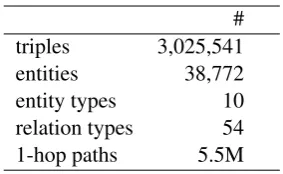
The data set used for the experiments are con-structed by extracting relations using a NLP pipeline from the Pubmed repository as shown in Section 3.1.1. It consists of 3,025,541 head, rel, tail triples. Details of this base data set is shown in Table 2. From this data set we created a set of 100 entity pairs with a ranked list of several one-hop pathsP connecting entity pairs (e1, e2) in the
knowledge graph.
We use two different path data sets for ex-periments 1 and 2. The details of this data set is shown in Table 3. Paths extracted are from query types: ‘Gene-Drug-Disease’, ‘Gene-Phenotype-Disease’, ‘Drug-Phenotype-Disease’,
#
triples 3,025,541
entities 38,772
entity types 10
relation types 54
[image:5.595.110.252.60.147.2]1-hop paths 5.5M
Table 2: Triple Data set statistics.
Exp 1 Exp 2
query types 4 6
avg no of paths 6 33
min no of paths 2 10
total paths 573 3356
Table 3: Path data set statistics used in experiment 1 and 2.
sets with train/test split and ground truth path ranking data sets for experiment 1 and 2 presented are available here.2
5 Experimental Results
5.1 Path recovery and ranking
In this experiment we show that the trained KBC model is able to recover the highest ranking path in the ground truth among the ranked set of paths retrieved by our ranking method for entity pairs in spite of not seeing the links belonging to the path in the training set. We also report on the mean average precision (MAP) obtained for top
nnumber of paths retrieved by the model. From the ground truth data set we choose one triple in the top ranking path p1 for each entity pair and
remove that triple from the training set. For exam-ple, if the highest ranking path is, ‘Drug1-Gene1-Disease1’ for entity pair ‘Drug1:Disease1’, we remove one triple from the path which could be
‘Gene1,Disease1,Gene1 Disease1’from the train-ing set. We train an embeddtrain-ing model with ProjE in the resulting data set using the following param-eters:d200,epochs200,lr0.0001,batchsize128,
dropout0.5,lossweight0.0001. We use a negative sampling rate of 0.25 and minimise the loss using
adamoptimiser.
The trained model is then used to build a set of ranked paths between the source and target en-tity pairs as described in section 3.2. What we test
2
https://storage.googleapis.com/pubmed-path-kg/pubmed exp data.zip
here is whether the model is able to recover the highest ranking pathp1 from the ground truth for
each entity pair in the ranked list of paths. Table 4 shows Hits@n (1,10,25,100) which is the num-ber of times p1 was ranked in the top n ranked
paths out of all entity pairs for scoring func-tions Embed+predrank and Embed+cosine and re-ports MAP for then ranked paths retrieved. We compare the result with a baseline in which we build paths by choosing the most similar entity to the source and target entities by cosine similarity and rank them based on the total score obtained. Though it still uses the learned embedding to com-pute similarities it does not consider any predic-tions made by the model. Column 1 refers to the number of top n predictions (100,300 and 500) that we request from the KBC model.
According to results in Table 4, Embed+cosine scoring function yields better Hits@n and MAP@n scores than Embed+pred rank in gen-eral. When more predictions are requested from the KBC model, we observe an increase in the Embed+cosine scores for both Hits@n and MAP@n. Increasing the number of predictions in the KBC model, allows for more entities to be predicted which in turn increases the depth of path search, therefore leading to a better chance that p1 could be retrieved for Hits@n and more
correct paths for MAP@n. When using the top 500 predictions, the model is able to recoverp1on
top 26% of the time, within the top 10, 60% of the time and within the top 25, 67% of the time. The scores are even higher when more ranked paths are extracted according to Hits@100. Within 100 and 300 predictions the model is able to achieve 34% and 49% MAP@10 and 31% and 45% MAP@25 using Embed+cosine scoring. When compared to the baseline we see the scores for both Hits@n and MAP@n obtained by our path building and ranking method is quite significant. Note that the baseline does not depend on the number of predictions requested by the model and hence it remains same for all three settings.
5.2 Path ranking
# Pred Scoring Hits MAP Hits MAP Hits MAP Hits MAP
@100 @100 @25 @25 @10 @10 @1 @1
100 Embed+predrank 0.36 0.13 0.22 0.14 0.1 0.15 0 0.07
Embed+cosine 0.36 0.27 0.27 0.31 0.23 0.34 0.07 0.26
Baseline 0.01 0 0 0 0 0 0 0
300 Embed+predrank 0.59 0.11 0.22 0.14 0.1 0.15 0 0.06
Embed+cosine 0.86 0.38 0.64 0.45 0.57 0.49 0.26 0.47
Baseline 0.01 0 0 0 0 0 0 0
500 Embed+predrank 0.59 0.11 0.22 0.14 0.1 0.15 0 0.06
Embed+cosine 0.89 0.37 0.67 0.43 0.6 0.47 0.26 0.43
[image:6.595.324.511.268.362.2]Baseline 0.01 0 0 0 0 0 0 0
Table 4: Hits@n and MAP@n scores for Embed+predrank, Embed+cosine scoring functions comparing to baseline for top 100, 300, 500 predictions given by KBC model.
model is trained on the whole data set. For each entity pair in the same test set, the model produces a set of ranked paths from which we compute the relative ranking of the known paths in the ground truth. For example if entity pair (e1, e2) has 15
ranked paths, and our model produced 25 ranked paths in total, we compute the relative ranking of only the 15 paths for this test. Our test statistic is spearman ranking correlation between the ranks retrieved by the model and the ground truth. The same test is repeated after randomly permuting the paths in the ground truth. We also compute the ranking correlation between the randomly per-muted set and the actual ground truth. The ground truth data set used for this experiment has at least 10 ranked paths for each entity pair and on aver-age has 33 paths per pair as shown in Table 3. We increased the number of predictions given by the KBC model to 1500 in this experiment because it increases the depth of path search and retrieves all known paths in the ground truth. This was purely done for evaluation purposes since its important to compare the rankings of all paths in the ground truth.
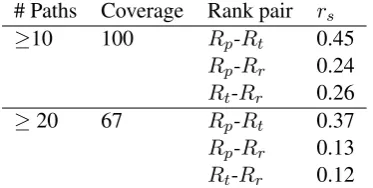
Table 5 shows the Spearman ranking correla-tion (rs) forRp-Rtranks of paths in ground truth
(Rt) and their relative ranking in predicted paths
(Rp), Rp-Rr ranks of randomly permuted paths
(Rr) and their relative ranking in predicted paths
(Rp), Rt-Rr ranks of paths in ground truth (Rt)
and their relative ranking in randomly permuted paths (Rr). We show rs observed for all entity
pairs (100) in row 1 and for the ones with at least 20 or more paths (67) in row 2. rsdecreases with
ranking complexity as we can see but in both cases
rs with the ground truth is better compared tors
# Paths Coverage Rank pair rs
≥10 100 Rp-Rt 0.45
Rp-Rr 0.24 Rt-Rr 0.26
≥20 67 Rp-Rt 0.37
Rp-Rr 0.13 Rt-Rr 0.12
Table 5: Spearman ranking correlation (rs) forRp-Rt ranks of paths in ground truth and their relative ranking in predicted paths,Rp-Rrranks of randomly permuted paths and their relative ranking in predicted paths,R
t-Rr ranks of paths in ground truth and their relative ranking in randomly permuted paths.
with the permuted set showing almost 3-fold (2.8) increase in the most difficult case. This proves the significance of the model’s ranking capability.
The ground truth data set used for this experi-ment is quite scarce and not very well distributed in terms of ranking. Since ranks are generated based on frequency of the paths observed, paths with same frequency get similar rankings. This is a limitation in the data set. We expect the method to perform better in cases where there exists larger number of paths with an evenly distributed rank-ing. This is left for future work.
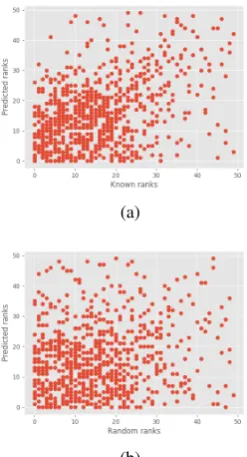
(a)
(b)
Figure 1: (a) Ranks of known paths in ground truth vs their relative rank in predicted paths, (b) Ranks of randomly permuted paths in the ground truth vs their relative rank in predicted paths for all entity pairs with at least 20 or more paths.
quite scattered compared to 1a as indicated by re-sults in Table 5.
6 Conclusion & Future Work
In this paper we proposed a simple method to au-tomatically build and rank paths between a source and target entity pair using embedding based knowledge base completion (KBC) models. To our knowledge this is the first paper that is fo-cused on trying to use path ranking to identify relevant entities bridging a pair of known entities and hence not directly comparable with other ap-proaches. To this purpose we built a data set that allow us to test our hypothesis. We demonstrated that our method is able to effectively rank known paths if available and also infer important miss-ing links between entities durmiss-ing the path buildmiss-ing process, ranking them high when they are signif-icant. Any embedding based KBC model can be used after initial training allowing for more flexi-bility and also less overhead. The number of paths built between a source and target is dependent on the number of predictions requested from the KBC model as the search space for paths increase with this parameter.
As future work we plan to build a benchmark
data set for multi-hop paths with a smooth dis-tribution of ranked paths, evaluate the same ap-proach and also perform an extensive evaluation with other state-of-the-art KBC models based on convolutional networks and matrix factorisation for path construction and ranking. We intend to also work on extending our method to use contex-tualised embedding representations to make bet-ter use of path information in the graph which we believe will have a positive impact on the current path building and ranking methodology.
References
Antoine Bordes, Nicolas Usunier, Alberto Garcia-Duran, Jason Weston, and Oksana Yakhnenko. 2013. Translating embeddings for modeling multi-relational data. In Advances in neural information processing systems, pages 2787–2795.
Rajarshi Das, Shehzaad Dhuliawala, Manzil Za-heer, Luke Vilnis, Ishan Durugkar, Akshay Kr-ishnamurthy, Alex Smola, and Andrew McCal-lum. 2017a. Go for a walk and arrive at the an-swer: Reasoning over paths in knowledge bases using reinforcement learning. arXiv preprint arXiv:1711.05851.
Rajarshi Das, Arvind Neelakantan, David Belanger, and Andrew McCallum. 2017b. Chains of reason-ing over entities, relations, and text usreason-ing recurrent neural networks. In Proceedings of the 15th Con-ference of the European Chapter of the Association for Computational Linguistics: Volume 1, Long Pa-pers, pages 132–141, Valencia, Spain. Association for Computational Linguistics.
Matt Gardner, Partha Talukdar, Jayant Krishnamurthy, and Tom Mitchell. 2014. Incorporating vector space similarity in random walk inference over knowledge bases. In Proceedings of the 2014 Conference on Empirical Methods in Natural Language Processing (EMNLP), pages 397–406, Doha, Qatar. Association for Computational Linguistics.
Matt Gardner, Partha Pratim Talukdar, Bryan Kisiel, and Tom Mitchell. 2013. Improving learning and in-ference in a large knowledge-base using latent syn-tactic cues. InProceedings of the 2013 Conference on Empirical Methods in Natural Language Pro-cessing, pages 833–838, Seattle, Washington, USA. Association for Computational Linguistics.
Kelvin Guu, John Miller, and Percy Liang. 2015. Traversing knowledge graphs in vector space. In
Proceedings of the 2015 Conference on Empirical Methods in Natural Language Processing, pages 318–327, Lisbon, Portugal. Association for Compu-tational Linguistics.
[image:7.595.120.244.73.302.2]random walks. In Proceedings of the 16th ACM SIGKDD international conference on Knowledge discovery and data mining, pages 881–888. ACM.
Ni Lao, Tom Mitchell, and William W. Cohen. 2011. Random walk inference and learning in a large scale knowledge base. InProceedings of the Conference on Empirical Methods in Natural Language Pro-cessing, EMNLP ’11, pages 529–539, Stroudsburg, PA, USA. Association for Computational Linguis-tics.
Xi Victoria Lin, Richard Socher, and Caiming Xiong. 2018. Multi-hop knowledge graph reasoning with reward shaping. arXiv preprint arXiv:1808.10568.
Yankai Lin, Zhiyuan Liu, Maosong Sun, Yang Liu, and Xuan Zhu. 2015. Learning entity and relation embeddings for knowledge graph completion. In
Twenty-ninth AAAI conference on artificial intelli-gence.
Arvind Neelakantan, Benjamin Roth, and Andrew Mc-Callum. 2015. Compositional vector space mod-els for knowledge base completion. InProceedings of the 53rd Annual Meeting of the Association for Computational Linguistics and the 7th International Joint Conference on Natural Language Processing (Volume 1: Long Papers), pages 156–166, Beijing, China. Association for Computational Linguistics.
Maximilian Nickel, Volker Tresp, and Hans-Peter Kriegel. 2011. A three-way model for collective learning on multi-relational data. In ICML, vol-ume 11, pages 809–816.
Richard Socher, Danqi Chen, Christopher D Manning, and Andrew Ng. 2013. Reasoning with neural ten-sor networks for knowledge base completion. In
Advances in neural information processing systems, pages 926–934.
Weiping Song, Zhijian Duan, Ziqing Yang, Hao Zhu, Ming Zhang, and Jian Tang. 2019. Ex-plainable knowledge graph-based recommendation via deep reinforcement learning. arXiv preprint arXiv:1906.09506.
Kristina Toutanova, Danqi Chen, Patrick Pantel, Hoi-fung Poon, Pallavi Choudhury, and Michael Gamon. 2015. Representing text for joint embedding of text and knowledge bases. In Proceedings of the 2015 Conference on Empirical Methods in Natural Lan-guage Processing, pages 1499–1509.
Th´eo Trouillon, Johannes Welbl, Sebastian Riedel, ´Eric Gaussier, and Guillaume Bouchard. 2016. Com-plex embeddings for simple link prediction. In In-ternational Conference on Machine Learning, pages 2071–2080.
Haoyu Wang, Vivek Kulkarni, and William Yang Wang. 2018. Dolores: Deep contextualized knowl-edge graph embeddings.CoRR, abs/1811.00147.
Xiang Wang, Dingxian Wang, Canran Xu, Xiangnan He, Yixin Cao, and Tat-Seng Chua. 2019. Explain-able reasoning over knowledge graphs for recom-mendation. InProceedings of the AAAI Conference on Artificial Intelligence, volume 33, pages 5329– 5336.