Neural Sequence-Labelling Models for Grammatical Error Correction
Helen Yannakoudakis,Marek Rei,Øistein E. Andersen and Zheng Yuan
The ALTA Institute Computer Laboratory University of Cambridge
{hy260,mr472,oa223,zy249}@cl.cam.ac.uk
Abstract
We propose an approach toN-best list re-ranking using neural sequence-labelling models. We train a compositional model for errordetectionthat calculates the prob-ability of each token in a sentence being correct or incorrect, utilising the full sen-tence as context. Using the error detec-tion model, we then re-rank the N best hypotheses generated by statistical ma-chine translation systems. Our approach achieves state-of-the-art results on error correction for three different datasets, and it has the additional advantage of only us-ing a small set of easily computed features that require no linguistic input.
1 Introduction
Grammatical Error Correction (GEC) in non-native text attempts to automatically detect and correct errors that are typical of those found in learner writing. High precision and good coverage of learner errors is important in the development of GEC systems. Phrase-based Statistical Machine Translation (SMT) approaches to GEC have at-tracted considerable attention in recent years as they have been shown to achieve state-of-the-art results (Felice et al.,2014;Junczys-Dowmunt and Grundkiewicz,2016). Given an ungrammatical in-put sentence, the task is formulated as “translat-ing” it to its grammatical counterpart. Using a par-allel dataset of input sentences and their corrected counterparts, SMT systems are typically trained to correct all error types in text without requir-ing any further lrequir-inguistic input. To further adapt SMT approaches to the task of GEC and tackle the paucity of error-annotated learner data, previ-ous work has investigated a number of extensions, ranging from the addition of further features into
the decoding process (Felice et al., 2014) via re-ranking the SMT decoder’s output (Yuan et al.,
2016) to neural-network adaptation components to SMT (Chollampatt et al.,2016a).
In this paper, we propose an approach toN-best list re-ranking using neural sequence-labelling models. N-best list re-ranking allows for fast ex-perimentation since the decoding process remains unchanged and only needs to be performed once. Crucially, it can be applied to any GEC system that can produce multiple alternative hypotheses. More specifically, we train a neural compositional model for errordetectionthat calculates the prob-ability of each token in a sentence being correct or incorrect, utilising the full sentence as context. Using the error detection model, we then re-rank theN best hypotheses generated by the SMT sys-tem. Detection models can be more fine-tuned to finer nuances of grammaticality and acceptability, and therefore better able to distinguish between correct and incorrect versions of a sentence.
Our approach achieves state-of-the-art results on GEC for three different datasets, and it has the additional advantage of using only a small set of easily computed features that require no linguis-tic information, in contrast to previous work that has utilised a large set of features in a supervised setting (Hoang et al.,2016;Yuan et al.,2016).
2 Previous work
The first approaches to GEC primarily treat the task as a classification problem over vectors of contextual lexical and syntactic features extracted from a fixed window around the target token. A large body of work has investigated error-type-specific models, and in particular models targeting preposition and article errors, which are among the most frequent ones in non-native English learner writing (Chodorow et al.,2007;De Felice and
man,2008;Han et al.,2010;Tetreault et al.,2010;
Han et al., 2006;Tetreault and Chodorow, 2008;
Gamon et al., 2008; Gamon, 2010; Rozovskaya and Roth,2010;Rozovskaya et al.,2012;Dale and Kilgarriff,2011;Leacock et al.,2014). Core com-ponents of one of the top systems in the CoNLL 2013 and 2014 shared tasks on GEC (Ng et al.,
2013, 2014) include Averaged Perceptron clas-sifiers, native-language error correction priors in Naive Bayes models, and joint inference frame-works capturing interactions between errors (e.g., noun number and verb agreement errors) ( Ro-zovskaya et al., 2012, 2014, 2011; Rozovskaya and Roth,2011). The power of the classification paradigm comes from its ability to generalise well to unseen examples, without necessarily requir-ing error-annotated learner data (Rozovskaya and Roth,2016).
One of the first approaches to GEC as an SMT task is the one byBrockett et al.(2006), who gen-erate artificial data based on hand-crafted rules to train a model that can correct countability er-rors. Dahlmeier and Ng(2011) focus on correct-ing collocation errors based on paraphrases ex-tracted from parallel corpora, whileDahlmeier and Ng (2012a) are the first to investigate a discrim-inatively trained beam-search decoder for full-sentence correction, focusing on five different er-ror types: spelling, articles, prepositions, punc-tuation insertion, and noun number. Yoshimoto et al.(2013) utilise SMT to tackle determiner and preposition errors, while Yuan and Felice(2013) use POS-factored, phrase-based SMT systems, trained on both learner and artificially generated data to tackle determiner, preposition, noun num-ber, verb form, and subject–verb agreement errors. The SMT approach has better capacity to correct complex errors, and it only requires parallel cor-rected sentences as input.
Two state-of-the-art systems in the 2014 CoNLL shared task on correction of all errors re-gardless of type use SMT systems: Felice et al.
(2014) use a hybrid approach that includes a rule-based and an SMT system augmented by a large web-based language model and combined with correction-type estimation to filter out error types with zero precision. Junczys-Dowmunt and Grundkiewicz(2016) investigate parameter tuning based on the MaxMatch (M2) scorer, the shared-task evaluation metric (Dahlmeier and Ng,2012b;
Ng et al.,2014), and experiment with different
op-timisers and interactions of dense and sparse fea-tures.
Susanto et al.(2014) andRozovskaya and Roth
(2016) explore combinations of SMT systems and classifiers, the latter showing substantial improve-ments over the CoNLL state of the art. Chol-lampatt et al. (2016a) integrate a neural net-work joint model that has been adapted using native-language-specific learner text as a feature in SMT, while Chollampatt et al. (2016b) inte-grate a neural network global lexicon model and a neural network joint model to exploit continuous space representations of words rather than discrete ones, and learn non-linear mappings. Yuan and Briscoe(2016) present a Neural Machine Transla-tion (NMT) model and propose an approach that tackles the rare-word problem in NMT.
Yuan et al. (2016) and Mizumoto and Mat-sumoto (2016) employ supervised discriminative methods to re-rank the SMT decoder’s N-best list output based on language model and syntac-tic features respectively. Hoang et al.(2016) also exploit syntactic features in a supervised frame-work, but further extend their approach to generate new hypotheses. Our approach is similar in spirit, but differs in the following aspects: inspired by the work of Rei and Yannakoudakis (2016) who tackle errordetectionrather thancorrectionwithin a neural network framework, we develop a neu-ral sequence-labelling model for errordetectionto calculate the probability of each token in a sen-tence as being correct or incorrect; using the error detection model, we propose a small set of features that require no linguistic processing to re-rank the
N best hypotheses. We evaluate our approach on three different GEC datasets and achieve state-of-the-art results, outperforming all previous ap-proaches to GEC.
3 Datasets
students from an Asian language background. We use the public FCE train/test split, and the NUCLE train/test set used in CoNLL 2014 (the test set has been annotated by two different annotators).
We also use the publicly available Lang-8 cor-pus (Mizumoto et al., 2012; Tajiri et al., 2012) and the JHU FLuency-Extended GUG corpus (J-FLEG) (Napoles et al., 2017). Lang-8 contains learner English from lang-8.com, a language-learning social networking service, which has been corrected by native speakers. JFLEG is a newly released corpus for GEC evaluation that contains fluency edits to make the text more native-like in addition to correcting grammatical errors, and contains learner data from a range of proficiency levels.
We use Lang-8 and the FCE and CoNLL train-ing sets to train our neural sequence-labelltrain-ing model, and test correction performance on JFLEG, and the FCE and CoNLL test sets. For JFLEG, we use the 754 sentences on whichNapoles et al.
(2017) have already benchmarked four leading GEC systems. As our development set, we use a subset of the FCE training data.
4 Neural sequence labelling
We treat error detection as a sequence labelling task and assign a label to each token in the input sentence, indicating whether it is correct or incor-rect in context. These binary gold labels can be automatically extracted from the manual error an-notation available in our data (see Section3). Sim-ilarly toRei and Yannakoudakis(2016), we con-struct a bidirectional recurrent neural network for detecting writing errors. The system receives a se-ries of tokens [w1...wT] as input, and predicts a probability distribution over the possible labels for each token.
Every token wt is first mapped to a token rep-resentation xet, which is also optimised during training. These embeddings are composed to-gether into context-specific representations using a bidirectional LSTM (Hochreiter and Schmidhu-ber,1997):
− →h
t =LSTM(xet,−−→ht−1) (1) ←h−
t =LSTM(xet,←−−ht+1) (2)
ht= [−→ht;←h−t] (3)
where ext is the token representation at position
t, −→ht is the hidden state of the forward-moving LSTM, ←h−t is the hidden state of the backward-moving LSTM, and ht is the concatenation of both hidden states. A feedforward hidden layer with tanh activation is then used to map the rep-resentations from both directions into a more suit-able combined space, and allow the model to learn higher-level features:
dt=tanhWdht (4)
whereWdis a weight matrix. Finally, a softmax output layer predicts the label distribution for each token, given the input sequence:
P(yt|w1...wT) =softmaxWodt (5)
whereWois an output weight matrix.
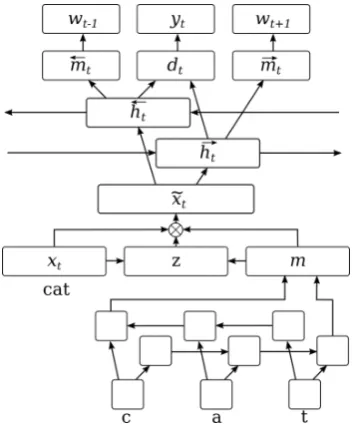
We also make use of the character-level archi-tecture proposed byRei et al.(2016), allowing the model to learn morphological patterns and capture out-of-vocabulary words. Each individual char-acter is mapped to a charchar-acter embedding and a bidirectional LSTM is used to combine them to-gether into a character-based token representation. This vector m, constructed only from individual characters, is then combined with the regular to-ken embeddingxtusing an adaptive gating mech-anism:
z=σ(Wz1·tanh(Wz2xt+Wz3m)
) (6)
e
xt=z·xt+ (1−z)·m (7)
whereWz1,Wz2 andWz3 are weight matrices,zis
a dynamically calculated gating vector, andxetis the resulting token representation at positiont.
We optimise the model by minimising cross-entropy between the predicted label distributions and the annotated labels. In addition to training the error detection objective, we make use of a multi-task loss function and train specific parts of the architecture as language models. This provides the model with a more informative loss function, while also encouraging it to learn more general compositional features and acting as a regulariser (Rei,2017). First, two extra hidden layers are con-structed:
−→
Figure 1: Error detection network architecture that is repeated for all the words in a sentence (illustra-tion for the word “cat”).
←−
mt=tanh←W−m←h−t (9)
where−W→m and←W−m are direction-specific weight matrices, used for connecting a forward or back-ward LSTM hidden state to a separate layer. The surrounding tokens are then predicted based on each hidden state using a softmax output layer:
P(wt+1|w1...wt) =softmax−W→q−→mt (10)
P(wt−1|wt...wT) =softmax←W−q←−mt (11)
During training, the following cost function is minimised, which combines the error detection loss function with the two language modeling ob-jectives:
E =−∑T t=1
logP(yt|wt...wT)
−γT∑−1
t=1
logP(wt+1|w1...wt)
−γ
T ∑
t=2
logP(wt−1|wt...wT)
(12)
whereγis a weight that controls the importance of language modeling in relation to the error detec-tion objective. Figure1shows the error detection network architecture.
4.1 Experimental settings
All digits in the text are replaced with the char-acter ‘0’. Tokens that occur less than 2 times in the training data share an out-of-vocabulary (OOV) token embedding, whereas the character-level component still operates over the original to-kens. The model hyperparameters are tuned based on F0.5 on the FCE development set (Section 3) andγ is set to0.1.1 The model is optimised us-ing Adam (Kingma and Ba, 2015), and training is stopped when F0.5 does not improve on the de-velopment set over 5 epochs. Token representa-tions have size 300 and are initialised with pre-trained word2vec embeddings pre-trained on Google News (Mikolov et al.,2013). The character rep-resentations have size 50 and are initialised ran-domly. The LSTM hidden layers have size 200 for each direction.
4.2 Error detection performance
Rei and Yannakoudakis (2016)’s error detection framework uses token-level embeddings, bidirec-tional LSTMs for context representation, and a multi-layer architecture for learning more com-plex features. They train their model on the public FCE training set, and benchmark their re-sults on the FCE and CoNLL test sets (Baseline LSTMFCE). We also train and test our detection model on the same data and evaluate the effec-tiveness of our approach (LSTMFCE). In Table1, we can see that our architecture achieves a higher performance on both FCE and CoNLL, and par-ticularly for FCE (7% higher F0.5) and CoNLL test annotation 2 (around 2% higher F0.5). When we use a larger training set that also includes the CoNLL training data and the public Lang-8 cor-pus (see Section 3), performance improves even further (LSTM), particularly for CoNLL test an-notation 1 (at least 8% higher F0.5 compared to LSTMFCE). We use this model in the experiments reported in the following sections.
5 Statistical machine translation
SMT attempts to identify the1-best correction hy-pothesisc∗ of an input sentence sthat maximises
the following:
c∗ = arg max
c pLM(c)p(s|c) (13)
FCE test set CoNLL test set annotation 1 CoNLL test annotation 2
System P R F0.5 P R F0.5 P R F0.5
Baseline LSTMFCE 46.10 28.50 41.10 15.40 22.80 16.40 23.60 25.10 23.90
LSTMFCE 58.88 28.92 48.48 17.68 19.07 17.86 27.62 21.18 25.88
[image:5.595.78.523.65.130.2]LSTM 79.10 21.19 51.14 54.51 8.69 26.53 69.60 7.91 27.18
Table 1: Token-level error detection performance of our detection models (LSTMFCE and LSTM) on FCE and the two CoNLL 2014 test set annotations. Baseline LSTMFCEand LSTMFCE are trained only on the public FCE training set.
A Language Model (LM) is used to estimate the correction hypothesis probability pLM(c) from a
corpus of correct English, and a translation model to estimate the conditional p(s|c) from a paral-lel corpus of corrected learner sentences. State-of-the-art SMT systems are phrase-based (Koehn et al., 2003) in that they use phrases as “trans-lation” units and therefore allow many-to-many “translation” mappings. The translation model is decomposed into a phrase-translation probability model and a phrase re-ordering probability model, and the1-best correction hypothesis is of the fol-lowing log-linear form (Och and Ney,2002):
c∗= arg max
c exp
K ∑
i=1
λihi(c, s) (14)
wherehrepresents a feature function (e.g., phrase-translation probability) andλthe feature weight.
In this work, we employ two SMT systems:
Yuan et al. (2016)2 and Junczys-Dowmunt and
Grundkiewicz (2016). We apply our re-ranking approach to each SMT system’s N-best list us-ing features derived from the neural sequence-labelling model for error detection described in the previous section, improve each of the SMT systems, and achieve state-of-the-art results on all three GEC datasets: FCE, CoNLL and JFLEG.
5.1 N-best list re-ranking
For each SMT system, we generate the list of all the10best candidate hypotheses. We then use the following set of features (tuned on the FCE de-velopment set, see Section3) to assign a score to each candidate, and determine a new ranking for each SMT model:
Sentence probability: Our error detection model outputs a probabilty indicating whether a
2Yuan et al.(2016) propose a supervisedN-best list re-ranking approach; however, we only use their baseline SMT system.
token is likely to be correct or incorrect in context. We therefore use as a feature the overall sentence probability, calculated based on the probability of each of its tokens being correct:∑
w logP(w)
Levenshtein distance: We first use Levenshtein distance (LD) to identify which tokens in the orig-inal/source sentence have been corrected by the candidate hypothesis. We then identify the tokens that our detection model predicts as incorrect (i.e., the probability of being incorrect is greater than
0.5). These give us two different sets of annota-tions for the source sentence: tokens in the source sentence that the candidate hypothesis identifies as incorrect; and tokens in the source sentence that the error detection model identifies as incorrect. We then convert these annotations to binary se-quences – i.e., 1 if the token is identified as in-correct, and 0 otherwise – and use as a feature the LD between those binary representations. More specifically, we would like to select the candidate sentence that has the smallest LD from the binary sequence created by the detection model: LD1
True and false positives: Given the binary se-quences described above, we also use as a feature the ratio of true positives (TP) to false positives (FP) by treating the error detection model as the “gold standard”. Specifically, we count how many times the candidate hypothesis agrees or not with the detection model on the tokens identified as in-correct: TP
FP
We use a linear combination of the above three scores together with the overall score (i.e., original rank) given by the SMT system (we do not include any other SMT features) to re-rank each SMT sys-tem’s10-best list in an unsupervised way. The new
1-best correction hypothesisc∗is then the one that
maximises:
c∗ = arg max
c K ∑
i=1
FCE test set CoNLL test set JFLEG
P R F0.5 GLEU P R F0.5 GLEU P R F0.5 GLEU
Baseline
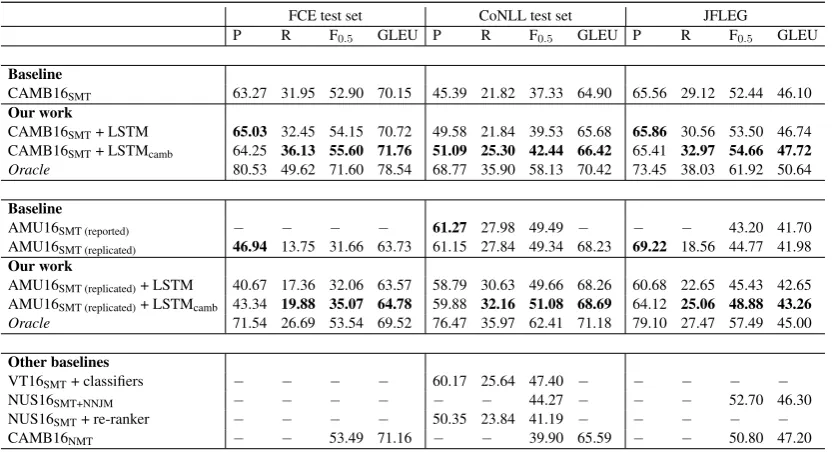
CAMB16SMT 63.27 31.95 52.90 70.15 45.39 21.82 37.33 64.90 65.56 29.12 52.44 46.10
Our work
CAMB16SMT+ LSTM 65.03 32.45 54.15 70.72 49.58 21.84 39.53 65.68 65.86 30.56 53.50 46.74
CAMB16SMT+ LSTMcamb 64.25 36.13 55.60 71.76 51.09 25.30 42.44 66.42 65.41 32.97 54.66 47.72
Oracle 80.53 49.62 71.60 78.54 68.77 35.90 58.13 70.42 73.45 38.03 61.92 50.64
Baseline
AMU16SMT (reported) − − − − 61.27 27.98 49.49 − − − 43.20 41.70
AMU16SMT (replicated) 46.94 13.75 31.66 63.73 61.15 27.84 49.34 68.23 69.22 18.56 44.77 41.98
Our work
AMU16SMT (replicated)+ LSTM 40.67 17.36 32.06 63.57 58.79 30.63 49.66 68.26 60.68 22.65 45.43 42.65
AMU16SMT (replicated)+ LSTMcamb 43.34 19.88 35.07 64.78 59.88 32.16 51.08 68.69 64.12 25.06 48.88 43.26
Oracle 71.54 26.69 53.54 69.52 76.47 35.97 62.41 71.18 79.10 27.47 57.49 45.00
Other baselines
VT16SMT+ classifiers − − − − 60.17 25.64 47.40 − − − − −
NUS16SMT+NNJM − − − − − − 44.27 − − − 52.70 46.30
NUS16SMT+ re-ranker − − − − 50.35 23.84 41.19 − − − − −
[image:6.595.93.510.62.288.2]CAMB16NMT − − 53.49 71.16 − − 39.90 65.59 − − 50.80 47.20
Table 2: Using the neural sequence-labelling model for error detection (‘+ LSTM’ or ‘+ LSTMcamb’) to re-rank the10-best lists of two SMT systems –Yuan et al.(2016) (CAMB16SMT) andJunczys-Dowmunt
and Grundkiewicz(2016) (AMU16SMT).
wherehrepresents the score assigned to candidate hypothesiscaccording to featurei;λis a param-eter that controls the effect featureihas on the fi-nal ranking; andK = 4as we have four different features (three features presented in this section, plus the original score output by the SMT system).
λs are tuned on the FCE development set and are set to1, except for the sentence probability feature which hasλ= 1.5.3
6 Evaluation
We evaluate the effectiveness of our re-ranking ap-proach on three different datasets: FCE, CoNLL 2014 and JFLEG. We report F0.5using the shared task’sM2scorer (Dahlmeier and Ng,2012b), and GLEU scores (Napoles et al., 2015). The latter is based on a variant of BLEU (Papineni et al.,
2002) that is designed to reward correct edits and penalise ungrammatical ones. As mentioned in Section 5, we re-rank the 10-best lists of two SMT systems: Yuan et al.(2016) (CAMB16SMT) andJunczys-Dowmunt and Grundkiewicz (2016) (AMU16SMT). The results are presented in Table
2.
We replicate the AMU16SMT system to obtain the 10-best output, and report results using this
3We experimented with a small set of values (from0to2 with increments of.1), though not exhaustively.
version (AMU16SMT (replicated)). Compared to the original results on CoNLL reported in their paper (AMU16SMT (reported)), we obtain slightly lower performance.4 We can see that AMU16SMT is the current state of the art on CoNLL, with an F0.5 of 49.49. On the other hand, CAMB16SMT generalises better on FCE and JFLEG: 52.90 and 52.44 F0.5respectively. The lower performance of AMU16SMT can be attributed to the fact that it is tuned for the CoNLL shared task.
The current state of the art on FCE is a neural machine translation system, CAMB16NMT (Yuan
and Briscoe,2016), which is also the best model on JFLEG in terms of GLEU. The rest of the base-lines we report are: Rozovskaya and Roth(2016), who explore combinations of SMT systems and classifiers (VT16SMT + classifiers); Chollampatt
et al. (2016a), who integrate a neural network joint model that has been adapted using native-language-specific learner text as a feature in SMT (NUS16SMT+NNJM); andHoang et al.(2016), who perform supervisedN-best list re-ranking using a large set of features, and further extend their ap-proach to generate new hypotheses (NUS16SMT+ re-ranker).5
4The differences are likely to be caused by different ver-sions of the NLTK tokeniser and/or Moses.
CAMB16SMT+ LSTMcamb
Ablated feature F0.5 GLEU
None 55.60 71.76
[image:7.595.97.271.64.150.2]Sentence probability 54.13 70.65 Levenshtein distance 55.42 71.78 True/false positives 55.14 71.75
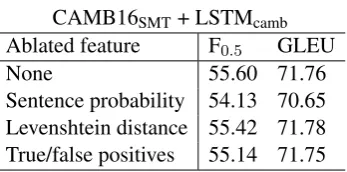
Table 3: Ablation tests on the FCE test set when removing one feature of the re-ranking system at a time.
When using our LSTM detection model to re-rank the 10-best list (+ LSTM), we can see that performance improves across all three datasets for both SMT systems. F0.5 performance of CAMB16SMT on FCE improves from 52.90 to
54.15, on CoNLL from37.33to39.53, and on JF-LEG from 52.44 to53.50 (the latter demonstrat-ing that the detection model also helps with flu-ency edits). This improved result is also better than the state of the art CAMB16NMT on FCE.6 When looking at AMU16SMT, we can see that ranking (+ LSTM) further improves the best re-sult on CoNLL from 49.34 (replicated) to 49.66
F0.5, and there is a similar level of improvement for both FCE and JFLEG.
As a further experiment, we re-train our er-ror detection model on the same training data as CAMB16SMT (+ LSTMcamb). More specifically, we use the Cambridge Learner Corpus (CLC) (Nicholls, 2003), a collection of learner texts of various proficiency levels, written in response to exam prompts and manually annotated with the errors committed (around 2M sentence pairs). In Table2, we can see that the detection model fur-ther improves performance across all datasets and SMT systems. Compared to just doing SMT with CAMB16SMT, re-ranking improves F0.5from
52.90 to 55.60 on FCE (performance increases further even though CAMB16SMT’s training set includes a large set of FCE data), from 37.33 to
42.44 on CoNLL, and from 52.44 to 54.66 on JFLEG. The largest improvement is on CoNLL (5%), which is likely because CoNLL is not in-cluded in the training set. AMU16SMT (replicated) is specifically tuned for CoNLL; nevertheless, the detection model also improves F0.5 on CoNLL from 49.34 to 51.08. Re-ranking using a small set of detection-based features produces
state-of-6We note that CAMB16
NMT outperforms the re-ranking approach byYuan et al.(2016).
the-art results on all three datasets (we note that CAMB16SMTgeneralises better across all).
We next run ablation tests to investigate the extent to which each feature contributes to per-formance. Results obtained on the FCE test set after excluding each of the features of the ‘CAMB16SMT + LSTMcamb’ re-ranking system are presented in Table3. Overall, all features have a positive effect on performance, though the sen-tence probability feature does have the biggest im-pact: its removal is responsible for a1.47and1.11
decrease of F0.5and GLEU respectively. A similar pattern is observed on the other datasets too.
6.1 Oracle
To calculate an upper bound per SMT system per dataset, we calculate character-level LD between each candidate hypothesis in the 10-best list and the gold corrected sentence. We then calculate an oracle score by selecting the candidate hypothe-sis that has the smallest LD. Essentially the or-acle is telling us the maximum performance that can be obtained with the given10-best list on each dataset. For datasets for which we have more than one annotation available, we select the oracle that gives the highest F0.5.
In Table 2, we can see that, overall, CAMB16SMT has a higher oracle performance compared to AMU16SMT. More specifically, the maximum attainable F0.5 on FCE is 71.60, on CoNLL58.13, and on JFLEG61.92. This shows empirically that the10-best list has great potential and should be exploited further. AMU16SMT has a lower oracle performance overall, though again this can be attributed to the fact that it is specifically tuned for CoNLL.
6.2 N-best list size
Next, we examine performance as theN-best list varies in size, ranging from1to10(Table4). We observe a positive effect: the larger the size, the better the model for all datasets. F0.5 does not seem to have reached a plateau with n < 10, which suggests that increasing the size of the list further can potentially lead to better results. We do, however, observe that large improvements are obtained when increasing the size from1to3, sug-gesting that, most of the time, better alternatives are identified within the top 3 candidate hypothe-ses. This, however, is not the case for the ora-cle (Foracle
CAMB16SMT
FCE test set CoNLL test set JFLEG N-best list F0.5 Foracle0.5 F0.5 Foracle0.5 F0.5 Foracle0.5
1 52.90 52.90 37.33 37.33 52.44 52.44 2 54.28 62.10 39.87 47.03 53.04 55.64 3 54.96 65.93 41.00 51.12 53.24 57.69 4 55.18 68.05 41.83 53.13 53.47 58.93 5 55.33 69.47 42.12 54.80 54.01 59.66 6 55.43 70.24 42.49 55.53 54.18 60.34 7 55.48 70.74 42.60 56.54 54.45 61.14 8 55.47 71.00 42.63 57.04 54.47 61.28 9 55.51 71.27 42.65 57.23 54.64 61.55
10 55.60 71.60 42.44 58.13 54.66 61.92
Table 4: Re-ranking performance using
LSTMcamb as the N-best list varies in size from1to10for CAMB16SMTand its oracle.
6.3 Error type performance
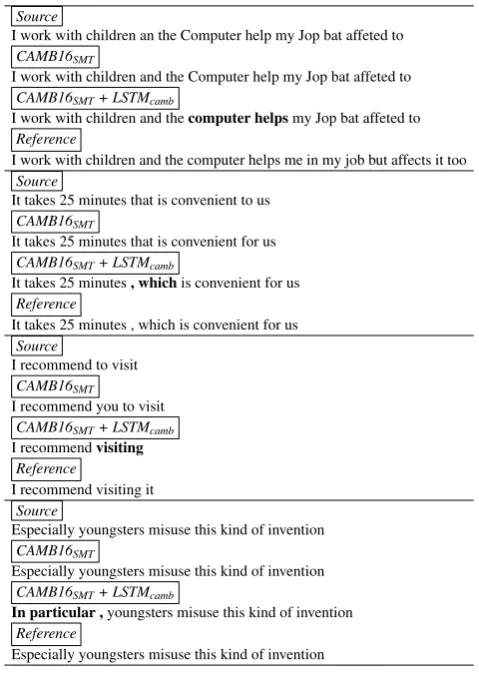
In Table5, we can see example source sentences, together with their corrected counterparts (refer-ence), 1-best candidates by CAMB16SMT and 1 -best candidates by CAMB16SMT + LSTMcamb. Re-ranking seems to fix errors such as subject– verb agreement (“the Computer help” to “the com-puter helps”) and verb form (“I recommend you to visit” to “I recommend visiting”). In this section, we perform an analysis of performance per type to get a better understanding of where the strength of the re-ranking detection model comes from.
Until recently, GEC performance per error type was only analysed in terms of recall, as sys-tem output is not annotated. Recently, however,
Bryant et al. (2017) proposed an approach to automatically annotating GEC output with error type information, which utilises a linguistically-enhanced alignment to automatically extract the edits between pairs of source sentences and their corrected counterparts, and a dataset-independent rule-based classifier to classify the edits into er-ror types. Human evaluation showed that the pre-dicted error types were rated as “Good” or “Ac-ceptable” 95% of the time. We use their pub-licly available code to analyse error-type per-formance before and after re-ranking.
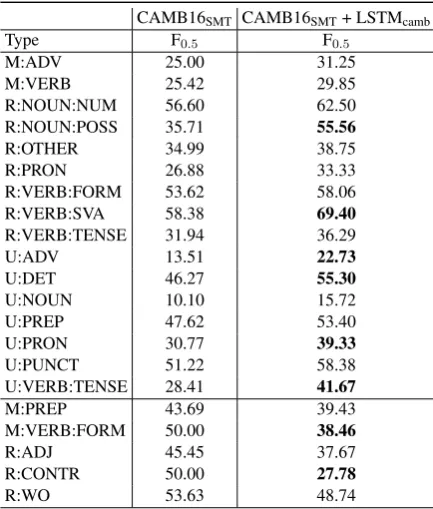
Table 6 presents the performance for a sub-set of error types that are affected the most before and after re-ranking CAMB16SMT on the FCE test set. The error types are inter-preted as follows: Missing error; Replace er-ror; Unnecessary error. The largest improve-ment is observed in replaceimprove-ment errors referring to possessive nouns (R:NOUN:POSS) and verb
Source
I work with children an the Computer help my Jop bat affeted to
CAMB16SMT
I work with children and the Computer help my Jop bat affeted to
CAMB16SMT+ LSTMcamb
I work with children and thecomputer helpsmy Jop bat affeted to
Reference
I work with children and the computer helps me in my job but affects it too
Source
It takes 25 minutes that is convenient to us
CAMB16SMT
It takes 25 minutes that is convenient for us
CAMB16SMT+ LSTMcamb
It takes 25 minutes, whichis convenient for us
Reference
It takes 25 minutes , which is convenient for us
Source
I recommend to visit
CAMB16SMT
I recommend you to visit
CAMB16SMT+ LSTMcamb
I recommendvisiting
Reference
I recommend visiting it
Source
Especially youngsters misuse this kind of invention
CAMB16SMT
Especially youngsters misuse this kind of invention
CAMB16SMT+ LSTMcamb
In particular ,youngsters misuse this kind of invention
Reference
Especially youngsters misuse this kind of invention
Table 5: Source sentences along with gold corrections (reference), 1-best candidates by CAMB16SMTand by CAMB16SMT+ LSTMcamb.
agreement (R:VERB:SVA); and in unnecessary errors referring to adverbs (U:ADV), determin-ers (U:DET), pronouns (U:PRON), and verb tense (U:VERB:TENSE).
The LSTM architecture allows the network to learn advanced composition rules and remem-ber dependencies over longer distances (e.g., R:VERB:SVA improves from 58.38 to 69.40). The network’s language modelling objectives al-low it to learn better and more general com-positional features (e.g., U:ADV improves from
13.51 to 22.73), while the character-level archi-tecture facilitates modelling of morphological pat-terns [e.g., replacement errors referring to verb form (R:VERB:FORM) improve from 53.62 to
58.06]. Between M, R, and U errors, the largest improvement is observed in U, for which there is at least 5% improvement in F0.5.7
Overall, re-ranking improves F0.5 across error types; however, there is a small subset that is
7U improves from 38.44 to 43.77; M from 43.43 to
[image:8.595.307.547.60.398.2]CAMB16SMT CAMB16SMT+ LSTMcamb
Type F0.5 F0.5
M:ADV 25.00 31.25
M:VERB 25.42 29.85
R:NOUN:NUM 56.60 62.50
R:NOUN:POSS 35.71 55.56
R:OTHER 34.99 38.75
R:PRON 26.88 33.33
R:VERB:FORM 53.62 58.06
R:VERB:SVA 58.38 69.40
R:VERB:TENSE 31.94 36.29
U:ADV 13.51 22.73
U:DET 46.27 55.30
U:NOUN 10.10 15.72
U:PREP 47.62 53.40
U:PRON 30.77 39.33
U:PUNCT 51.22 58.38
U:VERB:TENSE 28.41 41.67
M:PREP 43.69 39.43
M:VERB:FORM 50.00 38.46
R:ADJ 45.45 37.67
R:CONTR 50.00 27.78
[image:9.595.74.291.62.317.2]R:WO 53.63 48.74
Table 6: Error-type performance before and af-ter re-ranking on the FCE test set (largest impact highlighted in bold; bottom part of the table dis-plays negative effects on performance).
negatively affected (Table 6, bottom part); for example, performance on missing errors refer-ring to verb form (M:VERB:FORM) drops from
50.00 to38.46, and on replace contraction errors (R:CONTR) from 50.00 to 27.78. Importantly, such an analysis allows us to examine the strengths and weaknesses of the models, which is key for the deployment of GEC systems.
7 Conclusion
To the best of our knowledge, no prior work has in-vestigated the impact of detection models on cor-rection performance. We proposed an approach toN-best list re-ranking using a neural sequence-labelling model that calculates the probability of each token in a sentence being correct or incor-rect in context. Detection models can be more fine-tuned to finer nuances of grammaticality, and therefore better able to distinguish between correct and incorrect versions of a sentence. Using a lin-ear combination of a small set of features derived from the detection model output, we re-ranked the
N-best list of SMT systems and achieved state-of-the-art results on GEC on three different datasets. Our approach can be applied to any GEC system that produces multiple alternative hypotheses. Our
results demonstrate the benefits of integrating de-tection approaches with correction systems, and how one can complement the other.
Acknowledgments
Special thanks to Christopher Bryant, Mariano Fe-lice, and Ted Briscoe, as well as the anonymous reviewers for their valuable contributions at vari-ous stages.
References
Chris Brockett, William B Dolan, and Michael Gamon. 2006. Correcting ESL errors using phrasal SMT techniques. InProceedings of the 21st International Conference on Computational Linguistics and the 44th annual meeting of the Association for Compu-tational Linguistics, pages 249–256. Association for Computational Linguistics.
Christopher Bryant, Mariano Felice, and Ted Briscoe. 2017. Automatic annotation and evaluation of er-ror types for grammatical erer-ror correction. In Pro-ceedings of the 55th Annual Meeting of the Associa-tion for ComputaAssocia-tional Linguistics. Association for Computational Linguistics.
Martin Chodorow, Joel R Tetreault, and Na-Rae Han. 2007. Detection of grammatical errors involving prepositions. In Proceedings of the fourth ACL-SIGSEM workshop on prepositions, pages 25–30. Association for Computational Linguistics.
Shamil Chollampatt, Duc Tam Hoang, and Hwee Tou Ng. 2016a. Adapting grammatical error correction based on the native language of writers with neural network joint models. In Proceedings of the Con-ference on Empirical Methods in Natural Language Processing, pages 1901–1911.
Shamil Chollampatt, Kaveh Taghipour, and Hwee Tou Ng. 2016b. Neural network translation models for grammatical error correction. arXiv preprint arXiv:1606.00189.
Daniel Dahlmeier and Hwee Tou Ng. 2011. Correcting semantic collocation errors with L1-induced para-phrases. InProceedings of the Conference on Em-pirical Methods in Natural Language Processing, pages 107–117. Association for Computational Lin-guistics.
Daniel Dahlmeier and Hwee Tou Ng. 2012a. A beam-search decoder for grammatical error correction. In
Daniel Dahlmeier and Hwee Tou Ng. 2012b. Better evaluation for grammatical error correction. In Pro-ceedings of the 2012 Conference of the North Amer-ican Chapter of the Association for Computational Linguistics: Human Language Technologies, pages 568–572. Association for Computational Linguis-tics.
Daniel Dahlmeier, Hwee Tou Ng, and Siew Mei Wu. 2013. Building a large annotated corpus of learner english: The NUS corpus of learner English. In
Proceedings of the Eighth Workshop on Innovative Use of NLP for Building Educational Applications, pages 22–31.
Robert Dale and Adam Kilgarriff. 2011. Helping our own: The HOO 2011 pilot shared task. In Proceed-ings of the 13th European Workshop on Natural Lan-guage Generation, pages 242–249. Association for Computational Linguistics.
Rachele De Felice and Stephen G Pulman. 2008. A classifier-based approach to preposition and deter-miner error correction in L2 English. In Proceed-ings of the 22nd International Conference on Com-putational Linguistics, pages 169–176. Association for Computational Linguistics.
Mariano Felice, Zheng Yuan, Øistein E. Andersen, He-len Yannakoudakis, and Ekaterina Kochmar. 2014. Grammatical error correction using hybrid systems and type filtering. InProceedings of the 18th Con-ference on Computational Natural Language Learn-ing: Shared Task, pages 15–24. Association for Computational Linguistics.
Michael Gamon. 2010. Using mostly native data to correct errors in learners’ writing: a meta-classifier approach. In Human Language Technologies: The 2010 Annual Conference of the North American Chapter of the Association for Computational Lin-guistics, pages 163–171. Association for Computa-tional Linguistics.
Michael Gamon, Jianfeng Gao, Chris Brockett, Alexandre Klementiev, William B Dolan, Dmitriy Belenko, and Lucy Vanderwende. 2008. Using con-textual speller techniques and language modeling for ESL error correction. InIJCNLP, volume 8, pages 449–456.
Na-Rae Han, Martin Chodorow, and Claudia Leacock. 2006. Detecting errors in English article usage by non-native speakers. Natural Language Engineer-ing, 12(1):115–129.
Na-Rae Han, Joel Tetreault, Soo-Hwa Lee, and Jin-Young Ha. 2010. Using error-annotated ESL data to develop an ESL error correction system. In Pro-ceedings of LREC. Emi Izumi, Kiyotaka Uchimoto and Hitoshi Isahara.
Duc Tam Hoang, Shamil Chollampatt, and Hwee Tou Ng. 2016. Exploiting n-best hypotheses to improve an smt approach to grammatical error correction.
arXiv preprint arXiv:1606.00210.
Sepp Hochreiter and J¨urgen Schmidhuber. 1997. Long short-term memory.Neural Computation, 9. Marcin Junczys-Dowmunt and Roman Grundkiewicz.
2016. Phrase-based machine translation is state-of-the-art for automatic grammatical error correction.
arXiv preprint arXiv:1605.06353.
Diederik P. Kingma and Jimmy Lei Ba. 2015. Adam: a method for stochastic optimization. InInternational Conference on Learning Representations.
Philipp Koehn, Franz Josef Och, and Daniel Marcu. 2003. Statistical phrase-based translation. In Pro-ceedings of the 2003 Conference of the North Amer-ican Chapter of the Association for Computational Linguistics on Human Language Technology, pages 48–54. Association for Computational Linguistics. Claudia Leacock, Martin Chodorow, Michael Gamon,
and Joel Tetreault. 2014. Automated grammatical error detection for language learners, second edition.
Synthesis lectures on human language technologies, 7(1):1–170.
Tom´aˇs Mikolov, Kai Chen, Greg Corrado, and Jeffrey Dean. 2013. Efficient estimation of word represen-tations in vector space. InProceedings of the Inter-national Conference on Learning Representations (ICLR 2013).
Tomoya Mizumoto, Yuta Hayashibe, Mamoru Ko-machi, Masaaki Nagata, and Yu Matsumoto. 2012. The effect of learner corpus size in grammatical error correction of ESL writings. In 24th Inter-national Conference on Computational Linguistics, pages 863–872.
Tomoya Mizumoto and Yuji Matsumoto. 2016. Dis-criminative reranking for grammatical error correc-tion with statistical machine translacorrec-tion. In Proceed-ings of the North American Chapter of the Associ-ation for ComputAssoci-ational Linguistics, pages 1133– 1138.
Courtney Napoles, Keisuke Sakaguchi, Matt Post, and Joel Tetreault. 2015. Ground truth for grammati-cal error correction metrics. InProceedings of the 53rd Annual Meeting of the Association for Compu-tational Linguistics and the 7th International Joint Conference on Natural Language Processing, vol-ume 2, pages 588–593.
Courtney Napoles, Keisuke Sakaguchi, and Joel Tetreault. 2017. JFLEG: A fluency corpus and benchmark for grammatical error correction. arXiv preprint arXiv:1702.04066.
Hwee Tou Ng, Siew Mei Wu, Yuanbin Wu, Christian Hadiwinoto, and Joel Tetreault. 2013. The CoNLL-2013 shared task on grammatical error correction. In Proceedings of the Seventeenth Conference on Computational Natural Language Learning: Shared Task, pages 1–12. Association for Computational Linguistics.
Diane Nicholls. 2003. The Cambridge Learner Cor-pus - error coding and analysis for lexicography and ELT. InProceedings of the Corpus Linguistics 2003 Conference.
Franz Josef Och and Hermann Ney. 2002. Discrimina-tive training and maximum entropy models for sta-tistical machine translation. In Proceedings of the 40th Annual Meeting on Association for Computa-tional Linguistics, pages 295–302. Association for Computational Linguistics.
Kishore Papineni, Salim Roukos, Todd Ward, and Wei-Jing Zhu. 2002. Bleu: a method for automatic eval-uation of machine translation. In Proceedings of the 40th annual meeting on association for compu-tational linguistics, pages 311–318. Association for Computational Linguistics.
Marek Rei. 2017. Semi-supervised multitask learn-ing for sequence labellearn-ing. In Proceedings of the 55th Annual Meeting of the Association for Compu-tational Linguistics. Association for Computational Linguistics.
Marek Rei, Gamal K. O. Crichton, and Sampo Pyysalo. 2016. Attending to characters in neural sequence labeling models. InProceedings of the 26th Inter-national Conference on Computational Linguistics (COLING-2016).
Marek Rei and Helen Yannakoudakis. 2016. Composi-tional sequence labeling models for error detection in learner writing. In Proceedings of the 54th An-nual Meeting of the Association for Computational Linguistics.
Alla Rozovskaya, Kai-Wei Chang, Mark Sammons, Dan Roth, and Nizar Habash. 2014. The Illinois-Columbia system in the CoNLL-2014 shared task. In Proceedings of the Eighteenth Conference on Computational Natural Language Learning: Shared Task, pages 34–42. Association for Computational Linguistics.
Alla Rozovskaya and Dan Roth. 2010. Generating confusion sets for context-sensitive error correction. In Proceedings of the 2010 Conference on Empiri-cal Methods in Natural Language Processing, pages 961–970. Association for Computational Linguis-tics.
Alla Rozovskaya and Dan Roth. 2011. Algorithm selection and model adaptation for ESL correction tasks. InProceedings of the 49th Annual Meeting of the Association for Computational Linguistics: Hu-man Language Technologies, pages 924–933. Asso-ciation for Computational Linguistics.
Alla Rozovskaya and Dan Roth. 2016. Grammati-cal error correction: Machine translation and clas-sifiers. In Proceedings of the 54th Annual Meet-ing of the Association for Computational LMeet-inguis- Linguis-tics, pages 2205–2215.
Alla Rozovskaya, Mark Sammons, Joshua Gioja, and Dan Roth. 2011. University of Illinois system in HOO text correction shared task. InProceedings of the 13th European Workshop on Natural Language Generation, pages 263–266. Association for Com-putational Linguistics.
Alla Rozovskaya, Mark Sammons, and Dan Roth. 2012. The UI system in the HOO 2012 shared task on error correction. InProceedings of the Seventh Workshop on Building Educational Applications Us-ing NLP, pages 272–280. Association for Computa-tional Linguistics.
Raymond Hendy Susanto, Peter Phandi, and Hwee Tou Ng. 2014. System combination for grammatical er-ror correction. InProceedings of the Conference on Empirical Methods in Natural Language Process-ing, pages 951–962.
Toshikazu Tajiri, Mamoru Komachi, and Yuji Mat-sumoto. 2012. Tense and aspect error correction for ESL learners using global context. InProceedings of the 50th Annual Meeting of the Association for Computational Linguistics: Short Papers-Volume 2, pages 198–202. Association for Computational Lin-guistics.
Joel Tetreault, Jennifer Foster, and Martin Chodorow. 2010. Using parse features for preposition selection and error detection. InProceedings of the ACL 2010 conference short papers, pages 353–358. Associa-tion for ComputaAssocia-tional Linguistics.
Joel R Tetreault and Martin Chodorow. 2008. The ups and downs of preposition error detection in ESL writing. In Proceedings of the 22nd Inter-national Conference on Computational Linguistics, pages 865–872. Association for Computational Lin-guistics.
Helen Yannakoudakis, Ted Briscoe, and Ben Medlock. 2011. A new dataset and method for automatically grading esol texts. InProceedings of the 49th An-nual Meeting of the Association for Computational Linguistics: Human Language Technologies, pages 180–189. Association for Computational Linguis-tics.
Ippei Yoshimoto, Tomoya Kose, Kensuke Mitsuzawa, Keisuke Sakaguchi, Tomoya Mizumoto, Yuta Hayashibe, Mamoru Komachi, and Yuji Matsumoto. 2013. NAIST at 2013 CoNLL grammatical error correction shared task. In CoNLL Shared Task, pages 26–33.
Zheng Yuan, Ted Briscoe, and Mariano Felice. 2016. Candidate re-ranking for SMT-based grammatical error correction. InProceedings of the 11th Work-shop on Innovative Use of NLP for Building Educa-tional Applications, pages 256–266.