Volume 1, No. 4
December 1996
Exchanges
Newsletter of the Climate Variability and Predictability Programme (CLIVAR)
Important note for all recipients of
CLIVAR
EXCHANGES
Annual Update of the CLIVAR Mailing list:
To minimize the number of duplicates and non-active members on our mailing lists, the International CLIVAR Project Office will update them each year, beginning in January 1997. We ask all subscribers interested in receiving future issu-es of CLIVAR EXCHANGES to complete and return the reply form on page 12 via mail, e-mail or fax to the ICPO im-mediately. Please note that all members of CLIVAR committees and panels as well as subscribers who signed up during 1996 will remain on the list automatically.
2
3
4
5
6
7
8
8
9
10
11
12
In this issue:
CLIVAR in 1996 - Major Steps towards a CLIVAR Implementation Plan
CLIVAR DecCen Implementation Workshop on Atmosphere - Ocean Interactions on
Decadal-scale Climate Variability
CLIVAR Ocean Programme for DecCen Climate Variability Workshop
PAGES/CLIVAR Working Group - First Session
Workshop on Interdecadal Changes of the North Atlantic
Workshop on Polar Processes in Global Climate
CLIVAR NEG-2 - Second Session
Euroclivar - Second Session
CLIVAR Upper Ocean Panel - Second Session
The PIRATA Programme: An Extension of the TAO Array in the Atlantic
CLIVAR Monsoon Panel - First Session
CLIVAR
- Exchanges
V
olume 1 No. 4, December1996
CLIVAR in 1996 - Major steps towards a
CLI-VAR Implementation Plan
As EXCHANGES goes to press for the final time in 1996, the CLIVAR scientific community is working intently on the first draft of the CLIVAR Implementation Plan. The task is daunting, given the scope of CLIVAR, the comple-xity of the scientific issues at stake, and the need to arrive at a balanced set of activities that can be set in motion and fostered over the next 5-10 years with some confidence. Nonetheless, the Joint Scientific Committee for the WCRP has tasked the CLIVAR Scientific Steering Group and the ICPO to table a first draft at the 18th Session of the JSC in Toronto in March, 1997.
Many of you will have participated in the hectic round of workshops, panel sessions and working group meetings that were conducted over the past 6-8 months. This editi-on of Exchanges is almost completely taken up with the summary reports of these activities. The meetings specifi-cally sponsored by CLIVAR were:
• CLIVAR DecCen Workshop on Atmosphere- Ocean In-teractions & their Influence on Decadal-Scale Climate Variability, Vancouver, Canada
• CLIVAR DecCen/ACC Numerical Experimentation Group (NEG-2), 2nd Session, Victoria, Canada
• Workshop on a CLIVAR Ocean Climate Programme for DecCen Climate Variability, Villefranche-sur-Mer, France
• PAGES/CLIVAR Paleoclimatology Working Group, 1st Session, Villefranche-sur-Mer, France
• CLIVAR Upper Ocean Panel, 2nd Session and Work-shop on an Assessment of the Pacific Observing System for Analyses, Model-Testing and El Niño Forecasts, Villefranche-sur-Mer, France
• GCOS/CLIVAR TAO Implementation Panel 5th Sessi-on, Goa, India
• CLIVAR Monsoon Panel, 1st Session, Goa, India
In addition, there have been several other important work-shops held during the year, sponsored at a national level and by other components of the WCRP that will have a strong input to the CLIVAR Implementation Plan. Among these were:
• JCESS/CLIVAR Workshop on Decadal Climate Variabi-lity, Columbia, MD, USA
• International Workshop on Pacific Ocean Buoy Net-work, Mutsu City, Japan
• US. Ocean CLIVAR Workshop, San Antonio, TX, USA • GEWEX Water Vapour Project (GVap) Workshop,
Gen-eva, Switzerland
• Polar Processes in Polar Climate, Cancun, Mexico • International Workshop on the Climate Systems of
Monsoon Asia, Kyoto, Japan.
On behalf of the CLIVAR Scientific Steering Group I would like to express a deep appreciation to all who parti-cipated in these meetings, who worked so hard to ensure their success and who are continuing to work on the ideas generated. Without the combined scientific expertise of the several hundred participants, the individual contributi-ons, and the commitment of time to travel to the meetings there would be no CLIVAR Implementation Plan.
While the completion of the first draft in March will be a major step in the production of the CLIVAR Implementa-tion Plan, we will continue to review the components of the plan and refine its text for several months after the JSC meeting. To facilitate comments and feedback on what is being written into the Plan, we have established the following Web-sites:
http://www.dkrz.de/clivar/climp.html and http://www.clivar.ucar.edu/climp.html.
By August 1997, we anticipate that the content of the in-itial CLIVAR Implementation Plan will have been deci-ded and we will use the opportunity provideci-ded by the Conference on the World Climate Programme to have a summary available for participants.
Ultimately, CLIVAR will be implemented through natio-nal programmes and through contributions at the nationatio-nal level to the projected activities of modelling, data analy-sis, observations and field campaigns embodied in the plan. Accordingly, the Implementation Plan will be pre-sented to national representatives of the CLIVAR scienti-fic community at an appropriate time and venue, probably during the first half of 1998. It is critical then, that the planning process at the international level is matched by an equally vigorous planning process at the national level. It is gratifying to see that many nations have already esta-blished national CLIVAR committees with the relevant scientific expertise and the capacity for identifying and securing national research funds. These committees will be essential for real progress on implementing CLIVAR and we look forward to seeing that the number continue to grow through 1997.
V
olume 1 No. 4, December1996
CLIVAR
- Exchanges
not fit into any of the above categories then this will be the last copy of Exchanges you will receive unless you no-tify us that you wish to remain on the mailing list.
Again on behalf of the CLIVAR Scientific Steering Group, and the staff here at ICPO, I wish you all the best for a safe and happy transition into 1997.
Michael Coughlan, Director, ICPO
CLIVAR DecCen Implementation Planning
Workshop on Atmosphere-Ocean Interactions on
Decadal-scale Climate Variability
University of British Columbia Vancouver, Canada September 4-6, 1996
The meeting dealt with those processes producing de-cadal-to-centennial climate variability through the large scale interaction of the atmosphere and the ocean.
The meeting was conducted around the following series of key-note talks:
• Mechanisms of Decadal Variability and Questions for the Conference - E. Sarachik, University of Washington
• DecCen Variability in the Observed Atmospheric Re-cord- J.M. Wallace, University of Washington
• Coupled Models of MidLatitude Decadal Variability
-M. Latif, Max-Planck-Inst. for Meteorology
• Decadal Variability of the Atlantic Subtropical Dipole
-Ping Chang, Texas A&M University
• DecCen Variability in the Observed Ocean record - C. Deser, University of Colorado
• Decadal Variability and Greenhouse warming - L. Bengtsson, Max-Planck-Inst. for Meteorology
These presentations were interspersed with discussions during which the participants gave short presentations of their work relevant to the topics discussed.
The following five basic phenomena emerged as potential focuses for the CLIVAR Implementation Plan:
1.The decadal mode in the Pacific with broad horse-shoe shaped SST anomalies around the equator and strong mid-latitude anomalies of opposite sign.
2.The decadal variability of ENSO which may or may not be associated with the Pacific decadal mode.
3.The variability associated with the Atlantic sub-tropical dipole.
4.The variability associated with the North Atlantic Oscil-lation.
5.Abrupt Climate Change in the Atlantic.
DecCen climate variability induced by the ocean-only, either through modifications of water masses or by ocean circulation changes, was not thoroughly discussed: this
was addressed by the Villefranche sur-Mer implementati-on planning workshop from 28-31 October (see page be-low).
Since much of what we know of the variability identified above has been gleaned from routine observations in the atmosphere and ocean, a major recommendation of the meeting was to maintain these routine observations as a minimum base on which new observing systems will be built. These routine observations include the upper air and surface observations of the World Weather Watch, the XBT, moored and drifting buoy programmes instituted under TOGA, in situ and satellite observations of SST, sea level and sea-ice, etc.
Specific new ocean observations recommended for study-ing the above phenomena were:
• A meridional line in the Pacific along approximately 170oW from the equator to about 40oN, to explore the processes that produce the SST variability and its sub-surface counterparts. The line should measure sub-surface meteorology, SST, and subsurface thermal fields; and • Meridional lines along 10oW south to 15oS and along
30oW to 15oN, to explore the processes that produce the subtropical dipole.
Both lines need to be maintained for at least a decade.
Two process studies were recommended:
1. An oceanographic study of the shallow meridional cir-culation from the tropics to mid-latitudes (where the tropical thermocline isopycnals outcrop), in order to understand the processes that maintain the tropical thermocline and to complete the picture of the oceano-graphic interactions between the tropics and mid-lati-tudes.
2. A paleo “process” study in the North Atlantic to gather all paleo information that defines the motion of the subtropical front and its relationship to sea-ice, deep convection, and surface winds.
The numerical modelling programme in support of Dec-Cen variability and its relationship to the Anthropogenic Climate Change component of CLIVAR was discussed at the second session of CLIVAR NEG-2, during the follo-wing week in Victoria, BC. A separate summary on that meeting can be found elsewhere in this issue.
Brief descriptions on what participants intended to do in support of CLIVAR were solicited; these activities are al-so considered an integral part of CLIVAR implementation and the descriptions can be found at the CLIVAR web-si-te. The meeting was sponsored in part by grants from the Canadian Atmospheric Environment Service, and the United States National Science Foundation.
CLIVAR
- Exchanges
V
olume 1 No. 4, December1996
The second major CLIVAR implementation workshop was held in Villefranche-sur-Mer which is located in the heart of the French Riviera. More than 90 participants from 17 countries were welcomed by Fritz Schott and Ar-nold Gordon co-chairing this workshop which focused on the role of the world’s oceans in determining decadal-sca-le climate variability. The meeting was organized around 8 invited presentations and 5 working group sessions which were designed to develop elements of an imple-mentation strategy to study the ocean‘s role in climate on these time scales. Plenary sessions were held to exchange ideas developed in the working groups. The reports of the various working groups will be incorporated into the initi-al CLIVAR implementation document currently being prepared by the International CLIVAR Project Office. Review papers were presented on mechanisms of DecCen climate variability (DCV) (J. Willebrand, IFM, Kiel), DecCen climate variability in coupled ocean-atmosphere models (M. Latif, MPI, Hamburg), sustained ocean mea-surements required to observe DecCen climate variability (D. Roemmich, SIO, La Jolla) and ocean DecCen variabi-lity in the paleoclimatic record (J.-C. Duplessy, CFR, Pa-ris).
Papers were also given on observations of DecCen clima-te variability in convection and waclima-ter mass formation in the northern hemisphere (R. Dickson, MAFF, Lowestoft) and in the southern hemisphere (J. Church, CSIRO, Hob-art).
Process studies required to further understanding of varia-bility in the heat and fresh water budget and the role of oceanic deep mixing and recirculation in DecCen variabi-lity were featured in talks given by H. Bryden (SIO,
Pacific and Indian Ocean, the Atlantic, and Southern Oce-an.
The working groups identified several special focused projects which merge well with the recommendations from the Vancouver Workshop (see above), PAGES/CLI-VAR Working Group and the meeting on Polar Processes in Cancun (reports of both meetings in this issue). Almost all the areas of investigation identified involve studies across all CLIVAR time-scales in order to, for instance, understand the role of the annual cycle in modulating lon-ger time-scale variability and to sort out the interactions of shorter and longer time-scale variations (e.g. ENSO): • Role of the ocean in decadal NAO variability
• Role of the ocean in decadal PNA variability
• Role of the equatorial zone in interhemispheric commu-nication of decadal variability
• Decadal variability of ENSO
• Coupled DCV of the equatorial dipole in the Atlantic • DCV of Mode and Deep water formation
• Effect of Southern Ocean SST and ice anomalies on cli-mate variabilities in lower latitudes
The reports from the five working groups are being colla-ted by the workshop organizing committee and will serve as the basis for an important part of the initial CLIVAR Implementation Plan. The meeting was sponsored in part by Euroclivar.
V. Detemmerman (WCRP) & A. Villwock (ICPO) Southampton) and B. Owens (WHOI, Woods Hole). Parallel working group ses-sions were held to develop plans for global sustained measurements needed to monitor and identify Dec-Cen climate variability in the ocean and for identifying patterns of oceanic DecCen climate variability in the hi-storical and paleo records. Later, participants divided themselves into three groups to discuss special fo-cus studies which would ad-vance understanding of the mechanisms of DCV in the
CLIVAR Ocean Programme for DecCen Climate Variability Workshop
V
olume 1 No. 4, December1996
CLIVAR
- Exchanges
PAGES/CLIVAR Working Group - First Session
Villefranche-sur-Mer, Oct. 24-25, 1996
IGBP-PAGES and WCRP-CLIVAR recently teamed up to establish the PAGES/CLIVAR Working Group (WG). The impetus for this new WG stems directly from the Novem-ber 1994 joint IGBP-WCRP workshop (Venice, Italy) on climate variability and predictability, and from the re-cognition that the new WCRP CLIVAR programme needs a firm paleoenvironmental perspective to meet its needs. With the establishment of the PAGES/CLIVAR WG, PA-GES (Past Global Changes) becomes the first IGBP (In-ternational Geosphere-Biosphere Programme) core project to also serve the WCRP (World Climate Research Programme).
The first meeting of the PAGES/CLIVAR WG was held (October 24-25) in Villefranche-sur-Mer, France, and included participants from both the PAGES and CLIVAR research communities. The WG agenda built on the re-cently published “PAGES-CLIVAR Intersection” docu-ment edited by Jean-Claude Duplessy and Jonathan Overpeck, and available from either PAGES, CLIVAR or the Internet World Wide Web at
http://www.ngdc.noaa.gov/paleo/reports/clivar.htm The agenda called first for a critical review of the pa-leoclimatic data and methods available for addressing CLIVAR seasonal- to centennial-scale climate variability issues. This led to discussions focused on specific areas of potential PAGES-CLIVAR interaction, and then on ways to improve the interdisciplinary interaction between the PAGES and CLIVAR communities. A full report on the WG presentations and recommendations will be pu-blished as a joint PAGES/CLIVAR document. The recom-mendations are summarized here.
As a general preamble, it was decided that PAGES/CLI-VAR interactions focus on:
• societal-relevant climate variability (e.g., droughts, floods, storms) and the processes driving this variability, with the recognition that extremes of the 20th century were small relative to those of the preceding centuries and millennia;
• understanding seasonal to century-scale variability as a prerequisite to reliable predictive capability, with the acknowledgment from the paleoclimatic record that de-cadal to century-scale variability modulates seasonal to interannual variability, and that climate states can ab-ruptly change and persist for decades or longer;
• unravelling key phenomena and mechanisms of climate variability;
• understanding tropical-extratropical interactions.
The intersection of CLIVAR foci and PAGES capabilities led to the identification of several key phenomena and
mechanisms for joint study. Each of these phenomena ex-hibits behaviour that can be investigated only with the aid of a paleoclimatic perspective, and only the paleo-record contains empirical information on how these phenomena are affected by changes in climatic forcing. Among these phenomena are specifically:
• ENSO atmosphere-ocean interactions and extratropical linkages;
• Tropical/North Atlantic variability, and interactions bet-ween tropical processes and regional drought, the North Atlantic Oscillation, and thermohaline circulation; • Asian/African monsoon dynamics, linkages with ENSO
and extratropical variability;
• shallow meridional ocean circulation and other proces-ses as a mechanisms that link tropical and extratropical climate variability.
It was concluded that many paleoenvironmental tools are available for improving our understanding of these pheno-mena. There was particular interest in the insights that can be obtained from corals, ice cores, sediments, tree rings and historical data. These proxies, in conjunction with modeling studies and interdisciplinary interaction bet-ween the CLIVAR and PAGES communities, will provide a powerful basis for tackling several specific CLIVAR ob-jectives. It was recommended that the above-mentioned phenomena and mechanisms be examined with to follo-wing specific actions:
Recommended Action 1. A detailed study of the climatic variability of the last 400 years (globally) and the last 1000 years (where possible). The goal here is to provide the first comprehensive understanding of natural (non-an-thropogenically-forced) seasonal to interdecadal variabili-ty, and to put the last 100 years in the context of the last 1000. Where possible, the emphasis will be on deriving and using global fields of multiple climatic parameters (e.g., temperature, precipitation, sea-ice), and on the com-bined use of reconstructed time series of both climate ob-servations and climatic forcing (e.g., SST, volcanic activity - optical depth, solar radiation, trace-gases, and aerosols).
ma-CLIVAR
- Exchanges
V
olume 1 No. 4, December1996
jor abrupt transient climatic events of the Holocene and Pleistocene. The focus here is on climatic events of the past that, if they were to occur today, would have pro-found impact on human societies. Past abrupt changes oc-curred on seasonal to decadal time scales, and provide key insights into how the coupled climate system may re-spond to altered climate forcing in the future. This recom-mended PAGES/CLIVAR action is aimed at avoiding devastating climatic “surprises” in the future, and should be aimed ultimately at developing a predictive ability to simulate major abrupt changes in climatic variability.
The WG discussed linkages to other projects. Most rele-vant were the PAGES/CLIVAR ARTS (Annual Records of Tropical Systems) Initiative, and the Paleoclimate Mo-deling Intercomparison Project (PMIP), both of which fo-cus on meeting the specific PAGES/CLIVAR priorities listed above. A number of additional PAGES activities and tasks are also of great relevance to PAGES/CLIVAR. Increased coordination with these efforts will be a goal of PAGES/CLIVAR.
The WG meeting ended with a discussion of how interac-tion between the PAGES and CLIVAR communities could be improved. It was recommended that focused in-terdisciplinary science meetings and cross-disciplinary short-courses be held at regular intervals. In many cases, the science meetings should be collaborative with existing PAGES and CLIVAR efforts. Improved interdisciplinary data sharing should also be built upon the existing PAGES data management programme at the World Data Center-A for Paleoclimatology, with a special PAGES/CLIVAR In-ternet (WWW) interface for data and information sharing. Lastly, the PAGES/CLIVAR WG calls for greater partici-pation of paleoclimatologists in other CLIVAR activities (i.e., those associated with GOALS, DecCen and ACC).
This summary was provided by PAGES/CLIVAR WG Co-chairs J-C. Duplessy and J. Overpeck. Additional infor-mation, including a list of WG members, can be obtained by contacting either PAGES or CLIVAR. A full report of the WG meeting will soon be published (in hard and elec-tronic forms) jointly by PAGES and CLIVAR.
Workshop on Interdecadal Changes of the North
Atlantic
Moscow, Russia, July 22-25, 1996
The Workshop on Interdecadal Changes of the North At-lantic and its Subpolar Gyre was held in Moscow from 22 -25 July 1996 and at the P. Shirshov Institute of Oceano-logy, IORAS. The workshop was co-chaired by the local host, Sergey Gulev, and Peter Koltermann of the German Marine and Hydrographic Agency, BSH, Hamburg. The Workshop brought together oceanographers and
me-teorologists from different institutions and fields of exper-tise to discuss the changes in the North Atlantic between the 1990s and earlier decades. About 50 scientists from Russia, Europe, Canada and the USA participated in the Workshop.
There are well-documented observations showing that the North Atlantic themohaline circulation changed remar-kably in the late 80s. A new outflow of Labrador Sea Wa-ter and its intrusion into the North Atlantic being the most conspicuous feature. From recent field-work under WO-CE and earlier data going back to the International Geo-physical Year IGY in the 1950s, it appears that the North Atlantic circulation of 1990s looks different to what ocea-nographers have discerned for earlier periods. For the first time it now seems possible to describe large-scale chan-ges in the full-depth of the ocean on decadal time scales from observations.
The main questions addressed at the workshop were: - What are the changes, and how does the North Atlantic respond to these changes?
- Has the atmospheric circulation, or forcing on the oce-an circulation, choce-anged oce-and if so, why?
- Are the effects of these changes already detectable around the North Atlantic, i.e. in the Greenland and Ice-land seas, or the Arctic and Baltic seas?
- Are we beginning to see in the data something of what the models, coupled or not, have been telling us about li-kely decadal changes in the Atlantic?
During the Workshop, discussions and presentations of these changes focused on the interdecadal perspective, with particular emphasis on the context of the ocean-at-mosphere interactions and feedbacks in the North Atlan-tic.
The participants concluded that the North Atlantic ocean is very active on decadal times scales, and most of the re-levant signals are first seen in the changes of hydrogra-phic properties at intermediate and great depth. Besides changes in buoyancy first documented for the Great Sali-nity Anomaly in the mid 1970s, the impact of great heat loss in the Labrador Sea and the subsequent increase in LSW production is of more and direct impact on the meri-dional heat transports. The on-going programme elements of WOCE and a long-term strategy for CLIVAR will help to document these changes further, permit a better and more detailed description of the processes and linkages involved, and ultimately enhance our predictive skills. The Workshop was supported by the International Asso-ciation for the Promotion of Co-Operation with Scientists from the Newly Independent States of the Former Soviet Union, INTAS, Ministry of Science and Technology of the Russian Federation, Russian Foundation for Basic Re-search and the P. Shirshov Institute of Oceanology.
V
olume 1 No. 4, December1996
CLIVAR
- Exchanges
Polar Processes in Global Climate
Cancun, Mexico, November 13-15, 1996
A workshop on Polar Processes in Global Climate, co-sponsored by the American Meteorological Society (AMS), NASA and the National Science Foundation (NSF), was held paradoxically under tropical conditions in Cancun, Mexico, from November 13-15, 1996. Doug Martinson (chair US DEC-CEN Panel) welcomed the 80 or so participants and outlined the purpose and the goals of this meeting.
The workshop would:
• define the current status on climate relevant polar rese-arch,
• identify and prioritize the outstanding issues, • define and prioritize actions, and
• initiate collaborations.
Dr. Martinson noted that the current mix of polar research activities was being reviewed from both an international and a national (U.S.A.) perspective. The World Climate Research Programme (WCRP) is assessing the balance of polar research being promoted by its component program-mes, ACSYS (Arctic Climate System Study), CLIVAR, and GEWEX (Global Energy and Water Cycle Experi-ment). In the specific context of the development of the CLIVAR Implementation Plan, it will be necessary to identify the actions required to address the most important polar processes of relevance to CLIVAR. For the most part these will be initiated and carried out in collaboration with other polar research programmes. Additionally, wi-thin the United States, science and implementation plans for the GOALS (Global Ocean Atmosphere Land System) and DEC-CEN are under development by panels of the National Research Council (NRC). These plans have to be well tuned to the priorities of the USGCRP (US Global Change Research Program) and other bodies promoting and sponsoring climate-related research within the United States.
The meeting was structured into six parts, each introduced by a keynote speaker providing a broad scope overview, followed by 6-8 short presentations by other participants and capped by a discussion of the issues raised.
The main focuses were: • Global-polar connectivity:
How do the polar regions influence the global climate ? Model studies, on the one hand, show a global response and indicate a high sensibility to changes in polar regi-ons (e.g. sea ice and clouds). On the other hand, polar regions are influenced by mid/low latitude climate va-riations (e.g. Antarctic Circumpolar Wave). Clearly the-re athe-re still unknown causal the-relationships between polar regions and global climate variations (e.g. North Atlan-tic Oscillation (NAO), Pacific North American
Telecon-nections (PNA) and the thermohaline circulation) which have to explored by modelling and observational efforts. • Climatic changes in polar regions
Several regional climatic features of high latitudes (e.g. Arctic sea ice, northern hemisphere cyclonic activity and snow cover, Arctic halocline and front location, Weddell Sea deep water characteristics) show changes during the last decades but the causal links to global cli-mate variability are presently unknown.
• Specific processes repeatedly targeted for further stu-dies:
- Sea ice (extent, thickness, and temporal distribution) - Surface fluxes (heat, freshwater and momentum) - Radiation feedbacks (ice-albedo, cloud, water vapour
temperature)
- Impact of flux adjustment - High latitude precipitation - Ocean mixing
Finally a suite of recommendations for the investigation of polar processes relevant in global climate were made: • Modeling:
- A hierarchy of models is required (i.e. coupled mo-dels to investigate the polar-global connectivity, de-tailed process models to identify local influences). - Systematic model intercomparison as well as
diagno-stic studies for model validation. • Observations
- Monitoring the fundamental characteristics in polar regions of:
Sea ice extent and thickness Surface temperature
Ice sheet properties
- Focused programs to provide coherent data sets for diagnosing, improving and forcing polar models
a. Vertical profiles of temperature, water (humidity and salinity), pressure, velocity, clouds, albedo b. Surface fluxes (ocean and atmosphere boundary
layer)
- New or improved means for measuring important properties which are currently poorly observed.
a. Hydrological cycle b. Salinity
c. Permafrost
- Development of time series from paleo records and data archeology for model comparisons and maintai-ning them into the future.
• The following fundamental questions have to be addres-sed:
1. What roles in climatic variability are played by: a. Ice shelves
b. Polar land surfaces
c. Hydrological cycle in connecting polar and ex-tra-polar regions
CLIVAR
- Exchanges
V
olume 1 No. 4, December1996
through local processes, such as sea ice distribution ? 3. What is influence of global climate on polar regions ?
The workshop recommended that closer ties be fostered between polar and global-climate communities, and that steps be taken to ensure that the role of polar processes in global climate are not neglected or treated in isolation in major national and international research programmes. These programmes need to ensure that polar characteri-stics and processes are more fully considered in global models and global data analyses.
The presentations and discussions of this workshop high-lighted both the importance of polar processes for the glo-bal climate and the mostly poor representation of these processes in global modelling and observational program-mes. The recommendations will be presented to the U.S. national programmes and funding agencies as well as to the international programmes. ACSYS, GEWEX and CLIVAR are all addressing polar research issues and will need to work on the coordination of their research issues to provide an overall and effective programme on polar research.
The results of this workshop will be recorded in a procee-dings volume of the AMS and a summary is expected to appear shortly in the Bulletin of the AMS.
D. Martinson & A. Villwock
CLIVAR NEG-2 - Second Session
Victoria, Canada, Sept. 9-12, 1996
The CLIVAR Numerical Experiment Group, dealing pri-marily with the development and application of numerical models on decadal to centennial and anthropogenic as-pects of CLIVAR, held its second session from 9-12 Sep-tember 1996 at Dunsmuir Lodge on Vancouver Island near Victoria, British Columbia, Canada. The Group (NEG-2) was welcomed on behalf of the Atmospheric Environment Service by the local host and NEG-2 mem-ber, Dr. George Boer, from the Canadian Centre for Cli-mate Modelling and Analysis (CCCMA).
At its first session, the Group had initiated projects and activities in the following areas:
• Coupled Model Intercomparisons • Standardized Forcing Scenarios
• Refinement of the Ocean Component of Coupled Mo-dels
• Idealized Sensitivity Experiments • Detection of Climate Change
In addition to assessing the progress in these activities, the Group took up two additional issues:
• Development of Comprehensive Models of the Full Cli-mate System, and
• Paleoclimatic Studies
The Chairman of NEG-2, Prof. Lennart Bengtsson, refer-red to the 1995 IPCC Second Assessment Report which had highlighted the differences apparent in the various long coupled model runs despite common scenarios of greenhouse forcing. These differences were especially evident in energetics statistics of different models and in the representations of low frequency variability. The fin-dings of the IPCC Report underline the need for careful analysis of model results and for the exploration of all possible means of validating models. The IPCC Report had also pointed to the low confidence in projections of regional climate change. The JSC has requested the WCRP modelling groups (including the CLIVAR NEGs) to investigate ways of obtaining improved assessments of regional changes, e.g. by a nested high resolution model, or a “window” approach, in which a full global model was run at a significantly higher resolution than normal for a climate simulation but only for a limited period. The Chairman also drew attention to the need for the group to co-operate effectively with other modelling acti-vities, within CLIVAR itself (as undertaken by CLIVAR NEG-1), the WCRP generally, e.g. the Working Group on Numerical Experimentation (WGNE), GEWEX, WOCE, and SPARC, and the broader global environmental mo-delling community, e.g., IGBP/GAIM. Interactions with GAIM (Global Analysis, Interpretation and Modelling) would be very important for the effective development of comprehensive earth system models, while interactions with GEWEX, ACSYS and WGNE would help in the downscaling problem. The Group was fortunate to have Dr. Berrien Moore III, Chairman of the GAIM Task Force attending the session.
Very satisfactory progress has been made on the projects initiated by NEG-2 at its first session and, in particular, there had been a strong response by major modelling groups to participate in the Coupled Modelling Intercom-parison Project. These modelling projects and those of its partner, NEG-1, will need to be woven into the CLIVAR Implementation since a successful modelling programme is pivotal to the overall success of CLIVAR. While the two NEGs between them were had begun to address the seasonal to interannual and anthropogenic aspects of the CLIVAR modelling programme, there were equally chal-lenging modelling tasks ahead that were emerging from the DecCen workshops. A full report of the NEG-2 sessi-on can be obtained from the ICPO.
M. Coughlan
Euroclivar - Second Session
St-Lambert-les-Bois, Sept. 30 - Oct. 2, 1996
V
olume 1 No. 4, December1996
CLIVAR
- Exchanges
1. How to improve communication with and between the 1000 or more climate researchers in Europe?; and 2. How to formulate a European CLIVAR plan?
To improve communications on CLIVAR in Europe, a number of actions will be undertaken. Where possible, national CLIVAR committees and or contacts will be esta-blished. With the help of these contacts, a catalogue of CLIVAR related research in Europe will be drawn up. A first draft of such an inventory is already available in the
Catalogue of contracts in the fields of ‘The climate system of the past’ and ‘Climate variability and prediction of cli-mate change’. This catalogue describes projects funded under the Environment and Climate Programme of the European Commission, and can be obtained from Mr. Ib Troen at [email protected].
At its first meeting Euroclivar had selected a number of European CLIVAR focuses that will form the backbone of the European CLIVAR implementation plan (see the pre-vious issue of Exchanges). The plan will evolve in time and will be developed at a number of workshops schedu-led throughout the coming year.
In St. Lambert the following decisions were made: 1. Euroclivar will approach the European Climate
Sup-port Network (a collaborative enterprise of national Met Services) to express the interest in the availability of historical data;
2. The Atlantic focus to be elaborated on during the Oce-an DecCen workshop in VillefrOce-anche sur-Mer, (co-sponsored by Euroclivar). In addition, an additional workshop on the “Role of the Atlantic in Climate Va-riability” will be held.
3. A Euroclivar workshop on Cloud Feedbacks and Cli-mate Change will be held from 9 - 11 April 1997; 4. A Euroclivar workshop on climate data will be held on
September 1 - 3, 1997 in Abisko, Sweden.
5. Steps to be taken to improve technical cooperation bet-ween modelling groups in Europe;
6. A catalogue, listing the most important physical para-meterizations used in the different European Climate Models, will be compiled; and
7. The next Euroclivar committee meeting to be held in conjunction with the European Geophysical Society meeting in Vienna, 21 - 25 April 1997.
Additional information can be found on the Euroclivar website (http://www.knmi.nl/euroclivar). The focuses are also available in a report, entitled “Elements of a Eu-roclivar Implementation Plan”, available from Ger-brand Komen, Euroclivar coordinator
KNMI, P.O.Box 210, 3730 AE De Bilt, The Netherlands phone: 31 30 2206 676, fax: 31 30 2210 407,
e-mail: [email protected]
G. Komen
CLIVAR Upper Ocean Panel- Second Session
Villefranche-sur-Mer, France, Oct. 21-24 1996
The second meeting of the CLIVAR Upper Ocean Panel (UOP) was held at the Zoological Station of the Observa-toire Oceanologique de Villefranche-sur-Mer on October 21-24, 1996. The specific tasks of the meeting were to:
a) begin a quantitative approach on defining how well the ocean is observed using analyses based either so-lely on data or derived from ocean data assimilation systems;
b) use these analyses to identify shortcomings in the current observing system and in the deficiencies of the models and forecast systems;
c) assess what needs to be observed in order to initialize climate forecast systems;
d) make recommendations on the observing system re-quired to satisfy CLIVAR goals.
Most of the quantitative results at this workshop were for the tropical and subtropical Pacific. This region has been relatively well sampled for several decades. A sea level monitoring network, for example, was established in the mid-1970s. As part of TOGA a comprehensive in situ pro-gramme was implemented that consists of a basin wide array of TAO moorings, XBT sampling by volunteer ob-serving ships (VOS), and arrays of surface drifters. Since late 1992, with the launch of the TOPEX/POSEIDON spacecraft, basin scale altimetric estimates of sea level va-riability are also available. Some of these systems have equally served and been serviced under WOCE.
A principal focus of discussion at this panel meeting and its associated workshop related to an assessment of how well the variability of sea level could be documented using:
a) the tide gauges,
b) models assimilating temperature profiles, c) altimetric estimates of sea level.
All three techniques give estimates, that agree in the near equatorial band to within 2-4 cm rms. The largest diffe-rences occur in the western Pacific where salinity variabi-lity is important. These result reinforce the conclusions of earlier studies that a programme of systematic sampling of salinity variability in the upper ocean is required. Such a programme should build on the VOS sampling program-me carried out presently by the French in order to extract maximum value from the TOPEX data and to resolve all the interannual and interdecadal variability.
mo-CLIVAR
- Exchanges
V
olume 1 No. 4, December1996
dels. Although model-based analyses, using XBTs and TAO data give a comparable description of the low fre-quency sea level variability to that provided by the gau-ges, it is clear that the gauge network still serves an essential function in helping identify model problems and by providing calibrated in situ data sets that go back in so-me cases 50 years (100 years for a few).
Less comprehensive studies were reported on at the work-shop on:
• interannual variability of the annual cycle in the tropical Pacific;
• the status of the observing system in the Indian Ocean; documenting variability in the subtropical and midlati-tude Pacific;
• evaluation of different wind products for the tropical Pa-cific; and
• a beginning discussion of the definition of current varia-bility.
Summaries of these discussion will be in the final report of the meeting that is currently being prepared.
The next UOP workshop will start investigations into the observing systems required beyond the tropical Pacific. In addition the UOP will continue to examine the synergy between the different components of the observing system in the tropical Pacific, focusing more on our ability to de-fine circulation and subsurface structure changes and what is required for ENSO forecast models.
Ants Leetmaa
The PIRATA Programme: An Extension of the
TAO Array in the Atlantic
PIRATA (Pilot Research Moored Array in the Tropical Atlantic) is an initiative being proposed by an internatio-nal group of scientists (Brazil, France, USA) involved in tropical climatic research activities. The principal
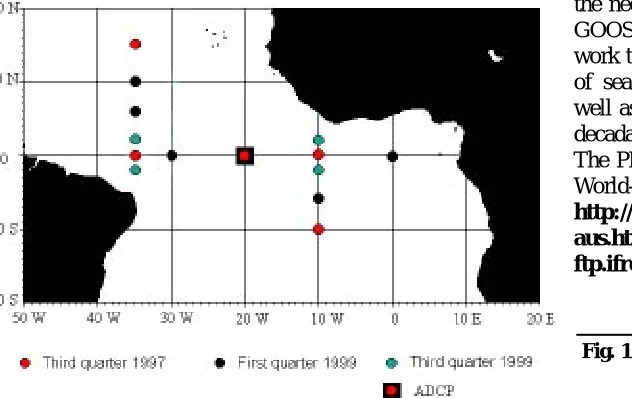
objecti-ve of PIRATA is to monitor the surface variables and up-per thermal structure of the ocean at key locations in the tropical Atlantic.The programme, which will be imple-mented as a collaborative, multinational effort, proposes the installation and maintenance of an array of 14 moored ATLAS buoys during the years 1997 to 2000 (Figure 1). This specific configuration has been chosen to provide coverage along the equator of regions of strong wind for-cing in the western basin, and significant seasonal-to-in-terannual variability in SST in the central and eastern basin. The meridional arrays cover the regions of high va-riability associated with the trans-equatorial dipole mode of SST variability.
For the pilot study, the ATLAS mooring systems will be built by NOAA/PMEL in Seattle, USA. The logistic sup-port in terms of shiptime for developing and maintaining the PIRATA moored array will be mainly the responsibili-ty of Brazil and France (about 50 days per year of shipti-me for servicing the entire array). The shipti-measureshipti-ments will be transmitted via satellite in real-time, and will be available to all interested users in the research or opera-tional communities. PIRATA can be considered as a pilot expansion in the Atlantic of the TAO system which was successfully implemented in the Pacific during the TOGA years and continues to operate with great success.
As is the case for the TAO programme, the PIRATA pro-gramme is not conceived as an observing system in isola-tion. The main role of PIRATA is to complement existing and other observing system planned for the tropical At-lantic, and which together will facilitate the initialization and validation of a wide range of model-based experi-ments and predictions. It is anticipated that PIRATA will provide a focus for many scientific collaborations within and between national and international programmes addressing the tropical Atlantic region. The three years of measurements proposed for the pilot array will only pro-vide a minimum of data for the study of seasonal to in-terannual variations in the tropical Atlantic. Yet confidence is high that PIRATA will demonstrate the need to establish, under auspices of CLIVAR, GOOS and GCOS, a longer term monitoring net-work that will address more completely the nature of seasonal to interannual climate variability, as well as the processes associated with longer term, decadal scale climate variability. The PIRATA electronic document is available via World-Wide-Web at:
http://www.ifremer.fr/orstom/pirata/pirat-aus.html, or directly via anonymous ftp at: ftp.ifremer.fr/ifremer/orstom/pirata30.rtf.Z
[image:10.595.40.356.580.779.2]Jacques Servain
V
olume 1 No. 4, December1996
CLIVAR
- Exchanges
The first session of the CLIVAR Monsoon Panel, chaired by Dr. Bill Lau and Prof. Akimasa Sumi, was held in Goa, India, from 19-22 November, 1996, overlapping with the 5th session of the TAO Implementation Panel. The Mon-soon Panel session was formally opened by Mr. N. R. Na-yak, who warmly welcomed the participants on behalf of Dr. Desa, Director of the Indian National Institute of Oce-anography (NIO), the local host for the two meetings. While several Panel members were unable to attend due to other commitments and travel constraints, the combina-tion of the meetings (participants pictured above) helped make up for some of this loss of expertise.
The work of the Monsoon Panel session began with an overview of the current status of CLIVAR by the Director of the ICPO, who stressed the urgency for outlining a CLIVAR initiative on the Asian-Australian Monsoon. CLIVAR, with its legacy deeply rooted in TOGA and WOCE, had enormous potential to bring new dimensions to the existing national and regional activities on the mon-soon. Chiefly these were the capacity for developing a global perspective on monsoons and the experience to in-corporate a coherent ocean component into the study of monsoon structures and variability.
To assist in defining an overall structure of monsoon cli-matology, Dr. Lau described the monsoon being compri-sed of ‘fast’ atmospheric and ‘slow’ oceanic/land systems that interacted at various intermediate timescales through processes that coupled the atmosphere with the land and with the adjacent oceans. Many of the phenomena asso-ciated with the ‘fast/slow’ system are manifested in the form of ‘intra-seasonal oscillations’ (ISOs), such as the 30-60 day Madden-Julian Oscillation (MJO), a quasi peri-odic set of waves of disturbed weather that can be tracked moving eastward in low latitudes from the Indian Ocean region, through the longitudes of the maritime continent, and into the Pacific Ocean. The character of a summer monsoon in any given year could generally be classified as ‘strong’ or ‘weak’ depending on the relative frequency
the Asian-Australian-African monsoon in the climate system
• the relative contribution of the slowly varying boundary conditions and the internal dynamics, and
• the impact of the monsoon on the predictability of the global climate system.
To achieve these goals, the initiative would need to fulfil the following objectives:
1. To document the spatial and temporal variability of the monsoon system for intraseasonal, interannual and de-cadal time scales.
2. To describe the mechanisms of the annual cycle in the monsoon system.
3. To determine the mechanisms of the intra-seasonal oscillations (ISOs) affecting the monsoon regions. 4. To determine the fundamental roles and mechanisms
in ENSO-coupling, including the tropospheric biennial oscillation (TBO) and interdecadal modulations. 5. To determine the relative roles of ocean processes in
different oceans, and land-surface processes in deter-mining monsoon variability.
6. To describe the relative contribution of ‘chaotic’ (~lo-cal, internal atmosphere) vs. deterministic (~lower boundary condition) processes in monsoon variability. 7. To determine how tropical-extratropical and
tro-pospheric-stratospheric interactions influence mon-soon variability.
In view of the importance of the ISOs to monsoon clima-tology, it was agreed that a study of them would form a key component of the first phase of the CLIVAR initiati-ve. A related aspect that would also require early attention is the determination of any potential skill in predicting the annual onset of a wet monsoon. While the overall list of objectives is quite daunting, the Panel was reminded of the many existing efforts on the of a national and regional nature that could be linked to and made an integral part of the CLIVAR initiative.
Michael Coughlan
CLIVAR Monsoon Panel - First Session
of active and break periods as-sociated with the passage of in-tra-seasonal disturbances. To begin the process of draf-ting an implementation plan for a CLIVAR Asian/Austra-lian monsoon initiative, the Pa-nel set about defining the priority science issues. After considerable discussion, a set of commensurate goals and ob-jectives were drawn up. The goals of the CLIVAR Asian/Australian monsoon in-itiative are the determination of:CLIVAR
- Exchanges
V
olume 1 No. 4, December1996
CLIVAR - Exchanges
Newsletter of the Climate Variability and Predictability Programme (CLIVAR), published by the International CLIVAR Project Office, c/o Max-Planck-Institut für Meteorologie, Bundesstr. 55, D-20146 Hamburg, Germany, Tel.: +49-40-41173-412, Fax.: +49-40-41173-413, e-mail : [email protected]
ISSN No.: 1026 - 0471 Note on Copyright
Permission to use any scientific material (text as well as figures) published in CLIVAR-Exchanges should be obtained from the authors.
CLIVAR
Calendar
ICPO can provide further information about the meetings on this calendar
Date Meeting Location Attendance
Feb 2-7 American Meteorological Society, 77th Annual Meeting
Long Beach, CA, USA Open
Feb 24-28 First WMO International Workshop on Monsoon Studies
Denpasar, Bali, Indo-nesia
Open
Mar 3-7 Atmospheric Radiation Measurement (ARM) Pro-gram Science Team Meeting, 7th Session
San Antonio, TX, USA
Limited
Mar 17-21 Joint Scientific Committee for the World Climate Research Programme, 18th Session
Toronto, Canada Invitation
Apr 7-11 5th International Conference on Southern Hemi-sphere Meteorology and Oceanography
Pretoria, South Africa Open
Apr 9-11 Euroclivar workshop on Cloud feedbacks and Cli-mate Change
Bracknell, UK Invitation
Apr 20-27 First GKSS Spring School : Anthropogenic Climate Change
Lauenburg, Germany Limited
Apr 21-25 European Geophysical Society, XXII Meeting Vienna, Austria Open
Apr 23-24 Third Euroclivar committee meeting (in conjunction with EGS)
Vienna, Austria Invitation
Apr 28-May 2 CLIVAR SSG 6th session Washington DC, USA Invitation
May 12-15 CLIVAR NEG-1, Second Session Palisades (N.Y), USA Invitation
May 12-14 Oceanology International 97: Pacific Rim Singapore Open
May 19-23 American Meteorological Society, Tropical Meteo-rology Conference
Fort Collins, CO, USA Open
Please return to the International CLIVAR Project Office by mail or email ([email protected])
Special requests :
Change of address
Please send CLIVAR-Exchanges to the following address : Remove as recipient
Name :
(Title) (First) (M.I.) (Last)
Organization :
Mailing address:
City: State: Zip: Country:
Telephone: Fax:
E-mail address:
❑
❑
❑