Review Article
The effect of Mobi-C cervical total disc replacement
versus ACDF in symptomatic degenerative disc
disease: a meta-analysis of randomized controlled trials
Weineng Xiang, Langtao Shi, Chengming Jiang, Ye Tang, Lin Jiang
Department of Spine Surgery, The First Hospital of Changsha, Changsha 410011, P. R. China
Received June 14, 2017; Accepted December 24, 2017; Epub April 15, 2018; Published April 30, 2018
Abstract: Introduction: The efficacy of total disc replacement (TDR) using Mobi-C cervical artificial disc for treat
-ing symptomatic degenerative disc disease remained controversial. We conducted a systematic review and meta-analysis to compare the efficacy and safety of Mobi-C cervical artificial disc versus anterior cervical discectomy and fusion (ACDF) in symptomatic degenerative disc disease. Methods: We searched PubMed, EMbase, Web of science, EBSCO, and Cochrane library databases through September 2017 for randomized controlled trials (RCTs) assessing the effect of Mobi-C versus ACDF on symptomatic degenerative disc disease. Meta-analysis was performed using the random-effect model. Results: Six RCTs involving 731 patients were included in the meta-analysis. Overall, compared with ACDF treatment for symptomatic degenerative disc disease, TDR using Mobi-C resulted in signifi
-cantly increased NDI score (Std. mean difference =0.33; 95% CI=0.18 to 0.49; P<0.0001) and NDI success rate (RR=1.36; 95% CI=1.16 to 1.61; P=0.0002), decreased reoperation (RR=0.25; 95% CI=0.16 to 0.39; P<0.00001) and adverse events than ACDF treatment (RR=0.53; 95% CI=0.38 to 0.73; P=0.0001), but demonstrated no signifi
-cant influence on pain scores (Std. mean difference =0.11; 95% CI=-0.05 to 0.27; P=0.19), blood loss (Std. mean difference =-0.78; 95% CI=-1.89 to 0.32; P=0.16), duration of surgery (Std. mean difference =0.17; 95% CI=-0.27 to 0.60; P=0.45), hospital stay (Std. mean difference =-0.14; 95% CI=-0.32 to 0.04; P=0.13). Conclusions: Mobi-C treatment resulted in a significantly improved NDI score and NDI success rate, decreased reoperation and adverse events compared to ACDF surgery in symptomatic degenerative disc disease.
Keywords: Mobi-C, total disc replacement (TDR), anterior cervical discectomy and fusion (ACDF), symptomatic degenerative disc disease, meta-analysis
Introduction
Anterior cervical discectomy and fusion (ACDF)
is widely accepted as the standard surgical
procedure for cervical disc decompression for
symptomatic degenerative disc disease and
can decompress affected neural components,
provide mechanical stability and lordosis, and
preserve intradiscal height [1-3]. However, AC-
DF has some limitations such as the increase in
motion, shear strain, and intradiscal pressure
in adjacent vertebrae [4-6]. Patients treated
with ACDF are reported to result in increased
rates of adjacent-segment degeneration be-
cause of force and motion translocation [4,
7-9].
Cervical total disc replacement (TDR) is a
treat-ment option for symptomatic radiculopathy and
myelopathy. Many studies have reported that
for one-level and two-levels cervical
decom-pression [10-14]. The Mobi-C cervical artificial
disc (LDR Medical; Troyes, France) consists of 2
cobalt-chromium-molybdenum alloy endplates
and an ultra-high-molecular-weight polyethyl
-ene mobile insert and allows 5 independent
degrees of freedom [15, 16]. Some RCTs have
reported cervical TDR using Mobi-C is able to
significantly improve neck disability index (NDI)
score, patient satisfaction, and reoperation co-
mpared to ACDF in symptomatic degenerative
disc disease [16-18].
However, the use of Mobi-C has not been well
established. Recently, several studies on the
topic have been published, and the results have
2933
Int J Clin Exp Med 2018;11(4):2932-2939
Materials and methods
Ethical approval and patient consent were not
required because this was a systematic review
and meta-analysis of previously published stud
-ies. The systematic review and meta-analysis
were conducted and reported in adherence to
PRISMA (Preferred Reporting Items for
Syste-matic Reviews and Meta-Analyses) [21].
Search strategy and study selection
Two investigators independently searched the
following databases (inception to September
2017): PubMed, EMbase, Web of science,
EBSCO, and Cochrane library databases. The
electronic search strategy was conducted using
the following keywords: Mobi-C or total disc
replacement, and anterior cervical discectomy
and fusion or ACDF. We also checked the refer
-ence lists of the screened full-text studies to
identify other potentially eligible trials.
Inclusive selection criteria were as follows: (i)
population: patients with symptomatic degen
-erative disc disease; (ii) intervention: TDR using
Mobi-C; (iii) comparison: ACDF; (iv) outcome
measure: neck disability index (NDI) score and
NDI success rate; and (v) study design: RCT.
Data extraction and outcome measures
We extracted the following information: author,
number of patients, population, age of patients,
setting, type of control, and the experience of
operators. Data were extracted independently
by two investigators, and discrepancies were
resolved by consensus. We contacted the cor
-responding author to obtain the data when
nec-essary. No simplifications and assumptions
were made. The primary outcomes were NDI
score and NDI success rate. Secondary out
-comes included reoperation, pain scores, blood
loss, duration of surgery, hospital stay, and
adverse events.
NDI success was defined as an improvement of
at least 30 points for patients with a baseline
NDI score of at least 60 or as an improvement
of at least 50% from baseline for patients with
a baseline NDI score less than 60 [22].
Quality assessment in individual studies
Methodological quality of the included studies
was independently evaluated using the modi
-fied Jadad scale [23]. There was 3 items for
Jadad scale: randomization (0-2 points), blind
-ing (0-2 points), dropouts and withdrawals (0-1
points). The score of Jadad Scale varied from 0
to 5 points. An article with Jadad score ≤ 2 was
considered to be of low quality. If the Jadad
score ≥ 3, the study was thought to be of high
quality [24].
Statistical analysis
We estimated the relative risk (RR) with 95%
confidence interval (CI) for dichotomous out
-comes (NDI success rate, reoperation, pain
scores, adverse events), and standard Mean
differences (Std. MDs) with 95% CI for
con-tinuous outcomes (NDI score, blood loss,
dura-tion of surgery, hospital stay). A random-effects
model was used regardless of heterogeneity.
Heterogeneity was reported using the I
2statis-tic, and I
2> 50% indicated significant heteroge
-neity [25]. Whenever significant heteroge-neity
was present, we searched for potential sources
of heterogeneity via omitting one study in turn
for the meta-analysis or performing subgroup
analysis. Publication bias was not evaluated
because of the limited number (<10) of includ
-ed studies. All statistical analyses were per
-formed using Review Manager Version 5.3
(The Cochrane Collaboration, Software Update,
Oxford, UK).
Results
Literature search, study characteristics and
quality assessment
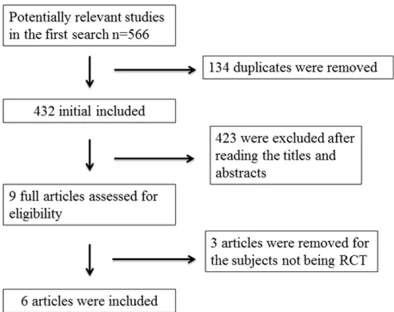
A detailed flowchart of the search and selection
[image:2.612.90.287.71.227.2]results was shown in
Figure 1
. 566 potentially
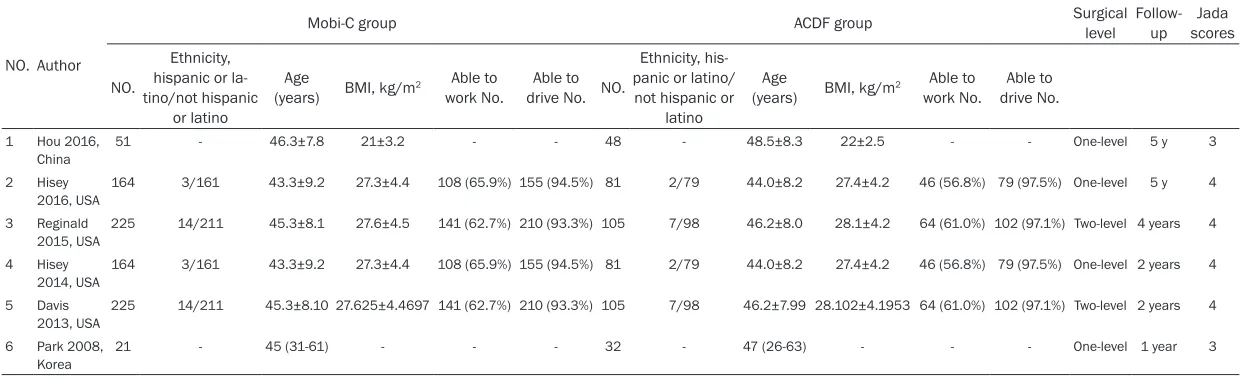
Table 1.
Characteristics of included studies
NO. Author
Mobi-C group ACDF group Surgical level Follow-up scoresJada
NO.
Ethnicity,
hispanic or la-tino/not hispanic
or latino
Age
(years) BMI, kg/m2 work No.Able to drive No. NO.Able to
Ethnicity, his -panic or latino/
not hispanic or latino
Age
(years) BMI, kg/m2 work No.Able to drive No.Able to
1 Hou 2016,
China 51 - 46.3±7.8 21±3.2 - - 48 - 48.5±8.3 22±2.5 - - One-level 5 y 3
2 Hisey
2016, USA 164 3/161 43.3±9.2 27.3±4.4 108 (65.9%) 155 (94.5%) 81 2/79 44.0±8.2 27.4±4.2 46 (56.8%) 79 (97.5%) One-level 5 y 4
3 Reginald 2015, USA
225 14/211 45.3±8.1 27.6±4.5 141 (62.7%) 210 (93.3%) 105 7/98 46.2±8.0 28.1±4.2 64 (61.0%) 102 (97.1%) Two-level 4 years 4
4 Hisey 2014, USA
164 3/161 43.3±9.2 27.3±4.4 108 (65.9%) 155 (94.5%) 81 2/79 44.0±8.2 27.4±4.2 46 (56.8%) 79 (97.5%) One-level 2 years 4
5 Davis
2013, USA 225 14/211 45.3±8.10 27.625±4.4697 141 (62.7%) 210 (93.3%) 105 7/98 46.2±7.99 28.102±4.1953 64 (61.0%) 102 (97.1%) Two-level 2 years 4 6 Park 2008,
2935
Int J Clin Exp Med 2018;11(4):2932-2939
relevant articles were identified initially. Finally,
six RCTs that met our inclusion criteria were
included in the meta-analysis [16-20, 26].
The baseline characteristics of the six eligible
RCTs in the meta-analysis were summarized
in
Table 1
. The six studies were published
between 2008 and 2016, and sample sizes
ranged from 53 to 330 with a total of 731. Two
same patient samples were studied in different
follow-up time and published by Hisey [18, 20]
and Davis [16, 17]. There were similar age, BMI,
work status and driving status in patients at
baseline. Of these six RCTs, four studies
report-ed one-level total disc [18-20, 26] and two
studies reported two-level total disc [16, 17] for
analysis. And the follow-up time varied from 1
year to 5 years.
Among the six studies included here, three
studies reported the NDI score [16, 17, 19], two
studies reported the NDI success rate [16, 17],
four studies reported the reoperation [16-19],
two studies reported the pain scores [17, 19],
three studies reported the blood loss, duration
of surgery and hospital stay [16, 19, 20], five
studies reported the adverse events [16-18,
20, 26].
Primary outcomes: NDI score and NDI success
rate
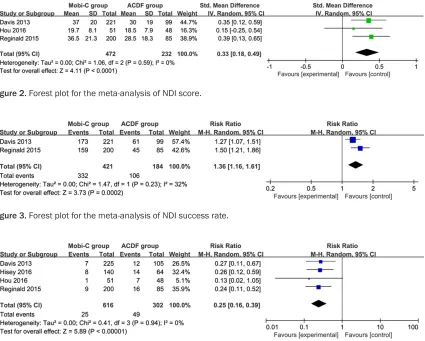
These two outcome data were analyzed with
a random-effects model, and the pooled
esti-mate of the three included RCTs suggested that
compared to ACDF, Mobi-C treatment could
sig-nificantly improve NDI score (Std. mean differ
-ence =0.33; 95% CI=0.18 to 0.49; P<0.0001)
for symptomatic degenerative disc disease,
with no heterogeneity among the studies (I
2=
0%, heterogeneity P=0.59) (
Figure 2
). Con-
sistently, TDR using Mobi-C resulted in signifi
-cantly increased NDI success rate (RR=1.36;
95% CI=1.16 to 1.61; P=0.0002), with low het
-erogeneity among the studies (I
2=32%, hetero
[image:4.612.97.522.71.412.2] [image:4.612.90.520.72.146.2]
-geneity P=0.23) (
Figure 3
).
Figure 2. Forest plot for the meta-analysis of NDI score.Figure 3. Forest plot for the meta-analysis of NDI success rate.
[image:4.612.89.530.310.411.2]Sensitivity analysis
Low heterogeneity or no heterogeneity was
observed among the included studies for NDI
score and NDI success rate. Thus, we did not
perform sensitivity analysis by omitting one
study in each turn to detect the source of
heterogeneity.
Secondary outcomes
Compared with ACDF in symptomatic degener
-ative disc disease, TDR using Mobi-C resulted
in significantly decreased reoperation (RR=
0.25; 95% CI=0.16 to 0.39; P<0.00001;
Figure
4
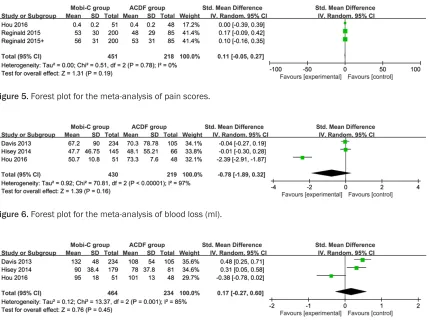
), but showed no notable influence on pain
scores (Std. mean difference =0.11; 95%
CI=-0.05 to 0.27; P=0.19;
Figure 5
), blood loss
(Std. mean difference =-0.78; 95% CI=-1.89 to
0.32; P=0.16;
Figure 6
), duration of surgery
(Std. mean difference =0.17; 95% CI=-0.27 to
0.60; P=0.45;
Figure 7
), hospital stay (Std.
mean difference =-0.14; 95% CI=-0.32 to 0.04;
P=0.13;
Figure 8
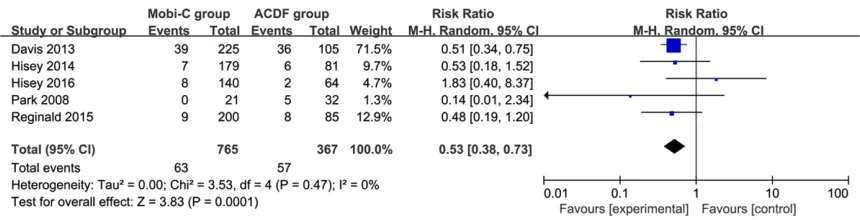
). In addition, Mobi-C
treat-ment led to remarkably reduced adverse events
than ACDF treatment (RR=0.53; 95% CI=0.38
to 0.73; P=0.0001;
Figure 9
).
Discussion
Short- and long-term studies have reported
greater improvements in NDI, neck pain, and
arm pain in TDR populations compared to ACDF,
but the significance of these results remain
controversial [12, 27-30]. Single-level TDR
clini-cal trials indicate that TDR may result in a lower
incidence of secondary operations [12, 29, 31].
For example, a 2-fold increase in secondary
surgery rates in patients with one-level ACDF
was revealed compared with Bryan cervical
disc replacement [32]. Our meta-analysis sug
-gested that compared to ACDF treatment for
symptomatic degenerative disc diseases, TDR
using Mobi-C was able to significantly improve
NDI score and NDI success rate, reduce
reop-eration and adverse events, but with no
nota-ble influence on pain scores, blood loss, dura
[image:5.612.95.524.69.396.2]-tion of surgery and hospital stay.
[image:5.612.92.520.71.147.2]Figure 5. Forest plot for the meta-analysis of pain scores.
Figure 6. Forest plot for the meta-analysis of blood loss (ml).
[image:5.612.92.523.307.387.2]2937
Int J Clin Exp Med 2018;11(4):2932-2939
The safety and effectiveness of TDR has been
proved based on many studies at different fol
-low-up periods [12, 32]. TDR has an important
advantage over ACDF with regard to motion
preservation. ACDF eliminates motion at
treat-ed levels, while TDR has preservtreat-ed segment
mobility with high success [29, 32]. TDR may
reduce the incidence of adjacent-segment de-
generation compared with ACDF due to
main-tain segmental motion and stress profiles
[33-35]. In one RCT involving one-level arm, there
were 4 times fewer TDR patients requiring a
subsequent operation at adjacent levels after
Mobi-c treatment than ACDF [16].
Similar results were revealed in the 2-level arm
for adjacent-level surgeries. In a long-term TDR
study with the Prestige artificial cervical disc,
TDR patients resulted in a lower rate of
second-ary surgeries involving adjacent segments com
-pared with ACDF controls (TDR 2.9% versus
ACDF 4.9%) [12]. Mummaneni et al. also report
-ed that TDR population demonstrat-ed a
statis-tically significant decrease in secondary opera
-tions because of adjacent segments (TDR
2/276 versus ACDF 9/265) [29]. One included
RCT reported a significantly greater rate of
adjacent-segment degeneration at both the
inferior and superior index levels for 2-level
ACDF compared with TDR using Mobi-C for
symptomatic degenerative disc disease at 4
years [17]. The rate of adjacent-level operations
was similar between one-level and two-level
ACDF or TDR groups.
This meta-analysis has several potential limita
-tions that should be taken into account.. Firstly,
our analysis is based on only four RCTs and two
of them had a relatively small sample size
(n<100). Overestimation of the treatment effect
is more likely in smaller trials compared with
larger samples. Next, pooling results may be
affected by different follow-up periods (ranging
from 1 year to 5 years) and longer follow-up
time is needed to confirm the efficacy of Mobi-C
treatment. Finally, although there is no hetero
-geneity among the reviewed studies, different
operation levels may have a potential impact
on our results.
Conclusions
TDR patients with Mobi-C demonstrated signifi
-cantly increased function and reduced reopera
-tion and adverse events for symptomatic
degenerative disc disease. TDR using Mobi-C
was recommended to be administrated in
clini-cal work.
Disclosure of conflict of interest
[image:6.612.91.519.73.150.2]None.
Figure 8. Forest plot for the meta-analysis of hospital stay (days). [image:6.612.91.521.188.298.2]Abbreviations
TDR, Total disc replacement; ACDF, Artificial
disc and anterior cervical discectomy and
fu-sion; RCTs, Randomized controlled trials; NDI,
Neck disability index; Std. MDs, Standard mean
differences.
Address correspondence to: Lin Jiang, Department
of Spine Surgery, The First Hospital of Changsha, NO.67, Shuitang Street, Furong District, Changsha 410011, P. R. China. Tel: 13017396625; E-mail: [email protected]
References
[1] Silber JS, Anderson DG, Daffner SD, Brislin BT, Leland JM, Hilibrand AS, Vaccaro AR and Albert
TJ. Donor site morbidity after anterior iliac
crest bone harvest for single-level anterior
cer-vical discectomy and fusion. Spine (Phila Pa 1976) 2003; 28: 134-139.
[2] Buttermann GR. Anterior Cervical Discectomy
and Fusion Outcomes over 10 Years: A
Pro-spective Study. Spine (Phila Pa 1976) 2018;
43: 207-214.
[3] van Eck CF, Regan C, Donaldson WF, Kang JD,
Lee JY. The revision rate and occurrence of ad-jacent segment disease after anterior cervical
discectomy and fusion: a study of 672 consec
-utive patients. Spine (Phila Pa 1976) 2014; 39:
2143-2147.
[4] Elsawaf A, Mastronardi L, Roperto R, Bozzao A, Caroli M and Ferrante L. Effect of cervical dy -namics on adjacent segment degeneration af-ter anaf-terior cervical fusion with cages. Neuro-surg Rev 2009; 32: 215-224; discussion 224. [5] Mendoza-Lattes S. Cervical disc replacement:
are we there yet? Commentary on an article by
Michael E. Janssen, DO, et al.: “ProDisc-C total disc replacement versus anterior cervical
dis-cectomy and fusion for single-level symptom
-atic cervical disc disease. Seven-year follow-up of the prospective randomized U.S. Food and
Drug Administration investigational device
ex-emption study”. J Bone Joint Surg Am 2015;
97: e71.
[6] Murrey D, Janssen M, Delamarter R, Goldstein J, Zigler J, Tay B and Darden B. Results of the prospective, randomized, controlled
multicen-ter Food and Drug Administration
investiga-tional device exemption study of the ProDisc-C
total disc replacement versus anterior
discec-tomy and fusion for the treatment of 1-level symptomatic cervical disc disease. Spine J 2009; 9: 275-286.
[7] Bydon M, Xu R, Macki M, De la Garza-Ramos R, Sciubba DM, Wolinsky JP, Witham TF, Gokaslan ZL and Bydon A. Adjacent segment disease af
-ter an-terior cervical discectomy and fusion in a large series. Neurosurgery 2014; 74: 139-146 discussion 146.
[8] Hilibrand AS and Robbins M. Adjacent seg-ment degeneration and adjacent segseg-ment
disease: the consequences of spinal fusion?
Spine J 2004; 4: 190S-194S.
[9] Janssen ME, Zigler JE, Spivak JM, Delamarter
RB, Darden BV, 2nd and Kopjar B. ProDisc-C total disc replacement versus anterior cervical
discectomy and fusion for single-level symp
-tomatic cervical disc disease: seven-year fol
-low-up of the prospective randomized U.S.
Food and Drug Administration investigational
device exemption study. J Bone Joint Surg Am
2015; 97: 1738-1747.
[10] Beaurain J, Bernard P, Dufour T, Fuentes JM,
Hovorka I, Huppert J, Steib JP, Vital JM, Au -bourg L and Vila T. Intermediate clinical and radiological results of cervical TDR (Mobi-C)
with up to 2 years of follow-up. Eur Spine J
2009; 18: 841-850.
[11] Lanman TH, Burkus JK, Dryer RG, Gornet MF,
McConnell J and Hodges SD. Long-term clinical and radiographic outcomes of the Prestige LP
artificial cervical disc replacement at 2 levels: results from a prospective randomized con -trolled clinical trial. J Neurosurg Spine 2017; 27: 7-19.
[12] Burkus JK, Haid RW, Traynelis VC and Mum -maneni PV. Long-term clinical and radiograph-ic outcomes of cervradiograph-ical disc replacement with the Prestige disc: results from a prospective
randomized controlled clinical trial. J Neuro -surg Spine 2010; 13: 308-318.
[13] Davis RJ, Nunley PD, Kim KD, Hisey MS, Jack -son RJ, Bae HW, Hoffman GA, Gaede SE, Dan-ielson GO 3rd, Gordon C and Stone MB. Two-level total disc replacement with Mobi-C cer-
vical artificial disc versus anterior discectomy and fusion: a prospective, randomized, con
-trolled multicenter clinical trial with 4-year fol -low-up results. J Neurosurg Spine 2015; 22: 15-25.
[14] Lei T, Liu Y, Wang H, Xu J, Ma Q, Wang L and
Shen Y. Clinical and radiological analysis of Bryan cervical disc arthroplasty: eight-year fol -low-up results compared with anterior cervical
discectomy and fusion. Int Orthop 2016; 40:
1197-1203.
[15] Jackson RJ, Davis RJ, Hoffman GA, Bae HW, Hisey MS, Kim KD, Gaede SE and Nunley PD. Subsequent surgery rates after cervical total
disc replacement using a Mobi-C Cervical Disc
Prosthesis versus anterior cervical discectomy and fusion: a prospective randomized clinical trial with 5-year follow-up. J Neurosurg Spine 2016; 24: 734-745.
-2939
Int J Clin Exp Med 2018;11(4):2932-2939
terson DL and Stokes JK. Cervical total discreplacement with the Mobi-C cervical artificial disc compared with anterior discectomy and fusion for treatment of 2-level symptomatic de -generative disc disease: a prospective,
ran-domized, controlled multicenter clinical trial:
clinical article. J Neurosurg Spine 2013; 19: 532-545.
[17] Reginald J. Davis, Pierce Dalton Nunley, Kee D. Kim, Michael S. Hisey, Robert J. Jackson, Hyun W. Bae, Gregory A. Hoffman, Steven E. Gaede, Guy O. Danielson III, Charles Gordon and Mar -cus B. Stone. Two-level total disc replacement
with Mobi-C cervical artificial disc versus ante
-rior discectomy and fusion: a prospective, ran
-domized, controlled multicenter clinical trial with 4-year follow-up results. J Neurosurg Spin
2015; 22: 15-25.
[18] Hisey MS, Zigler JE, Jackson R, Nunley PD, Bae
HW, Kim KD and Ohnmeiss DD. Prospective,
randomized comparison of one-level Mobi-C
cervical total disc replacement vs. Anterior
cer-vical discectomy and fusion: results at 5-year follow-up. Int J Spine Surg 2016; 10: 10.
[19] Hou Y, Nie L, Pan X, Si M, Han Y, Li J and Zhang
H. Effectiveness and safety of Mobi-C for treat
-ment of single-level cervical disc spondylosis:
a randomised control trial with a minimum of
five years of follow-up. Bone Joint J 2016;
98-B: 829-833.
[20] Hisey MS, Bae HW, Davis R, Gaede S, Hoffman G, Kim K, Nunley PD, Peterson D, Rashbaum R, Stokes J. Multi-center, prospective, random
-ized, controlled investigational device exemp -tion clinical trial comparing Mobi-C cervical
artificial disc to anterior discectomy and fusion in the treatment of symptomatic degenerative
discdisease in the cervical spine. Int J Spine Surg 2014; 8.
[21] Moher D, Liberati A, Tetzlaff J, Altman DG and Group P. Preferred reporting items for system
-atic reviews and meta-analyses: the PRISMA statement. J Clin Epidemiol 2009; 62:
1006-1012.
[22] Carreon LY, Glassman SD, Campbell MJ and
Anderson PA. Neck Disability Index, short form-36 physical component summary, and pain scales for neck and arm pain: the minimum clinically important difference and substan-tial clinical benefit after cervical spine fusion. Spine J 2010; 10: 469-474.
[23] Jadad AR, Moore RA, Carroll D, Jenkinson C, Reynolds DJM, Gavaghan DJ and McQuay HJ. Assessing the quality of reports of randomized clinical trials: is blinding necessary? Control Clin Trials 1996; 17: 1-12.
[24] Kjaergard LL, Villumsen J and Gluud C.
Report-ed methodologic quality and discrepancies between large and small randomized trials in meta-analyses. Ann Intern Med 2001; 135:
982-989.
[25] Higgins JP and Thompson SG. Quantifying het
-erogeneity in a meta-analysis. Stat Med 2002;
21: 1539-1558.
[26] Park JH, Roh KH, Cho JY, Ra YS, Rhim SC and Noh SW. Comparative analysis of cervical ar
-throplasty using Mobi-C® and anterior cervical
discectomy and fusion using the Solis® -cage. J
Korean Neurosurg Soc 2008; 44: 217-221. [27] Garrido BJ, Taha TA and Sasso RC. Clinical
outcomes of Bryan cervical disc arthroplasty a prospective, randomized, controlled, single
site trial with 48-month follow-up. J Spinal
Dis-ord Tech 2010; 23: 367-371.
[28] Sasso RC, Smucker JD, Hacker RJ and Heller
JG. Clinical outcomes of BRYAN cervical disc
arthroplasty: a prospective, randomized, con -trolled, multicenter trial with 24-month follow-up. J Spinal Disord Tech 2007; 20: 481-491. [29] Mummaneni PV, Burkus JK, Haid RW, Traynelis
VC and Zdeblick TA. Clinical and radiographic analysis of cervical disc arthroplasty compared with allograft fusion: a randomized controlled clinical trial. J Neurosurg Spine 2007; 6:
198-209.
[30] Ren C, Song Y, Xue Y and Yang X. Mid- to
long-term outcomes after cervical disc arthroplasty compared with anterior discectomy and fusion: a systematic review and meta-analysis of ran
-domized controlled trials. Eur Spine J 2014;
23: 1115-1123.
[31] Upadhyaya CD, Wu JC, Trost G, Haid RW, Traynelis VC, Tay B, Coric D and Mummaneni PV. Analysis of the three United States Food
and drug administration investigational device
exemption cervical arthroplasty trials. J Neuro
-surg Spine 2012; 16: 216-228.
[32] Sasso RC, Smucker JD, Hacker RJ and Heller JG. Artificial disc versus fusion: a prospective, randomized study with 2-year follow-up on 99 patients. Spine (Phila Pa 1976) 2007; 32:
2933-2940; discussion 2941-2932.
[33] Kim SW, Limson MA, Kim SB, Arbatin JJ, Chang
KY, Park MS, Shin JH and Ju YS. Comparison of radiographic changes after ACDF versus Bryan disc arthroplasty in single and bi-level cases.
Eur Spine J 2009; 18: 218-231.
[34] Robertson JT, Papadopoulos SM and Traynelis
VC. Assessment of adjacent-segment disease in patients treated with cervical fusion or
ar-throplasty: a prospective 2-year study. J Neuro -surg Spine 2005; 3: 417-423.
[35] Wigfield C, Gill S, Nelson R, Langdon I, Metcalf N and Robertson J. Influence of an artificial
cervical joint compared with fusion on adja-cent-level motion in the treatment of degener-ative cervical disc disease. J Neurosurg 2002;