Recurrent Attention Network on Memory for Aspect Sentiment Analysis
Peng Chen Zhongqian Sun Lidong Bing∗ Wei Yang
AI Lab Tencent Inc.
{patchen, sallensun, lyndonbing, willyang}@tencent.com
Abstract
We propose a novel framework based on neural networks to identify the sentiment of opinion targets in a comment/review. Our framework adopts multiple-attention mechanism to capture sentiment features separated by a long distance, so that it is more robust against irrelevant informa-tion. The results of multiple attentions are non-linearly combined with a recur-rent neural network, which strengthens the expressive power of our model for han-dling more complications. The weighted-memory mechanism not only helps us avoid the labor-intensive feature engineer-ing work, but also provides a tailor-made memory for different opinion targets of a sentence. We examine the merit of our model on four datasets: two are from Se-mEval2014, i.e. reviews of restaurants and laptops; a twitter dataset, for testing its performance on social media data; and a Chinese news comment dataset, for testing its language sensitivity. The experimental results show that our model consistently outperforms the state-of-the-art methods on different types of data.
1 Introduction
The goal of aspect sentiment analysis is to iden-tify the sentiment polarity (i.e., negative, neutral, or positive) of a specific opinion target expressed in a comment/review by a reviewer. For exam-ple, in “I bought a mobile phone, its camera is wonderful but the battery life is short”, there are three opinion targets, “camera”, “battery life”, and “mobile phone”. The reviewer has a positive senti-ment on the “camera”, a negative sentisenti-ment on the
∗Corresponding author.
“battery life”, and a mixed sentiment on the “mo-bile phone”. Sentence-oriented sentiment analysis methods (Socher et al.,2011;Appel et al.,2016) are not capable to capture such fine-grained senti-ments on opinion targets.
In order to identify the sentiment of an individ-ual opinion target, one critical task is to model ap-propriate context features for the target in its orig-inal sentence. In simple cases, the sentiment of a target is identifiable with a syntactically nearby opinion word, e.g. “wonderful” for “camera”. However, there are many cases in which opinion words are enclosed in more complicated contexts. E.g., “Its camera is not wonderful enough” might express a neutral sentiment on “camera”, but not negative. Such complications usually hinder con-ventional approaches to aspect sentiment analysis. To model the sentiment of the above phrase-like word sequence (i.e. “not wonderful enough”), LSTM-based methods are proposed, such as target dependent LSTM (TD-LSTM) (Tang et al.,2015). TD-LSTM might suffer from the problem that af-ter it captures a sentiment feature far from the target, it needs to propagate the feature word by word to the target, in which case it’s likely to lose this feature, such as the feature “cost-effective” for “the phone” in “My overall feeling is that the phone, after using it for three months and consid-ering its price, is really cost-effective”.1Attention
mechanism, which has been successfully used in machine translation (Bahdanau et al., 2014), can enforce a model to pay more attention to the im-portant part of a sentence. There are already some works using attention in sentiment analysis to ex-ploit this advantage (Wang et al.,2016;Tang et al.,
2016). Another observation is that some types of
1Although LSTM could keep information for a long dis-tance by preventing the vanishing gradient problem, it usually requires a large training corpus to capture the flexible usage of parenthesis.
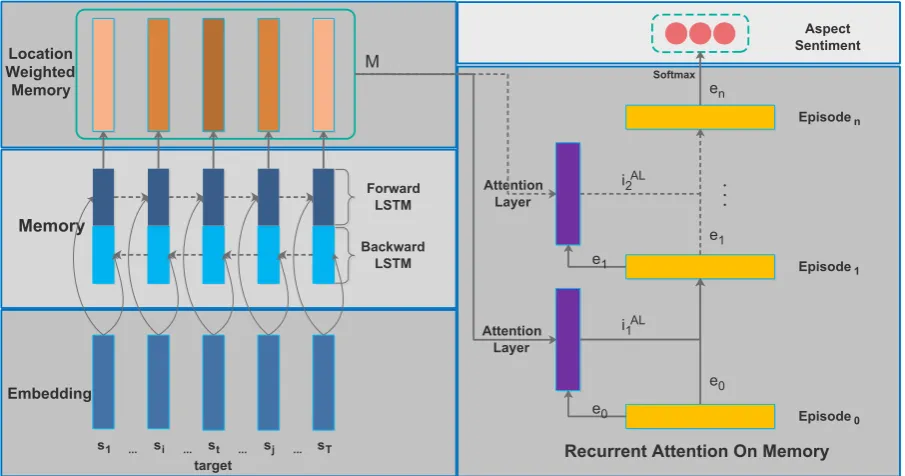
sentence structures are particularly challenging for target sentiment analysis. For example, in “Ex-cept Patrick, all other actors don’t play well”, the word “except” and the phrase “don’t play well” produce a positive sentiment on “Patrick”. It’s hard to synthesize these features just by LSTM, since their positions are dispersed. Single atten-tion based methods (e.g. (Wang et al.,2016)) are also not capable to overcome such difficulty, be-cause attending multiple words with one attention may hide the characteristic of each attended word. In this paper, we propose a novel framework to solve the above problems in target sentiment analysis. Specifically, our framework first adopts a bidirectional LSTM (BLSTM) to produce the memory (i.e. the states of time steps generated by LSTM) from the input, as bidirectional recur-rent neural networks (RNNs) were found effec-tive for a similar purpose in machine translation (Bahdanau et al., 2014). The memory slices are then weighted according to their relative positions to the target, so that different targets from the same sentence have their own tailor-made mem-ories. After that, we pay multiple attentions on the position-weighted memory and nonlinearly com-bine the attention results with a recurrent network, i.e. GRUs. Finally, we apply softmax on the out-put of the GRU network to predict the sentiment on the target.
Our framework introduces a novel way of ap-plying multiple-attention mechanism to synthesize important features in difficult sentence structures. It’s sort of analogous to the cognition procedure of a person, who might first notice part of the important information at the beginning, then no-tices more as she reads through, and finally com-bines the information from multiple attentions to draw a conclusion. For the above sentence, our model may attend the word “except” first, and then attends the phrase “don’t play well”, finally combines them to generate a positive feature for “Patrick”.Tang et al.(2016) also adopted the idea of multiple attentions, but they used the result of a previous attention to help the next attention at-tend more accurate information. Their vector fed to softmax for classification is only from the final attention, which is essentially a linear combination of input embeddings (they did not have a memory component). Thus, the above limitation of single attention based methods also holds for (Tang et al.,
2016). In contrast, our model combines the results
of multiple attentions with a GRU network, which has different behaviors inherited from RNNs, such as forgetting, maintaining, and non-linearly trans-forming, and thus allows a better prediction accu-racy.
We evaluate our approach on four datasets: the first two come from SemEval 2014 (Pontiki et al.,
2014), containing reviews of restaurant domain and laptop domain; the third one is a collection of tweets, collected by (Dong et al.,2014); to exam-ine whether our framework is language-insensitive (since languages show differences in quite a few aspects in expressing sentiments), we prepared a dataset of Chinese news comments with people mentions as opinion targets. The experimental re-sults show that our model performs well for differ-ent types of data, and consistdiffer-ently outperforms the state-of-the-art methods.
2 Related Work
The task of aspect sentiment classification belongs to entity-level sentiment analysis. Conventional representative methods for this task include rule-based methods (Ding et al., 2008) and statistic-based methods (Jiang et al., 2011; Zhao et al.,
2010). Ganapathibhotla and Liu(2008) extracted 2-tuples of (opinion target, opinion word) from comments and then identified the sentiment of opinion targets. Deng and Wiebe (2015) adopted Probabilistic Soft Logic to handle the task. There are also statistic-based approaches which employ SVM (Jiang et al., 2011) or MaxEnt-LDA (Zhao et al., 2010). These methods need either labo-rious feature engineering work or massive extra-linguistic resources.
Neural Networks (NNs) have the capability of fusing original features to generate new represen-tations through multiple hidden layers. Recursive NN (Rec-NN) can conduct semantic compositions on tree structures, which has been used for syntac-tic analysis (Socher et al.,2010) and sentence sen-timent analysis (Socher et al.,2013). (Dong et al.,
senti-s1 ... si ... st ... sj ... sT
Embedding
target
Memory
Forward LSTM
Backward LSTM
Location Weighted Memory
Attention Layer
Attention Layer
Episode0 Episode1 Episoden
Recurrent Attention On Memory
Aspect Sentiment
Softmax
...
i1AL
i2AL
e0
e0
e1 e1
en
[image:3.595.73.526.64.302.2]M
Figure 1: Model architecture. The dotted lines on the right indicate a layer may or may not be added.
ment of a clause which is then used to infer the sentiment of the target. The method has an as-sumption that an opinion word and its target lie in the same clause. TD-LSTM (Tang et al.,2015) utilizes LSTM to model the context information of a target by placing the target in the middle and propagating the state word by word from the be-ginning and the tail to the target respectively to capture the information before and after it. Never-theless, TD-LSTM might not work well when the opinion word is far from the target, because the captured feature is likely to be lost ((Cho et al.,
2014) reported similar problems of LSTM-based models in machine translation).
(Graves et al., 2014) introduced the concept of memory for NNs and proposed a differentiable process to read and write memory, which is called Neural Turing Machine (NTM). Attention mech-anism, which has been used successfully in many areas (Bahdanau et al., 2014;Rush et al., 2015), can be treated as a simplified version of NTM be-cause the size of memory is unlimited and we only need to read from it. Single attention or multiple attentions were applied in aspect sentiment clas-sification in some previous works (Wang et al.,
2016;Tang et al.,2016). One difference between our method and (Tang et al., 2016) is that we in-troduce a memory module between the attention module and the input module, thus our method can synthesize features of word sequences such as
sentiment phrases (e.g. “not wonderful enough”). More importantly, we combine the results of at-tentions in a nonlinear way. (Wang et al., 2016) only uses one attention, while our model uses mul-tiple attentions. The effectiveness of mulmul-tiple at-tentions was also investigated in QA task (Kumar et al.,2015), which shows that multiple attentions allow a model to attend different parts of the input during each pass. (Kumar et al.,2015) assigns at-tention scores to memory slices independently and their attention process is more complex, while we produce a normalized attention distribution to at-tend information from the memory.
3 Our Model
The architecture of our model is shown in Fig-ure1, which consists of five modules: input mod-ule, memory modmod-ule, position-weighted memory module, recurrent attention module, and output module. Suppose the input sentence is s = {s1, . . . , sτ−1, sτ, sτ+1, . . . , sT}, the goal of our
model is to predict the sentiment polarity of the targetsτ. For simplicity, we notate a target as one
word here, where necessary, we will elaborate how to handle phrase-form targets, e.g. “battery life”.
3.1 Input Embedding
Let L ∈ Rd×|V| be an embedding lookup
(Mikolov et al., 2013), where dis the dimension of word vectors and |V| is the vocabulary size. The input module retrieves the word vectors from L for an input sequence and gets a list of vec-tors{v1, . . . , vt, . . . , vT}wherevt ∈ Rd. Lmay
or may not be tuned in the training of our frame-work. If it is not tuned, the model can utilize the words’ similarity revealed in the original embed-ding space. If it is tuned, we expect the model would capture some intrinsic information that is useful for the sentiment analysis task.
3.2 BLSTM for Memory Building
MemNet (Tang et al., 2016) simply used the se-quence of word vectors as memory, which cannot synthesize phrase-like features in the original sen-tence. It is straightforward to achieve the goal with the models of RNN family. In this paper, we use Deep Bidirectional LSTM (DBLSTM) to build the memory which records all information to be read in the subsequent modules.
At each time stept, the forward LSTM not only outputs the hidden state−→hl
tat its layerl(−→h0t =vt)
but also maintains a memory−→cl
tinside its hidden
cell. The update process at timetis as follows:
i=σ(−W→i−→htl−1+−→Ui−→hlt−1) (1)
f =σ(−W→f−→htl−1+−→Uf−→hlt−1) (2)
o=σ(−W→o−→htl−1+−→Uo−→hlt−1) (3)
g= tanh(−W→g−→hlt−1+−→Ug−→hlt−1) (4)
− →cl
t=f −→clt−1+ig (5)
− →
hlt=otanh(−→clt) (6)
whereσandtanhare sigmoid and hyperbolic tan-gent functions, W−→i,−W→f,W−→o,−W→g ∈ R
− →d
l×−→dl−1, −
→U
i,−→Uf,−→Uo,−→Ug ∈R
− →
dl×−→dl, and−→dlis the num-ber of hidden cells at the layer l of the forward LSTM. The gates i, f, o ∈ R−→dl simulate binary switches that control whether to update the infor-mation from the current input, whether to forget the information in the memory cells, and whether to reveal the information in memory cells to the output, respectively. The backward LSTM does the same thing, except that its input sequence is reversed. If there are L layers stacked in the BLSTM, the final memory generated in this module is M∗ = {m∗
1, . . . , m∗t, . . . , m∗T}, where
m∗
t = (−→hLt,←−hLt)∈R
− →d
L+←−dL. In our framework, we use 2 layers of BLSTM to build the memory, as
it generally performs well in NLP tasks (Karpathy et al.,2015).
3.3 Position-Weighted Memory
The memory generated in the above module is the same for multiple targets in one comment, which is not flexible enough for predicting respective sentiments of these targets. To ease this problem, we adopt an intuitive method to edit the memory to produce a tailor-made input memory for each target. Specifically, the closer to the target a word is, the higher its memory slide is weighted. We de-fine the distance as the number of words between the word and the target. One might want to use the length of the path from the specific word to the target in the dependency tree as the distance, which is a worthwhile option to try in the future work, given the condition that dependency parsing on the input text is effective enough. Precisely, the weight for the word at positiontis calculated as:
wt= 1−|tt−τ|
max (7)
wheretmax is truncation length of the input. We
also calculate ut = ttmax−τ to memorize the
rela-tive offset between each word and the target. If the target is a phrase, the distance (i.e. t− τ) is calculated with its left or right boundary in-dex according to which side wt locates. The
final position-weighted memory of a target is
M = {m1, . . . , mt, . . . , mT} wheremt = (wt·
m∗
t, ut) ∈ R
− →
dL+←−dL+1. The weighted memory is designed to up-weight nearer sentiment words, and the recurrent attention module, discussed be-low, attends long-distance sentiment words. Thus, they work together to expect a better prediction ac-curacy.
3.4 Recurrent Attention on Memory
Particularly, we employ a GRU to update the episodeeafter each attention. Letet−1 denote the episode at the previous time andiAL
t is the current
information attended from the memoryM, and the process of updatingetis as follows:
r=σ(WriALt +Uret−1) (8)
z=σ(WziALt +Uzet−1) (9)
˜
et= tanh(WxiALt +Wg(ret−1)) (10)
et= (1−z)et−1+ze˜t (11)
whereWr, Wz ∈RH×(−→dL+←−dL+ 1),Ur, Uz∈
RH×H, W
g ∈ RH×(
− →d
L+←−dL+1), Wx ∈ RH×H, andH is the hidden size of GRU. As we can see from Equations (10) and (11), the state of episode
et is the interpolation of et−1 and the candidate hidden vectore˜t. A vector of 0’s is used ase0.
For calculating the attended informationiAL
t at
t, the input of an attention layer (AL for short) in-cludes the memory slices mj(1 ≤ j ≤ T) and
the previous episode et−1. We first calculate the attention score of each memory slice as follows:
gt
j =WtAL(mj, et−1[, vτ]) +bALt , (12)
where[, vτ]indicates when the attention result
re-lies on particular aspects such as those of products, we also add the target vectorvτ because different
product aspects have different preference on opin-ion words; when the target is a person, there is no need to do so. If the target is a phrase, vτ takes
the average of word embeddings. We utilize the previous episode for the current attention, since it can guide the model to attend different useful in-formation. (Tang et al.,2016) also adopts multiple attentions, but they don’t combine the results of different attentions.
Then we calculate the normalized attention score of each memory slice as:
αt
j = exp(g
t j)
P
kexp(gkt). (13)
Finally, the inputs to a GRU (i.e. Eqs. 8to11) at timet are the episodeet−1 at timet−1and the contentiAL
t , which is read from the memory as:
iAL
t =
T
X
j=1
αt
jmj. (14)
3.5 Output and Model Training
AfterN-time attentions on the memory, the final episodeeN serves as the feature and is fed into a
softmax layer to predict the target sentiment. The model is trained by minimizing the cross entropy plus anL2regularization term:
L= X
(x,y)∈D
X
c∈C
yclogfc(x;θ) +λkθk2 (15)
where C is the sentiment category set, D is the collection of training data,y ∈ R|C| is a one-hot
vector where the element for the true sentiment is
1, f(x;θ) is the predicted sentiment distribution of the model,λis the weight ofL2 regularization term. We also adopt dropout and early stopping to ease overfitting.
4 Experiments
4.1 Experimental Setting
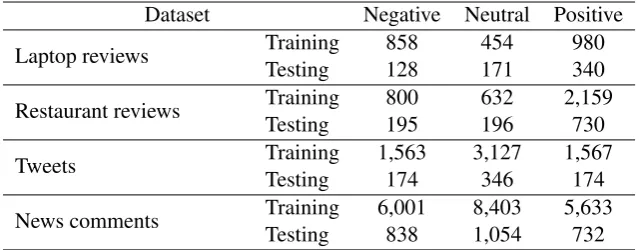
We conduct experiments on four datasets, as shown in Table 1. The first two are from Se-mEval 2014 (Pontiki et al., 2014), containing re-views of restaurant and laptop domains, which are widely used in previous works. The third one is a collection of tweets, collected by (Dong et al.,
2014). The last one is prepared by us for testing the language sensitivity of our model, which con-tains Chinese news comments and has politicians and entertainers as opinion targets. We purposely add more negation, contrastive, and question ments to make it more challenging. Each com-ment is annotated by at least two annotators, and only if they agree with each other, the comment will be added into our dataset. Moreover, we re-place each opinion target (i.e. word/phrase of pro-noun or person name) with a placeholder, as did in (Dong et al.,2014). For the first two datasets, we removed a few examples having the “conflict label”, e.g., “Certainly not the best sushi in New York, however, it is always fresh” (Pontiki et al.,
2014).
We use 300-dimension word vectors pre-trained by GloVe (Pennington et al.,2014) (whose vocab-ulary size is 1.9M2) for our experiments on the
En-glish datasets, as previous works did (Tang et al.,
2016). Some works employed domain-specific training corpus to learn embeddings for better per-formance, such as TD-LSTM (Tang et al., 2015) on the tweet dataset. In contrast, we prefer to use
Dataset Negative Neutral Positive Laptop reviews TrainingTesting 858128 454171 980340
Restaurant reviews TrainingTesting 800195 632196 2,159730
Tweets TrainingTesting 1,563174 3,127346 1,567174
[image:6.595.139.459.62.187.2]News comments TrainingTesting 6,001838 8,4031,054 5,633732
Table 1: Details of the experimental datasets.
the general embeddings from (Pennington et al.,
2014) for all datasets, so that the experimental re-sults can better reveal the model’s capability and the figures are directly comparable across different papers. The embeddings for Chinese experiments are trained with a corpus of 1.4 billion tokens with CBOW3.
4.2 Compared Methods
We compare our proposed framework of Recur-rent Attention on Memory (RAM) with the fol-lowing methods:
• Average Context: There are two versions of this method. The first one, named AC-S, averages the word vectors before the target and the word vectors after the target sepa-rately. The second one, namedAC, averages the word vectors of the full context.
• SVM (Kiritchenko et al., 2014): The tradi-tional state-of-the-art method using SVMs on surface features, lexicon features and parsing features, which is the best team in SemEval 2014.
• Rec-NN (Dong et al., 2014): It firstly uses rules to transform the dependency tree and put the opinion target at the root, and then performs semantic composition with Recur-sive NNs for sentiment prediction.
• TD-LSTM (Tang et al.,2015): It uses a for-ward LSTM and a backfor-ward LSTM to ab-stract the information before and after the target. Finally, it takes the hidden states of LSTM at last time step to represent the con-text for prediction. We reproduce its results on the tweet dataset with our embeddings, and also run it for the other three datasets.
• TD-LSTM-A: We developed TD-LSTM to make it have one attention on the outputs of
3https://github.com/svn2github/word2vec
forward and backward LSTMs, respectively.
• MemNet (Tang et al.,2016): It applies atten-tion multiple times on the word embeddings, and the last attention’s output is fed to soft-max for prediction, without combining the results of different attentions. We produce its results on all four datasets with the code re-leased by the authors.4
For each method, the maximum number of train-ing iterations is 100, and the model with the mini-mum training error is utilized for testing. We will discuss different settings of RAM later.
4.3 Main Results
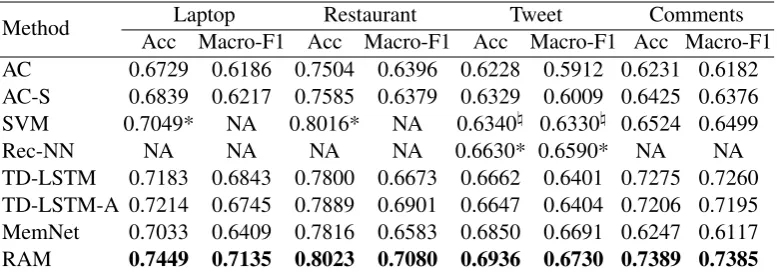
The first evaluation metric is Accuracy, which is used in (Tang et al.,2016). Because the datasets have unbalanced classes as shown in Table 1, Macro-averaged F-measure is also reported, as did in (Dong et al.,2014;Tang et al.,2015). As shown by the results in Table 2, our RAM consistently outperforms all compared methods on these four datasets. AC and AC-S perform poorly, because averaging context is equivalent to paying identi-cal attention to each word which would hide the true sentiment word. Rec-NN is better than TD-LSTM but not as good as our method. The ad-vantage of Rec-NN is that it utilizes the result of dependency parsing which might shorten the dis-tance between the opinion target and the related opinion word. However, dependency parsing is not guaranteed to work well on irregular texts such as tweets, which may still result in long path be-tween the opinion word and its target, so that the opinion features would also be lost while being propagated. TD-LSTM performs less competitive than our method on all the datasets, particularly on the tweet dataset, because in this dataset sen-timent words are usually far from person names,
Method Acc Macro-F1 Acc Macro-F1 Acc Macro-F1 Acc Macro-F1Laptop Restaurant Tweet Comments AC 0.6729 0.6186 0.7504 0.6396 0.6228 0.5912 0.6231 0.6182 AC-S 0.6839 0.6217 0.7585 0.6379 0.6329 0.6009 0.6425 0.6376 SVM 0.7049* NA 0.8016* NA 0.6340\ 0.6330\ 0.6524 0.6499
Rec-NN NA NA NA NA 0.6630* 0.6590* NA NA
TD-LSTM 0.7183 0.6843 0.7800 0.6673 0.6662 0.6401 0.7275 0.7260 TD-LSTM-A 0.7214 0.6745 0.7889 0.6901 0.6647 0.6404 0.7206 0.7195 MemNet 0.7033 0.6409 0.7816 0.6583 0.6850 0.6691 0.6247 0.6117 RAM 0.7449 0.7135 0.8023 0.7080 0.6936 0.6730 0.7389 0.7385
Table 2: Main results. The results with ‘*’ are retrieved from the papers of compared methods, and those with ‘\’ are retrieved from Rec-NN paper.
[image:7.595.105.495.62.198.2]No. of AL Laptop Restaurant Tweet Comments RAM-1AL 0.7074 0.7996 0.6864 0.7336 RAM-2AL 0.7465 0.7889 0.6922 0.7363 RAM-3AL 0.7449 0.8023 0.6936 0.7389 RAM-4AL 0.7293 0.8059 0.6879 0.7325 RAM-5AL 0.7293 0.7960 0.6864 0.7325
Table 3: The impacts of attention layers. (Word embeddings are not tuned in the training stage.)
for which case the multiple-attention mechanism is designed to work. TD-LSTM-A also performs worse than our method, because its two attentions, i.e. one for the text before the target and the other for the after, cannot tackle some cases where more than one features being attended are at the same side of the target.
Our method steadily performs better than Mem-Net on all four datasets, particularly on the News comment dataset, its improvement is more than 10%. MemNet adopts multiple attentions in or-der to improve the attention results, given the as-sumption that the result of an attention at a later hop should be better than that at the beginning. MemNet doesn’t combine the results of multiple attentions, and the vector fed to softmax is the result of the last attention, which is essentially the linear combination of word embeddings. As we described before, attending too many words in one time may hide the characteristic of each word, moreover, the sentiment transition usually combines features in a nonlinear way. Our model overcomes this shortcoming with a GRU network to combine the results of multiple attentions. The feature-based SVM, which needs labor-intensive feature engineering works and a mass of extra lin-guistic resources, doesn’t display its advantage, because the features for aspect sentiment
analy-sis cannot be extracted as easily as for sentence or document level sentiment analysis.
4.4 Effects of Attention Layers
One major setting that affects the performance of our model is the number of attention layers. We evaluate our framework with 1 to 5 attention lay-ers, and the results are given in Table 3, where
NAL means using N attentions. In general, our model with 2 or 3 attention layers works better, but the advantage is not always there for different datasets. For example, for the Restaurant dataset, our model with 4 attention layers performs the best. Using 1 attention is always not as good as using more, which shows that one-time attention might not be sufficient to capture the sentiment features in complicated cases. One the other hand, the performance is not monotonically increasing with respect to the number of attentions. RAM-4AL is generally not as good as RAM-3AL, it is because as the model’s complexity increases, the model becomes more difficult to train and less generalizable.
4.5 Effects of Embedding Tuning
The compared embedding tuning strategies are:
Embedding Laptop Restaurant Tweet Comment RAM-3AL-T-R 0.5806 0.7129 0.6272 0.6749 RAM-3AL-T 0.6854 0.7522 0.6402 0.7283 RAM-3AL-NT 0.7449 0.8023 0.6936 0.7389
Table 4: The impact of different embedding tuning strategies.
(a) Example of multiple attentions. The target is “windows”.
[image:8.595.95.501.154.326.2](b) Example of single attention. The target is “windows”.
Figure 2: Comparison of single attention and multiple attentions. Attention score by Eq. 13is used as the color-coding.
training stage.
• RAM-3AL-T: Using the pre-trained embed-dings initially, and they are also tuned in the training.
• RAM-3AL-NT: The pre-trained embeddings are not tuned in the training.
From Table 4, we can see that RAM-3AL-T-R performs very poorly, especially when the size of training data is smaller. The reason could be threefold: (1) The amount of labelled sam-ples in the four experimental datasets is too small to tune reliable embeddings from scratch for the in-vocabulary words (i.e. existing in the train-ing data); (2) A lot of out-of-vocabulary (OOV) words, i.e. absent from the training data, but exist in the testing data; (3) It increases the risk of over-fitting after adding the embedding parameters to the solution space (it requires the embeddings not only to fit model parameters, but also to capture the similarity among words). During training, we indeed observed that the training error converges too fast in RAM-3AL-T-R. RAM-3AL-T can uti-lize the embedding similarity among words at the beginning of training, but fine tuning will destroy this similarity during training. On the other hand, the initial embeddings of OOV words in the test-ing data are not tuned, so that their similarity with vocabulary words are also destroyed. In addition,
RAM-3AL-T also suffers from the risk of overfit-ting. RAM-3AL-NT performs the best on all four datasets, and we also observe that the training er-ror converges gradually while the model parame-ters are being updated with the error signal from the output layer.
4.6 Case Study
We pick some testing examples from the datasets and visualize their attention results. To make the visualized results comprehensible, we remove the BLSTM memory module to make the attention module directly work on the word embeddings, thus we can check whether the attention results conform with our intuition. The visualization re-sults are shown in Figures2and3.
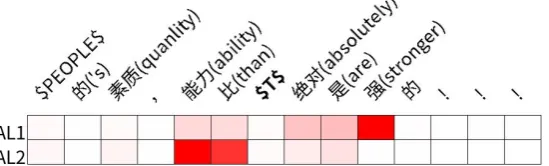
(a) Example of a Chinese contrastive sentence, whose translation is “$T$’s quality and ability are absolutely stronger than $PEOPLE$!!!”. The target is “$T$”.
[image:9.595.164.439.190.273.2](b) The sentence from3awith a different target, i.e. “$PEOPLE$’s quality and ability are absolutely stronger than $T$!!!”.
Figure 3: Example of multiple opinion targets. Attention score by Eq.13is used as the color-coding.
with only one attention, as shown in Figure2a, is a sort of uniform distribution and mingles too many word vectors in a linear way, which would ruin the characteristic of each word.
Figures 3a and 3b present a case that there are more than one opinion targets in a comment, which cannot be analyzed with sentence-level sen-timent analysis methods properly. Specifically, it’s a comparative sentence in which the reviewer has a positive sentiment on the first commented son, but a negative sentiment on the second per-son, and our model predicts both of them correctly. Although all useful information (e.g. “than” and “stronger”) is attended in both cases, the attention procedures of them show some interesting differ-ences. They mainly attend important information after the target $T$ in the first attention layer AL1. After that, Figure3battends more information be-fore $T$ in AL2. Since the same words in Figures
3aand3bhave different memory slices due to po-sition weighting and augmented offset feature, as described in Section3.3, our model predicts oppo-site sentiments on the two persons. For example in Figure3b, the model first attends a positive word “stronger” and then attends “than” before the tar-get, so it reverses the sentiment and finally predicts a negative sentiment.
5 Conclusions and Future Work
In this paper, we proposed a framework to iden-tify the sentiment of opinion targets. The model
first runs through the input to generate a memory, in the process of which it can synthesize the word sequence features. And then, the model pays mul-tiple attentions on the memory to pick up impor-tant information to predict the final sentiment, by combining the features from different attentions non-linearly. We demonstrated the efficacy of our model on four datasets, and the results show that it can outperform the state-of-the-art methods.
Although multiple-attention mechanism has the potential to synthesize features in complicated sentences, enforcing the model to pay a fix number of attentions to the memory is unnatural and even sort of unreasonable for some cases. Therefore, we need a mechanism to stop the attention pro-cess automatically if no more useful information can be read from the memory. We may also try other memory weighting strategies to distinguish multiple targets in one comment more clearly.
References
Orestes Appel, Francisco Chiclana, Jenny Carter, and Hamido Fujita. 2016. A hybrid approach to the sentiment analysis problem at the sentence level. Knowl.-Based Syst., 108:110–124.
Dzmitry Bahdanau, Kyunghyun Cho, and Yoshua Bengio. 2014. Neural machine translation by jointly learning to align and translate. CoRR, abs/1409.0473.
InNatural Computation, Fuzzy Systems and Knowl-edge Discovery (ICNC-FSKD), 2016 12th Interna-tional Conference on, pages 1532–1538.
KyungHyun Cho, Bart van Merrienboer, Dzmitry Bah-danau, and Yoshua Bengio. 2014. On the properties of neural machine translation: Encoder-decoder ap-proaches. CoRR, abs/1409.1259.
Lingjia Deng and Janyce Wiebe. 2015. Joint prediction for entity/event-level sentiment analysis using prob-abilistic soft logic models. In Proceedings of the 2015 Conference on Empirical Methods in Natural Language Processing.
Xiaowen Ding, Bing Liu, and Philip S Yu. 2008. A holistic lexicon-based approach to opinion mining. InProceedings of the 2008 international conference on web search and data mining, pages 231–240. Li Dong, Furu Wei, Chuanqi Tan, Duyu Tang, Ming
Zhou, and Ke Xu. 2014. Adaptive recursive neural network for target-dependent twitter sentiment clas-sification. InProceedings of the 52nd Annual Meet-ing of the Association for Computational LMeet-inguistics (Volume 2: Short Papers).
Murthy Ganapathibhotla and Bing Liu. 2008. Mining opinions in comparative sentences. InProceedings of the 22nd International Conference on Computa-tional Linguistics-Volume 1, pages 241–248. Alex Graves, Greg Wayne, and Ivo Danihelka. 2014.
Neural turing machines. CoRR, abs/1410.5401. Long Jiang, Mo Yu, Ming Zhou, Xiaohua Liu, and
Tiejun Zhao. 2011. Target-dependent twitter senti-ment classification. InProceedings of the 49th An-nual Meeting of the Association for Computational Linguistics: Human Language Technologies-Volume 1, pages 151–160.
Andrej Karpathy, Justin Johnson, and Fei-Fei Li. 2015. Visualizing and understanding recurrent networks. CoRR, abs/1506.02078.
Svetlana Kiritchenko, Xiaodan Zhu, Colin Cherry, and Saif Mohammad. 2014. Nrc-canada-2014: Detect-ing aspects and sentiment in customer reviews. In Proceedings of the 8th International Workshop on Semantic Evaluation (SemEval 2014), pages 437– 442.
Ankit Kumar, Ozan Irsoy, Jonathan Su, James Brad-bury, Robert English, Brian Pierce, Peter Ondruska, Ishaan Gulrajani, and Richard Socher. 2015. Ask me anything: Dynamic memory networks for natu-ral language processing. CoRR, abs/1506.07285. Tomas Mikolov, Kai Chen, Greg Corrado, and Jeffrey
Dean. 2013. Efficient estimation of word represen-tations in vector space.CoRR, abs/1301.3781. Thien Hai Nguyen and Kiyoaki Shirai. 2015.
Phrasernn: Phrase recursive neural network for aspect-based sentiment analysis. InProceedings of the 2015 Conference on Empirical Methods in Nat-ural Language Processing.
Jeffrey Pennington, Richard Socher, and Christo-pher D. Manning. 2014. Glove: Global vectors for word representation. InEmpirical Methods in Nat-ural Language Processing (EMNLP), pages 1532– 1543.
Maria Pontiki, Dimitris Galanis, John Pavlopoulos, Harris Papageorgiou, Ion Androutsopoulos, and Suresh Manandhar. 2014. Semeval-2014 task 4: As-pect based sentiment analysis. InProceedings of the 8th international workshop on semantic evaluation (SemEval 2014), pages 27–35.
Alexander M. Rush, Sumit Chopra, and Jason Weston. 2015. A neural attention model for abstractive sen-tence summarization.CoRR, abs/1509.00685. Richard Socher, Christopher D Manning, and
An-drew Y Ng. 2010. Learning continuous phrase representations and syntactic parsing with recursive neural networks. InProceedings of the NIPS-2010 Deep Learning and Unsupervised Feature Learning Workshop, pages 1–9.
Richard Socher, Jeffrey Pennington, Eric H. Huang, Andrew Y. Ng, and Christopher D. Manning. 2011. Semi-supervised recursive autoencoders for predict-ing sentiment distributions. In Proceedings of the 2011 Conference on Empirical Methods in Natural Language Processing, EMNLP 2011, pages 151– 161.
Richard Socher, Alex Perelygin, Jean Wu, Jason Chuang, Christopher D. Manning, Andrew Ng, and Christopher Potts. 2013. Recursive deep models for semantic compositionality over a sentiment tree-bank. In Proceedings of the 2013 Conference on Empirical Methods in Natural Language Process-ing.
Duyu Tang, Bing Qin, Xiaocheng Feng, and Ting Liu. 2015. Target-dependent sentiment classifi-cation with long short term memory. CoRR, abs/1512.01100.
Duyu Tang, Bing Qin, and Ting Liu. 2016. Aspect level sentiment classification with deep memory net-work. In Proceedings of the 2016 Conference on Empirical Methods in Natural Language Process-ing.
Yequan Wang, Minlie Huang, xiaoyan zhu, and Li Zhao. 2016. Attention-based lstm for aspect-level sentiment classification. InProceedings of the 2016 Conference on Empirical Methods in Natural Lan-guage Processing.