Multi-Task Identification of Entities, Relations, and Coreference
for Scientific Knowledge Graph Construction
Yi Luan Luheng He Mari Ostendorf Hannaneh Hajishirzi
University of Washington
{luanyi, luheng, ostendor, hannaneh}@uw.edu
Abstract
We introduce a multi-task setup of identifying and classifying entities, relations, and coref-erence clusters in scientific articles. We cre-ate SCIERC, a dataset that includes annota-tions for all three tasks and develop a uni-fied framework called Scientific Information Extractor (SCIIE) for with shared span
rep-resentations. The multi-task setup reduces cascading errors between tasks and leverages cross-sentence relations through coreference links. Experiments show that our multi-task model outperforms previous models in scien-tific information extraction without using any domain-specific features. We further show that the framework supports construction of a sci-entific knowledge graph, which we use to ana-lyze information in scientific literature.1
1 Introduction
As scientific communities grow and evolve, new tasks, methods, and datasets are introduced and different methods are compared with each other. Despite advances in search engines, it is still hard to identify new technologies and their relationships with what existed before. To help researchers more quickly identify opportunities for new combina-tions of tasks, methods and data, it is important to design intelligent algorithms that can extract and organize scientific information from a large collec-tion of documents.
Organizing scientific information into structured knowledge bases requires information extraction (IE) about scientific entities and their relationships. However, the challenges associated with scientific IE are greater than for a general domain. First, an-notation of scientific text requires domain expertise which makes annotation costly and limits resources.
[image:1.595.308.525.217.390.2]1Data and code are publicly available at:http://nlp. cs.washington.edu/sciIE/
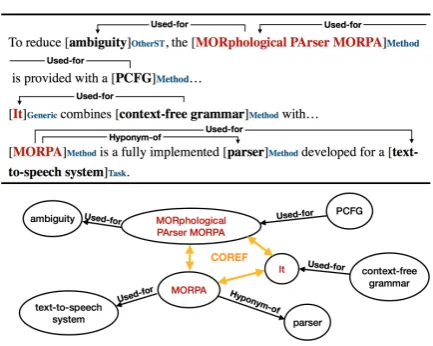
Figure 1: Example annotation: phrases that refer to the same scientific concept are annotated into the
same coreference cluster, such asMORphological
PAser MORPA,itandMORPA(marked as red).
In addition, most relation extraction systems are de-signed for within-sentence relations. However, ex-tracting information from scientific articles requires
extracting relations across sentences. Figure1
il-lustrates this problem. The cross-sentence relations between some entities can only be connected by entities that refer to the same scientific concept,
including generic terms (such as the pronoun it,
or phrases likeour method) that are not
informa-tive by themselves. With co-reference,context-free
grammarcan be connected toMORPAthrough the
intermediate co-referred pronounit. Applying
ex-isting IE systems to this data, without co-reference, will result in much lower relation coverage (and a sparse knowledge base).
In this paper, we develop a unified learning model for extracting scientific entities, relations, and coreference resolution. This is different from
previous work (Luan et al.,2017b;Gupta and
Man-ning,2011;Tsai et al., 2013;G´abor et al.,2018)
components of a pipeline. Our unified model is a multi-task setup that shares parameters across low-level tasks, making predictions by leveraging context across the document through coreference links. Specifically, we extend prior work for learn-ing span representations and coreference resolution
(Lee et al.,2017;He et al.,2018). Different from a
standard tagging system, our system enumerates all possible spans during decoding and can effectively detect overlapped spans. It avoids cascading errors between tasks by jointly modeling all spans and span-span relations.
To explore this problem, we create a dataset SCI
-ERC for scientific information extraction, which includes annotations of scientific terms, relation categories and co-reference links. Our experiments show that the unified model is better at predict-ing span boundaries, and it outperforms previous state-of-the-art scientific IE systems on entity and
relation extraction (Luan et al.,2017b;Augenstein
et al., 2017). In addition, we build a scientific
knowledge graph integrating terms and relations extracted from each article. Human evaluation shows that propagating coreference can signifi-cantly improve the quality of the automatic con-structed knowledge graph.
In summary we make the following contribu-tions. We create a dataset for scientific information extraction by jointly annotating scientific entities, relations, and coreference links. Extending a previ-ous end-to-end coreference resolution system, we develop a multi-task learning framework that can detect scientific entities, relations, and coreference clusters without hand-engineered features. We use our unified framework to build a scientific knowl-edge graph from a large collection of documents and analyze information in scientific literature.
2 Related Work
There has been growing interest in research on au-tomatic methods for information extraction from scientific articles. Past research in scientific IE addressed analyzing citations (Athar and Teufel,
2012b,a;Kas,2011;Gabor et al.,2016;Sim et al.,
2012; Do et al., 2013; Jaidka et al., 2014;
Abu-Jbara and Radev,2011), analyzing research
com-munity (Vogel and Jurafsky,2012;Anderson et al.,
2012), and unsupervised methods for extracting sci-entific entities and relations (Gupta and Manning,
2011;Tsai et al.,2013;G´abor et al.,2016).
More recently, two datasets in SemEval 2017
and 2018 have been introduced, which facilitate research on supervised and semi-supervised learn-ing for scientific information extraction. SemEval
17 (Augenstein et al., 2017) includes 500
para-graphs from articles in the domains of computer science, physics, and material science. It includes three types of entities (called keyphrases): Tasks, Methods, and Materials and two relation types: hyponym-of and synonym-of. SemEval 18 (G´abor
et al.,2018) is focused on predicting relations
be-tween entities within a sentence. It consists of six relation types. Using these datasets, neural
mod-els (Ammar et al.,2017,2018;Luan et al.,2017b;
Augenstein and Søgaard,2017) are introduced for
extracting scientific information. We extend these datasets by increasing relation coverage, adding cross-sentence coreference linking, and removing some annotation constraints. Different from most previous IE systems for scientific literature and
gen-eral domains (Miwa and Bansal,2016;Xu et al.,
2016; Peng et al., 2017;Quirk and Poon, 2017;
Luan et al.,2018;Adel and Sch¨utze,2017), which
use preprocessed syntactic, discourse or corefer-ence features as input, our unified framework does not rely on any pipeline processing and is able to model overlapping spans.
WhileSingh et al.(2013) show improvements
by jointly modeling entities, relations, and coref-erence links, most recent neural models for these tasks focus on single tasks (Clark and Manning,
2016;Wiseman et al.,2016;Lee et al.,2017;
Lam-ple et al.,2016;Peng et al.,2017) or joint entity
and relation extraction (Katiyar and Cardie,2017;
Zhang et al.,2017;Adel and Sch¨utze,2017;Zheng
et al.,2017). Among those studies, many papers
as-sume the entity boundaries are given, such as (Clark
and Manning,2016),Adel and Sch¨utze(2017) and
Peng et al.(2017). Our work relaxes this constraint
and predicts entity boundaries by optimizing over all possible spans. Our model draws from recent end-to-end span-based models for coreference
res-olution (Lee et al.,2017,2018) and semantic role
labeling (He et al.,2018) and extends them for the
multi-task framework involving the three tasks of identification of entity, relation and coreference.
Neural multi-task learning has been applied to a range of NLP tasks. Most of these models share word-level representations (Collobert and Weston,
2008;Klerke et al.,2016;Luan et al.,2016,2017a;
Rei,2017), whilePeng et al.(2017) uses high-order
cross-task information via span representations,
which is related toSwayamdipta et al.(2017).
3 Dataset
Our dataset (called SCIERC) includes annotations
for scientific entities, their relations, and corefer-ence clusters for 500 scientific abstracts. These ab-stracts are taken from 12 AI conference/workshop proceedings in four AI communities from the
Se-mantic Scholar Corpus2. SCIERC extends
pre-vious datasets in scientific articles SemEval 2017
Task 10 (SemEval 17) (Augenstein et al.,2017) and
SemEval 2018 Task 7 (SemEval 18) (G´abor et al., 2018) by extending entity types, relation types, rela-tion coverage, and adding cross-sentence relarela-tions using coreference links. Our dataset is publicly
available at: http://nlp.cs.washington.
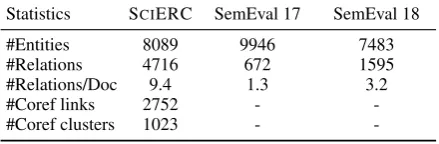
edu/sciIE/. Table1shows the statistics of SCI
-ERC.
Annotation Scheme We define six types for
an-notating scientific entities (Task, Method, Metric, Material, Other-ScientificTerm and Generic) and seven relation types (Compare, Part-of, Conjunc-tion, Evaluate-for, Feature-of, Used-for, Hyponym-Of). Directionality is taken into account except for the two symmetric relation types (Conjunction and Compare). Coreference links are annotated between identical scientific entities. A Generic en-tity is annotated only when the enen-tity is involved in a relation or is coreferred with another entity.
Annotation guidelines can be found in AppendixA.
Figure1shows an annotated example.
Following annotation guidelines from
Qasem-iZadeh and Schumann(2016) and using the BRAT
interface (Stenetorp et al., 2012), our annotators
perform a greedy annotation for spans and always prefer the longer span whenever ambiguity occurs. Nested spans are allowed when a subspan has a relation/coreference link with another term outside the span.
Human Agreements One domain expert
anno-tated all the documents in the dataset; 12% of the data is dually annotated by 4 other domain experts to evaluate the user agreements. The kappa score for annotating entities is 76.9%, relation extraction is 67.8% and coreference is 63.8%.
2
These conferences include general AI (AAAI, IJCAI), NLP (ACL, EMNLP, IJCNLP), speech (ICASSP, Interspeech), machine learning (NIPS, ICML), and computer vision (CVPR, ICCV, ECCV) at http://labs.semanticscholar. org/corpus/
Statistics SCIERC SemEval 17 SemEval 18
#Entities 8089 9946 7483
#Relations 4716 672 1595
#Relations/Doc 9.4 1.3 3.2
#Coref links 2752 -
-#Coref clusters 1023 -
-Table 1: Dataset statistics for our dataset SCIERC and two previous datasets on scientific information extraction. All datasets annotate 500 documents.
Comparison with previous datasets SCIERC
is focused on annotating cross-sentence relations and has more relation coverage than SemEval 17
and SemEval 18, as shown in Table1. SemEval 17
is mostly designed for entity recognition and only covers two relation types. The task in SemEval 18 is to classify a relation between a pair of entities given entity boundaries, but only intra-sentence re-lations are annotated and each entity only appears in one relation, resulting in sparser relation cover-age than our dataset (3.2 vs. 9.4 relations per
ab-stract). SCIERC extends these datasets by adding
more relation types and coreference clusters, which allows representing cross-sentence relations, and
removing annotation constraints. Table1gives a
comparison of statistics among the three datasets.
In addition, SCIERC aims at including broader
coverage of general AI communities.
4 Model
We develop a unified framework (called SCIIE)
to identify and classify scientific entities, relations,
and coreference resolution across sentences. SCIIE
is a multi-task learning setup that extends previous span-based models for coreference resolution (Lee
et al.,2017) and semantic role labeling (He et al.,
2018). All three tasks of entity recognition, re-lation extraction, and coreference resolution are treated as multinomial classification problems with
shared span representations. SCIIE benefits from
expressive contextualized span representations as classifier features. By sharing span representations, sentence-level tasks can benefit from information propagated from coreference resolution across sen-tences, without increasing the complexity of
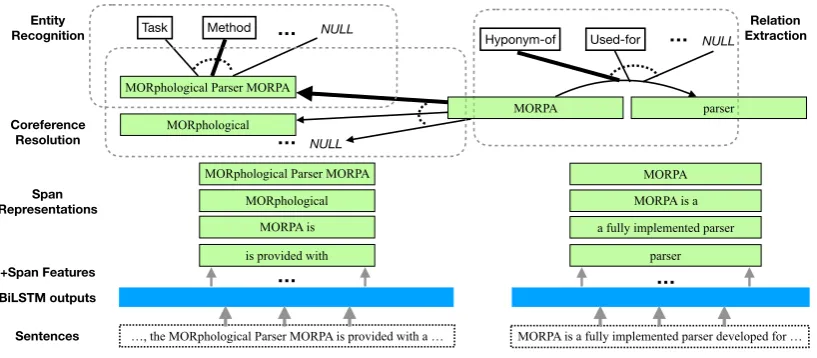
infer-ence. Figure2shows a high-level overview of the
SCIIE multi-task framework.
4.1 Problem Definition
The input is a document represented as a sequence
of wordsD={w1, . . . , wn}, from which we
[image:3.595.307.527.64.136.2]MORPA MORPA is a a fully implemented parser
parser MORphological Parser MORPA
MORPA is a fully implemented parser developed for … …, the MORphological Parser MORPA is provided with a …
MORphological MORPA is is provided with
NULL
Hyponym-of Used-for NULL
Method
Task NULL
Sentences BiLSTM outputs
Span Representations
Entity Recognition
+Span Features Coreference
Resolution
Relation Extraction
… …
parser MORPA
MORphological MORphological Parser MORPA
…
[image:4.595.97.506.62.241.2]… …
Figure 2: Overview of the multitask setup, where all three tasks are treated as classification problems on top of shared span representations. Dotted arcs indicate the normalization space for each task.
within-sentence word sequence spans (up to a rea-sonable length) in the document. The output
con-tains three structures: the entity types E for all
spansS, the relationsRfor all pair of spansS×S,
and the coreference linksCfor all spans inS. The
output structures are represented with a set of dis-crete random variables indexed by spans or pairs of spans. Specifically, the output structures are defined as follows.
Entity recognitionis to predict the best entity type
for every candidate span. LetLErepresent the set
of all possible entity types including the null-type.
The output structureEis a set of random variables
indexed by spans:ei ∈LEfori= 1, . . . , N.
Relation extractionis to predict the best relation
type given an ordered pair of spans(si, sj). LetLR
be the set of all possible relation types including
the null-type. The output structureRis a set of
random variables indexed over pairs of spans(i, j)
that belong to the same sentence: rij ∈ LR for
i, j= 1, . . . , N.
Coreference resolutionis to predict the best
an-tecedent (including a special null anan-tecedent) given a span, which is the same mention-ranking model
used in Lee et al. (2017). The output structure
C is a set of random variables defined as: ci ∈
{1, . . . , i−1, }fori= 1, . . . , N.
4.2 Model Definition
We formulate the multi-task learning setup as learning the conditional probability distribution
P(E, R, C|D). For efficient training and inference,
we decomposeP(E, R, C|D)assuming spans are
conditionally independent givenD:
P(E, R, C|D) =P(E, R, C, S |D) (1)
= N
Y
i=1
P(ei|D)P(ci |D)
N
Y
j=1
P(rij |D),
where the conditional probabilities of each random variable are independently normalized:
P(ei=e|D) = P exp(ΦE(e, si))
e0∈LEexp(ΦE(e0, si))
(2)
P(rij =r |D) =
exp(ΦR(r, si, sj))
P
r0∈LRexp(ΦR(r0, si, sj))
P(ci =j|D) = P exp(ΦC(si, sj))
j0∈{1,...,i−1,}exp(ΦC(si, sj0)),
whereΦE denotes the unnormalized model score
for an entity typeeand a spansi,ΦRdenotes the
score for a relation type r and span pairs si, sj,
andΦCdenotes the score for a binary coreference
link betweensi andsj. TheseΦscores are further
decomposed into span and pairwise span scores computed from feed-forward networks, as will be
explained in Section4.3.
For simplicity, we omitDfrom theΦfunctions
andSfrom the observation.
Objective Given a set of all documentsD, the
model loss function is defined as a weighted sum of the negative log-likelihood loss of all three tasks:
− X
(D,R∗,E∗,C∗)∈D
n
λElogP(E∗ |D) (3)
whereE∗,R∗, andC∗are gold structures of the
en-tity types, relations, and coreference, respectively.
The task weightsλE,λR, andλCare introduced as
hyper-parameters to control the importance of each task.
For entity recognition and relation extraction,
P(E∗ | D) and P(R∗ | D) are computed with
the definition in Equation (2). For coreference resolution, we use the marginalized loss
follow-ingLee et al.(2017) since each mention can have
multiple correct antecedents. Let Ci∗ be the set
of all correct antecedents for span i, we have:
logP(C∗ |D) =P
i=1..Nlog
P
c∈C∗
i P(c|D).
4.3 Scoring Architecture
We use feedforward neural networks (FFNNs) over
shared span representations g to compute a set
of span and pairwise span scores. For the span
scores,φe(si)measures how likely a span si has
an entity typee, andφmr(si)andφmc(si)measure
how likely a spansi is a mention in a relation or a
coreference link, respectively. The pairwise scores
φr(si, sj) andφc(si, sj) measure how likely two
spans are associated in a relationror a coreference
link, respectively. Letgi be the fixed-length
vec-tor representation for spansi. For different tasks,
the span scores φx(si) for x ∈ {e,mc,mr} and
pairwise span scoresφy(si, sj)for y∈ {r,c}are
computed as follows:
φx(si) =wx·FFNNx(gi)
φy(si, sj) =wy·FFNNy([gi,gj,gigj]),
where is element-wise multiplication, and
{wx,wy} are neural network parameters to be
learned.
We use these scores to compute the differentΦ:
ΦE(e, si) = φe(si) (4)
ΦR(r, si, sj) = φmr(si) +φmr(sj) +φr(si, sj)
ΦC(si, sj) = φmc(si) +φmc(sj) +φc(si, sj)
The scores in Equation (4) are defined for entity types, relations, and antecedents that are not the
null-type . Scores involving the null label are
set to a constant 0: ΦE(, si) = ΦR(, si, sj) =
ΦC(si, ) = 0.
We use the same span representations g from
(Lee et al.,2017) and share them across the three
tasks. We start by building bi-directional LSTMs
(Hochreiter and Schmidhuber,1997) from word,
character and ELMo (Peters et al.,2018)
embed-dings.
For a spansi, its vector representationgiis
con-structed by concatenating si’s left and right end
points from the BiLSTM outputs, an attention-based soft “headword,” and embedded span width features. Hyperparameters and other
implementa-tion details will be described in Secimplementa-tion6.
4.4 Inference and Pruning
Following previous work, we use beam pruning to reduce the number of pairwise span factors from
O(n4) to O(n2) at both training and test time,
wherenis the number of words in the document.
We define two separate beams:BCto prune spans
for the coreference resolution task, andBRfor
rela-tion extracrela-tion. The spans in the beams are sorted
by their span scoresφmcandφmrrespectively, and
the sizes of the beams are limited byλCnandλRn.
We also limit the maximum width of spans to a
fixed numberW, which further reduces the
num-ber of span factors toO(n).
5 Knowledge Graph Construction
We construct a scientific knowledge graph from a large corpus of scientific articles. The corpus includes all abstracts (110k in total) from 12 AI conference proceedings from the Semantic Scholar Corpus. Nodes in the knowledge graph correspond to scientific entities. Edges correspond to scientific relations between pairs of entities. The edges are typed according to the relation types defined in
Sec-tion3. Figure4shows a part of a knowledge graph
created by our method. For example, Statistical
Machine Translation (SMT)andgrammatical error
correctionare nodes in the graph, and they are
con-nected through aUsed-forrelation type. In order
to construct the knowledge graph for the whole
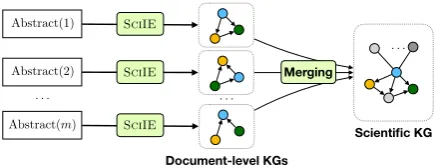
corpus, we first apply the SCIIE model over
sin-gle documents and then integrate the entities and
relations across multiple documents (Figure3).
Extracting nodes (entities) The SCIIE model
extracts entities, their relations, and coreference
Abstract(1)
<latexit sha1_base64="plPMi3PhbjdexTOfOHuoBb/buP8=">AAAB+3icbVBNS8NAEN34WetXrEcvi0Wol5KIoHiqePFYwX5AG8pmu2mXbjZhdyItIX/FiwdFvPpHvPlv3LQ5aOuDgcd7M8zM82PBNTjOt7W2vrG5tV3aKe/u7R8c2keVto4SRVmLRiJSXZ9oJrhkLeAgWDdWjIS+YB1/cpf7nSemNI/kI8xi5oVkJHnAKQEjDexKH9gU0ltfgyIUspp7PrCrTt2ZA68StyBVVKA5sL/6w4gmIZNABdG65zoxeClRwKlgWbmfaBYTOiEj1jNUkpBpL53fnuEzowxxEClTEvBc/T2RklDrWeibzpDAWC97ufif10sguPZSLuMEmKSLRUEiMEQ4DwIPuWIUxMwQQhU3t2I6JnkIJq6yCcFdfnmVtC/qrlN3Hy6rjZsijhI6Qaeohlx0hRroHjVRC1E0Rc/oFb1ZmfVivVsfi9Y1q5g5Rn9gff4Aq5qUJg==</latexit>
<latexit sha1_base64="plPMi3PhbjdexTOfOHuoBb/buP8=">AAAB+3icbVBNS8NAEN34WetXrEcvi0Wol5KIoHiqePFYwX5AG8pmu2mXbjZhdyItIX/FiwdFvPpHvPlv3LQ5aOuDgcd7M8zM82PBNTjOt7W2vrG5tV3aKe/u7R8c2keVto4SRVmLRiJSXZ9oJrhkLeAgWDdWjIS+YB1/cpf7nSemNI/kI8xi5oVkJHnAKQEjDexKH9gU0ltfgyIUspp7PrCrTt2ZA68StyBVVKA5sL/6w4gmIZNABdG65zoxeClRwKlgWbmfaBYTOiEj1jNUkpBpL53fnuEzowxxEClTEvBc/T2RklDrWeibzpDAWC97ufif10sguPZSLuMEmKSLRUEiMEQ4DwIPuWIUxMwQQhU3t2I6JnkIJq6yCcFdfnmVtC/qrlN3Hy6rjZsijhI6Qaeohlx0hRroHjVRC1E0Rc/oFb1ZmfVivVsfi9Y1q5g5Rn9gff4Aq5qUJg==</latexit>
<latexit sha1_base64="plPMi3PhbjdexTOfOHuoBb/buP8=">AAAB+3icbVBNS8NAEN34WetXrEcvi0Wol5KIoHiqePFYwX5AG8pmu2mXbjZhdyItIX/FiwdFvPpHvPlv3LQ5aOuDgcd7M8zM82PBNTjOt7W2vrG5tV3aKe/u7R8c2keVto4SRVmLRiJSXZ9oJrhkLeAgWDdWjIS+YB1/cpf7nSemNI/kI8xi5oVkJHnAKQEjDexKH9gU0ltfgyIUspp7PrCrTt2ZA68StyBVVKA5sL/6w4gmIZNABdG65zoxeClRwKlgWbmfaBYTOiEj1jNUkpBpL53fnuEzowxxEClTEvBc/T2RklDrWeibzpDAWC97ufif10sguPZSLuMEmKSLRUEiMEQ4DwIPuWIUxMwQQhU3t2I6JnkIJq6yCcFdfnmVtC/qrlN3Hy6rjZsijhI6Qaeohlx0hRroHjVRC1E0Rc/oFb1ZmfVivVsfi9Y1q5g5Rn9gff4Aq5qUJg==</latexit>
<latexit sha1_base64="plPMi3PhbjdexTOfOHuoBb/buP8=">AAAB+3icbVBNS8NAEN34WetXrEcvi0Wol5KIoHiqePFYwX5AG8pmu2mXbjZhdyItIX/FiwdFvPpHvPlv3LQ5aOuDgcd7M8zM82PBNTjOt7W2vrG5tV3aKe/u7R8c2keVto4SRVmLRiJSXZ9oJrhkLeAgWDdWjIS+YB1/cpf7nSemNI/kI8xi5oVkJHnAKQEjDexKH9gU0ltfgyIUspp7PrCrTt2ZA68StyBVVKA5sL/6w4gmIZNABdG65zoxeClRwKlgWbmfaBYTOiEj1jNUkpBpL53fnuEzowxxEClTEvBc/T2RklDrWeibzpDAWC97ufif10sguPZSLuMEmKSLRUEiMEQ4DwIPuWIUxMwQQhU3t2I6JnkIJq6yCcFdfnmVtC/qrlN3Hy6rjZsijhI6Qaeohlx0hRroHjVRC1E0Rc/oFb1ZmfVivVsfi9Y1q5g5Rn9gff4Aq5qUJg==</latexit>
Abstract(2)
<latexit sha1_base64="oH+E80xlkwVGYgNSnJz+yJi1Lw8=">AAAB+3icbVBNS8NAEN3Ur1q/Yj16WSxCvZSkCIqnihePFewHtKFstpt26WYTdifSEvpXvHhQxKt/xJv/xk2bg7Y+GHi8N8PMPD8WXIPjfFuFjc2t7Z3ibmlv/+DwyD4ut3WUKMpaNBKR6vpEM8ElawEHwbqxYiT0Bev4k7vM7zwxpXkkH2EWMy8kI8kDTgkYaWCX+8CmkN76GhShMK/WLwZ2xak5C+B14uakgnI0B/ZXfxjRJGQSqCBa91wnBi8lCjgVbF7qJ5rFhE7IiPUMlSRk2ksXt8/xuVGGOIiUKQl4of6eSEmo9Sz0TWdIYKxXvUz8z+slEFx7KZdxAkzS5aIgERginAWBh1wxCmJmCKGKm1sxHZMsBBNXyYTgrr68Ttr1muvU3IfLSuMmj6OITtEZqiIXXaEGukdN1EIUTdEzekVv1tx6sd6tj2VrwcpnTtAfWJ8/rR+UJw==</latexit>
<latexit sha1_base64="oH+E80xlkwVGYgNSnJz+yJi1Lw8=">AAAB+3icbVBNS8NAEN3Ur1q/Yj16WSxCvZSkCIqnihePFewHtKFstpt26WYTdifSEvpXvHhQxKt/xJv/xk2bg7Y+GHi8N8PMPD8WXIPjfFuFjc2t7Z3ibmlv/+DwyD4ut3WUKMpaNBKR6vpEM8ElawEHwbqxYiT0Bev4k7vM7zwxpXkkH2EWMy8kI8kDTgkYaWCX+8CmkN76GhShMK/WLwZ2xak5C+B14uakgnI0B/ZXfxjRJGQSqCBa91wnBi8lCjgVbF7qJ5rFhE7IiPUMlSRk2ksXt8/xuVGGOIiUKQl4of6eSEmo9Sz0TWdIYKxXvUz8z+slEFx7KZdxAkzS5aIgERginAWBh1wxCmJmCKGKm1sxHZMsBBNXyYTgrr68Ttr1muvU3IfLSuMmj6OITtEZqiIXXaEGukdN1EIUTdEzekVv1tx6sd6tj2VrwcpnTtAfWJ8/rR+UJw==</latexit>
<latexit sha1_base64="oH+E80xlkwVGYgNSnJz+yJi1Lw8=">AAAB+3icbVBNS8NAEN3Ur1q/Yj16WSxCvZSkCIqnihePFewHtKFstpt26WYTdifSEvpXvHhQxKt/xJv/xk2bg7Y+GHi8N8PMPD8WXIPjfFuFjc2t7Z3ibmlv/+DwyD4ut3WUKMpaNBKR6vpEM8ElawEHwbqxYiT0Bev4k7vM7zwxpXkkH2EWMy8kI8kDTgkYaWCX+8CmkN76GhShMK/WLwZ2xak5C+B14uakgnI0B/ZXfxjRJGQSqCBa91wnBi8lCjgVbF7qJ5rFhE7IiPUMlSRk2ksXt8/xuVGGOIiUKQl4of6eSEmo9Sz0TWdIYKxXvUz8z+slEFx7KZdxAkzS5aIgERginAWBh1wxCmJmCKGKm1sxHZMsBBNXyYTgrr68Ttr1muvU3IfLSuMmj6OITtEZqiIXXaEGukdN1EIUTdEzekVv1tx6sd6tj2VrwcpnTtAfWJ8/rR+UJw==</latexit>
<latexit sha1_base64="oH+E80xlkwVGYgNSnJz+yJi1Lw8=">AAAB+3icbVBNS8NAEN3Ur1q/Yj16WSxCvZSkCIqnihePFewHtKFstpt26WYTdifSEvpXvHhQxKt/xJv/xk2bg7Y+GHi8N8PMPD8WXIPjfFuFjc2t7Z3ibmlv/+DwyD4ut3WUKMpaNBKR6vpEM8ElawEHwbqxYiT0Bev4k7vM7zwxpXkkH2EWMy8kI8kDTgkYaWCX+8CmkN76GhShMK/WLwZ2xak5C+B14uakgnI0B/ZXfxjRJGQSqCBa91wnBi8lCjgVbF7qJ5rFhE7IiPUMlSRk2ksXt8/xuVGGOIiUKQl4of6eSEmo9Sz0TWdIYKxXvUz8z+slEFx7KZdxAkzS5aIgERginAWBh1wxCmJmCKGKm1sxHZMsBBNXyYTgrr68Ttr1muvU3IfLSuMmj6OITtEZqiIXXaEGukdN1EIUTdEzekVv1tx6sd6tj2VrwcpnTtAfWJ8/rR+UJw==</latexit>
Abstract(m)
<latexit sha1_base64="PuH458bIm0iyjkYW01I+k4X1XVk=">AAAB+3icbVBNS8NAEN34WetXrEcvi0Wol5KIoHiqePFYwX5AG8pmu2mX7iZhdyItIX/FiwdFvPpHvPlv3LQ5aOuDgcd7M8zM82PBNTjOt7W2vrG5tV3aKe/u7R8c2keVto4SRVmLRiJSXZ9oJnjIWsBBsG6sGJG+YB1/cpf7nSemNI/CR5jFzJNkFPKAUwJGGtiVPrAppLe+BkUoZDV5PrCrTt2ZA68StyBVVKA5sL/6w4gmkoVABdG65zoxeClRwKlgWbmfaBYTOiEj1jM0JJJpL53fnuEzowxxEClTIeC5+nsiJVLrmfRNpyQw1steLv7n9RIIrr2Uh3ECLKSLRUEiMEQ4DwIPuWIUxMwQQhU3t2I6JnkIJq6yCcFdfnmVtC/qrlN3Hy6rjZsijhI6Qaeohlx0hRroHjVRC1E0Rc/oFb1ZmfVivVsfi9Y1q5g5Rn9gff4ABtWUYg==</latexit>
<latexit sha1_base64="PuH458bIm0iyjkYW01I+k4X1XVk=">AAAB+3icbVBNS8NAEN34WetXrEcvi0Wol5KIoHiqePFYwX5AG8pmu2mX7iZhdyItIX/FiwdFvPpHvPlv3LQ5aOuDgcd7M8zM82PBNTjOt7W2vrG5tV3aKe/u7R8c2keVto4SRVmLRiJSXZ9oJnjIWsBBsG6sGJG+YB1/cpf7nSemNI/CR5jFzJNkFPKAUwJGGtiVPrAppLe+BkUoZDV5PrCrTt2ZA68StyBVVKA5sL/6w4gmkoVABdG65zoxeClRwKlgWbmfaBYTOiEj1jM0JJJpL53fnuEzowxxEClTIeC5+nsiJVLrmfRNpyQw1steLv7n9RIIrr2Uh3ECLKSLRUEiMEQ4DwIPuWIUxMwQQhU3t2I6JnkIJq6yCcFdfnmVtC/qrlN3Hy6rjZsijhI6Qaeohlx0hRroHjVRC1E0Rc/oFb1ZmfVivVsfi9Y1q5g5Rn9gff4ABtWUYg==</latexit>
<latexit sha1_base64="PuH458bIm0iyjkYW01I+k4X1XVk=">AAAB+3icbVBNS8NAEN34WetXrEcvi0Wol5KIoHiqePFYwX5AG8pmu2mX7iZhdyItIX/FiwdFvPpHvPlv3LQ5aOuDgcd7M8zM82PBNTjOt7W2vrG5tV3aKe/u7R8c2keVto4SRVmLRiJSXZ9oJnjIWsBBsG6sGJG+YB1/cpf7nSemNI/CR5jFzJNkFPKAUwJGGtiVPrAppLe+BkUoZDV5PrCrTt2ZA68StyBVVKA5sL/6w4gmkoVABdG65zoxeClRwKlgWbmfaBYTOiEj1jM0JJJpL53fnuEzowxxEClTIeC5+nsiJVLrmfRNpyQw1steLv7n9RIIrr2Uh3ECLKSLRUEiMEQ4DwIPuWIUxMwQQhU3t2I6JnkIJq6yCcFdfnmVtC/qrlN3Hy6rjZsijhI6Qaeohlx0hRroHjVRC1E0Rc/oFb1ZmfVivVsfi9Y1q5g5Rn9gff4ABtWUYg==</latexit>
<latexit sha1_base64="PuH458bIm0iyjkYW01I+k4X1XVk=">AAAB+3icbVBNS8NAEN34WetXrEcvi0Wol5KIoHiqePFYwX5AG8pmu2mX7iZhdyItIX/FiwdFvPpHvPlv3LQ5aOuDgcd7M8zM82PBNTjOt7W2vrG5tV3aKe/u7R8c2keVto4SRVmLRiJSXZ9oJnjIWsBBsG6sGJG+YB1/cpf7nSemNI/CR5jFzJNkFPKAUwJGGtiVPrAppLe+BkUoZDV5PrCrTt2ZA68StyBVVKA5sL/6w4gmkoVABdG65zoxeClRwKlgWbmfaBYTOiEj1jM0JJJpL53fnuEzowxxEClTIeC5+nsiJVLrmfRNpyQw1steLv7n9RIIrr2Uh3ECLKSLRUEiMEQ4DwIPuWIUxMwQQhU3t2I6JnkIJq6yCcFdfnmVtC/qrlN3Hy6rjZsijhI6Qaeohlx0hRroHjVRC1E0Rc/oFb1ZmfVivVsfi9Y1q5g5Rn9gff4ABtWUYg==</latexit>
. . .
<latexit sha1_base64="BD1XKLi2MLyNy/k+DR9W3roijvs=">AAAB7XicbVBNS8NAEJ3Ur1q/qh69LBbBU0lEUDwVvHisYD+gDWWz2bRrN9mwOxFK6H/w4kERr/4fb/4bt20O2vpg4PHeDDPzglQKg6777ZTW1jc2t8rblZ3dvf2D6uFR26hMM95iSirdDajhUiS8hQIl76aa0ziQvBOMb2d+54lrI1TygJOU+zEdJiISjKKV2n0ZKjSDas2tu3OQVeIVpAYFmoPqVz9ULIt5gkxSY3qem6KfU42CST6t9DPDU8rGdMh7liY05sbP59dOyZlVQhIpbStBMld/T+Q0NmYSB7Yzpjgyy95M/M/rZRhd+7lI0gx5whaLokwSVGT2OgmF5gzlxBLKtLC3EjaimjK0AVVsCN7yy6ukfVH33Lp3f1lr3BRxlOEETuEcPLiCBtxBE1rA4BGe4RXeHOW8OO/Ox6K15BQzx/AHzucPubePMA==</latexit>
<latexit sha1_base64="BD1XKLi2MLyNy/k+DR9W3roijvs=">AAAB7XicbVBNS8NAEJ3Ur1q/qh69LBbBU0lEUDwVvHisYD+gDWWz2bRrN9mwOxFK6H/w4kERr/4fb/4bt20O2vpg4PHeDDPzglQKg6777ZTW1jc2t8rblZ3dvf2D6uFR26hMM95iSirdDajhUiS8hQIl76aa0ziQvBOMb2d+54lrI1TygJOU+zEdJiISjKKV2n0ZKjSDas2tu3OQVeIVpAYFmoPqVz9ULIt5gkxSY3qem6KfU42CST6t9DPDU8rGdMh7liY05sbP59dOyZlVQhIpbStBMld/T+Q0NmYSB7Yzpjgyy95M/M/rZRhd+7lI0gx5whaLokwSVGT2OgmF5gzlxBLKtLC3EjaimjK0AVVsCN7yy6ukfVH33Lp3f1lr3BRxlOEETuEcPLiCBtxBE1rA4BGe4RXeHOW8OO/Ox6K15BQzx/AHzucPubePMA==</latexit>
<latexit sha1_base64="BD1XKLi2MLyNy/k+DR9W3roijvs=">AAAB7XicbVBNS8NAEJ3Ur1q/qh69LBbBU0lEUDwVvHisYD+gDWWz2bRrN9mwOxFK6H/w4kERr/4fb/4bt20O2vpg4PHeDDPzglQKg6777ZTW1jc2t8rblZ3dvf2D6uFR26hMM95iSirdDajhUiS8hQIl76aa0ziQvBOMb2d+54lrI1TygJOU+zEdJiISjKKV2n0ZKjSDas2tu3OQVeIVpAYFmoPqVz9ULIt5gkxSY3qem6KfU42CST6t9DPDU8rGdMh7liY05sbP59dOyZlVQhIpbStBMld/T+Q0NmYSB7Yzpjgyy95M/M/rZRhd+7lI0gx5whaLokwSVGT2OgmF5gzlxBLKtLC3EjaimjK0AVVsCN7yy6ukfVH33Lp3f1lr3BRxlOEETuEcPLiCBtxBE1rA4BGe4RXeHOW8OO/Ox6K15BQzx/AHzucPubePMA==</latexit><latexit sha1_base64="BD1XKLi2MLyNy/k+DR9W3roijvs=">AAAB7XicbVBNS8NAEJ3Ur1q/qh69LBbBU0lEUDwVvHisYD+gDWWz2bRrN9mwOxFK6H/w4kERr/4fb/4bt20O2vpg4PHeDDPzglQKg6777ZTW1jc2t8rblZ3dvf2D6uFR26hMM95iSirdDajhUiS8hQIl76aa0ziQvBOMb2d+54lrI1TygJOU+zEdJiISjKKV2n0ZKjSDas2tu3OQVeIVpAYFmoPqVz9ULIt5gkxSY3qem6KfU42CST6t9DPDU8rGdMh7liY05sbP59dOyZlVQhIpbStBMld/T+Q0NmYSB7Yzpjgyy95M/M/rZRhd+7lI0gx5whaLokwSVGT2OgmF5gzlxBLKtLC3EjaimjK0AVVsCN7yy6ukfVH33Lp3f1lr3BRxlOEETuEcPLiCBtxBE1rA4BGe4RXeHOW8OO/Ox6K15BQzx/AHzucPubePMA==</latexit> . . .<latexit sha1_base64="BD1XKLi2MLyNy/k+DR9W3roijvs=">AAAB7XicbVBNS8NAEJ3Ur1q/qh69LBbBU0lEUDwVvHisYD+gDWWz2bRrN9mwOxFK6H/w4kERr/4fb/4bt20O2vpg4PHeDDPzglQKg6777ZTW1jc2t8rblZ3dvf2D6uFR26hMM95iSirdDajhUiS8hQIl76aa0ziQvBOMb2d+54lrI1TygJOU+zEdJiISjKKV2n0ZKjSDas2tu3OQVeIVpAYFmoPqVz9ULIt5gkxSY3qem6KfU42CST6t9DPDU8rGdMh7liY05sbP59dOyZlVQhIpbStBMld/T+Q0NmYSB7Yzpjgyy95M/M/rZRhd+7lI0gx5whaLokwSVGT2OgmF5gzlxBLKtLC3EjaimjK0AVVsCN7yy6ukfVH33Lp3f1lr3BRxlOEETuEcPLiCBtxBE1rA4BGe4RXeHOW8OO/Ox6K15BQzx/AHzucPubePMA==</latexit><latexit sha1_base64="BD1XKLi2MLyNy/k+DR9W3roijvs=">AAAB7XicbVBNS8NAEJ3Ur1q/qh69LBbBU0lEUDwVvHisYD+gDWWz2bRrN9mwOxFK6H/w4kERr/4fb/4bt20O2vpg4PHeDDPzglQKg6777ZTW1jc2t8rblZ3dvf2D6uFR26hMM95iSirdDajhUiS8hQIl76aa0ziQvBOMb2d+54lrI1TygJOU+zEdJiISjKKV2n0ZKjSDas2tu3OQVeIVpAYFmoPqVz9ULIt5gkxSY3qem6KfU42CST6t9DPDU8rGdMh7liY05sbP59dOyZlVQhIpbStBMld/T+Q0NmYSB7Yzpjgyy95M/M/rZRhd+7lI0gx5whaLokwSVGT2OgmF5gzlxBLKtLC3EjaimjK0AVVsCN7yy6ukfVH33Lp3f1lr3BRxlOEETuEcPLiCBtxBE1rA4BGe4RXeHOW8OO/Ox6K15BQzx/AHzucPubePMA==</latexit><latexit sha1_base64="BD1XKLi2MLyNy/k+DR9W3roijvs=">AAAB7XicbVBNS8NAEJ3Ur1q/qh69LBbBU0lEUDwVvHisYD+gDWWz2bRrN9mwOxFK6H/w4kERr/4fb/4bt20O2vpg4PHeDDPzglQKg6777ZTW1jc2t8rblZ3dvf2D6uFR26hMM95iSirdDajhUiS8hQIl76aa0ziQvBOMb2d+54lrI1TygJOU+zEdJiISjKKV2n0ZKjSDas2tu3OQVeIVpAYFmoPqVz9ULIt5gkxSY3qem6KfU42CST6t9DPDU8rGdMh7liY05sbP59dOyZlVQhIpbStBMld/T+Q0NmYSB7Yzpjgyy95M/M/rZRhd+7lI0gx5whaLokwSVGT2OgmF5gzlxBLKtLC3EjaimjK0AVVsCN7yy6ukfVH33Lp3f1lr3BRxlOEETuEcPLiCBtxBE1rA4BGe4RXeHOW8OO/Ox6K15BQzx/AHzucPubePMA==</latexit><latexit sha1_base64="BD1XKLi2MLyNy/k+DR9W3roijvs=">AAAB7XicbVBNS8NAEJ3Ur1q/qh69LBbBU0lEUDwVvHisYD+gDWWz2bRrN9mwOxFK6H/w4kERr/4fb/4bt20O2vpg4PHeDDPzglQKg6777ZTW1jc2t8rblZ3dvf2D6uFR26hMM95iSirdDajhUiS8hQIl76aa0ziQvBOMb2d+54lrI1TygJOU+zEdJiISjKKV2n0ZKjSDas2tu3OQVeIVpAYFmoPqVz9ULIt5gkxSY3qem6KfU42CST6t9DPDU8rGdMh7liY05sbP59dOyZlVQhIpbStBMld/T+Q0NmYSB7Yzpjgyy95M/M/rZRhd+7lI0gx5whaLokwSVGT2OgmF5gzlxBLKtLC3EjaimjK0AVVsCN7yy6ukfVH33Lp3f1lr3BRxlOEETuEcPLiCBtxBE1rA4BGe4RXeHOW8OO/Ox6K15BQzx/AHzucPubePMA==</latexit>
. . .
<latexit sha1_base64="BD1XKLi2MLyNy/k+DR9W3roijvs=">AAAB7XicbVBNS8NAEJ3Ur1q/qh69LBbBU0lEUDwVvHisYD+gDWWz2bRrN9mwOxFK6H/w4kERr/4fb/4bt20O2vpg4PHeDDPzglQKg6777ZTW1jc2t8rblZ3dvf2D6uFR26hMM95iSirdDajhUiS8hQIl76aa0ziQvBOMb2d+54lrI1TygJOU+zEdJiISjKKV2n0ZKjSDas2tu3OQVeIVpAYFmoPqVz9ULIt5gkxSY3qem6KfU42CST6t9DPDU8rGdMh7liY05sbP59dOyZlVQhIpbStBMld/T+Q0NmYSB7Yzpjgyy95M/M/rZRhd+7lI0gx5whaLokwSVGT2OgmF5gzlxBLKtLC3EjaimjK0AVVsCN7yy6ukfVH33Lp3f1lr3BRxlOEETuEcPLiCBtxBE1rA4BGe4RXeHOW8OO/Ox6K15BQzx/AHzucPubePMA==</latexit>
<latexit sha1_base64="BD1XKLi2MLyNy/k+DR9W3roijvs=">AAAB7XicbVBNS8NAEJ3Ur1q/qh69LBbBU0lEUDwVvHisYD+gDWWz2bRrN9mwOxFK6H/w4kERr/4fb/4bt20O2vpg4PHeDDPzglQKg6777ZTW1jc2t8rblZ3dvf2D6uFR26hMM95iSirdDajhUiS8hQIl76aa0ziQvBOMb2d+54lrI1TygJOU+zEdJiISjKKV2n0ZKjSDas2tu3OQVeIVpAYFmoPqVz9ULIt5gkxSY3qem6KfU42CST6t9DPDU8rGdMh7liY05sbP59dOyZlVQhIpbStBMld/T+Q0NmYSB7Yzpjgyy95M/M/rZRhd+7lI0gx5whaLokwSVGT2OgmF5gzlxBLKtLC3EjaimjK0AVVsCN7yy6ukfVH33Lp3f1lr3BRxlOEETuEcPLiCBtxBE1rA4BGe4RXeHOW8OO/Ox6K15BQzx/AHzucPubePMA==</latexit>
<latexit sha1_base64="BD1XKLi2MLyNy/k+DR9W3roijvs=">AAAB7XicbVBNS8NAEJ3Ur1q/qh69LBbBU0lEUDwVvHisYD+gDWWz2bRrN9mwOxFK6H/w4kERr/4fb/4bt20O2vpg4PHeDDPzglQKg6777ZTW1jc2t8rblZ3dvf2D6uFR26hMM95iSirdDajhUiS8hQIl76aa0ziQvBOMb2d+54lrI1TygJOU+zEdJiISjKKV2n0ZKjSDas2tu3OQVeIVpAYFmoPqVz9ULIt5gkxSY3qem6KfU42CST6t9DPDU8rGdMh7liY05sbP59dOyZlVQhIpbStBMld/T+Q0NmYSB7Yzpjgyy95M/M/rZRhd+7lI0gx5whaLokwSVGT2OgmF5gzlxBLKtLC3EjaimjK0AVVsCN7yy6ukfVH33Lp3f1lr3BRxlOEETuEcPLiCBtxBE1rA4BGe4RXeHOW8OO/Ox6K15BQzx/AHzucPubePMA==</latexit>
<latexit sha1_base64="BD1XKLi2MLyNy/k+DR9W3roijvs=">AAAB7XicbVBNS8NAEJ3Ur1q/qh69LBbBU0lEUDwVvHisYD+gDWWz2bRrN9mwOxFK6H/w4kERr/4fb/4bt20O2vpg4PHeDDPzglQKg6777ZTW1jc2t8rblZ3dvf2D6uFR26hMM95iSirdDajhUiS8hQIl76aa0ziQvBOMb2d+54lrI1TygJOU+zEdJiISjKKV2n0ZKjSDas2tu3OQVeIVpAYFmoPqVz9ULIt5gkxSY3qem6KfU42CST6t9DPDU8rGdMh7liY05sbP59dOyZlVQhIpbStBMld/T+Q0NmYSB7Yzpjgyy95M/M/rZRhd+7lI0gx5whaLokwSVGT2OgmF5gzlxBLKtLC3EjaimjK0AVVsCN7yy6ukfVH33Lp3f1lr3BRxlOEETuEcPLiCBtxBE1rA4BGe4RXeHOW8OO/Ox6K15BQzx/AHzucPubePMA==</latexit>
Document-level KGs
Scientific KG Merging
SciIE<latexit sha1_base64="dkMVQqBbljsC87ORSph5l08iusY=">AAAB9XicbVDLSgNBEJz1GeMr6tHLYBA8hV0RFE8BEfQW0TwgWcPspDcZMju7zPSqYcl/ePGgiFf/xZt/4+Rx0MSChqKqm+6uIJHCoOt+OwuLS8srq7m1/PrG5tZ2YWe3ZuJUc6jyWMa6ETADUiiookAJjUQDiwIJ9aB/MfLrD6CNiNUdDhLwI9ZVIhScoZXuWwhPaHh2y8X15bBdKLoldww6T7wpKZIpKu3CV6sT8zQChVwyY5qem6CfMY2CSxjmW6mBhPE+60LTUsUiMH42vnpID63SoWGsbSmkY/X3RMYiYwZRYDsjhj0z643E/7xmiuGZnwmVpAiKTxaFqaQY01EEtCM0cJQDSxjXwt5KeY9pxtEGlbcheLMvz5PacclzS97NSbF8Po0jR/bJATkiHjklZXJFKqRKONHkmbySN+fReXHenY9J64Izndkjf+B8/gC0ypKa</latexit><latexit sha1_base64="dkMVQqBbljsC87ORSph5l08iusY=">AAAB9XicbVDLSgNBEJz1GeMr6tHLYBA8hV0RFE8BEfQW0TwgWcPspDcZMju7zPSqYcl/ePGgiFf/xZt/4+Rx0MSChqKqm+6uIJHCoOt+OwuLS8srq7m1/PrG5tZ2YWe3ZuJUc6jyWMa6ETADUiiookAJjUQDiwIJ9aB/MfLrD6CNiNUdDhLwI9ZVIhScoZXuWwhPaHh2y8X15bBdKLoldww6T7wpKZIpKu3CV6sT8zQChVwyY5qem6CfMY2CSxjmW6mBhPE+60LTUsUiMH42vnpID63SoWGsbSmkY/X3RMYiYwZRYDsjhj0z643E/7xmiuGZnwmVpAiKTxaFqaQY01EEtCM0cJQDSxjXwt5KeY9pxtEGlbcheLMvz5PacclzS97NSbF8Po0jR/bJATkiHjklZXJFKqRKONHkmbySN+fReXHenY9J64Izndkjf+B8/gC0ypKa</latexit><latexit sha1_base64="dkMVQqBbljsC87ORSph5l08iusY=">AAAB9XicbVDLSgNBEJz1GeMr6tHLYBA8hV0RFE8BEfQW0TwgWcPspDcZMju7zPSqYcl/ePGgiFf/xZt/4+Rx0MSChqKqm+6uIJHCoOt+OwuLS8srq7m1/PrG5tZ2YWe3ZuJUc6jyWMa6ETADUiiookAJjUQDiwIJ9aB/MfLrD6CNiNUdDhLwI9ZVIhScoZXuWwhPaHh2y8X15bBdKLoldww6T7wpKZIpKu3CV6sT8zQChVwyY5qem6CfMY2CSxjmW6mBhPE+60LTUsUiMH42vnpID63SoWGsbSmkY/X3RMYiYwZRYDsjhj0z643E/7xmiuGZnwmVpAiKTxaFqaQY01EEtCM0cJQDSxjXwt5KeY9pxtEGlbcheLMvz5PacclzS97NSbF8Po0jR/bJATkiHjklZXJFKqRKONHkmbySN+fReXHenY9J64Izndkjf+B8/gC0ypKa</latexit><latexit sha1_base64="dkMVQqBbljsC87ORSph5l08iusY=">AAAB9XicbVDLSgNBEJz1GeMr6tHLYBA8hV0RFE8BEfQW0TwgWcPspDcZMju7zPSqYcl/ePGgiFf/xZt/4+Rx0MSChqKqm+6uIJHCoOt+OwuLS8srq7m1/PrG5tZ2YWe3ZuJUc6jyWMa6ETADUiiookAJjUQDiwIJ9aB/MfLrD6CNiNUdDhLwI9ZVIhScoZXuWwhPaHh2y8X15bBdKLoldww6T7wpKZIpKu3CV6sT8zQChVwyY5qem6CfMY2CSxjmW6mBhPE+60LTUsUiMH42vnpID63SoWGsbSmkY/X3RMYiYwZRYDsjhj0z643E/7xmiuGZnwmVpAiKTxaFqaQY01EEtCM0cJQDSxjXwt5KeY9pxtEGlbcheLMvz5PacclzS97NSbF8Po0jR/bJATkiHjklZXJFKqRKONHkmbySN+fReXHenY9J64Izndkjf+B8/gC0ypKa</latexit>
SciIE<latexit sha1_base64="dkMVQqBbljsC87ORSph5l08iusY=">AAAB9XicbVDLSgNBEJz1GeMr6tHLYBA8hV0RFE8BEfQW0TwgWcPspDcZMju7zPSqYcl/ePGgiFf/xZt/4+Rx0MSChqKqm+6uIJHCoOt+OwuLS8srq7m1/PrG5tZ2YWe3ZuJUc6jyWMa6ETADUiiookAJjUQDiwIJ9aB/MfLrD6CNiNUdDhLwI9ZVIhScoZXuWwhPaHh2y8X15bBdKLoldww6T7wpKZIpKu3CV6sT8zQChVwyY5qem6CfMY2CSxjmW6mBhPE+60LTUsUiMH42vnpID63SoWGsbSmkY/X3RMYiYwZRYDsjhj0z643E/7xmiuGZnwmVpAiKTxaFqaQY01EEtCM0cJQDSxjXwt5KeY9pxtEGlbcheLMvz5PacclzS97NSbF8Po0jR/bJATkiHjklZXJFKqRKONHkmbySN+fReXHenY9J64Izndkjf+B8/gC0ypKa</latexit><latexit sha1_base64="dkMVQqBbljsC87ORSph5l08iusY=">AAAB9XicbVDLSgNBEJz1GeMr6tHLYBA8hV0RFE8BEfQW0TwgWcPspDcZMju7zPSqYcl/ePGgiFf/xZt/4+Rx0MSChqKqm+6uIJHCoOt+OwuLS8srq7m1/PrG5tZ2YWe3ZuJUc6jyWMa6ETADUiiookAJjUQDiwIJ9aB/MfLrD6CNiNUdDhLwI9ZVIhScoZXuWwhPaHh2y8X15bBdKLoldww6T7wpKZIpKu3CV6sT8zQChVwyY5qem6CfMY2CSxjmW6mBhPE+60LTUsUiMH42vnpID63SoWGsbSmkY/X3RMYiYwZRYDsjhj0z643E/7xmiuGZnwmVpAiKTxaFqaQY01EEtCM0cJQDSxjXwt5KeY9pxtEGlbcheLMvz5PacclzS97NSbF8Po0jR/bJATkiHjklZXJFKqRKONHkmbySN+fReXHenY9J64Izndkjf+B8/gC0ypKa</latexit><latexit sha1_base64="dkMVQqBbljsC87ORSph5l08iusY=">AAAB9XicbVDLSgNBEJz1GeMr6tHLYBA8hV0RFE8BEfQW0TwgWcPspDcZMju7zPSqYcl/ePGgiFf/xZt/4+Rx0MSChqKqm+6uIJHCoOt+OwuLS8srq7m1/PrG5tZ2YWe3ZuJUc6jyWMa6ETADUiiookAJjUQDiwIJ9aB/MfLrD6CNiNUdDhLwI9ZVIhScoZXuWwhPaHh2y8X15bBdKLoldww6T7wpKZIpKu3CV6sT8zQChVwyY5qem6CfMY2CSxjmW6mBhPE+60LTUsUiMH42vnpID63SoWGsbSmkY/X3RMYiYwZRYDsjhj0z643E/7xmiuGZnwmVpAiKTxaFqaQY01EEtCM0cJQDSxjXwt5KeY9pxtEGlbcheLMvz5PacclzS97NSbF8Po0jR/bJATkiHjklZXJFKqRKONHkmbySN+fReXHenY9J64Izndkjf+B8/gC0ypKa</latexit><latexit sha1_base64="dkMVQqBbljsC87ORSph5l08iusY=">AAAB9XicbVDLSgNBEJz1GeMr6tHLYBA8hV0RFE8BEfQW0TwgWcPspDcZMju7zPSqYcl/ePGgiFf/xZt/4+Rx0MSChqKqm+6uIJHCoOt+OwuLS8srq7m1/PrG5tZ2YWe3ZuJUc6jyWMa6ETADUiiookAJjUQDiwIJ9aB/MfLrD6CNiNUdDhLwI9ZVIhScoZXuWwhPaHh2y8X15bBdKLoldww6T7wpKZIpKu3CV6sT8zQChVwyY5qem6CfMY2CSxjmW6mBhPE+60LTUsUiMH42vnpID63SoWGsbSmkY/X3RMYiYwZRYDsjhj0z643E/7xmiuGZnwmVpAiKTxaFqaQY01EEtCM0cJQDSxjXwt5KeY9pxtEGlbcheLMvz5PacclzS97NSbF8Po0jR/bJATkiHjklZXJFKqRKONHkmbySN+fReXHenY9J64Izndkjf+B8/gC0ypKa</latexit>
[image:5.595.307.525.656.740.2]SciIE<latexit sha1_base64="dkMVQqBbljsC87ORSph5l08iusY=">AAAB9XicbVDLSgNBEJz1GeMr6tHLYBA8hV0RFE8BEfQW0TwgWcPspDcZMju7zPSqYcl/ePGgiFf/xZt/4+Rx0MSChqKqm+6uIJHCoOt+OwuLS8srq7m1/PrG5tZ2YWe3ZuJUc6jyWMa6ETADUiiookAJjUQDiwIJ9aB/MfLrD6CNiNUdDhLwI9ZVIhScoZXuWwhPaHh2y8X15bBdKLoldww6T7wpKZIpKu3CV6sT8zQChVwyY5qem6CfMY2CSxjmW6mBhPE+60LTUsUiMH42vnpID63SoWGsbSmkY/X3RMYiYwZRYDsjhj0z643E/7xmiuGZnwmVpAiKTxaFqaQY01EEtCM0cJQDSxjXwt5KeY9pxtEGlbcheLMvz5PacclzS97NSbF8Po0jR/bJATkiHjklZXJFKqRKONHkmbySN+fReXHenY9J64Izndkjf+B8/gC0ypKa</latexit><latexit sha1_base64="dkMVQqBbljsC87ORSph5l08iusY=">AAAB9XicbVDLSgNBEJz1GeMr6tHLYBA8hV0RFE8BEfQW0TwgWcPspDcZMju7zPSqYcl/ePGgiFf/xZt/4+Rx0MSChqKqm+6uIJHCoOt+OwuLS8srq7m1/PrG5tZ2YWe3ZuJUc6jyWMa6ETADUiiookAJjUQDiwIJ9aB/MfLrD6CNiNUdDhLwI9ZVIhScoZXuWwhPaHh2y8X15bBdKLoldww6T7wpKZIpKu3CV6sT8zQChVwyY5qem6CfMY2CSxjmW6mBhPE+60LTUsUiMH42vnpID63SoWGsbSmkY/X3RMYiYwZRYDsjhj0z643E/7xmiuGZnwmVpAiKTxaFqaQY01EEtCM0cJQDSxjXwt5KeY9pxtEGlbcheLMvz5PacclzS97NSbF8Po0jR/bJATkiHjklZXJFKqRKONHkmbySN+fReXHenY9J64Izndkjf+B8/gC0ypKa</latexit><latexit sha1_base64="dkMVQqBbljsC87ORSph5l08iusY=">AAAB9XicbVDLSgNBEJz1GeMr6tHLYBA8hV0RFE8BEfQW0TwgWcPspDcZMju7zPSqYcl/ePGgiFf/xZt/4+Rx0MSChqKqm+6uIJHCoOt+OwuLS8srq7m1/PrG5tZ2YWe3ZuJUc6jyWMa6ETADUiiookAJjUQDiwIJ9aB/MfLrD6CNiNUdDhLwI9ZVIhScoZXuWwhPaHh2y8X15bBdKLoldww6T7wpKZIpKu3CV6sT8zQChVwyY5qem6CfMY2CSxjmW6mBhPE+60LTUsUiMH42vnpID63SoWGsbSmkY/X3RMYiYwZRYDsjhj0z643E/7xmiuGZnwmVpAiKTxaFqaQY01EEtCM0cJQDSxjXwt5KeY9pxtEGlbcheLMvz5PacclzS97NSbF8Po0jR/bJATkiHjklZXJFKqRKONHkmbySN+fReXHenY9J64Izndkjf+B8/gC0ypKa</latexit><latexit sha1_base64="dkMVQqBbljsC87ORSph5l08iusY=">AAAB9XicbVDLSgNBEJz1GeMr6tHLYBA8hV0RFE8BEfQW0TwgWcPspDcZMju7zPSqYcl/ePGgiFf/xZt/4+Rx0MSChqKqm+6uIJHCoOt+OwuLS8srq7m1/PrG5tZ2YWe3ZuJUc6jyWMa6ETADUiiookAJjUQDiwIJ9aB/MfLrD6CNiNUdDhLwI9ZVIhScoZXuWwhPaHh2y8X15bBdKLoldww6T7wpKZIpKu3CV6sT8zQChVwyY5qem6CfMY2CSxjmW6mBhPE+60LTUsUiMH42vnpID63SoWGsbSmkY/X3RMYiYwZRYDsjhj0z643E/7xmiuGZnwmVpAiKTxaFqaQY01EEtCM0cJQDSxjXwt5KeY9pxtEGlbcheLMvz5PacclzS97NSbF8Po0jR/bJATkiHjklZXJFKqRKONHkmbySN+fReXHenY9J64Izndkjf+B8/gC0ypKa</latexit>
Figure 4: A part of an automatically constructed scientific knowledge graph with the most frequent
neighbors of the scientific termstatistical machine
translation (SMT)on the graph. For simplicity we
denoteUsed-for (Reverse)asUses,Evaluated-for
(Reverse)asEvaluated-by, and replace common
terms with their acronyms. The original graph and
more examples are given Figure10in AppendixB.
clusters within one document. Phrases are
heuris-tically normalized (described in Section6) using
entities and coreference links. In particular, we link all entities that belong to the same coreference cluster to replace generic terms with any other non-generic term in the cluster. Moreover, we replace all the entities in the cluster with the entity that has the longest string. Our qualitative analysis shows that there are fewer ambiguous phrases using
coref-erence links (Figure5). We calculate the frequency
counts of all entities that appear in the whole cor-pus. We assign nodes in the knowledge graph by selecting the most frequent entities (with counts > k) in the corpus, and merge in any remaining entities for which a frequent entity is a substring.
Assigning edges (relations) A pair of entities
may appear in different contexts, resulting in
differ-ent relation types between those differ-entities (Figure6).
For every pair of entities in the graph, we calculate the frequency of different relation types across the whole corpus.We assign edges between entities by selecting the most frequent relation type.
6 Experimental Setup
We evaluate our unified framework SCIIE on SCI
-ERC and SemEval 17. The knowledge graph for
detection object detection face detection human detection pedestrian detection action detection
1237 585
258 124 90 87
1297 510
177 84 57
[image:6.595.77.287.65.250.2]63 With Coref. Without Coref.
Figure 5: Frequency of detected entities with and without coreferece resolution: using coreference
reduces the frequency of the generic phrase
detec-tionwhile significantly increasing the frequency of
specific phrases. Linking entities through corefer-ence helps disambiguate phrases when generating the knowledge graph.
ConjunctionUsed
for
Usedfor (Re
verse)
0 20 40 60 80 80
10 4
#
Relation
T
riples
MT-ASR
Hyponym
of
ConjunctionUsed
for
Usedfor (Re
verse)
0 10 20 30
25
4
2 2
CRF-GM
Figure 6: Frequency of relation types between pairs of entities: (left) automatic speech recognition (ASR) and machine translation (MT), (right) con-ditional random field (CRF) and graphical model (GM). We use the most frequent relation between pairs of entities in the knowledge graph.
scientific community analysis is built using the Se-mantic Scholar Corpus (110k abstracts in total).
6.1 Baselines
We compare our model with the following
base-lines on SCIERCdataset:
• LSTM+CRF The state-of-the-art NER
sys-tem (Lample et al.,2016), which applies CRF
on top of LSTM for named entity tagging, the approach has also been used in scientific term
extraction (Luan et al.,2017b).
• LSTM+CRF+ELMo LSTM+CRF with
ELMOas an additional input feature.
• E2E RelState-of-the-art joint entity and
re-lation extraction system (Miwa and Bansal, 2016) that has also been used in scientific
lit-erature (Peters et al.,2017;Augenstein et al.,
[image:6.595.309.519.269.355.2]• E2E Rel(Pipeline) Pipeline setting of E2E Rel. Extract entities first and use entity results as input to relation extraction task.
• E2E Rel+ELMoE2E Rel with ELMOas an
additional input feature.
• E2E CorefState-of-the-art coreference
sys-temLee et al.(2017) combined with ELMO.
Our system SCIIE extends E2E Coref with
multi-task learning.
In the SemEval task, we compare our model
SCIIE with the best reported system in the SemEval
leaderboard (Peters et al., 2017), which extends
E2E Rel with several in-domain features such as gazetteers extracted from existing knowledge bases and model ensembles. We also compare with the state of the art on keyphrase extraction (Luan et al., 2017b), which applies semi-supervised methods to
a neural tagging model.3
6.2 Implementation details
Our system extends the implementation and
hyper-parameters fromLee et al.(2017) with the
follow-ing adjustments. We use a 1 layer BiLSTM with 200-dimensional hidden layers. All the FFNNs have 2 hidden layers of 150 dimensions each. We use 0.4 variational dropout (Gal and Ghahramani, 2016) for the LSTMs, 0.4 dropout for the FFNNs, and 0.5 dropout for the input embeddings. We model spans up to 8 words. For beam pruning,
we use λC = 0.3for coreference resolution and
λR= 0.4for relation extraction. For constructing
the knowledge graph, we use the following heuris-tics to normalize the entity phrases. We replace all acronyms with their corresponding full name and normalize all the plural terms with their singular counterparts.
7 Experimental Results
We evaluate SCIIE on SCIERC and SemEval 17
datasets. We provide qualitative results and human evaluation of the constructed knowledge graph.
7.1 IE Results
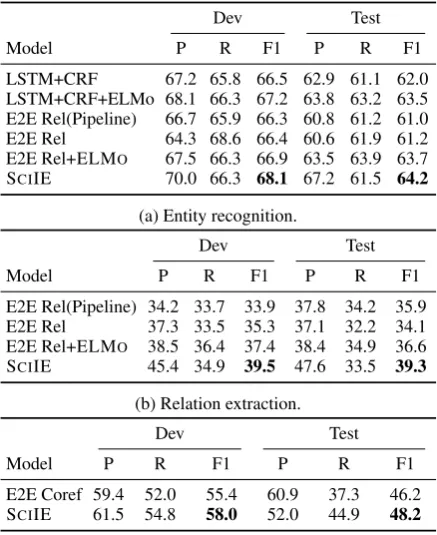
Results on SciERC Table2compares the result
of our model with baselines on the three tasks:
en-tity recognition (Table2a), relation extraction
(Ta-ble2b), and coreference resolution (Table2c). As
evidenced by the table, our unified multi-task setup
3We compare with the inductive setting results.
Dev Test
Model P R F1 P R F1
LSTM+CRF 67.2 65.8 66.5 62.9 61.1 62.0 LSTM+CRF+ELMo 68.1 66.3 67.2 63.8 63.2 63.5 E2E Rel(Pipeline) 66.7 65.9 66.3 60.8 61.2 61.0 E2E Rel 64.3 68.6 66.4 60.6 61.9 61.2 E2E Rel+ELMO 67.5 66.3 66.9 63.5 63.9 63.7 SCIIE 70.0 66.3 68.1 67.2 61.5 64.2
(a) Entity recognition.
Dev Test
Model P R F1 P R F1
E2E Rel(Pipeline) 34.2 33.7 33.9 37.8 34.2 35.9 E2E Rel 37.3 33.5 35.3 37.1 32.2 34.1 E2E Rel+ELMO 38.5 36.4 37.4 38.4 34.9 36.6 SCIIE 45.4 34.9 39.5 47.6 33.5 39.3
(b) Relation extraction.
Dev Test
Model P R F1 P R F1
E2E Coref 59.4 52.0 55.4 60.9 37.3 46.2 SCIIE 61.5 54.8 58.0 52.0 44.9 48.2
[image:7.595.307.526.62.330.2](c) Coreference resolution.
Table 2: Comparison with previous systems on the development and test set for our three tasks. For coreference resolution, we report the average
P/R/F1 of MUC, B3, and CEAFφ4 scores.
SCIIE outperforms all the baselines. For entity
recognition, our model achieves 1.3% and 2.4% relative improvement over LSTM+CRF with and
without ELMO, respectively. Moreover, it achieves
1.8% and 2.7% relative improvement over E2E Rel
with and without ELMO, respectively. For
rela-tion extracrela-tion, we observe more significant im-provement with 13.1% relative imim-provement over E2E Rel and 7.4% improvement over E2E Rel with
ELMO. For coreference resolution, SCIIE
outper-forms E2E Coref with 4.5% relative improvement. We still observe a large gap between human-level performance and a machine learning system. We invite the community to address this challenging task.
Ablations We evaluate the effect of multi-task
learning in each of the three tasks defined in our
dataset. Table3reports the results for individual
extrac-Task Entity Rec. Relation Coref. Multi Task (SCIIE) 68.1 39.5 58.0 Single Task 65.7 37.9 55.3 +Entity Rec. - 38.9 57.1
+Relation 66.8 - 57.6
+Coreference 67.5 39.5
-Table 3: Ablation study for multitask learning on
SCIERC development set. Each column shows
results for the target task.
tion (37.9) significantly benefits when multi-tasked with coreference resolution (7.1% relative improve-ment). Coreference resolution benefits when multi-tasked with relation extraction, with 4.9% relative improvement.
Results on SemEval 17 Table 4 compares the
results of our model with the state of the art on the SemEval 17 dataset for tasks of span identification, keyphrase extraction and relation extraction as well as the overall score. Span identification aims at identifying spans of entities. Keyphrase classifi-cation and relation extraction has the same setting
with the entity and relation extraction in SCIERC.
Our model outperforms all the previous models that use hand-designed features. We observe more significant improvement in span identification than keyphrase classification. This confirms the bene-fit of our model in enumerating spans (rather than BIO tagging in state-of-the-art systems). More-over, we have competitive results compared to the previous state of the art in relation extraction. We
observe less gain compared to the SCIERC dataset
mainly because there are no coference links, and the relation types are not comprehensive.
7.2 Knowledge Graph Analysis
We provide qualitative analysis and human evalua-tions on the constructed knowledge graph.
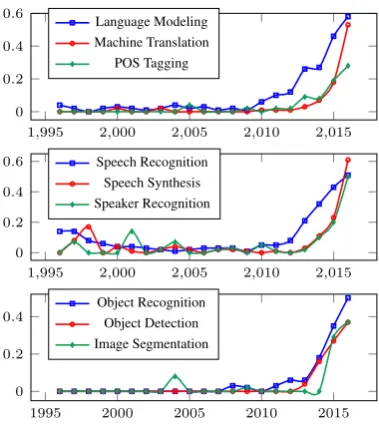
Scientific trend analysis Figure7shows the
his-torical trend analysis (from 1996 to 2016) of the
most popular applications of the phraseneural
net-work, selected according to the statistics of the extracted relation triples with the ‘Used-for’ rela-tion type from speech, computer vision, and NLP conference papers. We observe that, before 2000,
neural networkhas been applied to a greater
per-centage of speech applications compared to the NLP and computer vision papers. In NLP, neural networks first gain popularity in language modeling
1,995 2,000 2,005 2,010 2,015 0
0.2 0.4 0.6
Language Modeling
Machine Translation POS Tagging
1,995 2,000 2,005 2,010 2,015 0
0.2 0.4
0.6 Speech Recognition
Speech Synthesis
Speaker Recognition
1995 2000 2005 2010 2015 0
0.2 0.4
Object Recognition
Object Detection
[image:8.595.318.508.62.277.2]Image Segmentation
Figure 7: Historical trend for top applications of the
keyphraseneural networkin NLP, speech, and CV
conference papers we collected. y-axis indicates
the ratio of papers that useneural networkin the
task to the number of papers that is about the task.
0 20 40 60 80 100 84
86 88 90 92
Pseudo-recall %
Precision
%
With Coref. Without Coref.
Figure 8: Precision/pseudo-recall curves for human evaluation by varying cut-off thresholds. The AUC is 0.751 with coreference, and 0.695 without.
and then extend to other tasks such as POS Tag-ging and Machine Translation. In computer vision, the application of neural networks gains popularity
in object recognitionearlier (around 2010) than
the other two more complex tasks ofobject
detec-tionandimage segmentation(hardest and also the
latest).
Knowledge Graph Evaluation Figure8shows
[image:8.595.311.505.370.458.2]ex-Span Indentification Keyphrase Extraction Relation Extraction Overall
Model P R F1 P R F1 P R F1 P R F1
(Luan 2017) - - 56.9 - - 45.3 - - -
-Best SemEval 55 54 55 44 43 44 36 23 28 44 41 43
[image:9.595.69.527.63.130.2]SCIIE 62.2 55.4 58.6 48.5 43.8 46.0 40.4 21.2 27.8 48.1 41.8 44.7
Table 4: Results for scientific keyphrase extraction and extraction on SemEval 2017 Task 10, comparing with previous best systems.
tracted relations to define ground truth labels. Each domain expert is assigned 2 or 3 entities and all of
the corresponding relations. Figure8shows
preci-sion/recall curves for both systems. Since it is not feasible to compute the actual recall of the systems,
we compute the pseudo-recall (Zhang et al.,2015)
based on the output of both systems. We observe that the knowledge graph curve with coreference linking is mostly above the curve without corefer-ence linking. The precision of both systems is high (above 84% for both systems), but the system with coreference links has significantly higher recall.
8 Conclusion
In this paper, we create a new dataset and develop a multi-task model for identifying entities, relations, and coreference clusters in scientific articles. By sharing span representations and leveraging cross-sentence information, our multi-task setup effec-tively improves performance across all tasks. More-over, we show that our multi-task model is better at predicting span boundaries and outperforms previ-ous state-of-the-art scientific IE systems on entity and relation extraction, without using any hand-engineered features or pipeline processing. Using our model, we are able to automatically organize the extracted information from a large collection of scientific articles into a knowledge graph. Our analysis shows the importance of coreference links in making a dense, useful graph.
We still observe a large gap between the perfor-mance of our model and human perforperfor-mance, con-firming the challenges of scientific IE. Future work includes improving the performance using semi-supervised techniques and providing in-domain features. We also plan to extend our multi-task framework to information extraction tasks in other domains.
Acknowledgments
This research was supported by the Office of Naval Research under the MURI grant
N00014-18-1-2670, NSF (IIS 1616112, III 1703166), Allen Dis-tinguished Investigator Award, and gifts from Allen Institute for AI, Google, Amazon, and Bloomberg. We are grateful to Waleed Ammar and AI2 for sharing the Semantic Scholar Corpus. We also thank the anonymous reviewers, UW-NLP group and Shoou-I Yu for their helpful comments.
References
Amjad Abu-Jbara and Dragomir Radev. 2011. Co-herent citation-based summarization of scientific pa-pers. InProc. Annual Meeting of the Association for Computational Linguistics: Human Language Tech-nologies. volume 1, pages 500–509.
Heike Adel and Hinrich Sch¨utze. 2017. Global normal-ization of convolutional neural networks for joint en-tity and relation classification. InProc. Conf.
Empir-ical Methods Natural Language Process. (EMNLP).
pages 1723–1729.
Waleed Ammar, Dirk Groeneveld, Chandra Bhagavat-ula, Iz Beltagy, Miles Crawford, Doug Downey, Ja-son Dunkelberger, Ahmed Elgohary, Sergey Feld-man, Vu Ha, et al. 2018. Construction of the litera-ture graph in semantic scholar. InProc. Conf. North American Assoc. for Computational Linguistics: Hu-man Language Technologies (NAACL-HLT), (Indus-try Papers). pages 84–91.
Waleed Ammar, Matthew Peters, Chandra Bhagavat-ula, and Russell Power. 2017. The ai2 system at semeval-2017 task 10 (scienceie): semi-supervised end-to-end entity and relation extraction. In Proc.
Int. Workshop on Semantic Evaluation (SemEval).
pages 592–596.
Ashton Anderson, Dan McFarland, and Dan Jurafsky. 2012. Towards a computational history of the ACL: 1980-2008. InProc. ACL Special Workshop on Re-discovering 50 Years of Discoveries. pages 13–21.
Awais Athar and Simone Teufel. 2012a. Context-enhanced citation sentiment detection. In Proc. Conf. North American Assoc. for Computational Lin-guistics: Human Language Technologies (NAACL-HLT). pages 597–601.
ACL Workshop on Detecting Structure in Scholarly Discourse. pages 18–26.
Isabelle Augenstein, Mrinal Das, Sebastian Riedel, Lakshmi Vikraman, and Andrew McCallum. 2017. Semeval 2017 task 10: ScienceIE - extracting keyphrases and relations from scientific publications.
InProc. Int. Workshop on Semantic Evaluation
(Se-mEval).
Isabelle Augenstein and Anders Søgaard. 2017. Multi-task learning of keyphrase boundary classification.
In Proc. Annu. Meeting Assoc. for Computational
Linguistics (ACL). pages 341–346.
Kevin Clark and Christopher D. Manning. 2016. Improving coreference resolution by learning entity-level distributed representations. CoRR
abs/1606.01323.
Ronan Collobert and Jason Weston. 2008. A unified architecture for natural language processing: Deep neural networks with multitask learning. In Proc.
Int. Conf. Machine Learning (ICML). pages 160–
167.
Huy Hoang Nhat Do, Muthu Kumar Chandrasekaran, Philip S Cho, and Min Yen Kan. 2013. Extracting and matching authors and affiliations in scholarly documents. In Proc. ACM/IEEE-CS Joint Confer-ence on Digital libraries. pages 219–228.
Kata G´abor, Davide Buscaldi, Anne-Kathrin Schu-mann, Behrang QasemiZadeh, Ha¨ıfa Zargayouna, and Thierry Charnois. 2018. Semeval-2018 Task 7: Semantic relation extraction and classification in sci-entific papers. InProc. Int. Workshop on Semantic Evaluation (SemEval).
Kata Gabor, Haifa Zargayouna, Davide Buscaldi, Is-abelle Tellier, and Thierry Charnois. 2016. Se-mantic annotation of the ACL anthology corpus for the automatic analysis of scientific literature. In
Proc. Language Resources and Evaluation Confer-ence (LREC).
Kata G´abor, Ha¨ıfa Zargayouna, Isabelle Tellier, Davide Buscaldi, and Thierry Charnois. 2016. Unsuper-vised relation extraction in specialized corpora using sequence mining. InInternational Symposium on In-telligent Data Analysis. Springer, pages 237–248.
Yarin Gal and Zoubin Ghahramani. 2016. A theoret-ically grounded application of dropout in recurrent neural networks. In Proc. Annu. Conf. Neural In-form. Process. Syst. (NIPS).
Sonal Gupta and Christopher D Manning. 2011. An-alyzing the dynamics of research by extracting key aspects of scientific papers. InProc. IJCNLP. pages 1–9.
Luheng He, Kenton Lee, Omer Levy, and Luke Zettle-moyer. 2018. Jointly predicting predicates and argu-ments in neural semantic role labeling. InACL.
Sepp Hochreiter and J¨urgen Schmidhuber. 1997. Long short-term memory. Neural computation9(8):1735– 1780.
Kokil Jaidka, Muthu Kumar Chandrasekaran, Beat-riz Fisas Elizalde, Rahul Jha, Christopher Jones, Min-Yen Kan, Ankur Khanna, Diego Molla-Aliod, Dragomir R Radev, Francesco Ronzano, et al. 2014. The computational linguistics summarization pilot task. InProc. Text Analysis Conference.
Miray Kas. 2011. Structures and statistics of citation networks. Technical report, DTIC Document.
Arzoo Katiyar and Claire Cardie. 2017. Going out on a limb: Joint extraction of entity mentions and relations without dependency trees. In Proc. Annu. Meeting Assoc. for Computational Linguistics
(ACL). volume 1, pages 917–928.
Sigrid Klerke, Yoav Goldberg, and Anders Søgaard. 2016. Improving sentence compression by learning to predict gaze. InHLT-NAACL.
Guillaume Lample, Miguel Ballesteros, Sandeep Sub-ramanian, Kazuya Kawakami, and Chris Dyer. 2016. Neural architectures for named entity recognition.
In Proc. Conf. North American Assoc. for
Compu-tational Linguistics (NAACL).
Kenton Lee, Luheng He, Mike Lewis, and Luke S. Zettlemoyer. 2017. End-to-end neural coreference resolution. InEMNLP.
Kenton Lee, Luheng He, and Luke Zettlemoyer. 2018. Higher-order coreference resolution with coarse-to-fine inference. InNAACL.
Yi Luan, Chris Brockett, Bill Dolan, Jianfeng Gao, and Michel Galley. 2017a. Multi-task learning for speaker-role adaptation in neural conversation mod-els. InProc. IJCNLP.
Yi Luan, Yangfeng Ji, Hannaneh Hajishirzi, and Boyang Li. 2016. Multiplicative representations for unsupervised semantic role induction. In Proc. Annu. Meeting Assoc. for Computational Linguistics (ACL). page 118.
Yi Luan, Mari Ostendorf, and Hannaneh Hajishirzi. 2017b. Scientific information extraction with semi-supervised neural tagging. InProc. Conf. Empirical
Methods Natural Language Process. (EMNLP).
Yi Luan, Mari Ostendorf, and Hannaneh Hajishirzi. 2018. The uwnlp system at semeval-2018 task 7: Neural relation extraction model with selectively in-corporated concept embeddings. InProc. Int.
Work-shop on Semantic Evaluation (SemEval). pages 788–
792.
Nanyun Peng, Hoifung Poon, Chris Quirk, Kristina Toutanova, and Wen-tau Yih. 2017. Cross-sentence n-ary relation extraction with graph lstms. Trans.
Assoc. for Computational Linguistics (TACL)5:101–
115.
Matthew Peters, Waleed Ammar, Chandra Bhagavat-ula, and Russell Power. 2017. Semi-supervised se-quence tagging with bidirectional language models.
In Proc. Annu. Meeting Assoc. for Computational
Linguistics (ACL). volume 1, pages 1756–1765.
Matthew E. Peters, Mark Neumann, Mohit Iyyer, Matt Gardner, Christopher Clark, Kenton Lee, and Luke Zettlemoyer. 2018. Deep contextualized word repre-sentations. InNAACL.
Behrang QasemiZadeh and Anne-Kathrin Schumann. 2016. The ACL RD-TEC 2.0: A language resource for evaluating term extraction and entity recognition methods. InLREC.
Chris Quirk and Hoifung Poon. 2017. Distant su-pervision for relation extraction beyond the sen-tence boundary. InProc. European Chapter Assoc.
for Computational Linguistics (EACL). pages 1171–
1182.
Marek Rei. 2017. Semi-supervised multitask learning for sequence labeling. InProc. Annu. Meeting As-soc. for Computational Linguistics (ACL).
Yanchuan Sim, Noah A Smith, and David A Smith. 2012. Discovering factions in the computational lin-guistics community. InProc. ACL Special Workshop on Rediscovering 50 Years of Discoveries. pages 22– 32.
Sameer Singh, Sebastian Riedel, Brian Martin, Jiaping Zheng, and Andrew McCallum. 2013. Joint infer-ence of entities, relations, and coreferinfer-ence. InProc. of the 2013 workshop on Automated knowledge base construction. ACM, pages 1–6.
Pontus Stenetorp, Sampo Pyysalo, Goran Topi´c, Tomoko Ohta, Sophia Ananiadou, and Jun’ichi Tsu-jii. 2012. Brat: a web-based tool for nlp-assisted text annotation. InProc. European Chapter Assoc.
for Computational Linguistics (EACL). pages 102–
107.
Swabha Swayamdipta, Sam Thomson, Chris Dyer, and Noah A. Smith. 2017. Frame-semantic parsing with softmax-margin segmental rnns and a syntactic scaf-fold. CoRRabs/1706.09528.
Chen-Tse Tsai, Gourab Kundu, and Dan Roth. 2013. Concept-based analysis of scientific literature. In
Proc. ACM Int. Conference on Information &
Knowl-edge Management. ACM, pages 1733–1738.
Adam Vogel and Dan Jurafsky. 2012. He said, she said: Gender in the ACL anthology. InProc. ACL Special Workshop on Rediscovering 50 Years of Discoveries. pages 33–41.
Sam Wiseman, Alexander M. Rush, and Stuart M. Shieber. 2016. Learning global features for coref-erence resolution. InHLT-NAACL.
Yan Xu, Ran Jia, Lili Mou, Ge Li, Yunchuan Chen, Yangyang Lu, and Zhi Jin. 2016. Improved rela-tion classificarela-tion by deep recurrent neural networks with data augmentation. InProc. Int. Conf.
Compu-tational Linguistics (COLING). pages 1461–1470.
Congle Zhang, Stephen Soderland, and Daniel S. Weld. 2015. Exploiting parallel news streams for unsuper-vised event extraction.TACL3:117–129.
Meishan Zhang, Yue Zhang, and Guohong Fu. 2017. End-to-end neural relation extraction with global op-timization. InProc. Conf. Empirical Methods
Natu-ral Language Process. (EMNLP). pages 1730–1740.
Suncong Zheng, Feng Wang, Hongyun Bao, Yuexing Hao, Peng Zhou, and Bo Xu. 2017. Joint extrac-tion of entities and relaextrac-tions based on a novel tag-ging scheme. In Proc. Annu. Meeting Assoc. for
Computational Linguistics (ACL). volume 1, pages
A Annotation Guideline
A.1 Entity Category
• Task: Applications, problems to solve,
sys-tems to construct.
E.g. information extraction, machine reading system, image segmentation, etc.
• Method: Methods , models, systems to use,
or tools, components of a system, frameworks.
E.g. language model, CORENLP, POS parser, kernel method, etc.
• Evaluation Metric: Metrics, measures, or
entities that can express quality of a sys-tem/method.
E.g. F1, BLEU, Precision, Recall, ROC curve, mean reciprocal rank, mean-squared error, ro-bustness, time complexity, etc.
• Material: Data, datasets, resources, Corpus,
Knowledge base.
E.g. image data, speech data, stereo images, bilingual dictionary, paraphrased questions, CoNLL, Panntreebank, WordNet, Wikipedia, etc.
• Evaluation Metric: Metric measure or term
that can express quality of a system/method.
E.g. F1, BLEU, Precision, Recall, ROC
curve, mean reciprocal rank, mean-squared error,robustness, compile time, time complex-ity...
• Generic: General terms or pronouns that may
refer to a entity but are not themselves infor-mative, often used as connection words.
E.g model, approach, prior knowledge, them, it...
A.2 Relation Category
Relation link can not go beyond sentence boundary. We define 4 asymmetric relation types (Used-for,
Feature-of,Hyponym-of,Part-of), together with 2
symmetric relation types (Compare,Conjunction).
Balways points toAfor asymmetric relations
• Used-for:Bis used forA,BmodelsA,Ais
trained onB,BexploitsA,Ais based onB.
E.g.
TheTISPER systemhas been designed
to enable manytext applications.
Ourmethodmodelsuser proficiency. Ouralgorithmsexploitslocal soothness.
• Feature-of:Bbelongs toA,Bis a feature of
A,Bis underAdomain. E.g.
prior knowledgeof themodel
genre-specific regularities ofdiscourse structure
English textinscience domain
• Hyponym-of: Bis a hyponym of A,Bis a
type ofA. E.g.
TUITis asoftware library
NLP applicationssuch asmachine trans-lationandlanguage generation
• Part-of:Bis a part ofA... E.g.
Thesystemincludes two models:speech recognitionandnatural language under-standing
We incorporateNLU moduleto the
sys-tem.
• Compare: Symmetric relation (use blue to
denote entity). Opposite of conjunction, com-pare two models/methods, or listing two op-posing entities. E.g.
Unlike thequantitative prior, the
qualita-tive prioris often ignored...
We compare our system with previous
sequential tagging systems...
• Conjunction: Symmetric relation (use blue
to denote entity). Function as similar role or use/incorporate with. E.g.
obtained from human expert or
knowl-edge base
NLP applications such asmachine
trans-lationandlanguage generation
A.3 Coreference
Two Entities that points to the same concept.
• Anaphora and Cataphora:
We introduce amachine reading system...
Thesystem...
The prior knowledge include...Such
knowledgecan be applied to...
• Coreferring noun phrase:
We develop apart-of-speech tagging
A.4 Notes
1. Entity boundary annotation follows the ACL RD-TEC Annotation Guideline
(Qasem-iZadeh and Schumann,2016), with the
exten-tion that spans can be embedded in longer spans, only if the shorter span is involved in a relation.
2. Do not include determinators (such as the, a), or adjective pronouns (such as this,its, these, such) to the span. If generic phrases are not involved in a relation, do not tag them.
3. Do not tag relation if one entity is:
• Variable bound:
We introduce a neural based approach..
Itsbenefit is...
• The wordwhich:
We introduce a neural based approach,
whichis a...
4. Do not tag coreference if the entity is
• Generically-used Other-ScientificTerm:
...advantage gained from local
smooth-nesswhich... We present algorithms
ex-ploitinglocal smoothnessin more
aggres-sive ways...
• Same scientific term but refer to different
examples:
We use adata structure, we also use
an-otherdata structure...
5. Do not label negative relations:
X is not used in Y or X is hard to be applied in Y
B Annotation and Knowledge Graph
Examples
Here we take a screen shot of the BRAT interface
for an ACL paper in Figure9. We also attach the
original figure of Figure 3 in Figure 10. More
examples can be found in the project website4.
Figure 9: Annotation example 1 from ACL
Figure 10: An example of our automatically generated knowledge graph centered onstatistical machine
[image:14.595.99.507.325.711.2]