Original Article
Effects of aromatherapy essential oil inhalation on the
stress response after exposure to noise and arithmetic
subtraction stressor: randomized controlled trial
Iklyul Bae1*, Ji-Ah Song1*, Mikyoung Lee2, Myunghaeng Hur2
1Konyang University, Daejeon, South Korea; 2Eulji University, Daejeon, South Korea. *Equal contributors.
Received January 15, 2016; Accepted October 7, 2017; Epub January 15, 2018; Published January 30, 2018
Abstract: Objective: This study used a nonequivalent control group pretest/posttest design in order to compare the effects of aromatherapy essential oil (EO) inhalation on psychological and physiological responses after exposure to stressors. Methods: This study was a Randomized single Blind Controlled Trial. A total of 95 individuals who met the selection criteria were included as research subjects, and divided into experimental (n=33), placebo (n=31), and control (n=31) groups. In order to determine the effects of aromatherapy EO inhalation, subjects were asked a series of repeated arithmetic subtraction problems, in which they subtracted increments of 17 from 6315 for 2 min following a stressor: 3 min of white noise using a headset. The experimental group was inhaled 2 drops (2 drops=0.1 cc) of the blended EO of Lavandular officinalis and Cananga odorata, placebo group, 2 drops of 0.9% saline solu-tion; and control group, no inhalation. Measurements of stress scores, stress index, sympathetic nerve activity, serum cortisol levels, and blood pressure were examined in 4 test sessions: prior to the experiment (pre-test), right after exposure to the stressor, 10 min after the experiment, and 30 min after the experiment. Results: The stress index showed significant differences among the three groups (F=4.546, P=.013). Sympathetic nerve activity also showed significant differences among the three groups (F=6.056, P=.003), while cortisol levels were only partially significantly different among the three groups (F=3.110, P=.049). Both systolic (F=4.380, P=.015) and diastolic (F=4.438, P=.014) blood pressure readings showed significant between-group differences. Conclusion: The inhala-tion of aromatherapy EO was effective in reducing the stress score, stress index, sympathetic nerve activity, serum cortisol level, and blood pressure of participants.
Keywords: Stress, noise, essential oil, sympathetic nerve, cortisol, blood pressure
Introduction
Stress is emerging as an important issue in modern society. Appropriate regulation of stress is a vital element in improving one’s health, although individuals manifest varied responses to both routine and diverse stress-inducing factors [1].
Long-term stress can induce physiological responses, including autonomic nervous sys-tem (ANS) responses from stimulation of the hypothalamus by the cerebral cortex, and the activated sympathetic nervous system releas-ing catecholamines [2]. As a result, blood pres-sure and heart rate increase and cortisol is released into the blood vessels by a
hypothala-mus-pituitary-adrenal response [3]. According to a study by Lee, Hwang, and Kim [4], exces-sive excretion of cortisol from persistent and excessive stress can cause diverse problems associated with the cardiovascular, digestive, and musculoskeletal systems, and cause lost homeostasis and emotional stability. It can also cause disease as an ineffective stress coping mechanism.
been previous studies on the effects of abdom-inal massage for providing stress relief [7], the effects of hand massage on stress responses [4], and the efficacy of aromatherapy on stress [8]. Massage therapies, as many have pointed out, are limited by the need for skilled practitio-ners to perform the massage [9], as well as dif-ficulties in sustaining the therapy on an individ-ual basis due to the need for separate spaces and/or equipment [7].
On the other hand, inhalation of essential oil (EO) involves both short application times and quick physical response in patients, with EO components being detected in blood within 5 min and reaching maximum levels within 20 min. It is a non-invasive method that affects the brain directly, is a CAM therapy that is not restricted by time or place, is fast acting, and shows virtually no adverse effects [5]. Further, this method has an outstanding efficacy, as it spreads to the entire body through respiration to induce chemical reactions with enzymes, brings about enhanced psychological and phys-ical relief effects [10], and can positively affect blood flow [11].
Earlier studies on stress intervention using aroma inhalation have examined its effects on blood pressure and stress response in patients with essential hypertension [9], its effects on physical resistance to ANS and stress in patients after stroke [12], and its effects onpa-tients with breast cancer receiving radiation therapy [13]. However, many of these studies were limited either to participants with various
diseases or to pretest/posttest evaluations on experimental treatments.
Thus, the present study was conducted on healthy adults, in order to investigate interven-tion effects on both relief and preveninterven-tion of stress induced after exposure to noise and arithmetic subtraction stressor. Moreover, for the development of scientific and objective nursing interventions, environmental effects were minimized and, as a measure to control exogenous variables, the study was conducted in a laboratory with constant environmental settings. Furthermore, by identifying the effects of EO inhalation on stress over time, we could better investigate its time-based anti-stress effects.
Participants and methods
Study design
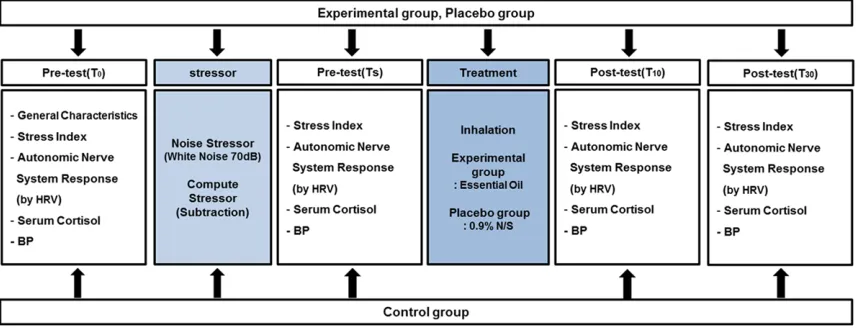
The present study used a parallel control group non-synchronized design to examine the effects of EO inhalation on stress index, sympathetic/ parasympathetic nerve activities, cortisol, and blood pressure after exposure to noise and arithmetic subtraction stressor (Figure 1).
Participants
[image:2.612.93.523.75.239.2]The study participants consisted of those who were recruited volunteers between July and September 2013. Selection criteria included understanding the study objectives and volun-teering to participate; male and female adults
between the ages 20 and 35 years and exclu-sion criteria were suffering from rhinitis, asth-ma, or cold that could affect sense of smell. Individuals who were currently receiving treat-ments for physical or mental conditions or who were taking anxiolytics or hypnotic medications were excluded.
Data were collected in accordance with the fol-lowing procedures.
(1) Candidates were recruited through an announcement, and selections made after veri-fying the status on any diseases and medica-tions taken.
(2) Explanations on experimental treatment, investigation methods, self-determination, and self-withdrawal were given to the candidates, and signed consent forms were received from those consenting to participate.
(3) The MS Excel program (Microsoft, Redmond, Wash) was used to randomly assigned partici-pants to the experimental, placebo, and control groups.
Sample size calculation
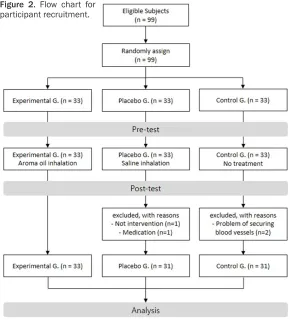
[image:3.612.90.380.71.391.2]Sample size was obtained by inputting alpha value, statistical power, and effect size into theG-power 3.1.7 program (Heinrich Heine University, Dusseldorf, Germany). To compare the differences between the three groups, effect size was calculated, based on a previous study [9], by inputting the number of groups, standard deviation, and mean, which resulted in an effect size of .34. The sample size was calculated with the effect size, significance level (α), and the power (1-β), .34, .05, and .9, respectively into the formula, it was determined that the total sample size needed was 90. In the present study, the total number of partici-pants was 99, allowing for a 10% drop-out rate, and the experimental, control, and placebo groups were assigned 33 participants each. However, 2 people in the control group dropped out owing to problems in securing an IV line, and 2 in the placebo group dropped out: one for inability to take the treatment medication and the other for inability to participate in the exper-iment. Therefore, the final number of partici-pants was 95: with 33, 31, and 31 participartici-pants
Figure 2. Flow chart for
participant recruitment. (4) Data were collected from the control, placebo, and
experimental group, in order, as part of a non-synchro-nized design.
(5) The data ID was codified to numbers and analyzed anonymously following data collection.
Concealment and blinding
in the experimental, control, and placebo groups, respectively (Figure 2).
Outcome measures
Stress index
The stress index represents the value for stress conditions based on balance of the ANS derived from heart rate variability (HRV) measured con-tinuously for 5 min using the Canopy 9 profes-sional 4.0 (IEMBIO, Gangwon-do, Korea), an ANS measurement instrument. The stress index is based on a scale of 1 to 10, with higher scores indicating greater exposures to stress conditions.
Low frequency activity
Sympathetic nerve activity was measured by low frequency activity of HRV which is the value representing the area of low frequency (LF), as a sympathetic nerve index. This was calculated from the value using HRV, measured continu-ously for 5 min with Canopy 9 professional 4.0. Higher sympathetic nerve activity values indi-cate greater exposures to stress conditions.
Serum cortisol
Cortisol is a response variable for stress. Thus, our experiments were conducted between 4 pm and 7 pm, when cortisol variability is low-est. In order to minimize the influence of exter-nal factors on cortisol, minimizing smoking, controlling diet, and other precautions were an- nounced in advance, and compliance was veri-fied with all participants before administering experimental treatments.
To measure serum cortisol levels, a nurse per-formed a venipuncture; after which, a 3-way syringe stopcock was used to secure a vein in order to draw 3 mL of venous blood. The col-lected blood was centrifuged in a well-equipped laboratory and then cold-stored. Then, the sp- ecimens were sent to laboratories for analysis of a cortisol with Cobra 5010 Quantun analysis equipment (Packard Instrument Co., Meridian, Conn); the unit of analysis was mcg/dL.
Blood pressure
For measurement of participants’ blood pres-sure, an electronic blood pressure monitor (Omron IA2, Kyoto, Japan) was used to measure
the systolic and diastolic pressures. Mea- surements were taken from the upper arm in a sitting position after the participants were stabilized.
Laboratory preferences
The area of the laboratory was 19.83 m2, and
the temperature inside the measurement site was set to 22 to 24°C, which was considered to be the appropriate temperature for the human body, as well as for measuring ANS response and blood pressure. The laboratory was well-ventilated, and the measurement site was fur-nished with a sofa, a table, and chairs to pro-vide a comfortable environment for the participants.
Intervention
Stressor
White noise refers to a series of noises with a frequency that is distributed in a continuously uniform manner throughout the entire audible range of 20 to 20.000 Hz, as well as fixed sounds that do not have specific audible pat-terns. As white noise has been found to have negative effects on mental arithmetic opera-tions, as well as physical and mental health, it was effectively used as the stressor. Based on the results from a previous study [14], the par-ticipants had heard 70 dB white noise for 3 min through headphones (MDR-1R, Sony Corpo- ration, Tokyo Japan) as astressor, after which, as a stress stimulus via mental arithmetic oper-ations, they were instructed to perform sub-tractions, starting from 6,135 and continuously subtracting 17 from the resultant, for 2 min. If an incorrect answer was given, they were instructed to start over from the beginning.
EO selection
palpitations, and Cananga odorata which is effective in reducing blood pressure, relieving heart palpitations and nervous tension, and mental relaxation. Lavandular officinalis and Cananga odorata were blended at a 1:1 ratio and cold-stored before use.
Data collection
Pre-surveys (T0): In terms of study procedures, pre-surveys were conducted when the pants first visited the laboratory. After partici-pants seated in a chair for 5 min to be stabi-lized, an IV line was secured, using a 3-way syringe stopcock for blood collection, followed by another 5 min for stabilization. After the stress score was measured, blood pressure was also monitored. We measured both stress index and sympathetic/parasympathetic nerve activities, and then collected and stored 3 mL of venous blood from each participant.
Experimental treatment
The experimental group
After loading the stressor, each participant was stabilized comfortably, followed by EO inhala-tion. In terms of the inhalation method, two drops of cold-stored EO (2 drops=0.1 cc), a blend of Lavandular officinalis and Cananga odorata, were dropped onto an aroma stone
and placed 10 cm away from the participant’s nose for 10 min of inhalation in a comfortable position.
The placebo group
After loading the stressor, each participant was stabilized comfortably, followed by inhalation of a 0.9% saline. The inhalation method was the same as the experimental group.
The control group
After loading the stressor, each participant was stabilized comfortably for 10 min.
Post-survey (T10, T30)
The first post-survey (T10) was performed 10 minutes after the experiment and the second post-survey (T30) was performed 30 minutes after the experiment. Stress scores, blood pressure, stress index, and sympathetic/para-sympathetic activity were measured in each post-surveys. 3 mL of venous blood was col-lected using a secured 3-way syringe stopcock and stored in a blood-collection container. Afterwards, the participants were instructed to complete the post-survey questionnaire.
Ethical considerations
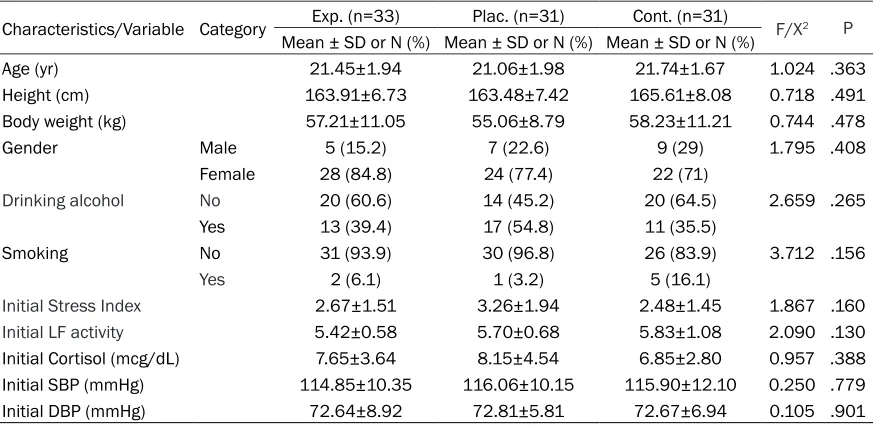
[image:5.612.89.529.84.298.2]This study was approved (EU 13-17) through the institutional review board of our institution. Table 1. Homogeneity test on general characteristics of participants
Characteristics/Variable Category Exp. (n=33) Plac. (n=31) Cont. (n=31) F/X2 P
Mean ± SD or N (%) Mean ± SD or N (%) Mean ± SD or N (%)
Age (yr) 21.45±1.94 21.06±1.98 21.74±1.67 1.024 .363
Height (cm) 163.91±6.73 163.48±7.42 165.61±8.08 0.718 .491 Body weight (kg) 57.21±11.05 55.06±8.79 58.23±11.21 0.744 .478
Gender Male 5 (15.2) 7 (22.6) 9 (29) 1.795 .408
Female 28 (84.8) 24 (77.4) 22 (71)
Drinking alcohol No 20 (60.6) 14 (45.2) 20 (64.5) 2.659 .265
Yes 13 (39.4) 17 (54.8) 11 (35.5)
Smoking No 31 (93.9) 30 (96.8) 26 (83.9) 3.712 .156
Yes 2 (6.1) 1 (3.2) 5 (16.1)
Initial Stress Index 2.67±1.51 3.26±1.94 2.48±1.45 1.867 .160
Initial LF activity 5.42±0.58 5.70±0.68 5.83±1.08 2.090 .130
Initial Cortisol (mcg/dL) 7.65±3.64 8.15±4.54 6.85±2.80 0.957 .388 Initial SBP (mmHg) 114.85±10.35 116.06±10.15 115.90±12.10 0.250 .779 Initial DBP (mmHg) 72.64±8.92 72.81±5.81 72.67±6.94 0.105 .901
Consent and signatures were received from individual participants, and it was explained to them that they had the right to withdraw partici-pation at any time during the study. Study par-ticipants were informed about possible adverse effects from EOs (e.g., vomiting, nausea, aller-gic reaction, headache) during experimental treatment.
Statistical analysis
The collected data were analyzed using IBM SPSS Statistics 20.0. The test of homogeneity among the three groups was assessed with
X2-test and ANOVA. The test for the differences
[image:6.612.91.522.95.495.2]between pre- and post-experiment conditions of the stress index, sympathetic nerve activity and parasympathetic nerve activity, serum cor-tisol level and blood pressure were analyzed by ANOVA, Scheffe’ method and LSD method. In addition, repeated measures of ANOVA and repeated measures of ANCOVA were performed to analyze the differences in the measure-ments for stress response, response of auto-nomic nervous system, cortisol level and blood pressure of the experimental, placebo and con-trol groups according to the time interval. Table 2. Comparison on stress index, sympathetic/parasympathetic nerve activities, cortisol, systolic/ diastolic blood pressure between the experimental, placebo, and control groups (N=95)
Variable Exp. (n=33) Plac. (n=31) Cont. (n=31) F P F (p)*
Mean ± SD Mean ± SD Mean ± SD
Stress Index T0 2.67±1.51 3.26±1.94 2.48±1.45 1.867 .160 Time 49.336 (<.001)
G*T 3.229 (.004) Group 8.811
(<.001)
TS 4.70±1.68 5.61±1.78 4.06±1.80 6.085 .003
T10 3.21±1.69a 5.06±2.11b 3.65±1.78b 8.519 <.001
Difference (T10-TS) -1.48±1.76a -0.54±1.85b -0.41±0.76b 4.536 .013 T30 2.73±1.62a 4.61±1.83b 3.10±1.66b 10.791 <.001 Difference (T30-TS) -1.96±1.82a -1.00±1.46b -0.96±1.16b 4.546 .013
LF activity T0 5.42±0.58 5.70±0.68 5.83±1.08 2.090 .130 Time 70.312 (<.001)
G*T 5.504 (<.001) Group 6.560
(.002)
TS 6.12±0.81 6.27±0.85 6.65±1.03 2.890 .061
T10 5.43±0.68a 6.11±0.63b 6.28±1.06b 9.906 <.001
Difference (T10-TS) -0.69±0.64a -0.15±0.53a,b -0.37±0.47b 7.397 .001
T30 5.08±0.63a 5.77±0.68b 6.02±1.08b 11.322 <.001
Difference (T30-TS) -1.03±0.64a -0.49±0.74b -0.62±0.54b 6.056 .003
Cortisol (μg/dL) T0 7.65±3.64 8.15±4.54 6.85±2.80 0.957 .388 Time 12.434 (<.001) G*T 1.25
(.280) Group .447
(.641)
TS 8.67±5.01 9.60±5.04 8.06±3.26 0.907 .407
T10 7.69±4.89 8.19±4.65 7.79±4.11 0.108 .898
Difference (T10-TS) -0.98±2.39 -1.41±1.81 -0.86±2.14 2.756 0.69
T30 6.74±3.82 7.58±4.42 7.28±3.53 0.377 .687
Difference (T30-TS) -1.93±3.04a -2.01±2.22a -0.62±1.96b 3.110 .049
SBP (mmHg) T0 114.85±10.35 116.06±10.15 115.90±12.01 0.250 .779 Time 40.145 (<.001) G*T 4.581
(<.001) Group 1.881
(.158)
TS 119.45±11.98 119.37±11.08 121.07±11.13 0.475 .624
T10 109.70±9.07a 115.23±8.70b 117.33±10.34b 6.276 .003 Difference (T10-TS) -9.76±6.18a -4.15±3.84b -3.90±4.18b 14.87 <.001
T30 107.58±10.30 113.13±10.81 115.23±8.447 5.054 .008
Difference (T30-TS) -11.87±9.46a -6.24±9.08b -5.83±8.82b 4.380 .015
DBP (mmHg) T0 72.64±8.92 72.81±5.81 72.67±6.94 0.105 .901 Time 19.650 (<.001)
G*T 3.025 (.007) Group 1.444
(.241)
TS 74.67±8.56 74.45±7.06 75.03±7.40 0.475 .624
T10 68.09±8.06a 71.19±7.40 73.40±6.02b 6.276 .003
Difference (T10-TS) -6.58±5.71a -3.26±8.83 -1.71±5,77b 4.438 .014
T30 67.64±6.81a 70.06±7.28 72.33±5.85b 5.054 .008
Difference (T30-TS) -7.03±6.21 -4.38±8.07 -2.70±7.22 2.916 .059
Results
We performed a homogeneity pre-test on the three groups, and confirmed homogeneity, as no significant differences were seen between the experimental, placebo, and control groups for general characteristics and dependent vari-ables (Table 1).
The four measurements taken for verification of the effects of EO inhalation on stress index showed significant differences based on time (F=49.336, P<.001); the reciprocal action bet- ween group and time also showed significant differences (F=3.229, P=.004) (Table 2). Sympathetic nerve activities showed significant differences based on time (F=70.312, P<.001); the reciprocal action between group and time also showed significant differences (F=5.504, P<.001) (Table 2).
Repeated-measures analysis of variance (AN- OVA) results on cortisol concentration showed no significant differences between the three groups, but the level of decrease did show sig-nificant differences between the three groups (F=3.110, P=.049). The post-hoc analysis re- sults indicated significant decreases in cortisol in the experimental and placebo groups, in comparison to the control group (P<.05) (Table 2).
There were significant differences in systolic pressure based on time (F=40.145, P<.001); the reciprocal action between group and time also showed significant differences (F=4.581, P<.001) (Table 2).
Analysis results on diastolic pressure show- ed significant differences based on time (F= 19.650, P<.001); the reciprocal action between group and time also showed significant differ-ences (F=3.025, P=.007) (Table 2).
Discussion
Our study sought to identify the effects of EO inhalation on both stress responses and on physiological responses, such as stress index, sympathetic/parasympathetic nerve activities, serum cortisol, and blood pressure. To load the stress, the participants were exposed to noise and arithmetic operation stressors prior to treatment. The experimental group was given
blended Lavandular officinalis and Cananga odorata EO, the placebo group was given 0.9% saline, and the control group was given nothing for inhalation. Measurements were taken at four points: prior to experimental treatment, after presenting the stressor, 10 min after treatment, and 30 min after treatment, in order to identify time-based effects.
Ward [15] reported that noise has a negative effect on task performance; in a study related to heart rate, it was reported that exposure to mental arithmetic tasks increased sympathetic nerve activities, while decreasing the parasym-pathetic nerve activities. In other words, stress is felt when performing tasks or engaging in thoughts that require close attention [1]. As such, the stressors used in the present study-70 dB level noise and arithmetic subtraction operations represent a stress level that we would often encounter in our daily lives. In the present study, white noise and arithmetic sub-traction operations did ultimately act as stressors.
Stress index was measured at 10 and 30 min-utes after treatment. The measured results at 10 and 30 minutes showed decreases in stress index for all three groups after withdrawing stressor (Ts) and giving treatment, but there were no decreases from the initial stress index. However, after EO inhalation, the experimental group showed a significant decrease in com-parison to the placebo and control groups, and showed a tendency of greater decrease at 30 min after treatment than at 10 min after treat-ment. We determined from these results that EO inhalation is effective in reducing the stress index, and that it effectively regulated the activ-ity of the hypothalamus to provide stable and relaxing conditions by creating balance and harmony in the sympathetic nervous system, indicating its potential for effective use in stressful conditions.
min-post-treatment. Based on these results, it was confirmed that EO inhalation reduced stress scores and sympathetic nerve activities to lev-els prior to inducement of stress, and thus is effective in aiding recovery from the stress response.
These results are consistent with other studies that indicated sympathetic nerve activity was reduced after aroma EO inhalation [16], and that stress scores decreased at 10 minutes after treatment for stress using aroma EO, blended with lavender, ylangylang, rosemary, and lemon [17]. Moreover, when compared to the study by Nord [6] on the use of single oil, it is believed that using blended EOs shows more synergistic effects that using a single oil in reducing stress. This is consistent with another study that reported blending 2 to 3 different oils maximized their efficacy through synergis-tic effects [18].
When the effects of aroma EO inhalation on serum cortisol were tested, the results showed no significant differences between the three groups at 10 minutes after treatment. However, at 30 minutes after treatment, significant dif-ferences between the three groups were observed, with the experimental and placebo groups showing significant decreases in com-parison to the control group. Changes in corti-sol in the three groups consisted of an increase in cortisol levels after being subjected to the stressor and a decrease in serum cortisol at 10 and 30 minutes after treatment in the control group, which only had the stressor removed; the experimental group, which had the stressor removed and was treated with EO inhalation; and the placebo group, which had the stressor removed, and was treated with a saline inhala-tion. From this, it was indirectly confirmed that serum cortisol changes depend on the levels of stress. However, in the study results, no signifi-cant differences between the experimental and placebo groups were discovered. Therefore, in order to explain the effects of aroma EO inhala-tion on serum cortisol concentrainhala-tion, further studies, which supplement additional informa-tion on frequency and time of inhalainforma-tion and the components and types of oil used, are deemed necessary.
Finally, to investigate the effects of EO inhala-tion on vital signs, systolic and diastolic blood pressures were measured. As a result, for
sys-tolic blood pressure, the experimental group showed a significant decrease compared to the placebo and control groups at both 10 and 30 minutes after treatment. When compared to a study that reported a decrease in systolic blood pressure after a 4-week inhalation of blended lavender and ylangylang EO through necklace and aroma stone applications [19], our results were more effective, time- and cost-wise, as recovery and reduction in systolic blood pres-sure were seen after just 10 minutes.
It appeared these physically relaxing effects and decreases in sympathetic nerve activities indicated feelings of stability, which led to a decrease in blood pressure. In particular, sys-tolic blood pressures measured in the labora-tory showed decreases in the experimental group of approximately 9.76 mmHg within 10 minutes and 11.87 mmHg after 30 minutes. This quick decrease in blood pressure from acute effects of EO inhalation could represent a meaningful finding. Moreover, diastolic blood pressure showed a significant decrease in the experimental group at 10 minutes after EO inhalation, compared to the placebo and con-trol groups, but significant differences were not seen after 30 minutes. This demonstrated that inhalation of blended Lavandular officinalis and Cananga odorata aroma EO had an immediate effect on diastolic blood pressure, but after recovery to a certain level, it stabilized.
decreases in blood pressure based on time can confirm the time frame of stress recovery, EO inhalation could potentially have broad-based applications in practical nursing.
Further, the results of this study can contribute to the development and the utilization of aroma EO inhalation applications as a CAM therapy that can be easily used as a relaxation therapy in daily life. Indeed, it could potentially serve as a self-nursing intervention measure for stress relief for adults, and contribute to enhancing both their quality of life and maintenance of their health.
In conclusion, aroma EO inhalation was shown to be effective for stress relief, as it decreased stress score as a psychological response, and reduced stress index, sympathetic nerve activ-ity, and blood pressure as a physiological response. Therefore, it can be used as a meth-od for relieving stress in both clinical and every-day settings, in which there are greater expo-sures to diverse stressors.
Acknowledgements
This research was supported by Basic Science Research Program through the National Re- search Foundation of Korea (NRF) funded by the Ministry of Science, ICT & Future Planning (NRF-2012R1A1A3013176) (NRF-2015R1A1A- 3A04001441).
Disclosure of conflict of interest
None.
Address correspondence to: Myunghaeng Hur, College of Nursing, Eulji University, 77 Gyeryong-ro, 771 Beon-gil, Jung-gu, Daejeon 34824, South Korea. Tel: 82(0)10-3348-0870; E-mail: mhhur@ eulji.ac.kr
References
[1] Brunner LS, Smeltzer SCC, Bare BG, Hinkle JL and Cheever KH. Brunner & Suddarth’s text-book of medical-surgical nursing. Philadelphia, Lippincott Williams & Wilkins 2010.
[2] Ha BJ. Aromatherapy. Seoul, Soomoonsa, 2006.
[3] Hal JE. Guyton and Hall textbook of medical physiology. Philadelphia, Saunders Elsevier, 2011.
[4] Lee HS, Hwang HS and Kim YA. Effects of hand massage with aroma oil on stress responses
and serum immunity of registered nurse dur-ing the night duty. J Korean Acad Soc Nurs Educ 2007; 13: 169-176.
[5] Rimmer L. The clinical use of aromatherapy in the reduction of stress. Home Healthc Nurse 1998; 16: 123-126.
[6] Nord D and Belew J. Effectiveness of the es-sential oils lavender and ginger in promoting children’s comfort in a perianesthesia setting. J Perianesth Nurs 2009; 24: 307-312.
[7] Chung M and Choi E. A comparison between effects of aroma massage and meridian mas-sage on constipation and stress in women col-lege students. J Korean Acad Nurs 2011; 41: 26-35.
[8] Park MK and Lee ES. The effect of aroma inha-lation method on stress responses of nursing students. Taehan Kanho Hakhoe Chi 2004; 34: 344-351.
[9] Hwang JH. The effects of the inhalation meth-od using essential oils on blometh-od pressure and stress responses of clients with essential hy-pertension. Taehan Kanho Hakhoe Chi 2006; 36: 1123-1134.
[10] Oh HK, Choi JY, Chun KK, Lee JS, Park DK, Choi SD, Chun TI, Kim MK and Kim SB. A study for antistress effects of two aromatic synergic blending oils. Proceedings of Korean Jungshin Science Symposium 2001; 14: 33-49. [11] Battaglia S. The complete guide to
aromather-apy. International Centre of Holistic Aromather-apy, Australia. Perfect Potion, 2003.
[12] Shin YS, Cho YS and Jung YJ. The effects of aromatherapy on autonomic nerve system and physical resistance of a stress. JKBNS 2004; 6: 5-17.
[13] Yun SH, Cha JH, Yoo YS, Kim YI, Chung SM and Jeong HL. Effects of aromatherapy on depres-sion, anxiety and the autonomic nervous sys-tem in breast cancer patients undergoing adju-vant radiotherapy. Korean J Hosp Palliat Care 2012; 15: 68-76.
[14] Yoon YH, Kim SH, Lee HJ, Lee JH and Kim HT. The effects of task stressor, noise stimulus, co-nifer needle odor and soundguard on SCR, PPG and behavioral performance. Korean Journal of Clinical Psychology 1997; 16: 435-445.
[15] Ward WD and Fricke JE. Noise as a public health hazard: proceedings. American Speech and Hearing Association, 1969.
[16] SM Peng, Koo M and Yu ZR. Effects of music and essential oil inhalation on cardiac auto-nomic balance in healthy individuals. J Altern Complement Med 2009; 15: 53-57.
[18] Hongratanaworakit T and Buchbauer G. Relax-ing effect of ylang ylang oil on humans after transdermal absorption. Phytother Res 2006; 20: 758-763.
[19] KimI H, Kim C, Seong K, Hur MH, Lim HM and LeeMS. Essential oil inhalation on blood