Antiproliferative Properties of Vinyl Dipeptides:
Synthesis and MCF-7 Cell Line Testing
Ashraf Hassan Bayoumi
Department of Organic Chemistry, Faculty of Pharmacy, Al-Azhar University, Cairo, Egypt Email: [email protected]
Received October 18, 2012; revised November 23, 2012; accepted December 2, 2012
ABSTRACT
Peptide mimics derived with close structure to peptide have vast utility because they are expected to interfere with bio-logical targets while having superior drug-like properties if compared to peptides. In this work, novel vinyl dipeptides which are different in a double bond between the α-carbon of peptide and C1 of its side chain. Added to that, suitable substituents were selected to harness drug-like properties. The compounds were found to have moderate activities when tested against MCF-7 breast cancer cell line. For instance, the adamantyl analogue 2-(benzoylamino)-3-(2-furyl)-N- (1-adamantyl) propenamide (1c) and the heterocyclic analogue 2-(Benzoylamino)-3-(2-furyl)-N-[2-(5-cyanothia-zol-2-
yl)] propenamide (1o) exhibited inhibition potency at 27.4 and 37.8 µM, respectively.
Keywords: Piptidomimetics; Vinyl Dipeptides; 2-Aminopropenamide; Antiproliferative; Breast Cancer;
Furan Derivatives
1. Introduction
Peptides are involved in most of uncontrolled cell divi-sion activities that lead to several malignant and immu-nologic diseases [1]. Enzymes in rapidly dividing cells utilize peptides as substrates or sometimes as activating agents. One of the established strategies to combat pro-liferative diseases is to interfere with peptides in their binding with active sites using mimic molecules leading to interruption of cell division activities [2]. The vi-nylpeptide 2-acylamino-N-substituted acrylamide scaf-fold 1 (Figure 1) has proven activities in several disor-
N H
H N
O R1
O
R3 N
H H N
O R1
O
R3
Normal dipeptide Vinyl dipeptide R2
[image:1.595.67.280.535.679.2]R2
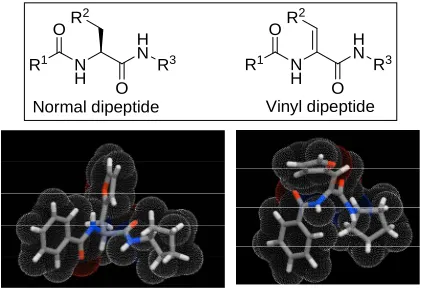
Figure 1. Peptidomimetic vinyl dipeptides. Top left normal dipeptide (left) and three dimensional of a representative example while the vinyl peptide is shown to the right. The three dimensional structure was generated using 3D-Galaxy module of Molinispiration.
ders such as malaria [3], respiratory disease [4], inflam- mation [5], viral diseases [6]. Compounds belonging to this pseudopeptide scaffold were synthesized and tested for their antiproliferative activities in different cancer cell lines [7,8]. Few reports investigated geranylgeranyl-transferase [5], dishevelled PDZ domain [9] as possible targets for tumor inhibition mechanisms of vinyl pep-tides.
We envisaged that the versatility of vinyl peptides en-ables them to have polypharmacology profile [10]. There- fore, preliminary screening of vinyl dipeptides should start with cell line inhibition tests rather than screening against specific protein target(s). In addition, the vinyl dipeptides showed ability to penetrate cells in several reports and in some cases they had in vivo potencies ef-ficacies [11,12].
We believe that this scaffold is indeed interesting for development of drug-like viable leads with potent anti-proliferative activity and therefore, we decided to inves-tigate some of its derivatives against breast cancer cell lines.
2. Results and Discussion
2.1. Chemistry
Compounds were synthesized as described in Scheme 1
starting from in-house prepared hippuric acid 2 which
lenmeyer conditions [13]. The lactone intermediate 3 was
heated with a set of different aliphatic, aromatic and het-erocyclic amines under microwave conditions in N, N- dimethylformamide (DMF) to give the vinylamide titled compounds except the 4-aminophenol that underwent dehydration and ring closure, under the same experimen-tal conditions, giving the 5(4H)-imidazolone 4. The 1H
NMR, HPLC/ES-MS and elemental analyses supported this interpretation. The imidazolone 4 did not show the
two distinct amide NH signals characteristic for the vinyl diamide open analogues. In addition, ES-MS showed molecular ion peak at m/z (M-18)+ off the expected open
structure. FT-IR of open analogues showed characteristic NH bands in the range of 3300 - 3100 cm–1. The ring-
closure observed in case of compound 4 was referred to
the strong positive resonance effect of the parahydroxy group that increases the nucleophilicity of the NH moiety facilitating the cyclization process as depicted in Scheme 2.
2.2. MCF-7 Cell Line Test
Breast cancer is our focus in this work because it is the most frequently diagnosed cancer and the leading cause of cancer death in females worldwide. About half of the breast cancer cases and 60% of the deaths are estimated to occur in economically developing countries [14].
Thus, inhibition of breast cancer cell line (MCF-7) was determined using SRB method as previously described by Skehan et al. [15]. Compounds 1c, 1d, 1k, 1o
exhib-ited promising inhibition potency (<50 µM) as described in Tables 1(a) and (b).
O
NH N H O
O R N
H O
OH
O Heat
N
O H
O
3 O O
H
+ Ac2O/AcONa
DMF, Microwave 200 C, 15 min.
RNH2
1a-q
O
2
N N O O
4
OH
Scheme 1. Synthesis of vinyl diamide compounds.
N H O
HN O
O
OH
HN N OH
O
OH O
4
Scheme 2. Proposed mechanism of formation of compound Ta
4.
ble 1. (a), (b) Molecular properties and MCF-7 breast
Cpd R M.Wt. MCF7 miLogP1 cancer cell line inhibition testing of title compounds.
(a)
IC50 µM
1a Et 284.3 509.3 2.150
1b Cyclopentyl
3- h
3
4-N Ph
5-CN olyl
D
324.2 241.8 3.170
1c Adamantyl 390.5 27.42 4.698
1d Ph 332.4 47.03 3.471
1e MeP 346.4 NA 3.896
1f 4-MePh 346.4 129.4 3.920
1g 3-FPh 350.3 74.14 3.611
1h 4-FPh 350.3 940.4 3.635
1i 3-ClPh 366.6 139.4 4.125
1j -MeOPh 362.4 82.13 3.504
1k 3-OH 348.1 47.37 2.968
1l H2SO2 411.4 89.59 2.165
1m 4-NO2Ph 377.4 56.48 3.430
1n 4-FBn 364.4 695.3 3.336
1o -2-thiaz 364.4 37.88 2.520
1p 2-Pyridyl 333.1 697.3 3.332
1q 3-Pyridyl 333.1 741.7 2.949
4 4-OHPh 330.3 >1000 3.330
oxorubicin 1.172
(b)
Cpd TPSA2 H-Bond H-Bond RBs3 Ro5 i
Chimney Acceptor Donor V olations Test
1a 71.33 5 2 5 0 5/6
1b 71.33 5 2 5 0 6/6
1c 71.33 5 2 5 0 6/6
1d 71.33 5 2 5 0 4/6
1e 71.33 5 2 5 0 6/6
1f 71.33 5 2 5 0 5/6
1g 71.33 5 2 5 0 4/6
1h 71.33 5 2 5 0 6/6
1i 71.33 5 2 5 0 6/6
1j 80.57 6 2 6 0 5/6
1k 91.56 6 3 5 0 6/6
1l 131.50 8 4 6 0 3/6
1m 117.16 8 2 6 0 5/6
1n 71.33 5 2 6 0 N/A
1o 108.02 7 2 5 0 5/6
1p 60.92 5 0 3 0 4/6
1q 60.92 5 0 3 0 3/6
4 68.27 5 1 3 0 6/6
1miLogP: Method for logP prediction developed at Molinispiration (miLogP2.2—
2.3. Discussion
The goal of this w activity and to fin
ork is to explore the antiproliferative d some lead structures as a starting
to perform preliminary evaluation of neuromo-to
cu-la
n
pseudopeptides have shown promis-ticancer agents. It is noteworthy to
re uncorrected and measured using t instrument (Stuart, UK). IR
spec-for Preparation of Vinyl Peptide 1a-q
oxa-zolo placed and 5
point for future disciplined search of optimized drug candidates. Cytotoxic evaluation of the prepared vinyl dipeptides using the MCF-7 cell line test revealed mod-erate cellular inhibition potencies of vinyl dipeptide com- pounds as measured by their IC50 values (Table 1). For
N-aliphatic series, it is clear that increasing the bulkiness of the alicyclic group led to a significant increase in the anticancer potency. The adamantyl derivative 1c had approximately 20-fold potency of N-ethyl derivative 1a while it was observed to have 10 times better cytotoxicity than the N-cyclopentyl analogue 1b. The N-benzenoid series showed inconsistent results indicating that the aryl group may not have a role in binding with the receptor. Another possibility of the inconsistent SAR observations is multiple modes of actions and interfering with more than one biological target. This is agreeing with our polypharmacology hypothesis for these compounds [10]. The three dimensional illustration of normal dipeptide vs. vinyl dipeptide of compound 1b (Figure 1) gave insight
to differences between the two structures and hence, their biological actions. It is noteworthy to underscore the ri-gidity added by this double bond in our pseudopeptide scaffold.
Concerning possible toxicities, we performed Chim-ney Test
r acute toxicity [17]. The most potent anti-proliferative compound 1c passed the test as all animals climbed the tube successfully within 30 seconds. The second potent compound 1o showed weak neurotoxicity evidenced by results of Chimney Test as five out of six animals passed the test. The ring-closed analogue 4 showed only weak antitumor activity compared to vinyl dipeptides 1 but it is not an indication of activity trend of this different che- mical species. Initial results above encouraged us to de-cide the follow-up studies on the open-chain series 1.
Towards developing drug-like molecules, we sub-jected all synthesized compounds to a variety of mole
r descriptors calculations (Table 1). No violation for
Lipinski’s Rule of 5 (Ro5) was observed in any com-pound [18]. Another tactic in this present study is to fix two diversity points featured in the scaffold 1 (Figure 1)
by using benzoyl and furfurylidene groups at positions R1 and R2. Therefore, our focus was to define SAR by
different amines on one diversity point. Our selection of the hydrophilic furyl group was based on keeping control on physico-chemical properties by balancing the hydro-phobic N-benzoyl substituent. This balance allowed us-ing wide range of hydrophobic amines such as the ada-mantyl derivative 1c as well as hydrophilic arylamines such as the cyanothiazolyl analogue 1o on the N-terminal
of the scaffold without violating the principles of drug- likeness [19].
3. Conclusio
The newly prepared ing activities as an
mention that all significantly active compounds (<50 µM) are having molecular weight under 400 mass unit. This is important because future research to discover more po-tent leads may require adding further molecular mass without concern of breaching the Ro5. Plans for future work are clear: Studying SAR on R1 and R2 that cover
broader molecular space. Driving potency to comparable level to doxorubicin should be reached and then followed by determining the anticancer mechanism by deeper bio- chemical and genetic studies.
4. Experimental
All melting points we capillary melting poin
tra were recorded as potassium bromide pellets on a Perkin-Elmer 1650 spectrophotometer (USA), Faculty of Science, Cairo University, Cairo, Egypt. 1H-NMR
spec-tra were determined on Avance III 600 MHz spectrome-ter (Bruker, Germany) and chemical shifts were ex-pressed as ppm against TMS as internal reference (King Fahd Center for Medical Research, King Abdulaziz Uni- versity, Jeddah, Saudi Arabia). Analyses by TSQ Quan- tum Access MAX Triple Stage Quadrupole Mass Spec- trometer, Faculty of Pharmacy, Helwan University, Cairo, Egypt.Data acquisition for quantification and confirma- tion are performed in full scan negative ion mode. Sam- ples are individually tuned for each target analyzes by direct injectionof the individual solution (1 mg/mL). Data acquisition and processing is performed using Ther- mo Scientific Xcalibur 2.1 software. Microanalyses were operated using Vario, Elmentar apparatus (Shimadzu, Japan), Organic Microanalysis Unit, Cairo University, Giza, Egypt. Column chromatography was performed on silica gel 60 (particle size 0.06 mm - 0.20 mm). All com- pounds prepared in this paper are new except (1d) [20],
and confirmed with spectral data. Hippuric acid and oxazolone 3 were prepared according to standard proce- dures and their structure confirmation data were found identical to literature [12].
4.1. General Procedure
In the microwave reaction tube, 5 mmol of both ne 3 and the appropriate amine were
microwave reactor (SynthLab) for 10 minutes. After cooling, the mixture was added slowly to dilute HCl mixed with crushed ice. The resulting solid was collected by filtration, washed with water and purified using silica gel chromatography (petroleum ether/CHCl3/EtOH,
gra-dient).
4.1.1. 2-(Benzoylamino)-3-(2-Furyl)-N- Ethylpropenamide (1a) [20]
R (600 MHz,
CDCl 2H, d, J = 7.2 Hz,
Cyclopentylpropenamide (1b)
R (600 MHz,
DMS J = 7.2 Hz,
Benzoylamino)-3-(2-Furyl)-N-(1-Adamantyl) Propenamide (1c)
DMS NH), 8.02 (2H, d, J = 6.0 Hz,
zoylamino)-3-(2-Furyl)-N- Phenylpropenamide (1d)
R (600 MHz,
DMS 9.96 (1H, s, NH), 8.08
Benzoylamino)-3-(2-Furyl)-N- (3-Methylphenyl) Propenamide (1e)
R (600 MHz,
CDCl = 7.8 Hz,
(4-Methylphenyl) Propenamide (1f)
1H NMR (600
MHz, J = 6.0
Benzoylamino)-3-(2-Furyl)-N- (3-Fluorophenyl) Propenamide (1g)
R (600 MHz,
DMS s, NH), 8.07
-(2-Furyl)-N- (4-Fluorophenyl) Propenamide (1h)
R (600 MHz,
DMS H), 8.08
White solid, mp: 133˚C - 134˚C. 1H NM 3) δ: 8.48 (1H, s, NH), 7.96 (
ArH), 7.60 (1H, t, J = 7.2 Hz, ArH), 7.51 (2H, t, J = 7.2 Hz, ArH), 7.45 ( 1H, s, ArH), 6.89 (1H, s, HC = C), 6.52 (1H, d, J = 2.4 Hz, ArH), 6.46 (2H, s, ArH and NH), 3.45 (2H, q, J = 6.6 Hz, CH2), 0.95 (3H, t, J = 7.2 Hz, CH3).
IR (KBr, ν, cm–1): 3162, 3053, 3018, 2940, 1687, 1636,
1620.MS: RT 0.58 min, m/z 284 (M, 40%), 268 (100%).
4.1.2. 2-(Benzoylamino)-3-(2-Furyl)-N-
White solid, mp: 169˚C - 171˚C. 1H NM
O-d6) δ: 9.71 (1H, s, NH), 8.03 (2H, d,
ArH), 7.93 (1H, d, J = 6.6 Hz, ArH), 7.73 (1H, d, J = 6.6 Hz, ArH), 7.60 (1H, br, NH), 7.53 (2H, t, J = 6.6 Hz, ArH), 7.05 (1H, s, HC = C), 6.66 (1H, d, J = 2.4 Hz), 6.56 (1H, s, HC = C), 3.45 (2H, q, J = 6.6 Hz CH-Cy-lopentyl), 1.82 (2H, m, CH-cycCH-Cy-lopentyl), 1.65 (2H, m, CH-cyclopentyl), 1.50 (4H, m, CH-cyclopentyl). IR (KBr,
ν, cm–1): 3162, 3053, 3018, 3005, 2937, 1676, 1631,
1623. MS: RT 0.23 min, m/z 323 (M-1, 60%), 298 (100%).
4.1.3. 2-(
White solid, mp: 185˚C - 187˚C. 1H NMR (600 MHz,
O-d6) δ: 9.71 (1H, s,
ArH), 7.74 (1H, s, ArH), 7.61 (1H, t, J = 6.6 Hz, ArH), 7.54 (2H, t, J = 7.2 Hz, ArH), 7.11 (1H, s, HC = CH), 6.99 (1H, s, NH), 6.66 (1H, d, J = 3.0 Hz), 6.56 (1H, s, ArH), 3.33 (1H, m, CH-adamanty), 2.03 (3H, m, CH-ad- amantyl), 1.99 (6H, m, CH-adamantyl), 1.64 (7H, m, CH-adamantyl). IR (KBr, ν, cm–1): 3146, 3048, 3030,
2952 - 3926, 1662, 1641, 1618. Anal.Calcd. For C24H26N2O3: C, 73.82; H, 6.71; N, 7.17. Found: C, 74.20;
H, 6.73; N, 7.32. MS: RT 0.85 min, m/z 389 (M-1, 80%), 276 (100%).
4.1.4. 2-(Ben
White solid, mp: 192˚C - 194˚C. 1H NM
O-d6) δ: 10.06 (1H, s, NH),
(2H, d, J = 6.6 Hz, ArH), 7.81 (1H, s), 7.72 (2H, d, J = 7.2 Hz, ArH), 7.62 (1H, d, J = 6.6 Hz, ArH), 7.56 (2H, d, J = 6.6 Hz, ArH), 7.33 ( 2H, t, J = 7.2, ArH), 7.14
( 1H, s, HC = C), 7.08 (1H, t, J = 6.6, ArH), 6.78 (1H, d, J = 3.0 Hz, ArH), 6.62 (1H, s, ArH). IR (KBr, ν, cm–1):
3162, 3053, 3018, 1687, 1636, 1620. Anal.Calcd. For C20H16N2O3: C, 72.28; H, 4.85; N, 8.43. Found: C, 72.48; H,
5.11; N, 8.32.MS: RT 0.32 min, m/z 331 (M-1, 33%), 298 (100%).
4.1.5. 2-(
Off-white solid, mp: 162˚C - 163˚C. 1H NM 3) δ: 8.59 (2H, s, NH), 7.99 (2H, d, J
ArH), 7.61 (1H, t, J = 7.2 Hz, ArH), 7.52 (2H, t, J = 7.2 Hz, ArH), 7.47 (1H, s, ArH), 7.43 (1H, s, ArH), 7.39 (1H, d, J = 7.8 Hz, ArH), 7.18 (1H, t, J = 7.8 Hz, ArH), 6.97 (1H, s, HC = C), 6.91 (1H, d, J = 7.2 Hz, ArH), 6.51 (1H, s, ArH), 6.47 (1H, s, ArH), 2.32 (3H, s, CH3). IR (KBr, ν, cm–1): 3155, 3092, 3011, 2931, 1665, 1621, 1618.MS:
RT 0.59 min, m/z 345 (M-1, 25%), 265 (100%).
4.1.6. 2-(Benzoylamino)-3-(2-Furyl)-N-
Pale brown solid, mp: 182˚C - 184˚C.
CDCl3) δ: 8.56 (2H, br, NH), 7.98 (2H, d,
Hz, ArH), 7.60 (1H, t, J = 6.6 Hz, ArH), 7.53 (2H, d, J = 7.2 Hz, ArH), 7.46 (2H, d, J = 6.6 Hz, ArH), 7.10 (2H, d, J = 7.2 Hz, ArH), 6.99 (1H, s, HC = C), 6.52 (1H, s, ArH), 6.46 (1H, s, ArH), 2.30 (3H, s, CH3). IR
(KBr, ν, cm–1): 3154, 3096, 3016, 2935, 1669, 1629,
1617. MS: RT 0.76 min, m/z 345 (M-1, 15%), 279 (100%).
4.1.7. 2-(
White solid, mp: 217˚C - 218˚C. 1H NM
O-d6) δ: 10.26 (1H, s, NH), 9.99 (1H,
(2H, d, J = 7.2 Hz, ArH), 7.82 (1H, s), 7.70 (1H, d, J = 12 Hz, ArH), 7.61 (1H, t, J = 7.2 Hz, ArH), 7.56 (2H, t, J = 7.2 Hz, ArH), 7.52 (1H, d, J = 7.8 Hz, ArH), 7.36 (1H, dd, J = 7.2 and 15.0 Hz, ArH), 7.13 (1H, s, HC = C), 6.91 (1H, t, J = 7.2 Hz, ArH), 6.80 (1H, d, J = 3.0 Hz, ArH), 6.63 (1H, s, ArH). IR (KBr, ν, cm–1): 3162, 3041,
3015, 1678, 1621, 1618.
4.1.8. 2-(Benzoylamino)-3
White solid, mp: 200˚C - 202˚C. 1H NM
O-d6) δ: 10.12 (1H, s, NH), 9.97 (1H, s, N
(2H, d, J = 6.6 Hz, ArH), 7.81 (1H, s), 7.74 (1H, dd, J = 3.6 and 4.8 Hz, ArH), 7.62 (1H, d, J = 6.6 Hz, ArH), 7.56 (2H, t, J = 6.6 Hz, ArH), 7.17 (2H, t, J = 7.2 Hz, ArH) 7.14 (1H, s, HC = C), 6.79 (1H, d, J = 3.0 Hz, ArH), 6.62 (1H, s, Ar). IR (KBr, ν, cm–1): 3160, 3039, 3015, 1675,
4.1.9. 2-(Benzoylamino)-3-(2-Furyl)-N- (3-Chlorophenyl) Propenamide (1i)
Off-white solid, mp: 206˚C - 208˚C. 1H NMR (600 MHz,
, s, NH), 8.07
(2H, d 1H, s, ArH),
openamide (1j)
White solid, mp: 160˚C - 161˚C. 1H NMR (600 MHz,
r, NH), 7.95
(2H, d, z, ArH),
Propenamide (1k)
White solid, mp: 110˚C - 112˚C. 1H NMR (600 MHz,
s, NH), 8.90
(1H, s, 7.2 Hz,
ulfonylphenyl) Propenamide (1l)
White solid, mp: 140˚C - 143˚C. 1H NMR (600 MHz,
, s, NH), 8.05
(2H, d, H),
amide (1m)
Off-white solid, mp: 229˚C - 230˚C. 1H NMR (600 MHz,
, s, NH), 8.25
(2H, d , ArH),
yl) Propenamide (1n)
White solid, mp: 128˚C. 1H NMR (600 MHz, DMSO-d6)
(2H, d, J =
7.2 Hz 7.61 (1H, t,
amide (1o)
Yellow-white solid, mp: 198˚C - 199˚C. 1H NMR (600
0 (1H, s,
NH), 8. (1H,
openamide (1p)
Pale Brown solid, mp: 160˚C. 1H NMR (600 MHz,
H, d, J = H, d, J = 4.2 Hz, ArH), 7.97
1H NMR (600 MHz, CDCl ) δ: 9.05 (1H, s, NH), 8.67
18 (1H, d, H, d, J = 7.2 Hz, ArH), 7.61 DMSO-d6) δ: 10.23 (1H, s, NH), 9.99 (1H
, J = 7.2 Hz, ArH), 7.91 (1H, s), 7.82 (
7.68 (1H, d, J = 6.0 Hz, ArH), 7.62 (1H, d, J = 6.0 Hz, ArH), 7.56 (2H, t, J = 6.0 Hz, ArH), 7.36 (1H, t, J = 6.0 Hz, ArH), 7.14 (2H, m, ArH and HC = C), 6.81 (1H, d, J = 6.0 Hz, ArH), 6.63 (1H, s, ArH). IR (KBr, ν, cm–1): 3166,
3032, 3018, 1684, 1620, 1613. MS: RT 0.58 min, m/z 365 (M-1, 25%), 363 (100%).
4.1.10. 2-(Benzoylamino)-3-(2-Furyl)-N- (3-Methoxyphenyl) Pr
CDCl3) δ: 8.59 (1H, br, NH), 8.64 (1H, b
J = 7.2 Hz, ArH), 7.57 (1H, t, J = 7.2 H
7.47 (2H, t, J = 7.2 Hz, ArH), 7.38 (1H, s, ArH), 7.38 (1H, s, ArH), 7.34 (1H, s, ArH), 7.12 (1H, t, J = 7.8 Hz, ArH), 7.08 (1H, d, J = 7.8 Hz, ArH), 6.80 (1H, s, HC = C), 6.59 (1H, dd, J = 7.8 and 1.8 Hz, ArH), 6.38 (2H, d, J = 7.2 Hz, ArH), 3.76 (3H, s, OCH3). IR (KBr, ν, cm–1):
3160, 3039, 3015, 1675, 1620, 1618. Anal.Calcd. For C21H18N2O4: C, 69.60; H, 5.01; N, 7.73; O, 17.66. Found:
C, 69.59; H, 5.13; N, 7.89.
4.1.11. 2-(Benzoylamino)-3-(2-Furyl)-N- (3-Hydroxyphenyl)
DMSO-d6) δ: 9.45 (1H, s, NH), 9.31 (1H, OH), 8.06 (2H, m, ArH), 7.63 (1H, d, J =
ArH), 7.58 (1H, d, J = 6.6 Hz, ArH), 7.51 (2H, d, J = 7.2 Hz, ArH), 7.30 (1H, s, ArH), 7.18 (1H, s, ArH), 7.05 (2H, m, ArH), 6.64 (1H, s, HC = C), 6.53 (1H, d, J = 7.2, ArH), 6.48 (1H, d, J = 7.8 Hz, ArH). IR (KBr, ν, cm–1):
3360, 3160, 3039, 3015, 1675, 1618. Anal.Calcd. For C20H16N2O4: C, 68.96; H, 4.63; N, 8.04. Found: C, 68.59;
H, 4.32; N, 7.98.
4.1.12. 2-(Benzoylamino)-3-(2-Furyl)-N- (4-Aminos
DMSO-d6) δ: 10.35 (1H, s, NH), 9.98 (1H
J = 7.2 Hz, ArH), 7.87 (2H, d, J = 7.8 Hz, Ar 7.80 (1H, d, J = 1.2 Hz, ArH), 7.76 (1H, s, ArH), 7.74 (1H, s, ArH), 7.60 (1H, t, J = 7.2 Hz, ArH), 7.53 (2H, t, J = 7.2 Hz, ArH), 7.24 (2H, s, SO2NH2), 7.13 (1H, s, HC =
C), 6.78(1H, d, J = 3.6 Hz, ArH), 6.60 (1H, dd, J = 3.6 and 1.8 Hz, ArH). IR (KBr, ν, cm–1): 3510, 3390, 3352,
3160, 3039, 3029, 1681, 1622.
4.1.13. 2-(Benzoylamino)-3-(2-Furyl)-N- (4-Nitrophenyl) Propen
DMSO-d6) δ: 10.67 (1H, s, NH), 10.06 (1H d, J = 7.2 and 2.4 Hz, ArH), 8.07 (2H, m
8.01 (2H, dd, J = 7.8 and 2.4 Hz, ArH), 7.85 (1H, s, ArH), 7.63 (1H, s, ArH), 7.56 (2H, s, ArH), 7.16 (1H, s, HC = C), 6.85 (1H, d, J = 3.0 Hz, ArH), 6.65 (1H, s, ArH). IR (KBr, ν, cm–1): 3307, 3279, 3220, 3096, 1685, 1619,
1598, 1507, 1344.
4.1.14. 2-(Benzoylamino)-3-(2-Furyl)-N- (4-Fluorobenz
δ: 9.85 (1H, s, NH), 8.68 (1H, br, NH), 8.07 , ArH), 7.75 (1H, d, J = 1.2 Hz, ArH),
J = 7.2 Hz, ArH), 7.54 (2H, t, J = 7.2 Hz, ArH), 7.35 (2H, t, J = 7.2 Hz, ArH), 7.22 (1H, s, HC = C), 7.14 (2H, t, J = 7.8 Hz, ArH), 6.71 (1H, d, J = 13.0 Hz, ArH), 6.57 (1H, dd, J = 3 and 1.8 Hz, ArH), 4.36 (2H, s). IR (KBr, ν, cm–1): 3132, 3046, 3032, 2937, 1632, 1617.MS: RT 0.78
min, m/z 363 (M-1, 47%), 284 (100%).
4.1.15. 2-(Benzoylamino)-3-(2-Furyl)-N-[2- (5-Cyanothiazol-2-Yl)] Propen
MHz, DMSO-d6) δ: 13.32 (1H, s, NH), 10.1 43 (1H, s, ArH), 8.08 (2H, d, J = 6.6), 7.87 s), 7.63 (m, 2H, ArH), 7.56 (2H, d, J = 6.6 Hz, ArH), 7.38 (1H, s, HC = C), 6.9 (1H, s, ArH), 6.65 (s, 1H, ArH). Anal.Calcd. For C18H12N4O3S: C, 59.33; H, 3.32; N,
15.38; O, 13.17; S, 8.80. Found: C, 58.99; H, 3.52; N, 15.37. MS: RT 0.78 min, m/z 363 (M-1, 25%), 275 (100%).
4.1.16. 2-(Benzoylamino)-3-(2-Furyl)-N-(2-Pyridyl) Pr
CDCl3) δ: 8.83 (1H, s, NH), 8.59 (1H, s, NH), 8.32 (1
7.2 Hz, ArH), 8.24 (1
(2H, d, J = 6.6 Hz, ArH), 7.70 (1H, t, J = 7.2 Hz), 7.59 (1H, t, J = 7.2 Hz), 7.52 (3H, m, ArH), 7.06 (1H, s, HC = C), 7.01 (1H, t, J = 6.6 Hz, ArH), 6.60 (1H, d, J = 3.6 Hz, ArH), 6.49 (1H, t, J = 1.8 and 1.2 Hz, ArH). IR (KBr, ν, cm–1): 3169, 3055, 3026, 1692, 1600, 1560.MS: RT 0.44
min, m/z 332 (M-1, 55%), 284 (100%).
4.1.17. 2-(Benzoylamino)-3-(2-Furyl)-N-(3-Pyridyl) Propenamide (1q)
3
(2H, s, NH and ArH), 8.31 (1H, d, J = 3.6 Hz, ArH), 8. J = 7.2 Hz), 7.98 (2
1558. MS: RT 0.31 min, m/z 332 (M-1, 15%), 329 (100%).
4.1.18. 4-[(Furan-2-yl) Methylene]-1-
(4-Hydroxyphenyl)-2-Phenyl-1H-Imidazol- 5(4H)-One (4)
H, s, ArH), 7.59
(2H, d, H,
t, J = 7 (2H, t, J = 7.2 Hz, ArH), 7.20
re
MI-ated f penicillin and 50 mg/mL of strep
ng 0.25% Trypsin-EDTA and seeded in 96-well plates at 1000 -
upplemented medium
climb backwards up a glass tu rment was ackwards up
for Prof. Dr. Ashraf Bahai Abdul Naim, in Shams University of per- ing. We are also grateful to
[1] “Cancer/Anticancer Peptides Section, Part VII,” In: A. J. Kasten, Ed., H ly Active Peptides, Academic Pre
esis of Novel
Bioac-ol. 46, No. 26, 2003, pp. 5553-5566.
1H NMR (600 MHz, CDCl
3) δ: 7.67 (1
J = 7.2 Hz, ArH), 7.56 (1H, s, HC = C), 7.41 (1 .2 Hz, ArH), 7.30
(1H, s, OH), 6.97 (2H, d, J = 8.4 Hz, ArH), 6.75 (2H, d, J = 8.4 Hz, ArH), 6.63 (1H, s, ArH), 6.45 (1H, s, ArH). IR (KBr, ν, cm–1): 3360, 3084, 1745, 1622, 1578. LC/MS:
LC/MS: Rt 18.65 min, m/z 331 (M + 1, 100%). Anal.Calcd. For C20H14N2O3: C, 72.72; H, 4.27; N, 8.48.
Found: C, 72.88; H, 3.91; N, 8.71.MS: RT 0.2 min, m/z 330 (M, 100%).
4.2. MCF-7 Cancer Cell Line Inhibition Test
4.2.1.Cell Cultu
MCF-7 human breast cancer cells was grown in RP 1640 medium, supplemented with 10% heat inactiv
htt
FBS, 50 units/mL o
-tomycin and maintained at 37˚ in a humidified atmos-phere containing 5% CO2. The cells were maintained as
“monolayer culture” by serial subculturing.
4.2.2.SRB Cytotoxicity Assay
Exponentially growing cells were collected usi
. 2000 cells/well in RPMI-1640 s
After 24 h, cells were incubated for 72 h with various concentrations of the tested compounds. Following 72 h treatment, the cells will be fixed with 10% trichloroacetic acid for 1 h at 4˚C. Wells were stained for 10 min at room temperature with 0.4% SRB dissolved in 1% acetic acid. The plates were air dried for 24 h and the dye was solubilized with Tris-HCl for 5 min on a shaker at 1600 rpm. The optical density (OD) of each well was meas-ured spectrophotometrically at 564 nm with an ELISA microplate reader (ChroMate-4300, FL, USA). The IC50 values were calculated according to the equation for Boltzman sigmoidal concentration—response curve us-ing the nonlinear regression fittus-ing models (Graph Pad, Prism Version 5).
4.3. Chimney Test for Neurotoxicity
The animals had to be (3
cm inner diameter, 25 cm long). Motor impai evidenced by the inability of mice to climb b
the tube within 30 s. Mice were divided into groups of 6 animals each. The first group received vehicle (tween 80/saline) and it had no neurotoxic symptoms. The rest
of Groups was given the tested compound at 0.15 M orally. The test was performed 30 minutes after oral ad-ministration.
5. Acknowledgements
I am thankful
Professor of Pharmacology, A forming all biological screen
Mr. Magdy Ghazy, NMR chemist at King Fahd Medical Research Center, King Abdulaziz University for assisting in 1H NMR spectroscopy.
REFERENCES
andbook of Biological ss, Waltham, 2006.
p://www.sciencedirect.com/science/book/97801236944 23#ancSE7.
[2] R. M. Freidenger, “Design and Synth
tive Peptides and Peptidomimetics,”Journal of Medicinal Chemistry, V
doi:10.1021/jm030484k
[3] P. B. McKay, M. B. Peters, G. Carta, C. T. Flood, E. Dempsey, A. Bell, C. Berry, D. G. Lloyd and D. Fay “Identification of Plasme
ne, psin Inhibitors as Selective An-timalarial Agents Using Ligand Based Drug Design,” Bio- organic & Medicinal Chemistry Letters, Vol. 21, No. 11, 2011, pp. 3335-3341. doi:10.1016/j.bmcl.2011.04.015
[4] T. T. H. Nguyen, H. Ryu, S. Lee, S. Hwang, V. Breton, J. H. Rhee and D. Kim, “Virtual Screening Identification of Novel Severe Acute Respiratory Syndrome 3C-Like Pro- tease Inhibitors and in Vitro Confirmation,” Bioorganic & Medicinal Chemistry Letters, Vol. 21, No. 10, 2011, pp. 3088-3091. doi:10.1016/j.bmcl.2011.03.034
[5] Y. K. Peterson, X. S. Wang, P. J. Casey and A. Tropsha, “Discovery of Geranylgeranyltransferase-I Inhibitors with Novel Scaffolds by the Means of Quantitative Structure- Activity Relationship Modeling, Virtual Screening, and Experimental Validation,” Journal of Medicinal Chemis-try, Vol. 52, No. 14, 2009, pp. 4210-4220.
doi:10.1021/jm8013772
[6] R. B. Perni, S. C. Conway, S. K. Ladner, K. Zaifert, M. J. Otto and R. W. King, “Phenylpropenamide
Inhibitors of Hepatitis B Virus Replication,” Derivatives as Bioorganic & Medicinal Chemistry Letters, Vol. 10, No. 23, 2000, pp. 2687-2690. doi:10.1016/S0960-894X(00)00544-8
[7] E. M. Al-Arab, B. Ezz, M. Wahid and H. H. Maharram, “Synthesis and Evaluation of Antitumor and Antiviral Screening of Some Newer Aryl Acrylamide Derivatives,”
ining Bioactive Molecular Skeletons Mansoura Journal of Pharmaceutical Sciences, Vol. 16, 2000, pp. 98-113.
[8] F. Shi, A. Dai, X. Zhang, B. Jiang and S. Tu, “Facile Di- versity-Oriented Synthesis of Novel Dipeptide Mimetic Compounds Conta
doi:10.1021/co1000458
[9] J. Shan and J. J. Zheng, “Optimizing Dvl PDZ Domain Inhibitor by Exploring Chemical Space,”
puter-Aided Molecular Design, Vol. 23, No. 1, 2009, pp. Journal of Com- 37-47. doi:10.1007/s10822-008-9236-1
[10] J. Peters, “Pharmacological Promiscuity and Molecular Properties,” In: J. Peters, Ed., Polypharmacology in Drug Discovery, Wiley, Hoboken, 2012, pp. 47-59.
doi:10.1002/9781118098141.ch3
[11] S. C. Khadse, G. S. Talele and S. S. Agrawal, “Aminocar- bonyl Arylvinylbenzamides as Gastric Sparin
flammatory Agents,” Pharmaceutical & Medicinal Che- g Anti-In-mistry, Vol. 344, No. 5, 2011 pp. 292-300.
doi:10.1002/ardp.201000096
[12] B. H. Banu and K. Bharathi, “Synthesis and Analgesic Activity of Some N-Protected Dehydrophenylalan
tides,” Journal of Pharmacy
ine Di Research, Vol. 3, No. 10,
Neurotoxicity,” The Open Medi pep-
2010, pp. 2450-2452.
[13] M. S. Mohamed, R. K. Mahmoud, A. I. Sayed and M. E. El-Araby, “Potent Anticonvulsant 1H-Imidazol-5(4H)-One Derivatives with Low ci-nal Chemistry Jourci-nal, Vol. 2, No. 2, 2012, pp. 24-29. [14] A. Jemal, F. Bray, M. M. Center, J. Ferlay, E. Ward and
D. Forman, “Global Cancer Statistics,” A Cancer Journal for Clinicians, Vol. 61, No. 2, 2011, pp. 69-90.
doi:10.3322/caac.20107
[15] P. Skehan, R. Storeng, D. Scudiero, A. Monks, J. McMa-hon, D. Vistica, J. T. Warren, H. Bokesch, S. Ke M. R. Boyd, “New Colo
nney and rimetric Cytotoxicity Assay for Anticancer-Drug Screening,” Journal of the National Can-
cer Institute, Vol. 82, No. 13, 1990, pp. 1107-1112.
doi:10.1093/jnci/82.13.1107
[16] P. Ertl, B. Rohde and P. Selzer, “Fast Calculation of Mo-lecular Polar Surface Area as a Sum of Fragment Based Contributions and Its Application to the Prediction of Drug Transport Properties,” Journal of Medicinal Chem-istry, Vol. 43, No. 20, 2000, pp. 3714-3717.
doi:10.1021/jm000942e
[17] J. J. Luszczki, E. Wojda, M. Andres-Mach, W. Cisowski,
ri-00129-0
M. Glensk, K. Glowniak and S. J. Czuczwar, “Anticon-vulsant and Acute Neurotoxic Effects of Imperatorin, Osthole and Valproate in the Maximal Electroshock Sei-zure and Chimney Tests in Mice: A Comparativestudy,” Epilepsy Research, Vol. 85, No. 2, 2009, pp. 293-299. [18] F. Lombardo, B. W. Dominy and P. J. Feeney, “Expe
mental and Computational Approaches to Estimate Solu-bility and PermeaSolu-bility in Drug Discovery and Develop-ment Settings,” Advanced Drug Delivery Reviews, Vol. 46, No. 1-3, 2001, pp. 3-26.
doi:10.1016/S0169-409X(00)
olecules: Rules-of- [19] M. Q. Zhang, “Working with Small M
Thumb of ‘Drug Likeness’,” Methods in Molecular Biol-ogy, Vol. 803, 2012, pp. 297-307.
doi:10.1007/978-1-61779-364-6_20
seeva, B. Brizga and
ids and Mono-[20] N. Saldabols, A. Treilone, L. N. Alek
K. Medne, “Synthesis and Transformations of Furan De-rivatives. VI. Amides of β-(2-Furyl)- and
β-(5-Nitro-2-furyl)-α-acylamidoacrylic Ac