Mesopotamian Marshlands: Salinization Problem
Sama AlMaarofi1, Ali Douabul2, Hamid Al-Saad2
1Biology Department, University of Waterloo, Waterloo, Canada; 2Department of Marine Environmental Chemistry, Marine Science
Center, University of Basra, Basra, Iraq.
Email: [email protected], [email protected]
Received July 23rd, 2012; revised August 24th, 2012; accepted September 18th, 2012
ABSTRACT
Salinization becomes a very serious problem affecting the restoration assessment of the newly re-flooded marshes of the Mesopotamian southern Iraq. From mid-1970 to early-1990, the whole marsh area was influenced by water shortage and desiccation processes. Increasing the average salinity level in the re-flooded marshes is acting versus their recovery progress and significantly affecting their aquatic biota. This study will examine the contributions of dams’ construction and desiccation on increasing the salinity level with in the Mesopotamian marshlands overtime. Water discharge and salinity concentration were monitored in the direct water inputs and outlets of the three marshlands from May 2006 to February 2007 on a monthly basis, while salinity and major ions concentrations including “Ca1+, Mg2+, Cl1–, and
” were monitored in 28 re-flooded marshes from March 2005 to August 2008 on a seasonal basis. The study indi-cate that increasing the salinity level in the Mesopotamian marshlands is due to three reasons: 1) The overtime increas-ing in the salinity level of their direct water inputs, due to dams’ constructions; 2) the increase of the Arab Gulf tide via Shatt Al-Arab river due to the reduction of the water level in the outlets of the Central and Al-Hammar marshlands; and 3) the huge accumulation of salts due to desiccation.
2 4
SO
Keywords: Mesopotamian Marshlands; Water Shortage; Desiccation; Salinization; Major Ion Sources
1. Introduction
The Mesopotamian marshlands southern Iraq (29˚55'N & 32˚45'N to 45˚25'E & 48˚30'E), were one of the biggest wetlands in the Middle East and used to occupy an area of 20,000 km2 [1], have been dramatically affected by
several anthropogenic activities mainly dams’ construc-tion and desiccaconstruc-tion. These acconstruc-tions are directly influence the hydrological regime of the area. The Tigris and the Euphrates Rivers “the Two Rivers” are the major water resources of the marshlands comparing to the partial seasonal discharge from the Iranian territories southern east the Mesopotamian, precipitation, and groundwater. Since the creation of the Mesopotamian marshlands their hydrological fluctuation and seasonal cycle have been significantly motivated by the hydrological regime of the Two Rivers [2-4]. Towards the ends of the twentieth century, specifically during mid-1970’s, the natural hy-drological cycle of the Two Rivers has changed dramati-cally due to dams’ construction in Turkey, where they originate. This led to reduce their annual quantity of wa-ter as well as their actual wawa-ter discharge. Not surprising that the sequences of the water shortage from such pro-jects can reach and affect the hydrological system of Mesopotamian marshlands. On the other hand, the des-iccation processes that initiated in early 1990’s during
same historical functions and the re-flooded marshes’ ecosystems may lose their recreational ability [9]. Sali- nization problem has been a concerning problem in dif-ferent wetlands in Australia, New Zealand, and Europe. The impacts of increasing salinity in wetlands can sig-nificantly 1) affect the biodiversity and assemblage of phytoplankton [10]; 2) change the distribution and abun-dance of macrophytes and fish [11,12]; 3) alter the pro-portions of major ion in the water and 4) magnify the effect of toxic component in the water and the sediment [13]. Although the hydrological regime of the re-flooded marshes are showing different levels of recovery re-sponses, the flooding process was chaotic and some of the re-flooded marshes received constant water supply with bad water quality [14]. The water quantity and qual-ity become the focus of many researches in order to as-sess the recovery potential of the re-flooded marshes and understand their ecological health [14,15]. This paper aimed to illustrate the impact of water shortage and des-iccation and their contribution to the increasing in the salinity level of the Mesopotamian marshlands overtime.
2. Study Description and Methodology
The Mesopotamian marshlands are historically divided in to three major marshlands: The Central Marshland (CM),
Al-Hawizeh marshland (HZ), and the Al-Hammar marsh- land (HM). From May 2006 to February 2007, water dis- charge (WD) and salinity concentrations were monitored in the direct water inputs and outlets of the Mesopota-mian on a monthly basis. On the other hand, Salt con-tents and major ions concentrations including: calcium (Ca1+), magnesium (Mg2+), chloride (Cl1–), and sulfate
( 2 4
SO) in 28 re-flooded marshes were determined in
water samples from March 2005 to August 2008. Figure 1 shows the monitored locations during the study period.
[image:2.595.127.472.407.695.2]Salinity concentrations were measured using a WTW Multi-meter model 350 i. Water samples (1 L) for major ions determination were collected from the water surface (depth ~30 cm) using a horizontal Van Dorn sampler and were filtered immediately using pre-weighted Whatman GF/F 0.7 µm filters. Major ion concentrations were termined according to the standard procedures de-scribed in [16]. The historical water discharge data from 1940 to 2005 that estimated at Al-Nasiriyah and Al-Kut stations “the closest points to the Mesopotamian marsh-lands”, respectively were taken from [6] unpublished re-ports. The historical salinity concentrations of the Two Rivers were used taken from [2]. The historical salinity and major ions concentrations of the Mesopotamian marshlands were taken from [17]. A principal components analysis (PCA) was used to examine the main dominant
major salt ions in 28 re-flooded marshes (13 in the Cen-tral, 5 in Al-Hawizeh, and 10 in the Al-Hammar marsh-lands) during the period from January 2006 to December 2006.
3. Results and Discussion
3.1. Water Shortage
The annual water discharge of the Tigris and the Eu-phrates Rivers has been significantly reduced for the last 50 years. Figure 2 shows the annual water discharge of
the Two Rivers into the Mesopotamian marshlands from 1940 to 2007. The regression line shows the graduate reduction of the Two Rivers’ water discharge during the recorded period. Generally, the figure indicates two pe-riods of water discharge reduction. The first period was during the 1970’s, in which many dams were constructed at the Tow Rivers’ upstream in Turkey [5]. The second period was late 1990’s, when the Iraqi government started drains the marshlands. During the pre-dam, the annual water discharge of the Two Rivers into the Mesopotamian marshlands from 1940 to 1970 was about 84.6 × 10⁹ m3. After this period until 1990’s, the
Meso-potamian marshlands lost more than 30% of their annual water discharge. The situation of water shortage become more complicated overtimes, unfortunately, the current annual water discharges of the two Rivers are still de-creasing, and its average value from early inundation in 2003 to 2007 was about 13.8 × 10⁹ m3. This indicate that
the Mesopotamian marshland have lost more than 80%
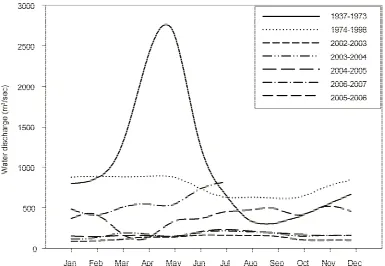
from their historical water input. This situation is dra-matically affecting the current hydrological conditions of the re-flooded marshes. This also indicates that the ex-isting quantity of water in the Two Rivers is not enough to re-cover the historical Mesopotamian’s size. On the other hand, Figure 3 shows the monthly fluctuation of
the recent water discharge of Tigris and Euphrates River compared to the historical monthly average fluctuation of the Euphrates River during the pre-dams construction taking from [5]. Obviously, the monthly water discharge fluctuations of the Two Rivers since the post-dams’ con-struction period had dramatic change comparing to the historical water discharge fluctuation up to the 1970’s. The impact has significantly eliminated the high fresh spring pulse and maintains constant water fluctuation until now. The loss of the huge spring pules had two main effects on the ecological and biological function of the marshlands by reducing the huge fresh water dis-charge and alter the vegetation and production cycle of the aquatic biota [12,18]. Along with the reduction in water discharge, the salinity concentrations among the direct water inputs of the Mesopotamian marshlands were significantly increased as it shown in the regression correlation between the current salinity concentration from May 2006 to February 2007 and the average his-torical salinity concentrations of the Tigris and Euphrates Rivers during 1958 (Figure 4). The increase of the
[image:3.595.112.487.457.699.2]aver-age salinity level in the Two Rivers came along with the reduction in their water discharge and losing the fresh spring pulses late 1970’s.
Figure 2. The monthly water discharge fluctuation of the Tigris and Euphrates River from 2002-2003 to 2006-2007 compared to the monthly average water discharge fluctuation of the Euphrates River pre-dams’ construction (1937-1973) and the post-dams’ constructions (1974-1998) taken from [5].
Figure 3. Regression correlation (R2 = 0.3) between the current average salinity concentration in direct water in-puts of the Mesopotamian marshlands from May 2006 to February 2007 and the historical average salinity concen-trations of the Tigris and the Euphrates Rivers from Janu-ary to December 1958 taken from [2].
3.2. Desiccation
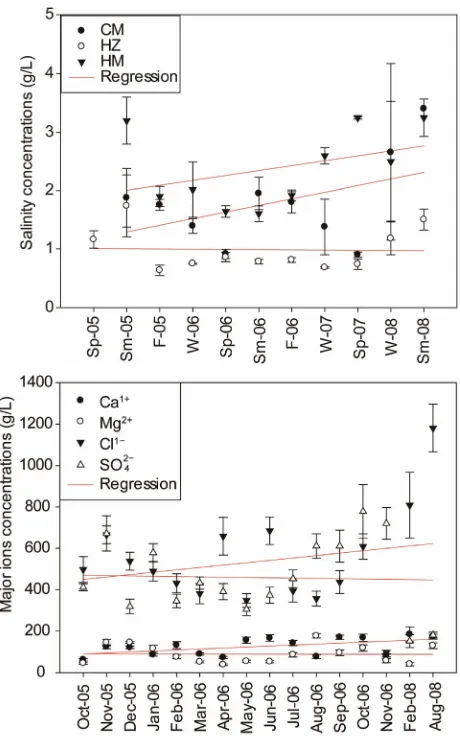
Salinity level in the Mesopotamian marshlands has been significantly increased over the past 40 years as it shown in Figure 5. This was clearly noticeable during the
[image:4.595.58.288.403.542.2]pe-riod of desiccation (1985-1991) to the first year of inun-dation (2004). From March 2005 to August 2008, the seasonal variation of the average salinity and major ions concentration were increased, especially in the Central and Al-Hammar marshlands. The results show that the
Figure 4. Overtime fluctuation of the average salinity con-centrations (+SE) of the Mesopotamian marshlands.
chloride and sulfate ions concentrations were higher and more fluctuated than the calcium and magnesium ions within the samples stations (Figure 6). This increase in
Figure 6. Seasonal average variation of the salinity and major ion concentrations (+SE) in the Central (CM), Al- Hawizeh (HZ), and Al-Hammar (HM) marshlands. Sp = spring, Sm = summer, F = fall, and W = winter.
shows a positive relationship between the average salin-ity and chloride ion in the Al-Hammar marshland water, while the salinity concentrations of the Central and Al- Hawizeh marshlands were slightly related to the increase in sulfate ion (Table 1). Since chloride is the dominant
ion in Al-Hammar marshland, this indicates that this marsh has influenced by marine water via the tidal cur-rent of the Shatt Al-Arab River.
The PCA of the major ions’ monthly variation in 28 re-flooded marshes shows significant differences in the salinity sources between the re-flooded marshes in the Al-Hawizeh and the re-flooded marshes in the Central and Al-Hammar. The graph also shows seasonal ex-change in the dominant periods between the sulfate and chloride ions in the re-flooded marshes of the Central and Al-Hammar. Generally, the chloride ion is more domi-nant in the Central and Al-Hammar waters during the summer, when the sulfate becomes dominant during fall (Figure 7). On the other hand, the regression coefficient
Table 1. Matrix of Pearson correlation coefficient for salin-ity and major ions concentrations for the selected re-flood- ed marshes in the Mesopotamia.
Salinity Ca1+ Mg2+ Cl1–
Ca1+ 0.08
Mg2+ 0.37 0.26
Cl1– 0.36 0.40 0.75
CM
2 4
SO 0.01 0.26 –0.54 –0.52
Ca+1 0.14
Mg2+ –0.02 <0.01
Cl1– 0.34 –0.05 0.40
HZ
2 4
SO 0.44 0.05 –0.03 0.81
Ca1+ <0.01
Mg2+ –0.03 –0.29
Cl1–
0.58 <0.01 0.52 HM
2 4
SO 0.38 –0.50 0.72 0.69
Figure 5. PCA of the major ions in the water of 28 re-flood- ed marshes in the Central (red squares), Al-Hawizeh (blue diamonds), and Al-Hammar marshlands (green circles. Axis 1 accounted for 64.0%, Axis 2 accounted for 93.8%, and axis 3 accounted for 98.7% of the total variance. Chlo-ride (Cl1−) had strong positive loadings on Axis 1, while sulfate (SO42) had negative loading on Axis 2.
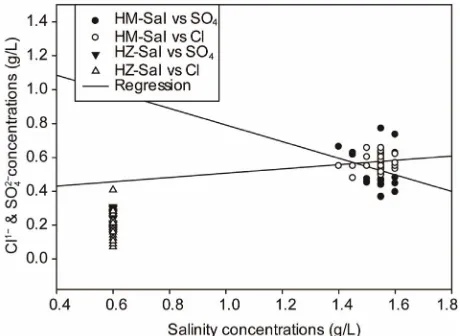
between the diurnal salinity concentrations and both chlo- ride and sulfate ions in Al-Hammar (Al-Mashab station) and Al-Hawizeh (Um Al-Niaaj station) indicate no sig-nificant changes between the salinity versus sulfate ion or chloride ion concentration, while in Al-Hammar the both salinity and chloride values were increased and co-incided with the tidal currents (Figure 8).
4. Conclusion
[image:5.595.309.539.122.519.2] [image:5.595.310.539.123.514.2]Figure 6. The regression coefficient between the diurnal sa- linity concentrations and both chloride ion (R2 = 0.13) and sulfate ions (R2 = 0.04) in Al-Hammar (Al-Mashab station) and Al-Hawizeh (Um Al-Niaaj station) recorded in De- cember 2006.
tion in the Mesopotamian marshlands will have a huge negative impact on their ecological function and their biological structure. This risk can be extended to affect the aquatic biodiversity of the newly flooded marshes and change their assemblages. Since the historical Me- sopotamian marshlands used to be fresh water body, the new hydrological conditions have indicated that both water shortage and desiccation processes will lead con-vert what left of marshes into brackish or even saline systems. The consequences of these changes can result in losing the historical uniqueness of the Mesopotamian marshlands and thus the development of completely new ecosystem. Obviously, there are huge amounts of water in the Tigris and Euphrates Rivers that are used either for irrigation or storage in the reservoirs to prevent the rivers from flushing all the accumulated salts components that accumulated on the surface sediment as a result of desic-cation. On top of that these rivers are also have been loaded with high amount of salts due to the loose of the fresh spring pulses and the decrease of the water dis-charge. After almost nine years of re-flooding the Meso-potamian marshlands, the IMWR reported that only 40% of the actual size of the Mesopotamian marshlands is accomplished. This indicates that the Iraqi government is not able to manage the flooding processes which re-quire sufficient amounts of fresh water to inundate the completely dried areas. The cold war of water share be-tween Iraq and his neighbours become the main factor in the existence of the Iraqi marshlands. The significant differences between the major ions concentrations among the three marshlands indicate the differences in the water sources for each marsh. Generally, the high chloride ion concentrations in the Al-Hammar marshland as oppose to the sulfate ion concentrations are indicative of marine water influence, which mainly attributed to the tidal ef
fect of Shatt Al-Arab River; while sulfate ion concentra-tions were higher than chloride ion in the Al-Hawizeh marsh is an indicator for fresh water sources. The impact of draining the Mesopotamian marshlands was corre-spond to the huge accumulation of salts that concentrated and compacted overtime on top of the sediments because of the graduate water evaporation; however, after re- flooding, the high salinity concentrations were many attributed to the dissolution of deposited salts, pollution and evaporation.
5. Acknowledgements
This work is a contribution from the Canada-Iraq Marsh-lands Initiative (CIMI). We gratefully acknowledge fi-nancial support from the Iraqi Ministry of Higher Educa-tion and Research and the Canadian InternaEduca-tional De-velopment Agency.
REFERENCES
[1] D. A. Scott, “A Directory of Wetlands in the Middle East,” IUCN, UK, 1995, p. 560.
[2] J. Rzoska, “Euphrates and Tigris, the Mesopotamian Eco- logy and Destiny,” W. Junk, The Hague, Boston, Hing- ham, 1980.
[3] J. F. Talling and I. B. Talling, “The Chemical Composi-tion of African Lake Waters,” Internationale Revue der gesamten Hydrobiologie und Hydrographie, Vol. 50, No. 3, 1965, pp. 421-463. doi:10.1002/iroh.19650500307 [4] M. I. Al-Hamed, “Limnological Study on the Inland
Wa-ters of Iraq,” Bulletin of the Iraq Natural History Museum,
Vol. 3, No. 5, 1966, pp. 1-22.
[5] H. Partow, “The Mesopotamian Marshlands: Demise of an Ecosystem-Division of Early Warning and Assess-ment,” United Nations Environment Programme, Nairobi, 2001, p. 46.
[6] Iraqi Ministry of Water Resources (IMWR), “Studying the Rehabilitation of Al-Hawizeh Marsh Ecological System,” Centre for the Restoration of Marshes, Iraq, 2006, p. 79. [7] F. Al-Manssori, “Future Assessment of Southern Iraqi
Marshes,” Ph.D. Thesis, University of Basra, Basra, 2008, p. 164.
[8] Iraq Foundation (IF), “Draft Report Physical Characteris-tics of Mesopotamian Marshlands of Southern Iraq,” Background Material Prepared for the Technical Advi-sory Panel Eden Again Project, 2003, p. 45.
[9] Florida Department of Environmental Protection (FDEP), “Restoration Procedures Manual for Public Lands in Flor-ida,” The Nature Conservancy, 1998, p. 124.
[10] D. W. Blinn, “Diatom Community Structure Change the Physiochemical Gradients in Saline Lakes,” Ecology, Vol.
74, No. 4, 1993, pp. 1246-1263. doi:10.2307/1940494 [11] B. C. Chessman and W. D. Williams, “Distribution of
25, No. 1, 1974, pp. 167-172. doi:10.1071/MF9740167 [12] R. H. Froend, E. M. Heddle, D. H. Bell and A. J. McConb,
“Effect of Salinity and Waterlogging on the Vegetation of Lake Toolibin, Western Australia,” Australian Journal of Ecology, Vol. 12, No. 3, 1987, pp. 281-298.
doi:10.1111/j.1442-9993.1987.tb00949.x
[13] D. L. Nielsen, M. A. Brock, G. N. Rees and D. S. Bald-win, “Effect of Increasing Salinity on Fresh Ecosystems in Australia,” Australian Journal of Botany, Vol. 51, No.
6, 2003, pp. 655-665. doi:10.1071/BT02115
[14] S. S. Mahamed, “Phosphorus and Nitrogen in Al-Hawizeh Marshes, Southern Iraq,” M.Sc. Thesis, University of Wa-terloo, Ontario, 2008.
[15] C. J. Richardson and N. A. Hussain, “Restoration the Gar-den of EGar-den: An Ecological Assessment of the Marshes of Iraq,” BioScience, Vol. 56, No. 6, 2006, pp. 477-489.
doi:10.1641/0006-3568(2006)56[477:RTGOEA]2.0.CO;2 [16] Americana Public Health Association (APHA), “Standard Methods for Examination of Water and Waste Water,” 20th Edition, Washington DC, 1979.
[17] N. A. Husain, “Ahwar of Iraq: Environmental Approach,” University of Bassra, Iraq, 1994, p. 290.