warwick.ac.uk/lib-publications
A Thesis Submitted for the Degree of PhD at the University of Warwick
Permanent WRAP URL:
http://wrap.warwick.ac.uk/111795
Copyright and reuse:
This thesis is made available online and is protected by original copyright.
Please scroll down to view the document itself.
Please refer to the repository record for this item for information to help you to cite it.
Our policy information is available from the repository home page.
INCOMES POLICY IN THE U.K. 1960-79
MODELLING AND ANALYSIS
by
John D. Whitley
thesis submitted for the degree of
Doctor of Philosophy
to the
UNIVERSITY OF WARWICK
Department of Economics
The research examines three aspects of incomes policy:
its measurement; its appropriate incorporation in an aggregate
model of wage inflation; a n d the empirical explanation of
changes in incomes policy. A continuous quantity measure of
policy is derived which incorporates the various pieces of
information and attitudes regarding policy. Inclusion of the
policy variable in a real w a g e resistance model of wage inflation
finds a statistically significant policy influence but considerable
average slippage between ex— ante and ex-post policy influence.
Significant incomes policy catch-up effects are also found but
these are weaker the longer the length of preceding policy. The
most important policy effects on wages identified are in the wage
freezes of 1966 and 1972 and during the policy of 1975-77.
The stance of incomes policy is reasonably successfully explained
by changes in the inflation rate and by deviations of employment
from a moving trend of unemployment so that a persistently high
level of unemployment is discounted for policy purposes. However,
there is considerable inertia in the setting of incomes policy.
The overall implication of the wage and policy model developed
is that changes in policy c a n either magnify or dampen exogenous shocks
to the wage-price sub-sector and thus policy feedback is not
CONTENTS
List of Tables and Figures iv
Acknowledgements vi
Abbreviations Used vii
Statistical Terms and Tests viii
1. INTRODUCTION 1.1
1.1 Objectives of the thesis 1.1
1.2 Outline of the research 1.2
1.3 Definition of incomes policy 1.7
2. REVIEW OF THE EMPIRICAL TREATMENT OF INCOMES POLICY
IN WAGE EQUATIONS 2.1
2.1 The real vage resistance model 2.1
2.2 Taxonomy of policy effects 2.5
2.3 Limitations of the existing treatment 2.8
2.4 Results from the empirical literature 2.21
2.5 Sunsnary and conclusions 2.28
3. THE GENERAL APPROACH 3.1
3.1 The model in outline 3.1
3.2 Specification of incomes policy within the
wage equation 3.8
3.3 Summary 3.14
4. POLICY ACTIONS AND THE GENERAL MACROECONOMIC BACKGROUND 4.1
4.1 Overall view 4.1
4.2 Conduct of policy and the use of policy instruments 4.13
4.3 Description of incomes policy 4.19
4.4 Summary 4.36
5. MEASUREMENT OF POLICY 5.1
5.1 Genaral considerations 5.1
ii
5.3 Government pressure and trade union response 5.16 1
5.3.1 The degree of formal controls 5.18 I
5.3.2 Government attitude 5.20 1
5.3.3 Trade union response 5.22 1
5.4 Comparison of the actual outturn in wages with
the policy norm 5.26 1
5.5 Description of the incomes policy measures 5.32 I
5.6 Summary 5.36 1
1 6. ESTIMATES OF INCOMES POLICY FROM A REAL WAGE MODEL 6.1 1
6.1 The appropriate measure of wages 6.1 1
6.2 Anticipation and catch— up effects 6.7 I
6.3 Estimation of the wage model 6.12 1
1 6.3.1 The unrestricted model 6.15 I
6.3.2 The restricted model 6.25
6.4 Properties of the wage models 6.28
6.5 Expectations and endogeneity 6.37
6.6 Summary and conclusions 6.39
1 7. ENDOGENEITY OF POLICY - SOME METHODOLOGICAL
CONSIDERATIONS 7.!
7.1 Introduction
7,1
7.2 The Theil approach and its limitations 7.2
7.2.1 General considerations 7.2
7.2.2 Comparison of the Theil approach
with other methods 7.5
7.3 A synthesis of Theil and other approaches
applied to the UK 7.18
7.4 Appropriate formulation of X and Yft ft 7.20
7.5 Conclusions 7.26
1
EMPIRICAL ESTIMATION OF INCOMES POLICY REACTIONFUNCTIONS 8.18.1 General background 8.1
8.2 Empirical estimates 8.5
8.3 Expectations 8.12
8.4 Simultaneity of policy setting and comparisons
with other instruments 8.15
iii
9. THE COMPLETE MODEL 9.1
9.1 Introduction 9.1
9.2 Empirical estimates 9.4
9.3 Simulation properties 9.18
9.4 Summary and conclusions 9.24
10. FINAL CONCLUSIONS 10.1
APPENDICES
A Chronology of Incomes Policy
B Definition and Sources of Data
C Detailed Calculations of the Wage Norm and Exceptions
D Alternative Aggregate Measures of Wages
E Estimates of Seasonal and Other Dunmy Variables
iv
LIST OF TABLES
1.1 Alternative Incomes Policy Periods 1.4
2.1 The Methodology Adopted in the Literature 2.9
2.2 The Effect on Wages and Real Wages of a once-for-all
10 per cent shock to Wages 2.15
2.3 Estimates of Policy Influence on Wages from the
Empirical Literature 2.25
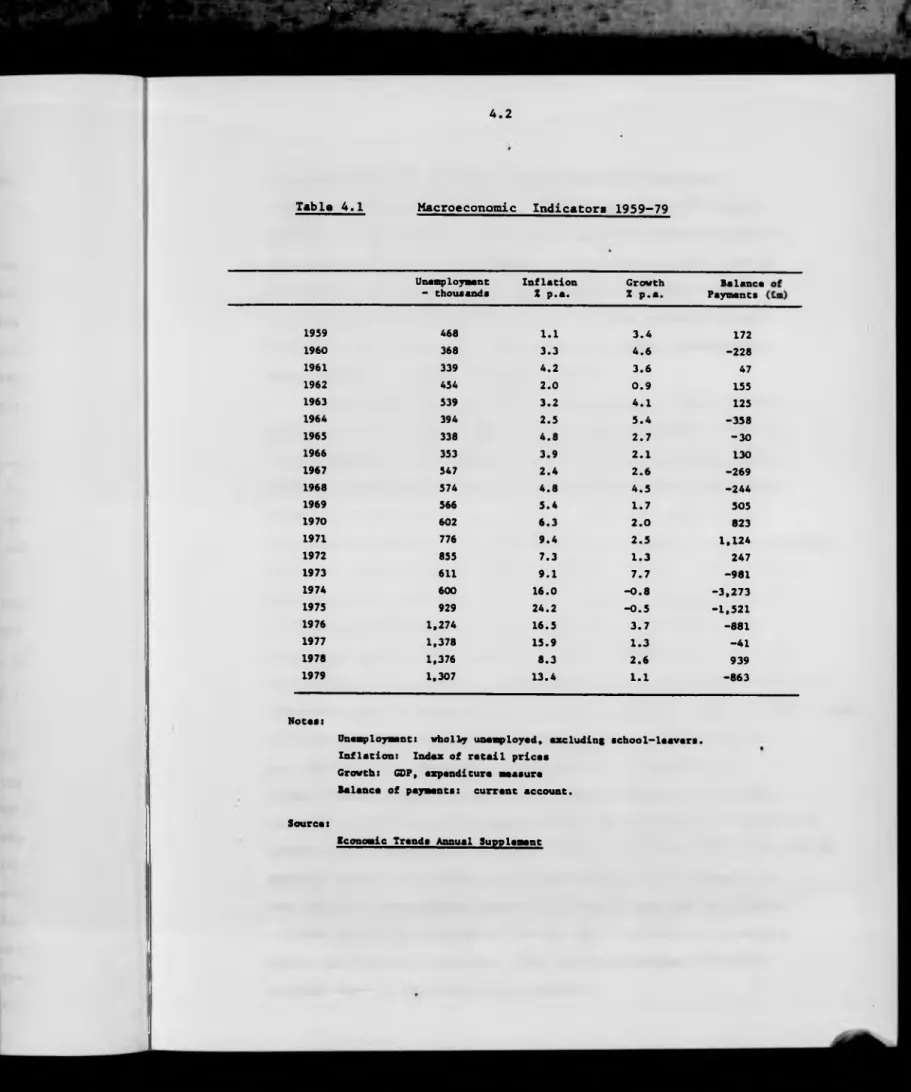
4.1 Macroeconomic Indicators 1959-79 4.2
4.2 General Economic Climate 4.5
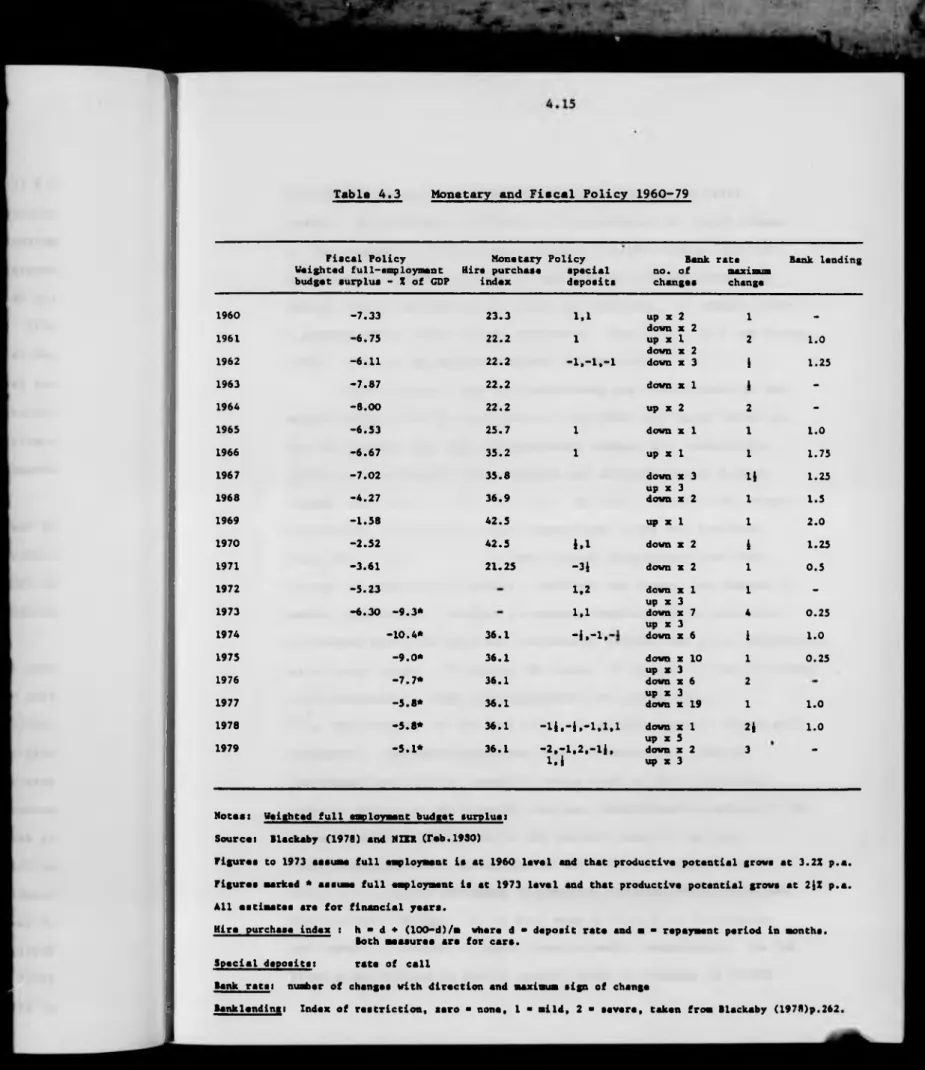
4.3 Monetary and Fiscal Policy 1960-79 4.15
4.4 Fiscal Measures 1960-79 4.17
5.1 Incomes Policy 1961-1979 5.2
5.2 The Central Wage Norm and Exceptions, 1961-79 5.5
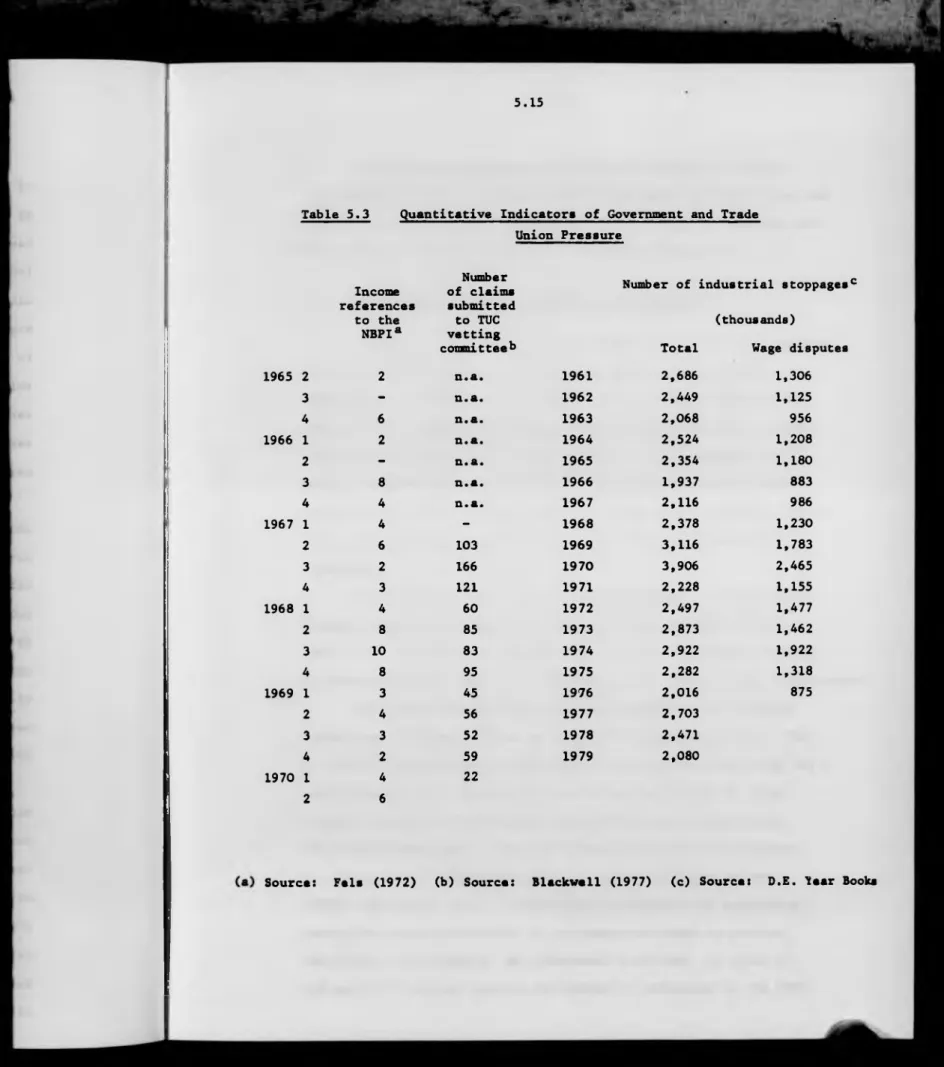
5.3 Quantitative Indicators of Government and Trade
Union Pressure 5.15
5.4 Indices of Government and TUC Pressure 1961-79 5.17
5.5 Wages and Earnings in Selected Policy Periods 5.27
5.6 Earnings and Wages by More Detailed Policy Episodes 5.29
5.7 Actual Earnings and Wage Entitlements under Various
Assumptions 5.31
5.8 Measures of Income Policy and its Strength 1961-79 5.35
6.1 Incomes Policy Announcements 6.10
6.2 Single-Equation Estimates of the Wage Equation 6.16
6.3 Estimation of Unrestricted Model Using Simultaneous
Equation Mathods 6.22
6.4 Estimation of the Restricted Model 6.26
6.5 Single-Equation Properties 6.29
6.6 Simulation Effacts Assuming Endogenous Wages and Prices 6.32
6.7 Simulation Effects: Wages, Prices and the Exchange
Rate Flexible: Unrestricted Model 6.34
6.8 Simulation Effects: Wages, Prices and the Exchange
V
Page
8.1 Incomes Policy Reaction Functions - OLS Estimates 8.6
8.2 Influences of Unemployment and Inflation on Incomes
Policy 8.11
8.3 Incomes Policy Reaction Functions - Further Results 8.14
8.4 Policy Instruments Compared 8.17
9.1 Joint Estimates of the Wage, Price and Policy Equation 9.3
9.2 Beta Coefficients for the Complete Model 9.7
9.3 Contribution of Incomes Policy to Wage Inflation
1963-79 9.14
9.4 Simulations with the Complete Model 9.19
9.5 Tests for Symmetry 9.22
10.1 Index of Policy Pressure 10.2
10.2 Impact on Wage Inflation from Policy 10.4
B.l Basic Data B.4
B.2 Incomes Policy Variables B.5
LIST OF FIGURES
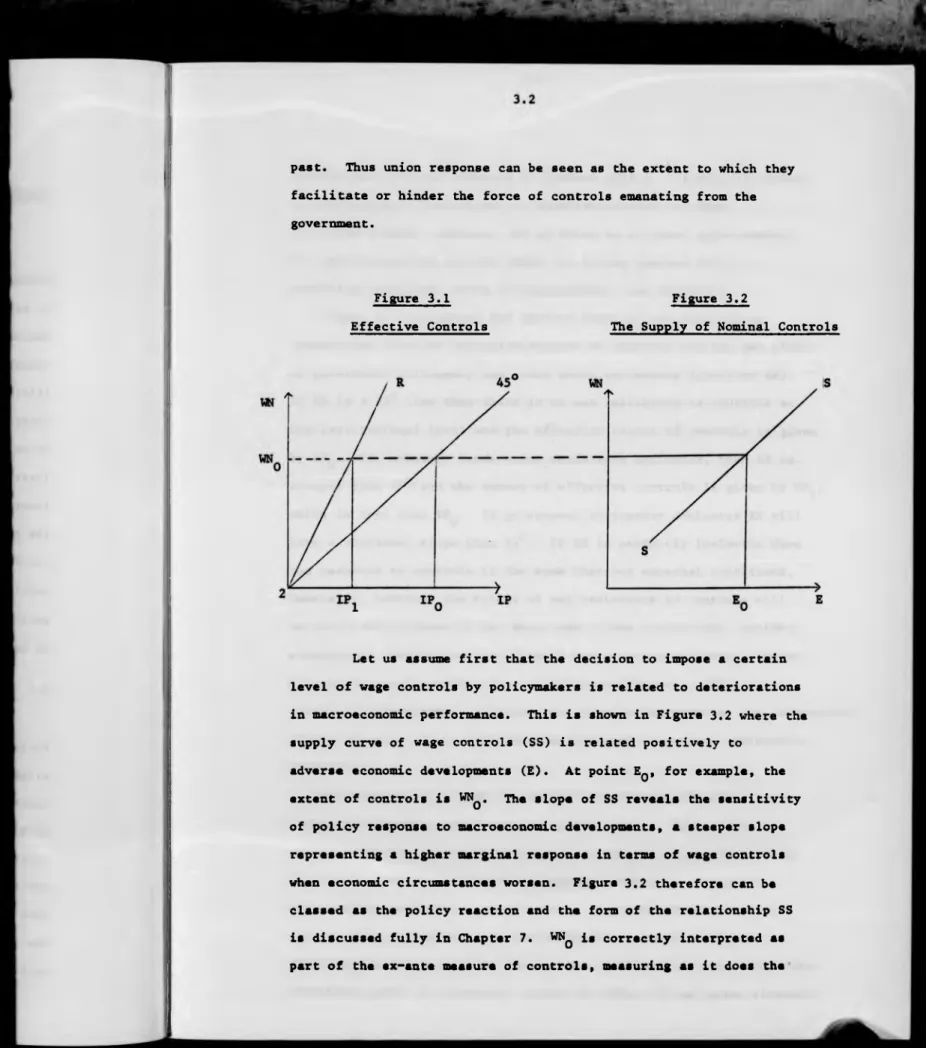
3.1 Effective Controls 3.2
3.2 The Supply of Nominal Controls 3.2
4.1 Price and Wage Inflation, Unemployment and Real Wages 4.4
5.1 Incomes Policy Measures 5.33
9.1 Variables in the Wage Equation 9.10
ACKNOWLEDGEMENTS
I am indebted to Professor K. Wallis for general
discussions and useful suggestions, to Carolyn West
for computing assistance and to Moira Fair for her
excellent typing and organisational abilities. 1 am
also grateful to the Institute for Employment Research
for the use of resources and facilities. Needless to
ACKNOWLEDGEMENTS
I am indebted to Professor K. Wallis for general
discussions and useful suggestions, to Carolyn West
for computing assistance and to Moira Fair for her
excellent typing and organisational abilities. I am
also grateful to the Institute for Employment Research
for the use of resources and facilities. Needless to
vii
ABBREVIATIONS USED
Institutions
CBI Confederation of British Industry
CEPG Cambridge Economic Policy Group
DAE Department of Economic Affairs
DE Department of Employment
EEC European Economic Community
GMWU General and Municipal Workers' Union
IMF International Monetary Fund
NBPI National Board for Prices and Incomes
NIC National Incomes Commission
NIESR NationalInstitute for Economic and Social Research
TUC Trade Union Congress
Other
DCE Domestic credit expansion
GDP Gross domestic product
HP Hire-purchase
M3 Measure of money supply, M 3
STATISTICAL TERMS AND NOTES
OLS
3SLS
TSP
GIVE
Durbin h
Xt-i
RSS
RHO
Ordinary least squares
Instrumental variable
Three stage least squares
Time Series Processor
General Instrumental Variable Estimator
Durbin Watson statistic
Durbin 'h' statistic
Degree of fit, adjusted for degrees of freedom
Chi-squared test statistic for i degrees of freedom
denotes a statistically significant value at the 10 per cent significance level
denotes a statistically significant value at the 5 per cent significance level.
natural logarithm
variable X lagged by i periods
is the forecast tsst for 4 quarters (x| (.005) “ 11.1)
is the joint test of first to eighth order serial correlation (x^g) (.005) ■ 17.5)
residual sum of squares
first order serial correlation
imposed coefficients
b e l o w coefficients indicates t value
n o t available
L I
CHAPTER 1 INTRODUCTION
1.1 Objectives of the thesis
"Incomes policy ... constitutes an attempt to solve a politically created economic policy problem by political
means. The evidence of past experience along these lines
is overwhelmingly negative; but it is a characteristic of political animals that they have the infinite self-confidence
that is born of solipsism and the disregard of past and others' experience as irrelevant, which is expressed in the view that past failures are attributable to the lack of determination or the lack of astuteness of others than oneself".
H.G. Johnson (1972, pp.269-70)
The above quotation leaves little room for further analysis
of incomes policy. The main aim of this thesis is to argue that
incomes policies have been inadequately modelled so that any previous
judgement on the past (or future) efficacy of incomes policies is
at best premature.
The typical approach towards estimating and modelling the
effects of incomes policy has been one of treating incomes policy
in the manner of a shift in economic behaviour and as a nuisance
which complicates the estimation of the underlying structural
parameters of the system. However, the frequency and variety of
incomes policy has been regarded as appearing out of the blue, like
some deus ex machine, rather than as a conscious decision of the
economic authorities related to other economic developments.
This thesis attempts to remedy these defects by providing
a more general framework whereby incomes policies can be included
in a formal representation of the macroeconomic system. Since,
however, incomes policy is not an homogeneous economic policy instru
ment, as say income tax rates, there are some limits to the extent
of generalisation possible. By concentreting on three specific erees
1.2
policy at the macroeconomic level.
The first specific area developed concerns the measurement
of incomes policy itself. Traditional analysis has treated incomes
policy as discontinuous and has >made little attempt to quantify the
variations in incomes policy over the past. By using some of the
available information on incomes policy over the period the thesis
is able to generate a continuous and quantifiable measure of incomes
policy which can be used to assess the ex-ante pressure of policy,
something which is not possible using the approaches hitherto applied
to U K economic policy.
The second area of work relates to the specification of incomes
policy within aggregate wage equations. Empirical estimation of
wage equations has tended to treat incomes policy as a temporary
irritant to the wage determination process whereas the frequency and
scale of policy intervention requires modelling incomes policy as an
integral part of the wage determination process. In addition, issues
such as the timing of policy and expectational elements havealso
been virtually ignored by the previous economic literature.
The third area of concern relates to the explanation of
the imposition and strength of incomes policy over the period. Not
only does the assumption of exogeneity of incomes policy have implic
ations for simulations with macroeconomic models (since such
simulations can never predict the introduction of incomes policy)
but it may also bias the parameters of the wage equation itself.
1.2 Outline of the research
In order to achieve some of the aims of this thesis,
notably that regarding the measurement of incomes policy, it is
essential to decide upon an appropriate definition.
Although there has been some general agreement in the
13
pay freeze of 1966, a consensus does not emerge so clearly for some
of the other policy episodes of the 1960s and 1970s. In particular,
there is some divergence in the empirical literature (see Table 1 • 1)
over the exact ending of particular policies. Further, there has
tended to be some dispute over the classification of certain policy
episodes which have been more implicit than explicit (for example
the 'n-1' policy of 1971-2). The following section of the thesis
is therefore devoted to discussion of the issues regarding the
definition of incomes policy and their appropriateness for economic
modelling.
In the second chapter of the thesis the previous treatment of
modelling of incomes policy is examined and its limitations explored.
This is followed by some discussion of the empirical estimates of
incomes policy on aggregate wages derived from previous
studies.
In the third chapter of the thesis the proposed general
approach to modelling incomes policy is discussed together with its
relationship to previous work in the area. Quantitative ex-ante
measures of incomes policy are derived using the "pressure" approach
modified by a more subjective indicator representing the political
stringency of the policy from both the government side and from
general trade union reaction. The "pressure" approach emphasises
the impact of incomes policy on real wages and uses information from
announced wage norms or guidelines and exceptions to these norms.
This approach then produces a quantity variable which indicates
variations in policy pressure. However, an ex-ante strength
indicator needs to be applied to this measure before w e can use it
as a comparative measure of policy strength since the same policy
might be applied to different degrees by government or opposed to a
1.4
Table 1.1 Alternative Incomes Policy Periods
NPBI
„ ( 1)
¡ (1)
(1)
!<»
Jen id) in
1963 ( l )
(2)
(3 ) (4 ) 1964 (1 )
(2)
( 3 ) (4 ) 1963 (1 )
ON
„ (
2)
u(2)
3(2)(
2
),(1) ¡ (1) ¡ (1)
Id)
Lipaey and Parkin
„ ( I ) Id) Id)
3
< l >„ ( D id) id) ; < »
Bd) ito id) it» (1) d) d ) :<2) „ (2)
1(2) 1(2) 1(2)
!(2)
(2)
„ (2)
1(2)
„ (
2
)J(2)
(
2
)^(2)
M (2)
(2) ON ON ON ON Solch u(l) Id) ,(1) Id)
1
(2
)1(2)
(
2
)1(2)
1
(2
)1(2)
„ (
2
)1
(2
)ON( 3 )
21(3) M <3>
S!<3> o n< 3 )
q u( 3 )
S3«) £ « >
„ ( 4 ) 1 ( 4 )
Parkin
„ (1)
ON ON
ON ¡ (1)
, ( l ) "(1) Id) 3d) ,d) id) id) id) (1) ¡ d )
d)
_ (2)
a (2 )
(2)
(2)
: « >
(
2
)¡ (
2
) 1(
2)
J ( 2 )
(
2)
(2)
1(2)
J ( 2 )
„ (2)
3(2)
¡ (2) ¡ (2)
.(2)
Parkin Hanry
at al. at al. Sheriff
0 N ( 1 ) ONU '
AN ON' 0 N d )
0 N kW
ON AN ON' ON' ON' °n; ON' ON' ON ON ON ON AN
o nJ ( 2 )
! « >
ON( l )
oS«>
ON AN ON ( 2 )
¡( 2 ) ON( l )ON1 1 ' ON*
ON
(3 )
(4 )
s(5)
J(S)
J ( 5 )
„(5)
( 3 )
(5)
1(3)
Henry and Ornerod Sargan ON tf(l> d ) ON ON „ ( I ) 3 d ) 3 d ) 3 d )
. d ) d ) d ) d )
d )
d ) ON( l ) o 2 (l) O"(2ÌCA(ì)0"(ì) ON^ /CA'
ON(2)cA(l)ON(l)
0N;:}cA^i;0N;t;127 3(2)
„ (2)
3(2)
1
(2
)1
(2
) ONI d ) j d )
gii) 3 d ) ¡ d ) d )
1970 (1) ca
(2) ca
(3)
1:4
(4) c a'
1971 (1) c a'
(2) CA1 (3) (4) 1972 Cl) (2) (3)
(4) ON«) AN«» ON1
1973 (1) (2) (3) (4) olt(2) W <2> ON«) £ « )
O N « ’ S « ) SS«) “ «>
»»! ON ON
o n' 1974 (1)
(2) CA<
(3) CA
(4) CA
1973 (1) CA(
on«> « 1 8 s « >
> S5«)
) os(2)
)c a(3>o n<2) “ (3)?2(2)
ON(2)
(4 )
1927 (1 )
(2)
1979 ( t )
(2)
1979 (1 )
1.5
Notes:
denotes end of estimation period
A N denotes announcement dunmy
CA denotes catch-up dummy
The numbers in brackets signify the different policy periods di s tingui shed.
S o u rces:
N.B.P.I. (1968)
Lipsey and Parkin (1970)
Smith (1968)
Parkin (1972)
Parkin et a l . (1976)
Henry et al. (1976)
Sheriff (1977)
Henry and Ormerod (1978)
as opposed to the general economic modelling part of the thesis
is relevant. The approach to explaining different policy strengths
is that of an extension and modification to the reaction function
approach to economic policy.
Problems in producing a continuous, rather than discrete,
measure of policy are also discussed in Chapter 3 and this
discussion is particularly relevant to the generalisation of
incomes policy in the aggregate wage equation which follows upon
an approach first applied to Canadian data by Reid (1979) but which
adopted a discrete approach to the modelling of incomes policy.
A description of the development of incomes policy over the
period under consideration is given in Chapter 4 in order to high
light the differences in the form of policy. The setting of
incomes policy against the underlying macroeconomic environment is
also discussed and this is particularly relevant for the area of
research concerned with the endogeneity of policy.
The following chapter is concerned with the derivation of
quantitative indicators of policy using the basic "pressure"
approach. Derivation of these indicators also tales account of the
severity with which the policy was intended to be applied and the
extent of TUC opposition to it. Problems of implicit wage norms
are discussed and timing problems are also incorporated into the
indicators. Having derived some measures of policy, these can then
be applied to an empirical model of wage behaviour. The form of
wage equation chosen is the real wage resistance model
since the empirical record (eg. Henry et a l ., 1976)
suggests that this is one of the better empirical descriptions
of aggregate wage behaviour. In obtaining empirical estimates
problems of expectations and wage catch-up are dealt with and the
1.7
exogeneity of incomes policy and those models which assume it to
be simultaneously determined.
The problems of policy endogeneity are dealt with in
Chapters 7 and 8. The former gives an outline of the general
literature relating to policy reaction functions and its limitations
whilst Chapter 8 applies a modified version of the reaction
function based on the piece-wise quadratic function of Friedman
(1975) to the incomes policy measure. In order to estimate
these reaction functions the issue of structural constancy is
discussed.
Having obtained a measure of policy, a description of
policy formation through the reaction function approach and
an empirical estimate of the effect of incomes policy on wage
behaviour, the results are applied through the use of a small
scale simulation m o d e l . *
1.3 Definition of incomes policy
Problems in defining incomes policy have bedevilled
much of the empirical literature on incomes policy which
have tended to characterise policy as either "on or "off".
For example, Parkin (1972) regards policy as "on" between
1961(3) and 1969(1) whereas Parkin at a l .(1976) regard policy
as "off" between 1962(3) and 1966(2) and after 1967(2);
Henry et a l . (1976) treat policy as "on" from 1972(A) to 1973(A)
whereas Henry and urmerod (1978) regard it as "on" until 197A(1).
Periods of wage freeses such as that of 1966(3) - (A) and
policy "on" periods (see Table 1.1)but decisions on the status of
policy in other historical periods are determined by no clear rule.
Often, in fact, the procedure is to follow the example of some
previous author (eg. Smith, 1968) whose own procedure has no
precisely stated criteria. It is clear that to model and evaluate
incomes policy requires some general understanding of what is meant
by incomes policy. Clegg (1979) defines incomes policy as
"... an attempt - usually by a Government - to alter the national
level of wages and salaries", (p.345).
However, this definition overlaps incomes policy with other
economic policy instruments, notably monetary and fiscal policies,
since these can also be seen as operating o n the level of wages,
whether through the level of unemployment, through real wages or
through expectations. By incomes policy we must therefore mean
some policy action designed to influence wages through some direct
influence on wage determination. Even if other policy changes have
the effect on wages as their principal aim, this is achieved initially
through markets other than that of labour. For example,
increasing real incomes by reducing direct taxation operates
initially through fiscal policy and the goods market. A suggested
topology for incomes policy is as follows:
(i) short term intervention in the wage determination
process, such as b y temporary wage controls or wage freezes;
(ii) educational and informative action designed to
influence the labour market. These measures might
include the preparation and publication of "expert" reports which outline the implications for the economy
of alternative rates of growth of money wages. The
aim of these measures would be to achieve some consensus on the acceptable growth of money wages;
(iii) the setting of mandatory or voluntary guidelines on
wage growth, regardless of whether there is accompany
ing price control or profit restraint. Thus price
(iv) the operation of some co-ordinated system of wage determination, with or without direct government intervention, or through some form of compulsory arbitration procedure;
(v) long-term measures such as institutional engineering.
These might include facilities for mediation, sanctions against unofficial disputes, etc.
The discussion of policy in Chapter 4 reveals that most of
the policies followed by the U K Government between 1962 and 1979
fall into (i) and (iii) although in the early part of the period
some attempts were made to operate via category (ii) and various
attempts have b e e n made to establish some co-ordinated system of
wage determination through the introduction of the National Board
for Prices and Incomes in the mid-1960s and the Pay Board in the
early 1970s. However these bodies degenerated rapidly into super
visory bodies concerned with overseeing policies which fall into
class (iii). Although arbitration procedures have been an important
element in sorting out individual wage problems there has been no
general arbitration system as an integral part of the wage determination
in the manner recently suggested by Meade (1982). Long-term
measures as defined by (v) have been notable by their absence.
The definition of incomes policy given by the above
classification includes implicit policies as well as explicit
policies. Many of the measures included under (ii), (iv) and (v)
might well be regarded as an implicit rather than explicit policy.
The existence of a wage norm or guideline is not therefore a
necessary condition for an incomes policy to exist although its
absence does complicate the construction of a quantitative index of
policy.
It should be noted that the topology of incomes policy does
not include measures aimed at restraining cost pressures in specific
1.10
say, if unaccompanied by comparable action in other sectors is
not designated as incomes policy. In practice, of course, wage
negotiations are sequential rather than simultaneous so that it
slight be argued that controlling wages in some particular sector
could be construed as incomes policy if wages in other sectors
were expected to be influenced by wages in this leading sector.
Although post-war governments have been well aware of the
comparab-ility issue in wage determination and have often comsienced any
intervention on wage settlements in the initial phase of a
wage-round in order to influence wage settlements later on, there is
little evidence that they have taken the leading sector theory of
wages seriously enough to limit their intervention to one or
. 2
two major settlements.
One of the problems in the suggested classification is
an extension of this sectoral case and concerns the treatment of
the public sector. It has frequently been argued that since the
Government must always take some view as to the acceptable level
of renumeration in the public sector then it must always be
operating an incomes policy. However, Clegg's definition clearly
states incomes policy as relating to the level of national wages
and salaries. Both because of the size of the public sector
(accounting for over one-quarter of employment in 1981) and because
of the interdependence between public and private sector pay
through comparability issues, public sector incomes policy must be
seen as a form of national incomes policy applied to a large but
not complete section of the labour force. However, this does not
mean that incomes policy is therefore always seen to be "on" as the
criteria for defining incomes policy still stand. Thus decisions
over public sector pay must be seen to follow a clear general
1.11
sector. Similarly, a public sector expenditure policy operating
through the imposition of cash limits but with no view as to the
mix of real expenditure and inflation does not constitute an instance
of incomes policy. Rather it is a form of fiscal policy.
The analysis of policy since 1962 suggests that, using the
above criteria, there has almost always been some form of incomes
policy in operation, the main exception being the very first few
months of the Conservative administration in 1970. The main issues
that arise therefore are not whether policy was "on" or "off",
since it was nearly always "on", but the extent to Which it was
r i ’i
* ■
1. 12
Footnotes to Chapter 1
This work concentrates on incomes policy and its impact on
wage determination. It does not consider the independent
role of any prices policy which, i n any event, has been rare over the period.
The work by Elliott (1976) shows that there is no regular wage-round in that settlements tend ,not to occur in the same sequence in each year although there is some support for the idea that settlements which occur early in the pay-round
(which probably begins in September/October of each year) do strongly influence succeeding wage demands in other s e ctors.
•'J
CHAPTER 2 REVIEW OF THE EMPIRICAL TREATMENT OF
INCOMES POLICY IN WAGE EQUATIONS
As noted in Chapter 1, the exact classification of periods
of economic history as being periods of policy "on or "off" has
been subjective rather than being based on a set of objective
criteria. Some (eg. Parkin et al., 1976) have included only
periods with zero norms backed by legislative powers ("freezes")
whilst others (eg. Henry and Ormerod, 1978) have included periods
of "voluntary restraint".
2.1 The real wage resistance model
For the purposes of the research in this thesis a real wage
resistance model of money wage determination is adopted. This is
based on the original paper by Sargan (1964) which was updated and
popularised by Henry et a l . (1976). Usually in the literature the
real wage resistance model has been postulated as emerging from a
bargaining framework where trade unions are assumed to strive for
a given real wage in the light of expected price developments. Thus
following Henry et a l . we have the target money wage, from the union
X
....(2.1)
where W refers to money wages, P to prices, e denotes the expected
value of a variable and d its desired value. The employers' reaction
enters the real wage resistance framework by the inclusion of a
demand variable, usually the level of unemployment, although this
may also be interpreted as an indicator of union bargaining strength.
Adding the unemployment term and taking logarithms gives (2.2). side, as given oy:
W ■ Wt
Wt- l - < p / ? . 1 >
W/p
2.1
CHAPTER 2 REVIEW OF THE EMPIRICAL TREATMENT OF
INCOMES POLICY IN WAGE EQUATIONS
As noted in Chapter 1, the exact classification of periods
of economic history as being periods of policy "on or "off" has
been subjective rather than being based on a set of objective
criteria. Some (eg. Parkin et a l ., 1976) have included only
periods with zero norms backed by legislative powers ("freezes")
whilst others (eg. Henry and Ormerod, 1978) have included periods
of "voluntary restraint".
2.1 The real wage resistance model
For the purposes of the research in this thesis a real wage
resistance model of money wage determination is adopted. This is
based on the original paper by Sargan (1964) which was updated and
popularised by Henry et a l . (1976). Usually in the literature the
real wage resistance model has been postulated as emerging from a
bargaining framework where trade unions are assumed to strive for
a given real wage in the light of expected price developments. Thus
following Henry et a l . we have the target money wage, from the union
X
. . . . ( 2 . 1 )
where W refers to money wages, P to prices, e denotes the expected
value of a variable and d its desired value. The employers' reaction
enters the real wage resistance framework by the inclusion of a
demand variable, usually the level of unemployment, although this
may also be interpreted as an indicator of union bargaining strength.
Adding the unemployment term and taking logarithms gives (2.2). side, as given Dy:
W “ W t - l . ( P / * > W
W/p
2.2
log W - log W , - log (Pt )e + X log (W /P)d - log pt-l/p >
t-1 t-1
+ 9 log U *— .... (2.2)
where U refers to the level of unemployment.
The formulation of (2.2) implies that, for a given level of
expected price inflation and unemployment, any deviation of actual
W/ d
real wages from their desired level ( 'P) must eventually be
made up. In other words, the formulation is that of partial
adjustment to any given desired or target level of real wages.
We can now see that if X, the partial adjustment of actual
to desired real wages,is zero, then the real wage resistance model
(RWR) collapses to the familiar augmented Phillips curve
(Friedman, 1975):
Thus,
log “ log (pe/pt;0 + 9 log u
Thus the fact that some of the previous empirical work (eg.
Lipsey and Parkin, 1970) has used the augmented Phillips curve
whilst others (eg. Henry et a l ., 1976) have used the real wage
resistance model does not prove a problem for our taxonomy of models
since the augmented Phillips curve (APC) can be seen as a specific
form of the more general real wage resistance model (RWR).
In both the RWR and APC outlined as (2.2) and (2.3) the
term in expected price inflation has a unit coefficient. Whilst this
has often been justified by an appeal to money illusion (eg.
Friedman, 1975) it has been seen by some as an empirical question,
especially in cases where some proxy (often actual past price
inflation) has been used for expected price inflation.1 In addition,
Artis and Miller (1979) have shown that a unit coefficent on price
inflation is not a necessary condition for absence of money illusion
2.3
Therefore, more general versions of the real wage
resistance model and the augmented Phillips curve can be written
as (2.4) and (2.5)
Real wage resistance (RUR)
log (“/ ^ ) - B log <pe/Pt_]) ♦ ^ |log(M /p)d - log(W t-l/p )j
+ 9 log U ...(2.4)
Augmented Phillips Curve (APC)
log (w /w ) - 6 log (pe/p ) + 9 log U .... (2.5)
t-1 6—1
One of the major problems with the real wage resistance
model concerns the determination of the desired or target real
wage. Henry et a l . (1976) assume that it grows at some constant
rate, y, so that we can write (2.4) as:
log (W^ t - 1 ) “ 8 log (Pe /p ) - X log (W t-1/D ) + 9 log U
t-1 /pt-l
+ y A T ♦ y x ... ( 2 . 6 )
where T ■ a time trend
and where log(W/p )d ■ y ♦ y T
or log (W / ) - aQ + a, log (P ^P .)♦ a, log(Vt-l/p )
t-1 c 1 t-1
♦ a ^ log U + a ^ T ... (2.7)
where aQ * y x
al m 6
a2 - - X
a3 ■ e
a4
and minus the ratio of the parameters on lagged real wages (c^) and
on the time trend (a^) gives y , the trend rate of growth of
desired real wages. In Sargan'a original formulation real wages
were defined as pre-tax wages whereas following Henry et a l . (1976)
real wages have generally been taken to be post-tax real wages.
If these are defined to b e the product of real wages and the ratio
of post-tax to pre-tax wages (the 'retention ratio') (2.7) can be re
written as:
lo8<W/W,-i * °o + “l 108 (P*/pt-]> + a2 lo8(rW/P)t_1
+ a^ log U ♦ T ... (2.8)
where r is the retention ratio
and is now y' X , i.e. related to the trend growth of
the post-tax target wage.
Criticisms of the RWR model have often centred on the
apparent immutability of this target real wage and the empirical
support for RWR runs into problems in the late 1970s when the
equations apparently shift (Henry and Ormerod, 1978). This apparent
shift in the relationship has sometimes been attributed to the
success of the incomes policy of 1976 and 1977 in reducing real
wages, in which case one might expect the original equation to
reassert itself once these effects have passed. Alternative
explanations have been along the lines that general economic events
and in particular the slow-down in the rate of growth of product
ivity had convinced trade unions that the previous desired rate of
growth of real wages was now unobtainable and therefore that the relation
ship had shifted permanently. Other explanations are possible but
the general problems relating to the use of the time trend make
2.5
Although the most common background to RWR is the
bargaining approach it has been argued that the model is consistent
with alternative theoretical and empirical backgrounds. In
particular, Parkin (1979) argues that the model is indistinguishable
from an excess supply model of real wages since the presence of
high real wages would, according to neo-classical theory, lead to
a downward pressure on wages through excess supply. He argues that
this is supported empirically by an inverse relationship between
real wages and wage inflation. Kuh (1967) has advanced a similar
explanation whereby the post-tax real wage represents the supply side
of the labour market and the time trend average productivity growth
and the demand side. The standard form of RWR does not distinguish
easily between the excess supply approach and the bargaining approach.
The most that one can say is that it is a reduced form of labour
market adjustment which may be consistent with more than one
theoretical model of labour market behaviour.
2.2 Taxonomy of policy effects
The major routes by which incomes policy might be thought
to affect wage inflation are as follows:
(a) dummy shift approach. Here policy operates by
changing the intercept term (a ) so that the entire equation shifts uniformly for the duration of the
policy. Estimates of the size and significance of
the dummy variable are then interpreted as a measure of the influence of policy.
(b) dummy slope approach. Here policy may change some
or all of the remaining parameters (a., i»l....n) with estimates of these coefficients again being used to evaluate the influence of policy.
(c) simulation approach. This is not a modelling device
not defined and Che impact of controls is measured as the difference between the actual and simulated values.
(d) on-off approach. This is a generalisation of (a)
and (b) where different equations are estimated for periods of policy "on" and policy "off" but with identical sets of explanatory variables. Structural differences between the models ere used
to indicate the significance and impact of controls
under the assumption that the policy "off" model is the true wage model.^
(e) difference in variable approach. Here the effects
of the explanatory variables are allowed to change under policy "on". Note however that our definition of incomes policy requires this to be a direct effect on the labour market so that we are concerned with, say, the implications of different price expectations under the imposition, or anticipation of imposition, of wage controls rather than the fact that incomes policy may enable the economy to be run at a higher level of activity and hence unemployment m a y be lower during policy "on" periods. If the target real wage itself is influenced by policy,however, then this is a'true’ policy effect.
(f) new model approach. This is an extension of the
"on/off" approach of (d) but where a different set of explanatory variables may appear in the policy "on" equation. As with (d) estimates of the
significance of controls are given by the difference between the two models.
(g) general model approach. This is an extension of the
new model approach (f) where the "on/off" equations are unified into a single formulation of aggregate wage determination where the values of some of the variables in the general equation indicate the strength
of incomes policy. This continuous approach then drops
the distinction between policy "on" and "off".
Most empirical assessments of incomes policy in the UK have
been based on methods (a) to (d) (see Table 2.1). The dummy shift
approach has been most comnon and has been used by Smith (1968),
Parkin et a l .(1976). and Henry et a l . (1976) amongst others. The
dummy variable generally takes on the value of unity in policy "on"
episodes and zero in periods of policy "off" (an exception is
Smith ,1968) where the variables are scaled in proportion to the
length of policy period). The "on/off" approach (d) has been used
2.7
With the exception of Sargan (1980), who uses the
instrumental variable estimation technique, all the previous
UK studies have treated incomes policy as exogenous in their
analyses of aggregate wage determination.
A recent study by Lawson (1982) which has been developed
in parallel but independently of the present study attempts to quantify
incomes policy by a similar real wage pressure method as this study
but using annual data. However the measure of policy derived
is not continuous (for example it ignores the 1972/3 experience); it
has no separate role for the intensity of policy; the incomes policy
variable merely enters as an additional influence; and policy is treated
2.8
2.3 Limitations of the existing treatment
The almost continuous presence of incomes policy in the
1960s and 1970s limits the ability to estimate a policy "off"
model and hence precludes the on/off approach (d) as well as the
simulation approach (c). It is a common feature of some of the
previous studies that the techniques used could, with some ingenuity,
distinguish between different periods of policy and could
therefore provide some ex-post evaluation but these models are
unable to give any reasonable guidance to the ex-ante effects of
incomes policy. Modelling treatment based on these approaches are
therefore not feasible unless policy "on" periods are relatively
rare.
Thu dummy variable approach ((a) and (b)) can deal more
easily with differences between policies whereas the policy "on'V'off"
approach treats all policy "on" periods as implicitly of the same
strength.
The dummy shift approach has been used by Henry and Ormerod
(1978), amongst others, to distinguish between different phases of
policy by specifying different dummy variables for each distinct
phase of policy. Even so it is inevitable that certain policy periods
are either lumped together (with the corresponding homogeneity
assumption of policy imposed) or ignored altogether in order to make
3
the estimation tractable. To generalise the approach to distinguish
finely between policy episodes runs the problem of spurious results
2.9
*4-4 • 4J
•H u •0) O 0) 0)
•o u O CO a o
4) o* a u-i 1 a
4-t a> 3 04 ■
M n c B u
<0 CO 4-1
£ § 0) 41
•H 0) o* m *4-1 *4-t
U CO > 0» O0 00 c0 > »—4 CO 2 * «•s W U
CO 0) (0 o *■* a
<0 a) M u
0) co ■ •u eo M CO 4J CO M CO 0) 4-1 CO u
«*4 *0 CO 00
¿.2 « a CO . M M
«2J 2 ^ 2 •
CO 3 0) -u 0) »+-• 0) 0) 01
S B 04 4J 4) 4J
3 2 oo a 00 *W 00 00 00 oo cr 00 O*
2 CO 4) CO CO cO CO «0 co CO
CO ^ O £ TO > * £ ^ 4) > f« & rH
1
2
1
§•
00 p-. ON r-4 •O m r^. co
T vO1 T
P*» 1 r-* 1 r- r*«. 1 r*» 1
00 00 00 vO 00 ON 1—4 CM
-O’ *n ^o- m vO cn
ON ON ON ON ON ON ON ON
H rH H f-4 H H e-4
2.10
any policy effect but will also capture any influence from
unidentified factors and random errors within the wage equation.
Even the more limited approach of Henry and Ormerod (1978) poses
particular problems for ex-ante estimation of policy effects, since
if more than one phase of policy is distinguished, which is the most
relevant for future policy evaluation ? Problems with timing effects
bedevil both the dunmy variable and the policy "on/off"
approaches. In the simple case where there are no timing effects
from policy itself the presence of serial correlation in the
residuals will invalidate the sample separation.
Suppose the policy "off" model is defined to exist until
period t and to recomnence in period t + n with the policy "on"
model existing between periods t + l t o t + n - 1 . If there is
serial correlation of order i in the underlying wage model then an
extra i observations should be excluded from both the policy "on"
and policy "off" periods which are then defined as policy "on" from
t + i + l t o t + n - 1 and policy "off" from t + n + i
considerably reducing the already small number of degrees of freedom.
Similar considerations apply if the true policy "on" and "off"
models differ and the policy "off" model contains lagged variables.
Pre-announcement or anticipation of controls and possible catch-up
after controls also make separation of the sample period into
different policy regimes somewhat complex. Prior announcement
can relate either to the imposition of controls or to their ending.
Whilst the former has been rare in the UK the latter has occurred
frequently. This then gives an incentive to shift wage bargains
from the period of controls into the post-control era.^ The possible general
anticipation of tighter or looser controls implies that
attempts to estimate a policy "off" model without allowing
Co misleading conclusions regarding the efficacy of the particular
policy episode. Thus, if wage settlements were brought forward
in time in order to avoid a period of tighter wage controls one
would observe a relatively high rate of wage inflation prior to
the controls and a relatively low rate during the period of
tighter controls, leading to the conclusion that the tightening
of policy had been successful in reducing wage settlements even
if the true result were that policy had merely shifted the pattern
of wage settlements through time.
Similar considerations apply to the ending of a relatively
severe phase of policy. Here again the conclusions regarding the
success of policy may merely relate to the shifting of settlements
over time.** Of course, it is also possible to confuse the
shifting of settlements due to policy with genuine policy catch
up. By policy catch-up is meant some form of compensation in wage
settlements for a lowering of wages during the policy. Henry and
Ormerod (1978) include dummy variables in an attempt to measure policy
catch-up and their work is therefore subject to the criticisms noted
above.
The general criticism of both the sample separation approach
(policy "on/off") and the dummy variable approach concerns the
inability of these methods to deal with the timing problems of
policy without either reducing the already scarce (if not non
existent) degrees of freedom for policy-off analysis or causing
an explosion in the number of dummy variables introduced with
consequent danger of spurious results. If one adds the observation
that the time period over which policy catch-up might be spread is
probably an empirical matter rather than one that can be decided
upon a priori the case for an alternative approach is strengthened.
2.12
is based on a more general approach to policy measurement which
avoids the proliferation of dummy variables but also stresses
the case-study element of incomes policy in dealing with timing
problems. At this point it is necessary to make some further
elaboration of the modelling of policy catch-up factors in the
real-wage resistance model.^
In the standard RWR model the desired real wage is
exogenously set. The basic presumption of this thesis is that
incomes policy, if effective, operates through reducing real
wages at least initially since empirical work on pricing behaviour
(e.g. Godley and Nordhaus, 1972) shows that prices respond only
8
with a lag to a reduction in wage costs. Recognition of these
facts explains the general unease with which trade unions hold
incomes policy although fears of losing their right to bargain freely,
and hence one of their historically important roles, may also be
relevant to this position.
The picture may be clarified a little by the use of a
simple algebraic model comprising a wage equation (omitting the
real wage resistance terms at first) and a price mark-up equation.
" 90 W t + 9i V 02 w t-2 +$ c.
where dots signify percentage rates of change ; p t is price inflation; the term ir
c t reflects cost changes other than wages and y is an exogenous
shock.
Allowing for wage-price feedbacks,the first period impact of an exog
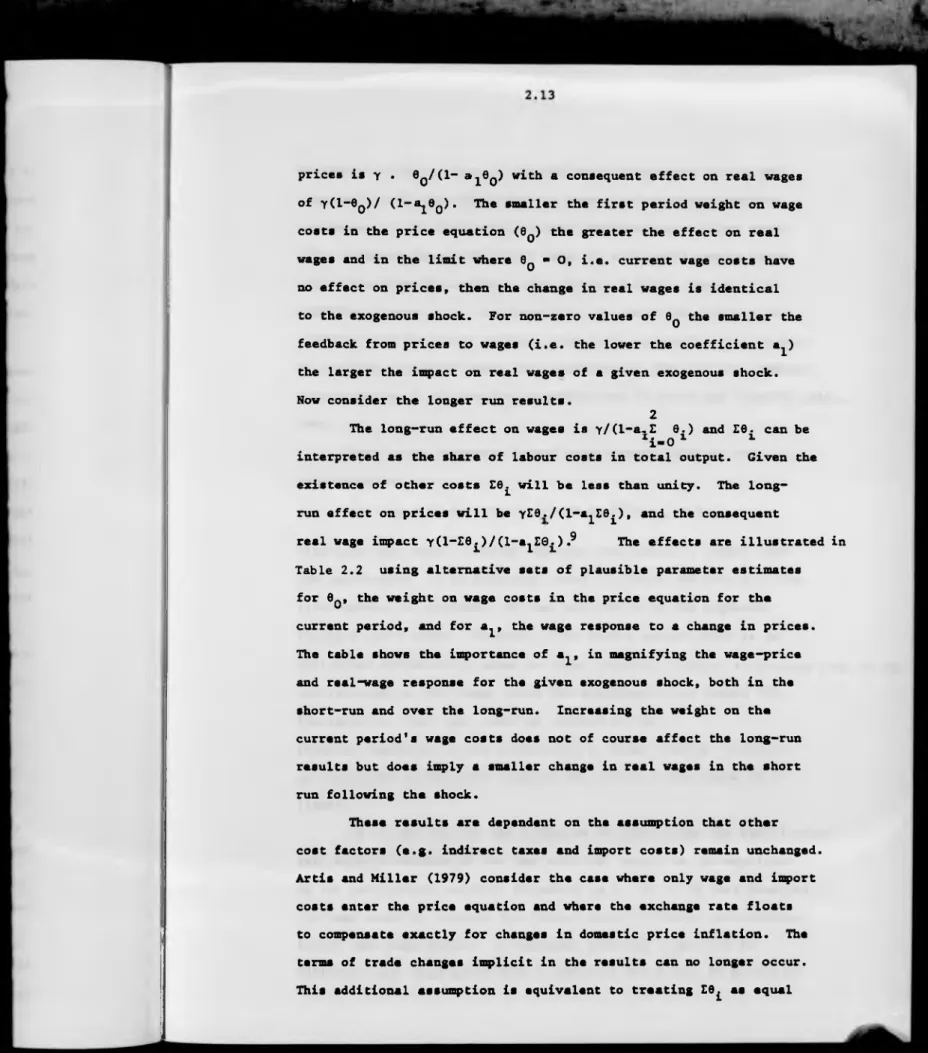
prices is y . 0Q /(1- a ^ g ) with a consequent effect on real wages
of y(1-6q)/ (l~a^6g). The smaller the first period weight on wage
costs in the price equation (0Q ) the greater the effect on real
wages and in the limit where 6q “ O, i.e. current wage costs have
no effect on prices, then the change in real wages is identical
to the exogenous shock. For non-zero values of 0Q the smaller the
feedback from prices to wages (i.e. the lower the coefficient a^)
the larger the impact on real wages of a given exogenous shock.
Now consider the longer run results.
2
The long-run effect on wages is Y/(l-a.E 0.) and 10. can be
xi - 0 1 1
interpreted as the share of labour costs in total output. Given the
existence of other costs £0^ will be less than unity. The
long-run effect on prices will be y£0.y (l-a^O^), and the consequent
real wage impact Y(l-£0^)/(l-a^£0£ ) ? The effects are illustrated in
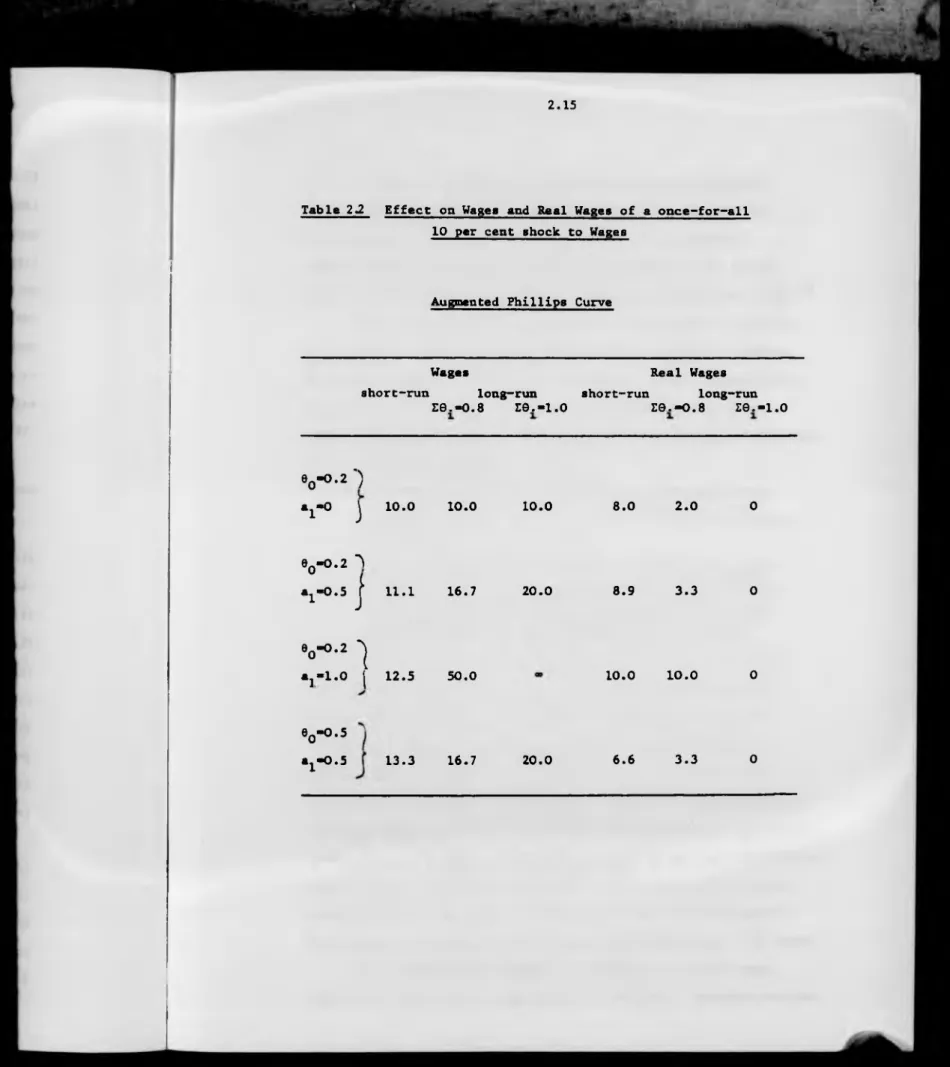
Table 2.2 using alternative sets of plausible parameter estimates
for 0q, the weight on wage costs in the price equation for the
current period, and for a^, the wage response to a change in prices.
The table shows the importance of a^, in magnifying the wage-price
and real-wage response for the given exogenous shock, both in the
short-run and over the long-run. Increasing the weight on the
current period’s wage costs does not of course affect the long-run
results but does imply a smaller change in real wages in the short
run following the shock.
These results are dependent on the assumption that other
cost factors (e.g. indirect taxes and import costs) remain unchanged.
Artis and Miller (1979) consider the case where only wage and import
costa enter the price equation and where the exchange rate floats
to compensate exactly for changes in domestic price inflation. The
terms of trade changes implicit in the results can no longer occur.
2.14
to unity. Clearly there is no real wage consequence now in the
long run but if the coefficient a^ equals unity wage inflation
accelerates. In practice of course, the presence of other costs
(like indirect taxes) will mean that 10^ will still remain below
unity even when the exchange rate floats in such a manner. In
addition, however, one must note that the empirical evidence on
exchange rate behaviour suggests that full compensation for changes
in domestic inflation takes some considerable time, if full compen
sation occurs at all (see the contributions in Gltis and Sinclair, eds.,
1981).
Now let us introduce a real wage element into the basic
wage equation.
w t “ a0 + al p t + a 2 u t + Y + a 3 ^ P J t - l + a4 T
With only real wages entering the wage equation in a lagged form
the implication of an exogenous shock for wages and prices in the
first period is equivalent to that derived using the augmented
Phillips curve above. However in the second period there is an
additional influence on wages as wages increase in order to restore some of the
earlier loss in real wages below the exogenously set target (T).
The extent of real wage catch-up depends on the
absolute magnitude of the coefficient a^ since this is in effect
an adjustment coefficient relating the level of real wages to its
target.
As in the case of the augmented Phillips curve the equilibrium
real wage properties of the wage equation depend on the magnitude
of the coefficient on price inflation (a^). If it is less than unity
the wage equation implies that higher price inflation continuously
lowers real wage growth. A permanent shift in y can lead to
2.15
Table 2.2 Effect on Wages and Real Wages of a once-for-all
10 per cent shock to Wages
Augmented Phillips Curve
Wages Real Wages
short-run long-run short-run long-run
E 0 . - O . 8 E 0 . - 1 . O E 0 . - O . 8 E 0 . - 1 . O
V
0 - 2
■
)
al * ° J 10.0 10.0 1 0 .0 8 . 0 2 . 0 0
90-0.2 1
* 1-0 . 5
J
1 1 . 1 1 6 . 7 2 0 .0 8.9 3.3 090 - 0 . 2 1
a j - 1 . 0 ( 1 2 . 5 50.0 10.0 10.0 0