A Thesis
presented for the degree of
Doctor of Philosophy
in
Electrical and Electronic Engineering
in the
University of Canterbury,
Christchurch, New Zealand
by
Bruce A MacDonald
BE (Hons)
Acknowledgements
Author's Note
ABSTRACT
CHAPTER I
1
2 3 4
INTRODUCTION CHAPTER SUMMARIES
HISTORY OF THE WORK IN THE THESIS ORGANIZATION OF THE THESIS
SUMMARY
CHAPTER II EXISTING ROBOTS ARE STUPID
1 LACK OF TEACHABILITY AND ADAPTABILITY
1.1 1.2 2 2. 1 2.2 3 3. 1 3. L 1
3.2 3.3 if
Teachability Adaptability
DETERMINATION OF MOTOR COMMANDS Description to motor commands
Movements and forces to motor commands EXISTING METHODS FOR TEACHING ROBOTS Leading
Facility, range and difficulty of tasks taught by leading
Programming and Guiding methods Combinations of methods
DETERMINING MOTOR COMMANDS FOR DIFFERENT CONDITIONS 4.1 Motor commands for different environmental conditions 4.2
4.3 5 5. 1 6
Coping with uncertainty about the environment Using Sensory Information
WAYS FOR EXISTING ROBOTS TO COPE WITH A RANGE OF SITUATIONS
Determining different sequences of movements CONCLUSION
NOTES FOR CHAPTER II APPENDIX FOR CHAPTER II A.1 Movements to motor commands A.2
A.3 A.4 A.4. 1
A.4.2 A.4.3 A.4.4 A.4.5 A.5
Forces to motor commands
Guiding and Programming methods Compensating for disturbances
Inherent elasticity, viscosity and inertia Feedback
Fixed compensation Adaptive compensation
Range of conditions, teacher assistance and adaption speed
Some examples of robot systems
CHAPTER III ENHANCING THE LEADING METHOD 1 TWO PATHS OF IMPROVEMENT
2 VERBAL CORRECTING (VC)
2. 1
2.2 2.3 3 4 4.1 4.2 5
Stability of Convergence of Verbal Correcting Correcting Movements
Corrections that cannot be made
PRODUCTION SYSTEM OF CORRECTIONS (PSC) GOAL-SEEKING (GS)
Example Task for a GS system Dual Control
CONCLUSION
NOTES FOR CHAPTER III APPENDIX FOR CHAPTER III
A.1 Verbal .correcting is Stable and Convergent Under A.2
A.3 A.4
Reasonable Conditions
Corrections that Can and Cannot be Made "VC" Simulation
Advanced PSC
CHAPTER IV 1
LEADING WITH AN MCLS AN MCLS PROVIDES SEQUENCES Sequences and Goals
Implementing VC
AND GOALS
1.1
1.2
2 MULTIPLE CONTEXT LEARNING SYSTEMS (MCLSs)
2.1 Formal Description and Terminology of MCLSs used in 2.2 2.3 2.3.1 2.3.2 2.4 3 4 A.1 A.2 A.2 .1 A. 2. 2 A.3 A. 3.1 A.3.2 A.3.2.1 A.3.2.2 A.3.2.3
this thesis
Example Use of Terminology Properties of MCLSs
Distinguishability
Generalization of Actions MCLSs Used in this thesis
PREVIOUS WORK ON MCLSs AND LEADING CONCLUSION
NOTES FOR CHAPTER IV APPENDIX FOR CHAPTER IV Example MCLS with VC Generalization
Action generalization : no VC Correction-action generalization Advanced Robots : Leading and MCLSs Teaching using an MCLS and leading
Required properties of Leading in future Robots Working out sequences of movements
Correcting information acquired during leading No external training switch
CHAPTER V
1
2 3 A.1 A.1. 1
A.1.1.1 A.1.2 A.1.2.1 A.1.2.2 A.1.2.3 A.2 A.2 .1 A.2.2 A.3 A.4 A.4.1 A.4.2 A.4.3 A.4.4 A.4.5 A.5
CHAPTER VI 1 2 2. 1 2.2 3 4 5
A SIMPLE LED ROBOT WITH AN MCLS EXAMPLE INTERACTION WITH ARM-ROBOT DISCUSSION
CONCLUSION
APPENDIX FOR CHAPTER V
Description of the arm-robot Example MCLS led robot Simple design for a robot arm
Implementation of robot arm
Robot "brain" : remembering led movements and learning actively
Reward
Decision procedure
Interface between the arm and the MCLS Arm-robot Interactions
Two Interactions with the arm-robot One simulated and two real interactions Interactions with the earlier arm-robot Discussion of Arm-robot interactions Determination of motor commands Improvements to the arm-robot
Leading a robot gives i t a repertoire of movements Leading a robot can show i t information about the
environment
The asynchronous characteristics of the MCLS brain of the arm-robot
Circuit diagram, modular servo system and program listings
OPTIMAL GOAL SEEKING THREE ASSUMPTIONS
LEAK-BACK FINDS OPTIMAL DECISIONS Policy Interaction and Leak-back
Proof : leak-back converges to an optimal policy DISCOUNTING OF FUTURE REWARDS
LEAK-BACK IN A MULTIPLE CONTEXT CONCLUSION
NOTES FOR CHAPTER VI
CHAPTER VII A FRESH LOOK AT CONDITIONED REFLEXES
1 REFLEXES
1 • 1 1. 2 1. 3 1. 3. 1 1.3.2 1.4 2 3 3. 1 3.2 4
Reasons for preprogramming eye movements A Natural Way
Reflexes in MCLSs Reflex implementation Reflex performance Reflexes in PURR-PUSS
MOVEMENT CONTROL FOR A ROBOT'S EYE AND HEAD REFLEXES VERSUS LEADING
Reflex, back-reflex and leading
Conditions for a reflex, back-reflex or led action CONCLUSION
NOTES FOR CHAPTER VII
A.1
A. 1. 1 A.1.2 A.1.3 A.1. 4 A.1. 5 A.2 A.2 .1 A.2.2 A.3 A.3 .1 A.3.2 A.4 A.4.1 A.4.2
APPENDIX FOR CHAPTER VII Reflex learning in PURR-PUSS Main context
Stimulus context Action context
( and
*
contextsPredicting a reflex~action
An Illustrative Interaction Interaction
X-OCCURRENCE Discussion X-OCCURRENCE
General learning of reflexes Head Movement System and Results Head Movement System
Experimental Results
356 359 360 361 362 365 369 370 375 380
CHAPTER VIII ANSWERING THE CRITICS 384
2 2.1 2.2 3 4 4.1 4.2 5 6 7 8 9 A.1 A.2 A.3
CHAPTER IX 1 2 3 4 A.1 A.2 A.3 A.4
GRAMMARS 387
UNIVERSAL TURING MACHINES 389
Relationship between machines and languages Universal Turing Machines (UTMs)
AN MCLS THAT CAN SIMULATE A TURING MACHINE 392
RESTRICTIONS? 394
Finite lifetime 395
Learning the tape 397
TEACHING WITH REFLEXES OR LEADING 399
'G~4AR1 LIKE PROPERTIES OF THE UTM SIMULATION 400
WHAT DOES AN MCLS1
S BEING ABLE TO LEARN ANY 401
GRAMMAR SHOW?
DOES AN MCLS NEED TO BE ABLE TO LEARN EVERY GRAMMAR? 403
CONCLUSION 405
NOTES FOR CHA~TER VIII 406
APPENDIX FOR CHAPTER VIII 407
MCLS description
Operation of the simulation 416
Teaching 418
WHEN IS 'NOT' NOT 'NOT' FOR A ROBOT 424
NHM. NEGATION HANDLING MCLS : VERSION 1 426
NEGATION HANDLING MCLS : VERSIONS 2 AND 3 430
MFLMs AND MCLSs 434
CONCLUSION 436
NOTES FOR CHAPTER IX 437
APPENDIX FOR CHAPTER IX 438
BASIC program for NHM
BASIC program changes for NHM' and NHM" LISP program for NHM
CHAPTER X CONCLUSION 444
REFERENCES 447
GLOSSARY 462
APPENDIX A HUMANS AND ROBOT DESIGN 467
A.1 HUMAN ACQUISITION AND PERFORMANCE OF MOTOR TASKS
A.2 HUMAN MUSCLES AND EYE MOVEMENTS 471
APPENDIX B FUTURE RESEARCH 475
B.1 SUGGESTED POST GRADUATE PROJECT FOR THE ELECTRICAL
B.2
AND ELECTRONIC ENGINEERING DEPARTMENT, UNIVERSITY OF CANTERBURY
II-1 II-2
II-3
II-4
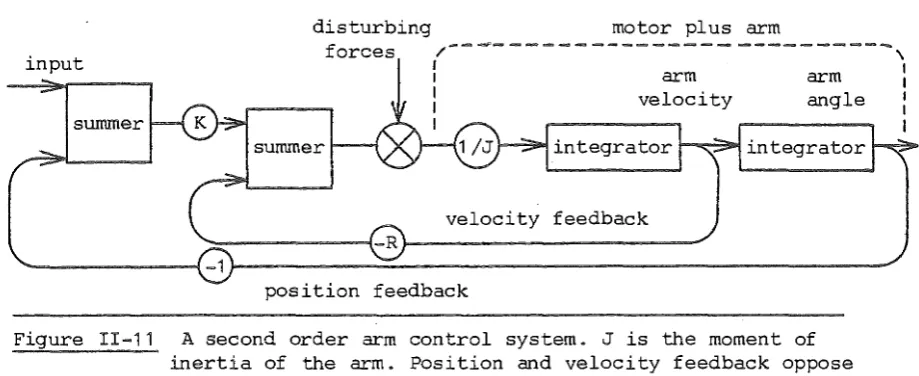
II-5 II-6 II-7 II-8 II-9 II-10 II-11 II-12II-13
III-1 III-2 III~3 III-4 III-5 III-6 III-7 III-8 III-9 III-10 III-11 III,;,12 III~13 III-14 III-15 III=16 III-17 IV-1 IV-2 IV-3 IV-4 IV-5 IV-6 IV-7 IV-8 IV-9 IV-10 IV-11 PageThe main controller in the robot 13
A simple position error controller for a motor shaft 14 Things a teacher might do to get a robot to perform
a task 18
List of different ranges of task
List of different ranges of situation 20
List of decreasing amounts of teaching required for a change in situation
List of different adaption speeds 21
Example coordinate system 43
Representation of "sliding mode" 48
A single degree of freedom arm is unstable under the 50 influence of gravity
A second order arm control system 55
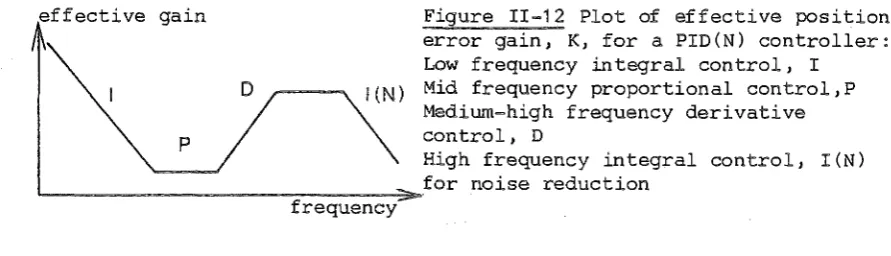
Plot of position error gain for a PID(N) controller 56
An adaptive arm control system 57
Two paths of improvement for the popular leading method 64
Popular leading 65
Branching 67
Verbal correcting (VC) 70
Production system of corrections (PSC) 72
Goal-seeking (GS) System 75
A proposed sample repertoire of verbal corrections 78
Strategy for verbally correcting a robot 79
The formation and changing of productions in a PSC 83
Goal-seeking (GS) system 87
Arm control system (ACS) 96
The die-casting unloading task 116
A worse correcting situation than that shown in 129 Figure III-14
Example one-dimensional graph of movements versus 134 actions
Verbal Correcting simulation runs 137
BASIC Verbal Correcting simulation 139
Advanced PSC, PSC-movements and Actions (PSC-M&A) 140
Operation of the MCLS
Object for a robot to paint
Internal representations in PAINT/2S, PAINT/58 and PAINT/1S2A
Internal representation in PAINT/1S2A(Sp) A second object for a robot to paint Internal representation in PAINT/3S2A(Sp) Internal representation in PAINT/2R
Storage of MCLS productions
Operation of the MCLS PAINT/2R, of section 1.1 Contexts represent parts of situations
V-1 V-2 V-3 V-4
v-s
V-6 V-7V-B
V-9 V-10 V-11 V-12 V-13 V-14 V-15 V-16 V-17 V-18 V-19 V-20 V-21 VI-1 VI-2 VI-3 VII-1 VII-2 VII-3 VII-4 VII-S VII-6 VII-7 VII-S VII-9 VII-1 0 VII-11 VII-12 VII-13 VII-14 VII-15 VII-16 VII-17 VII-18 VII-19 VII-20 VII-21 VII-22The single jointed lever arm of the arm-robot Acquiring the light beam task
Simple design for a manipulator
The main steps in the operation of the arm-robot MCLS Operation of the arm-robot MCLS
Examples of leak-back
Two interactions with the arm-robot Main Paths for Interaction 2
The six Paths of actions and stimuli Leak-back tree
Interaction with simulated arm-robot
Productions and Links formed during the interaction Two more interactions with the arm-robot
Nine interactions with the real, earlier arm-robot Adjusting the gain of the arm control system
Swamping the effect of gravity Program for simulated arm-robot Real arm-robot program
Modular servo arm control system Circuit Diagram of Conversion System Assembler programs
A Markov decision process
The two steps of the leak-back process
Discounting is suboptimal for minimising path length
Example sequence of actions and stimuli for a reflex Example sequence of actions and stimuli for no reflex Speech followed by a reflex
Three associations formed and recalled by PURR-PUSS The three associations that predict look-left
Ways for an MCLS to learn actions
An example of an Event diagram Event diagram for a reflex-action
Event diagram for a reflex-action by decision Context Templates
Decision Procedure
Forming the Stimulus Context predicting a reflex-follower when no reflex-trigger stimulus is present The squares which PURR-PUSS can see as walls or spaces
in the SQUARES environment
Example of the SQUARES environment Summary of interaction with PURR-PUSS Interaction with PURR-PUSS
The movements of PURR-PUSS in the SQUARES environment Possible [ stimuli
Formation of a stimulus production with non-[ stimuli predicting 200
Head Movement System
System investigated in the laboratory
Traces of the behaviour of the head control system shown in Figure VII-21.
VIII-1 VIII-2 VIII-3 VIII-4 VIII-5 VIII-6 VIII-7 VIII-8 VIII-9 VIII-10 IX-1 IX-2 IX-3 IX-4 IX-5 IX-6
The Chomsky hierarchy of grammars Actions of UTM-MCLS
The production templates and priorities of UTM-MCLS rules
The Operations of an MCLS that simulates a UTM Productions that are needed for UTM-MCLS
All the transition productions for UTM-MCLS
The identifier rule orders the operation of the other rules
Operation of the UTM simulation The teaching sequence
Teaching tape moving and adding
Handling negation
The Two situations : presence and absence of an SB after *B
NHM responds to the absence of SB after *B only if the actual stimulus hasn't occurred before
NHM can be taught to respond with the absence response
·in
the presence of the conditionBASIC program for negation handling by NHM LISP program for NHM, NHM' and NHM"
I am grateful to my supervi~or, John Andreae, for his excellent guidance and support. John always had time to talk to me. He
always took the time to carefully read and constructively criticise my work, returning i t quickly. John gave me unrestricted use of
his
computer, both for my work and for producing most of thisthesis. I thank Molly Andreae for numerous meals and cups of coffee.
I am grateful to the University Grants Committee for the scholarship which supported me. The Electrical and Electronic Engineering Department supported my work. Those who attended the
Language and Thought meetings run by John Andreae and Kon Kuiper provided me with an important forum. The General Manager of New Zealand Electricity granted me leave without pay and provided
facilities for producing some of this thesis. Berenice Crowther typed three large chapters.
My family supported me throughout.
Finally, my wife, Sue Stodart, gave me continuous support and
encouragement, and helped in the thesis production.
Author's Note
Although this thesis
is
long, about 480 pages, the main textis
only about 250 pages. Appendices are at the end of each chapter. The 80 pages of the chapter V appendix contain the details anddiscussion of a very simple demonstration "arm-robot", and so are not essential to the main thesis argument, but are necessary for the thesis to be complete.
ABSTRACT
This thesis advances the design of teachable adaptable robots. I propose two paths of improvement to the popular, easy to use,
leading method, in which a teacher literally leads the robot by its hand through movements. The improvements enable motor commands to be changed and conditional branches to be formed, without the need for a keyboard or other explicit programming device. On improvement path 1, the addition of a verbal correcting (VC) scheme would enable a teacher to make on-line verbal corrections to a robot's movement
sequences. The further addition of a production system of
corrections (PSC) would enable a robot to remember and use verbally taught conditional corrections. On path 2 a goal-seeking (GS) system and VC would enable a teacher to set goals, lead movements,
and verbally correct the robot. The robot then selects its own motor commands for achieving goals.
A multiple context learning system (MCLS), a multiple, extended GS system, combines the two paths. It enables both sequences and goals to be taught to a led robot. A simple, but real, led
MCLS-robot is demonstrated.
I establish four important properties of MCLSs: (a) an MCLS can enable a robot to learn to perform motor commands that are initially performed only by reflex, so that eye and speech motor commands,
neither suitable for being led, can still be learned; (b) an MCLS can learn to be a Turing machine, which is a universal computing machine, explicitly showing the error in criticisms of MCLSs'
computational power; (c) the selections of a context learning system in an MCLS converge on the optimal motor commands for achieving
CHAPTER I
INTRODUCTION
This thesis advances the design of teachable adaptable robots. Robot internal representations are developed along with the
teacher-robot interaction. The result is that robots would be easier to teach, and could learn more difficult and a wider variety of tasks1 they would be more teachable. Also, robots could learn to cope more quickly with a wider variety of situations. In learning to cope with different situations robots would require less teacher
assistance. They would be more adaptable, as well as more teachable. I will explain that existing robots are both (a) difficult to teach, and (b) not very adaptable.
The teaching method that I will mainly be concerned with is the lead-through, or leading method. The teacher teaches a robot to perform a movement, by moving the robot's arm through that movement while the robot is in a training mode. The robot remembers the movement, and may execute i t later while in its execution mode.
Now, when using popular leading a teacher must explicitly program the robot via a keyboard-type device, if either motor commands must be changed or conditional branches formed. The advances I propose remove this need for a keyboard-type device, but retain two
important aspects of leading:
(a) the teacher need have no expertise in explicit programming; and (b) the teaching will be most suited to a teacher who is expert at the task to be taught.
implementation of the leading method. On the first path, the
teachability of led robots is increased by the addition of an
on-line verbal correcting (VC) scheme. The scheme enables a teacher
to give verbal corrections for external disturbing forces while the
robot executes a sequence of movements. Thus tasks requiring
corrections to be made for external forces can be easily taught.
Also on the first path the teachability and adaptability of the
leading method is increased by the further addition of a production
system of corrections (PSC). A PSC would enable a robot to remember
and use the experience of correcting given by
vc.
The robotremembers which correction to make under which conditions.
On the second path of improvement, a goal-seeking (GS) system
is
employed with leading. It enables the robot to work out its own
motor command sequences for achieving teacher set goals. The
teacher would lead individual motor commands, set goals and, if VC
is added to the GS system, make verbal corrections·. The GS system
increases the teachability by enabling goals and subgoals to be
taught. The adaptability is also increased because the robot can
select its own motor command sequences for achieving a goal or
goals.
Now, path 1 improvements cannot enable goals to be learned, but
only motor command sequences. Path 2 improvements cannot enable
motor command sequences to be learned, but only goals. Having
established the two improvement paths, I go on to show how a
multiple, extended GS system, called a multiple context learning
system (MCLS), can enable a led robot to both perform sequences and
achieve goals. I report a simple demonstration of a led robot with
coworkers for intelligent robots of the future. References are given in section 2.
I then go on to establish four other properties of MCLSs. Firstly, leading is not suitable for teaching eye and speech
movements. So I show that a robot with an MCLS in i t can learn to perform eye motor commands from built-in eye reflexes. A few
specific eye and speech reflexes can result in general learning of eye and speech movements by an MCLS.
Secondly, I show that the class of MCLSs I use for both leading
and reflex learning, has more "power" than some critics think. MCLSs have been criticised for their lack of "power": " ••• i t seems clear that the machine can only learn finite automata. Something of the power of an augmented transition network would be forever beyond it. So i t certainly couldn1t learn a grarnrner for any reasonably
interesting subset of English." (p.10 Hayes, 1977). It should have already been clear that MCLSs are not subject to this criticism. I
explicitly dimiss the criticism by showing how a simple MCLS learns to be a Turing Machine, the theoretical machine with the greatest "power" in the sense used by Hayes.
Thirdly I establish the optimality and convergence of the goal
seeking process that is implemented by an MCLS. Finally I describe how a robot with an MCLS can handle the problem of negation; the
problem of doing something positive in the absence of a certain condition.
reports a simple demonstration of a led robot with an MCLS. Chapter VI establishes the convergence properties of the goal
seeking process in an MCLS. Chapter VII shows that an MCLS can learn to perform actions initially performed only by reflex. Chapter VIII shows how an MCLS can learn to be a Turing Machine.
Chapter IX shows how an MCLS can handle the problem of negation in three ways.
Section 1 gives a brief summary of each chapter. Section 2
briefly states the history of the work in the thesis. Section 3 sets out the organization of the thesis.
I.1 CHAPTER SUMMARIES
CHAPTER II EXISTING ROBOTS ARE STUPID
Industrial robots are difficult to teach. Industrial robots are not adaptable, can carry out manual tasks only in a limited range of
situations, and lack the ability to use sensory information. In general the environment in which a task is to be performed cannot be completely determined beforehand. Existing industrial robots cannot
cope.with uncertainty about the environment. Existing robots have only limited abiliy to coordinate their arms with sensory
information. Industrial robots lack sensors, so their capacity to respond to conditions in the environment is limited. The human performs s~ well because of the richness of his sensory feedback, .rather than the mechanical efficiency of his arm, which
is
not high • .. ;_~· ~CHAPTER III ENHANCING THE LEADING METHOD
A teacher must use a keyboard device on existing industrial robots if he wants to (a) correct taught motor commands, or (b)
teach conditional branches. This "explicit" programming of
corrections and branches is difficult and unnatural; especially if the teacher of the led robot is someone skilled in the task being
taught, but not a programmer. I propose two paths of improvement to the popular implementation of leading. Path 1 is the addition of
both verbal correcting (VC) and a production system of corrections (PSC). Path 2 is the use of a goal-seeking (GS) system to which VC is added. VC should increase the teachability of led robots by enabling a teacher to verbally correct motor commands on-line, using his own natural ability at verbally correcting humans. A PSC and a GS system should also increase the teachability of led robots. They
would enable a teacher to teach conditional branches using his own natural ability at leading and VC, and his own knowledge of the task goals; a PSC for teaching sequences of movements, and a GS system for teaching sequences of goals. Having sensed the environmental
conditions, a robot would select its own motor commands, once (a) the motor commands have been led, (b) verbal corrections made, and
(c) for a GS system, the goals set. A PSC and a GS system should
CHAPTER IV LEADING WITH AN MCLS
An MCLS can enable a robot to perform sequences of movements and achieve goals. A GS system enables only the achievement of goals. A PSC enables only the performing of movement sequences. An MCLS comprises several rules and a decision procedure. The word "rule"
is used in two ways in this thesis. When underlined, that is
"~", i t specifically means the MCLS variety, while just "rule"
has the normal meaning. A rule is similar to a GS system, but proposes motor commands to perform on the basis of the robot's
recent history. A GS system performs motor commands on the basis of only the immediate situation. The decision procedure of an MCLS selects motor commands to perform from ·all the motor commands proposed by all the rules.
CHAPTER V A SIMPLE LED ROBOT WITH AN MCLS
The arm~robot, comprising a real metal lever arm and a simple
MCLS, demonstrates how an MCLS can implement leading. The teacher leads the robot's arm into a light beam. The arm cuts the beam, causing a goal to be set for that arm angle. The teacher leads some more movements. The arm-robot then lifts its arm into the light, while there is a weight on the arm that makes the arm sag.
CHAPTER VI OPTIMAL GOAL SEEKING
I show that a successive overrelaxation method, called "leak-back", can be used on a rule in an MCLS, to work out the "best" motor command to perform for seeking a goal. The best motor command may be either one that optimizes the total expected goals reached, or one that minimizes the number of motor commands that
simultaneously with the decisions of an MCLS. The MCLS does not wait for leak-back to converge on optimal motor commands. The decisions determined by the current stage of the leak-back process are used by the MCLS.
CHAPTER VII A FRESH LOOK AT CONDITIONED REFLEXES
A teacher will have no natural feeling for the eye motor
commands or eye movements required for a task. He would not have the
same natural feeling for the visual information required for a task, as he would have for the physical manipulations required. He would have difficulty making a detailed description of the eye movements or motor commands required for a task. Instead of the teacher providing them, eye movements might be preprogrammed to occur in a
specific way, when the robot is built. [For example, a robot's eyes might be preprogrammed to follow its hand.] In that case, the robot would have to be able to learn to use the preprogrammed eye
movements in situations for which they had not been preprogrammed. I show that a robot with one of the simplest forms of preprogrammed eye movement can learn to perform the movements in situations for
which they are not preprogrammed. The simple preprogrammed movements are reflexes; they are simple fixed movements that are triggered by particular visual stimuli. The MCLS PURR-PUSS
CHAPTER VIII ANSWERING THE CRITICS
In Hayes's (1977) criticism of MCLSs he said that the MCLS
PURR-PUSS " can only learn finite automata ••• " and "So i t certainly couldn't learn a grammar for any reasonably interesting subset of English ••• " (p. 10). But grammars are finite sets of rules. So there is a finite automaton for every grammar. It has already been shown that an MCLS can learn any finite automaton that will fit into its memory (Andreae & Cleary, 1976). So an MCLS can
learn any grammar that will fit into its memory. An MCLS's memory could hold an enormous grammar. Since the importance of an MCLS's being able to learn any finite automaton does not seem to have been
recognized by the critics, as exemplified by the passage quoted from Hayes above, I explicitly show that an MCLS can learn any grammar
that will fit into its memory. To do this I describe an MCLS that learns to simulate a simple automaton and its "tape" memory. The tape memory
is
inside the MCLS. The tape can have a description ofa grammar on it. The MCLS learns this description. The simulated automaton reads the description and implements the grammar. Another
part of the tape is used as working memory, for intermediate results. The automaton is what is called a "universal Turing machine".
CHAPTER IX WHEN IS 'NOT' NOT 'NOT' FOR A ROBOT
It will be important for a robot to be able to do something positive in the absence of a particular condition. For example, on not recognizing something, say a person's face, a robot should do
something positive in the absence of a condition will be called the "negation problem". The absence of the condition must actually be an absence. The absence must not be represented by some stimulus that is present. I show that an MCLS can do something positive in the absence of a condition, in three ways, each by a different MCLS. The first negation handling MCLS (NHM) responds to the absence of a condition only if the actual condition present is one that the MCLS hasn't had before. The second MCLS, NHM', responds to the absence
of a condition whether the actual one is new or not. However, NHM' can be taught to respond to the presence of the particular condition with the absence response! NHM", the third MCLS, responds to the absence of a condition whether the actual condition is new or not, and cannot have its presence and absence responses changed once they
have been learned.
I.2 HISTORY OF THE WORK IN THE THESIS
Earlier versions of the work in this thesis are given in MacDonald (1979; 1980; 1981; 1982a; 1982b); specifically chapter
II ( 198l) , chapter III ( 1982b) , section 1 of chapter IV ( 1982b) , chapter V (1981; 1982a), chapter VI (1982a), section 3 of chapter
VII (1982a), the rest of chapter VII (1979), chapter VIII (1980); chapter IX (1980; 1981). Various work on MCLSs, the subject of chapter IV, has been published (Andreae, 1977a; 1972-1983; Andreae & MacDonald, 1981; Andreae & Andreae, 1979; Andreae & Andreae, 1978; Andreae & Cleary, 1976; Cleary, 1980a; 1980b; MacDonald & Andreae,
I.3 ORGANIZATION OF THE THESIS
Chapter II presents the state-of-the-art of robot teachability and adaptability. Chapter III proposes major improvements to led robots. Chapter IV carries the advances on to the MCLS. Chapter V
reports an actual demonstration of the proposed advanced
MCLS-led-robot design. Chapters VI through IX establish important properties of the design, as set out in section 1 above and briefly summarized in the paragraph before section 1.
A glossary of important words and abbreviations is given at the end of the thesis, just before the thesis appendix. The glossary
refers to the text where the entries are explained in more detail. The thesis appendix comprises (a) comments on humans and robot design, and (b) suggested future research.
I.4 SUMMARY
This thesis advances the design of teachable adaptable robots by
developing robot internal representations and teacher-robot
CHAPTER II
EXISTING ROBOTS ARE STUPID
This chapter is concerned with the teachability and adaptability of
existing robots. It explains that existing robots lack both.
All but the simplest robots, for example those with only manually
set mechanical stops, have a main controller which sends motor commands
to the motor control systems in the robot's body, in order to perform a
movement task. This is depicted in Figure II-1. The arm control system
is an example of a motor control system. In order to get a robot to
perform a movement task, a teacher may
(a) tell or show the robot the motor commands to send to the body
e.g. instructions fed in on a paper tape; or motor commands stored during remote control by the teacher
(b) tell or show the robot the movements and forces to achieve
e.g. programmed movements, say, MOVE X=10,Y=20; or teacher manually leading the robot through movements.
(c) give the robot a task description in more complex terms than the
movements and forces required
e.g. English description; or high level program, say PICK UP BLOCK.
For (b) and (c), the robot must determine the motor commands to send to
the body. This determination may be very simple. For example, consider
main controller
Figure II-1
motor commands arm control
system
The main controller in the robot sends motor
commands to the motor control systems of the robot's body;
for example the arm control system shown in the Figure.
robot
the position error controller, depicted in Figure II-2, for controlling
the angular position of a motor shaft. Suppose the sensitivity of the
feedback from the shaft position sensor is one volt per degree. To move
the shaft to 30 degrees a motor command of 30 volts might
be
sent tothe control system. The determination may also
be
complex, for examplewhen the dynamics of an arm and load are modelled in order to determine
the motor commands required for achieving movements.
motor commands (e.g. 30 volts) shaft
motor
volt per degree
Figure II-2 A simple position error controller for a motor shaft
A robot may acquire some of the ability to determine motor commands
from movements and forces, and from a task description. The teacher may
be involved in the robot's acquiring of these abilities. For example, a
scheme has been described in which a robot is preprogrammed in a high
level language, leaving some position transformations unspecified
(Takase et al, 1981 ).
An
operator may teach these transformations bymanually moving the arm during the task. This enables the robot to
calculate later movements.
So the teachability of a robot is concerned with the interaction
between the robot and the teacher, in (i) giving descriptions, (ii)
telling and showing movements and forces, (iii) telling and showing
motor commands, and (iv) helping a robot determine motor commands given
descriptions, movements and forces. The teachability of a robot is
partly a subjective judgement, since it depends on the interaction
between the robot and the teacher. The teacher is the one who judges
the teachability, but he is not a passive observer.
(a) the easier it is to teach tasks,
(b) the greater the range of tasks that can be taught,
(c) the more difficult the tasks that can be taught.
Different teachers may not agree on the relative importance of these
three, but most will agree that the greater the range of tasks, the
greater the difficulty of tasks, and the easier the teaching, the
greater the teachability. It is explained in this chapter that existing
robots lack teachability in all three ways.
The adaptability of a robot is to do with how the robot copes with
changing environmental conditions. A motor command will produce the
required movement or force under some conditions, but not under others.
In determining the motor commands required for a task from a
description or from movements and forces, a robot may take into account
the environmental conditions. Judgements of adaptability are somewhat
subjective because different environmental conditions may be seen, by a
human observer, as either (a) part of the task, for example different
object positions in a bin-picking task, or (b) a change in the
conditions for the task, for example, different object orientations for
a spray-painting task. That objects will have different positions is
implicit in the task of "bin-picking"; but different object
orientations are not implied in industrial spray-painting tasks.
I expect humans to find robots more adaptable
'(a) the greater the range of conditions they perf arm a task in,
(b) the less teacher assistance is required for enabling a robot to
determine the motor commands required when conditions change,
(c) the less time it takes the robot to return to proper performance
of a task when the conditions change.
Different humans may not agree on the relative importance of these
three, but most will agree that the greater the range of conditions,
greater the adaptability. It is explained in this chapter that existing
robots lack adaptability in all three ways.
Section 1 discusses the three ways in which existing robots lack
teachability, and the three ways in which existing robots lack
adaptability. Section 2 describes the state-of-the-art in the
determination of motor commands from given movements and forces, or a
given task description. In section 3 teaching methods for existing
robots are described and compared. Section 4 describes the
state-of-the-art in the determination of motor commands required for
different environmental conditions. Section 5 discusses the ways
existing robots cope with a range of environmental conditions. Some
examples of existing robot systems are discussed briefly in the
II. 1 LACK OF TEACHABILITY AND ADAPTABILITY
II.1 .1 Teachability
At the start of this chapter it was suggested that, in interacting
with a robot, a human will find the robot more teachable (a) the easier
the teaching is for the teacher, (b) the greater the range of tasks
that can be taught, and (c) the more difficult the tasks that can be
taught.
The sort of things a teacher might do in getting a robot to perform
a task are shown in Figure II-3. Items further down the list in
Figure II-3 are generally more difficult for a teacher to do. However
the list says nothing about the range and difficulty of tasks that can
be taught. For example, some teaching methods may enable a teacher to
get a robot to exert specific forces in the environment, while other
teaching methods may not. Specific forces may be required for
tightening a nut on a bolt.
Items further down the list shown in Figure II-4 have less difficult
and smaller ranges of task.
The teachability of existing robots is low. On both the list in Figure II-3 and the list in Figure II-4, existing robots are not placed
high. Humans abilities are actually well above these lists. They can
perform tasks for someone without being told to. They can invent tools
and machines, as well as use them. Sections 2 and 3 detail the low
Say a short English description of the task, e.g. "Paint those cars blue"
Write down a short English description of the task
Say a detailed English description of the task, e.g. "Paint the two cars on assembly
line 1 with the paint in can 3, ... "
Lead the robot through the movements for a task, e.g. lead a sequence of painting movements
Guide the robot through the movements for a task
Write a program in a high level programming language, e.g. PICK_UP BOLT; MOVE_TO BOLT_HOLE;
INSERT BOLT IN BOLT HOLE
Write down a program for the task in an assembler language
Set up mechanical stops for the robot's movements
Figure II~3. A list of things a teacher might do to get a robot to perform a task. Items further down the list are more difficult to do.
Use tools and machines
Use a particular tool
Repeat one of a repertoire of movement sequences, each for different environmental conditions
Repeat a specific sequence of movements
Repeat a specific sequence of motor commands
e.g. those a fitter
&
turner usese.g. spanner
e.g. assemble a variety of products as they arrive at the robot's workbench
e.g. a fixed assembly sequence
II.1 .2 ~naptability
At the start of this chapter it was suggested that humans would find
robots more adaptable (a) the greater the range of situations a task is
performed in, (b) the less teacher assistance is required for enabling
a robot to determine the motor commands required when the environmental
conditions change, and (c) the less time it takes the robot to adapt
when conditions change.
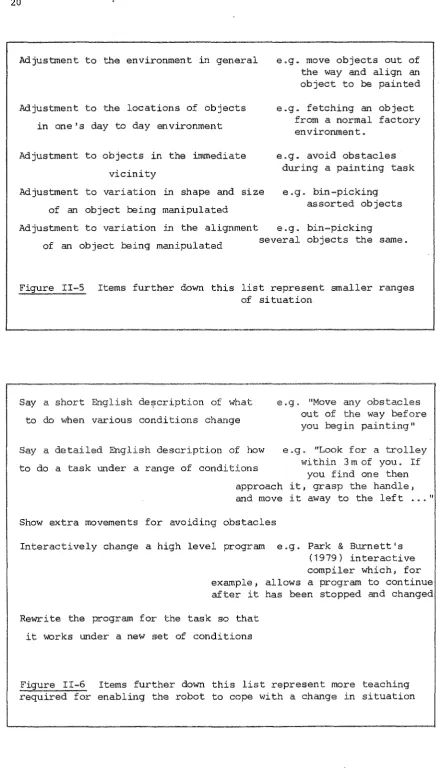
Items further down the list in Figure II-5 represent smaller ranges
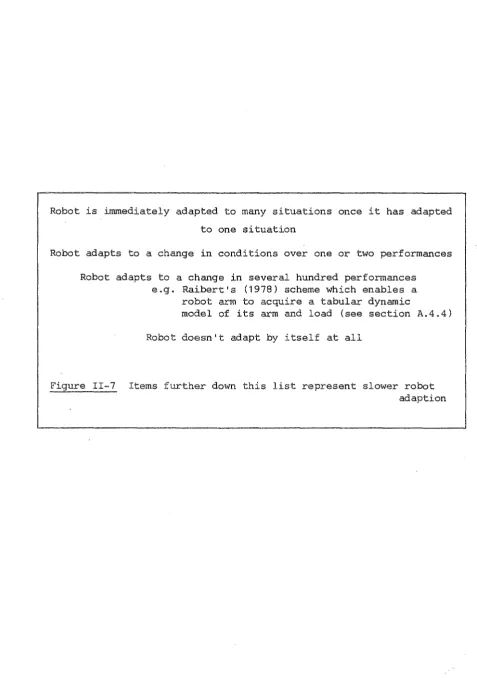
of situation. Items further down the list in Figure II-6 represent more
teaching required for enabling a robot to cope with a change in
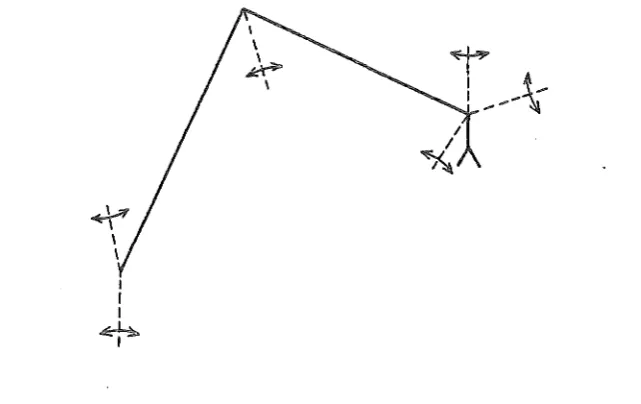
situation. Items further down the list in Figure II-7 represent slower
robot adaption. Gaines (1969) distinguishes different varieties of
adaptive behaviour. Briefly, he indicates that the more situations a
control system can adapt to, and the quicker it does adapt to them, the
more adaptive it is. For robot adaptability, the amount of teaching is
also important.
The adaptability of existing robots
is
low. On the lists inFigures II-5, II-6 and II-7, existing robots are not placed high.
Humans' abilities are actually well above these lists. They can adapt
to changes of environment, performing tasks in 'very different ways with
different materials. They can remain adapted to a huge variety of
situations, over a long period of time. It is reported that industrial
robots are not adaptable (Nitzan, 1979), can carry out manual tasks
only in a limited range of situations (Benati et al, 1980), and lack
the ability to use sensory information (Rosen, 1979). Sections 4 and 5
Adjustment to the environment in general
Adjustment to the locations of objects
in one's day to day environment
Adjustment to objects in the immediate
vicinity
Adjustment to variation in shape and size
of an object being manipulated
e.g. move objects out of the way and align an object to be painted
e.g. fetching an object from a normal factory envirorunent.
e.g. avoid obstacles during a painting task
e.g. bin-picking assorted objects
Adjustment to variation in the alignment e.g. bin-picking
several objects the same. of an object being manipulated
Figure II-5 Items further down this list represent smaller ranges of situation
Say a short English de~cription of what
to do when various conditions change
e.g. "Move any obstacles out of the way before you begin painting"
Say a detailed English description of how
to do a task under a range of conditions
approach and move
Show extra movements for avoiding obstacles
e.g. "Look for a trolley within 3 m of you. I f
you find one then it, grasp the handle, it away to the left ... "
Interactively change a high level program e.g. Park
&
Burnett's (1979) interactive compiler which, for example, allows a program to continue after it has been stopped and changedRewrite the program for the task so that
it works under a new set of conditions
[image:30.595.94.538.44.826.2] [image:30.595.101.533.73.406.2]Robot is immediately adapted to many situations once it has adapted
to one situation
Robot adapts to a change in conditions over one or two performances
Robot adapts to a change in several hundred performances e.g. Raibert's (1978) scheme which enables a robot arm to acquire a tabular dynamic
model of its arm and load (see section A.4.4)
Robot doesn't adapt by itself at all
[image:31.597.67.545.84.770.2]II.2
DETERMINATION OF MOTOR COMMANDS
The requirements for the determination of motor commands and the
state-of-the-art of satisfying those requirements are given in this
section.
In
many existing robot systems the determination of motor commands
from a description of a task is divided into two parts: (a) given a
description of the task, the required movements and forces are
determined, and (b) given the movements and forces that are required,
the motor commands to send to the robot's body are determined. This
division may
beconvenient if sensory information must
betaken into
account. For example visual information may be related most easily to
the actual movements for a task. For many tasks, movements are
naturally expressed as desired positions and orientations of the hand
(Benati et al, 1980). Also, robots tend to either (a) obtain movements
and forces from a task description, or (b) obtain motor commands from
desired movements and forces, but not both (Takase, 1979). That is,
"low level intelligence" in arms has not been combined with the "high
level intelligence" of
problem~solving robots (p.1095). The skills of"comparatively
special~purposelow intelligence systems" are "far more
dexterous than those of in tell igen t robots" (p. 1 09 5 ) . So the
determination of motor commands from a task description may be treated
in two parts: (a) the requirements for, and the state-of-the-art of the
determination of movements and forces from a task description; and (b)
the requirements for, and the state-of-the-art of the determination of
motor commands from movements and forces. (a) is given in section 2.1,
and (b) in section 2.2.
II.2.1
Description to motor commands
From a description of a movement task the required positions and
tip, must
be
determined as functions of time (Benati et al, 1980;Albus, 1975 ; Dobrotin
&
Lewis, 1977).The way existing robots determine movements, forces and torques from
a task description is by the use of high level robot programming
languages. The teacher gives a task description in the language. For
example, Lozano-Perez (1983) describes a language with this statement
in it,
PLACE BEARING1 SO (SHAFT FITS BEARING1 .HOLE)
AND (BEARING1 .BOTTOM AGAINST SHAFT.LIP)
The language interpreter or compiler produces a specification of
movements and forces, by applying the rules of the language to the
given task description. In some systems a small part of the task
description may be given by leading or guiding methods. For example, Holland et al (1979) describe how a teacher can show a robot the
positions and shapes of objects by leading or guiding its arm tip over the objects. However, the task descriptions one can give to existing
robots are not much removed from a specification of the required
movements, forces and torques, as set out in the remainder of this
section.
The sort of description of a task one would like to give a robot is
a rough English description (Inoue, 1979). For example, given the rough
English description "Spray-paint the car door blue", the required
position and orientation of the tip of the arm must be obtained as functions of time. Continuous control of motion in space and time is
required for spray-painting (McGhee, 1979). The spray nozzle will be at
the tip or hand of the arm. Door geometry, optimal spraying distance
and speed, and wnether or not the door is moving along a production
line must all be taken into account.
Given the rough English description "Screw the nut on the bolt", the
diameter, metal characteristics, and the function of the nut and bolt
assembly. The maximum tightening torque depends on this information.
There are many difficulties currently being experienced in making a
system to determine the arm tip positions, orientations, torques and
forces required for doing movement tasks. There is work on language
understanding; problem-solving; knowledge representation, acquisition
and use; high level manipulation programming languages; and vision (see
Winston
&
Brown, 1979a; Raphael, 1976; Finkel etal,
1975; Takase etal,
1981; Dobrotin&
Lewis, 1977; Ambler etal,
1975; Popplestone etal,
1980; Grossman&
Taylor, 1978; Hasegawa&
Inoue, 1979; Hasegawa,1982). However, no existing robot can perform complex movement tasks in
the real world, given the sorts of task description we are used to
giving (Raphael, 1976; Takase, 1979; Eenati et
al,
1980; Nevins&
Whitney 1 1979; Lozano.-Perez 1 1979; Winston & Brown, 1979a; Hasegawa &
Inoue, 1979 ) .
Takase (1979) states that " ... in general we are at the dawn of the
study of the skill of robot arms. " ( p. ·1 09 5 ) . Morris ( 198 2 ) states that "Today 's robots are 'dumb'." (p.62). There is not a mature technology
for creating intelligent robots to do jobs that are boring or dangerous
to humans (Winston
&
Brown, 1979a). Any apparent understanding that an industrial robot has of its assembly line task is "mere fiction" (p. 19Paul, 1979). No program exists for turning a task-level description,
one specified in terms of desired effects on objects, into a
specification of the movements required (Lozano-Perez, _1983;
McLaughlin, 1982). There is no functional programming of robots yet
(Nevins and Whitney, 1979). One cannot say to a robot "This is what I
want, you figure it out", and have the robot do so. Of task-level robct
programming languages 1 McLaughlin (1982) states: "All such languages
are still in the research phases, and show little hope of reaching full
robot programming languages, Bonner & Shin ( 1982) state that "A truly task-oriented language that conceals low-level aids like sensors and coordinate transformations from the user is an as yet unachieved dream." (p.87).·
II.2.2 Movements and forces to motor commande.
Having determined, or been told, the movements and forces that are required for a task, a robot must produce them. It must send motor commands to the control system or systems in its body which produce the desired movements and forces. That is, the robot must control its body
so that the desired movements and forces are achieved. The
determination of motor commands given desired movements is discussed in detail in the appendix. Briefly (i) kinematic equations describing the geometry of the arm can
be
solved to obtain joint movements, given desired hand movements; arid' (iU. dynamic equations may be solved toobtain the joint forces and torques that must
be
exerted, given the desired joint movements from (i). A PDP 11 computer can perform the solutions in real time as long as the characteristics of the load and arm are known. The determination of motor commands given des ired torques and forces is also discussed in the appendix. Briefly, there are three aspects to controlling the forces and torques exerted by the arm tip: (i) determining joint forces and torques from the static equations of the arm, given tip forces and torques (Horn, 1979); (ii) controlling the compliancy of the arm (Simons, 1980; Mason, 1981 ) ; and(iii) sensing and servoing tip forces and torques (Simons, 1980; Mason, 1981 ) .
II.3 EXISTING METHODS FOR TEACHING ROBOTS
Industrial robots are difficult to teach (Rosen, 1979; Grossman
&
Taylor, 1978; Nit zan, 1979). The teaching involved in setting up batch
production runs and in making product model changes, is expensive.
Expert teachers and programmers are often required for teaching
industrial robots, rather than the teaching being done by unskilled
people or people skilled in the tasks.
Robots are (i) programmed to do tasks, using programs which specify
movements, forces, torques and motor commands, (ii) physically led
through the sequence of movements required fer a task, and (iii) guided
through the movements via a teaching device. Section 2.1 explained that
existing robo~are not programmed with task descriptions.
The existing uses of the leading met~od are described in
section 3.1" The guiding and programming methods are described in
section 3.2. A robot may use a combination of methods, as explained in
section 3.3. The facility of each method, and the range and difficulty
of the tasks that can be taught Kith each method, are given (a) at the
end of section 3.1, for leading, and (b) in the appendix, for guiding
and programming methods.
II. 3.1 Leading
The leading method is one way for a robot to acquire an internal
representation of a manual task (Simons, 1980; Treer, 1979; Allan,
1979; Astrop, 1982 ; Benati et al, 1980; Haugan, 1974; Haugan
&
Jarvis,1974; Vaccari, 1982; Grossman & Taylor, 1978; Holland et al, 1979; Raphael, 1976; Holm, 1979; Lozano-Perez, 1983'; Ambler et al, 1982).
The leading method is characterised by the teacher doing the task
movements himself, with the robot's arm, rather than having any form of
controller to operate. The robot remembers the movements. An example of
of spray-painting an object (Haugan
&
Jarvis, 1974; Haugan, 1974; Vaccari, 1982; Production Engineer, 1982; Compressed Air Magazine,1981; The Industrial Robot 1982). While the robot is in a passive
training mode the teacher paints an object by physically moving the
robot's hand through a sequence of painting movements, and spray-gun
trigger presses. The movements and trigger presses are recorded. They
are played back to the arm at some later time; the robot paints the
object. Allan (1979) states that "The most common method of teaching a
robot is literally to lead it by the arm through the required sequence
of operations." (p. 32).
Beecher (1979) describes an assembly line system which has several
arms. One arm is used for training and the rest for assembling. The
training arm is identical to, and interchangeable with the other arms!
It is led or remotely guided through tasks. The sequences of motor
commands the training arm has recorded during leading or guiding, may
be replayed by the other arms.
Some tasks cannot be acquired solely by a robot being led through
the task movements. This is because the teacher shows the robot only
the movements required, but not the motor commands required for
achieving the movements. As explained in chapter III, some led motor
commands must be edited, so that certain opposing forces are
counteracted. Leading does not show a robot how to counteract opposing
forces. The teacher's leading solves only the kinematic equations of an
arm (Benati et al, 1980). The teacher's leading does not determine the
torques and forces that must be exerted by the arm's actuators.
There are various criticisms made of the leading method. The main
one is that the industrial implementations of the leading method do not
really make available the logical and symbolic commands that can be
used extensively in programming languages (see Simons, 1980; Seltzer,
difficult to edit and document led tasks (Simons, 1980). For example if
a movement must be added to, or deleted from a sequence of led stored
movements, most existing robots require all the subsequent movements to
be led again (Seltzer, 1979). In addition, some programming languages
all ow ". . . flexible use of sensor information for adaptive control"
(Seltzer, 1979).
Programming facilities may be added to the leading method to
overcome these disadvantages. For example, Takase et al (1981) describe
a system that acquires tasks by a combination of lead through and high
level programming. Tasks are programmed, leaving some coordinate
transformations undefined in the program. The transformations are
taught by the teacher leading the arm to the appropriate position,
whenever the program hasn't enough information to prescribe a
particular movement.
Led movements may be converted into MCVE statements in a high level
manipulation programming language (Jarvis, 1982). Once a sequence has
been led, the resulting program may be edited, and documented, to form
a complex task.
In this thesis I describe improvements to the leading method which
have quite a different nature. In chapter III I describe how the
leading method can be enhanced so that a robot can select its own motor
commands for producing a sequence of movements in a sequence of
environmental conditions. In chapter III I also describe how the
leading method can be enhanced so that a robot can select its own motor commands for achieving goals, rather than repeating a fixed, led
sequence of motor commands or a fixed sequence of led movements. The
robot can select motor commands on the basis of sensory information. A
verbal correction scheme, itself set up by the leading method, can be
used by a teacher to correct a robot's movements and motor commands
movements and motor commands are taught using either leading or verbal
correcting. Goals are set by a teacher when he leads or verbally guides
a robot to them.
This work in chapter III overcomes another criticism made of popular
leading: that it is sufficient only when the positions and movements
are known at teaching time (Lozano-Perez, 1983.). The robot can seek
goals, instead of following a fixed sequence of movements.
On-line programming by guiding, to be discussed in section 3.2, and leading, have been criticised in a comparison with off-line programming methods, for a third and fourth reason:
The first inefficiency is in the use of the human
progammer. On-line programming of complex tasks is
usually tedious, can be imprecise, and may be dangerous for the programmer ... . .. The second
inefficiency is in the use of the robot. On-line
programming of complex tasks is time consuming and
prevents the robot from doing useful work during the
teaching period. (p.492-3. Ambler et al, 1982).
Now firstly, programming languages can also be tedious and
time-consuming to use. For example, an experienced paint-sprayer would
find it very tedious and time-consuming to program a spray-painting
robot, using a robot programming language. In comparison with using a
programming language, he would be unlikely to consider it tedious to
lead a spray-painting robot through spraying tasks. So the use of a
human to lead or guide robot's on-line may not be inefficient.
Secondly, a robot will often need to be used during the debugging and
development of an off-line program for a task. Note that in both
off-line and on-line programming, one robot may be used for the
teaching, while others perform tasks (Beecher, 1979), as explained
Leading has been discussed by MacDonald (1979; 1981; 1982a; 1982b).
Leading is discussed in detail in chapters III1 IV and V, in which
various improvements to popular leading are explained and investigated.
The method of leading a robot through tasks has been employed in a
simple, real, single-jointed "arm-robot" both without goal-seeking
(MacDonald, 1981) and with a simple form of goal-seeking (MacDonald,
1982a). The arm-robot is explained in chapter V. Illustrative
interactions with the arm-robot are reported there. The way leading
might teach a robot has been studied with simulated robots, by Andreae
(1980a; 1980b; 1982a)1 and with a simulated version of the arm-robot
(MacDonald, 1981; 1982a).
II.3.1 .1 Facility, range and difficulty of tasks taught by leading
I pointed out at the start of section 3.1 that leading is an easy
teaching method to use. The teacher uses his own natural motor skills
to show the robot movements for a task. However, the popular
implementation of the leading method enables only specific sequences of
movements to be shown. So conditional branches cannot be put in the
sequences by leading. Any branches in the sequence must be explicitly
programmed in by the teacher, in the way explained in chapter III.
Thus, as the amount of branching required increases, the teaching
becomes more and more a matter of programming, rather than one of
leading. The teacher no longer uses only his natural motor skills. So
only a fixed sequence of movements can easily be taught to a robot
using the popular implementation of leading. In chapter III I explain
how this can be overcome in two ways: (a) with a goal-seeking (GS)
system, and (b) with a production system of corrections (PSC). No
programming is required. The robot selects its own motor
commands---taught by leading---for achieving goals, in the case of a GS
system, or for performing a sequence of movements, in the case of a
The range of tasks that can be taught using the popular leading
method is somewhat restricted. Any task that can be performed by the
execution of a sequence of movements can in principle be taught using
popular leading, as long as (a) the arm's control system automatically
compensates for forces which oppose the movements, (b) the teacher can
lead the movements, and (c) the robot is physically capable of
performing the movements. I explain in chapter III a verbal correcting
scheme (VC) which enables the first two limitations to be overcome in
most tasks. Verbal corrections can be made so that errors in the
recorded sequence can be corrected.
Tasks which require a robot to exert specific forces in the
environment, regardless of the resulting movements, cannot be taught
using the popular leading method. The teacher can show only specific
movements, not specific forces. The VC method that I explain in
chapter III might be used to teach a robot to perform led motor commands for exerting specific forces. The teacher could say "up" to
make the robot push harder upwards, when the robot's arm sags down.
This method of teaching a robot to use specific forces may be
cumbersome. It is nevertheless possible.
II.3.2 Programming and Guiding methods
In using these methods a teacher interacts with the robot via a
teaching device, for example a keyboard or joystick. There is no
fundamental distinction between programming and guiding. They differ in
the degree of real-time feedback that there is to the teacher or
operator about what the robot is doing.
Near the extreme of minimum real-time feedback to the operator is
the numerically controlled machine. A tape program may be prepared for
a numerically controlled machine before the task is executed.
Near the extreme of maximum real-time feedback to the operator is a