MENEGAZ, HMT and BATTISTINI, Simone
<http://orcid.org/0000-0002-0491-0226>
Available from Sheffield Hallam University Research Archive (SHURA) at:
http://shura.shu.ac.uk/24856/
This document is the author deposited version. You are advised to consult the
publisher's version if you wish to cite from it.
Published version
MENEGAZ, HMT and BATTISTINI, Simone (2018). Switching multiple model filter for
boost-phase missile tracking. IEEE Transactions on Aerospace and Electronic
Systems, 54 (5), 2547-2553.
Copyright and re-use policy
See
http://shura.shu.ac.uk/information.html
Switching Multiple Model Filter for Boost-Phase
Missile Tracking
Henrique M. T. Menegaz, Simone Battistini
Abstract—This paper introduces a filter for tracking a ballistic missile during its boost-phase. This filter includes a new switching algorithm and a modified Interacting Mul-tiple Model Unscented Filter (IMMUF) where the Markov Transition Matrix is time-variable. Position, velocity and all unknown parameters of a medium-range ballistic missile model are reconstructed. Simulations demonstrate the new filter is able to consistently estimate a missile’s trajectory and all unknown parameters and to outperform previous forms of the IMMUF.
Boost-Phase Tracking, Interacting Multiple Model Unscented Filter (IMMUF), Time-Varying Markov Tran-sition Matrix (MTM)
I. INTRODUCTION
This paper introduces a new filter for estimating the trajectory of a tactical ballistic missile (TBM) during
its boost-phase. This filter presents two novelties: i) it is
based on a novelswitching algorithmand ii) is composed of a newInteracting Multiple Model Filter (IMMF).The proposed filter assumesno a prioriknowledge about the system parameters and the missile maneuvers timing, resulting in a robust estimation scheme for boosted missile tracking.
Estimating a TBM’s trajectory during its boost-phase
is an attractive option because, in this phase, rockets are easy to detect and countermeasures are less effective [1]. Boost-phase estimation is challenging due to i) the strict time available, ii) many unknown parameters in the estimation, and iii) the boost-phase trajectory’s multi-phases form. The trajectory of a missile during its propelled phase is limited by physical constraints, such as dynamic pressure, thereby limiting the possibility of the missile to perform maneuvers. At the same time, this defines a sequence of well-known flight phases.
The trajectory’s multi-phases form can be described by the formalism of multiple model (MM) systems. An MM system is composed of both discrete and continuous variables. Usually, the continuous variables represent the system’s internal state, acquired measurements, and
H. M. T. Menegaz ([email protected]) and Simone Battistini ([email protected]) are with the Facul-dade Gama at the UniversiFacul-dade de Bras´ılia, Brazil.
noises; while the discrete variables denote the system’s operating mode, and define how the continuous state evolves.
Optimal solutions for the MM filtering problem are computationally intractable because they require exponentially-growing computational effort and memory usage [2]. Thus, suboptimal approaches such as IMMFs are required. Compared with other suboptimal filters for MM systems such as the Generalized Pseudo Bayes, IMMFs greatly improve performance without increasing computational load [3]. As a result, IMMFs have been accepted as solutions to TBM tracking [4]–[6].
IMMFs use Kalman Filters (KFs) [7], and the in-herent non-linearity of both dynamics and measure-ments involved in tracking a TBM calls for nonlinear
KFs—besides, tracking requires fusing measurements provided by a variety of sensors such as space-based infrared sensors [8] or ground-based radars [9]—. The most widely known nonlinear KF is the Extended Kalman Filter (EKF) [10], [11], but the literature has introduced better alternatives to the EKF, such as the
Unscented Kalman Filters (UKFs; see Section III-A)
[12]–[14]. This work uses an IMMF with UKFs; called
Interacting Multiple Model Unscented Filter (IMMUF).
Nevertheless, IMMUFs set-up remains a difficult sub-ject; it relies on a priori information [15] or dedicated analysis [16]. Besides, most literature’s IMMUFs con-sider the probabilities of the state transitioning between modes constant [17]–[21]. This requires two quite con-servative hypotheses: i) that the (non-constant) prob-ability of the TBM transitioning between phases are well approximated by constant values; and ii) that these constant probabilities area prioriknown [3], [15], [16]. As a result, this paper proposes the following two modifications to the IMMUF:
1) Time-varying probability of transitioning between
models. This modification relaxes hypothesis i) (see Section III-B).
2) A switching strategy between models. This modifi-cation relaxes hypothesis ii) (see Section III).
A Modified IMMUF (MIMMUF) with time-varying
in this paper improves this former concept (See Section III). In numerical simulations, the IMMUF of this work outperforms the MIMMUF of [22] and a standard time-invariant IMMUF (see Section IV).
The paper is organized as follows. Section II defines the model of the dynamical system of the measurements, defining the guidance strategy of the missile during its boost phase. Section III introduces the new switching filter. Section IV presents numerical simulations. Con-clusions are given in Section V.
II. BOOST PHASE EQUATIONS AND MEASUREMENTS
This section describes the equations of motion of the target missile and the measurements. The dynamical model that will be employed in the filter is reported as well. The sequence of phases of flight of the missile will be exploited when forming the mode transition matrix of the filter in Section III-B.
The trajectory of a medium range missile during its boost phase is composed of a number of arcs which differ by the direction and magnitude of thrust. Generally speaking, three arcs can always be identified, namely the vertical arc, the pitch maneuver and the gravity turn trajectory [22], [23]. The order of these three phases cannot mutate.
The dynamical model of the missile trajectory used in this work is given in [23] and it is reported hereafter. The equations of motion are written in an inertial reference frame centered at the launch station, known as the Local Horizontal Frame (LHF)(ˆr,E,ˆ Nˆ)with theNˆ axis along the North direction of the launch station, theEˆaxis along the East direction of the launch station and the rˆ axis away from the center of Earth:
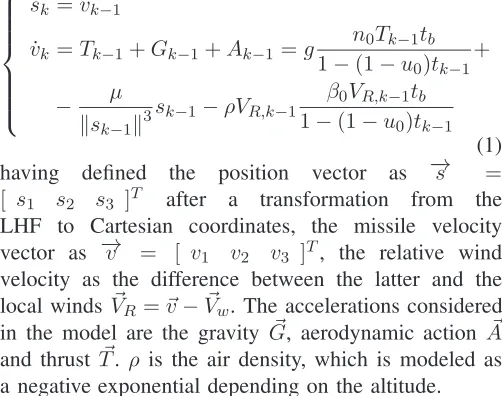
˙
sk =vk−1 ˙
vk =Tk−1+Gk−1+Ak−1 =g
n0Tk−1tb
1−(1−u0)tk−1 +
− µ ksk−1k3
sk−1−ρVR,k−1
β0VR,k−1tb
1−(1−u0)tk−1 (1) having defined the position vector as −→s = [ s1 s2 s3 ]T after a transformation from the LHF to Cartesian coordinates, the missile velocity vector as −→v = [ v1 v2 v3 ]T, the relative wind velocity as the difference between the latter and the local winds V~R=~v−V~w. The accelerations considered
in the model are the gravity G~, aerodynamic action A~
[image:3.612.321.557.73.210.2]and thrust T~. ρ is the air density, which is modeled as a negative exponential depending on the altitude.
Table I reports the parameters of the model. The first four are the fundamental parameters of the model and
Parameter Symbol Parameter Symbol
Initial thrust
to weight ratio n
0
Relative
mass rate q
0
Reduced
ballistic coefficient
β0
Burn-out
time tb
Specific
impulse Isp
Thrust over
weight ratio n(t) Structural over
total mass ratio u0
Ballistic
coefficient B
they are assumed constant. The remaining four parame-ters are derived from the former. It is important to notice that the sensitivity of the trajectory to the variations of these parameters (unknown to whom is carrying out the reconstruction of the trajectory) is very high [15]. The
n0, β0, u0 and tb parameters will be assumed unknown
to the estimator.
At the very beginning of its trajectory, the missile passes through the vertical arc, where it can be assumed
b
Tvert.= [1 0 0]T. (2)
After the vertical arc, the missile performs the pitch maneuver. Thrust direction at the pitch over is defined from the azimuth angle ψ and the kick angleκ:
b
Tpitchov. =
h
cosκ sinκsinψ sinκcosψ
iT
. (3) During the gravity turn, the thrust is aligned with the velocity vector in order to null the incidence [24].
b
Tgrav.turn=VbR. (4)
The sequence of these three phases of flight is fixed for all ballistic missiles. The switching time between the three phases varies from case to case and cannot be assumed constant. In general, the pitch maneuver is very rapid and the gravity turn lasts until the constraint on the dynamic pressure ceases to exist, i.e. until the missile exits from the atmosphere. In this paper it will be assumed that the boost-phase ends at the exit from the atmosphere. Further maneuvers outside of the atmo-sphere will be therefore not considered. The following features will be assumed unknown to the estimator:
1) Switching time between the phases.
[image:3.612.49.300.523.721.2]Fig. 1: Radar measurements.
angle θ from the radar to the target [22]. Range-rate measurements were not considered in this case. The azimuth angle in (3) is assumed to be the same returned from the measurements.
III. NEW FILTER FORTBMTRAJECTORY ESTIMATION
The TBM dynamics considered in this work is com-posed of the three phases explained in Section II. In order to estimate the state of the TBM during these phases, a filter based on a switching technique is introduced. This filter switches among three (sub)filters: two AdUKFs (see Section III-A) and a new IMMF (see Section III-B). The rationale of the filter for estimating a TBM trajectory during its boost phase is presented here, and in Section III-C an algorithm implementing this rationale is reported as well.
An AdUKF is run in thefirstseconds of the trajectory, the other AdUKF is run in the last seconds of the trajectory, and the new IMMF is run in the time interval
between these first and last seconds. Fig. 2 sketches the
reasoning behind the switching technique. The proposed switching mechanism is based on the following three hypotheses:
1) In the first seconds of the trajectory (until t=t1) it is reasonable to say that TBM is following a vertical arc trajectory. Thus, an AdUKF is run considering
vertical arc equations for the time interval [t0, t1]
2) For the last seconds, say from a time instantt=t2 on, one can say the TBM is following agravity turn
trajectory. Thus another AdUKF is run considering
gravity turn equations for the time interval[t2, tf].
3) For the time interval (t1, t2), there is no certainty about which trajectory model the TBM is following. Therefore a multiple model filter is more adequate, and the new IMMF is run.
The time instants t1 andt2 are defined as the following
ad-hocfunctions:t1 = ˆtb/2−10 s andt2 = ˆtb/2 + 10s,
where ˆtb is the estimateoftb. These functions oft1 and
t2 are conservative assumptions in the sense that they result in a wideinterval(t1, t2) of20 s; this is to ensure that the three hypotheses above hold.
Fig. 2: Time-line of the proposed switching filter.
A. Additive Unscented Kalman Filters
In the time intervals [t0, t1]and [t2, tf]the trajectory
phase of a given TBM can be assumed known. For [t0, t1], this trajectory is given by (1) with (2) (vertical arc); and for [t2, tf], by (1) with (4) (gravity turn). For
both time periods, the measurements are given by the second equation in (5).
In order to write the nonlinear dynamic system for the TBM trajectory, define the internal state vector at the step time k by xk := [sTk, vTk, β0,k, n0,k, tb,k, u0,k]T ∈Φnx.
Although the four parameters are considered constant, their values are supposed unknown in this work. In order to estimate their correct values, they are therefore included in the state vectorxk. This is a common practice
when both the state and the parameters of a given system are estimated [25].
Stochastic filters such as AdUKFs can be used to esti-mate the internal statexk of nonlinear dynamic systems,
resulting in a good trade-off between computational cost and estimation quality [26]. AdUKFs are based on the concepts ofσ-representation (σR) and Unscented Trans-formation (UT) [27]. The UT has interesting properties concerning the estimation ofY¯, PY Y andPXY:
µ[µχ,2]
γ = ¯Y[ ¯X,2],Σ
[µχ,1]
γγ =PY Y[ ¯X,1],Σ
[µχ,1]
χγ =PY Y[ ¯X,1],
where Y[c,l] stands for the Y’s Taylor Series around c truncated at thelth term,Σγγ :=PNi=1wci(χi−µχ)(⋄)T
is the sample covariance, and Σχγ := PNi=1wicc(χi −
µχ)(γi−µγ)T is the sample cross-covariance.
Properties like these make the UT a good choice to be used in stochastic filters; it can be applied in the Kalman Filter prediction-correction framework to form AdUKFs. There are many definitions of AdUKFs; a systematized presentation of them is given in [27].
AdUKFs are good options for nonlinear problems. However, there are problems that require more than one
[image:4.612.329.549.56.177.2]B. Time-Varying Interacting Multiple Model Unscented Filter
Since in the time interval(t1, t2)there is no certainty about which trajectory model the TBM is following, multiple choices have to be considered. In this sense, the TBM trajectory is described by a MM system with
M different models, introduced as
xk =fmk(xk−1) +̟,
yk=hmk(xk) +ϑ, k∈N; (5)
where f is the process function; h the measurement function;yk:= [¯ρkψkθk]T∈Φny the measurement vector;
̟ ∈ Φnx the process noise; ϑ∈ Φny the measurement
noise; and mk ∈ M := {1, . . . ,M} is the system’s
discrete modal state (mode). The noises ̟ and ϑ are supposed to i) be uncorrelated, ii) have mean zero, and iii) have covariancesQandR, respectively. The param-eter mk is assumed to follow a time-varying Markov
Chain with a Markov Transition Matrix (MTM), Π(k) defined as:
Πij(k) :=P{mk=j|mk−1=i}, i, j ∈M, where, for a given event e, P{e} stands for the proba-bility of e occurring.
The MM system (5) is set with M= 2, h1 =h2=h,
f1 =fvert., andf2=fpitchov..In deed, the MM system
for the time interval (t1, t2) can be written with only
two modes: one for the vertical arc and another for
the pitch maneuver. Even if the TBM is on a gravity turn trajectory, an MM systems with this two-modes formulation can model a gravity turn behavior as a rotation around the missile’s transversal axis, just like the pitch maneuver. In this way, the cardinality ofMcan
be reduced by 1 (instead of 3 modes, there are 2 modes), and the computational cost of the filter is reduced.
In this paper an IMMUF is used to estimate the state of this system. Since optimal solutions for the MM filtering problem are computationally intractable because they require exponentially-growing computational effort and memory usage [2], [25], suboptimal approaches are required. Interacting Multiple Model Filters are com-putationally cost-efficient suboptimal estimators of MM systems. In comparison with other suboptimal filters for MM systems, such as the Generalized Pseudo Bayes Filters, they greatly improve performance without in-creasing computational load [3].
However, literature’s IMMUFs might fail to estimate a TBM trajectory. In most literature’s IMMUFs, the MTM Π is time-invariant[Π(k) = Π(k+ 1)for every k∈N]
[17]–[21]. Nevertheless, with a TBM Π is rarely well
approximated by a constant value; for instance, when
the TBM system in mode mk = 1, the missile is in the
vertical arc phase; and when in mode mk = 2, in the
pitch maneuver phase; clearly,Π1,2(k) is smaller in the beginning of mode 1 than at its end.
C. Algorithm of the Switching filter
In this paper a modified IMMUF is introduced, where the entries ofΠchange linearly over time. Being∆tthe sampling time, the new matrix Π is given as follows:
π11,k =
−k∆t+ 0.5ˆtb,k−1
10 (6)
π22,k =
k∆t−0.5ˆtb,k−1
10 (7)
Π(k) =
"
π11,k 1−π11,k
1−π22,k π22,k
#
. (8)
When time is in the interval(t1, t2), the mode probability vector is initialized with pk= [pk,1, pk,2]T = [1,0]T .
Sincepk,1 = 1, at the beginning of the interval(t1, t2) it is sure that the TBM will be following the vertical arc (mk= 1). As time progresses, i) from (6), the probability
of the TBM being on thevertical arc diminishes linearly; and ii), from (7) the probability of the TBM being in the
pitch maneuver trajectory (mk = 2) increases linearly.
At the end of (t1, t2), the probability of the vertical arc is 0 and that of the pitch maneuver is 1. The new filter for estimating the TBM trajectory during its boost phase - called Switching Modified Interacting Multiple
Model Unscented Filter (SMIMMUF)- is based on i) the
switching rationale explained in the beginning of Section III, ii) AdUKFs [27], and iii) the MIMMUF structure described in [22]. Definek1:=quo(t1,∆t),
IV. NUMERICAL SIMULATIONS
Numerical simulations have been implemented in or-der to validate the proposed algorithm against an un-known target. The SMIMMUF will be compared with a classical IMMUF and the MIMMUF of [22]. The AdUKFs used in all cases are Homogeneous Minimum Symmetric AdUKF’s ( [27], Tab. IV).
A. Simulation parameters
For each algorithm, 300 Monte Carlo simulations have been run, each one differing by the initial guess. The initial guesses belong to a normal distribution with mean value equal to the true value of the state variables. The covariance error matrix P(0|0) is initialized in accordance with the variances of the initial guesses:
P0|0 =diagh 20002 20002 20002 1002 1002 . . .
Both the classical IMMUF and the MIMMUF of [22] run five models: one for the vertical arc, three for the pitch maneuver with an angle κ ∈[3.5◦,6.5◦] (the true value of κ being 5◦), and one for the gravity turn. The reconstruction of the kick angle κ will be therefore left to the filter. In the real model, the transition between the vertical arc and the pitch maneuver occurs after 40sand the transition between the pitch maneuver and the gravity turn occurs after 46 s. The process noise covariance matrixQ is the same for all the filters and can be found in [22]. The common scenario for all simulations is that of the medium range missile described in [23].
[image:6.612.342.521.44.778.2]B. Results
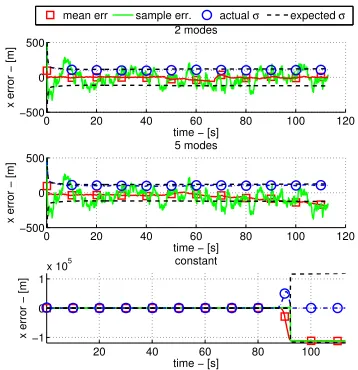
Fig. 3 to 5 show some of the results of the three simulations, in particular the estimation errors of the first component of ~sand~v and of the β0 parameter. The red line is the mean estimation error over the entire Monte Carlo set; the green line is the estimation error of one sample; the dashed black line is the theoreticalσ-bounds of the filter calculated from the error covariance matrix
P; the dashed blue line is the standard deviation of the errors. The other results are not shown for the sake of conciseness, but they are similar to those reported here. It can be seen that, in general, the algorithms with time-varying MTM - referred to as two-modes (the SMIMMUF) and five-modes (the MIMMUF of [22]) filters in the figures - provide more consistent results than the classical IMMUF with the constant transition matrix - referred to as constant. With the MIMMUF of [22], the mean error diverges at the end in the estimation of~sand
~v, while the mean error of the SMIMMUF does not. This demonstrates the superiority of the proposed filtering scheme with respect to the other tested algorithms.
V. CONCLUSIONS
This paper introduces a new filter for the tracking of a ballistic missile during the boost phase. The model fed to the filter includes several unknown parameters and dynamics. The new filter endowed with two novelties:
1) A modified IMMUF with time-varying transition matrix.
2) A switching rationale transitioning between Un-scented Kalman Filters and the modified IMMUF. The algorithm has been tested in a Monte Carlo nu-merical simulations based on radar measurements. A comparison with other two algorithms, a classic version of the IMMUF and a modified IMMUF with another time-varying MTM, has demonstrated that the proposed solution is a valid alternative to track an unknown ballistic missile.
0 20 40 60 80 100 120
−500 0 500
x error − [m]
time − [s] 2 modes
mean err sample err. actual σ expected σ
0 20 40 60 80 100 120
−500 0 500
x error − [m]
time − [s] 5 modes
20 40 60 80 100
−1 0 1
x 105
x error − [m]
time − [s] constant
Fig. 3: Estimation error on x.
20 40 60 80 100
−100 0 100
u error − [m/s]
time − [s] 2 modes
mean err sample err. actual σ expected σ
20 40 60 80 100
−100 0 100
u error − [m/s]
time − [s] 5 modes
20 40 60 80 100
0 2000 4000
u error − [m/s]
[image:6.612.343.522.58.243.2]time − [s] constant
Fig. 4: Estimation error on u.
20 40 60 80 100
−2 0 2
x 10−4
β0
error
time − [s] 2 modes
mean err sample err. actual σ expected σ
20 40 60 80 100
−2 0 2
x 10−4
β0
error
time − [s] 5 modes
20 40 60 80 100
−2 0 2
x 10−4
β0
error
time − [s] constant
[image:6.612.346.518.390.699.2]The proposed filter has shown promising results, but, for completely assessing it, new studies should test its robustness against adverse situations. For instance, when data association due to false alarms or neighboring targets is a significant problem [3], [28]; in this case, it could be compared with filters specifically developed for these situations, such as probabilistic data association filters and joint probabilistic data association filters.
REFERENCES
[1] D. A. Wilkening, “Airborne boost-phase ballistic missile de-fense,”Science and Global Security, vol. 12, pp. 1–67, 2004. [2] Y. Bar-Shalom, S. Challa, and H. Blom, “IMM estimator versus
optimal estimator for hybrid systems,” IEEE Trans. Aerosp. Electron. Syst., vol. 41, no. 3, pp. 986–991, 2005.
[3] E. Mazor, A. Averbuch, Y. Bar-Shalom, and J. Dayan, “Interact-ing multiple model methods in target track“Interact-ing: a survey,”IEEE Trans. on Aero. and Elec. Syst., vol. 34.
[4] W. J. Farrell, “Interacting multiple model filter for tactical ballistic missile tracking,”IEEE Trans. on Aero. and Elec. Syst., vol. 44, no. 2, 2008.
[5] D. Lainiotis, “Optimal adaptive estimation: Structure and pa-rameter adaption,” IEEE Transactions on Automatic Control, vol. 16, no. 2, pp. 160–170, 1971.
[6] B. Ristic, S. Arulampalam, and N. Gordon, “Beyond the kalman filter,” IEEE Aerospace and Electronic Systems Magazine, vol. 19, no. 7, pp. 37–38, 2004.
[7] H. Blom and Y. Bar-Shalom, “The interacting multiple model algorithm for systems with Markovian switching coefficients,” IEEE Trans. Autom. Control, vol. 33, no. 8, pp. 780–783, 1988. [8] J. Kidd and H. Caldwell, “Defense support program: Support to a changing world,” inSpace Progr. and Techn. Conf., 1992. [9] X. R. Li and V. P. Jilkov, “Survey of maneuvering target tracking: Iii. measurement models,” inInternational Symposium on Optical Science and Technology. International Society for Optics and Photonics, 2001, pp. 423–446.
[10] Y. Bar-Shalom and X.-R. Li, “Estimation and tracking: Princi-ples, techniques, and software,”IEEE Anten. and Propag. Mag., vol. 38, no. 1, p. 62, 1996.
[11] P. Zarchan, “Boost-phase filtering options: is simpler better?” Journ. of Guid., Cont., and Dyn., vol. 33, no. 6, pp. 1724–1731, 2010.
[12] S. J. Julier, J. K. Uhlmann, and H. F. Durrant-Whyte, “A new approach for filtering nonlinear systems,” in Proc. of the American Contr. Conf., vol. 3. IEEE, 1995, pp. 1628–1632. [13] A. Farina, B. Ristic, and D. Benvenuti, “Tracking a ballistic
target: comparison of several nonlinear filters,”IEEE Trans. on Aero. and Elect. Syst., vol. 38, no. 3, pp. 854–867, 2002. [14] B. Ristic, A. Farina, D. Benvenuti, and M. S. Arulampalam,
“Performance bounds and comparison of nonlinear filters for tracking a ballistic object on re-entry,”IEE Proceedings-Radar, Sonar and Navigation, vol. 150, no. 2, pp. 65–70, 2003. [15] A. Benavoli, L. Chisci, and A. Farina, “Tracking of a ballistic
missile with a-priori information,”IEEE Trans. on Aero. and Elec. Syst., vol. 43, no. 3, pp. 1000–1016, 2007.
[16] F. Reali, G. B. Palmerini, A. Farina, A. Graziano, and S. Giom-papa, “Parametric analysis of ballistic target-tracking problem by multiple model approach,”IET Radar, Sonar & Navigation, vol. 7, no. 4, pp. 459–469, 2013.
[17] T. Sathyan, A. Sinha, and T. Kirubarajan, “Passive geolocation and tracking of an unknown number of emitters,”IEEE Trans. Aerosp. Electron. Syst, vol. 42, no. 2, pp. 740–750, apr 2006.
[18] M. R. Morelande and B. Ristic, “Smoothed state estimation for nonlinear Markovian switching systems,”IEEE Trans. Aerosp. Electron. Syst, vol. 44, no. 4, pp. 1309–1325, oct 2008. [19] D. Lee, C. Liu, Y.-W. Liao, and J. K. Hedrick, “Parallel
Interacting Multiple Model-Based Human Motion Prediction for Motion Planning of Companion Robots,”IEEE Trans. Autom. Sci. Eng., vol. 14, no. 1, pp. 52–61, jan 2017.
[20] N. Tudoroiu, M. Zaheeruddin, V. Cretu, and E.-R. Tudoroiu, “IMM-UKF Versus Frequency Analysis,”IEEE Ind. Electron. Mag., vol. 4, no. 3, pp. 7–18, sep 2010.
[21] Y. Tian, Z. Chen, and F. Yin, “Distributed IMM-Unscented Kalman Filter for Speaker Tracking in Microphone Array Net-works,”IEEE/ACM Trans. Audio, Speech, Language Process., vol. 23, no. 10, pp. 1637–1647, oct 2015.
[22] S. Battistini and H. M. T. Menegaz, “Interacting multiple model unscented filter for tracking a ballistic missile during its boost phase,” inIEEE Aerospace Conference. IEEE, 2017, pp. 1–8. [23] F. Piergentili and P. Teofilatto, “Algorithm for missile detection from radar data,”Journal of Spacecraft and Rockets, vol. 44, no. 1, pp. 276–280, 2007.
[24] G. J. Culler and B. D. Fried, “Universal gravity turn trajecto-ries,”Journal of Appl. Phys., vol. 28, no. 6, pp. 672–676, 1957. [25] Y. Bar-Shalom, X.-R. Li, and T. Kirubarajan, Estimation with applications to tracking and navigation. New York: John Wiley & Sons, 2001.
[26] S. J. Julier and J. K. Uhlmann, “Unscented Filtering and Nonlinear Estimation,” Proc. IEEE, vol. 92, no. 3, pp. 401– 422, 2004.
[27] H. M. T. Menegaz, J. Y. Ishihara, G. A. Borges, and A. N. Vargas, “A Systematization of the Unscented Kalman Filter Theory,”IEEE Trans. Autom. Control, vol. 60, no. 10, pp. 2583– 2598, 2015.
[28] S. S. Blackman, “Multiple hypothesis tracking for multiple target tracking,”IEEE Aero. and Elec. Sys. Mag., vol. 19, no. 1, pp. 5–18, 2004.
Henrique M. T. Menegaz received a BS degree in Electrical Engineering from the Uni-versidade de Bras´ılia (UnB), Brazil, in 2007. He received a MS (2011) and a PhD (2016) in Engineering of Electronic Systems and Au-tomation from UnB. He is currently an As-sistant Professor with Faculdade Gama, UnB. His major field of study is filtering of nonlinear dynamic systems and their applications.