DEVELOPING AN INTEGRATED PROJECT
FOSTERING SCIENTIFIC CREATIVITY AMONG FIFTH
1
Norjanah Ambo,
1
Sk St Patrick Tawau, Sabah, Malaysia
2,3
Faculty of Psychology and Education, Universiti Malaysia Sabah, Malaysia
ARTICLE INFO ABSTRACT
The transformation in science
Technology, Engineering, Mathematics (STEM) for promoting creativity among students. This study aimed to determine the validity and reliability of an integrated project
teaching and learning module (Pro
Graders. The module consisted of six lessons and six project activities regarding Life Science, Physical Science and Material Science. Evaluation was
validity, and students’ perception on the learning module, which involved seven subject matter experts and 30 fifth graders. Data were captured through students’ responses to two five
scale quest single group STEM STEM group. reliability with a high positive perception
generate many ideas, b) generate unique ideas, c) expand ideas, d) think of a special topic, and e) use information from multiple sources to complement sketches. The positive written responses
indicated effects of the that Pro creativity of
Copyright © 2018, Norjanah Ambo et al. This is an open use, distribution, and reproduction in any medium, provided
INTRODUCTION
The implementation of the 21st Century learning that has become popular in the decades of world education system is also demanding a transformation in teaching and learning (TaL) methods. In order to create creative and innovative generations, the integration of project-based learning
Science, Technology, Engineering, and Mathematics (STEM) in science subjects is a strategy to unleash scientific creativity among students. Sneideman (2013) opined that STEM is a philosophy or a way of thinking where several subjects, namely Science, Mathematics, Engineering and Technology are integrated into an education field that is considered more appropriate and relevant to be taught in schools primarily because it emphasizes practical aspects and reality.
*Corresponding author: Nyet Moi Siew
Faculty of Psychology and Education, Universiti Malaysia Sabah, Malaysia.
ISSN: 0975-833X
Vol. 10, Issue, 09,
Article History: Received 04th June, 2018 Received in revised form 12th July, 2018
Accepted 15th August, 2018 Published online 30th September, 2018
Citation: Norjanah Ambo, Nyet Moi Siew and Crispina Gregory K Han Module for fostering Scientific Creativity among Fifth Graders
Key Words:
Fifth graders, Scientific creativity,
STEM, Project-based learning.
RESEARCH ARTICLE
DEVELOPING AN INTEGRATED PROJECT-BASED LEARNING AND STEM LEARNING MODULE FOR
FOSTERING SCIENTIFIC CREATIVITY AMONG FIFTH GRADERS
Norjanah Ambo,
*,2Nyet Moi Siew and
3Crispina Gregory K Han
Sk St Patrick Tawau, Sabah, Malaysia
Faculty of Psychology and Education, Universiti Malaysia Sabah, Malaysia
ABSTRACT
The transformation in science education warrants integration of project
Technology, Engineering, Mathematics (STEM) for promoting creativity among students. This study aimed to determine the validity and reliability of an integrated project
teaching and learning module (Pro-STEM) and evaluate its effects on scientific creativity of Fifth Graders. The module consisted of six lessons and six project activities regarding Life Science, Physical Science and Material Science. Evaluation was conducted to determine the reliability, content validity, and students’ perception on the learning module, which involved seven subject matter experts and 30 fifth graders. Data were captured through students’ responses to two five
scale questionnaires, open ended questions and self-developed scientific creativity test. single group pre- and post-test research design was employed to determine the effects of the STEM module. A total of 30 fifth graders from one primary school were
STEM group. The results of module evaluation indicated a good content validity and an acceptable reliability with alpha Cronbach's value of 0.65 to 0.87. Majority of the students were of moderately high positive perception (m=4.37) that the activities in the Pro
generate many ideas, b) generate unique ideas, c) expand ideas, d) think of a special topic, and e) use information from multiple sources to complement sketches. The positive written responses
indicated the appropriateness of the module. The results of Paired Sample T
effects of the Pro-STEM module in all trait dimensions of scientific creativity. These findings show that Pro-STEM module would represent a reliable and valid learning module for fostering scientific creativity of fifth graders.
open access article distributed under the Creative Commons Attribution provided the original work is properly cited.
Century learning that has become popular in the decades of world education system is also demanding a transformation in teaching and learning (TaL) methods. In order to create creative and innovative based learning (Pro) and Science, Technology, Engineering, and Mathematics (STEM) in science subjects is a strategy to unleash scientific creativity among students. Sneideman (2013) opined that STEM is a philosophy or a way of thinking where several subjects, nce, Mathematics, Engineering and Technology are integrated into an education field that is considered more appropriate and relevant to be taught in schools primarily because it emphasizes practical aspects and reality.
Faculty of Psychology and Education, Universiti Malaysia
In this way, children learn Science and Mathematics in real, realistic and meaningful contexts through technology applications and inventions. According to Minichiello, Campbell, Dorward and Marx (2015), integr
elements of teaching methods, incorporating of STEM elements, and promoting creative and innovative thinking in science and technology among students is a good step in creating dynamic, creative and competitive students in the 21 century. Creativity is one of the key skills needed in order to drive the development of a nation, especially in the increasingly complex social environment (Hennessey Amabile 2010; James, 2015). Creativity is also one of the key components for the developmen
(Robinson, 2011). In this regard, the role of teachers as the agents of knowledge should be wise in implementing teaching and learning strategy to ensure disseminated knowledge reaches its goal. However, the lack of reference ma
teacher guides to implement the project
International Journal of Current Research
Vol. 10, Issue, 09, pp.73466-73473, September, 2018
DOI: https://doi.org/10.24941/ijcr.32229.09.2018
Crispina Gregory K Han, 2018. “Developing an integrated Project-Scientific Creativity among Fifth Graders”, International Journal of Current Research, 10, (09), 73466
BASED LEARNING AND STEM LEARNING MODULE FOR
GRADERS
Crispina Gregory K Han
Faculty of Psychology and Education, Universiti Malaysia Sabah, Malaysia
education warrants integration of project-based learning and Science, Technology, Engineering, Mathematics (STEM) for promoting creativity among students. This study aimed to determine the validity and reliability of an integrated project-based learning and STEM and evaluate its effects on scientific creativity of Fifth Graders. The module consisted of six lessons and six project activities regarding Life Science, conducted to determine the reliability, content validity, and students’ perception on the learning module, which involved seven subject matter experts and 30 fifth graders. Data were captured through students’ responses to two five-point Likert developed scientific creativity test. Finally, a was employed to determine the effects of the 30 fifth graders from one primary school were randomly assigned to Pro-indicated a good content validity and an acceptable
Majority of the students were of moderately that the activities in the Pro-STEM module enable them to a) generate many ideas, b) generate unique ideas, c) expand ideas, d) think of a special topic, and e) use information from multiple sources to complement sketches. The positive written responses of students Paired Sample T-test established the in all trait dimensions of scientific creativity. These findings show e and valid learning module for fostering scientific
ribution License, which permits unrestricted
In this way, children learn Science and Mathematics in real, realistic and meaningful contexts through technology applications and inventions. According to Minichiello, Campbell, Dorward and Marx (2015), integration of various elements of teaching methods, incorporating of STEM elements, and promoting creative and innovative thinking in science and technology among students is a good step in creating dynamic, creative and competitive students in the 21st
Creativity is one of the key skills needed in order to drive the development of a nation, especially in the increasingly complex social environment (Hennessey and Amabile 2010; James, 2015). Creativity is also one of the key components for the development of science and technology (Robinson, 2011). In this regard, the role of teachers as the agents of knowledge should be wise in implementing teaching and learning strategy to ensure disseminated knowledge reaches its goal. However, the lack of reference materials and teacher guides to implement the project-based learning and INTERNATIONAL JOURNAL
OF CURRENT RESEARCH
STEM approach is often an issue. Recognizing these difficulties, the researchers have developed a Pro-STEM learning module to assist teachers in preparing TaL lesson plans aimed in enhancing scientific creativity through the design and making of science prototypes among Fifth Graders. Therefore, this paper will examine the reliability, content validity, and students’ perception on the developed Pro-STEM learning module on scientific creativity of Fifth Graders. The effects of using the Pro-STEM learning module will be evaluated through the achievement of the Fifth Graders in the pre-test and post-test scientific creativity test. Students’ views on Pro-STEM activities were analysed to evaluate the validity and usability of Pro-STEM learning module before it is applied in the actual study. In the context of this study, scientific creativity refers to the ability of pupils to produce as many sketches as they can that can be transformed into products to help overcome human capabilities and are used in everyday life. The five trait dimensions of scientific creativity were also assessed through their produced sketches. Students should also integrate the elements of STEM in every sketch or model that is presented as well as the ability to use recycled materials to produce science-based prototypes.
Development of Pro-STEM module: The self-developed
Pro-STEM module is based on the theory of constructivism, Directed Creative Model (Plsek and Associates, 1997), engineering design process model (Massachusetts Department of Elementary and Secondary Education, 2016), and cooperative learning Number-Head Together (CL ‘NHT’) (Kagan and Kagan, 2009), This module was developed based on Analysis, Design, Develop, Implement and Evaluation (ADDIE) design model proposed by Wegener (2006). There are 12 lessons as teacher’s guides in this module which involves six lessons and six project activities producing science-based prototypes with Pro-STEM learning. Similarly, the scientific creativity test was developed based on the Curriculum and Assessment Standard Document (DSKP) of the Fifth Graders for the topics of Life Science, Physical Science and Materials Science. There are five trait dimensions of scientific creativity tested that is guided and adapted from the Torrance creativity model (Torrance, Ball, and Safter, 2008) and Hu and Adey (2002) scientific creativity model: Fluency, Originality, Elaboration, Title Abstraction and Resistance to Premature Closure. The scientific creativity test was found to have a discrimination coefficient range from 0.22 to 0.36, Cronbach's alpha of 0.829, and item-total correlations range of 0.541 to 0.866 (Ambo and Siew, 2017).
METHODOLOGY
Respondents: This study involved 30 Fifth Grader from one
of the primary schools in the Tawau district. Chua (2011) states that the number of 30 respondents is sufficient to know the aspect of consistency in a measuring instrument. The study was conducted for 15 weeks at the beginning of the first semester of 2017. Table 1 shows the study procedures conducted for 15 weeks in obtaining the face validity of the Pro-STEM module.
Instruments: The instrument used in this study is an
open-ended questionnaire, two five-point Likert scale questionnaires and self-developed scientific creativity test (Ambo and Siew, 2017). Open-ended questions gave respondents the freedom to point out their views on the activities undertaken while learning using the Pro-STEM module.
Each activity in the Pro-STEM module covered the five trait dimensions of scientific creativity among pupils namely Fluency, Originality, Elaboration, Title Abstraction and Resistance to Premature Closure.
Procedures: The content validity of Pro-STEM module was
assessed by a team of seven experts from different fields. Experts were required to make a remark on the module evaluation form whether they agreed on the proposed assessment criteria and to make comments. Experts were also required to evaluate items in the open questionnaire adapted from the Othman (2015) regarding the activities in the developed Pro-STEM learning modules. The validity of language was assessed by a teacher who was from Language and Literature Board. Table 2 shows a list of experts involved in determining the content validity of Pro-STEM module.
RESULTS
Content Validity: Table 3 shows the findings of content
validity based on the Pro-STEM module evaluation criteria. The validity of language content indicates the language used was appropriate with only a few improvements. Among the improved criteria was the aspect of spelling and writing style.
Reliability: The reliability of Pro-STEM module was assessed to determine if the students can successfully master the objectives and follow the steps of each activity in the module.
Table 5 showed the obtained Alpha Cronbach's value for all project activities in the module ranged from 0.65 to 0.87 with the overall Alpha Cronbach value of 0.90. Most researchers suggest that the Alpha value of 0.8 and greater is typically a
high level of reliability (Cohen, Manion, and Morrison,2000;
Sekaran and Bougie 2010). However, according to Abd.
Ghafar (1999) and Konting (2000), the alpha Cronbach value of 0.6 is also sufficient for instruments developed in social science in the field of education. This shows that the developed
Pro-STEM module has a good degree of consistency (Babbie
and Mouton, 2001).
Questionnaire: A questionnaire was administered to find out
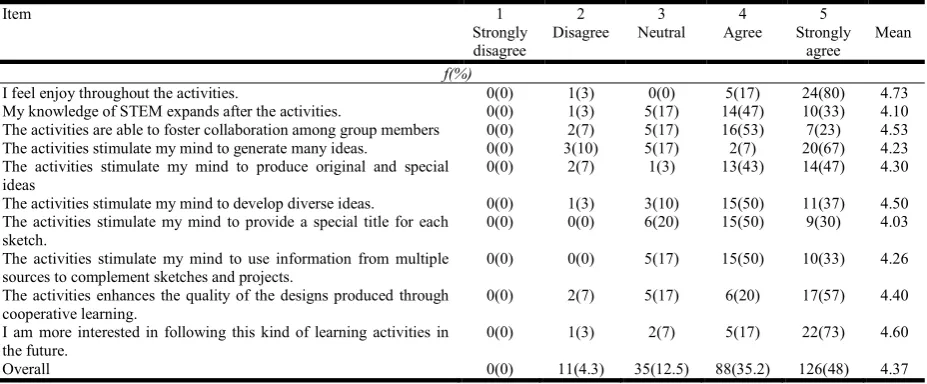
the students’ perception about the Pro-STEM activities. The results in Table 6 show students had overall mean of 4.37 regarding Pro-STEM activities. From the results, the mean scores ranged from 4.03 to 4.60 indicating the Fifth graders agreed that the module was acceptable to be used to foster scientific creativity in the primary school. According to Inas, Harry, Yugo, and Andika (2015), criteria with the mean level equal or more than 3.50 is acceptable.
Effects of Pro-STEM Module: The purpose of the developed
Table 1. Study Procedures
Week Activity
Week 1 Administering scientific creativity pre-test to 30 Fifth Graders at a city-level primary school.
Students are divided into 6 small groups
Briefing to the students
Week 2-3 First intervention: Project 1 - Animal of my Imagination Week 4-5 Second intervention: Project 2 - Bird Cage
Week 6-7 Third intervention - Project 3: Floating Seeds
Week 8-9 The fourth intervention - Project 4: Balloon-powered cars Week 10-11 The fifth intervention - Project 5: Friendly-Light Home Week 12-13 The sixth intervention - Project 6: Mini Ice Box Week 14-15 Administering scientific creativity post-test
[image:3.595.51.537.237.317.2] Administering questionnaires.
Table 2. Pro-STEM Module Content Evaluation Panel
No. Name Representatives Position Expertise
1 Expert A IPTA Professor Scientific Creativity 2 Expert B IPTA Senior lecturer(Dr) Creativity/STEM
3 Expert C Teacher Training Institute Lecturer (Dr) Project-based learning/Science pedagogy 4 Expert D Secondary school teacher Head of Department Malay language
[image:3.595.52.537.352.457.2]5 Expert E Primary Science teacher Expert teacher Science pedagogy 6 Expert F Primary school teacher Head of Department Science pedagogy 7 Expert G Primary school teacher Year 5 Science Senior teacher Science pedagogy
Table 3. Content Validity of Pro-STEM Module
Criteria Percent (%) Agreement
Expert 1
Expert 2
Expert 3
Expert 4
Expert 5
Expert 6
Expert 7
Summary
1 Daily lesson plan 100 100 100 100 100 100 100
Overall are good and satisfactory with few improvement 2 Learning standard 100 100 100 100 100 100 100
3 Project activities 100 100 100 100 100 100 100 4 Teaching and learning
activities
100 100 100 100 100 100 100
5 Scientific creativity skill 100 100 100 100 100 100 100
Table 4. Module feedback from expertsand improvements made
Aspects Review/Improvement
Daily Lesson Plan (DLP) DLP was clearly designed and detailed (P1) The writing of DLP followed KSSR format
Learning standard All learning standards were in line with Year 5’s DSKP. Learning outcomes were clearly explained.
Project activity The explanation for activity 5 needs to be explained in parallel with learning standard 1.3.1 and 1.3.2.
It is suggested the project title 5 should change to Friendly-Light House.
All project activities were able to stimulate pupils’ mind and able to solve non-routine problems.
Teaching and learning activity: Able to be implemented by teachers and pupils and suitable with the level of Fifth Graders TaL activity might be time-consuming. Not all group is able to present their sketch/model. Scientific creativity All activities can stimulate pupils’ mind to be more creative thinking, plan ideas/prototype,
make a project which solve the problems. Cooperative learning: Teamwork is implemented through the activities.
Small group members (4 pupils) make a ‘compulsion’ for each member to do their part. So, there is no ‘sleeping partner’.
Table 5: Alpha Cronbach Value of Pro-STEM Module (N = 30)
Project Title of activities in the Module Alpha Cronbach Item number
1 Animal of my Imagination .66 5
2 Bird Cage .70 5
3 Floating Seeds .65 5
4 Balloon-powered cars .79 5
5 Friendly-Light Home .85 5
6 Mini Ice Box .87 5
[image:3.595.64.524.492.664.2] [image:3.595.70.519.697.779.2]Pro-STEM group in five trait dimensions of scientific creativity. The result of this analysis (Table 8) indicates that the post-test mean score of fluency (M=12.03, SD= 2.141), originality (M=11.87, SD= 2.515), elaboration (M=24.00, SD= 4.511), title abstraction(M=20.67,SD=5.738), and resistance to premature closure (M=14.00,SD=3.184) are significantly higher (t (29) = -6.608, p < .05;t (29) = -10.433, p < .05;t (29) = -19.078, p < .05;t (29) = -7.067, p < .05;t (29) = -21.650, p < .05 respectively) than pre-test mean score of fluency (M=9.80, SD= 2.007), originality ( M=9.03, SD= 2.356), elaboration (M=20.87, SD= 4.337), title Abstraction (M=17.40, SD= 4.731), resistance to premature closure (M=11.27, SD= 3.107).These results indicated that Pro-STEM group performed significant better on the post-test compared to the pre-test in all trait dimensions of scientific creativity.
Open Questions: Open questions were given to pupils after
the intervention was conducted. A total of 30 respondents were asked to express their opinions on activities that were carried out using the Pro-STEM Module. Answers provided by respondents are explanatory. Therefore, the method of analysis involved was to transcribe the results of open questions first, then the findings were separated by sections and themes. Analysis results were shown in the form of tables, the number of frequencies and percentages. Then the table was discussed and interpreted to make a conclusion. This transcript was manually analysed by carefully repeated reading to see the broader view of the context.
Through this process the researcher was able to see every student's view of the activities carried out in the module. According to Chua (2011), through domain analysis, the theme and code were developed from their own survey data rather than the predetermined one before the analysis was done where the coding process was known as inductive coding.
Student assessment on Pro-STEM learning activities: My
feelings throughout the project-based STEM learning activities
Joy and fun: For the six project activities carried out, the pupils expressed their joy and fun performing activities involving hands-on activities.
"I feel enjoy..." (S1, S2, S5)
" The activities that the teacher told us to do is the best one..." (S4) "I am happy because we make various projects..." (S3, S6,)
"it is fun while following through STEM activities ..." (S7, S8)
Feel excited: The students also expressed excitement and
eagered to carry out the project and test the built prototype.
[image:4.595.71.535.79.271.2]"I like the testing of the prototype most.... amazing ..." (S3): "Everyone is eager to know what activities our numbers will do ..." (S2, M6). "Most meaningful if a project is ready…let's test it ..." (S11).
Table 6: Ranked means of students’ perception regarding Pro-STEM activities
Item 1
Strongly disagree
2 Disagree
3 Neutral
4 Agree
5 Strongly
agree
Mean
f(%)
I feel enjoy throughout the activities. 0(0) 1(3) 0(0) 5(17) 24(80) 4.73 My knowledge of STEM expands after the activities. 0(0) 1(3) 5(17) 14(47) 10(33) 4.10 The activities are able to foster collaboration among group members 0(0) 2(7) 5(17) 16(53) 7(23) 4.53 The activities stimulate my mind to generate many ideas. 0(0) 3(10) 5(17) 2(7) 20(67) 4.23 The activities stimulate my mind to produce original and special
ideas
0(0) 2(7) 1(3) 13(43) 14(47) 4.30
The activities stimulate my mind to develop diverse ideas. 0(0) 1(3) 3(10) 15(50) 11(37) 4.50 The activities stimulate my mind to provide a special title for each
sketch.
0(0) 0(0) 6(20) 15(50) 9(30) 4.03
The activities stimulate my mind to use information from multiple sources to complement sketches and projects.
0(0) 0(0) 5(17) 15(50) 10(33) 4.26
The activities enhances the quality of the designs produced through cooperative learning.
0(0) 2(7) 5(17) 6(20) 17(57) 4.40
I am more interested in following this kind of learning activities in the future.
0(0) 1(3) 2(7) 5(17) 22(73) 4.60
Overall 0(0) 11(4.3) 35(12.5) 88(35.2) 126(48) 4.37
Table 7 Paired Sample Correlations (n=30)
Correlation Sig. Pair 1 Pre-fluency &Post fluency .603 < .05 Pair 2 Pre-originality & Post originality .815 < .05 Pair 3 Pre-elaboration & Post elaboration .980 < .05 Pair 4 Pre-abstractness & Post abstractness .901 < .05 Pair 5 Pre-resistance & Post resistance .976 < .05
Table 8. Paired sample T-test
Variables Pre-test Post-test Difference t df p Mean (SD)
"I'm looking forward to waiting science class next week, what STEM project will the teacher tell us to do ..." (S8)
Feeling bored: For students who were less creative and did
not like sketching, they showed boredom. Normally, they tried to avoid engaging in activities while engaging in other activities. However, they were bound to the number of tasks given during co-operative learning, puts head together. If the specific task given during the week was not their favourite, then the pupil would show a sense of boredom and less cheerful. Apparently, most pupils prefered ‘hands on’ activities rather than stretching activities. Only a few people dared to present themselves confidently and smoothly. Most students were passive, shy and stiff during the group's presentation session. This gave them a boredom. Similarly, if the materials to make the project wereinadequate, boredom would arise because good ideas and sketches could not be completed due to lack of materials. Although basically, the teacher provided certain equipment, in order to find a difference, students needed to prepare their own materials so that their prototype produced were more unique and creative.
I'm tired of being told that my paintings are bad ..." (S5)"Boring if asked to involve in the stretching activity ..." (S7, S11, S15) "Bored if there is no more material to do the project ..." (S9, S14, S18)
Experience positive competition: Although Pro-STEM
learning objectives were not for competition, however, each group strove to produce the best design and creation. Additionally, teachers would reward the group that produced unique, fast and completed designs. This also enhanced motivation and healthy competition in discovering the students' scientific creativity.
"Often we are the most awesome group ..." (S1, S16, S22, S23) "Our project's is the best among all, we will not be going to lose ..." (S25, S24). "We are targeting to beat other groups in their creations..." (S26, S29)
The feeling of dissatisfaction: There was no doubt that
feelings of discontent aroused due to lack of positive attitude and cooperation by each member of the group. The attitude of the monopolies and the lack of responsibility shown by each member of the group was the cause of this problem.
"I do not like group activities because friends like to scramble, I'm fine doing it myself ..." (S7, S15). "Some friends do not work ... I have to do a lot of work..." (S18, S30). "Friends do not want to help, lazy to work...." (S4, S9, S14)
However, teachers emphasized the role of 'putting head together' so that each group member performed tasks by referring to the numbers and tasks they should follow. This indirectly trained discipline among students.
My most enjoyable experience in Pro-STEM learning sessions.
Get tested for prototypes / demonstrations: It's a natural fit
for children who like to play. Hence, the testing activity of project prototype of each group was the most anticipated time. Additionally, the designs were built in the form of science-based game tools. Each prototype of the group had its own design and uniqueness.
"I like most testing of the project 'floating seed'. (S3, S6, S8) We play the water in the school fish pond to float the seeds…best ... "(S4, S17). "I like to play the balloon-powered car…but balloon was too big then we release the balloon, eventually the car will move ..." (S11, S22, S26)
Have a chance to build a model: Creative students would be
eager to develop models according to their sketches. The collaboration shown by each team member was also a main factor in producing a good project.
"I like to do project activities because I can build something new..." (S16, S22, S17). "The best time to do the project ... we're working together ..." (S2, S11). "Making the mini fridge is the most fun…our juices are slowly become liquid ..." (S1, S3)
Have a chance to make a presentation: Discouraged students
and talk-makers were passionate about presentation. But there were also students who liked the activity because it was a good time to impose friends in other groups with various questions and criticisms during the question and answer session. This activity actually trained students to communicate well and wisely in explaining during presentation sessions.
"At the first time, I was afraid, but after a few strides I was ok ..." (S18)
"It's not a hard work because we just explain what's done ..." (S4, S7)
"I like presentation because other groups deliberately want to see our solution..." (S30)
Awareness of the elements in STEM: The integration of
STEM elements in Pro-STEM activity indirectly opened the mind of students to think more creative and divergent. Students were increasingly aware that the Pro-STEM learning also enabled them to master the concepts of Mathematics, Science and Technology. However, students were still weak in mastering the engineering skills.
"All activities are for sketches, there are ways to calculate the cost of creating a project. There must be an explanation of science and technology with the unique design ... "(S1, S3) "the activity is good, because I learn science, math, technology and others ..." (S11, S19, S30). "I like to calculate, the cost we used to make the project, just a small amount ..." (S1, S6)
The Pro-STEM learning session enable me to…………
Generate many ideas (Fluency): Generally, the students
acknowledged that the activities train them to generate more ideas.
"Many ideas can be shared with friends ..." (S5, S16, S24)
Expands original idea (Elaboration): The activities carried
out also stimulated the minds of the students to think outside the box. However, sometimes pupils needed to be stimulated by giving examples, situations or explanations before showing their ideas.
"Yes, my ideas are expanding ..." (S1, S2, S5)
"First of all, it is hard to think, but later more and more ideas I get ..." (S18, S28, S30)
Generate a special/unique Idea (Originality): Students
aware that the activities carried out in the Pro-STEM module were able to sharpen their minds to generate creative and unique ideas. Although the basic materials used were the same, each group would find uniqueness in every design.
"Yes, my ideas are always unique and special." (S1)"My idea is not the same as anyone else ..." (S24, S25)"Yes, my idea is better than anyone else ..." (S6, S12)
Thinking of a special title (Title Abstraction): Almost 50%
of students could not give a title to the illustrated sketches.
"It's hard to write a title for all the sketches I've made ..." (S14, S18, S25)."I do not know what title is appropriate for each title I am going to give..." (S7, S11, S15)
However, another 50% of students could give a special title.
"All the titles I give in my design are unique and special ..." (S1, S24, S25)."We've got it first, just love to give it a headline..." (S5, S16, S24). "We feel happy to find a special title ..." (S23, S30)
Obtaining information from various aspects (Resistance to
premature closure): Students got information on various
aspects to find solutions.
"Yes, I use information from various sources to produce good and interesting inventions" (S2, S7, S12, S16, S23). "My own idea was based on my daily life experiences" (S7, S9, S15, S17, S22, S24). "Information gained is through reading, experience and what has been taught by my parents and teachers." (S1, S3, S8, S10, S20)
Mastering Multiple Skills: Respondents agreed that the
activities carried out helped them to master a variety of skills.
"Yes, through Pro-STEM learning and projects, we all make, paint, calculate project costs, inventions, games, stretches and many more..." (S1, S7, S22, S30). " Pro-STEM learning not only trains us to think but makes us more creative and courageous to create something versatile ..." (S15, S23, S28)
Increased confidence to share ideas: The activities carried
out also provide a bit of coaching for students to boldly show themselves to express their ideas, respond to the issues raised, and give a glimpse of their creativity.
"I used to be afraid to express my ideas, but now it is ok ..." (S16, S22, S17). "I'm not shy anymore about doing a presentation ..." (S2, S13, S16. "I'm not afraid to be wrong because the teacher will correct me ..." (S1, S14)
Nurturing Teamwork: Pro-STEM activities through 'putting
head together' also trained students to always practice teamwork. Although each member had a role, however, good product required cooperation among members.
"We are working together in all of our activities..." (S1, S16, S22, S23). "There are also our lazy members, but we forced
them to do work ..." (S4, S9, S14). "If all the members working together, all the work will be ready..." (S7, S19, S21). "More ideas are collected to produce good projects ..." (S2, S15, S28)
Be wise calculating costs: Pro-STEM learning not only
trained students to learn about science and technology but also familiarized them with smart calculations taking into account the cost aspect of carrying out a project. The details of the cost of each project were indirectly improving motivation towards mathematics among students.
"In every project we make, there is an approximate budget ..." (S1, S17, S19, S27)). "The cost estimation is important so that the project does not require much spending..." (S3)
"All the projects we made were using recycled materials. So we do not need to use a lot of cost, more saving... "(S11, S26.S29). "This activity trains us to be smart in designing the activity but the outcome is very good ..." (S4)
Growing of idea:Pro-STEM learning and projects successfully
trained students to produce more designs but time constraint reduced the quality of sketch produced.
"Yes, we can do if we have enough time ..." (S1, S2, S5). "Of course, we share ideas to do what we want ..." (S7, S19). "Every member contributes their ideas, ideas are so many ..." (S4, S13, S28)
Think creatively. Pupils were more creative as each sketch
would be followed by prototype development.
"Although the materials provided by the teachers are all the same, we have managed to produce unique sketches and others from other groups ..." (S12, S25, S30)
Rational thinking: The pupils had its own justification which
could be explained in more detail through the presentation of sketches.
"Although our sketches. are strange, we have the reason why
we did so ..." (S2, S16). "All our designs have their own functions..." (S5, S23, S28)
Application in Everyday Life: Every activity learned in this
module can be applied in the daily life of the student because the activity was simple and did not involve much costs, in addition to responding to the '3R' campaign.
"Yes, I'll do it again, at home I can do with my brother's brother ....," (S6). "Of course, now I understand how to make a project ...", "(S2, S24, S27"
Towards Prototype Development: Pupils were more creative
as each sketch would be followed by prototype development.
"What we are going to expect is similar to the results of the projects we build ..." (S5, S16, S24). "Although our paintings are weird, we can transform it in form of product ..." (S7, S19)
Quality sharing of ideas: Students had also been aware of the
importance of group work to produce a good and skinny model. Furthermore, group activities could foster a loyal spirit of friends and strive to help one another.
Be able to produce various designs: Design and making activities through project within the group were seen as developing their skills. Students recognized that many model building activities were carried out, indirectly training them to create more designs.
"Yes, the more models are created, the more inventive skills we master..." (S7, S21)
Expanding ideas outside of school: Pupils aware that design
and making activities not only could be carried out at school but also could be made anywhere in the home. Armed with the existing experience and knowledge while pursuing learning in school, the idea will be developed and applied by the students according to the suitability and the material in the environment.
"At home, we can make various models ..." (S6, S21)
DISCUSSION
The analysis on the internal consistency reliability and content validity of the module were found to be acceptable. Overall the internal consistency reliability of 0.90 suggested that the Pro-STEM module was acceptable in fostering the five trait dimensions of scientific creativity. Each appointed expert greatly approved the pedagogy content (PBL and STEM), activity overview, relevance of each lesson plans, learning standard, and overall flow of the project activities. Some revisions needed to be made to improve the description of the activities, project titles and duration of the Development Phase, before the Pro-STEM module is used in the actual study.The result of the paired sample T-test indicated that Fifth Graders taught in Pro-STEM approach performed significantly better in their five trait dimensions of scientific creativity in the post-test compared to the pre-post-test. The majority of the students are of moderately high positive perception (m=4.37) that the activities in the Pro-STEM module generate excitement as they have the opportunity to build and test the prototypes and do the presentation to justify each design. This indirectly creates positive competition between groups. In each activity, students have the opportunity to generate many and unique ideas applying the elements of STEM. Despite efforts to create a prototype, there is sometimes a feeling of dissatisfaction and boredom among a small group of members. However, thanks to teamwork, they have finally succeeded in producing creative products. Not only that, the activities carried out turned out to be a platform for a) generating many ideas, b) generating unique/unique ideas, c) expanding ideas, and d) thinking of a special topic. Activities that are conducted also enable students to obtain information from various aspects while making them more confident to share ideas, foster teamwork, intelligently calculate the cost, thinking creatively and rationally in every action. In addition, students rated Pro-STEM activity as a kind of enjoyable learning which could promote knowledge about STEM, group cooperation and the quality of group prototypes, which in turn promotes their interest in learning science. Students agreed that this approach gears them towards developing the five trait dimensions of scientific creativity.
Conclusion
This paper highlighted the development and evaluation of the Pro-STEM learning module in fostering scientific creativity through content validity and reliability analysis.
This study has demonstrated that the principles of integrating the engineering design process model, Directed Creative Model, Scientific Creativity Structure Model, cooperative
learning (Number-Heads Together), and the ADDIE
instructional design model offers educators the potential to develop an integrated Pro-STEM learning module that is valid, reliable, and appropriate in fostering Fifth Graders’ scientific creativity. This convinces the researcher to test the Pro-STEM module in a real study involving a larger sample.
Acknowledgements
The research was supported by the Universiti Malaysia Sabah (UMS), Malaysia under Grant No. FRG0462-2017. Any opinions, viewpoints, findings, conclusions, suggests, or recommendations expressed are the authors and do not necessarily reflect the views of the Universiti Malaysia Sabah, Malaysia.
Competing interests: The authors declare that they have no
competing interests.
REFERENCES
Abd. Ghafar, M. N. 1999. Penyelidikan pendidikan [Education
research]. Skudai, Johor: Penerbit Universiti Teknologi
Malaysia.
Ambo, N. and Siew, N. M. 2017. Exploring scientific creativity through project based STEM learning: A pilot
study. Paper Conference of Science, Mathematics and
Technology Education. Universiti Malaysia Sabah, 7-10 November,2017.
Ambo, N. and Siew, N. M. 2017. The Development and Verification of Scientific Creativity Test Through Sketches
for Fifth Graders. Proceedings of the Sabah Zone National
Education Research Seminar 2017 (pp. 335-345). Tawau: Tawau Campus Teacher Education Institute.
Babbie, E., and Mouton, J. 2001. The practice of social research. Cape Town: Oxford University Press.
Chua, Y. P. 2011. Current Measurement of Creativity. Issues
and challenges. In Azrina, S. (ed). Islam, Creativity and
Innovation. Kuala Lumpur: Institute of Islamic Understanding Malaysia.
Cohen, L., Manion, L., and Morrison, K. 2000. Research
Methods in Education. London:
Design. 5th Ed. Belmont, California: Thomson Wadsworth
Learning.
Hennessey, B. A., and Amabile, T.M. 2010. Creativity. Annual
Review Psychologhy. 61, 569–598.
Hu, W. and Adey, P. A. 2002. Scientific creativity test for secondary school students. International Journal of Science Education, 24(4), 389‐403.
Inas, S. J., Harry, B. S., Yugo, K. I., and Andika, Y. U. 2015. Usability evaluation of the student centered e-learning environment. International Review of Research in Open
and Distributed Learning,16(4), 62-82.
James, M. A. 2015. Managing the Classroom for Creativity.
Creative Education, 6, 1032-1043.
Kagan. S., and Kagan, M. 2009. Kagan cooperative learning. California: Kagan Publising.
Konting, M. M. 2000. Kaedah penyelidikan pendidikan
[Educational research methods]. Kuala Lumpur: Dewan
Bahasa dan Pustaka.
Massachusetts Department of Elementary and Secondary
Technology/Engineering Curriculum Framework. Retrieved August 21, 2018, from www.doe.mass.edu/ frameworks/scitech/2016-04.pdf
Minichiello, A., Campbell, T., Dorward, J., Marx, S. 2015. Perspectives of pedagogical change within a broadcast STEM course ASEE Annual Conference and Exposition, Conference Proceedings, 122nd ASEE Annual Conference and Exposition: Making Value for Society (122nd ASEE Annual Conference and Exposition: Making Value for Society). Retrieved from https://digitalcommons.usu.edu/ cgi/viewcontent.cgi?article=1077 and context=mae_facpub
Othman, O. 201). Effect of Using Co-operative Learning
Modules-STEM Against Science Achievements. Master
Thesis. Universiti Kebangsaan Malaysia.
Plsek, P. E., and Associates. 1997. Working paper: Models for
the creative process. Retrieved August 20, 2018, from
http://www.directedcreativity.com/pages/WPModels.html
Retrieved from http://naturalstart.org/feature-stories/engaging-children-stem-education-early.
Robinson, K. 2011. Out of our minds: Learning to Be
Creative. UK: Capstone Publishing.
Routledge Falmer.
Sekaran, U., and Bougie, R. 2010. Research methods for
business: a skill building approach. (5th eds.). New York:
John Wiley and Sons.
Sneideman, J.M. 2013. Engaging Children in STEM Education
EARLY: Feature Story. Natural Start Alliance and NAAEE.
Torrance, E.P., Ball, O.E. and Safter, H.T. 2008. Torrance test of creative thinking: Streamlined scoring guide for figural
Forms A and B. Bensenville, IL: Scholastic Testing
Service, Inc.
Wegener, D. 2006. Training library patrons the ADDIE way. USA: Chandos Publishing.