RadarCat: Radar Categorization for Input & Interaction
Hui-Shyong Yeo, Gergely Flamich, Patrick Schrempf, David Harris-Birtill and Aaron Quigley
SACHI, School of Computer Science
University of St Andrews, Scotland, UK
{
hsy, gf38, ps90, dcchb, aquigley
}
@st-andrews.ac.uk
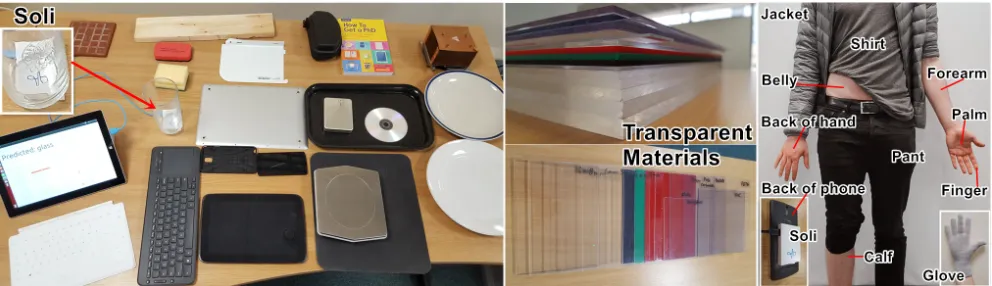
Figure 1. (left) The 26 materials/objects (including air and water) that we evaluate in the first study. (middle) 16 Transparent materials used in the second study, arranged from top to bottom according to the list in Figure 6. (right) 10 different body parts that are being classified in the third study.
ABSTRACT
In RadarCat we present a small, versatile radar-based sys-tem for material and object classification which enables new forms of everyday proximate interaction with digital devices. We demonstrate that we can train and classify different types of materials and objects which we can then recognize in real time. Based on established research designs, we report on the results of three studies, first with 26 materials (including complex composite objects), next with 16 transparent materi-als (with different thickness and varying dyes) and finally 10 body parts from 6 participants. Both leave one-out and 10-fold cross-validation demonstrate that our approach of classi-fication of radar signals using random forest classifier is ro-bust and accurate. We further demonstrate four working ex-amples including a physical object dictionary, painting and photo editing application, body shortcuts and automatic refill based on RadarCat. We conclude with a discussion of our results, limitations and outline future directions.
Author Keywords
Radar; Context-Aware Interaction; Machine Learning; Material Classification; Object Recognition; Ubiquitous Computing
ACM Classification Keywords
H.5.2. Information Interfaces and Presentation (e.g. HCI): User interfaces - Input devices and strategies;
INTRODUCTION
Today we know more about our computing devices than they know about us, their environments, and their use. Existing visions of computing [24] assume knowledge of the world to realize their aims. For example, Weiser’s vision of ubiq-uitous computing [34] relies on sensing, distributed through the fabric of life to help enable context-aware interaction [8]. Tangible user interfaces [11], rely on physical objects which often need to understand their collective configurations while Instrumental Interaction [4] offers an interaction model for post-WIMP interfaces. Richer sensing and understanding of the real world allows new forms and styles of interaction, and hence entirely new classes of user interface to emerge.
[image:1.612.61.557.179.322.2]knowl-edge (e.g., low vision users), consumer interaction (e.g., scales), or industrial automation (e.g., recycling).
Although radar technology [29] has been used for decades in aircraft tracking, security scanners and non-destructive test-ing and evaluation [15], we are not aware of any previous attempt to explore this technology for enabling novel proxi-mate interactions in the field of human-computer interaction and ubiquitous computing. As such, our contributions are:
1. Exploration of radar sensing to capture details of a proxi-mate target and introduction of a technique that shows the potential of re-using tiny radar to:
(a) Classify everyday objects and recognize their orienta-tion, or if a liquid is added.
(b) Classify and differentiate transparent yet visually sim-ilar materials.
(c) Classify different human body parts.
2. Series of studies showing that our sensing approach is ac-curate, which demonstrates the potential of RadarCat in a variety of real-world applications.
3. Identification of practical use-cases for real-world applica-tions, and implementation of four example context-aware applications enabled by RadarCat.
As the use of sensing for material and object classification is not new, we first describe the related work. We draw on the experimental design in previous work to design our experi-ments. By replicating existing experimental approaches our results can be compared against previous and future studies.
Radar Primer
Radar uses an emission of electromagnetic radio waves, gen-erally with a frequency within 1GHz-300GHz [1], which is then reflected back from an object and received by a detec-tor. The time of flight can be used to calculate the distance to an object, and using the Doppler shift the velocity of the object can also be measured. The properties which effect the received radar intensity are the absorption and scatter-ing properties of the material at the wavelengths used, and hence the reflection and transmission properties of the mate-rial, the material’s thickness and shape, the refractive index and hence the specular reflection from the material, as well as the distance to the object from the emitter/receiver. The received signal has contributions from the reflection from the bottom surface, the scattering from the internal structure, and the reflection from the rear surface of the material. There are several physical properties of the material, such as the den-sity, which effect these absorption and scattering coefficients, a review of which can be found in [12]. Objects may be com-posed of single (e.g., copper sheet) or composite materials (e.g., a mobile phone composed of a combination of materi-als such as glass, aluminium, plastics etc.) and have different received radar signals due to their physical properties.
RELATED WORK
Our research, and hence user studies, draw on three differ-ent bodies of research, including object recognition, material classification and approaches in context aware computing.
Object Recognition
Object recognition can be achieved by sampling the object in both destructive and non-destructive ways, or disruptive and non-disruptive ways. Destructive methods can involve taking a physical sample of the object and subjecting it to chemical analysis with different types of chromatography or spectroscopy. This relies on a single material or sampling suf-ficient aspects of composite materials to recognize the over-all object. Methods which involve localised destruction (e.g., etching) are also possible [9] to realize acoustic barcodes.
Non-disruptive and non-destructive approaches rely on sens-ing the object from its real world use. Computer vision tech-niques, which require the object to be visible, well lit and within range for a suitable resolution have been explored in a range of object tracking approaches [37] (e.g., tracking rect-angular objects [32] such as tablets), while depth sensing (Kinect) with infrared can overcome the issue of lighting.
Radar systems, have been used to recognize particular types of aircraft or materials in luggage or body scanners [26]. Ground-penetrating radar (GPR) can be used to detect buried objects [2, 14] such as utility pipes or bones. Object track-ing systems which rely on measurtrack-ing WiFi [3] or Bluetooth signals can also be employed to recognize objects.
Disruptive yet largely non-destructive approaches employ the addition of elements to the object which can be sensed (e.g., RFID [5], visual markers [25], QR codes) or by allowing the objects to emit visual or audio signals (e.g., ultrasonic [10]).
In practice, both destructive and disruptive object recogni-tion approaches can have a significant impact and hence real-world disruption on the physical infrastructure, environment, computational system or services offered [15].
Material Classification
The destructive methods of object identification can also be employed for material classification. Further non-destructive methods such as near-infrared (NIR) spectroscopy is often utilized for analyzing pharmaceutical products. Likewise, millimeter wave and terahertz technology are being used to detect materials from a distance [13] for scientific exploration (e.g., planet hunting) or security purposes. By re-purposing an off-the-shelf radio chipset Zhu et al. [38] have used radar to recognize materials from a distance based on a database of material/radar signal loss from different distance and incident angle [16]. InfraStructs [36] suggest future applications for interaction, using terahertz imaging. While research into the object detection and material recognition has been undertaken on buried objects with GPR images [6, 23]. Regardless of the approach, these sensing methods are complex and costly, let alone the size and power requirements.
as using a laser optical mouse sensor [20] for classification. More recent work in SpecTrans [27], is able to classify trans-parent materials in addition to surface material of everyday objects but does not report on different object states (e.g., filled/non-filled cup) or use with different body parts.
Vision based material classification suffers from being lim-ited to the material qualities which are present on the surface of the object. This can result in confusion where a layer of opaque material (packaging) blocks the primary object of in-terest for classification. RadarCat, by contrast, provides a de-gree of surface level penetration as long as the outer layer is not highly reflective to the radar signal. This allows us to ex-plore materials and classify object without being limited to just what is visible on the surface.
Context Recognition
[image:3.612.54.295.446.579.2]The placement of a device on the body or within the environ-ment can be seen as an aspect of context recognition. As such, existing wearable approaches suggest that material recogni-tion to enable placement detecrecogni-tion is valuable to both locarecogni-tion and activity recognition [8]. Phoneprioception [35] further strengthens this, by suggesting that simple sensors such as an accelerometer and light sensor can be combined to achieve high accuracy in determining a phone placement location, both on body and within ones personal space. Using EMG sensor, Botential [21] is able to detect different placements on the human body. On the other hand, Lien et al. [19] and Song et al. [31] introduce a new approach to sensing finger ges-tures, with an end-to-end radar system (Soli) and classify the gestures using machine learning techniques such as random forest and deep neural network. Similarly, it is also possible to infer the 3D finger and hand position on top of a transparent electric field sensor [18], based on random forest regression.
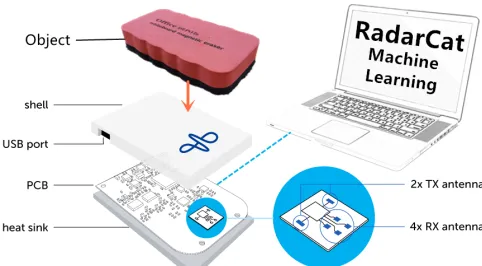
Figure 2. Soli alpha hardware exploded view (not to scale, image adapted from Soli alpha SDK). Object is placed on top of the sensor where raw radar signals are classified using machine learning (ML).
DESIGN OF RADARCAT: RADAR CATEGORIZATION The development of RadarCat was based on iterative tech-nical design decisions. We leveraged improved knowledge and analysis of radar signal signatures, machine learning and classification results in the development of our final approach. The signatures, unique to each object, are measured when the object is proximate to the sensor, and allows us to classify the object using a machine learning technique. Our goal is
to overcome the limitations of camera-based systems, with an embedded sensor that can detect surface material at high speed and accuracy. When the object is placed on or touched by the sensor, the near and fixed distance together with the fixed incident angle makes our classification task straight-forward and allowing for accurate classification. The final design of RadarCat incorporates the following unique capa-bilities and aspects (a) non-destructive, non-tagging, no il-lumination (b) use with surface materials, composite objects and certain body parts and (c) identification of new sensing applications and practical use cases and interaction that are brought to bear by a portable radar technology.
RadarCat Hardware
Our system uses Soli [30] (Figure 1 & 2), a prototype radar device by Google ATAP, designed for capturing subtle finger motion for enabling interaction with computers. For detailed information, we refer the reader to the Soli paper [19]. Gener-ally speaking, Soli is a monostatic radar device and contains multiple antennas (2 transmitters and 4 receivers), providing simultaneous operation of up to 8-channels, using frequency-modulated continuous wave (FMCW) operating in the 57-64 GHz range (center frequency of 60 GHz). The distance from the sensor top to plastic enclosure top is 6mm (Figure 2). In RadarCat, the object to be tested is placed on top of the en-closure, or touched by it as if using a stethoscope.
Currently, the Soli developer kit is only available to selected alpha developers. While Google’s ambition is to have Soli embedded in mobile devices in the near future, we do not claim that our technique works with off-the-shelf hardware just yet, nor do we claim that the hardware is our contribu-tion. Nonetheless, we suggest that our technique should work with other small radar systems such as Walabot [33], that will be available later in 2016. As noted previously, Zhu et al. [38] also explored the reuse of a off-the-shelf radio chipset work-ing as synthetic aperture radar (SAR) for the recognition of four different materials from a distance.
Implementation
We implemented our system in two parts i) a graphical user interface (GUI) in C++ using Qt and ii) a classifier back-end in Java using Weka [7] API. Communication between the GUI and classifier are with sockets, thus, the classifier can run on the same machine, or can be offloaded to a more powerful server via the network, suitable for scenarios involving wear-able devices with limited computing resources, as we show.
Feature extraction
The received radar intensity is influenced by the reflection and transmission properties of the material. Reflected signals from many points both within and on the object surface are overlapping and hence contribute to the received signal.
Figure 3. 8-channels raw radar signals for different materials, red dotted line is the average of 8 channels, from left to right i) aluminium ii) steel iii) copper iv) phone (Nexus5 front) v) phone (Nexus5 back) vi) combined view using the average channel. X-axis represents samples number, where each sample is 555 nanosecond long, as the sample rate is 1.8 mega samples per second.
Figure 4. 8-channels raw radar signals for similar materials, red dotted line is the average of 8 channels, from left to right i) empty glass ii) glass filled with water iii) tile iv) porcelain plate v) ceramic plate vi) combined view using the average channel. As we can see, the radar signals are unique.
square (rms) for each channel (x8); global maxima, global minima, avg, abs and rms for all channels (x1), yielding ex-tra 21 features, resulting in a total of 661 features. Through feature selection analysis, we found the derived features are highly ranked. Nonetheless, the remaining features are also important to fully capture the subtle signal behaviours and are important for training new objects. We experimented with different machine learning classifiers and ended up with two candidates: SVM and random forest. We finally selected ran-dom forest due to its established fast computation time, low memory footprint and in initial tests it outperformed SVM slightly. We trained our random forest classifier using the Weka API, with the default parameters. Once the classifier has been trained, classification can proceed in real-time.
EVALUATION
We conducted multiple studies, based on existing study de-signs, to evaluate several facets of RadarCat to support mul-tiple purposes: i) everyday material and object classifica-tion [8] ii) transparent material classificaclassifica-tion [27] and iii) body parts classification [21]. Our results, both post-hoc and real-time analysis, show that it is accurate and robust. The studies were conducted in a quiet lab, with objects trained and tested in the same location. The Soli sensor was left powered-on for 10 minutes as a warm-up phase before the study.
Study One - Office and Kitchen Objects
This study aims to evaluate the classification accuracy and scalability of RadarCat on a broad range of everyday objects, such as those commonly found in the office and the kitchen. We selected 26 materials from our lab, as shown in Figure 1 and Figure 5. Following the procedure of lightweight material detection by Harrison and Hudson [8], we sampled the 26 materials twice a day for three days.
In each session, the material is being placed ten times on the sensor at different positions and orientation, by removing it and replacing it by hand. The material to be sampled is se-lected randomly from the pool of 26 materials, and no two materials were collected consecutively, to ensure that the sen-sor couple differently with the materials. Each time a mate-rial was sampled, five data points were recorded over a 0.17 second period (30Hz). After five iterations, the radar clutter map was rebuilt to reduce background noise. This produces 300 data points per material (6 sets of 50). Due to this large dataset, we performed offline analysis using the Weka toolkit.
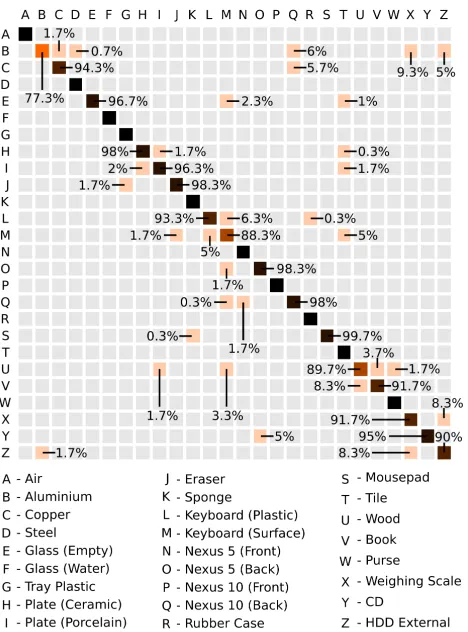
We trained our random forest classifier using five of the six sessions of the collected data and then evaluate the clas-sification accuracy using data from the remaining session. This leave-one-out process is repeated for all combinations of sessions (6 rotations), and the average accuracy is 96.0% (SD=1.3%). The confusion matrix is shown in Figure 5. Con-ventional 10-fold random holdout cross-validation using all samples which yields an optimistic accuracy of 99.97%.
Study Two - Transparent Materials
Figure 5. Confusion matrix for study one - 26 materials and objects commonly found, including air, as shown in Figure 1 (left).
We use the same procedure as the first study to collect the sample data (placing the objects ten times randomly, each time capturing five samples). Since the material is uniform when placed at different positions and orientations, we col-lected data for only three sessions, separated by one day each.
We trained our random forest classifier using two of the three sessions of the collected data and then evaluated the clas-sification accuracy using data from the remaining session. This leave-one-out process is repeated for all combinations of sessions (3 rotations), and the average accuracy is 98.67% (SD=0.9%). The confusion matrix is shown in Figure 6. Con-ventional 10-fold random holdout cross-validation using all samples yields an optimistic accuracy of 100%.
Study Three - Body Parts
[image:5.612.321.566.58.246.2] [image:5.612.321.565.267.454.2]This study aims to evaluate the accuracy of RadarCat on clas-sifying different body parts when they are touched. We ini-tially selected a list of body parts to be tested following Bo-tential [21]. However, from a pilot test, we found that the upper arm and back of arm performed poorly in real time classification, even though post-hoc analysis shows a promis-ing result [21]. Thus, we removed both from our experiment, leaving only palm, back of hand, finger, forearm, belly and calf. We further add in body parts covered by clothes: upper body wear, lower body wear, outerwear and glove, resulting in a total of 11 parts, including air, as shown in Figure 1 and Figure 7.
Figure 6. Confusion matrix for study two - 17 transparent materials.
Figure 7. Confusion matrix for study three - 11 body parts.
We recruited 6 participants from local computer science de-partment (2 females, mean age 20). Each study took about 30 minutes and participants were paid an Amazon voucher (5 GBP). During the data collection session, participants were instructed to put the sensor on different body parts and ap-ply a small amount of pressure, as if they are using a stetho-scope. We use the same procedure as the first and second study (placed ten times, each time capturing five samples). This procedure allows us to capture the variability performed by participant and we collected data for one session.
re-peated for all the gestures. The experimenter then recorded the on-screen result, which was not visible to the participant.
Per-user Classifier
Real time evaluation using per-user classification shows an average accuracy of 90.4% (SD=13.6%) while post-hoc anal-ysis using 10-fold cross validation yields 99.67% average ac-curacy. The confusion matrix is shown in Figure 7.
Generic Classifier
We also perform post-hoc analysis on the generic classifier (leave-one-out, using data from 5 users, test on remaining 1 user; note that they are all wearing different clothing) and the average accuracy is 62.15% (SD=11.69%, with clothing data) and 70.86% (SD=8.44%, clothing data removed), re-spectively. Although there are certain levels of cross user sim-ilarities, it is not reliable enough for general use, suggesting that per-user training is more appropriate for body parts clas-sification. Nonetheless, conventional 10-fold cross validation with all six users data yields 99.82% accuracy (with clothing data) and 99.81% (clothing data removed).
DISCUSSION
While the levels of accuracy are very high overall, and the levels of confusion are very low as show in Figure 5, we can see where single material types and composites can be con-fused, for example, a macbook cover (aluminium) vs. weigh-ing scale (contains aluminium). Likewise, wood can be oc-casionally be confused with a book. However, items (e) and (f), a filled and unfilled glass of water provide no confusion to each other, demonstrating the extent of the signal penetration and reflection required for RadarCat to disambiguate different materials and objects.
The results of this study further show that it is possible to recognize the front and the back of a mobile device, or recog-nize different models (e.g., Nexus5 and Nexus10). While the surface material of different models is the same (glass), the internal composition (different arrangement of the chipset) makes them differentiable by radar sensing. Some objects are composite (e.g., phone, tablet, eraser) which contains differ-ent materials in a thin form factor, while some materials are single and solid (e.g., glass, aluminium, plastic), while others have varying density throughout (e.g., wood). The states of electronic devices (switched on/off) did not affect the result.
Based on our testing, we can suggest that: i) For flat and solid materials (flush), very little training is needed to achieve the accuracy reported here, with the varieties of objects indicated. ii) For flat but low-density materials (sparse, hollow), more training from different positions and orientations of a single axis is needed but it is still possible to achieve high accuracy. iii) For non-flat materials, due to their geometry, more train-ing from different positions and orientations from all three axes is required, which can limit the suitability of this training approach, but is an interesting direction for future research.
Experimentation with a smaller set of features, and a larger range of objects, in a wider set of scenarios is also required. Deep-learning methods are applicable to improve the scala-bility and generalization to everyday objects (e.g., Apples of
different sizes). In addition, the extent of material character-istics (e.g., types of liquid) is an area of rich future work.
Little can be added to the results presented in Figure 6 due to the high levels of accuracy reported. Given the frequency range of the radar we suggest it is the absorption/scattering properties and concentration of the dye we are classifying along with the different thicknesses of materials. This means, we can not only differentiate visually similar materials like different types of transparent plastics but also color. The ex-tent of this, given different dye properties, thicknesses, mate-rial surface characteristics requires further exploration.
Finally, the results of the body parts study demonstrate that the forearm (e), belly (f) and calf(g) confused each other with, e - f (0.11), e to g(0.28), g to e (0.22), f - g (0.11), while the rest of body parts performed well. While this requires further study, we believe that this is due to these three body parts having somewhat similar structures (flat with mostly tissue and muscle) and hence appear similar to RadarCat, given that millimeter waves only penetrate shallowly into human tissue, typically less than 1mm [22].
In contrast, the palm, finger and back of hand each have very different structure near the 1mm range that the radar can “see”, due to the shape, nature of skin, bone and blood ves-sels near the surface, thus RadarCat differentiates this easily and has a higher accuracy. We also observe certain level of variability across users. For example, P1 has perfect accuracy on all trials on all body parts, while P4 has good accuracy on forearm and belly but 0 correct on calf and P5 has perfect ac-curacy on calf but 0 correct on forearm and belly (both are recognized as calf). Finally, body parts covered by clothes are often very accurate (Figure 7).
EXAMPLE USE SCENARIOS
There are many immediate applications that RadarCat can support (e.g., automatic waste sorting). Here we designed and implemented four example applications that demonstrate dif-ferent interaction possibilities if the proximate target material or object is known (see Figure 8 and video figure). Following this, we speculate about potential applications and use cases.
Current Applications
Physical object dictionary - when an object is placed on the sensor (Figure 8a), the system can recognize the object and automatically search for relevant information or language translation, and then feedback this to the user. This can be useful because searching online often requires the user to know the name of an object in the first place. However, there are times when users are not aware of the name of an item -e.g., a specific phone model, which will make searching for it difficult. It also aids in learning environments because we can relate physical objects in-situ to improve learning efficiency.
Figure 8. Four example applications to demonstrate the interaction possibilities of RadarCat, from left to right a) physical object dictionary b) tangible painting app c) context-aware interaction and body shortcuts d) automatic refill.
while touching plastic of different color or thickness changes the brush’s paint color and size.
Context-aware interaction and body shortcuts- with Radar-Cat attached to the back of a phone (as shown in Figure 8c), the system can tell whether the phone is held by bare palm or palm wearing a glove. This allows the phone to switch in-telligently to easy mode - where the buttons are considerably larger to accommodate the fat finger problem when wearing a glove. In addition, touching different body parts activates different shortcut commands instantly. For example, touch-ing the back of the hand, tummy (belly/trunk) and leg can be programmed to launch clock, food or map applications, re-spectively. It is also possible to know whether the phone is placed on the table, the sofa or inside the pocket (placement aware), facing up or facing down (situation aware), and al-low the phone to switch into different modes automatically to adapt the environment, such as silent mode or loud speaker mode or turning the screen off to save battery.
Automatic refill - in a bar or restaurant scenario, where RadarCat sensors are embedded ubiquitously beneath the sur-face of a table, the system can tell whether a cup is full or empty, and if it is the latter, the system can alert the waiter for refill, all without intervention of the user (Figure 8d).
Future Applications
Recycle center- human intervention is often still needed to separate different types of waste, such as metal, glass and wood. With RadarCat, sorting waste can be automated.
Assisting the visually impaired- while one’s sense or touch and smell can mitigate many of the challenges faced with-out sight, RadarCat once embedded in gloves or shoes can enhance ones understanding of the environment around you. Tactile paving on the sidewalk or limited braile interfaces might be replaced in the future.
Smart medical devices- current digital medical devices used outside the body, such as thermometers or stethoscopes still require the operator to manually note the different body parts being measured. Future devices with RadarCat embedded, can allow the automatic tagging of recorded temperature or sounds with the body part as it is detected.
LIMITATIONS
While RadarCat is a multi-purpose sensing system and achieves high accuracy in the three studies we conducted, it will not be suitable in all situations. For example, although our studies show that it can differentiate acrylic with different dyes with varying absorption/scattering properties (and hence
colors), this is mainly due to the high concentration of the dye component. In contrast, we were not able to differentiate sin-gle “stick-it note” of different colors. Therefore, in certain tasks, especially those involving identifying thin surface ma-terial based on color and texture we suggest imaging-based methods as described in our related work.
The radar hardware we used (Soli) is very sensitive, which in-troduces new problems. The high degree of sensitivity allows us to differentiate visually similar materials at high accuracy but this can be affected by background noise. In fact, the radar will gain clutter (reflections of unwanted objects) over time, especially before the hardware has reached a steady state tem-perature, or due to the movement or environmental changes. Radar clutter can impact the recognition rate, because the training data were collected with clutter removed. In practice, the clutter map can be easily rebuilt or by employing adaptive clutter removal [17]. Next version of Soli device removes this heat issue, and hence addressing the signal drift issue.
CONCLUSION AND FUTURE WORK
In this paper, we have presented RadarCat, a new sensing technique to provide versatile, multi-purpose material and ob-ject classification which enables novel forms of interaction. Our studies show that it is accurate and robust and we believe we have demonstrated its potential and implications in every-day interaction. Our technique can be used independently or combined with other sensing approaches. This can improve the sensing and computational edifice around which we real-ize new mobile, wearable and context-aware user interfaces.
Future work should explore a smaller set of channels, fea-tures and fewer sample points to explore the limits of object discrimination. For objects made of similar materials with strong radar reflections, investigation of its signature along different dimensions should be undertaken. In addition, the materials scattering and absorption properties at these wave-lengths should be investigated further. We further wish to em-pirically validate the observed ability to recognize different fruits or credit cards, or counting the number of poker cards, or differentiating liquid content in a container. Finally, we would like to explore ways to encode information into an ob-ject, or stacking multiple layers of different materials which can be sensed, similar to [36] but in real time for interaction.
ACKNOWLEDGEMENT
REFERENCES
1. IEEE standard letter designations for radar-frequency bands.IEEE Std 521-1984(Nov 1984), 1–8.
2. Al-Nuaimy, W., Huang, Y., Nakhkash, M., Fang, M., Nguyen, V., and Eriksen, A. Automatic detection of buried utilities and solid objects with gpr using neural networks and pattern recognition.Journal of Applied Geophysics 43, 2 (2000), 157–165.
3. Bahl, P., and Padmanabhan, V. N. RADAR: an in-building rf-based user location and tracking system. InProceedings IEEE INFOCOM 2000, The Conference on Computer Communications, Nineteenth Annual Joint Conference of the IEEE Computer and Communications Societies, Reaching the Promised Land of
Communications, Tel Aviv, Israel, March 26-30, 2000
(2000), 775–784.
4. Beaudouin-Lafon, M. Instrumental interaction: An interaction model for designing post-wimp user
interfaces. InProceedings of the SIGCHI Conference on Human Factors in Computing Systems, CHI ’00, ACM (New York, NY, USA, 2000), 446–453.
5. Buettner, M., Prasad, R., Philipose, M., and Wetherall, D. Recognizing daily activities with rfid-based sensors. InProceedings of the 11th International Conference on Ubiquitous Computing, UbiComp ’09, ACM (New York, NY, USA, 2009), 51–60.
6. El-Mahallawy, M. S., and Hashim, M. Material classification of underground utilities from gpr images using dct-based svm approach.Geoscience and Remote Sensing Letters, IEEE 10, 6 (2013), 1542–1546.
7. Hall, M., Frank, E., Holmes, G., Pfahringer, B., Reutemann, P., and Witten, I. H. The weka data mining software: An update.SIGKDD Explor. Newsl. 11, 1 (Nov. 2009), 10–18.
8. Harrison, C., and Hudson, S. E. Lightweight material detection for placement-aware mobile computing. In
Proceedings of the 21st Annual ACM Symposium on User Interface Software and Technology, UIST ’08, ACM (New York, NY, USA, 2008), 279–282.
9. Harrison, C., Xiao, R., and Hudson, S. Acoustic barcodes: Passive, durable and inexpensive notched identification tags. InProceedings of the 25th Annual ACM Symposium on User Interface Software and Technology, UIST ’12, ACM (New York, NY, USA, 2012), 563–568.
10. Harter, A., Hopper, A., Steggles, P., Ward, A., and Webster, P. The anatomy of a context-aware application.
Wirel. Netw. 8, 2/3 (Mar. 2002), 187–197.
11. Ishii, H., and Ullmer, B. Tangible bits: Towards seamless interfaces between people, bits and atoms. In
Proceedings of the ACM SIGCHI Conference on Human Factors in Computing Systems, CHI ’97, ACM (New York, NY, USA, 1997), 234–241.
12. Jol, H. M.Ground penetrating radar theory and applications. Elsevier, 2008.
13. Kemp, M. C. Millimetre wave and terahertz technology for detection of concealed threats - a review. InInfrared and Millimeter Waves, 2007 and the 2007 15th
International Conference on Terahertz Electronics. IRMMW-THz. Joint 32nd International Conference on
(Sept 2007), 647–648.
14. Khan, U. S., Al-Nuaimy, W., and El-Samie, F. E. A. Detection of landmines and underground utilities from acoustic and gpr images with a cepstral approach.
Journal of Visual Communication and Image Representation 21, 7 (2010), 731–740.
15. Kharkovsky, S., and Zoughi, R. Microwave and millimeter wave nondestructive testing and evaluation -overview and recent advances.IEEE Instrumentation Measurement Magazine 10, 2 (April 2007), 26–38.
16. Langen, B., Lober, G., and Herzig, W. Reflection and transmission behaviour of building materials at 60 ghz. InPersonal, Indoor and Mobile Radio Communications, 1994. Wireless Networks - Catching the Mobile Future., 5th IEEE International Symposium on(Sep 1994), 505–509 vol.2.
17. Laput, G., Yang, C., Xiao, R., Sample, A., and Harrison, C. Em-sense: Touch recognition of uninstrumented, electrical and electromechanical objects. InProceedings of the 28th Annual ACM Symposium on User Interface Software and Technology, UIST ’15, ACM (New York, NY, USA, 2015), 157–166.
18. Le Goc, M., Taylor, S., Izadi, S., and Keskin, C. A low-cost transparent electric field sensor for 3d interaction on mobile devices. InProceedings of the 32Nd Annual ACM Conference on Human Factors in Computing Systems, CHI ’14, ACM (New York, NY, USA, 2014), 3167–3170.
19. Lien, J., Gillian, N., Karagozler, M. E., Amihood, P., Schwesig, C., Olson, E., Raja, H., and Poupyrev, I. Soli: Ubiquitous gesture sensing with millimeter wave radar.
ACM Trans. Graph. 35, 4 (July 2016), 142:1–142:19.
20. Maldonado, A., Alvarez, H., and Beetz, M. Improving robot manipulation through fingertip perception. In
Intelligent Robots and Systems (IROS), 2012 IEEE/RSJ International Conference on(Oct 2012), 2947–2954.
21. Matthies, D. J. C., Perrault, S. T., Urban, B., and Zhao, S. Botential: Localizing on-body gestures by measuring electrical signatures on the human skin. InProceedings of the 17th International Conference on
Human-Computer Interaction with Mobile Devices and Services, MobileHCI ’15, ACM (New York, NY, USA, 2015), 207–216.
22. Nelson, D. A., Nelson, M. T., Walters, T. J., and Mason, P. A. Skin heating effects of millimeter-wave
23. Pasolli, E., Melgani, F., and Donelli, M. Automatic analysis of gpr images: A pattern-recognition approach.
Geoscience and Remote Sensing, IEEE Transactions on 47, 7 (2009), 2206–2217.
24. Quigley, A., Dix, A., Mackay, W. E., Ishii, H., and Steimle, J. Visions and visioning in chi: Chi 2013 special interest group meeting. InCHI ’13 Extended Abstracts on Human Factors in Computing Systems, CHI EA ’13, ACM (New York, NY, USA, 2013), 2545–2548.
25. Rekimoto, J., and Ayatsuka, Y. Cybercode: Designing augmented reality environments with visual tags. In
Proceedings of DARE 2000 on Designing Augmented Reality Environments, DARE ’00, ACM (New York, NY, USA, 2000), 1–10.
26. Roodaki, P. M., Taghian, F., Bashirzadeh, S., and Jalaali, M. A survey of millimeter-wave technologies. In
Electrical and Control Engineering (ICECE), 2011 International Conference on(Sept 2011), 5726–5728.
27. Sato, M., Yoshida, S., Olwal, A., Shi, B., Hiyama, A., Tanikawa, T., Hirose, M., and Raskar, R. Spectrans: Versatile material classification for interaction with textureless, specular and transparent surfaces. In
Proceedings of the 33rd Annual ACM Conference on Human Factors in Computing Systems, CHI ’15, ACM (New York, NY, USA, 2015), 2191–2200.
28. Sharan, L., Liu, C., Rosenholtz, R., and Adelson, E. H. Recognizing materials using perceptually inspired features.International Journal of Computer Vision 103, 3 (2013), 348–371.
29. Skolnik, M. I. Introduction to radar.Radar Handbook 2
(1962).
30. Project Soli.
https://www.google.com/atap/project-soli/.
31. Song, J., Wang, S., Lien, J., Poupyrev, I., and Hilliges, O. Interacting with soli: Exploring fine-grained dynamic gesture recognition in the radio-frequency spectrum. In
Proceedings of the 29th Annual ACM Symposium on User Interface Software and Technology, UIST ’16, ACM (New York, NY, USA, 2016).
32. Sugama, Y., Murase, T., and Fujii, Y. Projection based virtual tablets system involving robust tracking of rectangular objects and hands. InProceedings of the 7th Augmented Human International Conference 2016, AH ’16, ACM (New York, NY, USA, 2016), 33:1–33:2.
33. Walabot.http://walabot.com/.
34. Weiser, M. The computer for the 21st century.
SIGMOBILE Mob. Comput. Commun. Rev. 3, 3 (July 1999), 3–11.
35. Wiese, J., Saponas, T. S., and Brush, A. B.
Phoneprioception: Enabling mobile phones to infer where they are kept. InProceedings of the SIGCHI Conference on Human Factors in Computing Systems, CHI ’13, ACM (New York, NY, USA, 2013),
2157–2166.
36. Willis, K. D. D., and Wilson, A. D. Infrastructs: Fabricating information inside physical objects for imaging in the terahertz region.ACM Trans. Graph. 32, 4 (July 2013), 138:1–138:10.
37. Yilmaz, A., Javed, O., and Shah, M. Object tracking: A survey.ACM Comput. Surv. 38, 4 (Dec. 2006).