1 STUDENT UNDERSTANDINGS OF EVIDENCE-BASED MANAGEMENT:
WAYS OF DOING AND BEING
This paper advances the literature on Evidence Based Management (EBMgt) by exploring
how students understand EBMgt. We conduct a qualitative inductive study of undergraduate
students who were introduced to EBMgt and applied evidence-based processes as part of an
introductory management course. Our findings identify four qualitatively different student
understandings of EBMgt: (1) EBMgt as an unrealistic way of doing management; (2) EBMgt
as a way of doing management in particular situations; (3) EBMgt as a generally useful way
of doing management; and (4) EBMgt as an ideal way of being a manager. We find that
variations in student understanding are based upon perceptions of the utility of
evidence-based processes, the stance taken towards scientific evidence as a form of knowledge, and the
focus of reflection about the practice of EBMgt. By opening up insight into the how
undergraduate students understand and make sense of EBMgt as ways of doing and being, we
contribute to the theoretical literature on EBMgt and to the practice of EBMgt teaching and
learning and offer new paths for future research.
2
Educators and scholars have focused increasing attention on evidence-based management
(EBMgt) over the past decade. EBMgt is defined as ‘making decisions through the conscientious,
explicit, and judicious use of four sources of information: practitioner expertise and judgment,
evidence from the local context, a critical evaluation of the best available research evidence, and the
perspectives of those people who might be affected by the decision’ (Briner, Denyer, & Rousseau,
2009: 19). The growth and acceptance of EBMgt as an important topic in management education is
evident in publications such as AMLE’s recent special issue (Rynes, Rousseau, & Barends, 2014),
the Oxford Handbook of EBMgt (Rousseau, 2012), and specialist textbooks (Latham, 2009; Pearce,
2013), as well as the establishment of an international community of scholars, educators and
practitioners interested in evidence-based approaches.
The literature can be divided into two broad streams that reflect the maturing of EBMgt and
the need for ‘educators who help develop the professional skills on which EBMgt rests’ (Rousseau,
2012: xxv). The first stream of literature establishes the conceptual boundaries of EBMgt and
engages in scholarly debate and advocacy of why management educators should teach
evidence-informed decision making (Morrell & Learmonth, 2015; Pfeffer & Sutton, 2007; Rousseau, 2006;
Rousseau & McCarthy, 2007; Tourish, 2013). While some scholars note that evidence is a contested
concept within management and organizational studies (Learmonth, 2006; Morrell, 2008; Reay,
Berta, & Kohn, 2009), this literature stream predominantly argues that teaching students about
EBMgt develops them into ‘more sophisticated and informed consumer(s) of business ideas’ (Pfeffer
& Sutton, 2006: 36) able to critically appraise the legitimacy of information sources (Kepes, Bennett,
& McDaniel, 2014; Kovner, Elton, & Billings, 2000; Tranfield, Denyer, & Smart, 2003). Through
learning about EBMgt, it is proposed that students gain the skills needed to translate research
evidence into local solutions to organizational problems, thereby becoming more effective managers
and problem-solvers in the future (Baba & HakemZadeh, 2012; Barends & Briner, 2014; Graen,
2009). While this literature stream acknowledges that some management students may resist learning
3
relatively superficial. Insight into how students understand and make sense of course content and
materials related to EBMgt is lacking, especially at the undergraduate level where novice business
students are introduced to evidence-based practice for the first time.
The second stream of literature moves beyond advocating for the theoretical utility of
EBMgt to exploring the adoption and use of EBMgt by management educators. Attention has tended
to focus either on examining the uptake of EBMgt in programs and specialist courses (Briner &
Walshe, 2014; Charlier, Brown, & Rynes, 2011; Dietz et al., 2014) or on specific classroom
practices, teaching techniques and assessment strategies through which EBMgt can be taught (Erez
& Grant, 2014; Gamble & Jelley, 2014; Goodman & O'Brien, 2012; Wright, Middleton, Greenfield,
Williams, & Brazil, 2016a). A core aim of this literature stream is to advance the translation of the
concept of EBMgt into educator practice. Yet, although this literature is underpinned by an
assumption that students learn about EBMgt through exposure to the concept by educators, very few
empirical studies have collected data from, or about, students (an exception is Wright, Nichols,
McKechnie, & McCarthy, 2013). Thus, little is known about the impact of educators’ teaching
choices on student understanding of EBMgt.
Together, these two literature streams have advanced the field of management education by
enriching debates on the nature, use and value of EBMgt and by building a foundation for its
incorporation into management courses, curricula and teaching practices. However, much more work
is needed to improve pedagogy with respect to EBMgt. Both literature streams have taken an
educator-focused rather than student-focused perspective and offer limited explanation of how
students make sense of their course learning experiences with the concept of EBMgt. This gap in the
literature is greatest for undergraduate students, which constrains capacity to develop these students,
as future managers, into evidence-based practitioners. Further advances in the theory and practice of
EBMgt require management educators who are ‘striving continually to learn about students’
understanding [of EBMgt] and the effects of teaching on it’ (Ramsden, 2003: 8). As EBMgt matures,
4
accounts of teaching experiences with EBMgt to build empirically-grounded pedagogical insights
into how different types of students interpret, comprehend and experience EBMgt. Therefore, we aim
to contribute to the literature by addressing the following research question: How do undergraduate students understand EBMgt?
We investigate our research question through a qualitative inductive study of undergraduate
students’ experience with applying EBMgt and reflecting on its meaning and utility for practice. The
context for our study is a large undergraduate introductory management course. In response to our
research question, our findings reveal important variations in students’ understanding of EBMgt after
being introduced to and applying the concept for the first time. The undergraduate students in our
study expressed four qualitatively different understandings: (1) EBMgt is an unrealistic way of doing
management; (2) EBMgt is a way of doing management in particular situations; (3) EBMgt is a
generally useful way of doing management; and (4) EBMgt is an ideal way of being a manager. Our
findings show an individual student’s understanding is based upon their perception of the utility of
evidence-based decision processes, their stance towards scientific evidence as a form of knowledge,
and the focus of their reflection about the practice of EBMgt.
Our findings make two contributions to the literature. Our first contribution lies in our shift
away from the dominant educator perspective on EBMgt to exploration of the student perspective.
Whereas EBMgt scholars in the past have asked, ‘how can we teach EBMgt in ways that are
enlivening and convincing?’ (Bartenuk, 2014: 102), our study reframes the question away from
educators to consider how students understand EBMgt when we teach it. In doing so, we extend the
literature by opening up insight into the qualitatively different understandings of EBMgt that students
construct, based on their accounts of experience with EBMgt when engaging with a particular
management case, in the context of a pull approach to teaching. While prior scholars have speculated
about the positive and negative experiences that students have when educators try to teach EBMgt
(Erez & Grant, 2014; Goodman & O'Brien, 2012; Rousseau & McCarthy, 2007), our findings
5
rigorous analysis of students accounts of their own experience with EBMgt. We uncover variations
in student’s understandings of EBMgt that have important implications for the theory and practice of
EBMgt and its teaching by management educators.
Our second contribution arises from our focus on gaining deeper insight into the
undergraduate student experience of EBMgt. While the EBMgt literature has tended to emphasise the
postgraduate, executive and MBA levels (Charlier et al., 2011; Dietz et al., 2014; Graen, 2009;
Klimoski & Amos, 2012; Rubin & Dierdorff, 2009) and specialist courses (Briner & Walshe, 2014;
Glaub, Frese, Fischer, & Hoppe, 2015; Trank, 2014), we broaden the scope of EBMgt teaching and
learning to include novice management students in generalist first-year undergraduate courses.
Undergraduate students are ‘the next generation of future managers’ and the uptake of EBMgt in
organizations depends, in no small part, on engaging them in evidence-based practice during their
studies (Rousseau & McCarthy, 2007). However, whether it is possible to teach EBMgt
meaningfully in undergraduate programs has long been a source of debate.
On the one hand, introductory management and organizational behaviour courses are
‘critical to developing students’ schemas for management’ (Thompson, Purdy, & Fandt, 1997: 218).
Thus, exposing novice students to EBMgt at this early stage of study has potential benefit in seeding
evidence-based ways of doing, thinking and behaving as part of their future professional practice
(Dall'Alba, 2009). On the other hand, in comparison to students in more advanced undergraduate
courses (Kachra & Schneitz, 2008), students in first-year introductory courses are unfamiliar with the
theory and practice of management (Wright & Gilmore, 2012). They also lack knowledge and
personal experience of organizational contexts (Thompson et al., 1997). Our findings contribute to
the literature by offering new insight into students’ experiences of EBMgt when it is taught early in
undergraduate programs. We show that undergraduate students have the capacity to engage with
EBMgt very early in their programs of study through specifically targeted learning and assessment
activities in generalist introductory courses. We also bring to the surface the variations in
6
The remainder of the paper is structured as follows. First, we present a theoretical
background to the teaching and learning of EBMgt in management education. Next, we describe and
justify our methods for investigating our research question by collecting and analysing qualitative
data in a large introductory management course. We then report our findings regarding the four
qualitatively different understandings of EBMgt as ways of doing and being. Finally, the paper
concludes with a discussion of how our findings offer theoretical contributions to the literature,
practical implications for teaching and learning of EBMgt, and new paths for future research.
THEORETICAL BACKGROUND
EBMgt has become ‘influential’ in the field of management education even as scholarly
conversations have opened up about its assumptions and pedagogical implications (Morrell &
Learmonth, 2015: 526). In this section, we outline the major developments in the literature regarding
teaching of EBMgt and we call attention to the need for greater insight into the impact of teaching on
student understanding of evidence-based practice.
Teaching EBMgt as Professional Education
Scholars have looked to the literature on professional education for pedagogical insight to
guide teaching of EBMgt. Borrowing from Schulman’s (2005) work on signature pedagogies in
professions, Trank (2014: 381) has proposed that introducing EBMgt into management education ‘in
broad strokes … fits with the ideal that professional schools create a signature pedagogy … [which]
must measure up to the standards not just of the academy, but also of particular professions’.
According to Schulman (2005: 52), signature pedagogies are defined as ‘the types of teaching that
organize the fundamental ways in which future practitioners are educated for their new professions’.
Given that signature pedagogies ‘implicitly define what counts as knowledge in the field and how
things become known’ (Schulman, 2005: 54), proponents argue EBMgt should be approached as a
pedagogical means for reclaiming professionalism in business education (Trank & Rynes, 2003). In
doing so, teaching of EBMgt may revive the original founding mission of American business schools
7
Conceptualizing EBMgt as fundamental to professional education assumes that management
students are ‘apprentice professionals’ who educators are preparing ‘to be active consumers and
users of research as professionals’ after they graduate (Trank, 2014: 384). How management
graduates ‘earn their pay as professionals’ (Graen, 2009: 255) is justified and legitimated by their
ability to apply evidence-based processes to decisions in organizational contexts (Abbott, 1988).
Consistent with the literature on professional education and training (Dall'Alba, 2009; Schon, 1983),
learning about EBMgt can be staged along a novice to expert pathway (Benner, 1982). Novice
management students are introduced to the concept of EBMgt and ‘progress toward greater expertise
by developing more systematic and valid models of professional practice’ through a continuous cycle
of knowledge acquisition, practice, and reflection (Rousseau & McCarthy, 2007: 92). As students
move along the novice to expert pathway, they try on professional identities as evidence-based
practitioners (Barends & Briner, 2014; Wright et al., 2016a) and business schools function as identity
workspaces for professional education (Petriglieri & Petriglieri, 2010).
These emerging ideas about the place of EBMgt in the professional education of management
students require further research and development. The most pressing need for research lies at the
undergraduate end of the novice-expert pathway where the potential to meaningfully teach EBMgt is
subject to debate. As Rousseau and McCarthy (2007: 97) ask, ‘Can the value of EBMgt techniques
be appreciated by individuals with no managerial experience?’ The professional education literature
recommends introducing the principles of professional practice, including evidence-based practice,
as early as possible so that students become familiar with what they are expected to know and be
able to do as a professional (Barends & Briner, 2014; Scanlon, 2011; Ungaretti, Thompson, Miller,
& Peterson, 2015). In a similar vein, some scholars argue that EBMgt ‘should be taught at all levels of management education … [because] the basic principles can be conveyed to and understood by
any management school student’ (Briner & Walshe, 2014: 430, italics in original). Yet little
8
students’ understanding of EBMgt as they are ‘taking the first steps along the path to becoming an
expert’ (Rousseau, 2006: 265) through professional education in business schools.
Push and Pull Approaches to Teaching EBMgt
Literature conceptualizing EBMgt as a signature pedagogy for educating business students
is supported by other literature that offers guidance on concrete practices for teaching EBMgt. These
practices can broadly be distinguished into ‘push’ and ‘pull’ approaches (Kepes et al., 2014; Rynes et
al., 2014). Push approaches involve management educators presenting students with the best
available evidence on a particular topic. Educators can use course and curricula design to ‘push’
evidence-based principles derived from research onto students, such as designing leadership courses
in MBA programs around the most robust and current research findings on the topic of leadership
development (Klimoski & Amos, 2012). Pushing also occurs through teaching resources and
textbooks that report research-based principles on topics such as organizational behaviour and human
resources management (Latham, 2009; Pearce, 2013; Pfeffer & Sutton, 2006). Finally, instructors
can push best available research findings on a topic onto students during classroom activities,
interactions, and discussions (Charlier, 2014; Erez & Grant, 2014; Rousseau, 2006).
Pull approaches to teaching EBMgt complement push approaches by helping students attain
the metaskills and procedural knowledge for evidence-based practice (Rousseau, 2006). Rather than
having evidence ‘pushed’ on them as declarative knowledge about principles and research findings,
students are ‘pulled’ towards scientific evidence by management educators teaching them the general
skills and processes of evidence-based practice that can inform decision making about any topic
(Goodman, Shayne, & Wood, 2014; Rynes et al., 2014). Students engage in evidence-based
processes themselves by asking a question, acquiring evidence from research findings and local
sources, appraising the credibility and trustworthiness of evidence, applying the principles derived
from best available evidence to make a decision, and analysing the results (Kepes et al., 2014).
Pull approaches aim to teach students foundational skills in scientific research evaluation
9
Tranfield et al., 2003), performing bibliographic searches (Goodman et al., 2014), evaluating the
quality of different sources of evidence (Kepes et al., 2014; Reay et al., 2009), and producing local
evidence (Dietz et al., 2014). Pull approaches to EBMgt can also be incorporated into teaching
practices already used by management educators. For example, students can be asked to apply
evidence-based processes to analyse business case studies (Gamble & Jelley, 2014; Goodman &
O'Brien, 2012), current events (Wright et al., 2013), decisions made while playing business
simulations (Rousseau & McCarthy, 2007), and problem-based learning (Ungaretti et al., 2015).
Reporting of push and pull approaches in the literature has tended to take an
educator-focused perspective. Scholars make claims that teaching using push and pull approaches can
‘convince students’ about the utility of EBMgt (Erez & Grant, 2014: 115) and that students ‘come
away with … a respect for evidence and an understanding of the basic principle of evidence-based
practice’ (Barends & Briner, 2014: 482). However, these claims are typically based on educators’
first-person accounts rather than systematic collection and analysis of student accounts. Data on
whether students are convinced by EBMgt, and what their understanding is after being exposed to
EBMgt by course instructors, are ‘sparse’ (Dietz et al., 2014: 410). Even though proponents of
EBMgt tend to position ‘stories as an untrustworthy form of evidence’ (Morrell & Learmonth, 2015:
530), most reporting of the impacts of push and pull approaches on student learning can be
characterized as educator’s personal stories (e.g. Briner & Walshe, 2014; Charlier, 2014; Dietz et al.,
2014; Erez & Grant, 2014; Rousseau, 2006). Moreover, these educator stories tend to cluster at the
MBA and postgraduate levels. While scholars argue that their push and pull approaches for teaching
EBMgt have utility for student learning at the undergraduate level (Briner & Walshe, 2014; Erez &
Grant, 2014; Rousseau, 2006), the literature is relatively silent on undergraduate student perspectives
and their experiences of push and pull approaches.
Student Learning and EBMgt
Together, professional education pedagogy and push-pull approaches offer an invaluable
10
view on EBMgt. Mirroring Morrell and Learmonth’s (2015) criticism of the EBMgt literature for its
privileging of the interests of managers, we note that educator’s perspectives dominate the literature
on teaching and learning about EBMgt. Moreover, just as Reay et al. (2009: 13) called out scholars
for overreliance on ‘opinion pieces advocating the use of EBMgt’, we note a similar weakness in the
development of EBMgt pedagogy where little systematic data has been collected and analysed.
Recognising the irony of the dearth of evidence supporting EBMgt teaching practices, some scholars
have cautioned that educator claims about impacts on student learning ‘should be taken with a grain
of salt’ and require more rigorous evaluation (Erez & Grant, 2014: 117).
We propose that a worthwhile next step in generating research-based knowledge of student
learning about EBMgt is to focus empirical investigation on students’ understanding of EBMgt.
Student learning in academic disciplines is ‘fundamentally about changes in understanding of reality
and … [coming] to understand phenomena in the way that subject experts do’ (Ramsden, 2003: 31).
Not surprisingly, then, a common theme in the EBMgt literature is that understanding is a learning goal of highest priority. For example, Graen (2009: 255) argues that management educators have as
‘our primary responsibility … to prepare management students to understand EBMgt well enough to
use it’. Other scholars similarly note that educators ‘need to help these students understand how to
utilize EBMgt within their studies’ (Baack, Miller, Williams, Dierdorff, & Bielmeier, 2007: 144) and
to understand that ‘evidence-based practice is a way of looking at the world’ (Barends & Briner,
2014: 481) and ‘a way of thinking’ (Pfeffer & Sutton, 2006: 219). Elaborating further on the priority
for student understanding of EBMgt, Rousseau and McCarthy (2007: 97) note ‘our goals are learner
awareness, appreciation, and active use of relevant high-quality evidence’.
To better examine student understanding of EBMgt, we concentrate our attention in this
article on undergraduate students. Specifically we ask: How do undergraduate students understand
EBMgt? As noted previously, improving EBMgt pedagogy requires deeper insight into how novice
11
the early stages of professional education in business schools. Our focus on undergraduate student
understanding of EBMgt is guided by this definition:
Learning in educational institutions should be about changing the ways in which learners understand, or experience, or conceptualize the world around them. The ‘world around them’ includes the concepts and methods that are characteristic of the field of learning in which they are studying … From this point of view, the vital competences in academic disciplines and the application of knowledge consist in understanding. By understanding, I mean the way in which students apprehend and discern phenomena related to the subject (Ramsden, 2003: 6, italics in original).
In the remainder of the article, we explore undergraduate students’ understanding of EBMgt
through a qualitative inductive study. In doing so, we seek to build on the existing literature
concerning professional education pedagogy and push and pull approaches by bringing a student
perspective to teaching and learning of EBMgt. This is an important contribution because ‘we can
only improve the quality of [EBMgt] education if we study its effects on students and look at the
experiences through their eyes’ (Ramsden, 2003: 20).
METHOD
Research Setting and EBMgt Educational Intervention
The research was conducted in an Introductory Management course at a large university in a
major Australian city. The course is mandatory in the AACSB-accredited undergraduate business
management and commerce programs and is generally taken by students in the first year of their
program of study. Taught over a 13 week semester, the primary course objective is to introduce
novice business students to foundational management theories on the planning, organizing, leading
and controlling functions of management, and their use in practice. Student enrolments are typically
in excess of 1200 students, with students required to attend a two-hour lecture and a one-hour tutorial
each week. The course lecturer delivers multiple lectures each week to groups of 400 students and a
team of teaching assistants present tutorial classes to groups of 20 students. Of the four authors of
this paper, one was the course lecturer, while another worked as a course tutor. The other authors
12
The concept of EBMgt was first introduced in a lecture in the second week of the course.
Students then read Rousseau and McCarthy’s (2007) article about educating managers from an
evidence-based perspective as preparation for small-group discussions in the tutorial. After this
initial familiarization with EBMgt, students participated in an online simulation to provide a shared
experiential context for subsequent application of EBMgt (Proserpio & Gioia, 2007). Two criteria
guided the choice of simulation. First, students in the course needed to be able to ‘demonstrate and
practice the relevant competencies’ in the simulation (Salas, Wildman, & Piccolo, 2009: 565).
Simulations without a competitive industry context and which do not require specialized business
knowledge are more appropriate for developing the general problem-solving skills of novice business
students (Lovelace, Eggers, & Dyck, 2016; Thompson et al., 1997). Second, because of limited time
available in the curriculum, the simulation needed to engage student interest in a single session of
play. Research shows simulations that are team-based and have a storyline linked to crisis situations
engage students both cognitively and socioemotionally (Doh, 2009; Waller, Lei, & Pratten, 2014).
The ‘Leadership and Team Simulation: Everest V2’ released by Harvard Business
Publishing satisfied these criteria. The simulation storyline centres on a virtual commercial
expedition to climb Mount Everest, with participants assigned to different roles on five-person teams
which hike through five camps to the summit through successive rounds of play. Participants strive
to achieve individual and team goals as they make decisions during each round of play and
accommodate for asymmetric information and dynamic constraints such as weather, physical health,
resources, time and risk of death. Students played the simulation during a single class session in
computer laboratories under the supervision of course teaching staff. Students were asked to adopt
the persona and goals of their assigned role and to discuss and negotiate decisions within their hiking
team, keeping a record of team discussion and the factors influencing decisions in a logbook.
After participating in the simulation, students applied an EBMgt approach to their
experience by completing the following tasks. Students reviewed their simulation log book and
13
management theory and evidence. Examples of problems included team culture and managing
environmental uncertainty in decision making. Students then searched in the scholarly management
literature for journal articles containing findings to inform their understanding of their identified
problem and to gain insights to resolve it. The task description provided a list of peer reviewed
journals to delimit the search boundaries to quality sources of evidence.
Identifying relevant journal articles, students wrote an analysis applying each article’s
findings and frameworks to their simulation experience and evaluating if and how their decision
making could have been improved by the application of this evidence. Students were also required to
read the Rousseau and McCarthy (2007) article in the context of their own attempt at applying an
EBMgt approach and to reflect on whether or not they would use EBMgt in their future careers. The
design of this reflective task was guided by Trank’s (2014) suggestion that EBMgt educators should
pay attention to how students read different interpretations into scholarly journal articles based on
personal experience. To encourage students to reflect meaningfully on their experience of EBMgt
(Pavlovich, Collins, & Jones, 2009), students were provided with two guiding questions and asked
to write in first person voice (Varner & Peck, 2003). The guiding questions were ‘Based on your
experience completing this assignment, what are your thoughts on evidence-based management?’
and ‘Do you think you will use an Evidence-Based Management approach when you face
management-type problems throughout your future career?’ The total word length for the written
assignment was 2000 words and the assignment weighting represented 25% of the final course grade.
400 words were allocated to the student’s personal reflection on their own experience of applying
EBMgt.
Research Instrument and Limitations
Students’ written reflections on their experience with EBMgt provided a source of empirical
material to investigate our research question. These written reflections were an appropriate data
source about student understanding of EBMgt for three reasons. First, reflective writing tasks are
14
2004; Pavlovich et al., 2009) and provide a formalized means for students to offer an ‘authentic’
account of their experiences to course lecturers (Eriksen, 2012). Because written reflections offer
‘valuable insight into what students are learning’ (Varner & Peck, 2003: 58), they provide empirical
material on the qualitatively different ways that students understand EBMgt, the phenomenon of
interest in our study.
Second, prior empirical studies in management education have shown that students’ written
reflections completed as part of course assessment have ‘interpretive validity’ (Maxwell, 1992) as
meaningful accounts of student learning, which makes them suitable for use as ‘research
instruments’ for investigating differences in student understanding (Carson & Fisher, 2006; Dyer &
Hurd, 2016; Lovelace et al., 2016). Prior research also shows that students vary in the depth of
reflection, as displayed in writing tasks (Dyer & Hurd, 2016; Dyment & O'Connell, 2011). Since our
research purpose relies on exploring differences in student understanding of EBMgt, variations in the
depth of students’ written reflections are theoretically salient.
Third, in comparison to contemporaneous reflections written at the time of a student’s
immediate experience with using EBMgt, alternative forms of data collection suffer from
retrospective biases that would reduce their reliability. Under the university’s ethics approval
processes, student interviews and/or surveys could not be conducted until after all course grades were released, which would produce a two month lag between when students applied EBMgt processes during the assignment and when they would report on their experience in an interview or survey. This time delay between their experience of EBMgt and their reporting of it could generate
retrospective biases including inaccurate recall and simple lapses of memory, as well as faulty post hoc attributions and rationalisations in response to grading outcomes (Golden, 1992; Short, Ketchen, Combs, & Ireland, 2010). Thus, we deemed students’ within-course and pre-grading written
15 However, a limitation of assessable written reflections as empirical data is the potential for social desirability bias (Varner & Peck, 2003). Students may present a favourable opinion of EBMgt in their written reflection in anticipation of gaining marker approval and a higher grade. Accordingly, we used three signalling strategies to reduce social desirability bias. First, since choosing to assess reflective writing tasks sends a signal to students about what educators believe is important (Crème, 2005), we encoded signals that honesty and thoughtfulness were required, and would be rewarded, in the grading rubric (Sadler, 2005). Second, the message that students could report disapproval of EBMgt, if this was their personal experience, was communicated in an assignment support lecture presented by the course lecturer and during teaching staff office hours when students came to discuss the assignment. Third, guiding questions in the assignment task description further signalled the lecturer’s desire for frank self-assessment and thoughtful reflection of the student’s experience of the utility of EBMgt, whether positive or negative (Varner & Peck, 2003). The candid nature of students’ reflective comments suggested these three signalling strategies helped reduce social desirability bias. For example, almost half of the students indicated that EBMgt was not useful or only useful in particular situations. Some students candidly stated they would not ‘use their own time to undertake research throughout their studies and career’.
Sampling and Data Collection
All students enrolled in the course were sent an email one month after the final course
grades were released. This email invited students to participate in the study by agreeing to the use of
their course assignment – in which students wrote about their understanding of EBMgt immediately
after applying evidence-based processes themselves – for research purposes. Consistent with the
ethics approval we obtained for the study, students were advised that participation was voluntary and
their identity would remain confidential. The data set used for analysis included only those written
reflections authored by a student who gave permission for their assignment to be included.
16 higher proportion of females than the entire population of students who completed the course. There was no significant difference between the mean mark achieved on the assignment for the participant sample and the mean mark for the course population. The proportions of domestic and international students who participated in the study were also consistent with the course population, which comprises 30% international students.
Data Analysis
Our analysis followed well-established procedures for inductively building theory from
qualitative data (Corbin & Strauss, 2008; Denzin & Lincoln, 2000), along with guidelines for coding
and working with student reflection data as suggested by other authors (Dyer & Hurd, 2016). To
improve the trustworthiness and interpretive rigor of the data analysis process (Denzin, 1989), the
coding process was led by the first two authors and proceeded in two stages.
In the first stage, we began by reading the entire data-set of reflection texts. One text
contained insufficient content to be usable and was removed from the dataset, producing a final
dataset for analysis of 221 reflection texts. The first two authors then focused attention on a smaller
subset of 50 texts to develop a tentative coding framework. We read each reflection text multiple
times and compared within and across these texts looking for similarities and differences in how
students described their understanding of EBMgt. This initial coding suggested that student
understandings could be broadly distinguished into two groups according to whether EBMgt was
comprehended as a way of doing management or a way of being a manager. As we continued our
iterative comparisons, we discerned more fine-grained differences among the reflection texts. In
particular, we noticed that students expressed qualitatively different understandings of EBMgt as a
way of doing or a way of being according to how useful they perceived evidence-based processes to
be. We also noticed differences in understandings based upon the stance a student took toward
scientific evidence and the focus of their reflection about EBMgt. We tentatively speculated that
these three dimensions – utility, stance, focus – could be used as an emergent coding framework to
gain deeper insight into the qualitative differences among students in how they understand EBMgt.
17
This team meeting provided an opportunity to review the data and interrogate and clarify the
emergent dimensions of the coding framework.
In the second stage of data analysis, we applied our emergent coding framework to analyse
the full dataset of reflection texts. Coding involved grouping together reflection texts that contained
claims about EBMgt utility, stance toward scientific evidence, and focus of reflection which were
similar to each other and which were qualitatively different to the claims made in the texts that were
assigned to other groupings. The first author independently coded one half of the texts, while the
second author independently coded the other half. The two authors then switched reflection texts and
checked each other’s coding, producing a high level of inter-rater agreement of more than 95 per cent
(disagreement occurred on the codes assigned to ten reflection texts). Differences were resolved
through discussion. Through this coding process, similarities within and differences across the
groupings of reflection texts on the three dimensions of utility, stance, and focus clustered around
four distinct categories of student understandings of EBMgt. Comparing iteratively within and
between the reflection texts and our emergent categories, we challenged each other’s perspectives to
arrive at the most credible interpretation of our data in response to our research question (Corbin &
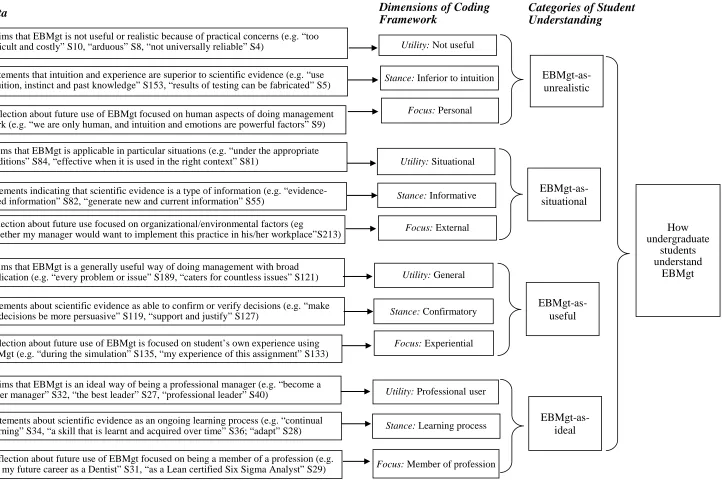
Strauss, 2008). Figure 1 illustrates the structure of this coding process as it relates to the emergent
dimensions and categories of student understanding of EBMgt.
--- INSERT FIGURE 1 ABOUT HERE ---
The first grouping of reflection texts was characterized by an overall understanding of
EBMgt as a way of doing management that was unrealistic. Coding indicated low perceived utility, a
stance that prioritized intuition over scientific evidence, and personally-focused reflection. We
labelled this first form of student understanding EBMgt-as-unrealistic and categorized 27 students into this group. The second grouping of reflection texts was characterized by an overall
understanding of EBMgt as a way of doing management that was applicable in particular situations.
externally-18
focused reflection. We labelled this second form of student understanding EBMgt-as-situational and categorized 75 students into this group. The third grouping of reflection texts was characterized by
an overall understanding of management as a way of doing management that was generally useful.
Coding indicated general utility, a confirmatory stance toward scientific evidence, and
experientially-focused reflection. We labelled this third form of student understanding EBMgt-as-useful and categorized 100 students into this group. Finally, the fourth grouping of reflection texts was
characterized by an overall understanding of EBMgt as a way of being a manager that was ideal.
Coding indicated perceived professional utility, a stance toward scientific evidence as a learning
process, and reflection focused on being a member of a profession. We labelled this fourth form of
student understanding as EBMgt-as-ideal and categorized 19 students into this group.
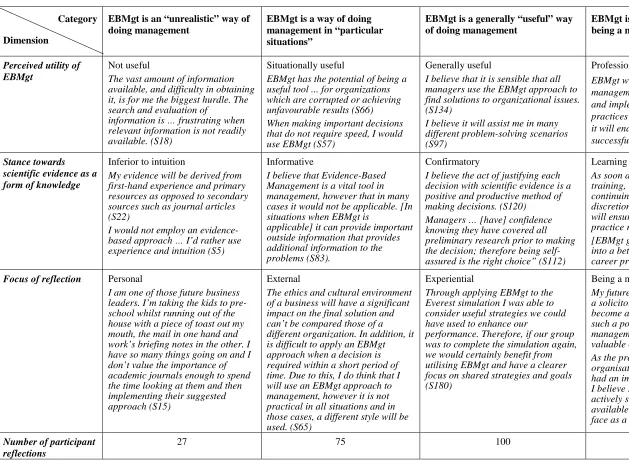
A summary of the categories and dimensions of student understanding of EBMgt that
emerged from our analysis of the 221 usable reflective texts is presented in Table 1. The table
includes illustrative examples of our data. Each of the categories of student understanding is
described in detail in the findings section. The dependability of our coding was increased through the
team approach to data analysis, with meetings used to challenge and probe emerging interpretations
of our data and display tables assembled to identify and verify patterns in the data (Miles &
Huberman, 1994).
--- INSERT TABLE 1 ABOUT HERE ---
FINDINGS
This section reports the findings of our analysis of our research question of how
undergraduate students understand EBMgt. We describe the four understandings of EBMgt as ways
of doing and being that emerged from our analysis using the dimensions outlined in Table 1:
perceived utility of evidence-based processes, stance toward scientific evidence as a form of
knowledge, and the focus of reflection about EBMgt practice. We identify the reflections of
19
are grounded in specific empirical material and that parallel meanings emerged from a breadth of
data sources (Johnson & Harris, 2002).
EBMgt is an Unrealistic Way of Doing Management
The first category of understanding comprised students who comprehended EBMgt as an
“unrealistic” (S9) way of doing management. These students perceived EBMgt had little utility for
the practice of management inside real organizations. Arguing “it would be difficult to utilise the
idea at this point in time” (S20), students supported their judgment of low utility by emphasising the
barriers to implementation. Major barriers recognised were the time and cost involved in accessing
research evidence and databases: “finding evidence is a tedious ordeal” (S22). Students also
emphasised the unreliability of using evidence-based principles derived from past patterns in the
dynamic and “unpredictable” environment of modern business (S6) and the absurdity of applying
ideas from medicine to “cure organization bodies” (S27). Dismissing evidence-based processes as
“impractical” (S9) and “hypothetical” (S8), students perceived low utility for EBMgt in management
decision making in organizations because “the costs outweigh the benefits” (S21).
Students who understood EBMgt as unrealistic way of doing management adopted a stance
that scientific evidence was inferior to intuition as a form of knowledge. These students refused to
attribute legitimacy to evidence published in academic journals “simply because it is science and
‘proven’” (S19). Instead, they prioritised personalised forms of knowledge based on human intuition
and experience over more abstract scientific evidence. One student, for example, stated, “I’d rather
use experience and intuition to make a risk-based assessment, as opposed to evidence” (S5). Another
student posited that acquisition of scientific knowledge through evidence-based research “cannot
change the way we think and, at the end of the day, we will make our decisions no matter how much
research we do” (S17). Privileging of experiential knowledge over scientific knowledge, and of
intuitive judgment over EBMgt decision processes, is echoed in this extract from a student reflection:
20
evidence may have an influence on our decisions, however, humans often choose to do what they ultimately feel is best, regardless of whether it is proven by science. (S16).
Finally, the focus of reflection for students in the EBMgt-as-unrealistic group was personal.
That is, when imagining and reflecting on the practice of EBMgt, students focused on the personal
and human aspects of doing management work “in my future” (S1). Consistent with their pragmatic
approach to EBMgt, students reflected on the circumstances of “real life” (S14) both inside and
outside organizations, including anticipated roles beyond the workplace. Students questioned, for
example, whether they would have “enough time” (S11, S14) to implement EBMgt given they
expected to have “children; husbands; wives; mortgages; sports; hobbies and interests outside of
work” (S15). The personally-focused reflection of students who understood EBMgt as an unrealistic
way of doing management is illustrated below:
I guess the problem that comes with EBMgt is the ongoing time and effort you have to put into finding appropriate research, reading, understanding and application. If I have a demanding job, family and other commitments, will I make it a priority? If it is not accessible then I most likely will not use EBMgt. (S19)
EBMgt is a Way of Doing Management in Particular Situations
The second category of understanding of EBMgt identified in our analysis represented those
students who understood EBMgt as an appropriate way of doing management in “certain situations”
(S58). Whereas students in the EBMgt-as-unrealistic group saw evidence-based processes as lacking
practical utility in real organizations, students in this group judged the utility of EBMgt as
situationally defined. They perceived that EBMgt was likely to be “beneficial” for decision making
and problem solving in some organizational situations and “irrelevant” (S89) in other situations.
When justifying why their future usage of EBMgt was expected to be “very situation based” (S56),
these students identified situational parameters related to whether the decision was “time sensitive”
(S80), the “nature of the problem” (S66), and the level of “experience” (S78) of the decision-maker.
EBMgt would be employed, for example, “early in my career” (S87), when “a problem is generic”
(S89), and “when there is sufficient time to implement EBM fully” (S88). In contrast, EBMgt was
less likely to be employed when problems required evidence that “may not be readily available”
21
(S79) within an organization. Interestingly, some students who understood EBMgt as a situational
way of doing management advocated for the necessity of using EBMgt when situations were
“ambiguous” (S67), while others distrusted EBMgt when conditions were “uncertain” (S81) or
“dynamic” (S86).
Students in the EBMgt-as-situational group took an informative stance toward scientific
evidence as a form of knowledge. These students recognised scientific evidence as “information”
(S49) that could help managers to “make a better and more informed decision” (S73). Students used
the terms “information / evidence” (S79) interchangeably, and tended not to distinguish scientific
evidence generated by management research from other sources of local evidence and information
such as “statistics and data” (S83), "data collected from the immediate environment” (S88) and
“factual knowledge” (S72). Unlike the students in the EBMgt-as-unrealistic group who privileged
knowledge developed from experience and intuition, students who understood EBMgt as a
situational way of doing management recognised scientific research evidence as a legitimate form of
knowledge that supported decision making “in particular scenarios” (S53).
Finally, the focus of reflection for students in the EBMgt-as-situational group was external.
When reflecting on their potential future practice, these students focused externally on the
organizational and environmental factors that would determine whether or not they adopted
evidence-based decision processes. They reflected on, for example, factors in the organizational
context that could constrain or enable their ability to implement EBMgt, including “restrictions
placed within a workplace” (S55), “the corporate culture of my organization” (S59), and the “beliefs
or preferences of [my supervising] manager” (S64). Alongside organizational factors, students
reflected on broader environmental factors and “societal expectations” (S77) that could increase
dissemination of EBMgt, including how trends in management education determine “whether or not
my fellow employees will be well-versed in this practice” (S213). Externally-focused reflection on
evidence-based practice supported students’ understandings of EBMgt as a situational way of doing
22 EBMgt as a Generally Useful Way of Doing Management
The third category of understanding of EBMgt involved those students who understood
EBMgt as a generally useful a way of doing management. In contrast to students in the
EBMgt-as-situational group who specified EBMgt-as-situational boundaries around the practice of EBMgt, students in this
group perceived EBMgt as having broad utility and practical application to “countless issues” (S121)
and “many different problem-solving scenarios” (S97). For these students, EBMgt was a “practical
and resourceful technique” (S109) for management decision making that could be applied “to every
problem or issue I come across” (S189). Students judged the utility of EBMgt based on expected
outcomes of improved management and organizational performance. For example, EBMgt could
“allow me to find the best solution in most, if not all, managerial problems” (S105) and, for
organizations, will “save time and effort by minimising the use of ineffective approaches” (S108)
and “facilitate the development of more effective processes” (S111).
Students who understood EBMgt-as-useful took a confirmatory stance towards scientific
evidence. They conceptualized scientific evidence as a form of knowledge that functioned to justify
decisions or confirm initial intuitions. Students described how scientific evidence could be collected
and evaluated to “prove and check” interpretations (S102), “verify my reasoning” (S134), and
“increase certainty and confidence” in decisions (S139). In contrast to the EBM-as-situational group
who equated scientific evidence with information, students in the EBMgt-as-useful group
differentiated scientific evidence as a special kind of knowledge that arose from “correctly executed,
objective scientific testing” (S107) and which was superior to “an intangible response such as
emotion” (S120). The following extract highlights the confirmatory stance towards scientific
evidence adopted by students who understood EBMgt as a generally useful way of doing
management:
23
Finally, the focus of reflection for students in the EBMgt-as-useful group was experiential.
When reflecting on their potential future practice with evidence-based processes, students focused
on their “involvement in the Everest Simulation” (S96), and “experience in completing the
assignment” (S102). Students noted that “when making the decisions for the simulation not much
thought went into the who, what, when, where and how” (S127). Yet after applying “research based
evidence to [evaluate] my own problems during the Everest Simulation” (S107) and reflecting on
their experience with evidence-based processes, students came to understand EBMgt as a “useful
decision-making tool” (S112) with the potential to help “bypass ineffective management practices”
(S138). Our data suggest that experientially-focused reflection helped these students to make
EBMgt meaningful as a generally useful way of doing management. For example, as one student
reflected, “the poor problem solving skills relied upon in the simulation [because we did not apply
EBMgt before playing] is one of the reasons why I will use an EBMgt approach” (S121). The quote below further illustrates the experientially-focused reflection of students who understood EBMgt as
generally useful:
The post-Everest simulation research activity has demonstrated [EBMgt’s] ability to become a useful tool for managers…As the simulation demonstrated, without the correct managerial knowledge, the [novice] group made several managerial ‘mistakes’. These issues led to inefficiency in reaching team goals, however upon researching evidence-based management articles, it was clear that there were some corrective actions that the group could have taken in the simulation by following what was found in these studies. (S110)
EBMgt as an Ideal Way of Being a Manager
The final category involved students who understood EBMgt as an ideal way of being a manager. In
contrast to the previous three groups of students who understood EBMgt as way of doing, students in the EBMgt-as-ideal group understood EBMgt as a way of being that was linked to their self-identity as a future professional manager. Students in this group perceived the utility of EBMgt was
embodied in professional users. These students understood EBMgt as the “ideal” (S39) way of being
a manager and believed that developing into an evidence-based practitioner was a “vital component
24
Students in the EBMgt-as-ideal group took a learning process stance towards scientific
evidence as a form of knowledge. Compared to the confirmatory stance of students who understood
EBMgt as generally useful, students who understood EBMgt as a way of being apprehended
scientific evidence as a “personal knowledge bank” (S40) that was intimately linked to an
individual’s “skills and knowledge” (S27). Scientific knowledge was incorporated into the self
through activities such as “developing critical thinking ability and decision awareness” (S29) and
staying “up to date with current research and findings in the management field” (S30). As a result,
students in the EBMgt-as-ideal group understood the evidence-based manager as somebody who
integrated scientific evidence into an ongoing process that involved “continued training and
understanding of relevant research” (S35) and “reflecting upon this learning” (S42).
Finally, students who understood EBMgt as an ideal way of being a manager engaged in
reflection that focused on membership within a profession. Some students in the EBMgt-as-ideal
group were enrolled in dual degrees and had already begun developing nascent professional identities
in their non-business courses in law (S28), dental science (S31), health science (S34), engineering
(S30), and physiotherapy (S33). These students understood evidence-based practice as an “obvious”
(S34) and “intelligent way” (S31) of signalling belonging to a profession that was equally relevant to
management as it was to traditional professions like “medicine and education” (S28). Students in the
EBMgt-as-ideal group who were not training in recognised professions also engaged in reflection
focused on membership in a profession. For these students, their reflection focused on their identity
as “future managers” and articulated a desire for management to professionalise and not be
“excluded from scientific approaches” that would develop professional managers into
evidence-based practitioners (S32). Focusing reflection on professional identity and membership of a
profession supported students’ understanding of EBMgt as an ideal way of being a manager, as
illustrated in this quote:
25 Summary
Students’ understanding of and reflections about EBMgt vary on the dimensions of
perceived utility of EBMgt, stance toward scientific evidence as a form of knowledge, and the focus
of reflection. Understanding of EBMgt as an unrealistic way of doing management is characterized
by perception that EBMgt is not useful, a stance towards scientific evidence as inferior to intuition,
and a personally-focused reflection. Understanding of EBMgt as a way of doing management that is
applicable in particular situations is characterized by perceived situational utility of EBMgt, an
informative stance towards scientific evidence, and an externally-focused reflection. Understanding
of EBMgt as a generally useful way of doing management is characterized by perceived general
utility, a confirmatory stance towards scientific evidence, and an experientially-focused reflection.
Finally, understanding of EBMgt as an ideal way of being a manager is characterized by perception
that EBMgt has utility for professional users, a learning process stance towards scientific evidence,
and a reflection that is focused on being a member of a profession.
DISCUSSION
In this paper, we sought to advance the literature on teaching and learning of EBMgt by
investigating: How do undergraduate students understand EBMgt? Our inductive qualitative study ofstudents in a first-year undergraduate introductory management course identified four qualitatively
different understandings of EBMgt: 1. EBMgt is an unrealistic way of doing management; 2. EBMgt
is a way of doing management in particular situations; 3. EBMgt is a generally useful way of doing
management; and 4. EBMgt is an ideal way of being a manager. We find that variations in student
understanding are shaped by perceptions of the utility of EBMgt, the stance taken toward scientific
evidence, and the focus of reflection about evidence-based practice. By opening up insight into how
undergraduate students understand and make sense of EBMgt after being introduced to and applying
evidence-based processes early in their program of study, we contribute to the theoretical literature
on EBMgt and to the practice of EBMgt teaching and learning, as well as offering new paths for
26 Theoretical Contributions
Our first major theoretical contribution to the literature, in the broadest sense, is to offer a
student perspective on EBMgt. Scholars have previously made unsupported claims that push and pull
approaches to teaching EBMgt are effective in promoting student learning (Barends & Briner, 2014;
Briner & Walshe, 2014; Charlier, 2014; Erez & Grant, 2014; Rousseau, 2006; Rousseau &
McCarthy, 2007). In response, our study subjects the claimed relationship between EBMgt teaching
practices and student learning to rigorous empirical examination, and in doing so explores whether it
is possible to teach EBMgt meaningfully at the undergraduate level. We focus on student
understanding as a fundamental aspect of student learning that is widely recognised in the education
literature (Biggs, 1999; Entwhistle & Tait, 1990; Marton, Hounsell, & Entwhistle, 1984; Perkins,
1999; Ramsden, 2003; Wright & Hibbert, 2015). Specifically, we investigate the impact of one form
of pull approach - students applying an evidence-based process to examine a problem experienced
during a simulation – on student understanding of EBMgt. By extricating how the pull approach
creates qualitatively different student understandings of EBMgt as ways of doing and being, our
study offers a deeper and more nuanced explanation of the relationship between EBMgt teaching
approaches and student learning.
Our findings show that EBMgt teaching does not produce a single consistent understanding
of EBMgt across all students. Instead, variations in student understanding arise as each student
makes sense of their own individual experiences with applying evidence-based processes. The four
variations of student understandings we uncovered broadly confirm first-person accounts and
speculations from educators in the literature that some students will resist EBMgt if evidence is not
accessible, whereas others are more readily convinced by the value of using scientific evidence to
inform management decision making (Briner & Walshe, 2014; Erez & Grant, 2014; Rousseau &
McCarthy, 2007). In the breakdown of our data, we found much higher frequencies for the
27
study prevents us attributing causal explanations to these frequency distributions, we offer some
tentative speculations about the general patterns as we elaborate our contributions to the literature. Overall, our findings build on and extend the literature by showing that students create the
meaning of EBMgt for themselves through how they apprehend the utility of EBMgt, what stance
they take towards scientific evidence, and where they focus their reflection of evidence-based
practice. We find, for example, that students who understand EBMgt as situational and general ways
of doing management, respectively, adopt stances toward scientific evidence as informative and
confirmatory and engage in externally-focused and experientially-focused reflections. We speculate
that of the three understandings of EBMgt as a way of doing, EBMgt-as-unrealistic broke out as the smallest category relative to the situational and generally-useful categories because it emerges when students focus their reflection on the personal and human aspects of doing work in their own
imagined future career and when they consider scientific evidence as inferior to intuition. Few first-year students might be expected to have sufficient experience and familiarity with business to
imagine the work-life constraints that thwart using evidence-based practice on a day to day basis. At the same time, since novice students at the beginning of a university degree program have made a recent and conscious decision to invest in building their knowledge base about a field of study, they
are likely to be relatively open to the value of scientific evidence produced by academic research and may be less confident that their own intuition will lead to superior decision making.
Our findings also show that some students construct an understanding of EBMgt as a way of
being rather than as a way of doing. Understanding EBMgt as an ideal way of being a manager broke
out as the smallest category in our data set because it requires students to reflect on being a member
of a profession and to take a stance towards scientific evidence as a learning process. We speculate that since neither of these actions come easily or naturally to first-year undergraduate students at the
28
advance scholarly debates on management’s status as a profession (Burke & Rau, 2010; Graen,
2009; Khurana, 2007; Khurana & Nohria, 2008; Pfeffer & Fong, 2002; Trank & Rynes, 2003) and
EBMgt as a signature pedagogy (Schulman, 2005; Trank, 2014) by suggesting that a student’s
capacity to understand EBMgt as an ideal way of being a manager depends on the extent to which
they apprehend management as a profession. Khurana (2007) argues that producing graduates who
view themselves as certified members of the management profession with knowledge and skills of
benefit to society, rather than as the self-interested ‘hired hands’ of shareholders, should be the aim
of business schools. Our study connects with Khurana’s (2007) argument by suggesting that EBMgt
holds the most promise for professionalizing management when students apprehend it as a way of
being.
Our data did not allow us to interrogate the relationships between understanding of EBMgt
as a way of being and a student’s background, including if they had prior exposure to a profession
and/or professionalism (Abbott, 1988; Freidson, 2001). However, our data do support the insight that
students in the way-of-being group made connections between what managers know and do
epistemologically with what managers are ontologically as professionals. These connections were not apparent in the three groups that understood EBMgt as a way of doing. Since making these
connections are core to education in professions (Dall'Alba, 2009), our findings suggest deeper
theorization and empirical investigation is needed of the mechanisms underpinning student
construction of EBMgt as ways of doing and being.
Our second major theoretical contribution is to advance insight into EBMgt teaching and
learning at the undergraduate level. While opportunities for EBMgt teaching in executive, MBA,
postgraduate and doctoral programs are increasingly recognised (Charlier et al., 2011; Klimoski &
Amos, 2012), scholars have paid limited attention to exploring the possibilities for teaching
evidence-based practice at the undergraduate level. Even less attention has been directed to resolving
debates about whether EBMgt can be taught meaningfully to undergraduate students (Rousseau &
29
First-year undergraduate students in management degrees are both novice university
learners (Ramsden, 2003) and ‘apprentice professionals’ in business management (Trank, 2014:
384). Thus, it is easy to dismiss first-year undergraduate students in business schools as lacking the
capacity to comprehend and apply evidence-based practice because of their position at the very start
of the novice-to-expert pathway. However, our study suggests that it is short-sighted to delay
introducing the basic idea of management as an evidence-based practice until undergraduate students
have progressed further along the pathway or to ignore teaching EBMgt until postgraduate levels.
While the first-year students who participated in our research did not come to understand or value
EBMgt in the same way as academic experts, our findings indicate that all of them were able to
develop some minimal level of awareness of the existence of scientific evidence for and about
management through a pull approach to teaching.
By drawing attention to student learning of EBMgt at the first-year undergraduate level, our
findings extend theoretical arguments that EBMgt has the potential to be a signature pedagogy in the
management profession (Schulman, 2005; Trank, 2014). Our data showing the differences in student
understanding EBMgt as a ‘way of being’ compared to a ‘way of doing’ illuminate how the business
school context can function as an identity workspace for professional education (Petriglieri &
Petriglieri, 2010). The ability to ‘try on’ professional identities as evidence-based practitioners
(Barends & Briner, 2014; Wright et al., 2016b) supported students in constructing an understanding
of EBMgt through focused reflection as a member of a profession. This insight from our study
extends the work of other scholars who find that identity shapes how students engage with research
evidence (Caprar, Do, Rynes, & Bartenuk, 2016; Lund Dean & Jolly, 2012; Trank, 2014).
At the same time, our findings highlight the potential value of pursuing development of
EBMgt as a signature pedagogy in management education that encourages students to continuously,
as well as critically (Morrell & Learmonth, 2015), reflect on the ways of doing and ways of being a
member of the profession of management (Khurana, 2007). Our study of first-year students suggests
30
programs. Students who do not encounter EBMgt until they are enrolled in MBA programs may be
less able to understand evidence-based practice as a way of being a manager because their own
identities as practitioners are well established (Hibbert & Cunliffe, 2015) and they may resist
research findings that challenge their self-concept (Caprar et al., 2016).
Practical Implications
Our study has several practical implications for teaching and learning of EBMgt. Our
findings encourage educators to adopt a program-level perspective towards EBMgt as a signature
pedagogy in management education. First-level introductory management courses, like the one we
studied here, are located at the start of the novice-to-expert pathway and can be used to introduce
students to evidence-based practice, producing variations in student understandings of EBMgt as
ways of doing and being. Subsequent courses along the pathway to graduation could provide further
opportunities to practice evidence-based processes and deepen student’s knowledge of EBMgt
techniques, encouraging reflection and refinement of student understandings of EBMgt as ways of
doing and being.
In reviewing the best suite of courses to implement this signature pedagogy, educators will
need to consider how introductory and reinforcing experiences with EBMgt can be timed and paced
across a student’s learning pathway, while maintaining the current breadth of content that is typical
in business and management degrees. One option is to integrate evidence-based practice into the
teaching of core courses in management, marketing, information systems, finance and strategic
management and in advanced courses within majors. This option mirrors the ‘integration strategy’
often adopted for teaching ethics in business degrees (Baetz & Sharp, 2004). A second option is to
introduce a small number of stand-alone specialist courses in EBMgt into standard business
programs. Specialist courses immerse students in a whole-of-course experience of evidence-based
processes and techniques, such as systematic reviews (Briner & Walshe, 2014; Tranfield et al.,