Theoretical Basis for Multiple Criteria Analysis of Variants
and Selection of the Most Effective Technological Scheme
for Hard Rock Surface Mining
Antipas T. S. Massawe, Mussa Daniel
Department of Chemical & Mining Engineering, College of Engineering & Technology, University of Dar es Salaam, Dar Es Salaam, Tanzania.
E-mail: [email protected], [email protected]
Received October 2, 2010; revised November 23, 2010; accepted November 26, 2010
Abstract
The technological scheme of a hard rock surface mine is a multiple level production system of
interdepen-dently functioning elements. Selection of the optimum combination of its elements constitutes a complex multiple variant and criteria problem of decision making. In this paper describes the theoretical part of the method proposed for the quantitative analysis and selection of the most competent technological schemes, based on the mathematical formulations of the selection criteria of the element of each level as functions of the alternative variants of the elements of the level and its adjacent levels. It is realized in accordance to standard procedures of decision making in the formation of the economical mathematical model of the cu-mulative influence of levels and elements on the effectiveness of all alternative variants in their analysis and generation of a small subset of the most competent variants, which are subjected to further analysis using the criterion of reliability in the generation of the optimum technological scheme. The scientific challenge inhe-rent in its realization constitutes a PhD research opportunity for those interested in the problems of optimiza-tion in hard rock surface mines.
Keywords: Level, Alternative Variants, Technological Schemes, Selection, Competent Variants
1. Introduction
The technological scheme of a hard rock surface mine represents a multiple level production system of interde-pendently functioning elements of mine design, equip-ment, mechanisms and processes [1,2]. The number of its alternative variants is huge and all exhibiting variable effectiveness in any class of mining and geological con-ditions. Selection of the most effective element for each level involves several conflicting criteria and the devel-opment and operation of the system is associated with huge capital and operational costs in the acquisition and exploitation of the expensive, but highly productive mining equipment and mechanisms. Therefore, it is ne-cessary to consider all alternative variants and important criteria in the selection of the system elements most compatible in accordance to their production and/ other functional capacities and fitness in the given class of mining and geological conditions because this is the best way to achieve the maximum utilization of production capacities and justify investment in the hard rock surface mining industry. The methods available for the selection
of solutions in hard rock surface mining don’t consider all possible variants and necessary criteria and most of them dwell on separate elements of the system in isola-tion [3-11]. The standard procedures of decision making successfully tested in the multiple criteria analysis of all possible variants and selection of the most effective pa-rameters of underground coal mines in Bangladesh [12] and Tanzania [13] could be used to enhance effective-ness in the selection of technological schemes for hard rock surface mines as well.
2. Description of the Method
mathemati-cal model of the cumulative influence of levels and their alternative variants of elements in the analysis and gen-eration of a small subset of most competent technologi-cal scheme (s) of hard rock surface mines in any class of mining and geological conditions. The small subset is subjected in the generation of optimum variant.
2.1. The Structural Model of the Alternative Variants of the Technological Schemes of Hard Rock Surface Mines and the Selection Criteria
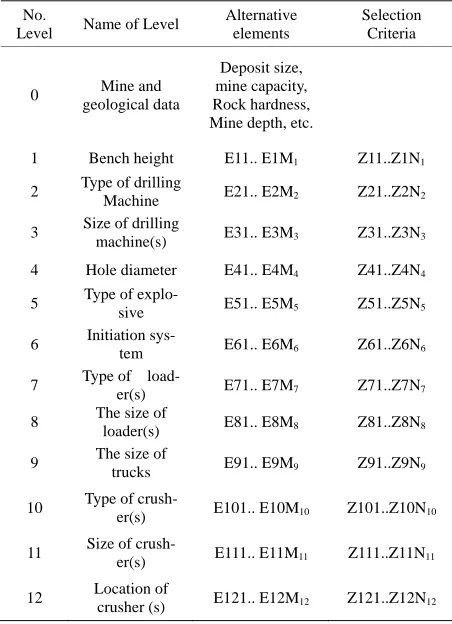
[image:2.595.58.284.407.719.2]The alternative variants of the most prospective tech-nological schemes of hard rock surface mines and the criteria considered in the optimum selection of the most effective element for each of the levels could be pre-sented in the form of the structural model illustrated in Table 1.
The model is developed based on viewing the tech-nological scheme of a hard rock surface mine as a com-plex production system of interconnected and interde-pendently functioning levels, each level having a definite number of alternative elements. The model shows that the alternative variants of the most prospective techno-
Table 1. Model of alternative variants and the criteria of selection.
No.
Level Name of Level
Alternative elements
Selection Criteria
0 Mine and geological data
Deposit size, mine capacity, Rock hardness, Mine depth, etc.
1 Bench height E11.. E1M1 Z11..Z1N1
2 Type of drilling
Machine E21.. E2M2 Z21..Z2N2
3 Size of drilling
machine(s) E31.. E3M3 Z31..Z3N3
4 Hole diameter E41.. E4M4 Z41..Z4N4
5 Type of
explo-sive E51.. E5M5 Z51..Z5N5
6 Initiation
sys-tem E61.. E6M6 Z61..Z6N6
7 Type of
load-er(s) E71.. E7M7 Z71..Z7N7
8 The size of loader(s) E81.. E8M8 Z81..Z8N8
9 The size of
trucks E91.. E9M9 Z91..Z9N9
10 Type of
crush-er(s) E101.. E10M10 Z101..Z10N10
11 Size of
crush-er(s) E111.. E11M11 Z111..Z11N11
12 Location of
crusher (s) E121.. E12M12 Z121..Z12N12
logical scheme of a hard rock surface mine fit for any class of mining and geological conditions could be more than hundreds of thousands. Selection and optimization of the technological schemes of hard rock surface mines in any class of mining and geological conditions involves a huge number of alternative variants and several con-flicting criteria in the selection of element for each of their levels which are interdependently and stochastically functioning under the influence of numerous mining, geological and organizational factors which are different for different mines and sections of the same mine. As a consequence, it is necessary to consider reliability of elements and the system as a whole in the selection of the most competent subset of variants and their optimiza-tion and generaoptimiza-tion of the optimum variant. Therefore, selection and optimization of the technological schemes of hard rock surface mines constitutes a complex mul-tiple variant and criteria problem of decision making which could only be solved based on the systems ap-proach methodology and the application of quantitative methods in the complex analysis of the whole set of al-ternative variants and generation of a small subset of the most competent which are subjected to further complex processes of optimization per criterion of reliability and generation of the most effective variant.
2.2. Analysis and Selection of the Subset of Most Competent Variants
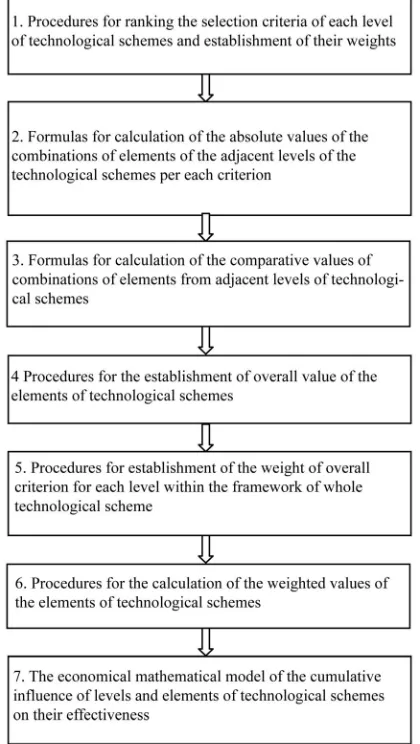
Analysis and selection of the subset of most competent variants is carried out based on the economical mathe-matical model of the cumulative influence of levels and elements of the alternative variants of technological schemes on their effectiveness and in accordance to standard procedures of decision making. Procedures in the formation of the economical mathematical model of the cumulative influence of levels and elements of the alternative variants of the technological schemes of hard rock surface mines on their effectiveness are shown on Figure 1 [12,13].
Figure 1. Block scheme for the formation of economical mathematical model.
worldwide. The method is realized in accordance to the procedures given on the block scheme shown on Figure 1. The block scheme describes the sequence of proce-dures in the formation of the economical mathematical model of the cumulative influence of levels and elements on the effectiveness of alternative variants in the analysis and generation of the most competent technological scheme (s) of a hard rock surface mine in any class of mining and geological conditions.
All procedures in the formation of the economical mathematical model described below are standard and borrowed from the theory of decision making, except block 2 which should be worked out in accordance to specially developed formulas.
Block 1: Criteria ranking and weights establishment Each level of the structural model of technological schemes has one or several criteria. In the presence of several criteria, they should be ranked by experts in
ac-cordance to their significance within the framework of each level. In the process of ranking the criteria of each level, expert assigns rank 1 to the criteria he considers to be most significant compared to the others and the next rank is assigned to the criteria less significant than the first one, and so on. If the ranking is carried out by sev-eral experts, the rank of i-th criteria is calculated as using formula (1):
1
1 m
i j ij
R R
m
(1)where: Rij- the rank assigned to the i-th criterion by j-th
expert; m - number of experts.
In the ranking of criteria within the framework of each level are arranged in the order of their significance, and then assigned weight ij by experts. The most
signifi-cant criterion is assigned weight 11 and the next criteria per significance assigned other weights i of
values ranging between 0 and 1 in the order of decrement. Refinement of the weights of criteria is carried out by experts in accordance to the method of sequential com-parison. If a criterion with weight 1 is more significant than the sum of other criteria, then weight 1 is revised in accordance to the condition expressed on formula (2).
1 2
n
i i
(2)where: n- the number criteria on the correspondent lev-el.
In case of the other way round, weight ω1 (if necessary) is reduced in accordance to the condition expressed on formula (3).
1 2
n i i
(3)Then, similar checks are made on the remaining crite-ria in accordance to the order of their weights decrement (excluding the last criterion).
If the procedure of weights assignment to criteria is carried out by several experts, then the weight of criteria within the framework of each level is calculated using formula (4):
1
1 m
i m j ij
(4)where: ij- the weight assigned to the i-th criterion by j-th expert; m- number of experts.
The standardized weight of criteria within the frame-work of each level is calculated using formula (5).
1
i
i n
i i
W
In order to establish the absolute values of the combi-nations of adjacent levels of the technological schemes per each criterion, the numerical values of criteria are worked out only considering the changing parameters of the examined and adjacent levels.
The value of the criteria of i-th level is generally influ-enced by the elements of both
i– 1
th and
i 1
th levels. Consequently, the value of criteria should account for the possibility of transition along any of the k- arcs through the i element of i-th level to any m i element of
i 1
th level and correspond to the values of the arcs illustrated on Figure 2.Block 3: Computation of Comparative values of the combinations of elements on adjacent levels
The comparative values of combinations of adjacent levels are established based on the absolute values. In doing so, the worst combination of each i element i-th level with each m-i element
i 1
th level is generated and counted basis. The comparative value of the combination of any elements of i-th level with the adjacent upper and lower levels is calculated using for-mulas (6) and (7). When maximizing criterion:
i 1 k i 1 k current
worse
Z ,
Z
i j i j
A A (6)
When minimizing criterion:
i 1 k i 1 m worse current
worse
Z Z
, 1
Z
i j i j
A A (7)
where: Zcurrent- the current value of criterion; Zworse- the value of criterion at worse (basis); j- number of criteria.
In the absence of mutual influence from adjacent levels, the comparative value of the combination of elements
Figure 2. Scheme of the formation of absolute values of the combinations of elements on adjacent levels.
from different levels is meaningless and replaced by the comparative value Bi of the elements of assessed level
,
established from analogue formulas (8) and (9):When maximizing criterion,
current worse
Z
Z
i j
B (8)
When minimizing criterion,
worse current worse
Z Z
1 Z
ij
B (9)
Block 4: Establishment of overall value of the ele-ments of technological schemes
The overall value of the elements of technological schemes is established by considering the weights of all criteria of the assessed level. The overall value of the combination of kth element of
i– 1
th level with i element of i-th level is established using formula (10). 1 1 1
Cii k
nkj Ai ji kWij (10)where: Ai j i 1 k
– Comparative value of the combination of k-th element of
i 1 -th level with i element of i-th level per jth criterion; nk- the number ofcrite-ria of the investigated i-th level; Wij- the standardized weight of jth criterion of the i-th level
The overall value of the combination of m-th element of
i 1
th level with i element of i-th level is established using formula (11). i 1 )m (i 1)m
i 1 ij
C
njk Ai j W (11)where: Ai j i 1 m
- The comparative value of the combina-tion of mth element of the
i1
-th level with
1
element of the i-th level per jth criterion. The overall value of the elements of i-th level under the mutual influence of
i 1
th and
i 1
th adjacent levels is calculated using formula (12). i 1 k i 1 m lik i i
D C C (12)
Obviously, the best combination corresponds to the maximum value of D1ik
.
In the absence of influence from one of the adjacent levels, the correspondent para-meter in formula (12) is assigned 1. In the absence of influence from both adjacent levels, the overall value of the elements of i-th level per all criteria is established using formula (13).2i 1 i j
D
njk B W ij (13)established in accordance to the relationships illustrated on formula (14) and (15)
In the presence of the influence of adjacent le-vels:
, 1
Di maxk m Dik m (14)
In the absence of the influence of adjacent le-vels:
2
DiDi 15 (15)
Block 5: Establishment of the weight of overall crite-rion for each level
Significances of the local and overall criteria of each level in the whole technological scheme are not the same. Therefore, in order to establish the real influence of le-vels and elements on the effectiveness of the technologi-cal schemes as a whole, it is necessary to establish the weights of the criteria of each level. The Assigning of weights to the criteria of each level could be made by experts, in accordance to the standard procedures, using formulas (1-5).
Block 6: Computation of the weighted values of ele-ments
The weighted values of the elements of each level are calculated using formula (16):
i i i i
E MOB D V (16)
where: Vi- The standardized weight of the local or
overall criterion of the ith level.
Block 7: The economical mathematical model of va-riants effectiveness
Includes all procedures described above and represents the algorithm for the formation of the values of arcs and nodes on the graph of alternative variants of the tech-nological schemes of a hard rock surface mine. From the realization of this model will generate matrices of the weighted values of each element of all levels of the ana-lyzed structural model MOBi, with the help of which and on the basis of special procedures of decision mak-ing, it is possible to proceed into the formalized analysis of paths on the graph of formation of the alternative va-riants of the technological schemes of a hard rock surface mine. These procedures are also standard [12,13]. The weighted values of each element allows (through simple summation) to establish the comparative effectiveness of any path on the graph of the formation of alternative va-riants of the technological schemes of a hard rock surface mine. While considering compatibility of the elements of different levels, such path which goes through elements (graph nodes) with the maximum weighted values shall always lead into the generation of one competent variant of the technological schemes of a hard rock surface mine, counted the basis variant and having (at the average
val-ue of Vi the total value of
av B
A , calculated using for-mula (17).
av
i max 1
AB
niLE (17) where: nL – the maximum number of levels on the structural model of variants.Generation of the other competent variants which are competitive with the basis could be made under the con-sideration of the variations of expert values for the signi-ficances of levels. For that purpose, it is necessary to group all levels of the technological schemes into k2- subsystems, excluding the levels with one element, rank (in the order of decrement) the maximum weighted val-ues of the elements of the levels of each subsystem and the elements of each level and, beginning with the most significant levels, sequentially compare variations of the sums of the weighted values for the basis variant, under the influence the assessed level for the optimistic and pessimistic views of experts 0.5Vi and 2.0Vi respec-tively) with the maximum possible decrement of the sums of weighted values when used for the formation of next variant of less significant elements of the as-sessed level. For that:
1) Weights are established for the optimistic VivaO and pessimistic Vivap approaches for the level of 1st rank of the first subsystem ivak using formulas (18-21). For the Optimistic Approach
For the significant level:
2 2 0.5 1 0.5
O ivak
iva
ivak V V
V
(18) For the other levels:
2 1 0.5
O i
iva
ivak V V
V
(19)
For the Pessimistic Approach
For the significant level:
2 2 2 1 0.5
p ivak
iva
ivak V V
V
(20) For the other levels:
1 2
p i
iva
ivak
V V
V
(21)
where: Vivak2- the average value of the significant level of k2th subsystem.
2) The new weighted values are established for the level of 1st rank of the 1st subsystem and the remaining levels using formulas (22,23).
For the Optimistic Approach
2 2 .
O
O iva
k i k i
i
V
MOB MOB
V
For the Pessimistic Approach
2 2 .
O
O iva
k i k i
i
V
MOB MOB
V
(23)
And the transformed matrix is formed.
3) The total weighted value is established for the basis variant for the optimistic
ABkO2 and pessimistic
2p Bk
A using formula (17). Variations of the total weighted values for the basis variant are calculated using formula (24).
P o B ivaB ivaB
Y G G (24)
4) Shift is made to the element of 2nd rank of the level of first rank of the first subsystem and analysis of the weighted value of the element of i-st rank made. Compa-tibility of a picked element with the other elements of the basis variant is verified. Total weighted values are cal-culated and the decrement of values established using formula (25).
Max o , p
C iva iva
Y G G (25)
where: GivaBo and GivaBP - variations of the total
weighted values of the basis variant for the optimistic and pessimistic approaches respectively, established us-ing formulas (26,27).
2 100%
av o
o B Bk
ivaB av B A A G A
(26)
2 100%
av p
p B Bk
ivaB av B A A G A
(27)
where: Givao and Givap- the degree of influence of the
individual elements of each significant level of each generated subsystem for the optimistic and pessimistic approach respectively, calculated using formulas (28,29)
2
100%
av O B k ivaj o iva av B A A G A
(28)
2
100%
av P B k ivaj P iva av B A A G A
(29)
where: 2
O k ivaj
A and 2
P k ivaj
A - The total weighted values in the transition to element of j-th rank of the level of 1-st rank for the optimistic and pessimistic approach respec-tively.
5) The difference between variations of the total weighted values is calculated. If the difference is greater or equal to the maximum decrement of values, the next variant of the technological scheme is formed.
6) Shift is made to the next subsystem
k2k2 1
and procedures (1)-(5) repeated.7) When subsystems for the generation of the required number of variants are all cleared, shift is made to the
level of 2-nd rank of the first subsystem and procedures (1)-(6) repeated.
8) When the required number of variants (Nvar) is ob-tained, the final synthesis and generation of the whole subset of most competent variants of the technological scheme of a hard rock surface mine is carried out.
Realization of all procedures described above should always lead to the development of software for the com-puter aided analysis and selection of the subset of most competent variants of the technological scheme of a hard rock surface mine on the basis of the economical ma-thematical model of the cumulative influence of levels and elements of technological schemes for justification in the generation of the subset of most competent va-riants of technology from the whole set of alternative variants. The subset of generated variants is subjected to further detailed analysis and optimization to generate the most reliable as the most effective technological scheme of a hard rock surface mine.
3. Conclusions and Recommendations
Realization of all procedures in the method described in this paper will have both scientific and practical signi-ficance. The scientific significance includes formulation the economical – mathematical model of the cumulative influence of levels and elements on the effectiveness of the alternative variants of most prospective technological schemes of hard rock surface mines, enabling the devel-opment of software for the computer aided analysis of all alternative variants and generation of the optimum va-riant of the technological scheme of a hard rock surface mine. The practical significance includes the possibility of using the mathematical models and software devel-oped in solving important practical questions in connec-tion with the selecconnec-tion, justificaconnec-tion and assessment of the economic effectiveness of the most prospective technological schemes of hard rock surface mines for the operating and new mines. The scientific challenge inhe-rent in the realization of the method proposed in this pa-per constitutes a PhD research opportunity for those in-terested in the problems of optimization in hard rock surface mining.
4. References
[1] W. Hustruli and M. Kuchta, “Open Pit Mine Planning and Design,” Taylor & Francis, London, 2006.
[2] B. Kennedy, “Surface Mining,” SME, 1990.
[4] A. Bortolussi and R. Ciccu, S. Forte and B. Grosso, “A Contribution to a Better Design and Control of Surface Blasting,” Balkema, Rotterdam, 2000.
[5] S. Qu, S. Hao, G. Chen, B. Li and G. Bian, “The BLAST- CODE Model: A Computer-Aided Bench Blast Design and Simulation System,” Fragblast, Vol. 6, No. 1, March 2002, pp.85-103.
[6] A. Mishra, “Design of Surface Blasts – A Computational Approach,” Bsc Thesis, Department of Mining Engineer-ing, National Institute of Technology, Rourkela-769008, 2009.
[7] E. Bozorgrahimi, R. A. Hall and G. H. Blackwell, “Sizing Equipment for Open Pit Mining,” A Review of Critical Parameters of Mining Technology, December 2003, Vol. 112, pp. 171-179.
[8] R. Franke, “Combined Mining Systems for Open Pit Mines,” Bulk Handling in Open Pit Mines & Quarries, 1986, pp. 177-182.
[9] H. Althof, “Cost Reduction by In-Pit Crushing and
Con-veying,” Bulk Handling in Open Pit Mines & Quarries, 1986, pp. 205- 208.
[10] G. Adel, T. Kojovic and D. Thornton, “Mine-to-Mill Optimization of Aggregate Production,” Virginia, 2006. doi:10.2172/914568
[11] R. Zhang, Y. Zhang, T. X. Ren and B. Denby, “The Se-lection of Surface Mining Technology Using a Decision Making System,” Balkema, Rotterdam, 1998.
[12] S. K. Majimdar, “Justification and Selection of the Technological Schemes and Their Parameters for the Conditions of Underground Coal Mining in Bangladesh,” Ph.D. Thesis, Moscow State Mining University, Moscow, 1985.