ISSN Online: 2165-3925 ISSN Print: 2165-3917
DOI: 10.4236/ojapps.2019.95034 May 30, 2019 403 Open Journal of Applied Sciences
An NC Algorithm for Sorting Real Numbers in
n n
O
n
log
loglog
Operations
Yijie Han, Sneha Mishra, Md Usman Gani Syed
School of Computing and Engineering, University of Missouri at Kansas City, Kansas City, MO, USA
Abstract
We apply the recent important result of serial sorting of n real numbers in
(
log)
O n n time to the design of a parallel algorithm for sorting real
num-bers in O
(
log1+εn)
time and loglog log
n n O
n
operations. This is the first NC algorithm known to take o n
(
logn)
operations for sorting real numbers.Keywords
Parallel Algorithms, Sorting, Sort Real Numbers, Complexity
1. Introduction
It is known widely that serial comparison sorting takes θ
(
nlogn)
time for sorting n numbers [1]. Although integer sorting can outperform the Ω(
nlogn)
lower bound for sorting n integers [2] [3], these algorithms generally do not ap-ply to the problem of sorting real numbers. It has been known that n integers can be sorted in O n
(
log logn)
time and linear space [2] [3]. The O n(
logn)
time bound remains for sorting real numbers ever since. Only very recently Han showed that real numbers can be converted to integers for the sorting purpose in
(
log)
O n n time [4], thus enabling the serial sorting of real numbers in
(
log)
O n n time.
Parallel sorting algorithms for sorting real numbers run on the PRAM (Paral-lel Random Access Machine) model are known [5] [6]. The AKS sorting network
[5] can be transformed into an EREW (Exclusive Read Exclusive Write) PRAM
How to cite this paper: Han, Y.J., Mishra, S. and Syed, M.U.G. (2019) An NC Algo-rithm for Sorting Real Numbers in
log log log
n n
O
n
Operations. Open Journal
of Applied Sciences, 9, 403-408.
https://doi.org/10.4236/ojapps.2019.95034
Received: April 8, 2019 Accepted: May 27, 2019 Published: May 30, 2019
Copyright © 2019 by author(s) and Scientific Research Publishing Inc. This work is licensed under the Creative Commons Attribution International License (CC BY 4.0).
http://creativecommons.org/licenses/by/4.0/
DOI: 10.4236/ojapps.2019.95034 404 Open Journal of Applied Sciences
algorithm with O
(
logn)
time and O n(
logn)
operations. Cole’s parallel merge sort [6] sorts n numbers in O(
logn)
time using n processors on the EREW PRAM. On the CRCW (Concurrent Read Concurrent Write) PRAM Cole showed[7] that his parallel merge sort can run in O
(
log log log 2n(
p n)
)
time using pprocessors. Also see [7].
There are also parallel algorithms for integer sorting [8] [9] [10] [11]. In the case of integer sorting, the operation bound can be improved to below O n
(
logn)
. In particular, [10] presents a CRCW PRAM integer sorting algorithm with(
log)
O n time and O n
(
log logn)
operations and [11] presents an EREW PRAM integer sorting algorithm with O(
logn)
time and O n(
logn)
opera-tions.For sorting real numbers, the previous best serial algorithm sorts in O n
(
logn)
time. It was also known that for comparison sorting, Ω
(
nlogn)
is the tight lower bound. Thus if we use comparison sorting to sort real numbers, then in serial algorithms, we cannot avoid the Ω(
nlogn)
time bound and in parallel algorithms, we cannot avoid the Ω(
nlogn)
operation bound. In the past, noother sorting methods are known to sort real number in less than O n
(
logn)
time and comparison sorting remained the norm for sorting real numbers. However, the situation is recently changed completely as Han found a way to convert real numbers to integers for sorting purpose and he showed that real numbers can be sorted in O n
(
logn)
time [4]. This result enables us to move further to improve the operation bound of parallel algorithms for sorting real numbers to below O n(
logn)
, as in the past, all parallel algorithms for sorting real numbers have an operation bound at least O n(
logn)
.In this paper, we will apply the O n
(
logn)
time serial real number sorting algorithm [4] to the design of an NC algorithm with O(
log1+εn)
time andlog log log
n n O
n
operations on the CREW (Concurrent Read Exclusive Write) PRAM. NC stands for Nick’s Class [12]. NC algorithms are parallel algorithms with polylog time and polynomial operations. Algorithm in [4] is an inherently serial algorithm without much parallelism within it. Here, we use it in the design
of an NC algorithm with O
(
log1+εn)
time and loglog log
n n O
n
operations. This is the first NC algorithm for sorting real numbers with o n
(
logn)
operations.DOI: 10.4236/ojapps.2019.95034 405 Open Journal of Applied Sciences
1
p
T p T≥ . When T p Tp = 1, the parallel algorithm is said to be an operation
op-timal algorithm.
The main contribution of this paper is the demonstration of the existence of an NC parallel algorithm with o n
(
logn)
operations for sorting real numbers. All previous parallel algorithms for sorting real numbers have at least O n(
logn)
operations. The algorithm presented in this paper is derived from Han’s
(
log)
O n n time serial algorithm [4] for sorting real numbers by applying pa-rallel algorithm design techniques. These papa-rallel algorithm design techniques are specially tuned for the derivation of our parallel algorithm.
The remaining part of this paper is organized as follows. In Section 2 we present our NC algorithm for sorting real numbers with O
(
log1+εn)
time andlog log log
n n O
n
operations. In Section 3, we present a running example of our algorithm and conclude our paper with the Main Theorem.
2. The Algorithm
Consider an algorithm for sorting n real numbers. Suppose each of the n/m lists with m real numbers in each list has already been sorted, we are to merge these
n/m lists into one sorted list. We will do k-way merge in each pass to merge every k-lists into 1 sorted list and there are log
(
n m)
logk passes to have alln/m lists merged into 1 sorted list.
For simplicity, let us break down n elements into lists with m elements in each list. We can do parallel sort on the individual list of m elements recursively. Now we pick every k-lists and have them merged together.
The k-way merging of sorted lists L L0, , ,1 Lk−1 is done as follows. For each
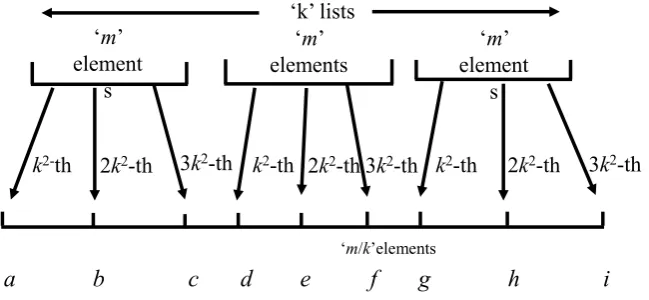
sorted list of m real numbers we pick every k2-th real number, i.e. we pick the 0th real number, the k2-th real number, the 2k2-th real number, the 3k2-th real number, and so on. Thus from each list Li we picked m/k2 real numbers and these m/k2 real numbers form a sorted list
i
L′. and from these k lists we picked m/k real numbers they form sorted lists L L0′ ′, , ,1 Lk′−1. We merge L L0′ ′, , ,1 Lk′−1
into one sorted list L' using Valiant’s merging algorithm [13] (its improved ver-sion is given by Kruskal in [14] with time complexity of O
(
log logm)
and li-near operations for merging two sorted lists of m elements each) in logk passes and O(
log logm)
time and O m k(
)
operations in each pass. Thus the total time for merging L L0′ ′, , ,1 Lk′−1 is O(
log log logk m)
and the total operationis O m
(
logk k)
.DOI: 10.4236/ojapps.2019.95034 406 Open Journal of Applied Sciences
the time for this binary search is O
(
logk)
and the operation is O m(
logk)
. The operation for all lists is O n(
logk k)
because there are n/m lists and everyk-lists are merged in the k-way merge, we picked n/k2 real numbers and every one of them has to use k processors to check k-lists in the k-way merging. Be-cause r is arbitrary picked and thus we know that every real number in L' knows its insertion point in every Lj. Let the real numbers in sorted order in L' be
0 1, , , m k 1
r r r − . To merge L L0, , ,1 Lk−1 we need now to merge or sort all real
numbers between the insertion points of ri and ri+1 in L L0, , ,1 Lk−1. There are
no more than k2 real numbers in L
j between the insertion points of ri and ri+1 and therefore the total number R i i
(
, 1+)
of real numbers (call them a block) in0, , ,1 k 1
L L L− between the insertion points of ri and ri+1 is no more than k3 (i.e.
(
, 1)
3R i i+ ≤k ). When R i i
(
, 1+ <)
k3 we will combine multiple blocks togetherto reach k3 real numbers. We use the O n
(
logn)
serial sorting algorithm to sort them in O k(
3 logk)
time. This represents O k(
3 logk)
time and(
log)
O n k operations in our parallel algorithm.
Thus the time for each stage is O k
(
3 logk)
and the operation for each stageis O n
(
logk)
. When we start with m as a constant then there are log logn k stages and therefore the time of our algorithm is 3loglog
k n O
k
and the
opera-tion is log
log
n n O
k
.
Pick k=logεn, we get O
(
log1+εn)
time and loglog log
n n O
n
operations.
3. Procedure
Step 1: Let’s say we have “m” sorted elements in each list, and we have a total of “n” elements to sort (Figure 1).
This implies that we have “n/m” lists to sort. To sort these blocks, we will ap-ply k-way merging.
Step 2: Each stage of k-way merging is to merge every k sorted lists into 1 sorted list. This is repeatedly until all n/m lists are merged into one list (Figure 2).
Step 3: To merge k lists into 1 list, we need to pick the “0-th”, “k2-th”, “2k2-th”, “3k2-th”, … real numbers in each list L
i to form a new list Li′ of m/k2 elements. This is shown as Figure 3.
Step 4: We merge L L0′ ′, , ,1 Lk′−1 into one sorted list L'. The elements of this
new formed list L' then use binary search to find their exact insertion point in
Figure 1.n/m sorted lists of m elements each.
DOI: 10.4236/ojapps.2019.95034 407 Open Journal of Applied Sciences
Figure 2.k-way merging of k lists.
Figure 3. Pick every k2-th element of each list.
0, , ,1 k 1
L L L− . These insertion points then partition L L0, , ,1 Lk−1 into m/k
blocks with each block containing no more than k3 real numbers.
Step 5: When every one of these m/k blocks are sorted, we effectively merged
0, , ,1 k 1
L L L− into one sorted list L.
Main Theorem: n real numbers can be sorted in O
(
log1+εn)
time andlog log log
n n O
n
operations on the CREW PRAM.
Proof: The algorithm and its time complexity analysis are presented in Sec-tion 2. An example of the running of the algorithm is presented in SecSec-tion 3. □
Conflicts of Interest
The authors declare no conflicts of interest regarding the publication of this pa-per.
References
[1] Corman, T.H., Leiserson, C.E., Rivest, R.L. and Stein, C. (2009) Introduction to Al-gorithms. Third Edition, The MIT Press.
[2] Han, Y. (2015) A Linear Time Algorithm for Ordered Partition. International Workshop on Frontiers in Algorithmics (FAW'15), LNCS, 9130, 89-103.
https://doi.org/10.1007/978-3-319-19647-3_9
[3] Han, Y. (2004) Deterministic Sorting in O(nloglogn) Time and Linear Space. Jour-nal of Algorithms, 50, 96-105. https://doi.org/10.1016/j.jalgor.2003.09.001 [4] Han, Y. (2017) Sort Real Numbers in O n
(
logn)
Time and Linear Space. Inar-Xiv.org with paper id 1801.00776.
[5] Ajtai, A., Komlós, J. and Szemerédi, E. (1983) An O(nlogn) Sorting Network. Pro-ceedings of the Fifteenth Annual ACM Symposium on Theory of Computing,
Bos-‘m’ ‘m’ ‘m’ ‘m’ ‘m’ ‘m’ ‘m’ ‘m’ ‘m’ ‘m’
‘k’ lists ‘k’ lists ……. ‘k’ lists
‘
m
’
elements
element
‘
m
’
s
‘
m
’
element
s
k
2-th 2
k
2-th 3
k
2-th
‘k’ lists
k
2-th 2
k
2-th 3
k
2-th
k
2-th
2
k
2-th 3
k
2-th
‘m/k’elements
DOI: 10.4236/ojapps.2019.95034 408 Open Journal of Applied Sciences ton, MA, 11-13 May 1983, 1-9. https://doi.org/10.1145/800061.808726
[6] Cole, R. (1988) Parallel Merge Sort. SIAM Journal on Computing, 17, 770-785. https://doi.org/10.1137/0217049
[7] Saxena, S., Chandra, P., Bhatt, P. and Prasad, V.C. (1994) On Parallel Prefix Com-putation. Parallel Processing Letters, 4, 429-436.
https://doi.org/10.1142/S0129626494000399
[8] Bhatt, P.C.P., Diks, K., Hagerup, T., Prasad, V.C., Radzik, T. and Saxena, S. (1991) Improved Deterministic Parallel Integer Sorting. Information and Computation, 94, 29-47. https://doi.org/10.1016/0890-5401(91)90031-V
[9] Hagerup, T. (1987) Towards Optimal Parallel Bucket Sorting. Information and Computation, 73, 39-51. https://doi.org/10.1016/0890-5401(87)90062-9
[10] Han, Y. and Shen, X. (1995) Conservative Algorithms for Parallel and Sequential Integer Sorting. International Computing and Combinatorics Conference, Lecture Notes in Computer Science, 959, 324-333. https://doi.org/10.1007/BFb0030847 [11] Han, Y. and Shen, X. (2002) Parallel Integer Sorting Is More Efficient than Parallel
Comparison Sorting on Exclusive Write PRAMs. Tenth Annual ACM-SIAM Sym-posium on Discrete Algorithms (SODA’99), Baltimore, Maryland, January 1999, 419-428. https://doi.org/10.1137/S0097539799352449
[12] Cook, S.A. (1981) Towards a Complexity Theory of Synchronous Parallel Compu-tation. L’Enseignement Mathématique, 27, 99-124.
[13] Valiant, L.G. (1975) Parallelism in Comparison Problems. SIAM Journal on Com-puting, 4, 348-355. https://doi.org/10.1137/0204030
[14] Kruskal, C.P. (1983) Searching, Merging, and Sorting in Parallel Computation. IEEE Transactions on Computers, C-32, 942-946.