Integration of Multi-layer SVM Classifier and
Multistage Dynamic Fuzzy Judgement and Its
Application in SCDA Measurement
Zhibin Liu
Economics and Management Department, North China Electric Power University, Baoding City, China Email: [email protected]
Haifen Yang
College of Economics and Trade, Agricultural University of Hebei, Baoding City, China Email: [email protected]
Shaomei Yang
Economics and Management Department, North China Electric Power University, Baoding City, China Email: [email protected]
Abstract—The supplier's cooperative design enables the enterprise to use supplier's technical ability fully, reduce the time of product coming into the market, improve quality, and reduce cost. In order to evaluate the supplier cooperative design ability (SCDA) scientifically and accurately, this paper overcomes the shortcoming of traditional linear SCDA evaluation method, proposes an improved support vector machine (SVM) evaluating method based on the multistage dynamic fuzzy judgment, takes the multistage dynamic fuzzy judgment as the sampling foundation, uses the SVM principle to establish evaluation model. This method not only can exert the unique advantages of multi-layer SVM classifier, but also overcome the difficulty of seeking the high grade training sample data. The SCDA evaluation of 8 enterprises in Jilin province indicates that the method to evaluate the SCDA is stable and reliable.
Index Terms—support vector machine, multistage dynamic fuzzy judgement, supplier cooperative design ability, comprehensive evaluation
I. INTRODUCTION
Under the currently circumstance of intense global competition, the fast technology renewal, and the accelerating new product development to reduce the product to go on the market, enterprise success is increasingly decided by the product development ability. Many enterprises begin to carefully examine traditional purchase thought, which can urge the supplier to melt into the enterprises’ new product development process as soon as possible. Certain demonstration analyses had already shown the huge income which coming from the cooperation of enterprise and supplier in product design and development phase. The supplier's cooperative design enables the enterprise to use supplier's technical ability fully, reduce the time of product coming into the
market, improve quality, and reduce cost. Therefore, when the difference of suppliers’ product quality and price is small, the primary factor that enterprises choose and evaluate suppliers is the cooperative design ability. At present, the concerned research of supplier cooperative design ability (SCDA) recognition has brought the recognition, but research results of how to use the effective analysis method to evaluate the suppliers cooperative design ability are numbered.
for the machine learning in small samples circumstances, and overcomes the insufficient problem of typical negative type data [10][11]. This paper uses the SVM algorithm to evaluate the SCDA synthetically.
II.THE SVM BASED ON MULTISTAGE DYNAMIC FUZZY JUDGEMENT
The evaluation method that unifies the multi-layer SVM classifier and the expert fuzzy judgement divides into 3 stages. First, we use the expert fuzzy judgement to evaluate, and obtain the massive samples; then establish the SVM model through the training samples; finally, use the multi-layer SVM classifier system to carry on the evaluation.
A. The basic SVM rationale
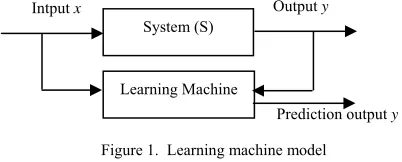
Support vector machine is one kind of new learning machine based on the statistics learning theory, the machine learning model is as shown in Figure 1. The system S corresponding to the random vector x produces the output y, learning machine can realize a group of forecasting function collection {f(x, ω)}, ω∈Ω, ω is the functional generalized parameter, {f(x, ω)} is also called the indicator function collection in two value classification question.
Figure 1. Learning machine model
1) VC dimension
The VC dimension is a core concept in the statistics learning methodology; up to now it is the best description index to the learning performance of function collection. When discussing the classified ability of function collection, the statistics learning theory has defined a series important index, such as the stochastic entropy, annealing VC entropy, and so on.
2) Structure risk minimum principle
The structure risk minimum is used to solve the minimum risk functional question of the experience risk and the fiducial limit. We decomposes the function collection S={f(x, ω)}, ω∈Ω to a sequence of function subsets.
S S
S
S1⊂ 2 ⊂⋅ ⋅⋅ k ⊂⋅ ⋅⋅⊂ (1) Make each subset to arrange according to the Φ magnitude, namely
⋅⋅ ⋅ ≤ ≤ ⋅⋅ ⋅ ≤
≤h hk
h1 2 (2) It is same in the identical subset fiducial limit; Seek for the smallest experience risk in each subset, it usually reduces along with the increase of subset complexity degree. The choice of smallest experience risk, the fiducial limit, and the smallest subset may achieve the smallest expected risk; the smallest subset's function is the optimal function, and this is the structure risk minimum principle.
3) Optimal planoid division of support vector machine
Support vector machine has realized the structure risk minimum thought well. The support vector machine method is proposed from the optimal classified planoid under the linear separable situation. Suppose training set of n samples
{
x y i n}
D= ( i, i) =1,2,⋅ ⋅⋅, (3)
In the formula: n
R x∈
[
+1,−1]
∈ yIf D can be separated by a planoid of w·x-b=0 infallibly, and the distance is biggest between the planoid and the vector that is nearest from the planoid, then we said that this vector set is separated by this optimal planoid. Separating infallibly can guarantee the smallest experience risk; Make the distance is biggest of Margin, guarantee the fiducial limit is smallest of promotional limit, thus cause the real risk is smallest. [12]
B. SVM classification principle
Suppose the sample set is: (xi, yi ), i = 1, 2, ... n, x∈Rd, y∈(+1, -1) is the type label. SVM is used to settle the optimal problem as follows:
∑
= + n ii T
c
b c
1 ,
, 2 1
minω ω ω ε
Subject to
(
T i)
ii x b
y ω φ( )+ ≥1−ε (4) n
i
i ≥0, =1,Λ, ε
ωis the hyperplane vector, the training sample xi is mapped to the high-dimensional space by the function Φ(xi), C>0 is the punishment factor for the wrong samples, b is the hyperplane offset. The optimization problem can be transformed into a simple allelism problem:
a e Qa
aT T
a 2 −
1 min
n i
c
ai , 1, ,
0≤ ≤ = Λ (5) Subject to yTa=0
ai is the lagrange multiplier of sample point xi, e is the vector l, Q is the n×n semi-definite matrix, Qij=yiyjK(xi,xj), K(xi,xj)=Φ(xi)TΦ(xj) is called kernel function. The decision function of SVM is:
⎟ ⎠ ⎞ ⎜
⎝
⎛
∑
+=
b x x K a y
n
i
j i i i 1
) , ( sgn
(6)
C. Integration of SVM and multistage dynamic fuzzy judgement
1) The basic principle of multistage dynamic fuzzy judgement
The practical thing has many kinds of attributes frequently or is influenced by many kinds of factors, the people need to carry on the comprehensive evaluation to these many kinds of attribute factors, and this is the comprehensive judgment. In the most situations, these attributes or the factors have the fuzziness, make the comprehensive evaluation to this kind of fuzziness factors, and this is the fuzzy comprehensive judgment. The basic
Prediction output y
Intput x Output y
System (S)
principle and the step of the multi-factor fuzzy comprehensive judgment method are as follows:
(1) Carry on the classification to the factor sets, X={x1, x2… xn}, according to certain attributes, and form s subset.
{
i i in}
i x x x
X = 1, 2,⋅ ⋅⋅, i=1,2,⋅⋅⋅,s. (7) In the formula:
∑
=
= s
i
i n
n
1 ;
;
1
U
== i
i X
X
. ,i j O X
XiI j ≠ ≠
(2) Make the comprehensive decision separately to each sub-factor Xi.
Suppose Yi={yi1, yi2, …, yin}, is the evaluation sets of subset Xi, the evaluation sets denote all levels of remark from high to low, weigh the certain sub-factor performance in the multi-layer structure model. For example, when m=5, Yi={yi1, yi2, …, yin} may express that superior, good, medium, ordinary, bad, and give certain scores separately.
The weighted distribution of the various factors in Xi is Ai={ai1, ai2, …, ain}. (8)
In the formula:
1
1
=
∑
=
ni
i it
a
If Ri is the single factor matrix, then we can gain the first-level judgment vector: Bi=Ai·Ri= {bi1, bi2… bim}, i=1, 2… s.
(3) Regard each Xi as a factor, record X={x1, x2… xs}, and X is also a factor set, the single factor decision-making matrix of X is:
⎥ ⎥ ⎥ ⎥
⎦ ⎤
⎢ ⎢ ⎢ ⎢
⎣ ⎡
= ⎥ ⎥ ⎥ ⎥
⎦ ⎤
⎢ ⎢ ⎢ ⎢
⎣ ⎡
=
sm s
s
m m
s b b b
b b
b
b b
b
B B B
R
L M M M M
L L
M
2 1
2 22
21
1 12
11
2 1
(9)
Each X1 is as a part of X, had reflected some kind of attribute of X, may give weighted distribution according to theirs importance A={a1, a2, …, as}, therefore we obtain the second-level judgment vector, namely comprehensive judgment result B, B=A·R= {b1, b2, …, bm}.
If the first-level factor set Xi (i=1, 2, …, s) still contained many factors, we can carry on the subdivision to the Xi again, therefore has the third-level, four-level models, and so on.
2) Integration of SVM and multistage dynamic fuzzy judgement
Although the multi-layer SVM classifier may obtain the complex non-linearity handling ability for SCDA evaluating system, but it obtains this ability through the self-learning process of feed forward neural network. Then, how to obtains the high grade evaluation data is very difficult, uses the union method of SVM evaluation method and the multistage dynamic fuzzy synthesis judgement is a good means to solve the difficulty. Therefore, we should invite the experts to apply the
multistage dynamic fuzzy synthesis judgement method to carry on the evaluation, absorb the experts' knowledge and the rich experience; then we unify the two methods, realize predominance complementarity each other, and make the overall system to achieve the higher intelligent level.
The key of the evaluation method lies in: First, the experts carry on fuzzy synthesis judgment, and select the sample, and the following must pay attention to: (1)The evaluation system is applied for a long time and confirmatory, therefore cannot add and modify at will; (2)Judges each evaluation system weight to use the analytic hierarchy process and the gray relevancy method; (3)Chooses the expert, executes the eschewal system strictly; (4)The various samples data result must strictly be preserve after the fuzzy synthesis judgment. Next, the sample selection must be met: (1) All kinds of sample (superior, good, general, bad) distribute evenly; (2) The quantity is enough; (3) The sample has the representation; (4) The sample data must carry on the standardized pretreatment. Once more, the system provides the multi-layer SVM model of the momentum training method and the self-adapted study speed training method, enables the user to be allowed to select the training method and the SVM model level structure according to the special details, and establishes the evaluation model according to the sample.
III. THE SCDA EVALUATING MODEL CONSTRUCTION
A. The indices system construction
SCDA is the ability of clasp between the supplier and enterprise, providing technical and the craft support. For more deeply melt into enterprise’s new product development, help the enterprise to reduce cost, promote quality, reduce the time of new product to go on the market, and establish the stable supply relation, the supplier has to have the condign cooperation design ability. New product development usually includes three stages of the product concept and the functional design, the product structural design and the project, the process design and the project. The different stage often needs the supplier to have the different ability and to provide the different support. Therefore, it is essential to consider all kinds of factors to affect the SCDA in the new product development different stage.
(1)Product concept and functional design support ability. In the product concept and functional design stage, the suppliers should have the abilities as follows: The abundant specialized technology and knowledge (X1), which can carry out the cooperation with the enterprise comprehensively; The recognition ability of the new material, the new product and the new flow technology (X2), which can strengthen the relation between the enterprise and the innovation idea; The support ability to the value analysis (X3), which can help the enterprise to realize the product function value and the sensation value maximization by the lowest cost.
suppliers should have the abilities as follows: The support ability to simplify the product design (X4), which can simplify the product and the process, and restrict the quantity of product module and the possible assembly operation; The support ability to product modulation (X5), which can increase module reusing; The support ability to product module choice decision-making (X6), which can help the enterprise to make the decision uses the new part or the old part, interior development or exterior development and so on; The module standardization support ability (X7), which can promote standard module reusing, response customer demand quickly and reduce cost; Adjusting own flow to adapt product design ability (X8), which can cooperate own production process and the product function, safeguard the part supply; The prompt reliable prototype manufacturing ability (X9), which can guarantee the early diagnosis and rapid feedback for the existent question, speed up the “design-prototype-test” process; The prompt communication ability of project alteration (X10), which can guarantee the product development team to obtain the newest change news immediately.
(3) Process design and project support ability. In the process design and project stage, the supplier should have the abilities as follows: The support ability to the opposite design (X11), which can assist the enterprise to develop the design, simplify the product process, and reduce the cost through the assembly method choice; The support ability to the new operation process as well as the production equipment design (X12), which can discover and solve the problems in the prototype structure and test stage.
B.Support vector machine classifiers
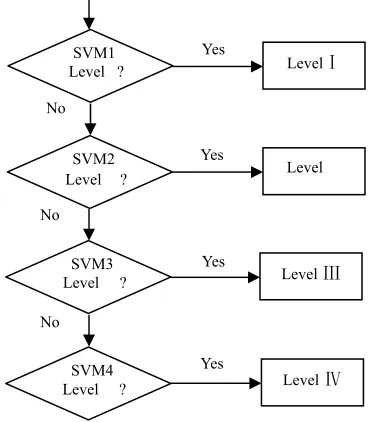
The basic principle of evaluating the SCDA using SVM is: in terms of the SCDA evaluating system, the input is each subsystem evaluating parameters, and the output is SCDA levels, we seek the non-linear relation between the input and output using SVM. SVM algorithm is actually two kinds of classifier, and the SCDA has a number of ability levels, two types of classifier can not meet the requirements. Therefore, we design the SCDA evaluating system based on SVM classifiers as shown in figure 2.
The system is composed of 4 SVM classifiers in series, each SVM classifier is used to determine a level, and then we begin to train the system. First, we take I level samples that the training samples is concentrated as the same class, the class label is 1. The remaining samples are identified as the other class, the class label is -1, train the classifier 1. Then, we select Ⅱ level samples as the same class, the class label is 1, the remaining samples are identified as the other class, the class label is -1, train the classifier 2. According to this method, we train the classifier 3 and classifier 4 in turn, construct the classification decision-making function. When carrying through the classification identification, we input the identifying sample into classifier 1. If the output of decision-making function is 1 show that the risk rating of testing samples fall into level I, the classification test is end, otherwise the testing samples will enter into the
classifier 2 automatically. If the decision-making function output is not 1 yet, the testing samples enter into the next classifier to go on the identifying classification, until the decision-making function output is 1, the classification is end.
Figure 2. The SCDA evaluating system based on SVM classifiers
C. Classification and sample weighted
The important foundation to ensure the SVM classification accuracy is the balance of two types of training samples. For sample imbalance classification issue in the training samples, the classification accuracy will be affected. When we train a certain SVM classifier, the many types of samples make the two sample numbers is unbalanced, the positive samples are less than negative samples in the SVM multiple classifiers. For example, training for SVM1, the positive samples are level I, and the negative samples are the sum of level Ⅱ, Ⅲ, Ⅳ. It is obvious that the positive samples are less than negative samples. Therefore, the SVM multiple classifiers are not fit for using in SCDA evaluating system directly. In order to overcome this drawback, this paper amends classification warp behavior that comes from the uneven sample using the SVM classification weighted method. Take the linear impartibility instance as an example, the hyperplane optimization problem of classification weighted SVM can be turned into:
∑
=
+
= l
i i i i s
C x
1 2
2 / 1 ) (
minϕ ω λ ξ (10)
i i
i x b
y t
s.. (ω + )≥1−ξ ξi ≥0 (11)
In the formula: λi is the weight of yi, λi≥1; si is the weight of sample xi, si>0. λi>1 denotes the small i sample; si<1 denotes the sample xi is unimportant; si=1 denotes xi is general important; si>1 denotes xi is important. In the C-SVM, (ξ1+ξ2+...ξl) is the geometric
loss coming from the classification error, and which reflects structural risk minimization thinking. In W-SVM, (s1ξ1+s2ξ2+...+ξlξl) is the actual loss coming from the classification error, and which reflects the amalgamation thinking of structural risk minimization and experience
No
No No
Level
LevelⅠ
LevelⅢ
LevelⅣ
SVM1 Level ?
Yes Yes
Yes
Yes SVM4
Level ? SVM2 Level ?
risk minimum. If the value of λi and si is set to 1, it is identical with the general support vector machine.
We can affect the classification accuracy through setting the class weight value λi and sample weight value si. When certain sample number is small, we can set the class weight value λi>1; When a sample is negative impact on the decision-making, we can set the sample weight value si<1; When a sample is particularly important for decision-making, we can set the sample weight value si >1. This method can avoid the classification error, and improve the classification reliability [13]-[16].
IV.SIMULATION EXPERIMENT
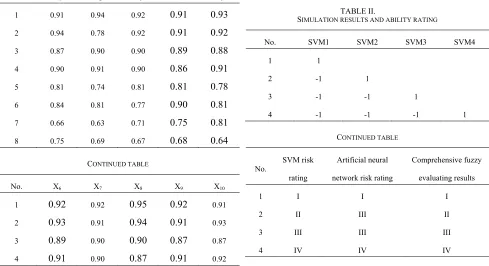
In this paper, we take the SCDA evaluation of 8 enterprises as an example, which are shown in table 1. The subsystem evaluating results are gained by scoring one by one according to various evaluating factors, the highest point is 1.0, then we can educe the ability rating of supplier cooperative design using the comprehensive fuzzy evaluation method based on subsystem parameter results. The SCDA are divided into four rating: level I denotes very high level, level II denotes high level, level III denotes general level, and level IV denotes low level. We take 1-8 group ability evaluating indices data and evaluating results in table 1 as the training samples, train the model, and carry through the simulation evaluation using the ability indices data of the four residual groups. We select the radial kernel function, function width=0.4, penalty parameter C=1000, class weight factor λi=1.5 (i negative), λi=1.0 (i positive). We use the MatLab to realize the software program, train the 4 level SVM classifier, and the training time is less than 0.09s.
TABLE I.
EVALUATING DATA AND TRAINING RESULTS
No. X1 X2 X3 X4 X5
1 2 3 4 5 6 7 8
0.91 0.94 0.87 0.90 0.81 0.84 0.66 0.75
0.94 0.78 0.90 0.91 0.74 0.81 0.63 0.69
0.92 0.92 0.90 0.90 0.81 0.77 0.71 0.67
0.91 0.91 0.89 0.86 0.81 0.90 0.75 0.68
0.93 0.92 0.88 0.91 0.78 0.81 0.81 0.64
CONTINUED TABLE
No. X6 X7 X8 X9 X10
1 2 3 4
0.92 0.93 0.89 0.91
0.92 0.91 0.90 0.90
0.95 0.94 0.90 0.87
0.92 0.91 0.87 0.91
0.91 0.93 0.87 0.92
5 6 7 8
0.82 0.86 0.78 0.66
0.85 0.82 0.75 0.64
0.76 0.74 0.68 0.69
0.79 0.86 0.77 0.72
0.81 0.88 0.69 0.68 CONTINUED TABLE
No. X11 X12 Decision Level
1 2 3 4 5 6 7 8
0.95 0.93 0.86 0.88 0.91 0.80 0.80 0.82
0.93 0.92 0.89 0.87 0.80 0.78 0.80 0.69
1 1 -1, 1 -1, 1 -1, -1, 1 -1, -1, 1 -1, -1, -1, 1 -1, -1, -1, 1
I I II II III III IV IV
We train the test samples using the trained SVM classifier, the simulating results are shown as table 2. In order to check the performance of this method, we design a artificial neural network classifier, input layer neurons is 7 which correspond 7 subcategories evaluation system respectively, the output layer neurons is 4 which correspond 4 ability rating of supplier cooperative design, the hidden layer nodes is 30. We go on the training and testing using the same sample and the same computer configuration, the ANN training results of the project 2 is difference from the SVM training results, the ANN misjudges the ability level II to Ⅲ, and ANN training time 1.54s is much higher than SVM training time.
TABLE II.
SIMULATION RESULTS AND ABILITY RATING
No. SVM1 SVM2 SVM3 SVM4 1
2 3 4
1 -1 -1 -1
1 -1 -1
1
-1 1 CONTINUED TABLE
No.
SVM risk rating
Artificial neural network risk rating
Comprehensive fuzzy evaluating results 1
2 3 4
I II III IV
I III III IV
V. CONCLUSION
The accuracy and generalization ability of SVM is excellent relatively, because the model is based on the principle of structural risk minimization, It solves the problem of "more learning" and "less learning", gains the overall optimum solution, and overcomes the deficiency of neural network can only get partial optimal solution. We can receive good results in the SCDA evaluation. At the same time, the SVM has powerful classification function and the good learning ability, so it has very broad application prospect on the SCDA evaluation.
ACKNOWLEDGMENT
This research was supported by the Scientific Research Foundation for Young Teachers of North China Electric Power University, and the item No. is 200611037.
This research was supported by the Philosophy and Social Science Research Topics of Baoding City. The item is “Research on Current Situation and Countermeasures of Agricultural Information Degree Based on New Rural Construction in Baoding City”, and the item No. is 20080223.
REFERENCES
[1] Lee, S.J., Lim,S.I., and Ahn,B.S., “Service restoration of primary distribution systems based on fuzzy evaluation of multi-criteria,” IEEE Trans on PWRS, vol. 13, no. 3, pp. 1156-1160, 1998.
[2] Karhunen J., Oja E., and L.Wang, “A class of neural
networks for independent component analysis,” IEEE
Trans on Neural Networks, vol. 18, no. 3, pp. 486-504,
1997.
[3] Z. Yuan, “Research on improved BP neural network,”
Information Technology, pp. 88-91, no. 2, 2006.
[4] Y.Y. Hsu, “A heuristic based fuzzy reasoning approach for distribute system service restoration,” IEEE Trans on PWRD, vol. 9, no. 2, pp. 948-953, 1994.
[5] X.Y. Li, “The model and application on the enterprise payoff ability evaluation based on improved BP neural network,” Industrial Technology Economy, vol. 25, no. 6,
pp. 92-96, 2006.
[6] Zhao, Q.C., “The application research and improvement of the enterprise comprehensive performance evaluation
based on BP neural network,” Industrial Engineering
Journal, vol. 8, no. 3, pp.102–107, 2005.
[7] He, J.G., “The credit evaluation system research based on improved BP neural network,” Computer Engineering and Design, vol. 27, no. 4, pp.605–621, 2006.
[8] Ren, F., “Comprehensive evaluation on sustainable
development for electric power industry based on
improved BP neural network model,” Journal of North
China Electric Power University, vol. 33, no. 1, pp.80–83,
2006.
[9] Miu N. K., “Fast service restoration for large-scale
distribution system with priority customers and constraints,” IEEE Trans on PWRS, vol. 13, no. 3, pp.
789-795, 1998.
[10]C. Warrender, and S. Forrest, “Detecting intrusions using system calls: alternative data models,” Proceedings of the IEEE Computer Society Symposium on Research in Security and Privacy, vol. 6, no. 5, pp. 133-145, 1999.
[11]C.J.C. Burges, “A tutorial on support vector machines for
pattern recognition,” Data Mining and Knowledge
Discovery, vol. 2, no. 2, pp. 121-127, 1998.
[12]G.L. Xian, G. M.Xian, “Support vector machine principle and its application in pattern classification,” China
Science and Technology Information, pp. 268-269, April 2008.
[13]K. Clark, “Project scope and project performance: the select of parts strategy and supplier involvement on product development,” Management Science, vol. 35, no.
10, pp.1247-1263, 1989.
[14]A. Tont, G. Nasstmbent, “A method for the evaluation of
suppliers’ co-design effort,” International Journal
Production Economics, vol. 72, no. 9, pp. 169-180, 2001.
[15]Z.H. Wang, F.H. Shu, “The improved support vector
machine and its application in coal mine safety evaluation system,” Mining Safety and Environmental Protection, vol.
34, no, 1, pp. 82-87, 2007.
[16]X.D. Hoang, J. Hu, “An efficient hidden markov model training scheme for anomaly intrusion detection of server
applications based on system calls,” 12th IEEE
International Conference on Networks, pp. 16-19,
November 2004.
Zhibin Liu, was born in Luannan County, China, and graduated from the agricultural university of Hebei in 2004, gained the master's degree of management. The author’s major field of study is the information management.
Since 2004, he is always working at the North China Electric Power University, Baoding City, China. And he has published more than 20 papers and 3 books. Such as the Research on the Advancing Front Topic of Asset Valuation (Beijing: Chinese Finance and Economical Publishing Company). His current research interests include the information management, international finance and machine learning.
Haifen Yang, was born in Rongcheng County, China, and graduated from the sichuan university in 2005, gained the doctor's degree of economics. The author’s major field of study is the economics.
Since 1994, she is always working at the agricultural university of Hebei, Baoding City, China. And she has published more than 20 papers, 10 books, and 20 research topics.
Shaomei Yang, was born in Handan City, China, and graduated from the agricultural university of Hebei in 2003, gained the master's degree of management. The author’s major field of study is the business management.