Quantum Interference between Light Sources Separated by 150 Million Kilometers
Yu-Hao Deng,1,2 Hui Wang,1,2 Xing Ding,1,2 Z.-C. Duan,1,2 Jian Qin,1,2 M.-C. Chen,1,2 Yu He,1,2 Yu-Ming He,1,2 Jin-Peng Li,1,2Yu-Huai Li,1,2Li-Chao Peng,1,2E. S. Matekole,3Tim Byrnes,4C. Schneider,5M. Kamp,5Da-Wei Wang,6
Jonathan P. Dowling,1,3,4 Sven Höfling,1,5,7 Chao-Yang Lu ,1,2,*Marlan O. Scully,8,9,10and Jian-Wei Pan1,2,†
1
Shanghai Branch, Department of Modern Physics and National Laboratory for Physical Sciences at the Microscale, University of Science and Technology of China, Shanghai 201315, China
2
CAS Center for Excellence and Synergetic Innovation Center in Quantum Information and Quantum Physics, University of Science and Technology of China, Shanghai 201315, China
3
Hearne Institute for Theoretical Physics and Department of Physics and Astronomy, Louisiana State University, Baton Rouge, Louisiana 70803, USA
4
New York University Shanghai, 1555 Century Ave, Pudong, Shanghai 200122, China
5Technische Physik, Physikalisches Institt and Wilhelm Conrad Rntgen-Center for Complex Material Systems,
Universitat Wrzburg, Am Hubland, D-97074 Wrzburg, Germany
6Department of Physics, Zhejiang University, Hangzhou 310027, China 7
SUPA, School of Physics and Astronomy, University of St. Andrews, St. Andrews KY16 9SS, United Kingdom
8Institute for Quantum Science and Engineering, Texas A&M University, College Station, Texas 77843, USA 9
Department of Physics, Baylor University, Waco, Texas 76798, USA
10Department of Mechanical and Aerospace Engineering, Princeton University, Princeton, New Jersey 08544, USA
(Received 30 April 2019; revised manuscript received 8 May 2019; published 21 August 2019)
We report an experiment to test quantum interference, entanglement, and nonlocality using two dissimilar photon sources, the Sun and a semiconductor quantum dot on the Earth, which are separated by
∼150million kilometers. By making the otherwise vastly distinct photons indistinguishable in all degrees of freedom, we observe time-resolved two-photon quantum interference with a raw visibility of 0.796(17), well above the 0.5 classical limit, providing unambiguous evidence of the quantum nature of thermal light. Further, using the photons with no common history, we demonstrate postselected two-photon entanglement with a state fidelity of 0.826(24) and a violation of Bell inequality by 2.20(6). The experiment can be further extended to a larger scale using photons from distant stars and open a new route to quantum optics experiments at an astronomical scale.
DOI:10.1103/PhysRevLett.123.080401
Can any two photons in the Universe, no matter how distantly and independently they originate from, show quantum interference and entanglement? According to quantum theory, when two quantum-mechanically indis-tinguishable single photons impinge upon a 50∶50 beam splitter, they bunch together out of the same output port due to bosonic statistics. The classical picture of electro-magnetic fields failed in understanding the interference of two photons from independent sources with a visibility better than 50%[1–4], which can be explained by quantum interference of the probability amplitudes of the two-photon events [5]. This effect, also known as Hong-Ou-Mandel (HOM) two-photon interference [6], poses a strong conceptual challenge to the celebrated statement by Dirac that each photon then interferes only with itself. Interference between different photons never occurs [7].
Since the original HOM experiment, which used two photons from the same parametric down-converted pair, progressively more and more independent, dissimilar, and distant sources have been used to test this type of quantum interference [8–18]. Apart from its fundamental interest,
the quantum interference of photons, emitted from different sources and without a common origin, can be harnessed for various quantum information tasks such as quantum teleportation[19], quantum repeaters[20], hybrid quantum networks[21], and measurement-device-independent quan-tum-key distribution[22].
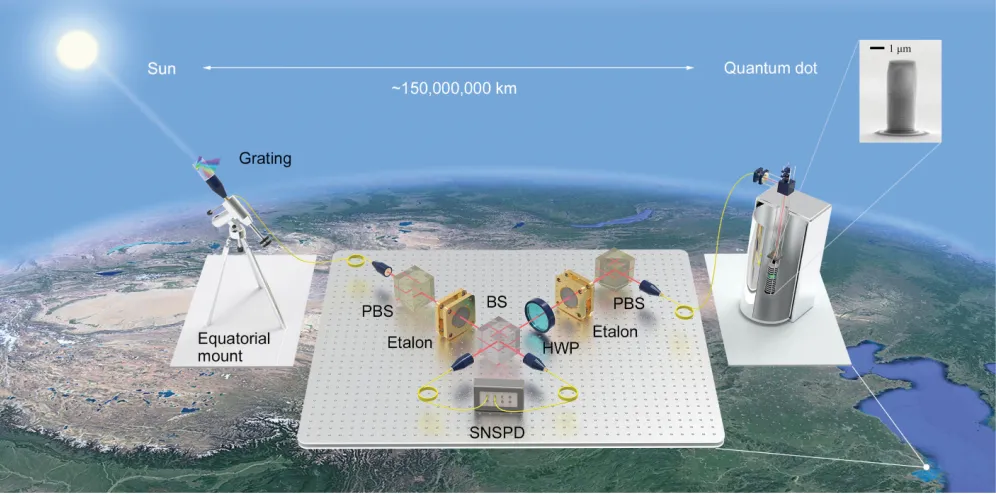
Here, we demonstrate nonclassical interference between sunlight and single photons from a semiconductor quantum dot (see Fig.1for an illustration of the experimental setup). The sunlight is collected with the assistance of an electric-motor-driven equatorial mount (located at121:5°E;31.1°N, in Shanghai) that tracks the Sun. The collected sunlight is then guided into our laboratory through a 50-m-long single-mode fiber. We choose days when there are few clouds and monitor the clouds distribution and motions in real time to avoid intensity fluctuations.
We use a self-assembled InAs/GaAs quantum dot (QD) as an ultrabright single-photon source with near-unity purity and indistinguishability[23,24]. The QD is embedded in a 2-μm diameter micropillar and sandwiched between 25.5 (15)λ=4-thick AlAs/GaAs mirror pairs that form lower
PHYSICAL REVIEW LETTERS
123,
080401 (2019)
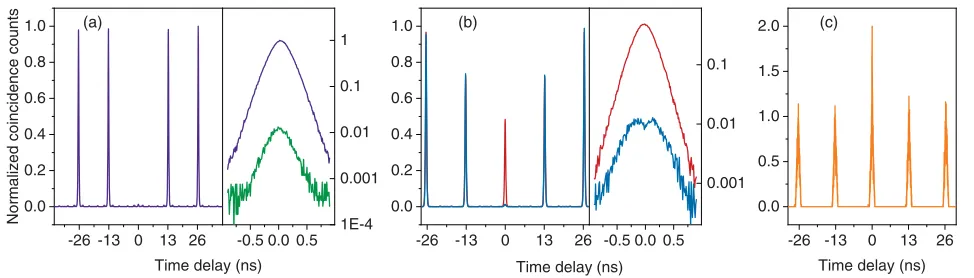
(upper) distributed Bragg reflectors. At a temperature of 4 K, the QD is spectrally resonant with the mode of the micro-cavity yielding a Purcell factor of 7.6. The high Purcell factor mitigates dephasing and efficiently funnels the spontaneous emission of the QD into the cavity mode, which enhances the single-photon extraction efficiency to 82%. Under resonant excitation with a picosecondπ-pulsed laser, with a repetition rate of 76 MHz, the source emits 25.6 million polarized single photons per second. After passing through an 1 GHz etalon, the photons at wavelength 893.198 nm (in air) show a second-order correlation functiongð2ÞQ ð0Þ ¼ 0.011ð1Þat zero time delay [Fig.2(a)]. We perform a series of HOM experiments with two QD single photons with their emission time separation varying from 13 ns to6.4μs, and observe the photons indistinguishability from 0.974(1) at 13 ns [see Fig.2(b)] slightly dropping to a plateau of 0.952 (3) through a dephasing time scale of ∼100 ns [25]. We measure that the QD single photons are Fourier transform limited with an indistinguishability of 0.952(3).
It is clear that the sunlight differs dramatically from the QD single-photon source in nearly all degrees of freedom (d.o.f.), including polarization, spatial modes, spectral and temporal properties, and also photon statistics. To observe
the HOM quantum interference, the two single photons from the independent sources should be made quantum mechanically indistinguishable. First, the sunlight has an extremely broad and complex solar spectrum, which can become even more complicated after passing through Earth’s atmosphere. We use optical filters and a temper-ature-tunable etalon with a bandwidth of 1 GHz to filter the sunlight so that it matches the spectrum of the QD single photons.
[image:2.612.58.556.51.298.2]from the sunlight (continuous in all the ∼13ns in each period) outside the time window of the QD actually emitting a single photon (∼100ps), we electrically gate the detections with a window of 1 ns, synchronized to the QD excitation laser pulses. This method suppresses the multiphoton contribution from the sunlight by a factor of ∼13compared to the case of ungated detection.
Third, for a good spatial-mode overlap, we collect the single photons from both sources into single-mode optical fibers, which transform the photons into the fundamental transverse Gaussian mode. For the polariza-tion d.o.f., the photons are prepared in a single polarized state using polarization beam splitters before the two-photon interference.
Last but not least, there is a counterintuitive property of the light sources which is not apparent in the first-order correlation function (but is manifest in their second-order correlation function)[26]that can also significantly influence the two-photon interference visibility. Unlike the high-purity QD single-photon source, sunlight is intrinsically thermal light, theoretically predicted second-order correlation function of gð2ÞS ð0Þ ¼2 [see Fig. 2(c)], indicating appreciable multiphoton event contributions. For an ideal 100%-purity single-photon source interfering with a thermal light field, if the intensity of the thermal light is reduced, one would in principle obtain near-unity interference visibility by suppressing the multiphoton events [16,34,35]. However, considering the small yet nonzero gð2ÞQ ð0Þ ¼0.011ð1Þ of the QD single-photon source, the dependence of the raw visibility on the intensity
of thermal light becomes more complicated (Fig. S5), so we optimize the relative intensity of the two sources and find a sweet spot for the maximum visibility[25]. In our experi-ment, the count rate of the photons from the Sun is set to be 2×10⁵s−1, and from the QD it is set as1.5×105s−1.
Figure3(a)shows the registered coincidence counts as a function of the time delay between the QD single photons and the sunlight photons for their relative polarizations prepared in orthogonal (red circle) and parallel (blue dot) directions. No background or dark-count subtraction is applied to the data. Each data point corresponds to a time bin of 10 ps. The red and blue curves are the result of our theoretical modeling, which takes into account the actual parameters of our experiment [25]. For parallel polar-izations, the data show a pronounced dip at zero delay. We sum up coincidence counts that fall into a delay time-bin τbin between the two detectors to calculate the
inter-ference visibility. Forτbin¼20ps, a raw visibility of 0.796
(17) is extracted, well above the classical limit of 0.5, which conclusively establishes the quantum nature of the two-photon interference between the QD and the Sun. The dependence of the visibility on the delay time bin is illustrated in Fig. 3(b), showing a visibility higher than 0.5 is maintained up to τbin¼440ps. The nonvanishing
dip at the zero time delay is mainly attributed to the multiphoton events from the QD and the Sun, as we discuss further in the Supplemental Material[25].
While the Hanbury Brown–Twiss interference with thermal light was demonstrated more than 60 years ago
[36], their results could be explained within the framework of classical coherence theory. Previous attempts on HOM -26 -13 0 13 26
0.0 0.2 0.4 0.6 0.8 1.0
-0.5 0.0 0.5 1E-4 0.001 0.01 0.1 1
-26 -13 0 13 26 0.0
0.2 0.4 0.6 0.8 1.0
-0.5 0.0 0.5 0.001 0.01 0.1
-26 -13 0 13 26 0.0
0.5 1.0 1.5 2.0 (c) (b)
Normalized
coincidence
c
ounts
Time delay (ns) (a)
[image:3.612.65.552.44.183.2]Time delay(ns) Time delay (ns)
FIG. 2. Characteristics of the independent sources. (a) Intensity-correlation histogram of the pulsed RF from quantum dot obtained using a Hanbury Brown–Twiss-type setup. The second-order correlationgðQ2Þð0Þ ¼0.011ð1Þis calculated by summing all coincidence counts in the zero-delay peak divided by that of its adjacent peak. The right panel is a zooming-in plot of the coincidence counts around zero time delay (green) and 26 ns delay (purple) with log scale. (b) Intensity-correlation histogram of the pulsed RF from Purcell-enhanced QD-micropillar system in Hong-Ou-Mandel interference setup with cross polarization (red) and parallel polarization (blue). The time separation between the two single photons emitted from the single QD set to 13.2 ns (one pulse separation). The right panel is a zooming-in plot of the coincidence counts around zero time delay. A raw visibility Vr¼ ðPcross−PparallelÞ=Pcross¼96.36%, where
interference with table-top pseudothermal light sources have also been reported [16,37], but the low visibilities were insufficient to support the nonclassical picture. In our experiment, however, the quantum nature manifests itself by directly observing visibilities well above 50%, which has no classical analog[1–4]. This is not a surprise for single-photon sources, since single-atom resonance fluorescence had shown antibunching 40 years ago that provided the first evidence of the quantum nature of light
[26,38,39]. However, our result also demonstrates how
thermal light from a natural source requiring only classical optics for its description can be involved in a highly nonclassical quantum-optics experiment.
Owing to the combination of our high-performance single-photon sources (developed only very recently), and techniques making the otherwise vastly different photons indistinguishable in all d.o.f., the observed raw visibility not only exceeds the classical limit of 0.5, for strictly proving nonclassical interference, but also is higher than the threshold of 0.71 that enables postselected entan-glement generation and a test of Bell inequality. By initializing the two photons in orthogonal polarizations and overlapping them onto a beam splitter, and selecting only the events (with 50% probability) where there is one and only one photon in each output, the two output photons are projected into an entangled state close to the form of jψ−i ¼ ðjHi
1jVi2−jVi1jHi2Þ= ffiffiffi
2 p
, where HðVÞ denotes horizontal (vertical) polarization. We perform two-photon correlation measurements along the basis of H=V, þ=−, andR=L, whereji ¼ ðjHi jViÞ=pffiffiffi2, andjRi ¼ ðjHiþ
ijViÞ=pffiffiffi2,jLi ¼ ðjHi−ijViÞ=pffiffiffi2. The data are plotted in Fig. 4, from which we calculate the state fidelity of the generated entanglement (defined as the wave-function
overlap of the experimentally obtained state with the ideal jψ−i) to be 0.826(24) forτ
bin¼50ps, which is sufficient
to confirm the two-particle entanglement.
Finally, we use the two-photon entanglement thus generated to perform a Bell test in the Alley-Shih configu-ration[40]. While Bell experiments were usually performed with entangled particles sharing a common source, it is interesting to conduct Bell tests that use particles from physically separated remote sources sharing no common
0 100 200 300 400 500
0.4 0.5 0.6 0.7 0.8
Parallel Cross
1500 1000 500 0 500 1000 1500 0
100 200 300 400
Time delay (ps)
Coincidence counts
Raw visibility
Time-bin (ps)
[image:4.612.317.561.450.588.2](a) (b)
FIG. 3. HOM interference between photons from QD and the Sun. (a) Histogram of the time delays of the coincident arrivals of the two photons on the superconducting nanowire single photon detectors. Blue disks correspond to the parallel polarization (indistinguishable) situation, while red circles correspond to cross polarization situation (distinguishable). Each bin is 10 ps long. We got an overall coincidence count rate of 32 Hz for cross polarization and 24 Hz for the parallel polarization, and for the central 10 ps bin around zero time delay the coincidence count rate is 0.36 Hz for cross polarization and 0.07 Hz for parallel polarization. The solid lines are fits based on the model in[25]. The counts of parallel-polarization situation have been normalized to the counts of cross polarization situation for fair comparison. Error bars indicate the standard deviation. (b) Dependence of the raw visibility on the width of sampling delay bins centered at the zero delay. Red horizontal dashed line corresponds to the classical limit 0.5. Error bars represent statistical errors.
HH HV VH VV
0.0 0.1 0.2 0.3 0.4 0.5
Normalized
c
ount
(a) (b) (c)
Measurement settings
RR RL LR LL 0.0 0.1 0.2 0.3 0.4 0.5
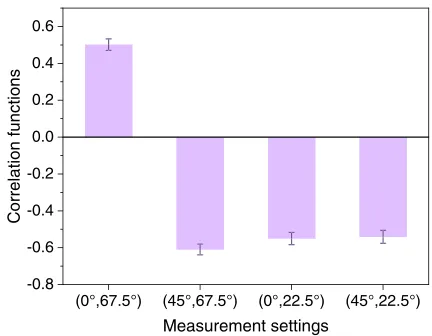
history[41]. Here, we use the QD single photons and the sunlight which were originally separated by one astro-nomical unit to test the Clauser-Horne-Shimony-Holt (CHSH)-type inequality[42], which is given by
S¼ jEðφ1;φ2Þ−Eðφ1;φ02Þ þEðφ01;φ2Þ þEðφ01;φ02Þj ≤2;
whereEðφ1;φ2Þis the two-photon correlation at measure-ment angles of φ1 and φ2, respectively. The angles are selected among (0,π=8), (0,3π=8), (π=4,π=8), and (π=4, 3π=8). The observed data in the four settings are summa-rized in Fig. 5, from which we find S¼2.20ð6Þ, with a violation of the CHSH-Bell inequality S≤2 by 3.3 standard deviations.
In summary, we have reported a quantum optics experi-ment with extremely dissimilar light, which are emitted from a semiconductor QD and from the Sun, respectively, separated by a distance of one astronomical unit. Mixing the high-performance quantum-dot single-photon source with the thermal light, our experiment observed highly nonclassical two-photon Hong-Ou-Mandel interference with ∼80% raw visibility, thus providing clear evidence of the quantum nature of the thermal light. The two dissimilar light sources have been further used to generate high-fidelity entanglement and violation of Bell inequality. Our results validate the universality of the principles of quantum statistics and violation of Bell inequality on astronomical scales.
The experiment can be further extended to a much larger scale using photons from distant stars, e.g., the Sirius, within currently available technologies. With a single-photon source of better purity [27–29], one can tolerate even feebler starlight and shorten the data accumulation time significantly [25]. Moreover, the technique reported in this work can be implemented to study astronomical
objects spectroscopy, probing into the second-order coher-ence information of the luminous objects (processes), e.g., single-mode linewidth, decoherence properties, and spec-tral density matrix[43]. We propose to probe the second-order coherence of photons in other wavelengths from sunlight, especially the special spectra lines of elements abundant in the solar atmosphere. We expect their coher-ence properties may reveal dynamic sun activities, for example, dramatic changes in magnetic field, reemission of photons at dark lines, dispersion (chirping) mechanism, etc. Besides, our techniques reported in this Letter demonstrate the highest measuredgð2ÞS ð0Þ ¼1.94 over all previous works on measuringgð2ÞS ð0Þ[44], calling for future applications in highly sensitive starlight intensity interfer-ometry, and large-scale ghost-imaging experiment with sunlight[45,46].
This work is supported by the National Natural Science Foundation of China, the Chinese Academy of Science, the Anhui Initiative in Quantum Information Technologies, the Science and Technology Commission of Shanghai Municipality, the National Fundamental Research Pro-gram, the State of Bavaria, the State of Texax, and the US National Science Foundation.
[1] L. Mandel, Photon interference and correlation effects produced by independent quantum sources, Phys. Rev. A
28, 929 (1983).
[2] H. Paul, Interference between independent photons, Rev. Mod. Phys.58, 209 (1986).
[3] S. Prasad, M. O. Scully, and W. Martienssenn, A quantum description of the beam splitter, Opt. Commun. 62, 139 (1987).
[4] J.-W. Pan, Z.-B. Chen, C.-Y. Lu, H. Weinfurter, A. Zeilinger, and M. Żukowski, Multiphoton entanglement and interferometry,Rev. Mod. Phys.84, 777 (2012). [5] T. B. Pittman, D. V. Strekalov, A. Migdall, M. H. Rubin,
A. V. Sergienko, and Y. H. Shih, Can Two-Photon Interfer-ence be Considered the InterferInterfer-ence of Two Photons?, Phys. Rev. Lett.77, 1917 (1996).
[6] C. K. Hong, Z. Y. Ou, and L. Mandel, Measurement of Subpicosecond Time Intervals Between Two Photons by Interference,Phys. Rev. Lett.59, 2044 (1987).
[7] P. A. M. Dirac, The Principles of Quantum Mechanics (Clarendon, Oxford, United Kingdom, 1958).
[8] R. Kaltenbaek, B. Blauensteiner, M.Żukowski, M. Aspelmeyer, and A. Zeilinger, Experimental Interference of Independent Photons,Phys. Rev. Lett.96, 240502 (2006).
[9] J. Beugnon, M. P. A. Jones, J. Dingjan, B. Darqui´e, G. Messin, A. Browaeys, and P. Grangier, Quantum interfer-ence between two single photons emitted by independently trapped atoms,Nature (London)440, 779 (2006). [10] P. Maunz, D. L. Moehring, S. Olmschenk, K. C. Younge,
D. N. Matsukevich, and C. Monroe, Quantum interference
(0°,67.5°) (45°,67.5°) (0°,22.5°) (45°,22.5°) -0.8
-0.6 -0.4 -0.2 0.0 0.2 0.4 0.6
C
o
rrelation
functions
[image:5.612.66.282.44.212.2]Measurement settings
of photon pairs from two remote trapped atomic ions,Nat. Phys.3, 538 (2007).
[11] C. Lang, C. Eichler, L. Steffen, J. M. Fink, M. J. Woolley, A. Blais, and A. Wallraff, Correlations, indistinguishability and entanglement in Hong-Ou-Mandel experiments at microwave frequencies,Nat. Phys.9, 345 (2013). [12] H. Bernien, L. Childress, L. Robledo, M. Markham, D.
Twitchen, and R. Hanson, Two-Photon Quantum Interfer-ence from Separate Nitrogen Vacancy Centers in Diamond, Phys. Rev. Lett.108, 043604 (2012).
[13] E. B. Flagg, A. Muller, S. Polyakov, A. Ling, A. Migdall, and G. Solomon, Interference of Single Photons from Two Separate Semiconductor Quantum Dots, Phys. Rev. Lett.
104, 137401 (2010).
[14] R. B. Patel, A. J. Bennett, I. Farrer, C. A. Nicoll, D. A. Ritchie, and A. J. Shields, Two-photon interference of the emission from electrically tunable remote quantum dots, Nat. Photonics4, 632 (2010).
[15] J. G. Rarity, P. R. Tapster, and R. Loudon, Non-classical interference between independent sources,J. Opt. B7, S171 (2005).
[16] X. Li, L. Yang, L. Cui, Z. Y. Ou, and D. Yu, Observation of quantum interference between a single-photon state and a thermal state generated in optical fibers,Opt. Express16, 12505 (2008).
[17] A. J. Bennett, R. B. Patel, C. A. Nicoll, D. A. Ritchie, and A. J. Shields, Interference of dissimilar photon sources,Nat. Phys.5, 715 (2009).
[18] S. V. Polyakov, A. Muller, E. B. Flagg, A. Ling, N. Borjemscaia, E. Van Keuren, A. Migdall, and G. S. Solomon, Coalescence of Single Photons Emitted by Disparate Single-Photon Sources: The Example of InAs Quantum Dots and Parametric Down-Conversion Sources, Phys. Rev. Lett.107, 157402 (2011).
[19] C. H. Bennett, G. Brassard, C. Cr´epeau, R. Jozsa, A. Peres, and W. K. Wootters, Teleporting an Unknown Quantum State Via Dual Classical and Einstein-Podolsky-Rosen Channels,Phys. Rev. Lett.70, 1895 (1993).
[20] H.-J. Briegel, W. Dr, J. I. Cirac, and P. Zoller, Quantum Repeaters: The Role of Imperfect Local Operations in Quantum Communication,Phys. Rev. Lett.81, 5932 (1998). [21] M. Halder, A. Beveratos, N. Gisin, V. Scarani, C. Simon, and H. Zbinden, Entangling independent photons by time measurement,Nat. Phys.3, 692 (2007).
[22] H.-K. Lo, M. Curty, and B. Qi, Measurement-Device-Independent Quantum Key Distribution, Phys. Rev. Lett.
108, 130503 (2012).
[23] Y.-M. He, Y. He, Y.-J. Wei, D. Wu, M. Atatüre, C. Schneider, S. Höfling, M. Kamp, C.-Y. Lu, and J.-W. Pan, On-demand semiconductor single-photon source with near-unity indistinguishability, Nat. Nanotechnol. 8, 213 (2013).
[24] X. Ding et al., On-Demand Single Photons with High Extraction Efficiency and Near-Unity Indistinguishability from a Resonantly Driven Quantum Dot in a Micropillar, Phys. Rev. Lett.116, 020401 (2016).
[25] See Supplemental Material at http://link.aps.org/ supplemental/10.1103/PhysRevLett.123.080401 for more details on the characterization of the Fourier-transform-limited QD, the model and methods for intensity ratio
optimization, the modeling of the temporal interference pattern, thermal statistics under attenuation, and extention of the experiment on further stars. The Supplemental Material includes Refs. [24,26–33].
[26] R. J. Glauber, The quantum theory of optical coherence, Phys. Rev.130, 2529 (1963).
[27] L. Schweickert et al., On-demand generation of back-ground-free single photons from a solid-state source,Appl. Phys. Lett.112, 093106 (2018).
[28] L. Hanschke, K. A. Fischer, S. Appel, D. Lukin, J. Wierzbowski, S. Sun, R. Trivedi, J. Vučković, J. J. Finley, and K. Müller, Quantum dot single-photon sources with ultra-low multi-photon probability,npj Quantum Inf.4, 43 (2018). [29] H. Wang et al., On-Demand Semiconductor Source of Entangled Photons which Simultaneously has High Fidelity, Efficiency, and Indistinguishability, Phys. Rev. Lett. 122, 113602 (2019).
[30] A. Thoma et al., Exploring Dephasing of a Solid-State Quantum Emitter via Time- and Temperature-Dependent Hong-Ou-Mandel Experiments, Phys. Rev. Lett. 116, 033601 (2016).
[31] H. Wang et al., Near-Transform-Limited Single Photons from an Efficient Solid-State Quantum Emitter,Phys. Rev. Lett.116, 213601 (2016).
[32] T. Legero, T. Wilk, A. Kuhn, and G. Rempe, Time-resolved two-photon quantum interference, Appl. Phys. B 77, 797 (2003).
[33] M. H. Liet al., Test of Local Realism into the Past Without Detection and Locality Loopholes, Phys. Rev. Lett. 121, 080404 (2018).
[34] Z. Y. Ou, Quantum theory of fourth-order interference, Phys. Rev. A37, 1607 (1988).
[35] R. Wiegner, J. Von Zanthier, and G. S. Agarwal, Quantum interference and non-locality of independent photons from disparate sources, J. Phys. B: At. Mol. Opt. Phys. 44, 055501 (2011).
[36] R. H. Brown and R. Q. Twiss, A test of a new type of stellar interferometer on Sirius,Nature (London)178, 1046 (1956).
[37] H. Chen, T. Peng, S. Karmakar, and Y. Shih, Simulation of Bell states with incoherent thermal light,New J. Phys.13, 083018 (2011).
[38] H. J. Kimble, M. Dagenais, and L. Mandel, Photon Anti-bunching in Resonance Fluorescence,Phys. Rev. Lett.39, 691 (1977).
[39] D. F. Walls, Evidence for the quantum nature of light, Nature (London)280, 451 (1979).
[40] Y. H. Shih and C. O. Alley, New Type of Einstein-Podolsky-Rosen-Bohm Experiment Using Pairs of Light Quanta Produced by Optical Parametric Down Conversion, Phys. Rev. Lett.61, 2921 (1988).
[41] T. B. Pittman and J. D. Franson, Violation of Bells Inequal-ity with Photons from Independent Sources,Phys. Rev. Lett.
90, 240401 (2003).
[42] J. F. Clauser, M. A. Horne, A. Shimony, and R. A. Holt, Proposed Experiment to Test Local Hidden-Variable Theories,Phys. Rev. Lett.23, 880 (1969).
[44] P. K. Tan, G. H. Yeo, H. S. Poh, A. H. Chan, and C. Kurtsiefer, Measuring temporal photon bunching in black-body radiation,Astrophys. J. Lett.789, L10 (2014). [45] A. Gatti, E. Brambilla, M. Bache, and L. A. Lugiato,
Ghost Imaging with Thermal Light: Comparing
Entanglement and Classical Correlation, Phys. Rev. Lett.
93, 093602 (2004).
[46] X. F. Liu, X.-H. Chen, X.-R. Yao, W.-K. Yu, G.-J. Zhai, and L.-A. Wu, Lensless ghost imaging with sunlight,Opt. Lett.