RESEARCH ARTICLE
A COMPARATIVE STUDY TO ANALYSE THE EFFECT OF STAIR GAIT TRAINING VERSUS VARIED
OVER GROUND WALKING TRAINING FOR DYNAMIC BALANCE AND WALKING ABILITY IN
STROKE PATIENTS - RCT
1*
Dr. Chaitany Patel,
2Chandani Devaliya and
2Nirali Patel
1Assistant Professor, Shree B. G. Patel College of Physiotherapy, Sardar Patel University, Anand, Gujarat, India
2BPT, Shree B. G. Patel College of Physiotherapy, Sardar Patel University, Anand, Gujarat, India
ARTICLE INFO ABSTRACT
Objectives: To study the effect of stair gait training for dynamic balance and walking ability in
stroke patients. To study the effect of varied over ground training for dynamic balance and walking ability in stroke patients. To compare the effect of stair gait training vs varied over ground training for
dynamic balance and walking ability in stroke patients. Methods: Cross Sectional Study design
assigned by convenient samplingwith30 Subjects in each group. Outcome Measure: BBS, 5 METER
WALK TEST, TUG test LEFS. Results: stair gait training for dynamic component in BBS
score42.73 – 51.40(8.67mean differences) and in varied over ground training BBS score is 38.35- 46.73 (8.37 mean differences) which mean differences shows the both are statistically significant and
highly significant in stair gait training as well as in LEFS score. Conclusion: Stair gait training and
varied over ground training shows significant improvement in dynamic balance, gait speed and lower limb function activity. Dynamic balance and lower limb functional activity shows more improvement in stair gait training. In gait speed for TUG Test, and 5 Meter Walk Test shows equally improvement in both the training group.
Copyright©2019, Chaitany Patel et al. This is an open access article distributed under the Creative Commons Attribution License, which permits unrestricted use,
distribution, and reproduction in any medium, provided the original work is properly cited.
INTRODUCTION
Stroke is a global health problem and is a leading cause of adult disability (Ashrafian, 2010). After stroke, most patients walk at speeds that range from approximately 0.2 m/s to 0.8 m/s, These velocities are significantly lower than the SCWS exhibited by age-matched individuals (1.3 m/s to 1.4 m/s) (Straudi, 2016). In Particular, walking up and down stairs is a basic activity in daily life, but only 5–25% of stroke patients are capable of this activity when they are discharged from a rehabilitation- center (Paolucci, 2008). A Stair gait exercise is among the exercises that strengthen the lower limbs of stroke patients, and it is frequently used for transportation and walking on flat ground. Compared with flat-area walking, stair climbing requires more energy and muscle strength in the lower limbs, as it involves horizontal movement and vertical ascent at the same time, while keeping the body balanced. These days, steppers are widely used for lower limb exercise and rehabilitation, which has benefit of reducing stress on the knee joints (Prado-Medeiros, 2011; Alton, 1998). They are also recommended for use in aerobic exercise similar to stair walking, which builds muscle strength (Nadeau, 2003).
Accordingly, stair gait training in the clinical field is an essential exercise process applied to stroke patients who will be discharged from the hospital. (Eun, 2004) In a review of stair gait-related studies, Eun et al.(2004) stated that much larger extension moments than flexion moments occurred in the lower extremity joints of healthy individuals and that larger extension moments occurred in the knee and hip joints than in the ankle joints. It has been suggested that treatment strategies for stroke patients with poor motor control should focus on isolated and selected joint movement training to break up the mass synergistic pattern and improve walking pattern. Isolated ankle dorsiflexion while hip and knee are in extension is the first sign of selective motor control after stroke (Yavuzer, 2006). In clinical practice, it is now widely accepted that high-intensity and task-specific interventions, such as task-oriented circuit training (TOCT), are pivotal to achieve functional recovery after stroke. TOCT is a relatively new concept in neurorehabilitation and it consists of progressive task-specific therapy provided in a group setting (class) (Straudi, 2016). Task-oriented training includes a wide range of interventions such as treadmill training, walking training on the ground, bicycling programmes, endurance training and circuit training, sit-to-stand exercises, and reaching tasks for improving balance.
ISSN: 0975-833X
International Journal of Current Research Vol. 11, Issue, 08, pp.6493-6497, August, 2019
DOI: https://doi.org/10.24941/ijcr.36324.08.2019
INTERNATIONAL JOURNAL OF CURRENT RESEARCH
Article History:
Received 26th May, 2019
Received in revised form 19th June, 2019
Accepted 20th July, 2019 Published online 31st August, 2019
Citation: Dr. Chaitany Patel, Chandani devaliya and Nirali Patel, 2019. “A comparative study to analyse the effect of stair gait training versus varied over ground
walking training for dynamic balance and walking ability in stroke patients - rct”, International Journal of Current Research, 11, (08), 6493-6497.
Key Words
Stroke, Stair gait Training, varied
over Ground Walking Training,
Obstacle Walking, Dynamic Balance, Step Task Training, TUG Test
In addition, use is made of arm training using functional tasks such as grasping objects, constraint-induced (movement) therapy (CIMT) and mental imagery (Rensink, 2009). In a randomized controlled trial, Yang et al. compared a motor-motor dual-task intervention (walking while manipulating either one or two balls of various size) to a no-intervention control. Compared to 12 patients who did not receive any intervention, the 13 patients who received dual-task training significantly improved their gait speed during both single-task and dual-task (tray carrying) walking (Plummer-D'Amato, 2012). Bayouk et al. argued that exercise using tasks is effective at enhancing balance and mobility. Said et al. reported that obstacle training had a significant impact on walking and balance, stroke patients’ and it has also been reported that diverse afferent stimuli and functional activities help to improve the ability to perform daily life activities.(4) Depaul et al. studied varied over ground training versus treadmill training proving both interventions effective in improving gait speed (DePaul, 2015). According the previous study of stair gait training as well as MLWP (varied over ground walking) for stroke patients to improve the balance and gait speed but there is no find out comparative study. In an effort to assess the relative value of motor-learning science as a theoretical framework, the Stair Gait Training was compared with MLWP (varied over ground walking).
MATERIALS AND METHODOLOGY
Study Design: Pre and Post quasi-experimental study.
Study Setting: Department of Physiotherapy, Shree B.G.Patel,
college of physiotherapy, Anand.
Sampling Method: Random sampling.
Sample Size: 15 Subjects in each group (total 30).
Subjects: Male and Female diagnosed with stroke.
Inclusion Criteria
were 40 years or above,
<3 months since onset of ischemic or hemorrhagic stroke
were able to 30 m walk without assistance (gait aid allowed)
were able to maintain independent standing posture for 30s or longer
able to follow a 2 step verbal command
Exclusion Criteria
were unable to follow commands properly,
had an Abbreviated Mental Test score below 6
were medically unstable,
severe visual impairment
Materials used in study
Assessment form, Measure tape, Chair, Cones, Stopwatch, Pencil, Paper.
Apparatus Required for the Study
STANDRAD STAIR CASE - LENGTH -- 28 cm
WIDTH -- 0.8 m
HEIGHT -- 7inch (around 10 to 12 cm)
Outcome Measures
1. BBS
2. METER WALK TEST 3. TUG test
4. LEFS
Procedure
30 subjects of age 45-85 years of age referred by Neurophysician were recruited in study. Subjects were selected on basis of inclusion and exclusion criteria. Informed consent in written form were obtained from all the patients. Demographic data in form of age, onset time, duration, affection side and dominant side were collected and pre intervention test was assessed by BBS, TUG test and 5 Meter walk test.
Protocol
Stair Gait Training group: Group will practice 10 step activity at every session:
Forward stepping with affected leg / non affected leg
Step down with affected leg / non-affected leg
Heal-off with affected leg and non affected leg on step / non-affected and affected leg on step
With affected leg on step, non-affected leg through step up-up and down- down / non affected leg on step, affected leg trough step up-up and down-down
Affected leg on 1st step them with non affected leg direct step up to next step and direct step down to the ground / Non-Affected leg on 1st step them with affected leg direct step up to next step and direct step down to the ground
This step task do 12 repetation per session. This step task completed then do 1fight of stair (12 stair) climbing ascending and descending and after that 4step on stair as much as fast Each subject in this group stand in front of the stair walking training apparatus and the therapist then assisted the patient during stair climbing by fixing the ischium on the patients paretic side, helping popliteal flexion, and supporting the ankle if the ankle joint was unstable. During stair descent, patient with left hemiplegia maintained stability by supporting the lower limb above the knee joint with his/her left hand while the physical therapist held the waist of the patient with his/her hand. When the patient’s foot came into contact with the stairs, the forefoot was placed first to assist weight bearing by the knee. To prevent falls, the patient was permitted to hold the safety bar on the stairs if nesessary.
Varied Overground Walking group: Group will practice 7
core walking activities at every session:
Short walks;
Longer distance (≥50 m);
Steps, curbs, and slopes;
Transitions (e.g., sit to stand and walk);
Changes in centre of gravity (e.g., pick up an object off floor); and
Changes in direction
This task do 12 repetation per session. When any patient complained of pain or showed abnormalities of breathing, feelings of fatigue, or vertigo after the beginning walking training the walking training was immediately stopped. Duration of the study: Each group received the intervention five times per week, for four weeks.
STATISTICAL ANALYSIS
Paired and unpaired T test was used at end of the study. Null hypothesis will be rejected if < 0.05. All the statistical analysis was conducted with the help of version 16.0 of the SPSS.
Data Analysis: Total 30 patients were included in the study depending on which following distribution is observed. Mean ± SD of age for the study population was Mean ± SD of age for stair gait training group was 50.1 ± 8.238797 Mean ± SD of age for varied over ground training group was 51.8 ± 6.425643
RESULTS
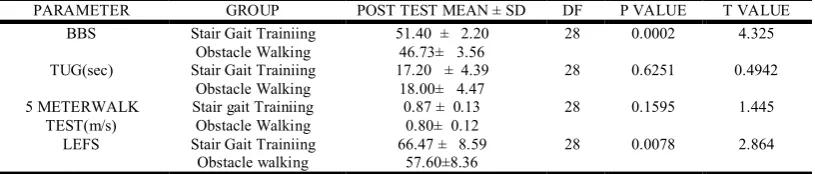
In this study stair gait training for dynamic component in BBS score 42.73 – 51.40(8.67mean differences) and in varied over ground training BBS score is 38.35- 46.73 (8.37 mean differences) which mean differences shows the both are statistically significant and highly significant in stair gait training. In this study In this study stair gait training for dynamic balance and gait speed component in TUG Test is26 sec-17.20 sec (8.8 sec mean differences) and in varied over ground training TUG Test 25.07sec- 18.00 sec mean differences) which mean differences shows the both are statistically significant But both the training have equally effect. In this study stair gait training for gait speed component in 5 meter walk Test is 0.55 m/ sec –0.87 m/sec (o.32 m/sec mean differences) and in varied over ground training 5 meter walk Test 0.54 m/sec- 0.80 m/sec (0.26 m/sec mean differences) which mean differences shows the both are statistically significant But both the training have equally effect. In this study stair gait training for functional activity in that LEFS score gait speed component is 44.73- 66.47( 21.74 mean differences) and in varied over ground training LEFS score 46.20- 57,60 (11.4 mean differences) which mean differences shows the both are statistically significant But highly significant in stair gait training.
DISCUSSION
In stair gait training and varied over ground training directly shows effect in some BBS component like stepping reaction time, one leg standing, alternate stepping and functional reach task so the major dynamic components as well as static component also improve but stair gait training shows more improvement. Kim reported that a step exercise could facilitate a patient’s walking pattern when conducting a stepping motion and it could increase walking speed, as found with the stair gait exercise (Kim, 2013).
Kim et al. (2006)examined the contact force applied to knee joints during flat surface gaits and during slope-way or stair gaits. They reported that the contact force was greater during stair gaits, approximately 4.25 times that of the body weight.
As Christina and Savannah (Christina, 2002) mentioned, physical ability is required more during stair gait than during ground gait training, because balance ability of the trunk and muscle strength of the lower limbs are needed. A study on stair gait conducted with 30 adult hemiplegic patients to determine changes in balance and muscle activity after gait training with different stair heights reported that the 10 cm-high stair gait training group showed the most significant difference in balance abilities, as well as larger changes in muscle activities than stair gait groups with other heights (Horstman, 2008). Stair gait training shows in some other effect like improvement in gait cycle, muscle strength, and functional reach test also.
According this study result in TUG test for stair gait training and varied over ground training means differences is 8.8 sec and 7.07 sec and other study result in TUG test mean differences 5.02 sec so in this study shows more significant result in TUG test. Geiger et al. divided chronic hemiplegic patients into a proprioceptive group and a control group and
observed the TUG test result decreased from 23.08s to 14.62s (8.46 mean differences) in the proprioceptive group. Kyo CS,
Kim HA.et all in this study comparison of TUG for measuring dynamic balance ability was showed statistically significant decrease in both two groups (p>.05) and significant decrease in experimental group more than control group (p>.001) (Kyo, 2013). Rebecca A. States et all systemic review result for over ground training in that Timed Up and Go test improved by 1.81 seconds (95% CI, -2.29 to -1.33) based on three studies (n -118),and our study varied over ground training tug test improvement shows in 1.77sec - 7.07 sec which shows more significant (Rebecca, 2009). Kyo CS, Kim HA.et all this study has investigated that that the gait velocity at after stair gait training on stroke patients was showed significant differences with 0.44.- 08m/s at before -training and 0.75.-18m/s at after-training (p>.05) (Kim, 2013). According this study result in 5 meter walk test for stair gait training and varied over ground training means differences is 0.32 m/sec sec and 0.26m/sec and other study result in 5 meter walk test mean differences 0.31 m/sec sec so in this study shows significant. DePaul et al. showed that despite a lack of between-group differences in the primary outcome, it is important to note that both interventions resulted in a clinically meaningful change (0.14 m/s) in comfortable gait speed (Horstman, 2006). Vincent et al. In this tidy there was meaningful change of gait speed 0.12 m/s and 0.11m/s in varied over ground training and limited progressive treadmill training group which was statistically significant in within group comparison but also was clinically beneficial And with our study correlation shows more significant change in gait speed in 5 meter walk test 0.26 m/sec.
Rebecca States et al. systemic review result for over ground training in that Walking speed increased by 0.07 m/sec [95% confidence interval (CI), 0.05– 0.10] based on seven studies (n _ 396), and our study varied over ground training 5 meter walk test improvement shows in 0.26 m/sec which shows more significant (Rebecca, 2009). The literature suggests that an average walking velocity of 1.1 to 1.5 m/s is probably fast enough to be functional as pedestrian in different environmental and social contexts (eg, crossing a street safely) (Pohl, 2002).
In past research for stair gait training and varied over ground training I have not found as in functional activity assessment so in this study interpretation of functional activity manly for lower limb in that outcome measure taken as Lower extremity functional scale (LEFS). In this study stair gait training and varied over ground training both are showing improvement in lower extremity functional scale so stabilize the functional outcome. Based on motor learning science, the MLWP was specifically designed to encourage cognitive effort and problem solving during training. Practice tasks were random or serial in order and feedback and guidance was delayed or limited in frequency to allow self-evaluation and correction of errors. Although these strategies have been associated with improved outcomes after stroke, there is evidence that the degree of benefit is influenced by the complexity of the skill being learned and the experience of the learner (DePaul, 2015)
Conclusion
[image:4.595.79.517.144.241.2]Stair gait training and varied over ground training shows significant improvement in dynamic balance, gait speed and lower limb function activity. Dynamic balance and lower limb functional activity shows more improvement in stair gait training. In gait speed for TUG Test, and 5 Meter Walk Test shows equally improvement in both the training group
Table No.1. Shows the demographic data
Gender Side of hemiplegia Causeof stroke
Male Female Right Left ischemic hemorrhagic
21 9 12 18 22 8
Table No.2. Comparison of Pre and Post Value in Stair Gait training Group And over ground waliking group
Parameter Group Pretest Post test Df P value T value
Mean ± sd Mean ± sd
Bbs Stair gait trainiing 42.73± 2.91 51.40 ± 2.20 14 <0.0001 12.35
Obstacle walking 38.33± 4.48 46.73± 3.56 14 <0.0001 6.315
Tug(sec) Stair gait trainiing 26.00± 7.86 17.20 ± 4.39 14 <0.0001 8.15
Obstacle walking 25.07± 4.85 18.00± 4.47 14 <0.0001 7.926
5 meterwalk test(m/s) Stair gait trainiing 0.55±0.16 0.87 ± 0.13 14 <0.0001 28.28
Obstacle walking 0.54± 0.15 0.80± 0.12 14 <0.0001 7.460
Lefs Stair gait trainiing 44.73± 6.94 66.47 ± 8.59 14 <0.0001 16.14
Obstacle walking 46.20±7.32 57.60±8.36 14 <0.0001 12.92
Table 3. Comparison of Post Value in Stair Gait training Group And over ground waliking group
PARAMETER GROUP POST TEST MEAN ± SD DF P VALUE T VALUE
BBS Stair Gait Trainiing 51.40 ± 2.20 28 0.0002 4.325
Obstacle Walking 46.73± 3.56
TUG(sec) Stair Gait Trainiing 17.20 ± 4.39 28 0.6251 0.4942
Obstacle Walking 18.00± 4.47
5 METERWALK TEST(m/s)
Stair gait Trainiing 0.87 ± 0.13 28 0.1595 1.445
Obstacle Walking 0.80± 0.12
LEFS Stair Gait Trainiing 66.47 ± 8.59 28 0.0078 2.864
[image:4.595.95.503.276.363.2]Limitation of the study
The sample size was too small.
Long term follow was not there to check the consistency & long term effect of the treatment.
Future Research
Multicenter trials with long-term follow-up can be carried out to check the carry over effect.
Outcome measure to evaluate quality of life can be considered.
There is no compression study for stair gait training and varied over ground training so study done with larger population then result are more valid.
REFERENCES
Alton F., Baldey L., Caplan S. et al. 1998. A kinematic comparison of overground and treadmill walking. Clin Biomech (Bristol, Avon), 13: 434–440. [PubMed]
Ashrafian H. 2010. Familial stroke 2700 years ago. Stroke; a journal of cerebral circulation.
Bassett DR., Vachon JA., Kirkland AO. et al. 1997. Energy cost of stair climbing and descending on the college alumnus questionnaire. Med Sci Sports Exerc., 29: 1250–1254. [Medline]
Brach JS., Van Swearingen JM., Perera S., Wert DM., Studenski S. 2013. Motor learning versus standard walking exercise in older adults with subclinical gait dysfunction: a randomized clinical trial. Journal of the American Geriatrics Society.,
61(11):1879-86.
Capo-Lugo CE., Mullens CH., Brown DA. 2012. Maximum walking speeds obtained using treadmill and overground robot system in persons with post-stroke hemiplegia. Journal of neuroengineering and rehabilitation.9:80.
Christina KA., Cavanagh PR. 2002. Ground reaction forces and frictional demands during stair descent: effects of age and illumination. Gait Posture, 15: 153–158. [Medline]
DePaul VG., Wishart LR., Richardson J., Thabane L., Ma J., Lee TD. 2015. Varied overground walking training versus body-weight-supported treadmill training in adults within 1 year of stroke: a randomized controlled trial. Neurorehabilitation and neural repair. 2015;29(4):329-40.
Eun SD., Lee KK., Seo JS. 2004. The study on the gait pattern in stair-ascent activity of elderly persons. J Sport Leis Stud., 22: 511–522.
Geiger RA., Allen JB., O’Keefe J. et al. 2001. Balance and mobility followingstroke: effects of physical therapy interventions with and without biofeedback/ forcesplate training. Phys Ther., 81: 995–1005. [Medline]
Horstman AM., Beltman MJ., Gerrits KH. et al. 2008. Intrinsic muscle strength and voluntary activation of both lower limbs and functional performance after stroke. Clin Physiol Funct Imaging, 28: 251–261. [Medline]
Khallaf ME., Gabr AM., Fayed EE. 2014. Effect of Task Specific Exercises, Gait Training, and Visual Biofeedback on Equinovarus Gait among Individuals with Stroke: Randomized Controlled Study. Neurol Res Int. 2014, 693048.
Kim CR., Choi SJ., Shin WS. 2013. EMG study for muscle activation during variable gait training in stroke patients: stepper climbing, stair-up and level-ground gait. J Korean Soc Phys Ther., 25: 393–398.
Kim YS. 2006. Muscle activation patterns of stair gait in hemiparetic patients using surface electromyography. J Adapted Phys Act., 14: 1–15.
Kim YS., Kim EJ., Seo CJ. 2006. The comparative analysis of EMG and gait patterns of lower extremities during going up stairs and down. Korean J Phys Educ., 45: 535–545.
Kyo CS., Kim HA. 2013. The effects of gait ability in the stroke patients after stair gait exercise and lamp gait exercise.
Journal of The Korean Society of Physical Medicine.,
8(3):397_406.
Lau KW., Mak MK. 2011. Speed-dependent treadmill training is effective to improve gait and balance performance in patients with sub-acute stroke. Journal of rehabilitation medicine.
43(8):709-13.
Mauritz KH. 2002. Gait training in hemiplegia. Eur J Neurol., 9: 23–29, 53–61. [Medline]
Nadeau S., McFadyen BJ., Malouin F. 2003. Frontal and sagittal plane analyses of the stair climbing task in healthy adults aged over 40 years: what are the challenges compared to le ve l
walking? Clin Biomech (Bristol, Avon), 18: 950–
959. [PubMed]
Paolucci S., Bragoni M., Coiro P. et al. 2008. Quantification of the probability of reaching mobility independence at discharge from a rehabilitation hospital in nonwalking early ischemic stroke patients: a multivariate study. Cerebrovasc Dis., 26: 16–22. [PubMed]
Park KT., Kim HJ. 2016. Effect of the a circuit training program using obstacles on the walking and balance abilities of stroke patients. Journal of physical therapy science., 28(4):1194-8. Park YH., Kim YM., Lee BH. 2013. An ankle proprioceptive
control program improves balance, gait ability of chronic stroke patients. J Phys Ther Sci., 25: 1321–1324. [PMC free article] [PubMed]
Plummer-D'Amato P., Kyvelidou A., Sternad D., Najafi B., Villalobos RM., Zurakowski D. 2012. Training dual-task walking in community-dwelling adults within 1 year of stroke: a protocol for a single-blind randomized controlled trial. BMC neurology., 12:129.
Pohl M., Mehrholz J., Ritschel C., Ruckriem S. 2002. Speed-dependent treadmill training in ambulatory hemiparetic stroke patients: a randomized controlled trial. Stroke. 33(2):553-8. Prado-Medeiros CL., Sousa CO., Souza AS. et al. 2011. Effects
of the addition of functional electrical stimulation to ground level gait training with body weight support after chronic stroke. Rev Bras Fisioter., 15: 436–444. [PubMed]
Rebecca A. States, PhD, MA., Yasser Salem, PT., PhD. 2009. Overground Gait Training for Individuals with Chronic Stroke: A Cochrane Systematic Review. JNPT., 33: 179–186) Rensink M., Schuurmans M., Lindeman E., Hafsteinsdottir T.
2009. Task-oriented training in rehabilitation after stroke: systematic review. Journal of advanced nursing., 65(4):737-54.
Straudi S, Martinuzzi C., Baroni A., Benedetti MG., Foti C., Sabbagh Charabati A. et al., 2016. Monitoring Step Activity During Task-Oriented Circuit Training in High-Functioning Chronic Stroke Survivors: A Proof-of-Concept Feasibility Study. Annals of rehabilitation medicine. 40(6):989-97. Yavuzer MG. 2006. Walking after stroke: Interventions to restore
normal gait pattern.
Yong-Kyu Choi, MS1), Kyoung Kim, PhD1)*, Jin-Uk Choi, PhD2),Effects of stair task training on walking ability in stroke patients. J. Phys. Ther. Sci., 29: 235–237, 2017