929
Finite Elements Approaches in the Solution of Field Functions in
Multidimensional Space: A Case of Boundary Value Problems
Chukwutoo Christopher Ihueze*1, Okafor Emeka Christian1, Edelugo Sylvester Onyemaechi2
1Department of Industrial ⁄ Production Engineering, Nnamdi Azikiwe University Awka. 2Department of Mechanical Engineering University of Nigeria
*Corresponding Author: ihuezechukwutoo @yahoo.com
ABSTRACT
An idealized two dimensional continuum region of GRP composite was used to develop an efficient method for solving continuum problems formulated for space domains. The continuum problem is solved by minimization of a functional formulated through a finite element procedure employing triangular elements and assumption of linear approximation polynomial. The assemblage of elements functional derivatives system of equations through FEM assembly procedure made possible the definition of a unique and parametrically defined model from which the solution of continuum configuration with an arbitrary number of scales is solved. The finite element method(FEM )developed is recommended to be applied in the evaluation of the function of functions in irregular shaped continuum whose boundary conditions are specified such as in the evaluation of displacement in structures and solid mechanics problems, evaluation of temperature distribution in heat conduction problems, evaluation of displacement potential in acoustic fluids evaluation of pressure in potential flows, evaluation of velocity in general flows, evaluation of electric potential in electrostatics, evaluation of magnetic potential in magnetostatics and in the solution of time dependent field problems. A unified computational model with standard error of 0.15 and correlation coefficient of 0.72 was developed to aid analysis and easy prediction of regional function with which the continuum function was successfully modeled and optimized through gradient search and Lagrange multipliers approach. Above all the optimization schemes of gradient search and Lagrangian multiplier confirmed local minimum of function as 0.006-0.00847 to confirm the predictions of FEM and constraint conditions.
1. INTRODUCTION
In calculus of variations, instead of attempting to locate points that extremize function of one or more variables that extremize quantities called functional, functions of functions that extremize the functional are found [1]. Also in the finite element process an approximate solution is sought to the problem of minimizing a functional. The concept of the finite element approach to elasticity as a process in which the total potential energy is minimized with respect to nodal displacements can obviously be extended to a variety of physical problems in which an extremum principle exists. The two concepts are combined in this study. Zienkiewicz and Cheung [2] applied similar approach to solve continuum problem expressed in derivative format employing the concept of functional minimization with FEM.
Above all, there are many problems encountered in engineering and physics where the minimization of the integrated quantity usually referred as functional and subject to some boundary conditions results in the exact solution.This functional may represent a physical recognizable variable in some instances, for many purposes it is simply a mathematically defined entity.
The geometry of field quantities or continuum may be a problem to close form solution of field functions encountered in engineering and science that appropriate algorithm becomes necessary to obtain optimum solution, it is then necessary to employ calculus of variation principles and FEM to obtain optimum continuum field functions whose boundary conditions are specified. The engineering field continuum problems can be basically in form of wave phenomenon, diffusion phenomenon and potential phenomenon usually represented by hyperbolic, parabolic and elliptic differential equations respectively [3].
The objective of this study is therefore to present a methodical approach to solve multiple dimensional field problems using integrated variational and FEM approach to establish relations for all elements functional of continuum where the minimization of the elements functionals system and solution are expected to give the stationary values of the function which extremize the functional.
2. THEORETICAL BACKGROUND
A finite element model of a two dimensional quadratic function is expected to present a methodical approach to employ for solution of multidimensional field functions that may have regular or irregular field regions. Zienkiewicz and Cheung [2] presented Euler theorem to approximate field functions if the integral or functional of the form
.
is to be minimized. The necessary and sufficient condition for this minimum to be reached is that the unknown function u (x, y, z) should satisfy the following differential equation
∂ ∂x [
∂f
∂(∂u/∂x) ] + ∂ ∂y [
∂f
∂(∂u/∂y) ] + ∂ ∂z [
∂f
∂(∂u/∂z) ] - ∂f
∂u = 0 (2)
within the same region, provided u satisfies the same boundary conditions in both cases,while the equation governing the behaviour of unknown physical quantity u can generally be expressed as
∂
∂x (kx∂∂ux ) + ∂∂y (ky∂∂uy ) + ∂∂z ( kz∂∂uz ) + Q = 0 (3)
where
u = unknown function assumed to be single valued within the region kx, ky, kz , Q = specified functions of x, y, z
x, y, z = space variables
The equivalent formulation to that of equation (3) is the requirement that the volume integral given below and taken over the whole region, should be
χ =
∫∫∫
{12 [kx (∂∂ux ) 2 + ky(∂∂uy )2 + kz(∂∂uz )2] - Q u}dxdydz (4)subject to u obeying the same boundary conditions.
For two dimensional differential equation representing some physical quantities then
χ =
∫∫
{12 [kx (∂∂ux ) 2 + ky(∂∂uy )2] - Q u}dxdy (5)For the case of our interest, the equivalent functional to be minimized for 2-D Laplace model reduces to
χ =
∫∫
{12 [kx (∂∂x )u 2 + ky(∂∂uy )2] }dxdy (6)3. FINITE ELEMENT METHOD (FEM)
Euler variational minimum integral theorem was applied with the procedure of [4] on the general equation governing the behavior of field functions presented by [2] to develop a finite element version of elements functions functionals. The elements function functionals are minimized with respect to degrees of freedoms in the finite element method of assembly are applied to obtain the system model that is solved for the field of function . Basic approaches to achieve finite element solouttion of continuum are also available in [5-8}.
3.1 Formulation of Finite Elements Equations
The elements functional of the study are derived for each element and minimized using equation (6). Minimization of element functional entails finding the partial derivatives of the element functional at its nodes. The contributions of each element nodes are established and added for all continuum nodes to obtain the finite element model of the system. The formulation of finite element model starts by choosing the element type and then choosing the approximation polynomial coefficients are determined for establishing the element equations from where the interpolation functions for u are established for all elements. This function u is used then employed in finding the finite element model of the elements functionals from where the sought functions are found.
3.1.1 Discritization and element topology description
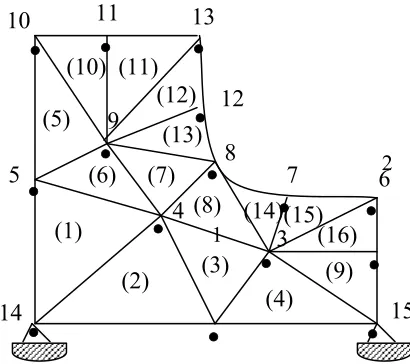
The region is discretized into 16 triangular elements with 26 degrees of freedom and assuming displacement in the global system of coordinate (horizontal direction only) only as in Figure 1 elements topologies are described in Table 1 for the establishment of element interpolation functions for the functional equations for the finite element minimization scheme.
[image:4.612.116.321.495.677.2]
Figure 1: Idealized Finite element Model of two Dimensional Composite Body.
.
.
.
.
.
.
.
.
.
.
.
.
.
.
.
(1)(2) (3)
(4) (9) (6) (7)
(8) (14)(15) (16) (13)
(12) (11) (10)
(5)
10 11 13
5
14 15
3
6 7
8 12
4 9
1
Table 1: Element Topology Description.
Element Number
Active degrees of freedom of elements
Element coordinates Element nodes 1 u5, u4, u14, v5, v4, v14 (0,0), (0,21), (16,16) 14, 5, 4 2 u1, u4, u14, v1, v4, v14 (0,0), (16,16), (21, 0) 14, 4, 1 3 u1, u4, u3, v1, v4, v3 (21, 0), (16, 16), (25, 10) 1, 4, 3 4 u1, u3, u15, v1, v3, v15 (21, 0), (21, 0), (25, 10) 1, 3, 15 5 u5, u10, u9, v5, v10, v9 (0, 21), (0, 37), (10, 25) 5, 10, 9 6 u5, u9, u4, v5, v9, v4 (0, 21), (0, 25), (16, 16) 5, 9, 4 7 u9, u4, u8, v9, v4, v8 (16, 16), (10, 25), (22, 13) 4, 9, 8 8 u8, u4, u3, v8, v4, v3 (16, 16), (22, 23), (25, 10) 4, 8, 3 9 u15, u3, u2, v15, v3, v2 (25, 10), (35, 10), (35, 0) 15, 3, 2 10 u9, u10, u11, v9, v10, v11 (0, 37), (10, 37), (10, 25) 9, 10, 11 11 u9, u11, u13, v9, v11, v13 (10, 25), (10, 37), (18, 37) 9, 11, 13 12 u9, u13, u12, v9, v13, v12 (10, 25), (18, 37), (19, 29) 9, 13, 12 13 u9, u12, u8, v9, v12, v8 (10, 25), (19, 29), (22, 23) 9, 12, 8 14 u3, u8, u7, v3, v8, v7 (25, 10), (22, 23), (29, 19) 3, 8, 7 15 u3, u7, u6, v3, v7, v6 (25, 11), (29, 19), (35, 18) 3, 7, 6 16 u3, u6, u12, v3, v6, v12 (25, 10), (35, 18), (35, 10) 3, 6, 2
3.2Determination of FEM Characteristics
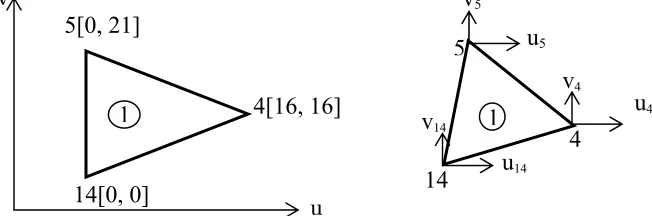
3.2.1 Element 1 interpolation and functional equation formulation
By assuming a linear approximation polynomial of the form
y
a
x
a
a
y
x
u
(
,
)
0
1
2 (1)and following the method of Ihueze etal (2009) and Asterly (1992) 5[0, 21]
4[16, 16]
14[0, 0] 1
u v
u4
v5
1 5
v14
u14
v4
u5
Where a0, a1, a2 are called polynomial coefficients or shape constants so that by passing (1) through the nodes of element1the system of unknown function of the element becomes:
14 2 14
1 0
14
a
a
x
a
y
u
4 2 4
1 0
4
a
a
x
a
y
u
5 2 5
1 0
5
a
a
x
a
y
u
Putting the above polynomial function in matrix form then 5 4 14 2 1 0 5 5 4 4 14 14 1 1 1 u u u a a a y x y x y x
By applying Crammers rule
14 4 5 5 4 4 5 14 14 5 5 14 4 4 14
21
0 u x y x y u x y x y u x y x y
a A
(2)
14 4 5 4
5 14
5
14 4
21
1 u y y u y y u y y
a A
14 5 4 4
14 5
5
4 14
21
2 u x x u x x u x x
a A
Substituting (2) in (1) then
y a x a a
u1 0 1 2
u x x u
x x
u
x x
y x y y u y y u y y u y x y x u y x y x u y x y x u u A A A 14 4 5 5 14 4 4 5 14 21 4 14 5 14 5 4 5 4 14 2 1 14 4 4 14 5 5 14 14 5 4 4 5 5 4 14 21 1 (3)Recall that the approximation function is given as
5 5 4 4 14
14u N u N u
N
u (4)
x
y
x
y
x
y
y
y
x
x
x
y
N
14,
21A 4 5
5 4
4
5
5
4 (5)
x
y
x
y
x
y
y
y
x
x
x
y
N
4,
21A 5 14
14 5
5
14
14
5
x
y
x
y
x
y
y
y
x
x
x
y
N
5,
21A 14 4
4 14
14
4
4
14But A = 12
x4y5 x5y4
x5y14x14y5
x14y4 x4y14
= 168mm2 (6)where A= area of triangular element so that
x y
N 14 3361 336 5 16
x
N 4 3361 21
x y
N 5 3361 16 16
Substituting (7) in (4)
14 3361
4 3361
53361 336 5x 16y u 21x u 16x 16y u
u
336 16 336 21 336
5u14 u4 u5 x
u
336 16 336
16u14 u5 y
u
By assuming a two dimensional Laplace function for the continuum function of the form
∂2u ∂x2 +
∂2u
∂y2 = 0 (10)
The minimum function integral called functional to be minimized becomes in which case
kx = ky = kz = 1 and Q = 0 (11)
So that (4 ) reduces to
dxdy
x
uyx
u 2 2
2
1
(9) (8)
By substitutingg the first partial derivatives of the element 4 interpolation functions in ( 12) with
dxdy = A = 168
2 5 2 4 5 4 14 5 14 4 2
14 0.313 0.524 _0.656 0.762
418 .
0 u u u u u u u u u
x
(13)
By differentiating w.r.t.u14,u4,and u5
0.836 14 0.313 4 0.524 5
*0.514
u u
u u
x
1.312 4 0.313 14 5
*0.54
u u u
u
x
1.524 5 0.524 14 4
*0.55
u u u
u
x
3.2.2 Element 2 interpolation and functional equation formulation
By assuming a linear approximation polynomial of the form
y a x a a y x
u ( , ) 0 1 2 (15)
Passing (15) through the nodes then
14 2 14
1 0
14 a a x a y
u
1 2 1
1 0
1 a a x a y
u
4 2 4
1 0
4 a a x a y
u
Putting the system in matrix form then
By applying Crammers rule,
14 1 4 4 1 14 1 4 14 4 1
21
0 u x y x y u y y u x x
a A
1 4 14 14 4 1
4 14
1
14 4
2 1
1 u x y x y u y y u x x
a A
4 14 1 1 14 4
14
4
1 14
2 1
2 u x y x y u y y u x x
a A (16)
Substituting (16) in (15)
21u
14x
1y
4x
4y
1u
14y
1y
4u
14x
4x
1u
A
u
1x
4y
14
x
14y
4
u
1
y
4
y
14
u
1
x
14
x
4
(17)
u
4x
14y
1
x
1y
14
u
4
y
14
y
1
u
4
x
1
x
14
Recalling that the approximation function is
4 4 1 1 14
14u N u N u
N
u (18)
Comparing (18) and (17) then
x y x y y y x x x
yN14 21A 1 4 4 1 1 4 4 1
x y x y
y y
x x x
yN1 21A 4 14 14 4 4 14 14 4
x y x y
y y
x x x
yN4 21A 14 1 1 14 14 1 1 14 (19)
But A = 12
x1y4 x4y1
x4y14 x14y4
x14y1 x1y14
=168mm2 (20)so that
x x yN14 3361 336 0 16 16 21 3361 336 16 5
x
y
x y
N1 3361 0 16 0 016 3361 16 16
y
y
N4 3361 0 0 21 0 3361 21 (21)
Substituting (22) into (18)
14 3361
1 3361
43361 336 16x 5y u 16 16y u 21y u
u
21 21
336 16 336
16u14 u1 u14 u1 x
u 16 21 336 5 336 21 336 16 336
5u14 u1 u14 u14 u1 u4
y
u
(23)
By substitutingg the first partial derivatives of the element 4 interpolarion functions in ( 12) with dxdy = A = 168mm2
2
4 4 1 14 4 2 1 14 1 2
14 0.3611 0.38 0.156 0.5 0.328
190 .
0 u u u u u u u u u
x (24)
By differentiating w.r.t.u14,u1,and u4
4 1 14 14 156 . 0 261 . 0 418 .
0 u u u
u x 5 14 1 1 5 . 0 261 . 0 76 .
0 u u u
u x 1 14 4 4 5 . 0 156 . 0 656 .
1 u u u
u
x
(25)
3.2.3 Element 3 interpolation and functional equation formulation
By assuming a linear approximation polynomial of the form
x y
a a x a yu , 0 1 2 (26)
and passing (26) through the nodes then
1 2 1
1 0
1 a a x a y
u
3 2 3
1 0
3 a a x a y
u
4 2 4
1 0
4 a a x a y
u
v
[16, 16] 4
3 [25, 10]
Putting the above equations in matrix form then,
4 3 1
2 1 0
4 4
3 3
1 1
1 1 1
u u u
a a a
y x
y x
y x
(27)
By applying Crammers rule,
1 3 4 4 3 1 3 4 1 4 3
21
0 u x y x y u y y u x x
a A
3 4 1 1 4 3
4 1
3
1 4
21
1 u x y x y u y y u x x
a A
4 1 3 3 1 4
1 3
4
3 1
21
2 u x y x y u y y u x x
a A
(28) Substituting (28) into (26)
21u
1x
3y
4x
4y
3u
1y
3y
4u
1x
4x
3u
A
u
3x
4y
1
x
1y
4
u
3
y
4
y
1
u
3
x
1
x
4
u
4x
1y
3
x
3y
1
u
1
y
1
y
3
u
4
x
3
x
1
(29)
Recall that the approximation function or interpolation function is expressed as:
4 4 3
3 1
1u N u N u
N
u (30)
Comparing (29) and (30) then,
x y x y y y x x x
yN1 21A 3 4 4 3 3 4 4 3
x y x y
y y
x x x
yN3 21A 4 1 1 4 4 1 1 4
x y x y
y y
x x x
yN4 21A 1 3 3 1 1 3 3 1
(31)
But A = 12
x1y4 x4y3
x4y1 x1y4
x1y3 x3y1
= 57mm2 (32)
then
x
y
x y
N1 1141 400160 1016 1625 1141 2406 9
x
y
x y
N3 1141 0336 160 2116 1141 33616 5
x
y
x y
N4 1141 5250 010 2521 1141 52510 4
Substituting (30) into (31)
1 1141
3 1141
41141 240 6x 9y u 336 16x 5y u 525 10x 4yu
u
114 10 114
16 114
6u1 u3 u14
x
u
114 4 114 5 114
9u1 u3 u4 y
u
(34)
By substitutingg the first partial derivatives of the element 4 interpolarion functions in ( 12) with dxdy = A = 57
2 4 4 3 2 3 4 1 3 1 2
1 0.224 0.105 0.616 0.789 0.254
257 .
0 u uu uu u uu u
x (35)
By differentiating w.r.t.u1,u3, and u4
4 3 1 1 105 . 0 224 . 0 514 .
0 u u u
u x 4 1 3 3 789 . 0 224 . 0 232 .
0 u u u
u
x
3 1 4 4 789 . 0 105 . 0 508 .
1 u u u
u
x
(36)
3.2.4 Element 4 interpolation and functional equation formulation
By substitutingg the first partial derivatives of the element 4 interpolarion function in (12)
2 3 15 3 3 1 2 15 15 1 2
1 0.214 0.207 0.5 0.2 0.35
357 .
0 u uu u uu uu u
x
(37) By differentiating w.r.t.u1,u15, and u3
3 15 1 1 5 . 0 2144 . 0 714 .
0 u u u
du dx 3 1 15 15 2 . 0 214 . 0 414 .
0 u u u
du
dx
15 1 3 3 2 . 0 5 . 0 7 .
0 u u u
du
dx
3.2.5 Element 5 interpolation and functional equation formulation
By substitutingg the first partial derivatives of the element 4 interpolarion functions in (12) with dxdy = A =57mm2
2 10 10 9 2 9 10 5 9 5 2
5 0.6 0.163 0.4 0.2 0.181
35 .
0 u uu uu u uu u
x (39)
By differentiating w.r.t.u5,u9,and u10
10 9 5 5 163 . 0 6 . 0 70 .
0 u u u
u x 10 5 9 9 2 . 0 6 . 0 80 .
0 u u u
u x 9 5 10 10 2 . 0 163 . 0 362 .
0 u u u
u x (40)
3.2.6 Element 6 interpolation and functional equation formulation By similar procedures as above,
2 5 9 5 2 9 9 4 5 4 2
4 0.105 0.614 0.616 0.618 0.257
254 .
0 u u u uu u u u u
x
(41) By differentiating w.r.t.u4,u9,and u5
10 9 5 4 508 .
0 u u u
u x 5 5 9 9 618 . 0 614 . 0 232 .
1 u u u
u x 9 4 5 5 618 . 0 105 . 0 514 .
0 u u u
u
x
(42)
3.2.7 Element 7 interpolation and functional equation formulation By similar procedures as above,
2 9 9 8 2 8 9 4 8 4 2
4 0.469 0.302 0.305 0.141 0.221
385 .
0 u u u u u u u u u
x
9 8 4 4 302 . 0 469 . 0 77 .
0 u u u
u x 9 4 8 8 141 . 0 469 . 0 61 .
1 u u u
u
x
9 4 9 9 141 . 0 302 . 0 442 .
0 u u u
u
x
(44)
3.2.8 Element 8 interpolation and functional equation formulation By similar procedures as above,
2 4 8 4 2 8 4 3 8 3 2
3 0.61 0.369 0.295 0.530 0.450
215 .
0 u uu uu u u u u
x
(45) By differentiating w.r.t.u3,u8,and u4
4 8 3 3 369 . 0 061 . 0 430 .
0 u u u
u x 4 3 8 8 530 . 0 061 . 0 590 .
0 u u u
u x 9 3 4 4 530 . 0 369 . 0 90 .
0 u u u
u x (46)
3.2.9 Element 9 interpolation and functional equation formulation By similar procedures as above,
15 2 2 15 2 3 3 2 2
2 0.5 0.25 0.25 0.5
5 .
0 u uu u u uu
x
(47) By differentiating w.r.t.u2,u3,and u15
15 3 2 2 5 . 0 5 .
0 u u
u u x 2 3 3 5 . 0 5 .
0 u u
u x 2 15 15 5 . 0 5 .
0 u u
u
x
(48)
11 9 2 9 2 10 11 10 2
11 0.61 0.3 0.208 0.417
508 .
0 u u u u u uu
x
(49) By differentiating w.r.t.u11,u10, and u9
9 10 11 11 417 . 0 6 . 0 016 .
1 u u u
u
x
11 10 10 6 . 0 6 .
0 u u
u
x
11 9 9 417 . 0 416 .
0 u u
u
x
(50)
3.2.11 Element 11 interpolation and functional equation formulation By similar procedures as above,
11 9 2 9 2 11 13 11 2
13 0.75 0.542 0.167 0.333
375 .
0 u u u u u uu
x
(51) By differentiating w.r.t.u9,u13, and u1
11 9 9 333 . 0 334 .
0 u u
u x 11 13 13 75 . 0 75 .
0 u u
u x 9 13 11 11 333 . 0 75 . 0 084 .
1 u u u
u x (52)
3.2.12 Element 12 interpolation and functional equation formulation By similar procedures as above,
2 13 13 12 2 12 13 9 12 9 2
9 0.68 0.151 0.68 0.158 0.319
214 .
0 u u u uu u u u u
x
By differentiating w.r.t.u9,u12, and u13
13 12 9 9 151 . 0 684 . 0 428 .
0 u u u
u
x
3 9 12 12 158 . 0 684 . 0 368 .
1 u u u
u
x
12 9 13 13 158 . 0 151 . 0 638 .
0 u u u
u
x
3.2.13 Element 13 interpolation and functional equation formulation By similar procedures as above,
2 9 12 9 2 12 9 8 12 8 2
8 0.758 0.386 0.561 0.182 0.170
367 .
0 u u u u u u u u u
x
(54) By differentiating w.r.t.u8, u12, and u9
9 12 8 8 386 . 0 758 . 0 734 .
0 u u u
u
x
9 8 12 12 182 . 0 758 . 0 122 .
1 u u u
u
x
12 8 9 9 182 . 0 386 . 0 34 .
0 u u u
u
x
(55)
3.2.14 Element 14 interpolation and functional equation formulation By similar procedures as above,
2 8 8 7 2 7 8 3 7 3 2
3 0.462 0.051 0.563 0.665 0.307
206 .
0 u uu uu u uu u
x
(56) By differentiating w.r.t.u3,u7, and u8
8 7 3 3 051 . 0 462 . 0 412 .
0 u u u
u x 8 3 7 7 665 . 0 462 . 0 126 .
1 u u u
u x 7 3 8 8 665 . 0 51 . 0 614 .
0 u u u
u x (57)
3.2.15 Element 15 interpolation and functional equation formulation By similar procedures as above,
2 7 7 6 2 6 7 3 6 3 2
3 0.154 0.51 0.385 0.923 0.716
178 .
0 u uu uu u uu u
x
7 6 3 3 51 . 0 154 . 0 356 .
0 u u u
u x 7 6 3 3 51 . 0 154 . 0 356 .
0 u u u
u
x
6 3 7 7 923 . 0 51 . 0 432 .
1 u u u
u
x
(58)
3.2.16 Element 16 interpolation and functional equation formulation By similar procedures as above,
2 6 6 2 2 2 3 2 2
3 0.4 0.513 0.625 0.313
2 .
0 u u u u u u u
x
By differentiating w.r.t.u3, u2 and u6
2 3 3 4 . 0 4 .
0 u u
u x 6 3 2 2 625 . 0 4 . 0 026 .
0 u u u
u
x
2 6 6 625 . 0 626 .
0 u u
u
x
(59)
4. SYSTEM ELEMENTS ASSEMBLY ALGORITHMS
The algorithms for element assembly involves the addition of all elements contributing to
minimization dX
e
du , this leads to system of equations that equals the degrees of freedoms in the
continuum, the derivatives are then added in a special format called assembly. There are 15 effective degrees of freedoms for the assembly of 16 elements
dX e
ui = 0, i = 1, 2, 3,……, 16
For
i = 1, X
e
u1 = 0 (60)
i = 2, X
e
u2
i = 3, X
e
u3 = 0 (62)
i = 4, X
e
u4 = 0 (63)
i = 5, X
e
u5 = 0 (64)
i = 6, X
e
u6 = 0 (65)
i = 7, X
e
u7 = 0 (66)
i = 8, X
e
u8 = 0 (67)
i = 9, X
e
u9 = 0 (68)
i = 10, X
e
u10
= 0 (69)
i = 11, X
e
u11
= 0 (70)
i = 12, X
e
u12 = 0 (71)
i = 13, X
e
u13 = 0 (72)
i = 14, X
e
u14 = 0 (73)
i = 15, X
e
u15 = 0 (74)
5. ELEMENTS EQUATIONS ASSEMBLY
All the partial derivatives resulting from the minimization scheme with respect to the fifteen (15) active degrees of freedom (DOF) are added as follows the superscripts on these equations denote element sources:
X
u1
= Xe
u1
= 0 = X
2
u1
+ X
3
u1
+ X
4
u1
= 1.988u1 – 0.724u3 - 0.105u4 – 0.5u5 – 0.261u14 – 0.214u15 (75)
X
u2 =
Xe
u2 = 0 =
X9
u2 +
X16
u2
X
u3 =
Xe
u3 = 0 =
X16
u3 +
X15
u3 +
X14
u3 +
X9
u3 +
X4
u3 +
X3
u3 +
X8
u3
= - 0.724u1 – 0.9u2 + 3.03u3 – 1.158u4 + 0.154u6 – 0.972u7 – 0.001u8 - 0.2u15 (77)
X
u4
= Xe
u4
= 0 = X
1
u4
+ X
2
u4
+ X
3
u4
+ X
6
u4
+ X
7
u4
+ X
8
u4
= -1.158u3 + 5.49u4 – 0.395u1 + 0.008u5 – 0.469u8 – 1.832u9 – u10 – 0.001u14 (78)
X
u5 =
Xe
u5 = 0 =
X1
u5 +
X5
u5 +
X6
u5
= - 0.409u4 + 1.979u5 – 1.218u9 – 0.163u10 – 0.262u14 (79)
X
u6
= Xe
u6
= 0 = X
15
u6
+ X
16
u6
= 1.396u6 – 0.625u2 + 0.154u3 – 0.923u7 (80)
X
u7 =
Xe
u7 = 0 =
X15
u7 +
X14
u7
= 2.549u7 – 0.972u3 – 0.923u6 – 0.665u9 (81)
X
u8
= Xe
u8
= 0 = X
7
u8
+ X
8
u8
+ X
13
u8
+ X
14
u8
= 0.449u3 – 0.999u4 – 0.665u7 + 3.548u8 + 0.245u9 – 0.758u12 (82)
X
u9 =
Xe
u9 = 0 =
X13
u9 +
X12
u9 +
X11
u9 +
X10
u9 +
X7
u9 +
X6
u9 +
X5
u9
= - 0.302u4 – 1.832u5 + 0.386u8 + 3.851u9 – 0.20u10 – 0.75u11 + 0.502u12 + 0.151u13 (83)
X
u10
= Xe
u10
= 0 = X
5
u10
+ X
10
u10
= - 0.163u5 – 0.2u9 + 0.962u10 – 0.6u11 (84)
X
u11 =
Xe
u11 = 0 =
X11
u11 +
X10
u11
= - 0.75u9 – 0.6u10 + 2.1u11 - 0.75u13 (85)
X
u12
= Xe
u12
= 0 = X
13
u12
+ X
12
u12
X
u13 =
Xe
u13 = 0 =
X11
u13 +
X12
u13
= - 0.151u9 – 0.75u11 – 0.158u12 + 1.388u13 (87)
X
u14
= Xe
u14
= 0 = X
2
u14
+ X
1
u14
= - 0.261u1 – 0.313u4 – 0.262u5 + 0.836u14 (88)
X
u15 =
Xe
u15 = 0 =
X4
u15 +
X9
u15
= - 0.214u1 – 0.5u2 – 0.2u3 + 0.914u15 (89)
6. APPLICATION OF BOUNDARY CONDITION
In this work a special case where displacements at the boundaries are limited to 0.5mm for an irregular continuum is considered to predict continuum displacement, strain and stress functions, while the constrained conditions are taken as zero so that by equating u14 = u15 = 0 and u2 = u5= u6 = u8 = u10= u13 = 0.50 , (75 - 89) transform to the following:
1.988u1 – 0.724u3 – 0.105u4 = 0.25 (90)
0.900u3 = 0.201 (91)
- 0.724u1 + 3.03u3 – 0.158u4 – 0.972u7 = 0.374 (92)
- 1.158u3 + 5.490u4 – 0.395u1 = 0.731 (93)
- 0.409u4 – 1.218u9 = - 0.907 (94)
0.154u3 – 0.923u7 = - 0.386 (95)
2.549u7 – 0.972u3 – 0.665u9 = 0.462 (96)
0.449u3 – 0.999u4 – 0.665u7 + 0.245u9 – 0.758u12 = - 1.774 (97)
3.851u9 – 0.302u4 – 0.75u11 + 0.502u12 = 0.748 (98)
2.100u11 – 0.750u9 = 0.675 (100)
- 0.153u3 + 0.502u9 + 2.490u12 = - 0.379 (101)
- 0.151u9 – 0.750u11 – 0.158u12 = - 0.694 (102)
- 0.261u1 – 0.313u4 = 0.131 (103)
- 0.214u1 – 0.200u3 = 0.250 (104)
7. SOLUTION AND POST PROCESSING FOR CONTINUUM FUNCTION
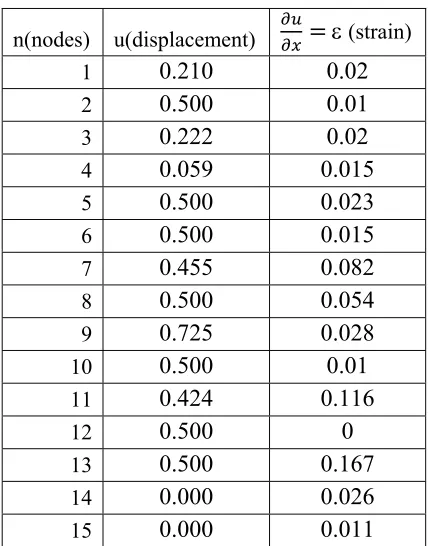
[image:21.612.199.413.433.706.2]The following nodal displacements in mm are further evaluated by first evaluating u3 = 0.222 from (91) so that other nodal values of the displacement function is as presented in Table 2. The first partial derivatives of the interpolation function evaluated with active degree of freedom in of element with respect to the x axis gives the slope of the function and also gives the value of the strain as presented in Table 2. The computations are achieved with sixteen elements interpolation functions associated with the elements global coordinate axis. The strains so computed may be used with Hooke’s law of elasticity to predict the stress distribution function at the respective nodes when the elastic modulus is known from literature.
Table 2: FEM Results.
n(nodes) u(displacement) (strain)
1 0.210 0.02
2 0.500 0.01
3 0.222 0.02
4 0.059 0.015
5 0.500 0.023
6 0.500 0.015
7 0.455 0.082
8 0.500 0.054
9 0.725 0.028
10 0.500 0.01
11 0.424 0.116
12 0.500 0
13 0.500 0.167
14 0.000 0.026
The stress prediction model of a material within the elastic limit is expressed as
σ = Е (105)
where Е = modulus of elasticity
The excel graphics of FEM result using Table 2 of Figure 2 shows a serious indication that the minimum value of the function is between node 14 and 15 hence another extremization method is needed to point at which point of the region is this extremum.
Figure 2: Distribution of Function within the Region.
8. DISCUSSION AND VALIDATION OF RESULTS
Regression analysis was carried out on FEM results to obtain a unified model for elements function interpolation. The regression model so obtained is further used to transform the element functional equation to aid extremization of FEM results.
8.1 Regression Analysis
Multiple linear regression analysis was carried out on finite element results to obtain the
following model for the region. By employing the classical multiple linear regression equation of the form
u(x, y) = ao + a1 x+ a2y (106) ‐0.2
0 0.2 0.4 0.6 0.8
1 2 3 4 5 6 7 8 9 10 11 12 13 14 15
Function,u(x,y)
Nodal Points
Distribution
of
function,u(x,y)
within
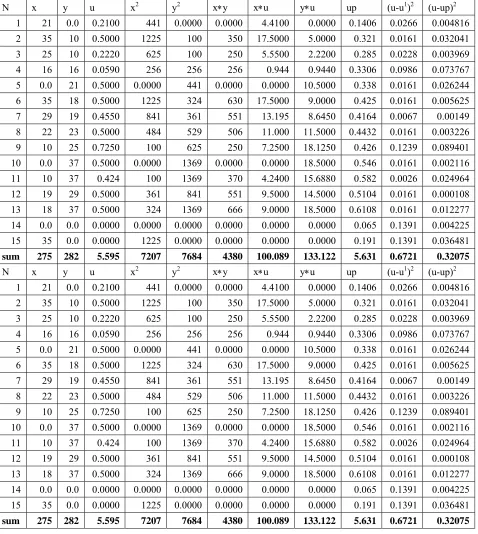
a regression model for the FEM is obtained with Table 3 and expressed as (107).
u(x,y) = 0.065 + 0.0036x + 0.0130y (107)
The goodness of fit of regression was evaluated to obtain: Coefficient of determination, r2 = 0.52, correlation coefficient, r = 0.72, standard error, se = 0.1
where u = field function evaluated through FEM u1 = average of FEM function
up = field function predicted with regression model
Table 2 and Figure 2 show the variation of the function within the region. Continuum fluid elements in heat and mass transfer operations associated with pipeline transportation can elegantly be analyzed following the procedure of this work. The FEM developed can be applied in the evaluation of the stress distribution in irregular shaped continuum whose boundary conditions are specified such as in the evaluation of displacement in structures and solid mechanics problems, evaluation of temperature distribution in heat conduction problems, evaluation of displacement potential in acoustic fluids ,evaluation of pressure in potential flows ,evaluation of velocity in general flows, evaluation of electric potential in electrostatics and in evaluation of magnetic potential in magnetostatics.
8.2 Extremization of Functional: Extremization by Lagrange Multipliers Approach
In order to further analyse the FEM results, the functional, of any element is transformed to a function of (x, y) using the regression model of (107) to obtain:
χ f x, y 0.000042x 0.0017y 0.000059x 0.00034y 0.00015xy 0.00847 108
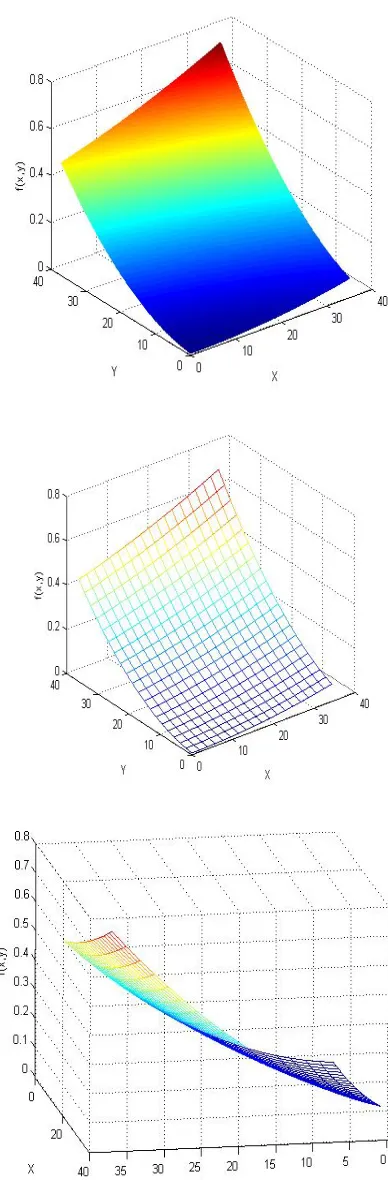
Figure 4a,b and c show versions of 3D plots of function using Matlab for (108) The objective function
f x, y 0.000042x 0.0017y 0.000059x 0.00034y 0.00015xy 0.00847
subject to the constraint relations
u x, y 0.5 0.0225x 0.5 109
u x, y 0.0201x 0.0238y 0 110
Table 3 Computations For Regression and Error Analysis of FEM Results.
N x y u x2 y2 xy xu yu up (u-u1)2 (u-up)2
1 21 0.0 0.2100 441 0.0000 0.0000 4.4100 0.0000 0.1406 0.0266 0.004816 2 35 10 0.5000 1225 100 350 17.5000 5.0000 0.321 0.0161 0.032041 3 25 10 0.2220 625 100 250 5.5500 2.2200 0.285 0.0228 0.003969 4 16 16 0.0590 256 256 256 0.944 0.9440 0.3306 0.0986 0.073767 5 0.0 21 0.5000 0.0000 441 0.0000 0.0000 10.5000 0.338 0.0161 0.026244 6 35 18 0.5000 1225 324 630 17.5000 9.0000 0.425 0.0161 0.005625 7 29 19 0.4550 841 361 551 13.195 8.6450 0.4164 0.0067 0.00149 8 22 23 0.5000 484 529 506 11.000 11.5000 0.4432 0.0161 0.003226 9 10 25 0.7250 100 625 250 7.2500 18.1250 0.426 0.1239 0.089401 10 0.0 37 0.5000 0.0000 1369 0.0000 0.0000 18.5000 0.546 0.0161 0.002116 11 10 37 0.424 100 1369 370 4.2400 15.6880 0.582 0.0026 0.024964 12 19 29 0.5000 361 841 551 9.5000 14.5000 0.5104 0.0161 0.000108 13 18 37 0.5000 324 1369 666 9.0000 18.5000 0.6108 0.0161 0.012277 14 0.0 0.0 0.0000 0.0000 0.0000 0.0000 0.0000 0.0000 0.065 0.1391 0.004225 15 35 0.0 0.0000 1225 0.0000 0.0000 0.0000 0.0000 0.191 0.1391 0.036481
sum 275 282 5.595 7207 7684 4380 100.089 133.122 5.631 0.6721 0.32075
N x y u x2 y2 xy xu yu up (u-u1)2 (u-up)2
1 21 0.0 0.2100 441 0.0000 0.0000 4.4100 0.0000 0.1406 0.0266 0.004816 2 35 10 0.5000 1225 100 350 17.5000 5.0000 0.321 0.0161 0.032041 3 25 10 0.2220 625 100 250 5.5500 2.2200 0.285 0.0228 0.003969 4 16 16 0.0590 256 256 256 0.944 0.9440 0.3306 0.0986 0.073767 5 0.0 21 0.5000 0.0000 441 0.0000 0.0000 10.5000 0.338 0.0161 0.026244 6 35 18 0.5000 1225 324 630 17.5000 9.0000 0.425 0.0161 0.005625 7 29 19 0.4550 841 361 551 13.195 8.6450 0.4164 0.0067 0.00149 8 22 23 0.5000 484 529 506 11.000 11.5000 0.4432 0.0161 0.003226 9 10 25 0.7250 100 625 250 7.2500 18.1250 0.426 0.1239 0.089401 10 0.0 37 0.5000 0.0000 1369 0.0000 0.0000 18.5000 0.546 0.0161 0.002116 11 10 37 0.424 100 1369 370 4.2400 15.6880 0.582 0.0026 0.024964 12 19 29 0.5000 361 841 551 9.5000 14.5000 0.5104 0.0161 0.000108 13 18 37 0.5000 324 1369 666 9.0000 18.5000 0.6108 0.0161 0.012277 14 0.0 0.0 0.0000 0.0000 0.0000 0.0000 0.0000 0.0000 0.065 0.1391 0.004225 15 35 0.0 0.0000 1225 0.0000 0.0000 0.0000 0.0000 0.191 0.1391 0.036481
By taking partial derivatives of Lagrange expression
L x, y, λ ,λ f x, y λ g x, y λ g x, y 111
0.000042x 0.0017y 0.000059x 0.00034y 0.00015xy 0.00847
λ 0.0225x λ 0.0201x 0.0238y
to obtain the following relations
∂L
∂x 0.000042 0.0001x 0.00015y 0.0225λ 0.0201λ 0 112
∂L
∂y 0.0017 0.0068y 0.00015x 0.0225λ 0.0238λ 0 113
∂L
∂λ 0.0225x 0 114
∂L
∂λ 0.0201x 0.0238y 0 115
By solving (107)- (110) from(109)
0, λ 0.0356, λ 0.0378
By substituting the variables in (108) the optimum value of the function is obtained as
u(x,y) = f(x,y) = 0.00847
χ f x, y 0.000042x 0.0017y 0.000059x 0.00034y 0.00015xy 0.00847 108
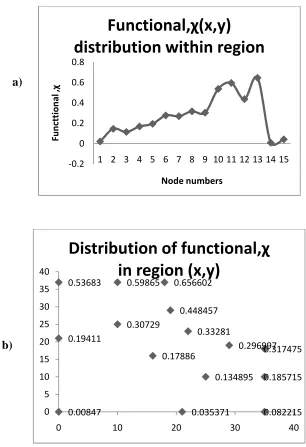
The prediction of functional, χ with (108) are presented in Table 4 using excel package to draw conclusion with the FEM and multiple linear regression results of Table 3.
Table 4: Prediction of Functional with Equation (108).
N x Y Χ
1 21 0 0.035371
2 35 10 0.185715
3 25 10 0.134895
4 16 16 0.176886
5 0 21 0.19411
6 35 18 0.317475
7 29 19 0.296997
8 22 23 0.33281
9 10 25 0.30729
10 0 37 0.53683
11 10 37 0.59865
12 19 29 0.448457
13 18 37 0.656602
14 0 0 0.00847
15 35 0 0.082215
Tables 3 and 4 are compared for u , up and their functional, χ are found approximate.
8.2.1 Extremization by Lagrange gradient search approach
The extremum conditions for continuous and differentiable functions are defined [1] as follows:
f . . . f . . .
f . f .
Since fxx and fyy > 0 minimum extremum or local extremum exists.
8.2.2 Extremization by Lagrange multipliers approach By expressing (108) in the form
f x, y 0.000042x 0.0017y 0.000059x 0.00034y 0.00015xy 0.00847
Subject to the constraint relations
u x, y 0.5 0.0225x 0.5 120
u x, y 0.0201x 0.0238y 0 121 derived for nodes 14 and 10 of elements 1 and 5 at the boundaries.
By taking partial derivatives of Lagrange expression
L x, y, λ ,λ x, y λ g x, y λ g x, y 122
0.000042x 0.0017y 0.000059x 0.00034y 0.00015xy 0.00847 λ 0.0225x λ 0.0201x 0.0238y
to obtain the following relations
∂L
∂x 0.000042 0.0001x 0.00015y 0.0225λ 0.0201λ 0 123
∂L
∂y 0.0017 0.0068y 0.00015x 0.0225λ 0.0238λ 0 124
∂L
∂λ 0.0225x 0 125
∂L
∂λ 0.0201x 0.0238y 0 126
By solving (123)- (126) starting from(125)
0, λ 0.0356, λ 0.0378
Figure 3a, b Distribution of function within the Region.
‐0.2 0 0.2 0.4 0.6 0.8
1 2 3 4 5 6 7 8 9 10 11 12 13 14 15
Functtional
,
χ
Node numbers
Functional,
χ
(x,y)
distribution
within
region
0.035371
0.185715 0.134895
0.17886 0.19411
0.317475 0.296997 0.33281
0.30729 0.53683 0.59865
0.448457 0.656602
0.00847 0.082215
0 5 10 15 20 25 30 35 40
0 10 20 30 40
Distribution
of
functional,
χ
in
region
(x,y)
9. CONCLUSSIONS
The methods of this article apply to:
1. Solution of boundary value engineering phenomena whose function can be expressed as partial differential equation.
2. Solution of of displacement in structures and solid mechanics problems, temperature distribution in heat conduction problems, displacement potential in acoustic fluids , pressure in potential flows , velocity in general flows, electric potential in electrostatics magnetic potential in magnetostatics , torsion of non – homogenous shaft, flow through an anisotropic porous foundation, axi – symmetric heat flow, hydrodynamic pressures on moving surfaces
3. Solution of time dependent field problems such as creep, fracture and fatigue.
4. Equations (97) and (98) are recommended for the prediction of possible values of the displacement function of GRP composites region from where other properties of the region could be evaluated.
5. A unified computational model with standard error of 0.15 and correlation coefficient of 0.72 was developed to aid analysis and easy prediction of regional function with which the continuum function was successfully modeled and optimized through gradient search and Lagrange multipliers approach.
6. The MatLab 3-D graphics of Figure 4 show potential trend of function within the regionwith minimum and maximum at the boundaries.
REFERENCES
[1] Amazigo, J.C and Rubenfield, L.A (1980). Advanced Calculus and its application to the
Engineering and Physical Sciences, John Wiley and sons Publishing, New York, pp.130 [2] Zienkiewicz,O.C., and Cheung, Y.K,(1967). The Finite Element in Structural and
Continuum Mechanics, McGraw-Hill Publishing Coy Ltd, London, pp.148 [3] Sundaram,V.,Balasubramanian,R.,Lakshminarayanan,K.A.,(2003) Engineering
Mathematics, Vol.3,VIKAS Publishing House LTD, New Delhi,pp.173.
[4] Ihueze, C. C,Umenwaliri,S.Nand Dara,J.E (2009) Finite Element Approach to Solution of Multidimensional Field Functions, African Research Review: An International
Multi-Disciplinary Journal, Vol.3 (5), October, 2009, pp.437-457.
[5] Astley, R.J., (1992), Finite Elements in Solids and Structures, Chapman and Hall Publishers, UK, pp.77
[7] Ihueze, Chukwutoo. C., (2010). Finite Elements in the Solution of Continuum Field Problems, Journal of Minerals and Materials Characterization and Engineering (JMMCE), Vol.9, No.5.pp.427-452