Title: Fast- and slow-exploring pigeons differ in how they use previously learned rules
Author: L.M. Guillette D.M. Baron C.B. Sturdy M.L. Spetch
PII: S0376-6357(16)30159-0
DOI: http://dx.doi.org/doi:10.1016/j.beproc.2016.07.006
Reference: BEPROC 3277
To appear in: Behavioural Processes
Received date: 29-1-2016
Revised date: 9-6-2016
Accepted date: 12-7-2016
Please cite this article as: Guillette, L.M., Baron, D.M., Sturdy, C.B., Spetch, M.L., Fast-and slow-exploring pigeons differ in how they use previously learned rules.Behavioural Processes http://dx.doi.org/10.1016/j.beproc.2016.07.006
Fast- and slow-exploring pigeons differ in how they use previously learned rules
Guillette, L.M.1,2*, Baron, D.M.2, Sturdy, C.B.2,3& Spetch, M.L.2
1 School of Biology, University of St Andrews, St Andrews, Fife, UK, KY16 9TH
2 Department of Psychology, University of Alberta, Edmonton, Alberta, Canada, T6G 2E9
3Neuroscience and Mental Health Institute, University of Alberta, Edmonton, Alberta,
Canada, T6G 2E9
Highlights
Exploratory behaviour is related to performance on a line-orientation generalization
Fast-explorers have steeper generalization gradients compared to slow-explorers
There is a link between information use, post-acquisition, and personality.
Abstract
Several studies report a correlation between exploratory behaviour and performance on tests of cognitive ability. Exploration may influence learning because less exploratory animals are less likely to come in contact with to-be-learned stimuli. Alternatively, the way information available in the environment is processed could influence the rate of exploration. Pigeons are one of the most-studied species used to examine the mechanisms underlying cognitive abilities, but have not been used to examine the relationship between these abilities and animal personality. Here, twelve pigeons were first tested in a novel environment to assess repeatability in exploratory behaviour. Pigeons were then trained to discriminate between two visual stimuli: lines oriented at 90° (vertical, the S+) and 135° (the S-). After training pigeons underwent generalization testing with ten additional visual line orientation stimuli. We found exploratory behaviour was related to generalization performance: fast-explorers had steeper generalization gradients compared to slow-explorers. This effect was only seen in the direction towards the S-. These results suggest that birds with different exploratory styles differ in how they use previously learned information. Further testing is needed to confirm which cue(s) (S+ or S-) control the behaviour of fast-explorers.
1. Introduction
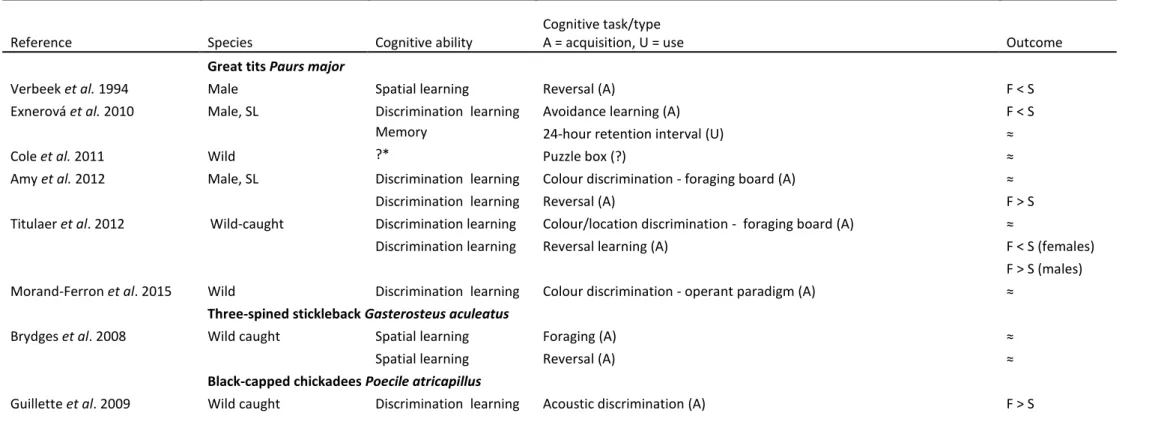
How an animal searches or explores the environment affects the amount of information that animal encounters. Then again, how an animal processes new or updates old information may affect that animal’s movement through the environment. Exploratory behaviour is one of the most-studied animal personality traits (Reader, 2015; Reale et al., 2007; Stamps, 2015), has been shown to affect fitness (Dingemanse et al., 2004; Smith and Blumstein, 2007), and is heritable (Drent et al., 2003). Several recent empirical studies have examined the relationship between variation in exploration of a novel environment and variation in performance on cognitive tests (see Table 1). The results from this limited, but growing, body of work are inconclusive as to: (1) whether exploration and cognition co-vary and (2) what the nature of the relationship is (reviewed in Stamps, 2015; Griffin et al., 2015). Perhaps the strongest support for the former comes from studies conducted in laboratory mice showing that general learning ability is correlated with exploratory behaviour: mice that score higher in general learning ability (as measured across a suite of tasks) also explore more (Light et al., 2011; Matzel et al., 2006, 2003, see Table 1 for list of cognitive tasks used.)
Exnerová et al., 2010). Most of the experiments on exploratory behavioural and cognition have focused on variation in learning speed (also called learning rate, e.g., trials to reach learning criteria, marked with ‘A’ for information acquisition in Table 1). Tests of other cognitive processes, notably how animals’ respond to novel stimuli, that share features with stimuli they have been previously trained with (i.e., generalization, marked ‘U’ for information use in Table 1) and other predictions laid out by Sih and Del Giudice (2012), are lacking. To better understand how cognition and personality may be related it is imperative to study cognition on more than just one level. That is, to examine more than just learning rate.
2015). We suggested that fast-exploring chickadees may learn more absolute features of stimuli, while slow-explorers may learn more general features of stimuli.
In the current experiment, homing pigeons (Columba livia) were used as a model species to examine if slow-exploring and fast-exploring birds differ in the way they generalize responses to novel visual stimuli, line orientations, after being trained on a binary line-discrimination task. Pigeons were first run in a novel environment task to assess exploratory behaviour. Each pigeon was then trained to discriminate between a reinforced (S+) and a non-reinforced (S-) visual stimulus (two different line orientations) in an operant chamber. Upon successfully learning the discrimination, the responses of each pigeon to novel line orientations with varying degrees of similarity to the trained S+ and S- stimulus were tested. The cognitive task in the current study is based on a classic psychological testing paradigm similar to that of Honig et al. (1963). We used a modified version of this task, where the stimuli vary in line orientation (different degrees of rotations, with 90° as vertical similar to Bloomfield 1967). The resulting generalization gradients allow comparison of discrimination performance: animals that produce steeper generalization gradients discriminate between test stimuli more precisely than animals that produce shallower gradients.
We predict that fast-explorers will learn more about the absolute features of a stimulus, as proposed by Guillette et al., (2015), and thus will respond less to novel modified stimuli resulting in steep generalization gradients. Slow-exploring birds, because they are more likely to learn about general features of stimuli, are more likely to generalize their learned response, thus responding more to novel stimuli and have shallower generalization gradients.
2. Material and methods
Twelve homing pigeons (Columba livia; five male and seven female), were obtained from a local breeder (Vandermeer Farms, Sherwood Park, Alberta). Each pigeon was housed individually in a metal cage (42 × 47 × 42 cm) in a colony room that was maintained on a 12:12-hour light:dark cycle with light onset at 08:00 h. Pigeons had visual and vocal, but not physical, contact with one another. Standard poultry grit and vitamin-supplemented water (Vetoquinol, Polytonine A Complex) were available ad libitum and each pigeon was maintained at 85% of its free-feeding weight on a diet of Kee Tee pigeon pellets. No pigeons had prior open field (i.e., novel environment) experience. All pigeons had been subjects in either touch screen or touch key operant experiments but were naïve to the current experimental stimuli.
All animal studies were conducted in accordance with the Canadian Council on Animal Care Guidelines and Policies and with approval from the Animal Care and Use Committee for Biosciences for the University of Alberta.
2.2 Apparatus
2.2.1 Novel environment room
barriers, so that the pigeon was unable to view the entire novel environment room from the start location, or any other location within the novel environment room.
2.2.2. Operant chamber
One operant chamber (74 × 31 × 40.5 cm) was used for both training and testing all pigeons. The custom-made chamber was composed of aluminum and stainless steel and had a 34 × 24.5 cm opening in the back wall for the flat-screen LCD color computer monitor (IBM ThinkVision) with attached infrared touch frames (CarrollTouch model no. D27566-001). The monitor screen was located 7 cm above the chamber floor and was covered with a thin sheet of Plexiglass that was located approximately 1.5 cm in front of the monitor. The touch frames had a resolution of 3 mm and detected individual peck responses. On the rear of the chamber, on either side of the monitor, was a food hopper, that when activated by a correct choice, provided the bird with a small amount of food. For the current experiment, both hoppers were activated each time reinforcement was provided, and the bird was able to choose which hopper to visit. A computer was located in the adjacent control room and controlled the stimulus presentation as well as recorded all data.
2.3 Stimulus preparation
2.4 Novel environment task
Each pigeon’s exploratory behaviour was assessed in the novel environment prior to training and testing in the operant task. Individual birds were placed in the start box and the clear door that separated the start box from the novel environment allowed the birds to visually assess the room without being able to move into it. Birds were allowed ten minutes to habituate to the holding box and visually inspect the novel environment room before the door was lifted and the bird was given 30 minutes to explore. Each bird’s activity within the room was recorded by a video camera suspended from the ceiling. Once 30 minutes had elapsed, the room lights were extinguished, the bird was immediately removed from the novel environment room and returned to its colony room cage. Thirty-five days after each bird’s first session in the novel environment room, it participated in a second session, with all procedures carried out exactly as during the first session. All novel environment trials were conducted between the hours of 10.00 and 14.00 between 16 October and 27 November 2011.
2.5 Operant Task
whichever occurred first. The criterion to complete Autoshaping was entering a hopper on each of 30 opportunities per daily session for one day. After completing Autoshaping, pigeons moved onto Peck Training I.
2.5.1 Peck Training I. The purpose of Peck Training I was to train the pigeon to peck the stimulus on the screen to received access to food. In Peck Training I the first peck on the stimulus (white circle, 1 cm diameter) was rewarded with a 2 s access to the food hoppers. Each trial began with a 10 s ITI with no stimulus presentation followed by a 60 s stimulus presentation. The first peck on the stimulus resulted in activation of both food hoppers. The opportunity for reinforcement remained available for 5 s. After the infrared beam in a hopper was broken and a 2 s access to food was given, followed by a new trial. Failure to peck on the stimulus after 60 s elapsed ended the trial, and following a 10 s ITI, a new trial began. Each daily session continued until the pigeon received 60 reinforcement opportunities, or until 45 minutes had elapsed, whichever occurred first. The criterion to complete Peck Training I was one daily session where the pigeon responded to each stimulus presentation.
If a pigeon failed to peck during the stimulus presentation on two consecutive daily sessions it was moved to Remedial Autoshaping training. In Remedial Autoshaping training, all rules from Autoshaping, outlined above, remained in place, with the exception of the following: both food hoppers were activated 5 s after the stimulus was presented on each trial. The criterion to complete Remedial Autoshaping was entering a hopper on each of 30 opportunities per daily session for one day. Birds then moved back to Peck Training I. After completing Peck Training I pigeons moved onto Peck Training II.
preceding phaseswas displayed, but with the addition of a 90° (vertical) black line through the center (see Figure 2, stimulus presented in the middle). The stimulus was fixed on the screen for the entire daily session (i.e., no ITI) and the bird was reinforced for each peck on the S+. Once the S+ was pecked, both hoppers were activated and the opportunity for reinforcement remained available for 5 s. As in the previous phase, once the infrared beam in a hopper was broken, the pigeon had 2 s access to food. Each daily session ended when the bird received 40 reinforcements or after 45 minutes elapsed, whichever occurred first. The criterion to complete Peck Training II was one daily session in which the bird responded 40 times. After completing Peck Training II pigeons moved onto Variable Interval S+ Training.
2.5.3 Variable Interval S+ Training. The purpose of Variable Interval S+ Training was so that the pigeon learned that the reward for a correct response occurs after a random interval, rather than a fixed interval. Variable interval training promotes a high rate of responding, such that decrements in response rate can be measured in future phases. In this phase there were 55 trials per daily session. Each trial started with a 10 s ITI with no stimulus presentation followed by the S+ displayed on the centre of the screen. Each pigeon was reinforced on a variable interval (VI) 30 s schedule with 2 s access to food for its first peck on the S+ after a random amount of the time had elapsed from the start of the trial (range = 3-57 s). Each trial ended once the bird received reinforcement, or after 60 s elapsed with no response, whichever occurred first. The criterion to complete Variable Interval S+ Training was a difference in average response rate no greater than 10% across the last three days, after a minimum of 10 days of training. After completing Variable Interval S+ Training pigeons moved onto Discrimination Training.
stimulus on the right) stimuli. Each pigeon received 54 trials in each daily session (27 S+ and 27 S- presentations). Responses to the S+ were reinforced on a VI 30 schedule, with trials ending after the fixed 2 s access to the food hoppers. No reinforcement was provided for pecking on the S-. Trials were separated by a 10 s ITI. The presentation order of the S+ and S- were pseudo randomized so there were never more than two consecutive presentations of any stimulus type. The lengths of the S- trials were yoked to the lengths of the S+ trials in a random order, so the duration of daily experience with both the S+ and S- stimulus was equivalent. S+ trials timed out after 60 s with no response. The criterion to complete Discrimination Training was a discrimination ratio (DR) of 0.75 for three consecutive sessions where at least 19 of the 27 S+ presentations were rewarded. The DR was calculated by dividing the number of pecks on the S+ by the total pecks per session (i.e., the sum of the number of pecks on the S+ and the number of pecks on the S-). Discrimination is at chance (DR = 0.50) when the animal is responding equally to both stimulus types and perfect (DR = 1.00) when the animals is only responding to presentation of the S+. After completing Discrimination Training pigeons were moved onto Generalization Testing.
Some pigeons performed Discrimination Training with high DRs but did not receive the minimum number of reinforcements (19 per daily session), meaning they were pecking on the S+ more than the S-, but were not pecking enough to obtain at least 19 reinforcements. These pigeons were returned to Variable Interval S+ Training, and in some cases, to Peck II Training, and then were returned to Discrimination Training. If a bird still did not meet the minimum required number of reinforcements, it was moved onto Generalization Testing (described below) after 35 cumulative daily sessions of Discrimination Training.
stimuli indicate that the pigeon perceives this stimulus as similar to the trained S+. Twelve stimuli of 15-degree increment line orientations, including the S+ and S- (see Figure 2, Panel b), were presented once per block, in six blocks, randomized for order in each daily session. Each trial began with a 5 s ITI with no stimulus presentation, followed by a stimulus presentation where the stimulus remained fixed on the screen for 30 s. All stimuli, including the S+, were presented under extinction, that is, they never yielded a food reward. Testing continued for two daily sessions. All pigeons completed the stimulus generalization operant task between 10 January 2012 and 27 May 2012. Six pigeons were run in a squad; each pigeon was run seven days a week, at the same time each day, between 09 00 and 14 00 hr. After each daily session of training or testing, pigeons were returned to the colony room and fed each day at approximately 15 00 hr.
2.6 Data collection
2.6.2 Novel environment
2.6.3 Operant task
during generalization testing, would respond more to the stimulus with the line orientation that is shifted 15° or possibly even 30 ° to the left of the trained S+.
2.7 Statistical Analyses
To test for repeatability of exploration in the novel environment across time (the two sessions of the novel environment task), an Intraclass Correlation Coefficients was calculated (Lessells and Boag, 1987). To examine if exploratory behaviour in the novel environment can be predicted by performance during generalization testing following intradimensional discrimination training, a step-wise linear regression was conducted where all variables were considered for entry (probability of F-to-enter ≤ 0.05) or removal (probability of F-to-remove ≥ 0.1) at each step. The linear regression had the six slope measurements available to predict exploration in the novel environment. All statistics were conducted with IBM SPSS Statistics v23.
3. Results
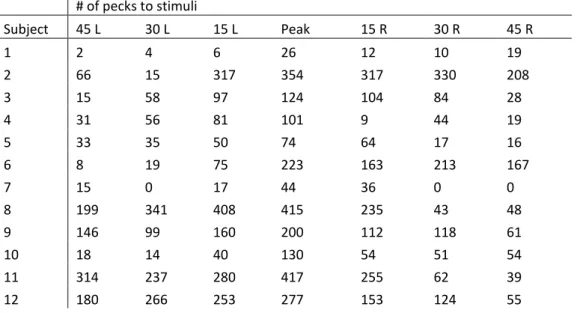
Exploratory behaviour was not significantly repeatable; although the number of squares entered was positively correlated across the two sessions in the novel environment, the correlation failed to reach statistical significance, ICC r(12) = 0.612, p = 0.06, see Figure 3. The step-wise linear regression revealed that exploration in the novel environment was significantly related to performance in the cognitive task: The slope of the line between the peak response and the stimulus rotated 15° to the right (towards the S-) significantly predicted the total number of squares entered in the novel environment, F(1,10) = 6.688, R2 = 0.401, p =
4. Discussion
The results revealed that exploratory behaviour in a novel environment was not significantly consistent across time, but marginally so (i.e., p = 0.06). This suggests that exploration is either; (1) not completely consistent in pigeons over a short (i.e., 35 days) time period or (2) that the novel environment was not novel after the first session, and pigeons with different behaviour profiles attenuated (or habituated) to the novel environment at different rates. The latter explanation is likely true, considering the variation in exploration scores as evidenced after the first session of the novel environment. That is to say, if one individual entered the novel environment and explored extensively during the first session, while a second individual did not, then the novelty during the second session of the novel environment room varied by individual. Is should also be noted that there were only 12 pigeons in this study and future work should seek to replicate and expand these results with more subjects.
fast-exploring pigeon need not have been sensitive or aware of anything in the environment with the exception of the S+ to achieve perfect discrimination.
While this interpretation seems plausible, it does not, however, account for the complete pattern of results we obtained. For instance, if the fast-exploring, active pigeons were only responding according to the rule “only respond to the S+” then we would expect that the slope of lines between the S+ and the stimuli rotated in both directions (towards and away from the S-) to be predictive of behaviour. However, in regression equations that significantly predicted exploration, only the slope of line between the stimulus with peak responding and stimuli rotated towards the S- were predictive. Steeper slopes indicated more control (behavioural inhibition) by the S-, and fast-exploring pigeons had steep slopes on the side towards the S-. This indicates that fast-exploring pigeons were not likely relying on the strategy of “only respond to the S+”. This idea, that the fast-exploring pigeons were more sensitive to the S- could be tested by training the pigeons with the same S+ (vertical line, 90°), and then training with two S-s, one at 135° as in the current experiment, and the other at 45°, the mirror image of 135°. With these methodological changes the prediction would be that the slope of the lines to both sides of the S+ would be steeper for fast-exploring pigeons.
This study is another in a growing body of work (see Table 1) showing that how an animal explores a novel environment is related to some aspect of cognitive performance. Initial investigations of the personality/cognition relationship focused on learning speed suggested perhaps that acquisition rate (i.e., learning) is faster when an animal explores more because exploration, ipso facto, put animals in contact with more to-be-associated stimuli compared to animals that explore less (Dugatkin and Alfieri, 2003; Guillette et al., 2009; Sneddon, 2003). Although the parsimony of this explanation is appealing the influence of exploration tendency in a learning task can be removed methodically by, for example (1) habituating the subject to, and (2) training them how to use the experimental apparatus before acquisition training (to measure learning speed) begins (e.g., Guillette et al., 2015, 2011b). Alternatively, a learning task that does rely on exploratory behaviour, for example, classical conditioning, cause be used (Griffin and Guez, 2016). Evidence from several studies in mice that increased exploration rate in novel environments, either by exposing animals repeatedly to different novel environments (Light et al., 2008) or by administering anxiolytic drugs (Grossman et al., 2007) found no corresponding increase in general learning ability (GLA). A corresponding increase in GLA would be expected if exploration had either a causal effect on learning speed or if stress mediated both exploration and learning.
Alternately, the rate at which animals process information they receive from the environment may mediate how quickly they can move through their environment. That is, animals that are slower to process new information may take longer in one area before moving onto another area, with potentially novel information. In this view, novel environment exploration can be considered a cognitive task sensu (Light et al., 2011). It is not clear how best to test these hypotheses linking learning speed to exploration.
reach asymptotic performance on a cognitive task. This can begin to assess how the animal may have been able to solve the task, that is, what features of the stimuli used in training may be controlling the behaviour of the animal. The relationship we currently find is not due to processing speed, rather, how information is acted on once acquired. The current results thus suggest that links between cognition and personality are not limited to information acquisition, but extend into how animals use information.
In conclusion, we designed a novel environment test that can be used to examine exploratory behavior in a pigeon model. We also found that fast-exploring pigeons were better discriminators and slow-exploring pigeons were more likely to generalize, sampling novel stimuli that were similar to trained stimuli. Further tests with either aversive stimuli, or the use of multiple unreinforced stimuli during training are needed to confirm current results. Extant long-term datasets on cognitive abilities in animals may be sufficient to allow for cursory analyses of individual differences in cognitive abilities, when the same subjects have been used in multiple cognitive tests (Griffin et al., 2015; Thornton and Lukas, 2012; Vonk and Povinelli, 2011).
Acknowledgements
References
Amy, A., van Oers, K., Naguib, M. 2012. Worms under cover: relationships between performance in learning tasks and personality in great tits (Parus major). Anim. Cog. 5, 763-770.
Bebus, S.E., Small, T.W., Jones, B.C., Elderbrock, E.K., Schoech, S.J. 2016. Associative learning is inversly related to reversal learning and varies with nestling corticosterone exposure. Anim. Behav. 111, 254-260.
Bell, B.A., Phan, M.L., Vicario, D.S., 2015. Neural responses in songbird forebrain reflect learning rates, acquired salience, and stimulus novelty after auditory discrimination training. J. Neurophysiol. 113, 1480–92. doi:10.1152/jn.00611.2014
Bloomfield, T.M., 1967. A peak shift on a line tilt continuum. J. Exp. Anal. Behav. 4, 361– 366.
DePasquale, C., Wagner, T., Archard, G.A., Ferguson, B., Braithwaite, V.A., 2014. Learning rate and temperament in a high predation risk environment. Oecologia 176, 661–667. doi:10.1007/s00442-014-3099-z
Dingemanse, N.J., Both, C., Drent, P.J., Tinbergen, J.M., 2004. Fitness consequences of avian personalities in a fluctuating environment. Proc. R. Soc. B Biol. Sci. 271, 847–852. doi:10.1098/rspb.2004.2680
Drent, P.J., van Oers, K., Noordwijk, A.J. Van, 2003. Realized heritability of personalities in the great tit (Parus major). Proc. R. Soc. B Biol. Sci. 270, 45–51. doi:10.1098/rspb.2002.2168
Dugatkin, L.A., Alfieri, M.S., 2003. Boldness, behavioral inhibition and learning. Ethol. Ecol. Evol. 15, 43–49.
Exnerová, A., Svádová, K.H., Fucíková, E., Drent, P.J., Stys, P., 2010. Personality matters: individual variation in reactions of naive bird predators to aposematic prey. Proc. R. Soc. B Biol. Sci. 277, 723–728. doi:10.1098/rspb.2009.1673
Griffin, A.S., Guez, D., 2016. Bridging the Gap Between Cross-Taxon and Within-Species Analyses of Behavioral Innovations in Birds: Making Sense of Discrepant Cognition-Innovation Relationships and the Role of Motor Diversity, in: Naguib, M., Mitani, J.C., Simmons, L.W., Barrett, L., Healy, S., Zuk, M. (Eds.), Advances in the Study of Behavior. pp. 1–40. doi:10.1016/bs.asb.2016.02.001
Griffin, A.S., Guez, D., 2014. Innovation and problem solving: A review of common mechanisms. Behav. Processes 109, 121–134. doi:10.1016/j.beproc.2014.08.027
Griffin, A.S., Guillette, L.M., Healy, S.D., 2015. Cognition and personality: An analysis of an emerging field. Trends Ecol. Evol. 30, 207–214. doi:10.1016/j.tree.2015.01.012
Grossman, H.C., Hale, G., Light, K., Kolata, S., Townsend, D. a, Goldfarb, Y., Kusnecov, A., Matzel, L.D., 2007. Pharmacological modulation of stress reactivity dissociates general learning ability from the propensity for exploration. Behav. Neurosci. 121, 949–64. doi:10.1037/0735-7044.121.5.949
differences in learning speed, performance accuracy and exploratory behaviour in black-capped chickadees. Anim. Cogn. 18, 165–178. doi:10.1007/s10071-014-0787-3
Guillette, L.M., Reddon, A.R., Hoeschele, M., Sturdy, C.B., 2011a. Sometimes slower is better: slow-exploring birds are more sensitive to changes in a vocal discrimination task. Proc. R. Soc. B Biol. Sci. 278, 767–73. doi:10.1098/rspb.2010.1669
Guillette, L.M., Reddon, A.R., Hoeschele, M., Sturdy, C.B., 2011b. Sometimes slower is better: slow-exploring birds are more sensitive to changes in a vocal discrimination task. Proc. R. Soc. B Biol. Sci. 278, 767–773. doi:10.1098/rspb.2010.1669
Guillette, L.M., Reddon, A.R., Hurd, P.L., Sturdy, C.B., 2009. Exploration of a novel space is associated with individual differences in learning speed in black-capped chickadees, Poecile atricapillus. Behav. Processes 82, 265–270. doi:10.1016/j.beproc.2009.07.005 Hanson, H.M., 1959. Effects of discrimination training on stimulus generalization. J. Exp.
Psychol. 58, 321–334.
Honig, W.K., Boneau, C.A., Burstein, K.R., Pennypacker, H.S., 1963. Positive and negative generalization gradients obtained after equivalent training conditions. J. Comp. Physiol. Psychol. 56, 111–116. doi:10.1037/h0048683
Honig, W.K., Urcuioli, P.J., 1981. The legacy of Guttman and Kalish: 25 years of reearch on stimulus generalization. J. Exp. Anal. Behav. 3, 405–445.
Lessells, C.M., Boag, P.T., 1987. Unrepeatable Repeatabilities : A Common Mistake. Auk 104, 116–121.
Light, K., Grossman, H., Kolata, S., Wass, C., Matzel, L.D., 2011. General learning ability regulates exploration through its influence on rate of habituation. Behav. Brain Res. 223, 297–309. doi:10.1016/j.bbr.2011.04.050
Light, K.R., Kolata, S., Hale, G., Grossman, H., Matzel, L.D., 2008. Up-regulation of exploratory tendencies does not enhance general learning abilities in juvenile or young-adult outbred mice. Neurobiol. Learn. Mem. 90, 317–329. doi:10.1016/j.nlm.2008.04.007 Matzel, L.D., Han, Y.R., Grossman, H., Karnik, M.S., Patel, D., Scott, N., Specht, S.M., Gandhi, C.C., 2003. Individual differences in the expression of a “general” learning ability in mice. J. Neurosci. 23, 6423–33.
Matzel, L.D., Townsend, D.A., Grossman, H., Han, Y.R., Hale, G., Zappulla, M., Light, K., Kolata, S., 2006. Exploration in outbred mice covaries with general learning abilities irrespective of stress reactivity, emotionality, and physical attributes. Neurobiol. Learn. Mem. 86, 228–40. doi:10.1016/j.nlm.2006.03.004
Morand-Ferron, J., Cole, E.F., Quinn, J.L., 2015. Studying the evolutionary ecology of cognition in the wild: a review of practical and conceptual challenges. Biol. Rev. doi:10.1111/brv.12174
Reader, S.M., 2015. Causes of Individual Differences in Animal Exploration and Search. Top. Cogn. Sci. 7, n/a-n/a. doi:10.1111/tops.12148
doi:10.1111/j.1469-185X.2007.00010.x
Rowe, C., Healy, S.D., 2014. Measuring variation in cognition. Behav. Ecol. 0, 1–6. doi:10.1093/beheco/aru090
Shettleworth, S.J., 2010. Cognition, Evloution and Behavior, 2nd ed. Oxford University Press, New York.
Sih, A., Del Giudice, M., 2012. Linking behavioural syndromes and cognition: a behavioural ecology perspective. Philos. Trans. R. Soc. B Biol. Sci. 367, 2762–2772. doi:10.1098/rstb.2012.0216
Smith, B.R., Blumstein, D.T., 2007. Fitness consequences of personality: a meta-analysis. Behav. Ecol. 19, 448–455. doi:10.1093/beheco/arm144
Sneddon, L.U., 2003. The bold and the shy: individual differences in rainbow trout. J. Fish Biol. 44, 971–975. doi:10.1046/j.1095-8649.2003.00084.x
Stamps, J., 2015. Individual differences in behavioural plasticities. Biol. Rev. 7, 1–37. doi:10.1111/brv.12186
Thornton, A., Lukas, D., 2012. Individual variation in cognitive performance: developmental and evolutionary perspectives. Philos. Trans. R. Soc. B Biol. Sci. 367, 2773–2783. doi:10.1098/rstb.2012.0214
Titulaer, M., van Oers, K., Naguib, M., 2012. Personality affects learning performance in difficult tasks in a sex-dependent way. Anim. Behav. 83, 723–730. doi:10.1016/j.anbehav.2011.12.020
van Horik, J.O., Madden, J.R., 2016. A problem with problem solving: motivational traits, but not cognition, predict success on novel operant foraging tasks. Anim. Behav. 114, 189– 198. doi:10.1016/j.anbehav.2016.02.006
Verbeek, M.E.M., Drent, P.J., Wiepkema, P.R., 1994. Consistent individual differences in early exploratory behaviour in male great tits. Anim. Behav. 48, 1113–1121.
Figure Captions
Figure 1. Panel a - Top-down schematic of novel environment room and start box (S). The gray partitions are represented by the gray boxes. The lines partitioned the novel environment into 30 distinct areas that were visible to the researchers and used to quantify exploration and activity scores. These lines were not visible to the pigeons. Panel b – picture of pigeon in the novel environment room.
Figure 2. Panel a - Operant task training stimuli. Circle with no line was the stimulus used in Autoshaping, Remedial Autoshaping, and Peck training; 90° line orientation S+ used in Peck training, Discrimination, and Generalization testing; 135° line orientation S- used in Discrimination and Generalization testing. Panel b - Twelve line orientation stimuli ranging from 0° to 165° in 15° increments used in Generalization testing
Figure 3. Plots of exploration score, the number of novel squares entered during the first session (X-axis) and in the second session of the novel environment (Y-axis).
Table 1. Relationship between exploration score in a novel environment behavioural test and cognitive test(s). F indicates faster explorers and S indicates slower explorers, SL indicates selection lines for F and S exploration, and ≈ indicates no statistically significant relationship. Sex of subject was either both or not reported, unless otherwise stated. *It is not clear which cognitive ability underpins problem solving (Griffin and Guez, 2014; Morand-Ferron et al., 2015; Rowe and Healy, 2014) if any (van Horik and Madden, 2016). For the cognitive task it is indicated whether the ‘A’ acquisition or ‘U’ use of previously acquired information was measured. A ‘?’ indicates that it is not clear whether information acquisition of use were measured (e.g., number of errors for a set number of trials).
Reference Species Cognitive ability
Cognitive task/type
A = acquisition, U = use Outcome
Great tits Paurs major
Verbeek et al. 1994 Male Spatial learning Reversal (A) F < S
Exnerová et al. 2010 Male, SL Discrimination learning Avoidance learning (A) F < S
Memory 24-hour retention interval (U) ≈
Cole et al. 2011 Wild ?* Puzzle box (?) ≈
Amy et al. 2012 Male, SL Discrimination learning Colour discrimination - foraging board (A) ≈
Discrimination learning Reversal (A) F > S
Titulaer et al. 2012 Wild-caught Discrimination learning Colour/location discrimination - foraging board (A) ≈
Discrimination learning Reversal learning (A) F < S (females)
F > S (males)
Morand-Ferron et al. 2015 Wild Discrimination learning Colour discrimination - operant paradigm (A) ≈
Three-spined stickleback Gasterosteus aculeatus
Brydges et al. 2008 Wild caught Spatial learning Foraging (A) ≈
Spatial learning Reversal (A) ≈
Black-capped chickadees Poecile atricapillus
Guillette et al. 2011 - Discrimination learning Acoustic discrimination (A) ≈
Discrimination learning Reversal (A) F < S
Guillette et al. 2015 - Discrimination learning Acoustic discrimination (A) ≈
Generalization Novel acoustic exemplars (U) F < S
Discrimination learning Reversal (A) ≈
Discrimination learning Colour discrimination - Foraging board (A) ≈
Discrimination learning Reversal (A) ≈
Behavioural inhibition Detour reaching (A) ≈
Eastern water skink Eulamprus quoyii
Carazo et al. 2014 Wild caught Spatial learning Refuge location (A) ≈
Panamanian bishop fish Brachyrhaphis episcopi
DePasquale et al. 2014 Wild caught Associative learning Cue predicts food availability (A) F > S
Florida scrub-jay Aphelocoma coerulescens
Bebus et al. 2016 Wild Discrimination learning Colour discrimination - Foraging board (A) ≈
Discrimination learning Serial reversal (A) ≈
Mallard Anas platyrhynchos
Bousquet et al. 2015 Captive wild-type female Spatial learning Maze - move to correct goal location (?) ≈
Common carp Cyprinus carpio
Mesquita et al. 2015 Discrimination learning Colour discrimination – foraging (A) F < S
CF1 mice
Kazlauckas et al. 2005 Male Behavioural inhibition Inhibitory avoidance -Platform test (?)
F > (higher inhibition) S
Spatial leaning Lashley maze (?) F > S
CD-1 outbred mice (Harlan Sprague Dawley)
Galsworthy et al. 2002 Male General learning Route learning, Hebb-Williams maze; ≈
(PCA score) Spatial learning, Morris water maze; Problem solving:
(Burrowing task, Contextual memory, Plug puzzle) (?)
Matzel et al. 2003 - General learning Associative fear conditioning; passive avoidance; odour discrimination; F > S
Matzel et al. 2006 - General learning Associative fear conditioning; passive avoidance; odour discrimination; F > S
(PCA score) Route learning, Lashley maze; spatial learning, Morris water maze (?)
Light et al. 2011 - General learning Associative fear conditioning; passive avoidance; odour discrimination; F > S
Table 2. The number of pecks to the stimulus of peak responding (peak) and to the stimuli rotated 15°, 30° and 45° to the left (L) and the right (R) for each subject during generalization testing.
# of pecks to stimuli
Subject 45 L 30 L 15 L Peak 15 R 30 R 45 R
1 2 4 6 26 12 10 19
2 66 15 317 354 317 330 208
3 15 58 97 124 104 84 28
4 31 56 81 101 9 44 19
5 33 35 50 74 64 17 16
6 8 19 75 223 163 213 167
7 15 0 17 44 36 0 0
8 199 341 408 415 235 43 48
9 146 99 160 200 112 118 61
10 18 14 40 130 54 51 54
11 314 237 280 417 255 62 39