Double-Observer Line Transect Methods: Levels of Independence
Stephen T. Buckland,1,* Jeffrey L. Laake2 and David L. Borchers1
1Centre for Research into Ecological and Environmental Modelling, University of St
Andrews, The Observatory, Buchanan Gardens, St Andrews, Fife KY16 9LZ, Scotland
2 National Marine Mammal Laboratory, Alaska Fisheries Science Center, NMFS, Seattle,
WA 98115, USA
SUMMARY. Double-observer line transect methods are becoming increasingly
widespread, especially for the estimation of marine mammal abundance from aerial and
shipboard surveys when detection of animals on the line is uncertain. The resulting data
supplement conventional distance sampling data with two-sample mark-recapture data.
Like conventional mark-recapture data, these have inherent problems for estimating
abundance in the presence of heterogeneity. Unlike conventional mark-recapture
methods, line transect methods use knowledge of the distribution of a covariate which
affects detection probability (namely distance from the transect line) in inference. This
knowledge can be used to diagnose unmodelled heterogeneity in the mark-recapture
component of the data. By modelling the covariance in detection probabilities with
distance, we show how the estimation problem can be formulated in terms of different
levels of independence. At one extreme, full independence is assumed, as in the Petersen
estimator (which does not use distance data); at the other extreme, independence only
occurs in the limit as detection probability tends to one. Between the two extremes, there
is a range of models, including those currently in common use, which have intermediate
levels of independence. We show how this framework can be used to provide more
simulation, and by analysis of a dataset for which true abundance is known. We illustrate
the approach through analysis of minke whale sightings data from the North Sea and
adjacent waters.
KEY WORDS: Distance sampling; Double-observer methods; Full independence; Limiting
1. Introduction
Distance sampling (Buckland et al., 2001) is widely used for estimating animal
abundance. In line transect sampling, an observer travels along each of a number of
lines, laid out according to some randomised (usually systematic random) scheme, and
records each detected animal, together with its perpendicular distance from the line. One
of the key assumptions of the method is that animals on the line are certain to be detected.
A number of authors have considered so-called observer or
double-platform methods to extend line transect sampling to the case that not all animals on the
line are detected (e.g., Buckland and Turnock, 1992; Palka, 1995; Alpizar-Jara and
Pollock, 1996; Manly et al., 1996; Quang and Becker, 1997; Chen, 2000; Innes et al.,
2002). The double-observer data can be regarded as two-sample mark-recapture.
However, heterogeneity in detection probabilities generates bias in abundance estimates,
just as heterogeneity in capture probabilities generates bias in mark-recapture estimates
of abundance. Authors have attempted to minimize this bias, for example by modelling
the effects of covariates (Borchers et al., 1998a,b; Borchers, 1999; Schweder et al.,
1999; Laake and Borchers, 2004; Borchers et al., 2006), or by assuming independence
in the detections of instantaneous cues (such as whale blows) rather than of animals
(Skaug and Schweder, 1999; Schweder et al., 1999).
In the absence of any heterogeneity in detection probabilities, we might assume
that observer j detects any given animal in the surveyed strip with probability ,
, and that the probability that both observers detect a given animal is .
This is the ‘full independence’ assumption. However, in line transect sampling, we allow
detection probability to fall off with distance y from the line so that . Thus it
is natural to apply the full independence assumption at each distance from the line, so that
for an animal at y, we assume
j p
2 , 1
=
j p12 = p1p2
) (y p pj = j
) ( ) ( )
( 1 2
12 y p y p y
Laake (1999) introduced the concept of ‘point independence’ to reduce the impact
of unmodelled heterogeneity in detection probabilities. Knowledge of the distribution of
distances allows the full independence assumption to be weakened, as outlined below.
(For the moment, we ignore variables other than distance for simplicity.)
A double-observer line transect survey generates both conventional distance
sampling data and mark-recapture data. Under the assumption of uniform animal
distribution perpendicular to the transect line (achievable by random line placement or
systematic placement with a random start), the shape of the probability density function
of observed distances is the same as that of the detection function (Buckland et al.,
2001:52-53). The mark-recapture data provide additional information on the shape of the
detection function based on an assumption of independence of detection probabilities
without any assumption about the distribution of perpendicular distances of animals. If
we retain the assumption of uniform perpendicular distance distribution, discrepancies
between the shapes can be interpreted as failure of the assumption of independence
between detection probabilities.
We diagnose dependence by (a) modelling the shape of observer j’s detection
function ( , ) under the uniform perpendicular distance assumption, (b)
modelling the conditional probability that observer j detects an animal at y,
given that observer detected it ( )
(y
pj j=1,2
) ( ' | y
pj j
'
j j=1,2,j'=3− j) and (c) modelling the covariance in
the observers’ detection probabilities as a function of y using a function δ(y) defined
below.
For real data, typically does not decline as steeply as . Hence
the full independence assumption ( = ) cannot be made at each distance.
The reason for this is that at greater distances, only the most detectable animals tend to be
recorded, and those that are detected by one observer are therefore more likely to be )
( ' | y
pj j pj(y)
) ( ' | y
detected by the other observer. Laake (1999) argued that heterogeneity is less of a
problem on the line, where probability of detection is relatively high, than away from the
line, so that assuming independence only on the line should yield less biased estimates of
abundance. The idea was further developed by Laake and Borchers (2004) and Borchers
et al. (2006).
Although we can anticipate less dependence between detections on the line than at
greater distances, unless detection on the line is certain, it seems possible that some
dependence remains. In this paper, we consider levels of independence, and show that
the independence assumption can be weakened further by assuming that, as detection
probability tends to unity, dependence tends to zero (i.e., independence). We term this
‘limiting independence’.
We illustrate the methods through analyses of data from a shipboard survey of
minke whales in the North Sea and adjacent waters.
2. Methods
Suppose detected animals within a strip extending a distance W either side of the line are
recorded. We assume that two observers search independently from the same platform,
or from two platforms following the same route at almost the same time. We also assume
that duplicate detections can be correctly classified, based on time and location of
animals or animal cues, for example.
2.1 Independence Assumptions
At the simplest level, we might assume that observer 1 detects animals in this covered
strip with probability , while observer 2 independently detects animals with probability
. In this ‘full independence’ case, an animal is detected by at least one observer with
probability . A Horvitz-Thompson estimator of , the number of 1
p
2 p
2 1 2 1 p p p p
animals in the strip, is thus
∑
• • = = p n pNˆc 1 where is the number of animals detected
by at least one observer. Note that
n
12 2 1 n n n
n= + − where is the number of animals
detected by observer j, , and is the number of animals detected by both
observers. If we estimate by
j n 2 , 1 =
j n12
j
p pˆj =n12/nj' for j=1,2,j'=3− j, and substitute in, we
find that 12 2 1 ˆ n n n
Nc = , which is the familiar Petersen estimator. This is the full maximum
likelihood estimator of (Borchers et al., 2002:111), or within a single animal of the
maximum likelihood estimator, if we allow for the fact that is integer.
c N
c N
Now suppose that probability of detection is a function of distance y from the line.
There may also be dependence on additional covariates z, although we omit this
dependence below, for clarity. Full independence applied at each y gives
, so that a model is now needed for ,
) ( ) ( ) ( ) ( )
(y p1 y p2 y p1 y p2 y
p• = + − pj(y) j=1,2.
We can then proceed to fit the model, and hence to estimate abundance in the covered
strip (below).
We would like to relax the full independence assumption. Allowing some degree
of dependence (δ(y)), the independence assumption can be expressed more generally
such that p12(y)=δ(y)p1(y)p2(y), p•(y)= p1(y)+ p2(y)−δ(y)p1(y)p2(y), and
) ( ) ( ) ( '
| y y p y
pj j = δ j , j=1,2,j'=3− j. The function δ(y) is related to the
covariance σ12(y) between detection probabilities p1(y) and p2(y) as follows:
) ( ) ( ] 1 ) ( [ )
( 1 2
12 y = δ y − p y p y
σ . Various alternative expressions can be derived for δ(y)
including ) ( / ) ( ) ( / )} ( ) ( ) ( ) ( { )} ( ) ( /{ ) ( )
(y = p12 y p1 y p2 y = p1|2 y + p2|1 y − p1|2 y p2|1 y p• y = pj|j' y pj y δ
between the conditional detection functions derived from the mark-recapture
data and the unconditional detection functions which are derived from distance
sampling data with the requirement that is known for some . For distance
sampling with a single observer, the standard assumption is . With double
observers, this often untenable assumption can be replaced with the assumption of full
independence,
) ( ' | y
pjj
) (y pj
) (y*
pj y*
1 ) 0 ( = j p 1 ) (y =
δ for all y, or point independence, δ(y*)=1 at a specified ,
usually (Laake and Borchers, 2004). Fitting full independence models to data
requires a functional form for and point independence requires the same and a
model for . Neither require a model for
* y 0 *= y ) (y pj ) ( ' | y
pj j δ(y).
We now relax the assumption that δ(y*)=1 at a specified . Instead we
assume that we achieve independence in the limit as detection probability tends to one.
This requires a model for
*
y
) (y
δ with the following properties to ensure valid
probabilities:
1) δ(y)≤U(y) where U(y)=min
{
1/ p1(y),1/ p2(y)}
, which ensures that. 1 ) ( ' | y ≤
pjj
2) δ(y)≥L(y) where
⎭ ⎬ ⎫ ⎩ ⎨ ⎧ + − = ) ( ) ( 1 ) ( ) ( , 0 max ) ( 2 1 2 1 y p y p y p y p y
L , which ensures that
. 1 ) ( ≤ • y p
If we defineδ0(y)=
{
δ(y)−L(y)}
/{U(y)−L(y)}, it is restricted to the unit interval andcan be represented by an appropriate functional form such as a logistic. Note also that
Using a logistic formulation forδ0(y), we can write ⎭ ⎬ ⎫ ⎩ ⎨ ⎧ − ( ) 1 ) ( log 0 0 y y e δ δ as some
linear function of . Full and point independence can be derived as special cases of the
limiting independence model if we include the following offset
y ⎭ ⎬ ⎫ ⎩ ⎨ ⎧ − − 1 ) ( ) ( 1 log y U y L
e in δ0(y)
which fixes δ(y)=1. If we consider the following logistic model for limiting
independence: ⎭ ⎬ ⎫ ⎩ ⎨ ⎧ − − + + = ⎭ ⎬ ⎫ ⎩ ⎨ ⎧
− ( ) 1
) ( 1 log ) ( 1 ) ( log 0 0 y U y L y y y e
e δ α β
δ
, (1)
then α =0 specifies point independence at y*=0, and α =β =0 specifies a full
independence model. If β =0 and α ≠0, a model with constant dependence for all
can be specified. Models restricted to independence or positive dependence can be
achieved by restricting
y
0 ,
0 ≥
≥ β
α . Hence this general formulation provides a model
selection framework for a range of models with varying degrees of independence.
2.2 Likelihood
The full likelihood for double-platform data may be expressed as L=LnLzLy|zLω where
is the component accounting for variation in total number of animals n detected by at
least one observer, corresponds to any observation-specific covariates
n L
z
L z,
corresponds to the conditional distribution of distances y, given covariates
z y|
L
z, and
corresponds to the mark-recapture data (Laake and Borchers, 2004). incorporates
the assumption of uniform distribution of animals perpendicular to transect lines. We use
just two components of the full likelihood: and . By doing this, we can avoid
making distributional assumptions about n and
ω L z y| L z y|
L Lω
such assumptions. Instead, we draw inference conditional on n and z, and use a
design-based approach to allow for variation in n. If there are no covariates z, the full
likelihood is , and we use the second and third components only (in this case,
incorporates the assumption of uniform distribution of animals perpendicular to
transect lines). Again for simplicity we consider this latter case; the extensions to
include covariates ω
L L L
L= n y
y L
z are straightforward.
We have
∏
∏
= = • • • = = n i n i i i i y p E y y p y f1 1 ( )
) ( ) ( ) ( π L
where is the pdf of detection distances of animals detected by at least one
observer, evaluated at , )
(yi
f• y
i
y p•(yi)= p1(yi)+ p2(yi)−δ(yi)p1(yi)p2(yi) is the probability
that an animal at distance from the line is detected by at least one observer, yi π(yi) is
the unconditional pdf of distances y in the population (whether detected or not), evaluated
at , and (Laake and Borchers, 2004:114). Random
positioning of the lines (or of a systematic grid of lines) ensures that
i
y E p• =
∫
wp• y y dy0 ( ) ( )
)
( π
W y) 1/
( =
π .
We also need
∏
= • = n i i i i y p y1 ( )
) | Pr(ω ω L where )} ( ) ( 1 ){ ( } | ) 0 , 1 (
Pr{ωi = yi = p1 yi − p2 yi δ yi
)} ( ) ( 1 ){ ( } | ) 1 , 0 (
Pr{ωi = yi = p2 yi − p1 yi δ yi
) ( ) ( ) ( } | ) 1 , 1 (
Pr{ωi = yi = p1 yi p2 yi δ yi
The likelihoods for full, point and limiting independence only differ in the definition of
) (yi
use (Borchers et al., 1998b) and with the point independence assumption, and
can be maximized independently using models for and which separate
into the two respective likelihood components (Borchers et al., 2006). When the
likelihood is specified in terms of models for and ω
L Lω Ly
) ( ' | y
pjj pj(y)
) (y
pj δ(y), both components of the
likelihood must be maximized jointly.
We assume logistic forms for the detection functions:
) exp(
1
) exp(
) (
1 0
1 0
y y y
p
j j
j j
j λ λ
λ λ
+ +
+
= for j=1 or 2. (2)
2.3 Diagnostic for Reliable Estimation under Limiting Independence
When fitting limiting independence models, the Hessian matrix is sometimes nearly
singular, due to high correlation between the estimates of pj(y) and δ(y) at . In
these cases, the models are unstable, typically yielding very large abundance estimates
and associated variances. We can still usefully calculate Akaike’s Information Criterion
(AIC), but if AIC indicates that a limiting independence model is required, then reliable
estimation is not possible. To identify such cases, the following diagnostic check was
found useful. If the magnitude of the estimated correlation between
0
=
y
αˆ of equation (1)
and of equation (2) is found to be large, then estimated abundance should be
considered unreliable. The test can be conducted for each of
j
0 ˆ
λ
1
=
j and , or by
arbitrarily choosing one of the two; the two correlations tend to be similar when they are
close to . We defined ‘large’ to be greater than 0.99 in section 3 and 0.9 in section 4;
choices in the range of 0.9 to 0.99 were found to be effective. Lowering the correlation
criterion provides a more conservative approach to avoid over-estimation with the only
cost being potential underestimation due to the unmodelled dependence. 2
=
j
1
2.4 Estimating Abundance
Given models for p1(y), p2(y) and δ(y), the likelihood conditional on n, , can be
maximized, which allows us to estimate . Estimated abundance in the covered
area is then
ω
L Ly
) (p• E ) ( ˆ ) ( ˆ 1 ˆ 1 • = • = =
∑
p E n p E N n i c (3)This is a Horvitz-Thompson estimator in which the inclusion probabilities have been
estimated (Laake and Borchers, 2004:116). When covariates z are present, the
simplification represented by the second equality does not hold. If the covered area is of
size a, and the entire survey region of size A, then estimated abundance in the survey
region is ) ( ˆ ˆ ˆ • = = p E n a A N a A
N c (4)
where a=2wL and is the total length of transect line. L
For our limiting independence model, we cannot use as defined in
Borchers et al. (2006), because the conditional and unconditional detection functions
share parameters under the above formulation. Adapting their result, we have
) ˆ r( aˆ
v Nc
d d θ S
Nˆc) (ˆ) ˆTˆ ˆ r(
aˆ
v = 2 + −1
I
where 2
1 2 2 )} ( ˆ { )} ( ˆ 1 { )} ( ˆ { ) ( ˆ 1 ) ˆ ( • • = • • = − − =
∑
p E p E n p E p E S n i θ , θ θ ˆ ˆ ˆ d N dd = c , and −Iˆ is the matrix of second
derivatives of ln(Ly)+ln(Lω), evaluated at θˆ , the vector of parameter estimates.
Adapting equation (11) of Marques and Buckland (2003),
⎪⎭ ⎪ ⎬ ⎫ ⎪⎩ ⎪ ⎨ ⎧ + − − ⎟ ⎠ ⎞ ⎜ ⎝ ⎛ =
∑
= − K k T c k ckk d d
K L N l N l L a A N 1 1 2 2 ˆ ˆ ˆ 1 ) / ˆ / ˆ ( ) ˆ r( aˆ
where ) ( ˆ ) ( ˆ 1 ˆ 1 • = • = =
∑
p E n p EN n k
i ck
k
is estimated abundance for strip k, which has half-width
w and length , where lk K l L.
k k =
∑
=1
An alternative to the above is to use the bootstrap, in which bootstrap resamples
are generated by sampling the lines with replacement.
If animals occur in clusters, with animals in the si ith detected cluster, then the
above formula gives estimated cluster abundance, and estimated animal abundance is
given by ) ( ˆ ˆ 1 • =
∑
= p E s a A N n i iVariance can be estimated as before, except that now,
∑
= • • − = n i i s p E p E S 1 2 2 2 )} ( ˆ { )} ( ˆ 1 { ) ˆ
(θ ,
θ θ ˆ ˆ ˆ d N d
d = c is evaluated using
) ( ˆ ˆ 1 • =
∑
= p E s N n i ic , and in the formula for variance of Nˆ ,
) ( ˆ ˆ 1 • =
∑
= p E s N n i ic and
) ( ˆ ˆ 1 • =
∑
= p E s N k n i i ck .3. Simulation Study
Simulations were conducted to evaluate the performance of the limiting independence
model. We simulated a population of N =1000 animals that were uniformly distributed
in a strip of width two ( ) and undefined length. For each of 100 simulation
replicates, we generated capture histories for two observers with identical detection
probability functions . We used four different logistic models for
1 = w ) ( ) ( 2
1 y p y
and two different logistic models for δ0(y) to create eight scenarios. For models with a
covariate z, the covariate value was generated from a uniform (0,1) distribution. We
fitted the simulated observed data (10, 01, 11 capture histories) with the model that
generated the data, and with the equivalent models under the point independence and full
independence restrictions. We computed the AIC for each of the fitted models. For
model fits where the magnitude of the correlation between αˆ and exceeded 0.99,
results are not reported.
j
0 ˆ
λ
The eight scenarios were as follows. The offset
⎭ ⎬ ⎫ ⎩
⎨ ⎧
− −
1 ) (
) ( 1 log
y U
y L
e was used in each
dependence model to simulate and fit the data. The dependence model
was used in scenarios 1, 3, 5 and 7, while
(representing stronger dependence) was used in scenarios 2, 4, 6 and 8. The detection
probability model was used in scenarios 1 and 2,
in scenarios 3 and 4, 1
1 0( ) (1 )
− − −
+
= e y
y
δ 2 2 1
0( ) (1 ) − − −
+
= e y
y δ
, 2 , 1 , ) 1
( )
(y = +e−1.1+3 −1 j=
p y
j
1 3 ) 1 ( )
( = + y −
j y e
p ( , )=(1+ 0.8417+3y−0.8417z)−1
j y z e
p in scenarios 5
and 6, and ( , )=(1+ 3y−5z)−1
j y z e
p in scenarios 7 and 8.
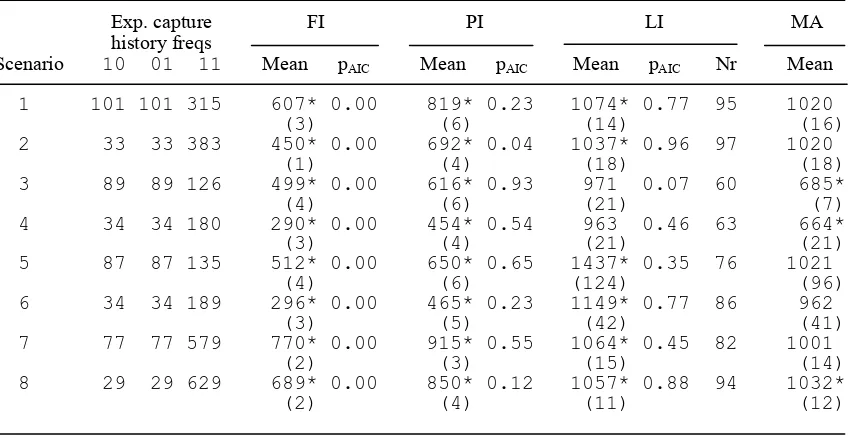
Simulation results appear in Table 1. Full independence and point independence
models had substantial negative bias in all scenarios, with full independence models
consistently more biased than point independence models. Within a scenario, the bias
was remarkably consistent, reflected in the very small standard errors of Table 1, but the
bias varied substantially between scenarios. Although the data were simulated from
limiting independence models, significant upward bias was found in six of the eight
scenarios when the data were analysed using the true model. However, the size of the
bias in most cases was substantially smaller than for point independence models.
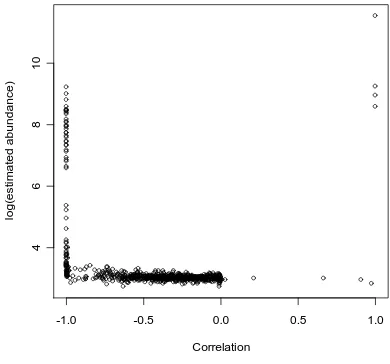
analyses under the limiting independence model were rejected due to high correlation
between αˆ and . Figure 1 shows the need to reject such cases; all of the very high
abundance estimates obtained correspond to a correlation between
j
0 ˆ
λ
αˆ and very close
to . In all cases use of AIC correctly diagnosed the presence of unmodelled
heterogeneity, although in some cases it did not differentiate well between point
independence and limiting independence scenarios.
j
0 ˆ
λ
1
±
4. Stake Data
Laake (1999) used data on a population of wooden stakes of known size to illustrate
independence issues in double-observer surveys. We use the same dataset here. The
surveys were conducted in 1977 and 1978 (Laake, 1978); as in Laake (1999), we
consider only the 1977 data. Multiple observers traversed a 1 km line marked with poles
at 100 m intervals and searched a strip of sagebrush-grassland habitat 20 m on either side
of the line for 150 wooden stakes that protruded 30 cm above ground. The stakes had a
random uniform distribution throughout the 1000 m × 40 m strip. Eight observers
separately surveyed the stakes, remaining on the line. Distances from the line were
measured accurately by an assistant.
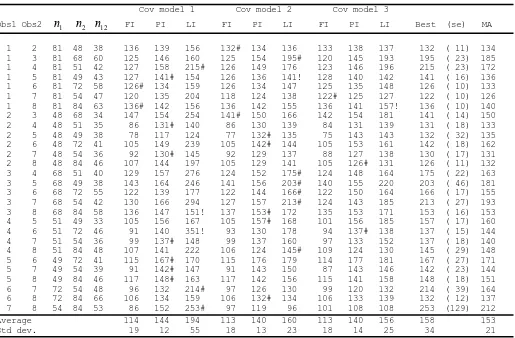
For each pair of observers, we show estimates of abundance in Table 2. Models
were fitted corresponding to full independence (α =β =0), point independence
(α =0,β unconstrained) and limiting independence with α ≥0,β ≥0. In each case,
three models were fitted: the first with observer as a factor and distance as a covariate,
the second with the addition of an interaction term between the two, and the third with
the squared distance as an additional covariate, together with interaction terms between
It is clear from Table 2 that models with all three forms of independence are
useful for the analysis of these data. Overall performance is remarkably good, with the
average of the best estimates (as judged by AIC) coming out close to the true abundance
of , as does the average of the model-averaged estimates, using AIC weights
(Buckland et al., 1997).
150
=
N
5. Shipboard Survey of Minke Whales
The second Small Cetacean Abundance in the North Sea and adjacent waters
(SCANS II) survey was a multinational survey conducted in 2005 by ship and aircraft to
estimate cetacean abundance in the North Sea, Kattegat, Skagerrak, western Baltic,
English Channel and the Celtic Sea. Double-observer line transect survey methods were
used because for many species detection of animals on the trackline was expected to be
less than unity. Details of the survey and further information can be found at
http://biology.st-andrews.ac.uk/scans2/. Here we analyse only shipboard survey data on
minke whales.
The methods used in the SCANS surveys were designed to break up the
dependence between the two observers, by ensuring that they are not simultaneously
searching the same patch of sea. A ‘tracker’ scans with high-powered binoculars well
ahead of the ship, and tracks detected animals in, to check whether the primary platform,
searching with hand-held binoculars and naked eye, detects them (so-called duplicate
detections). Previously, we have had no means of testing whether the method is
successful in breaking up the dependence between observers.
Using a truncation distance of 700 m, the tracker detected 54 minke groups
totalling 62 animals, while the primary platform detected 57 groups totalling 59 animals;
17 groups (19 animals) were detected by both tracker and primary platform.
) exp( 1 ) exp( ) , ( 2 1 0 2 1 0 z y z y z y p j j j j j j
j λ λ λ
λ λ λ + + + + +
= , (6)
)} , ( ) , ( ){ , ( ) , ( ) ,
(y z =L y z +δ0 y z U y z −L y z
δ (7)
where ⎭ ⎬ ⎫ ⎩ ⎨ ⎧ + − = ) , ( ) , ( 1 ) , ( ) , ( , 0 max ) , ( 2 1 2 1 z y p z y p z y p z y p z y
L , U(y,z)=min
{
1/ p1(y,z),1/ p2(y,z)}
and ) exp( )} , ( 1 { } 1 ) , ( { ) exp( )} , ( 1 { ) , ( 0 y z y L z y U y z y L z y β α β α δ + − + − + −
= . Covariate z is sea state
(Beaufort).
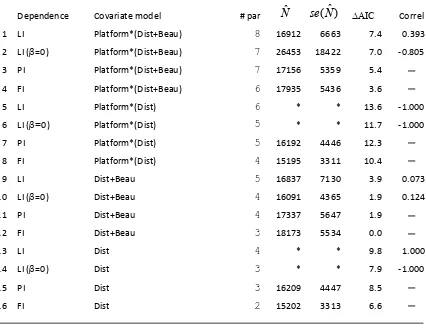
The benefits of field methods to break up heterogeneity are immediately apparent
from Table 3. AIC favours models with full independence (α =β =0), and selects the
model with identical detection functions for the two observers, and sea state as a
covariate. Estimation is largely unaffected by whether we assume full independence or
point independence. If we also relax the assumption of point independence, AIC values
are larger, but estimation is not greatly affected, with the exception of model 2.
Estimation is very similar to that reported by Burt et al. (unpublished). In that
analysis, no covariates were included, and point independence was assumed. Abundance
was estimated as with . The most comparable of our analyses
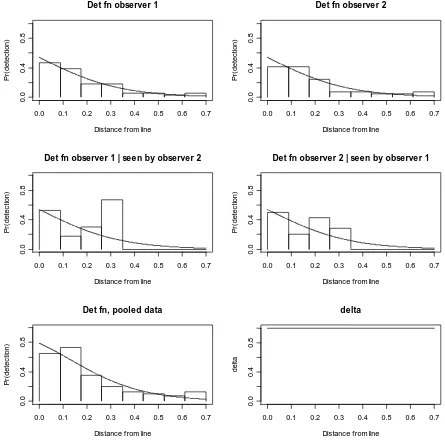
is model 7 of Table 3, for which and . AIC favours model 12,
and corresponding fits are shown in Figure 2.
13281
ˆ =
N se(Nˆ)=4780
16192
ˆ =
N se(Nˆ)=4446
It is surprising that AIC favours models which assume the same detection
function for the two observers, given that the tracker is searching much further ahead of
the ship than the primary platform. However, estimation is barely affected by whether
we make this assumption or not. The distribution of distances from the line of detections
(Figure 2), although beyond this distance, the tracker detects more animals than the
primary platform.
6. Discussion
Our methods allow assessment of whether the full independence or point independence
assumptions are reasonable. The methods also provide a means of analysing
double-observer surveys without having to assume independence between the double-observers’
detection probabilities, even at distance zero. However, strong dependence between the
observers’ detection probabilities can lead to unreliable estimation. If possible, field
methods should be developed to ensure that there are not animals in the population that
are very unlikely to be detected, even if they are on the line. However, this strategy can
create problems for identifying duplicate detections, so that in some circumstances, it
may be preferable to estimate the proportion of animals that are essentially undetectable.
For example in aerial surveys of marine mammals, the observers might record only those
animals that are at the surface as they pass abeam, and a separate study might be used to
estimate the proportion of animals at the surface at any time.
Extension of the methods to point transect sampling is straightforward. We now
have if points are positioned randomly. In (4), the covered area a is now
, where K is the number of points. For , we obtain a similar result to
(5) by adapting equation (3.48) from Marques and Buckland (2004). 2
/ 2 )
(y = y w π
2
w K
a= π vaˆr(Nˆ)
It is knowledge of π(y) that allows us to weaken the full independence
assumption. In principle, the same approach could be applied to conventional
mark-recapture models, if π(y) were known for some explanatory variable y, although this
If there is responsive movement prior to detection so that the distances y available
for detection differ in an unknown way from that prior to movement (i.e. from π(y)),
then (a) δ(y) cannot be interpreted as above and (b) under the assumption of full
independence, δ(y) can be interpreted as a measure of deviation from π(y) due to
responsive movement. This can be seen from the following. The pdf of observed
distance for observer j is fj(y)= pjj(y) (y)− (y)/
∫
pjj(y) (y)−1 (y)dy' | 1
'
| δ π δ π . If we
assume full independence, then is equal to the unconditional detection function
for observer j, and hence is proportional to the pdf of y after movement.
Note that while the interpretation of ) ( ' | y
pjj
1 ) ( ) (y δ y −
π
) (y
δ is different in this case from the case with no
responsive movement, the abundance estimator is still valid.
It is worth noting that although δ(y) is superficially similar to α(z) of Chen
(1999) and α of Chen and Lloyd (2000), it is in fact quite different. To see this, consider
a situation in which distance y and other variables u affect detection probability but only
y is recorded (in this case α(z) is a constant). Whereas α(z) and α quantify the
heterogeneity due to y, δ(y) quantifies the heterogeneity at y due to the unrecorded
variables u. This is an important difference because the formulations of Chen (1999)
and Chen and Lloyd (2000) do not accommodate heterogeneity due to the unrecorded
variables u, and it is precisely this heterogeneity that is at issue here. Chen (1999) and
Chen and Lloyd (2000) assume that p•(y)= p1(y)+ p2(y)− p1(y)p2(y) whereas we
assume that p•(y)= p1(y)+ p2(y)−δ(y)p1(y)p2(y). It is the discrepancy between the
shapes of and (j=1,2) which provides the basis for modelling
heterogeneity due to the unrecorded variables (together with knowledge of )
(y
fj pj|j'(y)
) (y
π ); the
) ( ' | y
pjj and are therefore unable to exploit the information in the discrepancy between
the two. This applies equally to the case in which additional variables z are recorded
(but u remains unrecorded).
We have used AIC to select between models. We have estimated detection
functions by maximum likelihood, but abundance is estimated using a Horvitz-Thompson
estimator in which the inclusion probabilities have been estimated (by maximum
likelihood). As the components of the abundance estimators that are not estimated by
maximum likelihood (corresponding to sample size, and to extrapolation from the
covered area to the entire survey area) are common across models, it seems not
unreasonable to use AIC to select between abundance estimators. However, when some
inclusion probabilities are very small, modest error in estimating them can generate large
positive bias in the abundance estimate, which would be undetectable by AIC.
ACKNOWLEDGEMENTS
We thank Evan Cooch for generously providing computer time on his Linux machine.
We also thank the editors and referees of this and an earlier draft, which led to a
REFERENCES
Alpizar-Jara, R. and Pollock, K.H. (1996). A combination line transect and capture
recapture sampling model for multiple observers in aerial surveys. Environmental
and Ecological Statistics3, 311-327.
Borchers, D.L. (1996). Line Transect Estimation with Uncertain Detection on the
Trackline. PhD thesis, University of Cape Town.
Borchers, D.L. (1999). Composite mark-recapture line transect surveys. Pp. 115-126 in
Marine Mammal Survey and Assessment Methods, eds G.W. Garner, S.C.
Amstrup, J.L. Laake, B.F.J. Manly, L.L. McDonald and D.G. Robertson.
Balkema, Rotterdam.
Borchers, D.L., Buckland, S.T., Goedhart, P.W., Clarke, E.D. and Hedley, S.L. (1998a).
Horvitz-Thompson estimators for double-platform line transect surveys.
Biometrics54, 1221-1237.
Borchers, D.L., Buckland, S.T. and Zucchini, W. (2002). Estimating Animal Abundance:
Closed Populations. Springer-Verlag, London.
Borchers, D.L., Laake, J.L., Southwell, C. and Paxton, C.G.M. (2006). Accommodating
unmodeled heterogeneity in double-observer distance sampling surveys.
Biometrics62, 372-378.
Borchers, D.L., Zucchini, W. and Fewster, R.M. (1998b). Mark-recapture models for
line transect surveys. Biometrics54, 1207-1220.
Buckland, S.T., Anderson, D.R., Burnham, K.P., Laake, J.L., Borchers, D.L. and
Thomas, L. (2001). Introduction to Distance Sampling: Estimating Abundance
of Biological Populations. Oxford University Press, Oxford.
Buckland, S.T., Burnham, K.P. and Augustin, N.H. (1997). Model selection: an integral
Buckland, S.T. and Turnock, B.J. (1992). A robust line transect method. Biometrics48,
901-909.
Burt, M.L., Borchers, D.L. and Samarra, F. (unpublished). Abundance estimates from
SCANS-II: stratified analysis.
Chen, S.X. (1999). Estimation in independent observer line transect surveys for cluster
populations. Biometrics55, 754-759.
Chen, S.X. (2000). Animal abundance estimation in independent observer line transect
surveys. Environmental and Ecological Statistics7, 285-299.
Chen, S.X. and Lloyd, C.J. (2000). A nonparametric approach to the analysis of
two-stage mark-recapture experiments. Biometrika87, 633-649.
Innes, S., Heide-Jørgensen, M.P., Laake, J.L., Laidre, K.L., Cleator, H., Richard, P. and
Stewart, R.E.A. (2002). Surveys of belugas and narwhals in the Canadian high
Arctic in 1996. Scientific Publications of the North Atlantic Marine Mammal
Commission4, 169-190.
Laake, J.L. (1978). Line Transect Estimators Robust to Animal Movement. MS thesis,
Utah State University.
Laake, J.L. (1999). Distance sampling with independent observers: reducing bias from
heterogeneity by weakening the conditional independence assumption. Pp.
137-48 in Marine Mammal Survey and Assessment Methods, eds G.W. Garner, S.C.
Amstrup, J.L. Laake, B.F.J. Manly, L.L. McDonald and D.G. Robertson.
Balkema, Rotterdam.
Laake, J.L. and Borchers, D.L. (2004). Methods for incomplete detection at distance
zero. Pp. 108-189 in Advanced Distance Sampling, eds S.T. Buckland, D.R.
Anderson, K.P. Burnham, J.L. Laake, D.L. Borchers and L. Thomas. Oxford
Manly, B.F.J., McDonald, L.L. and Garner, G.W. (1996). Maximum likelihood
estimation for the double-count method with independent observers. Journal of
Agricultural, Biological, and Environmental Statistics1, 170-189.
Marques, F.F.C. and Buckland, S.T. (2003). Incorporating covariates into standard line
transect analyses. Biometrics59, 924-935.
Marques, F.F.C. and Buckland, S.T. (2004). Covariate models for the detection function.
Pp. 31-47 in Advanced Distance Sampling, eds S.T. Buckland, D.R. Anderson,
K.P. Burnham, J.L. Laake, D.L. Borchers and L. Thomas. Oxford University
Press, Oxford.
Palka, D. (1995). Abundance estimate of the Gulf of Maine harbor porpoise. Pp. 27-50
in Biology of the Phocoenids, eds A. Bjørge and G.P. Donovan. International
Whaling Commission, Cambridge.
Quang, P.X. and Becker, E.F. (1997). Combining line transect and double count
sampling techniques for aerial surveys. Journal of Agricultural, Biological, and
Environmental Statistics1, 170-189.
Schweder, T., Skaug, H.J., Langaas, M. and Dimakos, X.K. (1999). Simulated likelihood
methods for complex double-platform line transect surveys. Biometrics 55,
678-687.
Skaug, H.J. and Schweder, T. (1999). Hazard models for line transect surveys with
Table 1.
Mean (standard error in parentheses) of 100 abundance estimates under full independence (FI), point independence (PI) and limiting independence (LI) models for the eight simulation scenarios. The expected capture history frequencies are shown for each scenario. Also shown is pAIC, the proportion of times each model was selected by AIC, and model-averaged (MA) estimates, obtained by taking a weighted average of estimates from the above three models, using AIC weights. Where an LI model was deemed to be parameter-redundant (correl(αˆ,λˆ01) >0.99), the model was not considered even if it had the best AIC value, and the weighted average was over the FI and PI models only. The mean and standard error for LI models is across only those runs for which the model was not deemed to be parameter-redundant. The number of runs (Nr) out of 100 contributing to the LI results under each scenario is shown. True abundance is 1000. *Bias significant at 5% level.
Exp. capture FI PI LI MA history freqs
Scenario 10 01 11 Mean pAIC Mean pAIC Mean pAIC Nr Mean
Table 2.
Estimates of abundance for the stake data for all combinations of the 8 observers under full independence, FI (α =β =0), point independence, PI (α =0,β unconstrained) and limiting independence, LI with
0 ,
0 ≥
≥ β
α . Covariate model 1 has covariate structure observer + distance, model 2 has structure
observer * distance, and model 3 has structure observer * (distance + distance2). ‘Best’ corresponds to the model with the smallest AIC (indicated by ‘#’, with standard error in parentheses), and ‘MA’ is the model-averaged estimate, using AIC weights. True abundance is 150. LI fits with
9 . 0 ) ˆ , ˆ (
correlα λ01 > were not used for the best or model-averaged estimates, and are indicated by ‘!’.
Cov model 1 Cov model 2 Cov model 3
Obs1 Obs2 n1 n2 n12 FI PI LI FI PI LI FI PI LI Best (se) MA
1 2 81 48 38 136 139 156 132# 134 136 133 138 137 132 ( 11) 134 1 3 81 68 60 125 146 160 125 154 195# 120 145 193 195 ( 23) 185 1 4 81 51 42 127 158 215# 126 149 176 123 146 196 215 ( 23) 172 1 5 81 49 43 127 141# 154 126 136 141! 128 140 142 141 ( 16) 136 1 6 81 72 58 126# 134 159 126 134 147 125 135 148 126 ( 10) 133 1 7 81 54 47 120 135 204 118 124 138 122# 125 127 122 ( 10) 126 1 8 81 84 63 136# 142 156 136 142 155 136 141 157! 136 ( 10) 140 2 3 48 68 34 147 154 254 141# 150 166 142 154 181 141 ( 14) 150 2 4 48 51 35 86 131# 140 86 130 139 84 131 139 131 ( 18) 133 2 5 48 49 38 78 117 124 77 132# 135 75 143 143 132 ( 32) 135 2 6 48 72 41 105 149 239 105 142# 144 105 153 161 142 ( 18) 162 2 7 48 54 36 92 130# 145 92 129 137 88 127 138 130 ( 17) 131 2 8 48 84 46 107 144 197 105 129 141 105 126# 131 126 ( 11) 132 3 4 68 51 40 129 157 276 124 152 175# 124 148 164 175 ( 22) 163 3 5 68 49 38 143 164 246 141 156 203# 140 155 220 203 ( 46) 181 3 6 68 72 55 122 139 177 122 144 166# 122 150 164 166 ( 17) 155 3 7 68 54 42 130 166 294 127 157 213# 124 143 185 213 ( 27) 193 3 8 68 84 58 136 147 151! 137 153# 172 135 153 171 153 ( 16) 153 4 5 51 49 33 105 156 167 105 157# 168 101 156 185 157 ( 17) 160 4 6 51 72 46 91 140 351! 93 130 178 94 137# 138 137 ( 15) 144 4 7 51 54 36 99 137# 148 99 137 160 97 133 152 137 ( 18) 140 4 8 51 84 48 107 141 222 106 124 145# 109 124 130 145 ( 29) 148 5 6 49 72 41 115 167# 170 115 176 179 114 177 181 167 ( 27) 171 5 7 49 54 39 91 142# 147 91 143 150 87 143 146 142 ( 23) 144 5 8 49 84 46 117 148# 163 117 142 156 115 141 158 148 ( 18) 151 6 7 72 54 48 96 132 214# 97 126 130 99 120 132 214 ( 39) 164 6 8 72 84 66 106 134 159 106 132# 134 106 133 139 132 ( 12) 137 7 8 54 84 53 86 152 253# 97 119 96 101 108 108 253 (129) 212
Table 3. Models fitted to the minke whale survey data. The full model, denoted here by LI (Limiting Independence), Platform*(Dist+Beau), is defined by equations (6) and (7). The estimates and were obtained by appropriate extensions of equations (3) and (4) for a stratified design. Correl for LI models with a platform effect corresponds to whichever of
Nˆ se(Nˆ)
) ˆ , ˆ (
correlα λ01 and correl(αˆ,λˆ02) is closest to 1. PI indicates Point Independence (α =0) and FI denotes Full Independence (α =β =0).
# Dependence Covariate model # par
Nˆ se(Nˆ) ∆
AIC Correl
1 LI Platform*(Dist+Beau) 8 16912 6663 7.4 0.393
2 LI (β=0) Platform*(Dist+Beau) 7 26453 18422 7.0 ‐0.805
3 PI Platform*(Dist+Beau) 7 17156 5359 5.4 ─
4 FI Platform*(Dist+Beau) 6 17935 5436 3.6 ─
5 LI Platform*(Dist) 6 * * 13.6 ‐1.000
6 LI (β=0) Platform*(Dist) 5 * * 11.7 ‐1.000
7 PI Platform*(Dist) 5 16192 4446 12.3 ─
8 FI Platform*(Dist) 4 15195 3311 10.4 ─
9 LI Dist+Beau 5 16837 7130 3.9 0.073
10 LI (β=0) Dist+Beau 4 16091 4365 1.9 0.124
11 PI Dist+Beau 4 17337 5647 1.9 ─
12 FI Dist+Beau 3 18173 5534 0.0 ─
13 LI Dist 4 * * 9.8 1.000
14 LI (β=0) Dist 3 * * 7.9 ‐1.000
15 PI Dist 3 16209 4447 8.5 ─
16 FI Dist 2 15202 3313 6.6 ─
*correl(αˆ,λˆ0j) >0.99 for j=1 and 2 (models 1-8) or correl(αˆ,λˆ0) >0.99 (models
Figure 1. Plot of against , illustrating that the very high estimates
of abundance from the simulations all arose when was very close to . )
ˆ
log(N correl(αˆ,λˆ01)
) ˆ , ˆ (
correlα λ01 ±1
-1.0 -0.5 0.0 0.5 1.0
468
1
0
Correlation
lo
g(
est
im
a
te
d abundance)
Figure 2. Estimated detection functions for minke whales, model 12 (see Table 3). The
top left plot is the estimated unconditional detection function for observer 1, and top right is the estimated unconditional detection function for observer 2. The corresponding conditional detection functions are shown in the centre. Under this model, all four of these detection functions are identical, but the data in each plot differ. The estimated detection function for the two observers combined is shown at the bottom left. The bars are: relative frequencies of detections made by observer 1 (top left), relative frequencies of detections made by observer 2 (top right), proportion of observer 2 detections made by observer 1 (middle left), proportion of observer 1 detections made by observer 2 (middle right), and relative frequencies of detections made by at least one observer.
0.0 0.1 0.2 0.3 0.4 0.5 0.6 0.7
0.
0
0.
4
0
.8
Det fn observer 1
Distance from line
P
r(
det
ec
tion
)
0.0 0.1 0.2 0.3 0.4 0.5 0.6 0.7
0.
0
0.
4
0
.8
Det fn observer 2
Distance from line
P
r(
det
ec
tion
)
0.0 0.1 0.2 0.3 0.4 0.5 0.6 0.7
0.
0
0
.4
0.
8
Det fn observer 1 | seen by observer 2
Distance from line
P
r(
det
ec
tion)
0.0 0.1 0.2 0.3 0.4 0.5 0.6 0.7
0.
0
0
.4
0.
8
Det fn observer 2 | seen by observer 1
Distance from line
P
r(
det
ec
tion)
0.0 0.1 0.2 0.3 0.4 0.5 0.6 0.7
0.0
0
.4
0
.8
Det fn, pooled data
Distance from line
P
r(
d
ete
c
tion
)
0.0 0.1 0.2 0.3 0.4 0.5 0.6 0.7
0.0
0
.4
0
.8
delta
Distance from line
de