A MULTI-DIRECTIONAL MODIFIED PHYSARUM ALGORITHM FOR OPTIMAL MULTI-OBJECTIVE DISCRETE DECISION MAKING
L. Masia and M. Vasileb
aDepartment of Mechanical & Aerospace Engineering University of Strathclyde
75 Montrose Street, G1 1XJ, Glasgow, UK [email protected]
bDepartment of Mechanical & Aerospace Engineering University of Strathclyde
75 Montrose Street, G1 1XJ, Glasgow, UK [email protected]
Abstract. This paper will address an innovative bio-inspired algorithm able to incrementally grow decision graphs in multiple directions for dis-crete multi-objective optimisation. The algorithm takes inspiration from the slime mould Physarum Polycephalum, an amoeboid organism that in its plasmodium state extends and optimizes a net of veins looking for food. The algorithm is here used to solve multi-objective Traveling Salesman and Vehicle Routing Problems selected as representative ex-amples of multi-objective discrete decision making problems. Simulations on selected test cases showed that building decision sequences in two di-rections and adding a matching ability (multi-directional approach) is an advantageous choice if compared with the choice of building decision sequences in only one direction (unidirectional approach). The ability to evaluate decisions from multiple directions enhances the performance of the solver in the construction and selection of optimal decision sequences.
Keywords: Physarum, Multi-Objective, Multi-Directional
1 Introduction
The idea that nature can inspire humans to solve complex decision making prob-lems was widely used over the past two decades. A number of bio-inspired al-gorithms designed to solve decision making problems was and still are studied and developed. An example is the ACO (Ant Colony Optimisation) alghorithm [1] that takes inspiration from the social behaviour of ants looking for food. Fol-lowing this concept, the behaviour of other social animals was successfully used: examples are bee colonies [2], reies [3], birds [4].
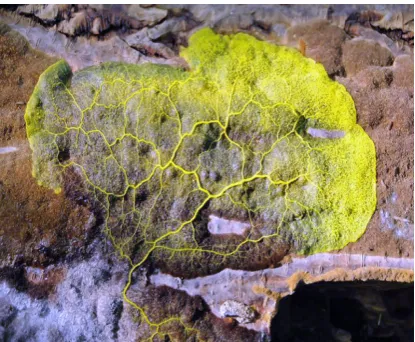
Fig. 1. Physarum Polycephalum. Image courtesy of Howard County Bird Club at www.howardbirds.org.
inahabiting moist areas that was endowed by nature with heuristics that can be used to solve single-objective and multi-objective discrete decision making problems. In [5] it has been shown that Physarum Polycephalum is able to solve a maze nding the shortest path that connects the maze's entrance and exit by changing its shape. It has been shown also that a living Physarum is able to recreate the Japan rail network [6] and the Mexican highway network [7], both using an experimental arena with food sources at each of the major cities in the regions. Physarum based algorithms have been developed recently to solve multi-source problems with a simple geometry [8,9], mazes [10] and transport network problems [6,10].
In this paper a multi-directional modied Physarum Polycephalum algorithm able to solve NP-hard multi-objective classical problems in operations research is proposed. In [11,12,13] multi-objective bio-inspired algorithms, i.e. ant colony algorithms, have been proposed and studied. The algorithm presented in this work is a multi-objective generalization of the single-objective multi-directional modied Physarum solver previously presented in [14] for discrete decision mak-ing.
de-cision problems that can be represented with directed symmetric dede-cision graphs, i.e. graphs where the contribution of an arc to a complete path can be evalu-ated moving forward or backward along the graph. In [14] it has been already shown that the single-objective multi-directional modied Physarum algorithm is more ecient than the unidirectional algorithm when applied to small scale single-objective discrete decision making problems. This thesis will be demon-strated for the multi-objective algorithm in Sect. 4 solving some test cases. Bi-objective Traveling Salesman and Vehicle Routing Problems (TSP and VRP), introduced in Sect. 3, with a number of nodes between 10 and 100, were chosen as representative examples of the above type of decision making problems, here called reversible decision-making problems, i.e. problems in which a decision can be taken either moving forward or backward along the graph, as explained in Sect. 2.
2 Biology and Mathematical Modeling
Physarum Polycephalum is a large, single-celled amoeboid organism that ex-hibits intelligent plant-like and animal-like characteristics. Its main vegetative state, the plasmodium, is formed of a network of veins (pseudopodia). The stream in these tubes is both a carrier of chemical and physical signals, and a supply network of nutrients throughout the organism [9]. Physarum searches for food by extending this net of veins, whose ux is incremented or decremented de-pending on the food position with reference to its centre. The longest is the path connecting the centre with the source of food, the smallest is the ux and viceversa: best veins in terms of length that connect its centre with the food tend to increase their radius and the ux of nutrients inside, while longer veins tend to decrement the ux and close with time. This behaviour can be interpreted as a natural attitude in optimising the energy required to feed the organism by shape variation.
2.1 Problem Formulation: Multi-Objective Discrete Decision Making
Given a solutionjto a discrete multi-objective decision making problemP, with
cost vector sj= [sj 1, s
j
2, ..., sjn]and a solutioniwith cost vector si= [si1, si2, ..., sin], the solution j dominates i ifsjk ≤sik for all thek = 1,2, ..., n andsjk < sik for
at least onek. The relation sj ≺si states that sj dominates si. The dimension of the vector sj expresses the number of evaluating criteria for a solutionj. The cost vector represents the cost associated with a decision. A general problem in discrete multi-objective optimisation is to nd the feasible non dominated solu-tions to the given discrete multi-objective decision making problemP. Following
the theory developed in [18], it is possible to associate a scalar dominance index
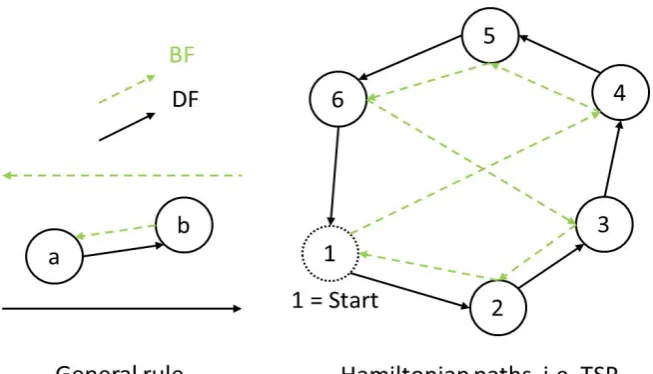
Fig. 2. Generally a Physarum working in direct ow (DF) would build the decision that brings fromato b, while the Physarum working in back ow (BF) would build the symmetric decision bringing from b to a (left). In a traveling salesman problem (TSP, right) nodes are xed while arcs are built with time and a decision that brings fromatobcan be built from both DF and BF Physarum, as for the arc that connect
4to5.
associated scalar indexes will be I ={I(sj) = 0, I(si) = 1, I(sk) = 2}. All the non-dominated solutions in a general setS form the set:
P F ={s|I(s) = 0} (1)
which is called Pareto front. Therefore, the solution of the problemP translates
into nding the elements ofP F.
2.2 Multi-Objective multi-directional Physarum Algorithmic
A reversible discrete decision problem can be modeled using a symmetric directed graph. The reversibility of a decision that induces a change from a state a to
stateb indicates here that the decision that brings back fromb to aexists and
can be evaluated. Not necessarily these two decisions have the same cost. The symmetric directed graph can be seen as the superposition of two directed graphs (direct-ow, DF, and back-ow, BF, graphs) whose nodes are coincident and edges have opposite orientation. In so doing, the decision between stateaandb
has a forward link atob and a superposed backward link bto a. It is assumed
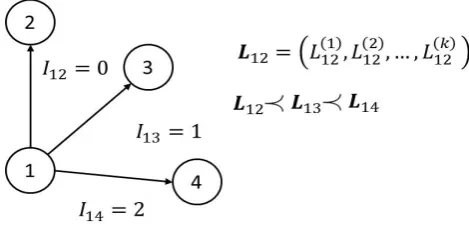
Fig. 3. Example of acrs' values assignment.LijandIijare respectively the cost vector
and dominance index associated with the general decision from nodeito nodej.
by extending their net of veins. A multiple direction growing decision Physarum graph is obtained. In the example mentioned before, the Physarum working in DF would build its graph by creating arcs that move from ato b. If the graph
was traversed by a virtual agent, the agent would walk along an arc froma to b. The other Physarum would build its graph in the opposite direction then
walking along each arc frombtoa. The result is a graph where both nodes and
links are incrementally built by two expanding Physarum.
In this work the decisional problems analyzed are the TSP and the VRP, see Sect. 3; being Hamiltonian paths, all the nodes are built at the beginning, and only the arcs are built with time. This means that both the Physarum working inDF and the one working inBF can build arcs connecting two nodes in both
directions. If the graphs built by the two Physarum are fully connected after a transient of growth, which is the case in this paper, two superposed symmetric directed graph are obtained. Fig. 2 shows a simple example for a TSP problem. Exploration Using the Hagen-Poiseuille law, the ux through the net of Physarum veins is [6,8,9,10]:
Qij =
πr4 ij 8µ
∆pij
Lij (2)
whereQij is the ux betweeniandj,µis the dynamic viscosity,rij the radius,
Lij the length and∆pij the pressure gradient.
In a multi-objective algorithm the length Lij, representing the cost of the decision that brings from i to j, is a vector Lij. Its value can be substituted with the scalar dominance indexIij∈N0, see Fig. 3: the cost vectors associated with each veins that connect a nodeNi with other nodesNjk can be compared and the dominance indexes can be evaluated. Eq. (2) becomes:
Qij =
πr4 ij 8µ
∆pij
(Iij+ 1) (3)
Table 1. Input parameters for the modied Physarum solver.
m Linear dilation coecient, see Eq. (9). ρ Evaporation coecient, see Eq. (5). GFini Initial growth factor, see Eq. (7)
Nagents Number of virtual agents.
pram Probability of ramication, see Sect. 2.2.
α Weights on ramication, see Eq. (8).
kexplosionradii upper limit, see Eq. (10)
The strategy of using a single structure (in this case the ux) has been pre-viously examined in [11] for Ant Colony Optimisation applied to multi-objective problems (where a weighted sum of all the objectives is used instead of the in-dexIij). Another strategy, as reported in [11], could be the use of several uxes structures ([11] refers to pheromones), one for each objective. The rst strategy was chosen because it has the advantage of being easy to implement and usable when the number of objectives is high, as in many real-world problems. This considerations will be further discussed in Sect. 4.1.
Diameter variations then cause a change in the ux. Veins' dilation due to an increasing number of nutrients owing can be modeled using a monotonic function of the ux:
d dtrij
dilation
=f(Qij) (4)
where f(0) = 0 , i.e. linear, sigmoidal, etc. Veins' contraction, similarly to the evaporative eect in ACO [1], can be assumed to be linear with radius:
d dtrij
contraction
=−ρrij (5)
where ρ ∈ [0,1] is dened evaporation coecient. The probability associated with each vein connecting i and j is then computed using a simple adjacency
probability matrix based on uxes:
Pij=
{ Q
ij
∑
j∈NiQij if j∈Ni
0 if j /∈Ni
(6) whereNi is the set of neighbour fori.
An additive term in the veins' dilation process, whose rst main term is expressed in Eq. (4) was added in the algorithm and takes inspiration from the behaviour of the amoeba Dictyostelium discoideum [16]. This dilation is:
d dtrijbest
elasticity
=GF rijbest (7)
current calculated Pareto front. This dilation, as explained in [14], simulates the tendency of best veins to further increase their radius for the eect of the ux. Growth in multiple directions and matching The incremental growth of decision network in multiple directions is then based on a weighted roulette. Nutrients inside veins are interpreted as virtual agents that move in accord with adjacency probability matrix in Eq.( 6). Once a node is selected, there is a probabilitypram of ramication towards new nodes that are not yet connected with the actual node. The value of pram can be chosen a priori or a law can be dened, i.e.
pc
ram = pcram(Ac), where c is the current ramifying node and Ac the number of arcs that leave node c. In this work a priori values were chosen before the
simulations.
If ramication is the choice, a weighted roulette, based on objective function evaluations, helps the Physarum with the selection and construction of a new link. The probability of a new link construction from the current node c to a
new possible nodeni ∈N, whereN is the set of new possible decisions, is here assumed to be inversely proportional to the cost Icni of the decision betweenc andni, i.e. the dominance scalar index associated with the decision:
pcni∝ 1 (Icni+ 1)
α (8)
where αis a weight. Once a new link is built, a complete decision path is
con-structed (creating other links if necessary).
Assuming then the presence of two counter expanding Physarum, one in direct-ow DF and one superposed in back-ow BF, as explained in the previ-ous paragraph, a matching condition can be then dened. If an arc connecting two nodes that belongs to DF and BF Physarum respectively, exists or can be created, it is traversed by the agent and becomes part of both the DF and the BF. Some matching strategies were compared in [14] for single-objective problems. In this paper, two matching strategies were implemented in the multi-objective modied Physarum solver.
The rst one, called selective-matching, follows an elitist criterion where at each generation a joint path is selected if and only if its total cost vector is not dominated by the previous joint paths selected during the same generation, as in [14]. It could be noted that if a high number of exploring agents is chosen, a high number of paths are matched. This could lead to a slowdown of the code speed, especially if complete decision sequences are long, as in more complex multi-objective VRPs and TSPs (more than20cities). For this reason, an other strategy, called mix-matching, was designed for larger scale problems. Selective matching is done only considering the bestn solutions in DF and BF during a
generation, so that worst routes are excluded a priori. A valuen= dim 5 , where
dimis the problem dimension, i.e. the number of cities for TSP and VRP, was
used in the simulations presented in this paper. Furthermore thenbest decisions
Algorithm 1 multi-directional incremental modied Physarum solver
initializem,ρ,GFini,Nagents,pram,α
generate a random route from start to destination both inDF andBF for each generation do
for each virtual agent in all directions (DF andBF) do if current node̸=end node then
if rand≤pram then
using Eq. (8) create a new link to a node not yet connected update scalar dominance indexes for current node, see Sect. 2.1 else
move on existing graph using Eq. (6) end if
end if end for
look for possible matchings among decision sequences in DF and BF update Pareto front
contract and dilate veins using Eqs. (4), (5), (7) if rijexceeds upper radius limit, see Eq. (10) then
block radius increment end if
update uxes and probabilities using Eqs. (3), (6) end for
These matching conditions can be interpreted as a communication ability be-tween the two Physarum: they move according to their nature and the knowledge acquired exploring the decision space, which contains both personal experience and shared information.
Restart procedure Simulations on selected test cases (see Sect. 4) were carried out adding in the Physarum algorithm two restart procedures to avoid stagnation on local minima. The rst restart procedure, called restart1, is a routine for the adaptive control of the growth factorGF. This control was introduced in order
to incrementally boost the eect of GF during a simulation, driving exploring
agents towards best veins. Simulations showed that the adaptive control ofGF
helps the convergence of the algorithm towards optimal solution when used on small scale problems (number of cities less than16in this paper). Given an initial value for the growth factor GFini, GF is incremented by a xed percentage σ after every generation. If the highest probability pP Fbest associated with the
paths in the calculated Pareto front so far is higher than a xed value plowlim ,
the increment is set to zero. Then, if pP F
best exceeds a value p high
Table 2. Values used as input parameters - TSP test case (rst row) and VRP test case (second row).
Instance m ρ GFini Nagents pram α kexplosion
Ulysses16 5×10⁻⁵ N1·10−5
agents 5·10
−3
100 0.8 0 108
Tuscany10 5×10⁻⁵ 1·10−5
Nagents 1·10
−3 150 0.8 0 108
KroAB100 5×10⁻⁵ 5·10−6
Nagents 5·10
−3 50 1 0 5
nodes in common among decision sequences in a generation and among decision sequences and Pareto front; the algorithm is restarted if one of the following conditions is achieved:
I) the minimum number of nodes in common ncommin, obtained comparing all decision sequences among each other in a generation, exceeds a thresholdncom.
II) a fractionβ of the decision sequences built during a generation belong to the
calculated Pareto front at same generation.
In this paper a valuencom=dim2 , wheredimis dimension of the problem, i.e. the number of cities, and a valueβ= 23were used. The goal of this restart procedure is to avoid both a stagnation to local single minima and to the calculated Pareto front itself.
Considerations on the algorithm The set of Eqs. (2)-(6) can be implemented as in the following. In accordance to Eq. (2), ux in each vein is proportional to the radius and inversely proportional to the length (the scalar dominance index in a multi-objective problem, Eq. (3) ). These two main parameters are taken into account in the algorithm. Once a vein is selected by a virtual agent in a generation, its radius is incremented using Eq. (4). In the present work, a function linear with respect to the product between the radiusr(ijn) of the veins
traversed by agentn, and the inverse of the sum of dominance indexes (Itot(n), see
Sect. 2.1), associated with each arc of the decision taken by agentn, will be used
for the veins' dilation:
d dtr
(n) ij
dilation =mr
(n) ij
Itot(n)
(9) where the coecientmis the linear dilation coecient. Evaporation is taken into
account using Eq. (5) for each agent. Fluxes are then calculated using Eq. (3) and probabilities are updated in accordance with Eq. (6). Due to the mathematical nature of the algorithm (the ux is related to the fourth power of the radius), an upper limit on the maximum vein radius was introduced in order to avoid veins' ux explosion. If the radiusrijexceeds a maximum valuermax, the vein dilation is blocked up until the radius is again belowrmaxfor the eect of evaporation. This upper limit, calledkexplosion, is given as ratio betweenrij andrini:
kexplosion=
rij
rini
whereriniis the initial radius of the veins. The main parameters of the modied Physarum solver are listed in Table 1. The initial radius of the veins rini is always set equal to 1 in the simulations presented in this paper. The pseudocode of the multi-directional incremental modied Physarum solver is provided in Algorithm 1.
3 Application to Multi-Objective Traveling Salesman and
Vehicle Routing Problems and Benchmark
In single-objective optimisation the Traveling Salesman problem, TSP, is the problem of nding the shortest tour that visit each city of a given set S of n
cities.
In the multi-objective optimisation case considered in this paper the cost function to be minimized is a vector of two values: the total lengthLtot=
∑ jLj and the total road trac Ttot =
∑
jTj of each tours, wherej = 1, ..., nis the index that identies each part of the tour. The road trac is here assumed to be inversely proportional to the lengthTj = 1/Lj. The shorter is the tour, the higher is the probability that the tour is chosen by drivers, increasing the road trac. The total road trac Ttot =
∑
jTj will be called Road Trac Index in the following. Although conicting criteria, both length and road trac in a tour have to be minimised.
TSPLIB [17] was used to benchmark the proposed Physarum algorithm, de-veloped in Matlab⃝R R2010b, on the TSP problem. In Sect. 4 are reported the
re-sults obtained by applying the multi-objective multi-directional Physarum solver to test case Ulysses16 that was modied adding the road trac to the cost func-tion and to the test case KroAB100, obtained from the single-objective intances KroA100 and KroB100. For the KroAB100 the consideration above on the road trac index does not apply: it is a bi-objective problem itself and two objectives to be minimised are included in the instance.
The multi-objective Vehicle Routing Problem, VRP, considered in this paper is a similar problem. Given a set ofncities with a demandk, whose reciprocal
distance Lj and road trac Tj = 1/Lj are known, v vehicles of capacity c,
d depots located in xed cities, the VRP is the problem of delivering goods
located in the depots using a dened amount of vehicles with nite capacity. The goal is to satisfy the demand of each city minimizing the cost functions, i.e. the distance and road trac. VRP reduces to a TSP if there is only one vehicle with innite capacity. When the modied Physarum algorithm is applied to VRP, a probability skew factor ψ is included in the algorithm. If an agent is
not obliged to go to depot, the probability to reach the depot is lowered of a factor (1−ψ). Other probabilities are then risen of a same value in order to have the sum of probabilities equals to 1. The skew factorψis introduced in the
0.8 1 1.2 1.4 1.6 150
200 250 300 350 400 450 500 550 600 650
Lenght
Road Traffic Index
a) − TSP test case
Global D DB
400 500 600 700 800 900
0.2 0.25 0.3 0.35 0.4 0.45 0.5
Lenght
Road Traffic Index
b) − VRP test case
[image:11.595.156.454.122.313.2]Global D DB
Fig. 4. Pareto front - TSP test case Ulysses16 at 6.5·105 function evaluations, (a)
- VRP test case Tuscany10 at3·105 function evaluations, (b). In the legend, Global
indicates the global Pareto front obtained from all the runs of the D and D&B algo-rithms (1600 for the VRP test case and 2800 for the TSP test case), while D and D&B indicate an example of a Pareto front found during a run of the D and D&B algorithms respectively.
a city considered the depot (Ponsacco). The Euclidean distance in kilometers was used. VRP parameters were set ton= 9, k =cost= 1, v= 1, c= 4, d= 1, i.e. one vehicle with capacity equals to 4, one depot and a constant demand equals to1.
3.1 Testing Procedure
The testing procedure proposed in [18] was used in this paper. Two metrics are dened:
Mspr = 1
Mp Mp ∑
i=1 min j∈Np
∥fj−gigi∥ (11)
Mconv= 1
Np Np ∑
i=1 min j∈Mp
∥gj−fi
gj ∥ (12)
0 2 4 6 8
x 105
0 0.1 0.2 0.3 0.4 0.5 Function evaluations P conv
TSP test case Ulysses16
a)
D D&B
0 2 4 6 8
x 105 0 0.2 0.4 0.6 0.8 Function evaluations P spr
TSP test case Ulysses16
b)
D D&B
0 1 2 3
x 105
0 0.2 0.4 0.6 0.8 1 Function evaluations P con v
VRP test case Tuscany10
c)
D D&B
0 1 2 3
x 105 0 0.2 0.4 0.6 0.8 1 Function evaluations P spr
VRP test case Tuscany10
d)
[image:12.595.149.452.124.394.2]D D&B
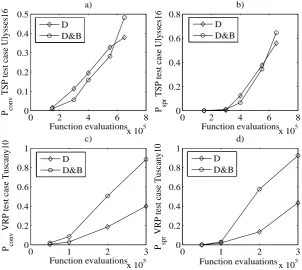
Fig. 5. Variation of the indexes of performance pconv and pspr with the number of
function evaluations - TSP test case Ulysses16, (a) and (b) - VRP test case Tuscany10, (c) and (d).
over all the elements in the global Pareto front, of the minimum distance of all the elements in the Pareto front Np from the ith element in the global Pareto front: this metric would be high ifNp was only a partial representation of the global Pareto front. Mconv, instead, is the sum, over all the elements in the
Pareto frontNp, of the minimum distance of the elements in the global Pareto
front from theithelement in the Pareto frontNp: this metric would give a low value ifNpwas an accurate, although partial, representation of the global Pareto front.
From the considerations above, both the metricsMspr andMconvshould be low for a good estimate of the global calculated Pareto front. The indexes of per-formance pconv=P(Mconv< tolconv)andpspr=P(Mspr < tolspr)will be used to explore the eciency of the algorithm and to compare the multi-directional and the unidirectional versions. Given nrepeated runs,pconv is the probability that Mconv achieves a value less than tolconv, whilepspr is the probability that
4 6 8 10
x 104 4.5
5 5.5 6 6.5 7 7.5 8
8.5x 10
4
Objective 1
Objective 2
b)
Global Global, D Global, D&B
4 6 8 10
x 104 4.5
5 5.5 6 6.5 7 7.5 8
8.5x 10
4
Objective 1
Objective 2
a)
[image:13.595.159.452.119.316.2]Global D D&B
Fig. 6. Pareto fronts for TSP test case KroAB100 at4·107 function evaluations. In
the legend of gure a), Global indicates the global Pareto front obtained from all the runs of the D and D&B algorithms (40), while D and D&B indicate an example of
a Pareto front found during a run of the D and D&B algorithms respectively. In the legend of gure b), Global indicates the global Pareto front as in a), while Global, D and Global, D&B indicate the global Pareto fronts obtained from all the runs of the D and D&B algorithms respectively (20).
an error ≤5%with a 95% of condence [18]. For the TSP test case Ulysses16 the tolerances tolconv and tolspr are set equal to0.0465and 0.045respectively, for the VRP test case Tuscany10 to0.030and0.035, and for the TSP test case KroAB100 to 0.048 and0.058.
4 Results
1 2 3 4 x 10⁷ 0
0.1 0.2 0.3 0.4 0.5 0.6 0.7 0.8
Function evaluations P conv
TSP test case KroAB100
a)
D D&B
1 2 3 4
x 107 0
0.1 0.2 0.3 0.4 0.5 0.6 0.7 0.8 0.9
Function evaluations P spr
TSP test case KroAB100
b)
[image:14.595.153.449.119.277.2]D D&B
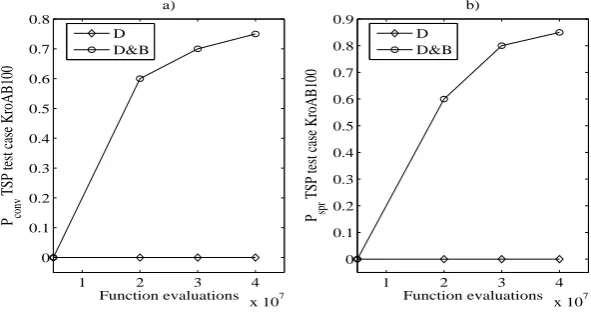
Fig. 7. Variation of the indexes of performance pconv and pspr with the number of
function evaluations - TSP test case KroAB100.
OS Windows 7 Intel⃝R CoreTM2 Duo CPU E8500 3.16GHz 3.17GHz.
0 5 10 15 20 0
0.2 0.4 0.6 0.8
5⋅106 Function Evaluations
Runs
Mspr
0 5 10 15 20
0 0.2 0.4 0.6 0.8
5⋅106 Function Evaluations
Runs
M conv
0 5 10 15 20
0 0.05 0.1 0.15 0.2 0.25
4⋅107 Function Evaluations
Runs
M spr
0 5 10 15 20
0 0.05 0.1 0.15 0.2
4⋅107 Function Evaluations
Runs
Mconv
D&B D
D&B D
D&B D D&B
[image:15.595.153.469.122.362.2]D
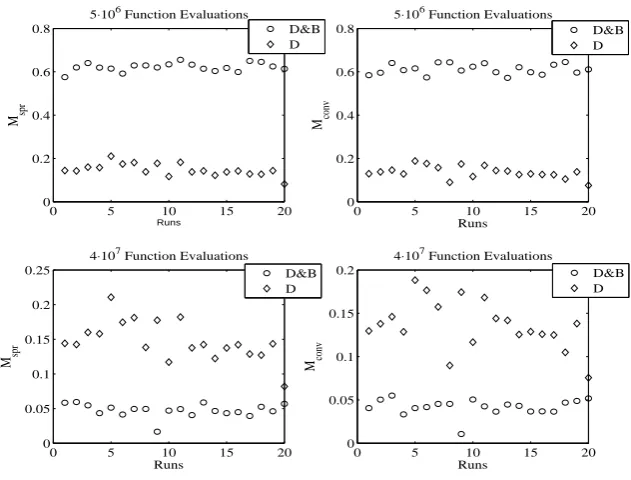
Fig. 8. Value of the metrics in Eqs. (11)-(12) for the D and D&B algorithms at5·106
and4·107 function evaluations.
exceeds the performance of the unidirectional.
4 6 8 10
x 104
4.5 5 5.5 6 6.5 7 7.5 8
8.5x 10
4
Objective 1
Objective 2
b)
Global
Global, D&B increasing m Global, D&B
4 6 8 10
x 104
4.5 5 5.5 6 6.5 7 7.5 8 8.5
9x 10
4
Objective 1
Objective 2
a)
Global
D&B, increasing m D&B
Fig. 9. Eect of the variation of the linear growth coecientmand evaporationρat
4·107 function evaluations. In a) Global is the global Pareto front obtained from all
the runs of the D and D&B algorithms (40) as in Fig. 4, D&B indicates an example of
a Pareto front found during a run of the D&B algorithm with classical settings, as in Tab. 2, and D&B increasing m indicates an example of a Pareto front found during a run of the D&B algorithm wherem= 5·10−3andρ= 10−5. In b), Global is the global
Pareto front as above, while Global D&B increasing m indicate the global Pareto fronts obtained from all the runs (20) of the D&B algorithms withm= 5·10−3andρ= 10−4
and Global, D&B indicate the global Pareto fronts obtained from all the runs (20) of
the D&B algorithms with classical settings.
in Fig. 7, where the unidirectional algorithm performs better than the multi-directional (although the performance is still not signicant). This transient can be appreciated in Fig. 8: it reports the value of the metrics in Eqs. (11)-(12) for the D and D&B algorithms at5·106 and4·107 function evaluations. From the gure it is evident that D performs better at low function evaluations, but their increment is not able to improve its performance signicantly, as for D&B. This behaviour is similar to that found in [14].
Fig. 9 shows the eect of increasing the linear growth coecient tom= 5·10−3 and evaporation parameter toρ= 10−5. This variation should increase the rate of veins' expansion with time and limit the eect of contraction. From Fig. 9 one can argue that increasing the rate of veins' expansion is a bad choice: the algorithm tends to converge very rapidly to a set of solutions and the exploration is not ecient as with lower rate of expansion.
[image:16.595.167.459.121.310.2]building decision sequences in two directions and adding a matching ability is an advantageous choice if compared with the choice of building decision sequences in only one direction in the solution of multi-objective discrete decision making problems. The two Physarum can evaluate each step of the decision sequence from two directions and create joint paths: this forward and backward decision making process improves the performance of the algorithm.
A comparison among the proposed algorithm and other bio-inspired ACO-style algorithms is not reported in this paper and will be the subject of the future work. Recently [13] provided an excellent comparison of the performance of multi-objective ACO algorithms and of SPEA2 and NSGA-II, applied to a benchmark of TSP problems, including KroAB100. In [13] the higher perfor-mance of the ACO algorithms if compared to NSGA-II and SPEA2 is shown. A rst visual analysis of the Pareto Front obtained by the Physarum algorithm and the best multi-objective ACO algorithms in [13] indicates that the Physarum is able to nd very quickly the centre of the front while there is a diculty in nd-ing the tails. This can be explained by the fact that a snd-ingle structure is used (see Sect. 4.1).
4.1 Conclusion
disadvantage of using a single structure as proposed in this paper, could be over-come by adding sub-populations of agents that consider only one objective. This will be further studied in the future, although rst results are encouraging.
References
1. Dorigo, M., Maniezzo, V., Colorni, A.: The Ant System: optimisation by a colony of cooperating agents. Systems, Man, and Cybernetics-Part B IEEE Transactions, 26(1), 29-41 (1996)
2. Chong, Chin Soon, Malcolm Yoke Hean Low, Appa Iyer Sivakumar, and Kheng Leng Gay: A bee colony optimisation algorithm to job shop scheduling. IEEE Simulation Conference. WSC 06. Proceedings of the Winter, 1954-1961 (2006)
3. Sayadi, M. K., Ramezanian, R., Ghaari-Nasab, N.: A discrete rey meta-heuristic with local search for makespan minimisation in permutation ow shop scheduling problems. International Journal of Industrial Engineering Computations, 1(1), 1-10 (2010)
4. Yang, Xin-She, Suash Deb: Cuckoo search via Lévy ights. Nature & Biologically Inspired Computing. NaBIC 2009. World Congress on. IEEE, 210-214 (2009) 5. Nakagaki, T., Yamada, H., Toth, A.: Maze-Solving by an Amoeboid Organism.
Nature, 407, 470 (2000)
6. Tero, A., Takagi, S., Saigusa, T., Ito, K., Bebber, D.P., Fricker, M.D., Yumiki, K., Kobayashi, R., Nakagaki, T.: Rules for Biologically Inspired Adaptive Network Design. Science, 439, 327 (2010)
7. Adamatzky, A., Martínez, G. J., Chapa-Vergara, S. V., Asomoza-Palacio, R., Stephens, C. R.: Approximating Mexican highways with slime mould. Natural Com-puting, 10(3), 1195-1214 (2011)
8. Hickey, D. S., Noriega, L. A.: Insights into Information Processing by the Single Cell Slime Mold Physarum Polycephalum. UKACC Control Conference, 2008 9. Tero,A. , Yumiki, K., Kobayashi, R., Saigusa, T., Nakagaki, T.: Flow-Network
Adap-tation in Physarum Amoebae. Theory in Biosciences, 127(2), 89-94 (2008)
10. Tero, A., Kobayashi, R., Nakagaki, T.: Physarum Solver: a Biologically Inspired Method of Road-Network Navigation. Physica: A Statistical Mechanics and its Ap-plications, 363(1), 115-119 (2006)
11. Alaya, I., Solnon, C., Ghedira, K.: Ant colony optimisation for multi-objective optimisation problems. Tools with Articial Intelligence. ICTAI 2007. 19th IEEE International Conference, 1, 450-457 (2007)
12. Lopez-Ibanez,M.: Multi-objective Ant Colony optimisation. Diploma thesis, Intel-lectics Group, Computer Science Department, Technische Universitat Darmstadt, Germany, 2004
13. Garcia-Martinez, C., Cordon, O., Herrera, F.: A Taxonomy and an Empirical Anal-ysis of Multiple Objective Ant Colony optimisation Algorithms for the Bi-Criteria TSP. European Journal of Operational Research, 180, 116-148 (2007).
14. Masi,L., Vasile,M.: A multi-directional Modied Physarum Solver for Optimal Dis-crete Decision Making. Proceedings of International Conference on Bio-Inspired op-timisation Methods and their Applications, BIOMA, Bohinj, Slovenia, 2012 15. Dorigo, M., Gambardella, L.M.: Ant Colonies for the Traveling Salesman Problem.
BioSystems, 43, 73-81 (1997)
17. TSPLIB, library of instances for Traveling Salesman and Vehicle Routing Problems, Ruprecht Karls Universitaet Heidelberg, URL: http://comopt.i.uni-heidelberg.de/software/TSPLIB95/.