UV SURFACE ENVIRONMENT OF EARTH-LIKE PLANETS ORBITING
FGKM STARS THROUGH GEOLOGICAL EVOLUTION
S. Rugheimer1,3, A. Segura2, L. Kaltenegger3, and D. Sasselov1 1
Harvard Smithsonian Center for Astrophysics, 60 Garden st., 02138 MA Cambridge, USA;[email protected]
2
Instituto de Ciencias Nucleares, Universidad Nacional Autónoma de México, México 3
Carl Sagan Institute, Cornell University, Ithaca, NY 14853 USA
Received 2014 October 27; accepted 2015 May 1; published 2015 June 12
ABSTRACT
The UV environment of a host star affects the photochemistry in the atmosphere, and ultimately the surface UV environment for terrestrial planets and therefore the conditions for the origin and evolution of life. We model the surface UV radiation environment for Earth-sized planets orbiting FGKM stars in the circumstellar Habitable Zone for Earth through its geological evolution. We explore four different types of atmospheres corresponding to an early-Earth atmosphere at 3.9 Gyr ago and three atmospheres covering the rise of oxygen to present-day levels at 2.0 Gyr ago, 0.8 Gyr ago, and modern Earth. In addition to calculating the UVflux on the surface of the planet, we model the biologically effective irradiance, using DNA damage as a proxy for biological damage. Wefind that a pre-biotic Earth(3.9 Gyr ago)orbiting an F0V star receives 6 times the biologically effective radiation as around the early Sun and 3520 times the modern Earth–Sun levels. A pre-biotic Earth orbiting GJ 581(M3.5 V)receives 300 times less biologically effective radiation, about 2 times modern Earth–Sun levels. The UVfluxes calculated here provide a grid of model UV environments during the evolution of an Earth-like planet orbiting a range of stars. These models can be used as inputs into photo-biological experiments and for pre-biotic chemistry and early life evolution experiments.
Key words:astrobiology –Earth–planets and satellites: surfaces– planets and satellites: terrestrial planets
1. INTRODUCTION
Thousands of extrasolar planets have been found to date with thousands more awaiting confirmation from space and ground-based searches. Several of these planets have been found in or near the circumstellar Habitable Zone (see, e.g., Udry et al.
2007; Borucki et al.2011,2013; Kaltenegger & Sasselov2011; Batalha et al. 2013; Kaltenegger et al. 2013; Quintana et al.
2014) with masses and radii consistent with rocky planet models. The quest for finding habitable planets focuses on main-sequence stars with lifetimes conducive for the origin and evolution of life, namely, the F, G, K, and M spectral types with stellar main-sequence lifetimes at least 2 Gyr or more. The UV environment of a host star will affect the atmosphere, and ultimately the surface UV environment for terrestrial planets.
(see e.g., Segura et al.2003; Rugheimer et al.2013,2014; Sato et al.2014).
Future mission concepts to characterize Earth-like planets are designed to take spectra of extrasolar planets with the ultimate goal of remotely detecting atmospheric signatures that can indicate habitability and life (e.g., Beichman et al.
1999,2006; Cash 2006; Kaltenegger et al. 2006; Traub et al.
2006; Seager & Bains2015).The UV surface environment for planets is an important component in providing boundary conditions for biological models exploring the origin of life on Earth as well as planets orbiting other types of stars.
Depending on the intensity, UV radiation can be both useful and harmful to life as we know it. UV radiation from 180–300 nm can inhibit photosynthesis and cause damage to DNA and other macromolecule damage (Voet et al. 1963; Matsunaga et al. 1991; Tevini 1993; Kerwin & Remmele
2007). However, these same wavelengths also drive several reactions thought necessary for the origin of life (e.g., Senanayake & Idriss 2006; Barks et al. 2010; Ritson & Sutherland2012; Patel et al.2015). In this paper we model the
UV surface radiation environments for both pre-biotic and post-biotic planets orbiting other stars at the 1 AU equivalent distance based on Earth’s evolution.
Previous studies used an analytic atmospheric attenuation model to model UV environment for Archean Earth (Cockell
1998,1999,2000; Cnossen et al.2007)as well as F stars(Sato et al.2014). An earlier study(Segura et al.2003)examined the amount of UV radiation reaching the surface of an Earth-like planet with varying oxygen atmospheric concentration orbiting an F2V, G2V(the Sun), and K2V host star. Our paper expands the grid of host stars as well as models of the UV surface environments for atmospheres that correspond to geological epochs throughout Earth’s evolution (following Kaltenegger et al.2007). We focus on four geological epochs corresponding to a 3.9 Ga (assumed prebiotic)4, 2.0 Ga, 0.8 Ga, and the modern Earth atmosphere for a grid of FGKM host stars.
In Section2, we describe our model, Section3presents the calculated UVfluxes at the surface and top of the atmosphere of an Earth-like planet for 12 stellar types and the four different atmosphere models through geological time. In Section 4 we conclude by summarizing the results and discussing their implications.
2. MODEL DESCRIPTION 2.1. Stellar and Planetary Model
We use a grid of host stars from F0V to M8V(Teff=7000 to 2400 K; see Rugheimer et al.2013,2014). All stellar models use observations in the UV by theIUE5except for 3 M dwarfs withHubble Space Telescope HSTdata and reconstructed Lyα
fluxes (France et al. 2013) up to 3000 Å combined with The Astrophysical Journal,806:137(10pp), 2015 June 10 doi:10.1088/0004-637X/806/1/137
© 2015. The American Astronomical Society. All rights reserved.
4
Ga—billion years ago. 5
PHOENIX (Allard et al. 2000; Allard 2014) or ATLAS
(Kurucz 1979) stellar models6 for larger wavelengths (F0V, F7V, Sun(G2V), G8V, K2V, K7V, M1V, M3V, M8V7). The three M dwarfs with updated UV data are GJ 581(M3V,Teff= 3498 K), GJ 832 (M1.5 V, Teff = 3620 K), and GJ 1214
(M4.5 V,Teff =3250 K; France et al.2013).
To model the planetary atmospheres, we use a coupled 1D radiative-convective atmosphere code developed for rocky exoplanets. It iterates between a 1D climate (Kasting & Ackerman1986; Pavlov et al. 2000; Haqq-Misra et al.2008)
and a 1D photochemistry code (Pavlov & Kasting 2002; Segura et al. 2005, 2007) to calculate the atmosphere transmission of UVfluxes to the ground of Earth-sized planets. We simulate the effects of stellar radiation on a planetary environment with an altitude range that extends upwards to 60 km, corresponding to a pressure of 1mbar, with 100 height layers. A two-stream approximation (see Toon et al. 1989), which includes multiple scattering by atmospheric gases, is
used in the visible/near-IR to calculate the shortwave fluxes. Four-term, correlated-kcoefficients parameterize the absorption by O3, H2O, O2, and CH4(Pavlov et al.2000). Clouds are not explicitly calculated. Clouds can either reduce or enhance UV radiation reaching the surface of an Earth-like planet(Grant & Heisler 1997; Parisi & Downs 2004). The climatic effects of clouds on the temperature versus pressure profile are included by adjusting the planet’s surface albedo to the value that for the modern Earth–Sun system yields a surface temperature of 288 K (following Kasting et al. 1984; Pavlov et al. 2000; Segura et al.2003,2005). The photochemistry code, originally developed by Kasting et al. (1985), solves for 55 chemical species linked by 220 reactions using a reverse-Euler method
(see Segura et al.2010, and references therein).
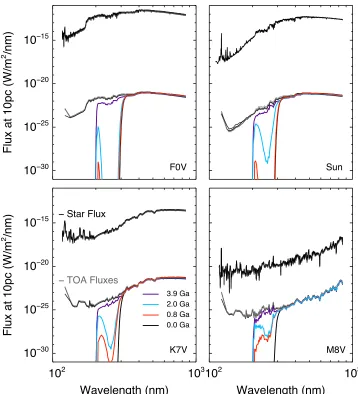
[image:2.612.125.483.48.442.2]For the geological epoch at 3.9 Ga, we use a 1D photochemical model for high-CO2/high-CH4terrestrial atmo-spheres(see Pavlov et al.2001; Kharecha et al.2005; Segura et al.2007, and references therein). This model simulates an anoxic atmosphere composed of 0.9 bar of N2 and fixed amounts of CO2 and CH4. We run the radiative-convective model to convergence and then use the resulting temperature profile to run the photochemical model that contains 73 chemical species involved in 359 reactions. The model spans Figure 1.Stellarflux(black lines), TOAfluxes(gray lines), and surface UVfluxes(colored lines)for each of the four geological epochs for an F0V(top left), the Sun
(top right), a K7V(bottom left), and M8V(bottom right)host star.
6
BT-Settl PHOENIX models are used for the M stars and ATLAS models are used for the FGK stars.
7
the region from the planetary surface up to 64 km in 1 km steps. All of the simulated planets at 3.9 Ga are assumed to be devoid of life; hence, none of the compounds in the atmosphere are considered to have a biological source.
2.2. Simulation Set-up
We focus on four geological epochs from Earth’s history to model the UV environment on the surface of an Earth-like planet at the 1 AU equivalent distance from its host star. The geological evidence from 2.8–3.5 Ga is consistent with an atmosphere with similar atmospheric pressure as modern Earth
(Som et al.2012; Marty et al.2013). Therefore, we use one bar for the surface pressure for all epochs.
Currently no model can predict the rate of the evolution of life on planets around different stars which themselves have a different main sequence lifetimes. For the Earth–Sun case, we use a solar evolution model for each epoch(Claire et al.2012). We reduce the stellar flux of all other host stars by the same factor as afirst order approximation of how much stellarflux would be received at a corresponding epoch for the other host stars. This procedure is not meant to capture the nuances of stellar evolution. Rather, it is intended to compare across different stellar hosts for planets that receive the same bolometric flux with different atmospheric compositions modeled after Earth’s evolution. This translates into different evolutionary stages of the star–planet system as well as into different distances from the the host stars corresponding to 1.15–1 AU (75%–100% current insolation). Especially for M stars, which evolve much more slowly on the main sequence, reducing the stellar flux by the same amount as Earth is equivalent to increasing its distance from the host star. We model each of the four atmospheres for planets orbiting stars with spectral types of F0V, F7V, the Sun(G2V), G8V, K2V, K7V, M1V, M3V, and M8V to sample the FGKM spectral range along with three observed MUSCLES stars, GJ 581, GJ 832, and GJ 1214, with well characterized UV observations fromHST.
Thefirst epoch corresponds to a pre-biotic world, similar to early Earth at 3.9 Ga with a CO2 dominated atmosphere. We model the atmosphere with a fixed surface mixing ratio of CO2 = 0.1 and CH4 =1.65×10⁻⁶ and no biological gas
fluxes. We assume a stellar flux of 74.6% of the present day Earth–Sun system.
The next three epochs represent planets with an active biosphere with oxygenic photosynthesis. To model atmo-spheres corresponding to a similar stage of biological evolution as Earth’s, we use calculated biological surfacefluxes from the Earth–Sun model as inputs for the same epoch for all other stellar types as detailed in the following three paragraphs.
The second epoch corresponds to 2.0 Ga, when oxygen starts to build up in Earth’s atmosphere. We model the atmosphere with a fixed surface mixing ratio of CO2 = 0.01 and O2 =
2.1×10⁻³ (1% PAL = Present Atmospheric Level) and a stellarflux of 87%. For the Earth–Sun case wefix the mixing ratios of the other biological gases to CH4 = 7.07×10⁻³
(4300x PAL), N2O=8.37×10⁻⁹, and CH3Cl=5.0×10⁻¹⁰ (see Kaltenegger et al. 2007). The corresponding biological surface fluxes required to sustain those mixing ratios are CH4 = 1.01×10¹⁷g yr−1, N2O = 3.14×10¹³g yr−1, and CH3Cl=9.06×10¹¹g yr−1. All other stellar types except the Sun use these surface fluxes as the boundary conditions for those gases. For H2and CO we usedfixed deposition velocities
of2.4×10−4and1.2×10−4cm s−1, respectively, correspond-ing to the maximum rate of transfer into an ocean ( Domagal-Goldman et al.2014). For the later stellar types, K7V, M1V, M3V, and the three observed MUSCLES stars, the CH4 boundary condition was changed to afixed mixing ratio(see also Segura et al. 2005; Rugheimer et al. 2014). For those stellar types, we used a mixing ratio of CH4corresponding to the last stable value, calculated for the K2V case, of
4.5×10⁻³. For the M8V model, we needed to further reduce the CH4mixing ratio to4.0×10−3for a stable atmosphere.
The third epoch corresponds to Earth as oxygen continues to rise at 0.8 Ga and the start of the proliferation of multicellular life. We model the atmosphere with a fixed mixing ratio of CO2=0.01 and O2=2.1×10⁻²(10% PAL)and a stellarflux of 94.8%. For the Earth–Sun case we fix the mixing ratios of the other biological gases to CH4=1.65×10⁻³(1000x PAL), N2O = 9.15×10⁻⁸, and CH3Cl = 5.0×10⁻¹⁰ (see Kalte-negger et al. 2007). The correspondingfluxes used for other stellar types are CH4=2.75×10¹⁶g yr−1, N2O=2.08×10¹³ g yr−1, and CH3Cl = 7.76×10¹¹g yr−1. For H2 and CO we used fixed deposition velocities as above. For the later stellar types, M3V, M8V, and the three observed MUSCLES stars, the CH4boundary condition was changed to afixed mixing ratio. We used a mixing ratio of CH4corresponding to the last stable value, calculated for the M1V case, of1.1×10−2.
The fourth epoch corresponds to modern Earth. The model atmosphere has a fixed mixing ratio of CO2 =355 ppm and O2=0.21. The biogenicfluxes were heldfixed in the models in accordance with thefluxes that reproduce the modern mixing ratios in the Earth–Sun case. The surfacefluxes for long-lived gases H2, CH4, N2O, CO, and CH3Cl were calculated such that the Earth around the Sun yields a Tsurf = 288 K for surface mixing ratios:cH2= 5.5×10⁻⁷,cCH4=1.6×10⁻⁶,cCO2=
3.5×10⁻⁴, cN
2O = 3.0×10⁻⁷, cCO = 9.0×10⁻⁸, and cCH3Cl = 5.0×10⁻¹⁰ (see Rugheimer et al. 2013). The corresponding surface fluxes are −1.9×10¹²g H2/year,
5.3×10¹⁴ g CH
4/year, 7.9×10¹² g N2O/year,1.8×1015 g CO/year, and4.3×1012 g CH
3Cl/year. M8V, CH4, and N2O were given afixed mixing ratio of1.0×10−3and1.5×10−2, respectively(following Rugheimer et al.2014).
3. RESULTS: UV FLUXES FOR PLANETS ORBITING FGKM STARS
For each model atmosphere and star type we calculate the UV flux reaching the surface of an Earth-like planet and compare that to the UVflux incident on the top-of-atmosphere
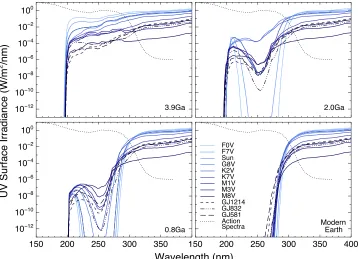
(TOA). In Figure 1 we show the flux of the host star (black lines), theflux at the TOA(gray lines), and theflux reaching the ground for each epoch (colored lines) as seen from an observer at 10 pc. Theflux from the host star relative to what is incident on the top of the atmosphere at 500 nm ranges from 103to 1010for the M8V to F0V, respectively.
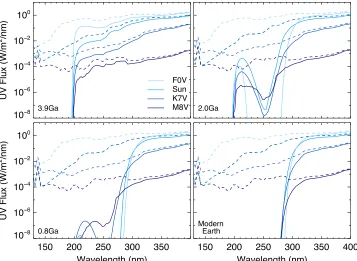
Figure2compares the incident(dashed)and surface(solid)
flux at the planet at each of the four geological epochs for an F0V (Teff = 7000 K), the Sun (Teff = 5778 K), a K7V
atmosphere by CO2and H2O and no UV flux at wavelengths below 200 nm reaches the surface of the planet for any star type considered. With the rise of oxygen at 2.0 Ga to 1% PAL we see absorption of UV photons around 250 nm due to ozone
(Figure2, upper right). This is pronounced for F stars which have ozone column depths an order of magnitude higher at 2.0 Ga than G, K, and M stars due to higher incident UVflux and photolysis of O2producing O3(see Table1for O3column depths for all stars and epochs). As oxygen continues to rise at 0.8 Ga to 10% PAL and then to current levels for the modern Earth, absorption increases for λ < 280 nm due to ozone, effectively blocking UVC radiation from reaching the surface
(see also Table6).
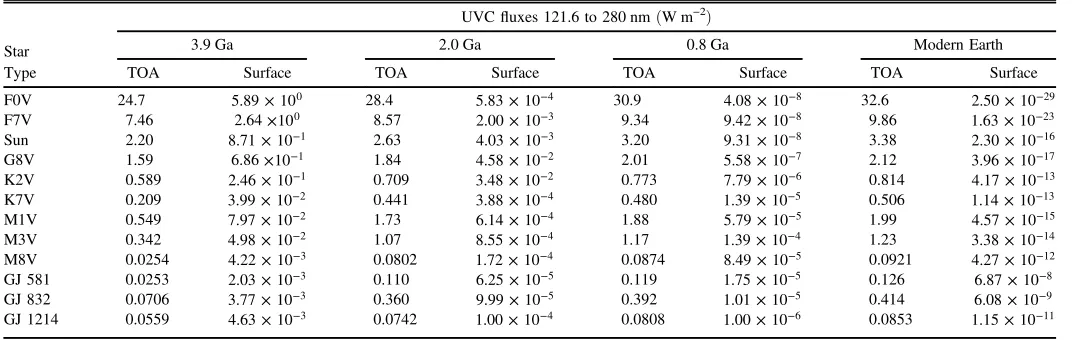
Table 2 lists the TOA and surface UV fluxes for each stellar type and geological era for planets orbiting at the 1 AU equivalent distance for their host star. Tables4–6show the TOA and surface UVfluxes subdivided into UVA(315–400 nm), UVB
(280–315 nm), and UVC (121.6–280 nm). Note that all fluxes have been diurnally averaged and calculated for a zenith angle of 60 degrees, representing a global average. We discuss the F0V-M8V results below and, comparable information for the three MUSCLES stars can be found in Table2and Tables4–6.
At 3.9 Ga, 54%–77% of the total incoming stellar UV flux
(121.6–400 nm)reaches the surface for a pre-biotic atmosphere orbiting different host stars. The lowest percentage of UV radiation reaches the ground for a pre-biotic Earth orbiting our M8V model star, and the highest percentage of UV radiation reaches the ground a K7V star(this trend holds for all epochs). Note that this does not correspond to the minimum and maximum of the absolute transmittedflux. The minimum UV
flux that reaches the ground is 0.035 W m−2for an M8V host star and the maximum is 61 W m−2for an F0V host star in this epoch. However, the fraction of UVA, UVB, and UVCfluxes reaching the surface is different. In the UVA region, between 80% (G2V)–82% (M8V) of the incident flux and between
0.026 W m−2(M8V)and 45 W m−2(F0V)reaches the surface. In the UVB region, between 57%(F0V)and 59 %(K2V)of the incident flux and between 0.0030 W m−2 (M8V) and 10 W m−2 (F0V) reaches the surface. In the UVC region between 15%(M1V)and 43%(G8V)of the incidentflux and between 4.2×10⁻³W m−2 (M8V) and 5.9 W m−2 (F0V) reaches the surface. The percentage and absoluteflux reaching the ground depends on the interplay between the intensity of incoming UV radiation and the amount of ozone shielding.
At 2.0 Ga, 25% (M8V)–69% (K7V) of the total incoming stellar UVflux reaches the surface. In absoluteflux, the minimum UVflux that reaches the surface is 0.032 W m−2(M8V)and the maximum is 48 W m−2(F0V). In the UVA region, between 73%
(Sun)–78%(K7V)of the incidentflux and between 0.029 W m−2
[image:4.612.128.485.51.312.2] [image:4.612.317.569.381.536.2](M8V)and 47 W m−2(F0V)reaches the surface for a planet. In Figure 2.Incident stellar UVflux(dashed lines)and the surface UVflux(solid lines)at four geological epochs for a sample of four stellar types spanning the stellar effective temperature range for FGKM stars.
Table 1
Ozone Column Depths for the Grid of Host Stars(F0V to M8V)
O3Column Depth
Star 3.9 Ga 2.0 Ga 0.8 Ga Modern Earth
F0V 1.76×10¹⁶ 5.13×10¹⁸ 9.07×10¹⁸ 1.15×10¹⁹
F7V 3.93×10¹⁵ 2.20×10¹⁸ 6.17×10¹⁸ 8.62×10¹⁸
Sun 1.84×10¹⁵ 6.01×10¹⁷ 4.23×10¹⁸ 5.29×10¹⁸
G8V 4.21×10¹⁴ 1.73×10¹⁷ 1.62×10¹⁸ 5.56×10¹⁸
K2V 7.32×10¹⁴ 1.23×10¹⁷ 1.08×10¹⁸ 3.62×10¹⁸
K7V 1.10×10¹⁶ 5.31×10¹⁷ 7.38×10¹⁷ 3.46×10¹⁸
M1V 1.01×10¹⁶ 5.37×10¹⁷ 7.37×10¹⁷ 4.03×10¹⁸
M3V 9.88×10¹⁵ 3.97×10¹⁷ 5.66×10¹⁷ 3.59×10¹⁸
M8V 1.43×10¹⁵ 2.63×10¹⁷ 3.15×10¹⁷ 2.47×10¹⁸
GJ 581 6.76×10¹⁵ 3.55×10¹⁷ 4.75×10¹⁷ 1.18×10¹⁸
GJ 832 2.49×10¹⁵ 3.46×10¹⁷ 6.25×10¹⁷ 1.59×10¹⁸
the UVB region, between 7.8% (F0V)and 48% (K2V) of the incident flux and between 2.2×10⁻³W m−2 (M8V) and 2.5 W m−2(G8V)reaches the surface. In the UVC region between
2.1×10 %−3 (F0V) and 2.5% (G8V) of the incident flux and between 1.7×10⁻⁴W m−2 (M8V) and 5.8×10⁻⁴W m−2
(F0V)reaches the surface for a planet.
At 0.8 Ga, 26% (M8V)–69% (K7V) of the total incoming stellar UVflux reaches the surface. In absoluteflux, the minimum UVflux that reaches the surface is 0.035 W m−2(M8V)and the maximum is 51 W m−2(F0V). In the UVA region, between 72%
(F0V)–79% (M8V) of the incident flux and between 0.032 W m−2 (M8V) and 50 W m−2(F0V) reaches the surface for a planet. In the UVB region, between 4.0%(F0V)and 36%
(M8V) of the incident flux and between 2.3×10⁻³W m−2
(M8V)and 1.0 W m−2(F7V)reaches the surface. In the UVC region between1.3×10 %−9 (F0V)and 0.097%(M8V)of the incident flux and between 4.1×10⁻⁸W m−2 (F0V) and
1.4×10⁻⁴W m−2(M3V)reaches the surface for a planet. For the modern Earth-like atmosphere, 25% (M8V)–69%
(K7V)of the total incoming stellar UVflux reaches the surface. In absoluteflux, the minimum UVflux that reaches the surface is 0.034 W m−2(M8V)and the maximum is 53 W m−2(F0V). In the UVA region, between 72% (F0V)–79% (M8V) of the incidentflux and between 0.034 W m−2 (M8V) and 53 W m−2
[image:5.612.40.575.74.245.2](F0V) reaches the surface for a planet. In the UVB region, between 2.7%(F0V)and 17%(K7V)of the incidentflux and Table 2
Top-of-atmosphere(TOA)and Surface UV Fluxes for F, G, K, and M Stars
UVfluxes 121.6 to 400 nm(W m−2)
Star 3.9 Ga 2.0 Ga 0.8 Ga Modern Earth
Type TOA Surface TOA Surface TOA Surface TOA Surface
F0V 98.6 60.8 113. 48.1 123. 51.1 130. 53.3
F7V 62.6 44.2 71.7 39.1 78.1 40.8 82.4 42.5
Sun 37.9 28.1 43.6 27.8 51.4 30.4 55.0 32.3
G8V 31.3 23.4 35.8 23.8 39.0 24.4 41.2 25.0
K2V 16.5 12.6 19.0 13.1 20.7 13.8 21.8 14.2
K7V 4.79 3.71 5.68 3.94 6.19 4.29 6.53 4.50
M1V 2.00 1.22 3.39 1.19 3.69 1.30 3.89 1.36
M3V 0.934 0.510 1.75 0.465 1.91 0.503 2.01 0.533
M8V 0.0646 0.0347 0.125 0.0316 0.136 0.0349 0.144 0.0353
GJ 581 1.57 1.25 2.04 1.35 2.04 1.47 2.15 1.57
GJ 832 2.06 1.61 2.64 1.74 2.87 1.90 3.03 2.02
GJ 1214 0.943 0.722 1.19 0.778 1.19 0.847 1.25 0.902
Note.Allfluxes have been diurnally averaged.
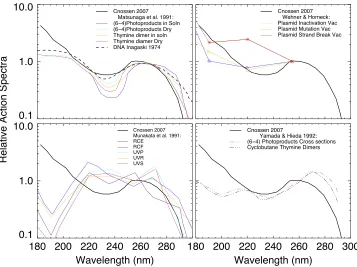
Figure 3.Action Spectra for photoproduct formation(top left, bottom right), DNA plasmid inactivation, mutation, and strand-breaks(top right), and the inactivation of bacterial spores(bottom left).
[image:5.612.127.484.280.547.2]between 9.9×10⁻⁴W m−2 (M8V) and 0.80 W m−2 (Sun) reaches the surface. In the UVC region between7.7×10−29%
(F0V) and 4.6×10⁻⁹% (M8V) of the incident flux and between 2.5×10⁻²⁹W m−2 (F0V) and
4.3×10⁻¹²W m−2
(M8V)reaches the surface for a planet.
To estimate the biologically relevant UVfluxes, it is useful to consider the damage to DNA and other biomolecules. An action spectrum is a parameter which gives the relative biological response effectiveness at different wavelengths. Multiplying the surfaceflux by the action spectrum gives the biologically effective irradiance. Integrated for a wavelength interval gives the biochemical effectiveness in that region,
Eeff:
Eeff Fsurf( )S ( )d (1) 1
2
∫
λ λ λ=
λ λ
λ
whereFsurf( )λ is the surfaceflux(W m−2nm−1)andSλ( )λ is the
action spectrum of the biomolecule of interest in relative units. Action spectra are typically normalized at 260 or 300 nm and are given in relative units. The damage of such molecules as the thymine dimers and (6–4)photoproducts correspond to DNA damage and have similar action spectra (see Figure 3 and Matsunaga et al. 1991). We use a DNA action spectrum for 182 nm < <λ 370nm based on Cnossen et al. (2007) for
260
λ< nm and Setlow(1974)8forλ>265nm. For compar-ison to other shortwave action spectra(λ<300 )we plot the response curves for DNA photoproducts formation(Matsunaga et al. 1991; Yamada & Hieda 1992), DNA plasmid inactiva-tion, mutainactiva-tion, and strand-breaks (Wehner & Horneck 1995), and the inactivation of bacterial spores(Munakata et al.1991; see Figure 3). The action spectra agree to within an order of magnitude and is shown to 360 nm in Figure5.
We normalized our DNA action spectrum at 260 nm and reference to modern Earth–Sun when quoting the biologically effective irradiance as given in Equation (2) to estimate the
damage through geological time.
E
F S d
F S d
( ) ( )
( ) ( )
(2)
eff
182 nm 370 nm
surf DNA
182 nm 370 nm
surf modern DNA
∫
∫
λ λ λ
λ λ λ
=
λ
λ
⊕
Table 3 gives the biologically effective irradiance and the absolute UV flux ratio compared to the modern Earth–Sun model for each geological epoch and stellar type.
[image:6.612.42.578.74.244.2]Because biological damage is heavily focused in the UVC and UVB regions(shown in Figure4)theEeffvalues are much higher for the early-Earth case than is intuitive from the absolutefluxes, especially around F-type host stars. For an F0V prebiotic atmosphere, we calculateEeff =3520, three orders of magnitude larger than for modern Earth and 6 times larger than Table 3
Biologically Effective IrradianceEeff, Relative to Modern Earth Levels
Fluxes integrated from 182 to 370 nm
Star 3.9 Ga 2.0 Ga 0.8 Ga Modern Earth
Type Eeff UV Ratio Eeff UV Ratio Eeff UV Ratio Eeff UV Ratio
F0V 3520 2.19 2.75 1.42 0.655 1.47 0.367 1.51
F7V 1680 1.57 10.8 1.23 1.13 1.23 0.524 1.27
Sun 611 0.969 41.3 0.906 1.53 0.942 1.00 1.00
G8V 482 0.806 107 0.797 7.71 0.781 0.678 0.773
K2V 181 0.416 56.5 0.425 5.93 0.433 0.671 0.436
K7V 26.2 0.102 1.95 0.105 1.28 0.114 0.105 0.117
M1V 44.5 0.0345 1.13 0.0301 0.662 0.0327 0.0317 0.0330
M3V 27.8 0.0150 1.26 0.0118 0.644 0.0126 0.0245 0.0126
M8V 2.33 0.00104 0.182 0.000807 0.132 0.000881 0.00393 0.000839
GJ 581 2.02 0.0312 0.432 0.0335 0.345 0.0364 0.120 0.0385
GJ 832 3.37 0.0403 0.616 0.0431 0.353 0.0468 0.105 0.0493
[image:6.612.322.567.190.507.2]GJ 1214 2.67 0.0176 0.153 0.0186 0.0693 0.0202 0.0180 0.0213
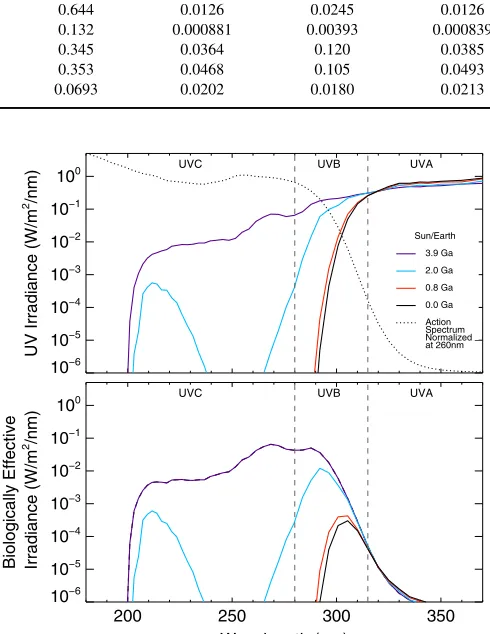
Figure 4.UVfluxes at the surface for the Earth–Sun case through time with the dashed line as the DNA Damage Action Spectrum (top). The relative biological effectiveness of UV damage is the convolution of theflux and action spectrum over wavelength(bottom).
8 From database: http://www.esrl.noaa.gov/gmd/grad/antuv/docs/version2/
the early Earth–Sun model. ThisEeffvalue is 1600 times larger than the ratio of UVfluxes at the surface for a prebiotic world orbiting an F0V host star, which highlights the importance of including the action spectrum when considering biological effects. For the anoxic atmosphere at 3.9 Ga, all stars haveEeff larger than one, the modern Earth–Sun value. We find the smallest Eeff values are about 2 times the modern Earth–Sun value in our model for the surface of a prebiotic planet orbiting GJ 581. It has 31 times less total UV ground radiation and 300 times less biologically effective radiation as the prebiotic Earth–Sun model.
At the rise of oxygen at 2.0 Ga (1% PAL O2), we see a substantial reduction in Eeff values. The surface of planets
orbiting F, G, and K grid stars still receive UV radiation corresponding to Eeff values higher than modern Earth–Sun, but planets orbiting M stars receive biologically effective irradiances near or less than modern Earth. At 0.8 Ga (10% PAL O2), we see further reduction inEeff values. For modern Earth’s atmosphere composition, the surface of planets orbiting all other host stars receive UV fluxes that correspond to Eeff values less than one. For the F stars, this is due to increased shielding from higher abundances of ozone. For the cooler K and M stars, this is due to a lower abundance of stellar UV photons incident on the atmosphere.
[image:7.612.128.486.51.310.2]In Figure 4 we show the action spectrum (normalized at 260 nm, dashed line) with the Earth–Sun UV surface fluxes Figure 5.Surface UVflux levels(W m−2nm−1)for an Earth-sized planet at four geological epochs orbiting F0V to M8V host stars. Lines have been smoothed for clarity. DNA action spectrum is shown as a dotted line.
Table 4
Top-of-atmosphere(TOA)and Surface UVAfluxes for F, G, K, and M Stars
UVAfluxes 315 to 400 nm(W m−2)
Star 3.9 Ga 2.0 Ga 0.8 Ga Modern Earth
Type TOA Surface TOA Surface TOA Surface TOA Surface
F0V 56.0 44.7 64.1 46.5 69.8 50.2 73.6 52.7
F7V 43.8 34.9 50.2 37.0 54.7 39.8 57.7 41.8
Sun 29.9 23.8 34.4 25.6 40.2 29.5 43.1 31.5
G8V 25.0 19.9 28.6 21.3 31.1 23.0 32.8 24.4
K2V 13.9 11.1 15.9 12.0 17.4 13.0 18.3 13.8
K7V 4.31 3.51 4.94 3.83 5.38 4.18 5.68 4.45
M1V 1.30 1.06 1.49 1.14 1.62 1.25 1.71 1.34
M3V 0.505 0.412 0.578 0.435 0.630 0.475 0.664 0.521
M8V 0.0331 0.0260 0.0379 0.0292 0.0412 0.0324 0.0435 0.0343
GJ 581 1.48 1.21 1.70 1.32 1.85 1.44 1.95 1.54
GJ 832 1.91 1.56 2.19 1.70 2.38 1.86 2.51 1.98
GJ 1214 0.858 0.700 0.983 0.764 1.07 0.832 1.13 0.890
Note.Allfluxes have been diurnally averaged.
[image:7.612.45.571.381.552.2]through the four geological epochs. Note the strong overlap for the pre-biotic atmosphere. Already at 2.0 Ga most of the UV
flux has been attenuated by O3 in the atmosphere, causing a sharp decrease in the Eeff values for the later epochs. The bottom panel of Figure4 shows the surface UVflux weighted by the DNA action spectrum, highlighting which wavelengths and epochs have the most damaging irradiation for molecules with similar responses as the DNA action curve.
Despite harsh UVB and UVC radiation conditions present on a planet without an ozone shield, certainly prebiotic chemistry and the origin of lifeflourished on the early Earth. Being under a layer of water or rock would mitigate the problems induced by high UV fluxes. Microbial mats scatter light such that the lower levels have only 1% of incident light at 0.5 mm depth, and subsurface community hosting layers of sandstone reduce light levels to 0.005% of incidence (Nienow & Friedmann
1993; Garcia-Pichel et al. 1994; Nienow et al.1988; Cockell
1999). As well, prebiotic organic polymers and dissolved inorganic ions may provide sufficient protection from UV degradation in as little as 2 mm of ocean water (Cleaves & Miller1998).
Figure5shows the smoothed lines for the surface UVflux for an Earth-sized planet at the four geological epochs with the action spectrum curve overlaid for all grid stars modeled.
4. DISCUSSION AND CONCLUSIONS
In this study, we investigated the exoplanet surface UV
fluxes for Earth-like planets orbiting a grid of F, G, K, and M stars at four possible biogeological epochs in the evolution of life. We use the input flux from 12 different stellar types, 9 model stars in the FGKM range with Teff = 4250 K to Teff
[image:8.612.41.578.74.244.2]=7000 K, and three M stars(GJ 581, GJ 832, and GJ 1214) with observed UVfluxes for our calculations. The atmospheres selected correspond to a pre-biotic Earth model at 3.9 Ga, a model atmosphere for the early rise of oxygen at 2.0 Ga and 0.8 Ga, and modern Earth biology. We also consider the amount of UVA, UVB, and UVC fluxes, with the latter two showing the greatest changes among stellar types and geological epochs. For a pre-biotic atmosphere, a significant portion of incident UVCflux reaches the surface. Whereas in the modern atmosphere for planets orbiting any grid star, all Table 5
Top-of-atmosphere(TOA)and Surface UVB Fluxes for F, G, K, and M Stars
UVBfluxes 280 to 315 nm(W m−2)
Star 3.9 Ga 2.0 Ga 0.8 Ga Modern Earth
Type TOA Surface TOA Surface TOA Surface TOA Surface
F0V 18.0 10.3 20.6 1.60 22.5 0.905 23.7 0.644
F7V 11.4 6.67 13.1 2.13 14.2 0.998 15.0 0.692
Sun 5.77 3.41 6.76 2.19 8.04 0.902 8.63 0.798
G8V 4.71 2.79 5.39 2.45 5.87 1.31 6.19 0.583
K2V 2.00 1.19 2.29 1.10 2.49 0.714 2.63 0.404
K7V 0.261 0.153 0.145 0.110 0.325 0.108 0.343 0.0566
M1V 0.126 0.0730 0.0844 0.0466 0.158 0.0461 0.266 0.0219
M3V 0.0737 0.0422 0.00590 0.0281 0.0920 0.0275 0.0970 0.0120
M8V 0.00516 0.00298 0.0863 0.00219 0.00643 0.00230 0.00678 0.000986
GJ 581 0.0578 0.0350 0.0721 0.0310 0.0721 0.0321 0.0760 0.0280
GJ 832 0.0754 0.0457 0.0863 0.0399 0.0941 0.0389 0.0992 0.0322
GJ 1214 0.0279 0.0169 0.0319 0.0141 0.0348 0.0143 0.0367 0.0116
[image:8.612.41.578.303.473.2]Note.Allfluxes have been diurnally averaged.
Table 6
Top-of-atmosphere(TOA)and Surface UVC Fluxes for F, G, K, and M Stars
UVCfluxes 121.6 to 280 nm(W m−2)
Star 3.9 Ga 2.0 Ga 0.8 Ga Modern Earth
Type TOA Surface TOA Surface TOA Surface TOA Surface
F0V 24.7 5.89×100 28.4 5.83×10⁻⁴ 30.9 4.08×10⁻⁸ 32.6 2.50×10⁻²⁹
F7V 7.46 2.64×100 8.57 2.00×10⁻³ 9.34 9.42×10⁻⁸ 9.86 1.63×10⁻²³
Sun 2.20 8.71×10⁻¹ 2.63 4.03×10⁻³ 3.20 9.31×10⁻⁸ 3.38 2.30×10⁻¹⁶
G8V 1.59 6.86×10⁻¹ 1.84 4.58×10⁻² 2.01 5.58×10⁻⁷ 2.12 3.96×10⁻¹⁷
K2V 0.589 2.46×10⁻¹ 0.709 3.48×10⁻² 0.773 7.79×10⁻⁶ 0.814 4.17×10⁻¹³
K7V 0.209 3.99×10⁻² 0.441 3.88×10⁻⁴ 0.480 1.39×10⁻⁵ 0.506 1.14×10⁻¹³
M1V 0.549 7.97×10⁻² 1.73 6.14×10⁻⁴ 1.88 5.79×10⁻⁵ 1.99 4.57×10⁻¹⁵
M3V 0.342 4.98×10⁻² 1.07 8.55×10⁻⁴ 1.17 1.39×10⁻⁴ 1.23 3.38×10⁻¹⁴
M8V 0.0254 4.22×10⁻³ 0.0802 1.72×10⁻⁴ 0.0874 8.49×10⁻⁵ 0.0921 4.27×10⁻¹²
GJ 581 0.0253 2.03×10⁻³ 0.110 6.25×10⁻⁵ 0.119 1.75×10⁻⁵ 0.126 6.87×10⁻⁸
GJ 832 0.0706 3.77×10⁻³ 0.360 9.99×10⁻⁵ 0.392 1.01×10⁻⁵ 0.414 6.08×10⁻⁹
GJ 1214 0.0559 4.63×10⁻³ 0.0742 1.00×10⁻⁴ 0.0808 1.00×10⁻⁶ 0.0853 1.15×10⁻¹¹
UVC photons are effectively shielded by ozone. For all epochs, the smallest percentage of total UVflux compared to incident
flux reaching the ground is for an M8V star and the highest fraction is for a K7V star due to the balance of available near-and far-UV photons near-and the amounts of ozone produced. However in terms of absoluteflux, the smallest amount reaches the surface is for an M8V host star and the largest amount for an F0V star.
To analyze the potential biological consequences of the UV surface environment for the origin and evolution of life, we convolve the UV surfacefluxes with the DNA action spectrum as a proxy for biological damage. While it is uncertain whether DNA will arise as the primary information carrier on another planet, current biosignature searches are focused on finding carbon-based chemistry. Since the action spectra for other carbon based biomolecules follow similar trends in their actions spectra, we use DNA as a proxy for biochemical effectiveness of UV radiation damage. The surface of pre-biotic worlds have significantly higher Eeff values than around the early Sun. Deinococcus radiodurans is one of the most radiation tolerant organism known, withstanding 1000x the lethal human radiation dose. UV tolerance experiments show D. radiodurans can survive 400 J m−2 of 254 nm radiation without significant loss of viability with appreciable loss of viability occurring around 500–600 J m−2(Gascón et al.1995). A layer of water or soil might be needed to shield life for hot stars. Even for a planet orbiting the least UV active star in our grid, the biologically effective irradiance on the surface of a pre-biotic world is several times the value for modern Earth. With higher ozone concentration in the atmosphere, that value decreases for planets orbiting all star types.
We model clear sky atmospheres for all planets at all epochs which on average will represent an upper limit to the UV radiation environment at the surface since clouds most frequently block up to 80% of incoming UV radiation (Grant & Heisler1997; Parisi & Downs 2004). However clouds also can focus more UV radiation to the ground depending on cloud cover and type, increasing the amount of UV radiation reaching the surface. Earth measurements of UVA and UVB radiation on cloudy versus cloud-free days show clouds can enhance UV radiation by a factor of 1.08 and 1.4 for UVA and UVB radiation, respectively (Parisi & Downs2004).
Note that higher CO2 and CH4 concentrations in the atmosphere as well as hazes could further protect the surface from UV radiation (Cnossen et al. 2007; Cockell 1999). In addition, UV photons may also positively contribute to pre-biotic reactions leading to the origin of life (Senanayake & Idriss2006; Barks et al.2010; Ritson & Sutherland2012; Patel et al.2015).
Our models provide boundary conditions for the UV environment on the surface of Earth-like planets orbiting a grid of FGKM stars from pre-biotic to modern Earth atmosphere. Our results inform photo biological assessments, pre-biotic chemistry, and early life evolution experiments.
Wefind that a pre-biotic Earth(3.9 Gyr ago)orbiting an F0V star receives 6 times the biologically effective radiation as around the early Sun and 3500 times the modern Earth-Sun levels. A pre-biotic Earth orbiting an M8V star receives around 300 times less biologically effective radiation and 2 times modern Earth-Sun levels.
For the second geological epoch with 1% PAL O2, a planet orbiting an F0V and M8V star receives 15 and 230 times less
biologically effective radiation than the Earth-Sun model at that geological epoch, respectively. For the third geological epoch with 10% PAL O2, a planet orbiting an F0V and M8V star receives 2 and 12 times less biologically effective radiation than the Earth-Sun model at that geological epoch, respec-tively. For the fourth geological epoch, corresponding to modern Earth concentrations of O2, a planet orbiting an F0V and M8V star receives 3 and 250 times less biologically effective radiation than the modern Earth-Sun, respectively. Note that for all epochs after oxygen begins to rise in the atmosphere, both the hottest stars and coolest stars have less biologically effective radiation. For the hottest stars, this is due to increased ozone shielding from higher-UV environments, and for the coolest stars this is due to less absolute UVflux.
We would like to thank Kevin France for discussions concerning the MUSCLES database and Sukrit Ranjan for discussions concerning DNA action specta. This work has made use of the MUSCLES M dwarf UV radiation field database. We would also like to acknowledge support from DFG funding ENP KA 3142/1-1 and the Simons Foundation
(290357, Kaltenegger and 290360, Sasselov).
REFERENCES
Allard, F. 2014, in Proc. Int. Astronomical Union 8(Cambridge: Cambridge Univ. Press), 271
Allard, F., Hauschildt, P. H., & Schwenke, D. 2000,ApJ,540, 1005
Barks, H. L., Buckley, R., Grieves, G. A., et al. 2010, ChemBioChem, 11, 1240
Batalha, N. M., Rowe, J. F., Bryson, S. T., et al. 2013,ApJS,204, 24
Beichman, C., Lawson, P., Lay, O., et al. 2006, Proc. SPIE,6268, 62680S
Beichman, C. A., Woolf, N. J., & Lindensmith, C. A. 1999, in The Terrestrial Planet Finder (TPF): a NASA Origins Program to search for habitable planets(Pasadena, CA: JPL Publications)
Borucki, W. J., Agol, E., Fressin, F., et al. 2013,Sci,340, 587
Borucki, W. J., Koch, D. G., Basri, G., et al. 2011,ApJ,736, 19
Cash, W. 2006,Natur,442, 51
Claire, M. W., Sheets, J., Cohen, M., et al. 2012,ApJ,757, 95
Cleaves, H. J., & Miller, S. L. 1998,PNAS,95, 7260
Cnossen, I., Sanz-Forcada, J., Favata, F., et al. 2007,JGRE,112, E02008
Cockell, C. S. 1998,Journal of Theoretical Biology, 193, 717 Cockell, C. S. 1999,Icar,141, 399
Cockell, C. S. 2000,P&SS,48, 203
Domagal-Goldman, S. D., Segura, A., Claire, M. W., Robinson, T. D., & Meadows, V. S. 2014,ApJ,792, 90
France, K., Froning, C. S., Linsky, J. L., et al. 2013,ApJ,763, 149
Garcia-Pichel, F., Mechling, M., & Castenholz, R. W. 1994, Applied and Environmental Microbiology, 60, 1500
Gascón, J., Oubiña, A., Pérez-Lezaun, A., & Urmeneta, J. 1995, Current
Microbiology, 30, 177
Grant, R. H., & Heisler, G. M. 1997, JApMe,36, 1336
Haqq-Misra, J. D., Domagal-Goldman, S. D., Kasting, P. J., & Kasting, J. F. 2008,AsBio,8, 1127
Kaltenegger, L., Fridlund, M., & Karlsson, A. 2006,Ap&SS,306, 147
Kaltenegger, L., & Sasselov, D. 2011,ApJ,736, L25
Kaltenegger, L., Sasselov, D., & Rugheimer, S. 2013,ApJ,775, L47
Kaltenegger, L., Traub, W. A., & Jucks, K. W. 2007,ApJ,658, 598
Kasting, J. F., & Ackerman, T. P. 1986,Sci,234, 1383
Kasting, J. F., Holland, H. D., & Pinto, J. P. 1985,JGR,90, 10497
Kasting, J. F., Pollack, J. B., & Crisp, D. 1984, JAtC,1, 403
Kerwin, B. A., & Remmele, R. L. 2007,Journal of Pharmaceutical Sciences,
96, 1468
Kharecha, P., Kasting, J. F., & Siefert, J. 2005, Geobiology, 3, 53 Kurucz, R. L. 1979,ApJS,40, 1
Marty, B., Zimmermann, L., Pujol, M., Burgess, R., & Philippot, P. 2013,Sci,
342, 101
Matsunaga, T., Hieda, K., & Nikaido, O. 1991, Photochemistry and
Photobiology, 54, 403
Munakata, N., Saito, M., & Hieda, K. 1991,Photochemistry and Photobiology, 54, 761
Nienow, J. A., & Friedmann, E. I. 1993, in Antarctic Microbiology, ed. E. I. Friedmann(New York: Wiley), 343
Nienow, J. A., McKay, C. P., & Friedmann, E. I. 1988, MicEc, 16, 271 Parisi, A. V., & Downs, N. 2004,Photochemical and Photobiological Sciences,
3, 643
Patel, B. H., Percivalle, C., Ritson, D. J., Duffy, C. D., & Sutherland, J. D. 2015,NatCh,7, 301
Pavlov, A. A., Brown, L. L., & Kasting, J. F. 2001,JGR,106, 23267
Pavlov, A. A., & Kasting, J. F. 2002,AsBio,2, 27
Pavlov, A. A., Kasting, J. F., Brown, L. L., Rages, K. A., & Freedman, R. 2000,JGR,105, 11981
Quintana, E. V., Barclay, T., Raymond, S. N., et al. 2014,Sci,344, 277
Ritson, D., & Sutherland, J. D. 2012,NatCh,4, 895
Rugheimer, S., Kaltenegger, L., Segura, A., Linsky, J. L., & Mohanty, S. 2015, ApJ, in press
Rugheimer, S., Kaltenegger, L., Zsom, A., Segura, A., & Sasselov, D. 2013,
AsBio,13, 251
Sato, S., Cuntz, M., Guerra Olvera, C. M., Jack, D., & Schröder, K.-P. 2014,
IJAsB,13, 244
Seager, S., & Bains, W. 2015, Science Advances, 1, e1500047 Segura, A., Kasting, J. F., Meadows, V., et al. 2005,AsBio,5, 706
Segura, A., Krelove, K., Kasting, J. F., et al. 2003,AsBio,3, 689
Segura, A., Meadows, V. S., Kasting, J. F., Crisp, D., & Cohen, M. 2007, A&A,472, 665
Segura, A., Walkowicz, L. M., Meadows, V., Kasting, J., & Hawley, S. 2010,
AsBio,10, 751
Senanayake, S. D., & Idriss, H. 2006,PNAS,103, 1194
Setlow, R. B. 1974,PNAS,71, 3363
Som, S., Catling, D. C., Harnmeijer, J., Polivka, P., & Buick, R. 2012,Natur,
484, 359
Tevini, M.(ed.)1993, in UV-B Radiation and Ozone Depletion: Effects on Humans, Animals, Plants, Microorganisms, and Materials (Boca Raton, Florida: Lewis Publishers)
Toon, O. B., McKay, C. P., Ackerman, T. P., & Santhanam, K. 1989,JGR,94, 16287
Traub, W. A., Levine, M., Shaklan, S., et al. 2006, Proc. SPIE, 6268, 62680T
Udry, S., Bonfils, X., Delfosse, X., et al. 2007,A&A,469, L43
Voet, D., Gratzer, W., Cox, R., & Doty, P. 1963,Biopolymers, 1, 193 Wehner, J., & Horneck, G. 1995,Journal of Photochemistry and Photobiology
B: Biology, 28, 77