Abstract— In this work, the effect of number of interacting (influential) agents, as an add-on parameter to the population size, market temperature and time lag, on price-change in stock market was investigated using agent-based spin-1 Ising model and Monte Carlo simulation. The average decision (to perform trading activity), was used to extract excess demand/supply for determination of the asset’s market price. From the results, though population size is not significant, other parameters have significant effects on the average trading decision resulting in different characteristic of market price value and fluctuation. Specifically, the high- and low-temperature phases of the average trading decision is evident, where the transition point shifts to higher market temperature with increasing number of interacting agents. This is due to having more consensuses requires more market stimulation to lessen the investing agreement bound by trustworthiness. For the price-return distribution, higher market temperature, more number of interest agents, and longer time lag, were found to broaden the distribution. This is as more market liquidity and less influence from other investors help alleviating the price stiffness and allow more price fluctuation. Consequently, the distribution can be ranged to farther regimes. However, for the time lag, as the correlation usually decays at longer time, the consecutive prices used in price-return calculation then become less dependent as expected. With this greater level of randomness, it then shapes the distribution to become more uniform (broaden out). As seen, apart from the usual investigating parameters, the number of interacting agents also prove its importance as significant add-on parameters when modeling the behavior of price changes in stock market, emphasizing that herding effect should be taken with profound consideration.
Index Terms— Econophysics; Monte Carlo Simulation; Price-return Distribution; Spin-1 Ising model; Stock-price; Stock market
I. INTRODUCTION
HE stock market is financial market for investors to trade/exchange their ownership (stock) in companies
Manuscript received March 20, 2018; revised April 18, 2018.
Y. Laosiritaworn is with the Department of Physics and Materials Science, Faculty of Science, Chiang Mai University, Chiang Mai, Thailand and Thailand Center of Excellence in Physics (ThEP Center), CHE,
Bangkok 10400, Thailand (e-mail address:
A.P. Jaroenjittichai is with the Department of Physics and Materials Science, Faculty of Science, Chiang Mai University, Chiang Mai, Thailand and Thailand Center of Excellence in Physics (ThEP Center), CHE, Bangkok 10400, Thailand (e-mail address: [email protected]).
W.S. Laosiritaworn is with the Department of Industrial Engineering, Faculty of Engineering, Chiang Mai University, Chiang Mai, Thailand (e-mail address: [email protected]).
and make profits (or losses) from their trading/exchanging [1]. It is therefore a ‘place’ where a large number of investors interact among themselves as well as external sources of information (news that have influences on trading decision) to determine the market price of a given stock [1]−[2]. Since the stock-price changes according to demand and supply, the excess demand or excess supply then result the growth or suppression of the stock-price and associated price-return [3]. Generally, the excess demand/supply is caused by un-matched decision of each individual investor’s in trading the stock. In addition, as one’s trading decision can be interfered by the others, the stock-price does not only depend on the companies’ performance but also collective obsessional behavior arisen from interaction among investors [2], e.g. panic sell or panic buy. Therefore, how one agent interacts with other is one of the key factor to understand the price dynamics of an asset in stock market. Recently, one aspect that can be used to investigate the investors’ behavior in stock market is the econophysics, where the dependence of stock-price and market situation, such as market temperature and companies’ turnover, were suggested [4].
Econophysics in a branch of sociophysics, which syndicates the knowledge in economics with mathematical tools in physics to pursue for fundamental understanding about market dynamics, investor behaviors, and wealth distribution in the community [4]−[5]. There were many recent studies proposed on the stock-price using econophysics techniques to investigate the stock-price dynamics either directly, such as continuous-time random walk [6], Monte Carlo technique and Fokker-Planck equation [7], or indirectly via the distribution of the price-return (e.g. consider [8]−[9] for reviews). However, most previous works did not emphasize the collective effect of interacting investors on one in the way how many of other investors should have influences on one’s decision. Some pervious works imitated square lattice type model where number of interacting investors is locally fixed depending on how many neighboring are considered [10]−[11], and some considered all other investors in the population [12]. However, with the rise of social network, one can interact with many via wireless channels and internet. The number of interacting agents should then be a free parameter to be tuned for modeling a stock market. In addition, with help of borderless internet communication, the interaction range among investors should not be limited the agents’ real-space addresses. Therefore, this work aims to honor this current
Gathering Effect of Interacting Agents on Stock
Market Price: Econophysic Modeling via
Agent-based Monte Carlo Simulation
Yongyut Laosiritaworn, Atchara Punya Jaroenjittichai, and Wimalin Sukthomya Laosiritaworn
investor-investor relationship in modeling stock-price and its price-return distribution with concurrent varying the population size (system size), the market temperature, and number of interacting agents using Monte Carlo simulation and agent-based spin-1 Ising model in econophysics.
II. THEORY AND METHODOLOGY A. Spin-1 Ising Hamiltonian and Econophysic
In this work, the model considered is of an agent-based type, where member or the investing agent of the system is considered individually. Since each investor can perform 3 different kinds of trading action, i.e. sell, hold, and buy, on a stock, an equivalent spin model derived from statistical physics was chosen for implementation. Specifically, the spin-1 Ising model was employed as it contains 3 possible discrete states, i.e. −1, 0, and 1. These 3 different states can be applied to economics by referencing to decision states of an individual investor to perform in stock market. Specifically, “−1” is for decision to “sell or bid”, “0” is for decision to hold, and “+1” is for decision to “buy or ask” the stock. Then, the average of the all spin states (called magnetization in Physics) or the net decision to perform trading action, can be related to average decision to sell, to hold, or to sell the stock that each individual holds. For instance, if the magnetization is negative, the investor may want to sell his stock and the price of the stock may drop. However, if the magnetization is positive, the investor may want to buy and the price may increase. Nevertheless, for zero magnetization, the current price is hold due to demand-supply agreement.
In nature, all systems tend to minimize their energies for equilibration. To employ this in economics, the state of investors’ decision on preforming trading actions can be investigated by adopting the Ising energy (or Ising Hamiltonian H), e.g. see Ref. [5],[13]. This Hamiltonian could be assigned as the level of ‘disagreement’ [10]−[11], where it needs to be minimized unless the market may fail to form due to the failure to meet between demand and supply.
However, as the spin-1 was considered, where the option of holding is also allowed, we then designed the Hamiltonian to take the form
,
i j i
i j i
H = −J
−h
, (1)where Kronecker delta function is responsible for herding (interacting) behavior among agents with multi-state decision. As is seen, the Hamiltonian H in (1) is the sum of 2 terms. The first term ( ,
i j
i j nn
J
−
) is due to the interactions among spins (investors) with a strength J. Here, the spin i = {−1,0,+1} is the spin-1 Ising with states −1, 0,and +1 referring to decision to sell, to hold, and to buy the considered asset, respectively. Also, in (1), the Kronecker delta function is 1 for i = j and 0 otherwise. With this
Kronecker delta function, the spins (agents, investors) will trade under the influence of other interacting spins in minimizing the Hamiltonian H. The notation “<i,j>” implies that the sum considers only interaction from pairs of investors that have strong enough relationship/interaction.
This is the same in real stock market as the influence on making trading decision of an investor usually comes from individuals that have strong investing influences on that investor. Note that, due to the internet and social media, the influential people or the interacting agents do not need so be spatially closed, and they (the influential people and the investor himself) do not have to be friends in real life. This is the case for influential people who are investment experts, where the relationship is one-way like. Specifically, agent j
may have some influences on agent i but not in the opposite direction. Note that when all spins are in the same state (−1, 0, or 1), H is minimized (most negative as J is positive) which is the case for ground state in nature. In economics, this state can be referred to extreme conditions where system is truly guided by herding consensus. This can be represented by depression state in economics where no one performs any trading actions. Particularly, all investors may stay doing nothing, so the price maintains (for 0 state), or the set price may insanely go up (for +1 state) and drops down (for −1 state) as no supply or demand to match, respectively.
However, for the second term ( i
i
h
−
) in (1), it refers to the external influence, which could come from the company’s financial situation, market trends, economic cycle, etc. The positive h refers to the period of economic prosperity, where people have purchasing power leading to decision to buy. Meanwhile, the negative h is for economic recession, where the purchasing power declines and induces the excess supply. Note that the sign of i is to follow thesign of h to minimize H.
The observables to (1) can be defined from the average magnetization per spin (the average decision in perform trading per investor), i.e. [10],
( )
( )
( )
max
1 1
; i
i t
m m t m t t
t N
=
=
(2)and the magnetization variance (the fluctuation level of the investors’ decision), i.e.
2
2 2
m m m
= − (3)
In (2) and (3), N is the total number of investors in the system, tmax is the total number of measurements, and
(for m→ 0) or dramatically changes (for m→ +1 or m→
−1). In details, at low temperatures, the set price of a stock is determined by the value of h. If the considered company has profitable sales (h > 0), its stock may have the associate set price to go up. However, if the company is with some loss (h < 0), the set price may be plunged. Typically, when h
→ {0−,0+}, which is the case that the company has just come
to its turning point, it usually takes time for the set price to change (stock-price maintained) at low market temperatures since there is less demand and supply in matching. This economical recovering period could be shortened by the increasing the magnitude of the influence field.
Nonetheless, at high temperatures or when liquidity comes in, there occur more frequent trading activities that demand and supply meet. Therefore, with influence field being introduced, the set price will change to match with the direction of the influence field. Nevertheless, the change occurs in a more continuous fashion compared to that of the extreme state, as there is real trading and real money associated. In this work, since there is a symmetrical behavior for negative and positive h (as i needs to follow
the direction of h) in (1), only the case h > 0 was considered as its behavior would be the same as that for h < 0 (but just opposite implication). The case h = 0 was dropped here, as this study aims to investigate the economic situations when both interaction among agents comes into the play with the external influential field.
B. Stock-price and Magnetization Relationship
In a stock market, there generally consists of 2 types of the investors, i.e. fundamental and interacting investor. The fundamental investor knows reasonable price pfund(t) of the
stock. They tend to buy the stock when the current price p(t) is less than pfund(t), and sell otherwise. The amount of orders
issued by a fundamentalist depends on the differences between the current and fundamental prices as
( )
(
( )
( )
)
fund fund fund ln fund ln
x t =a N p t − p t , (4)
where xfund is the amount of the fundamental orders, Nfund is
the number of fundamental investors, and afund is a constant.
Apart from fundamental orders, the interacting orders are also important to determine the market price. The interacting orders are supplied by interacting investors, where their excess demand/supply can be estimated from [11],[14]
( )
( )
inter inter inter
x t =a N m t , (5)
In (5), xinter is the amount of the interacting orders, Ninter is
the number of interacting investors, and ainter is another
constant. In general, the market price can be determined from the demand and supply being in balance, i.e.
( )
( )
0fund inter
x t +x t = or
( )
( )
( )
( )
( )
( )lnp t =lnpfund t +km t ; p t =pfund t ekm t , (6) where inter inter 0
fund fund
a N
k
a N
= . Considering the price equation in (6), the market can be categorized in several situations. For instance, for m(t) = 0, the market price p(t) stay at the fundamental price pfund(t). However, for m(t) > 0, there are
excess demand which pushes p(t) to surpass the pfund(t),
whereas for m(t) < 0, the price p(t) drops below the pfund(t).
In addition, it is also of interest to investigate the characteristic of the proposed model via the price-return
( )
lnp t( )
lnp t(
)
( )
(
)
r t m t m t
k
− −
= − − , (7)
where is the time lag, and the fundamental price is assumed unchanged during the course of stock-price variation, i.e. pfund(t) = pfund(0). Then, by performing
histogram analysis between the price-return r and its count
N (r), the relationship in the form [8]
( )
bN r =a r , (8)
is usually found. In (8), a is a constant and b = −(1+) is the exponent to the scaling, which specifies the characteristic of an individual stock market or model [8].
C. Monte Carlo simulation
In the simulation, the population of the considered system was arrayed in computer memory as two-dimensional array of sizes N = LL, where each element of the array contains a single investor (Ising spin). The investor-investor interaction strength J was set a unit parameter, i.e. J = 1. Each investor had I other interacting investors for constructing interaction pairs <ij> in (1), and these I investors were chosen at random. The varying parameters were the market temperature T (ranging from 0.1 to 15.0 J), the system size L (ranging from 10 to 50), and number of interacting agents I or number of other investors who have influence on the current considered investor (ranging from 2 to 10). As mentioned, the economic-field strength h was fixed at 1.00 J. For each simulation, the investors/spins’
decisions to perform trading action were randomly initialized, i.e. −1 (for to sell), 0 (for to hold), and +1 (for to buy). Then, the investors could interact among themselves and their decisions got updated via the heat bath probability
(
)
(
exp)
/ 2(
)
exp / 2 exp / 2
H T
P
H T H T
− =
+ − , (9)
where H is the Hamiltonian difference due to the update. Note that, as seen in (9), the market temperature T was set to have the same unit of Hamiltonian by absorbing relevant constant parameter into itself. The unit time step used in the simulation was defined from one full trial update (either successful or unsuccessful) of all N investors in the system, i.e. 1 Monte Carlo step (mcs). In performing the Monte Carlo update, the procedure can be detailed as follows. Firstly, a random investor is picked, and a new random trading state is assigned to that investor. Then, the H due to this update is calculated using (1) as well as the probability in (9). After that, a uniform random number r in the range 0 to 1, is drawn from random number generator and compared with the probability P. If r is less than or equal to P, the new state is accepted, unless the state turns back to original state. Then, another new investor is chosen for repeating this trial update. With these trials taken up to N
m(t) was collected, where its expectation average m and the associated variance 2
m
were extracted using (2) and (3) at the end of the simulation After that, the price function was calculated from (6), and the price-return distribution was constructed from (7) and (8) for the time-lag ranging from 1 to 100 mcs. Then, the exponent to the scaling, in (8), was extracted for each considered condition. This whole Monte Carlo procedure was repeated for each {L,I,T} set.
III. RESULT AND DISCUSSION
In this work, the average decision in performing trading action (to sell, to hold, and to buy) per agent m(t) was investigated as a function of time t using (2). With the initial decision of all agent setting at random, i.e. m(0) → 0, and the time step of 1 mcs, the simulation was carried out in updating the decision configurations, where the m(t) and
p(t) were recorded. Then, at the end of the simulation, the variance of the magnetization m2 was also calculated to
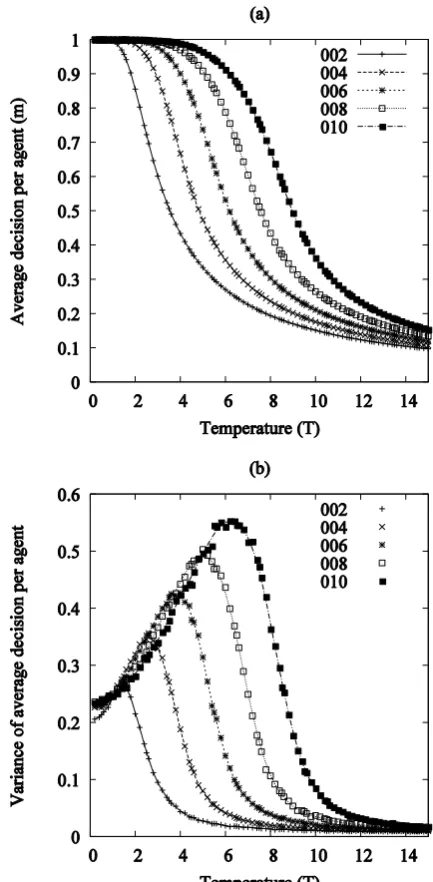
retrieve the fluctuation level in agents’ decision. Example of the results, for magnetization average or the average decision per agent and variance of net-decision per agent as function of temperature with varying number of interacting agents can be found in Fig. 1. Note that, in this investigation, the system size L in the considered range was not found to yield significant effect on the results (not shown), so only results for L = 30 were presented.
As seen in Fig. 1, both number of interacting agents I and temperature T have significant on the <m> and m2. For
instance, with increasing the market temperature T, <m> drops (see Fig. 1a) but the variance results in peak (see Fig. 1b). This is expected as when the market is with high liquidity (as T can be referred to average wealth per agent [15]), the investors then trade somewhat more frequent so the excess demand (supply) decrease. As is seen, there appears low- and high-temperature for the average decision <m>, which can be separated by defining a transition point, similar to the Curie point in ferromagnetic materials. This transition can be found from the market temperature that the greatest slope of <m> presents or where 2
m
results in peak. Note that, the variation is greatest at the transition point due to interaction among members of the system is about to get compromised (on the average) with the temperature influences. Therefore, switch between binding and unbinding states occurs all the time which cause even a small fluctuation to develop to large fluctuation, corresponding to the divergence of correlation length in phase transition and critical phenomena topic. Note that the transition points obtained Fig. 1b are from curve smoothing as there appears to be somewhat large fluctuation between adjacent data, and this could be the cause that the transition points obtained from both subfigures in Fig. 1 are slightly different. To improve the quality of the data, more runs and longer simulations may be needed. However, the fine extraction of the transition point lies beyond the scope of this work, which will be investigated in the future.
Apart from the average decision results, it is also of interest to investigate the price-return distribution of the conditions considered to realize how wealth distributes in
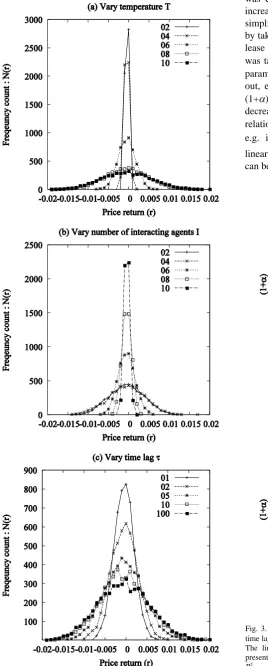
the system. As is seen in Fig. 2, market temperature, number of interacting agents and time lag all have significant effect on the price-return distribution broadness. Specifically, the distribution peaks become broader with increasing the market temperature, reducing the number of interest agents, and widening the lagging time frame. To explain point by point, the enhancement in market temperature brings more market liquidity, which allows greater oscillation to price change giving rise to more count at high return magnitudes. On the other hand, the increase of interacting agents brings more strength in bonding the considered investor to other investor, giving him less freedom in making his own trading decision. Consequently, the price becomes less in variation with more influential people considered, and hence the price-return distribution becomes less broad. Finally, with enlarging the lagging time frame, it is typical that the correlation between pair of data decays at longer time, so they become less dependent. As a result, it allows more spreading out of the price differences so the price-return distribution to become broaden out (more uniform).
[image:4.595.312.529.304.746.2]Since the two sides of the price-return distribution is symmetrical (e.g. see Fig. 2), the power law scaling in (8)
was considered as a function of the return magnitude to increase number of data points in regression analysis. For simplicity, the data was transformed into more linear scale by taking logarithmic operation on both sides of the (8), and lease square linear fit (with library provided in Ref. [16]) was taken on log(N) and log(r). Results of the fit, i.e. the parameters a and b = −(1+), were extracted and plotted out, e.g. see Fig. 3. As suggested in Fig. 3, the exponent (1+) reduces with increasing , increasing T, and decreasing I. In addition, there could be some non-linear relationship between the time lag and the exponent (1+), e.g. in the form
(
1+)
=ab. Therefore, least square linear fit was performed, where the coefficients to the fits can be found in TABLE I.As being evident in TABLE I, due to the poor R2, instead
[image:5.595.59.328.58.726.2]of quantitative discussion, it is more appropriate to discuss the relationships among parameters qualitatively. To improve the quality of these statistical results, more lengthy
Fig. 2. Histograms presenting the price-return distribution with (a) varying T at fixed I = 10 and = 100, (b) varying I at fixed T = 4 and = 100, and (c) varying at fixed T = 10 and I = 10.
Fig. 3. The exponent to the price-return distribution (1+) as a function of time lag with (a) varying T at fixed I = 10 and (b) varying I at fixed T = 6. The linear lines are from the lease square linear fits (with coefficients presented in TABLE I), and should be used only for visual aids due to poor
[image:5.595.318.551.238.680.2]simulation as well as finite size scaling to extend to work to very large or national scale may be considered [17]. However, on the average, it is found that the scaling exponents (1+) tend to decrease with increasing T, reducing I, and enhancing. This agrees with price-return characteristics suggested in Fig. 2. Therefore, according to the results reported, it can be suggested that to make more profit/loss or get involved in the “high risk high return” (to allow one with greater |r|), one should depend less on the other, trade less frequent, and avoid trading in economic recession period. Nevertheless, if one prefers the less overwhelmed style, i.e. small loss and small gain, one should avoid the above-mentioned situations.
IV. CONCLUSION
In this work, the collective effect of other influential investor on one’s trading decision was investigated. The excess demand/supply from trading mismatch and its associated price dynamics were modeled using spin-1 Ising model and Monte Carlo simulation. Both interaction with other investors and the external influenced field were considered, where the stock-price variation as a function of time, system size (of population), number of interacting agent, and market temperature, was measured. The low- and high-phase of trading decision was evident, where the phase
transition points move to higher market temperature with increasing number of interacting agents. The price-return distribution results agree well with this enhanced transition point as the distribution broadness enhances with increasing market temperature but reducing number of interacting agents. The enhancement of distribution broadness was also evident with increasing time lag, yielding qualitative agreement with real stock making, which confirms the validity of this work. The distribution characteristic also suggests transformation possibilities from “high risk high return” type investor to “low risk low return” type investor by trading more frequent, concentrate during economic recession, and listen to more people in shaving one own decision in trading. As seen, this work highlights significance of herding interaction, as an add-on to the usual investigated parameters, which may lie another fruitful step in model the stock-price variation across various economic situations.
REFERENCES
[1] R. Levine and S. Zervos, “Stock markets, banks, and eonomic growth,” Am. Econ. Rev., vol. 88, pp. 537−558, 1998.
[2] Y. Yu, W. Duan, and Q. Cao, “The impact of social and conventional media on firm equity value: A sentiment analysis approach,” Decis. Support. Syst., vol. 55, pp. 919−926, 2013.
[3] H. Schaller and S. Van Norden, “Regime switching in stock market returns,” Appl. Finan. Econ., vol. 7, pp. 177−191, 2010.
[4] R. N. Mantegna and H. E. Stanley, An Introduction to Econophysics:
Correlations and Complexity in Finance. Cambridge: Cambridge
University press, 2000.
[5] J. Voit, The Statistical Mechanics of Financial Markets, 3rd ed. Berlin: Springer, 2005.
[6] M. Raberto, E. Scalas, and F. Mainardi, “Waiting-times and returns in high-frequency financial data: an empirical study,” Physica A, vol 314, pp. 749−755, 2002.
[7] T. D. Frank, “Exact solutions and Monte Carlo simulations of self-consistent langevin equations: A case study for the collective dynamics of stock-prices,” Int. J. Mod. Phys. B, vol. 2, pp. 1099−1112, 2007.
[8] A. Chakraborti, I. M. Toke, M. Patriarca, and F. Abergel, “Econophysics review: I. Empirical facts,” Quant. Financ., vol. 11, pp. 991−1012, 2011.
[9] A. Chakraborti, I. M. Toke, M. Patriarca, and F. Abergel, “Econophysics review: II. Agent-based models,” Quant. Financ., vol. 11, pp. 1013−1041, 2011.
[10] A. P. Jaroenjittichai and Y. Laosiritaworn, “Effect of external economic-field cycle and market temperature on stock-price hysteresis: Monte Carlo simulation on the Ising spin model,” J. Phys. Conf. Ser., vol. 901, pp. 012170-1−012170-4, 2017.
[11] Y. Laosiritaworn, C. Supatutkul, and S. Pramchu, “Computational econophysics simulation of stock price variation influenced by sinusoidal-like economic cycle,” Lect. Notes Eng. Comput. Sc., vol. 2225, pp. 165−169, 2016.
[12] A. Thongon, S. Sriboonchitta, and Y. Laosiritaworn, “Affect of markets temperature on stock-price: Monte Carlo simulation on spin model,” AISC, vol. 251, pp. 445−453, 2014.
[13] A. Krawiecki, J. A. Hołyst, and D. Helbing, “Volatility clustering and scaling for financial time series due to attractor bubbling,” Phys. Rev. Lett., vol. 89, pp. 158701-1−158701-4, 2002.
[14] T. Kaizoji, S. Bornholdt, and Y. Fujiwara, “Dynamics of price and trading volume in a spin model of stock markets with heterogeneous agents,” Physica A, vol. 316, pp. 441−452, 2002.
[15] V.M. Yakovenko and J. B. Rosser, “Colloquium: Statistical mechanics of money, wealth, and income,” Rev. Mod. Phys., Vol. 81, pp. 1703−1725, 2009.
[16] W.H. Press, B.P. Flannery, S.A. Teukolsky and W.T. Vetterling,
Numerical Recipes in C. Cambridge: Cambridge University Press,
1988.
[17] D. P. Landau and K. Binder, A Guide to Monte Carlo Simulation in
Statistical Physics. Cambridge: Cambridge University Press, 2015.
TABLEI
RESULTS OF THE POWER LAW FITTING TAKEN ON(1 ) b
a
+ = FOR VARIOUS INTERACTING AGENTS I AND MARKET TEMPERATURE T.
#Interacting agents I
Temperature
T a b R
2
2
2 1.231284 -0.060797 0.342887 4 0.971361 -0.043204 0.234128 6 0.847147 -0.005278 0.004865 8 0.864739 -0.012002 0.028749 10 0.898136 -0.004246 0.002966 12 0.962452 -0.027796 0.148492 14 0.891737 -0.009079 0.011048
4
2 1.782212 -0.036909 0.220097 4 1.130337 -0.087444 0.549237 6 0.983840 -0.061120 0.392694 8 0.965836 -0.041116 0.306585 10 0.972020 -0.045839 0.340783 12 0.918773 -0.026921 0.154957 14 0.981026 -0.031339 0.157888
6
2 1.768609 -0.011118 0.007424 4 1.356009 -0.048950 0.298597 6 1.055984 -0.080956 0.452052 8 1.009687 -0.067896 0.459004 10 0.946035 -0.037945 0.161221 12 0.971569 -0.048496 0.295376 14 0.878648 -0.022567 0.080288
8
2 1.897941 0.0322610 0.013922 4 1.673193 -0.086526 0.497307 6 1.226271 -0.085891 0.637506 8 0.955498 -0.065062 0.440811 10 0.909611 -0.054120 0.259940 12 0.935323 -0.037514 0.230689 14 0.882644 -0.029338 0.131774
10