Abstract—Femtocell is considered as a coverage extension for both outdoors and indoor coverage where poor coverage of the Macrocell Base Station does not exist. The main purpose is to position FBSs in the mobile network such that the quality performance of service is achieved for the customers of Femto users, particularly at the indoor environment. The network traffic is highly demanded by the customers, without interruption/interference. The distance between the centralised base stations has been a challenge for the mobile provider, and this must be solved. The network performance is improved because FBS is closer to the users of the systems. The algorithm determines the placing of FBSs in the mobile network, where the intensity of data traffic has improved without interfering. In this paper, we propose a positioning algorithm as a strategy for the deployment of femtocells network for quality service scenario for an indoor environment and for an optimal cellular network. The simulation results prove that the positioning algorithm satisfied the performance of service and allowed an optimal cellular network.
Index Terms—Cellular Network, Femtocell Base Station (FEBS), Positioning Algorithm (PA), Quality of Service (QS), Optimal Network (ON)
I. INTRODUCTION
HE advances in technologies have supported multi-tiered structure for the next generation cellular network such as high (Macrocell) and low (Femtocell) layer structure. These provide a broad range of coverage that served the network users at both indoor and outdoor environments. Due to the maximum capacity of Macrocell when loaded in a highly populated area, it becomes inefficient to serve the indoor environment users.
Femtocells are considered to be a promising technology for coverage extension to the indoor environment when Macrocell coverage is insufficient. The connection of Femtocell over the mobile network is through the use of resident Digital Subscriber Line (DSL), broadband connection or optical fiber [1] [2]. The closeness of Femto Base Station in an indoor environment between the users,
Manuscript received March 12, 2017; revised April 04, 2017. This work was supported in part by the University of Johannesburg.
O. A. Akinlabi is with the Department of Electrical and Electronic Engineering Science, University of Johannesburg, South Africa. (Phone: +27-717157260; e-mail: [email protected]).
Prof. Meera K. Joseph is an Associate Professor at the Department of Electrical and Electronic Engineering Technology, University of Johannesburg, Johannesburg, South Africa. (E-mail: [email protected]).
[image:1.595.312.547.226.316.2]allows a network sustainability and increases the data rate. In figure 1 we illustrate the Internet connection of femtocell via mobile network. The link is through the Internet of the service provider.
Figure 1. Femtocell via mobile network connection [3] The cooperative positioning approach will have allowed the increase in quality performance and the signal strength for the femtocell users in the cellular network. The operation of the positioning algorithm will rely on the distance of the femtocell access point (FAP) and other factors.
The integration of Femtocells into the cellular network has improved the quality operation of network service such that the effects were an excellent voice call, multimedia and data usage, and as well as additional service to the indoor user [4-8].
The study by ABI indicates that voice calls will increase in the nearest future while data usage will indicate from indoor environment i.e. (50% to 80%) [9]. Femtocells are a home base station, mounted by end users, and it is linked to the mobile operator’s core via the Internet [10], [11]. Therefore, the rate charges are reasonable for deployments, which can be used as a standard for home applications.
The overwhelming merits of femtocells Base Station is that the maintenance culture and the functioning cost of the operator are reduced. These will offer an excellent quality of service for the consumer and a good network throughput. This smaller localised base station provides very stable and efficient Internet connections.
The rest of the paper is structured as follows. In section II we present the objectives and motivation. In section III we present related literature. In Section IV we describe the problem statement. While in section V we explained the deployment of the positioning algorithm. In section VI we present the network model. In section VII we evaluate the network performance. In Section VIII the conclusion is presented.
Positioning Algorithm for Deployment of
Femtocell Network in Mobile Network
O.A. Akinlabi,
Member, IAENG
and Meera K. Joseph
II. OBJECTIVE AND MOTIVATION
The goal of the service provider is to meet the request of the mobile data used by the users of the network, especially in the indoor environment. The mobile providers gain an advantage over femtocell service such that it serves as a coverage expansion and profit, and time wasting. Mostly, the mobile data are highly demanding in an indoor setting according to [9], while more than 80% of the mobile data use is in an indoor environment.
The main objective of this work is to optimise the deployment of the femtocell in cellular networks using utility function. Other sub-objective are listed below:
1. To discuss the economic impact of femtocells. 2. To explore similar works on resource allocation. 3.To optimize both regions of deployment of femtocell. 4.To ensure fairness of transmission using the positioning algorithm. We use simulation using MATLAB to obtain the fairness.
III. RELATED WORK: LITERATURE REVIEW
Many works focus on Wireless Network, especially in the area of planning the node as an entering point of the Base Station using the algorithm. The author in [12] presents an optimal arrangement of a small cell into cellular coverage. The author uses the configuration of the base station for optimising the network, and this reduces interference of the small cell. However, other problems of sub-optimal are solved through linear programming.
The use of an antenna for placing the small cell was proposed by the author in [13], this comprises configuration and location of network coverage infrastructure. In this work, it takes into account algorithm for the planning of the wireless network. The existing algorithm was improved by the author: PAM and M-PAM, and proposed Clustering with Weighted Node-Partitioning Around Medoids (CWNPAM). In [13], the author investigates the placement of Base Station in Wireless Sensor Networks that proposed dynamic method of repositioning during the operation. Another work centred on successive interference cancellation to improve network performance and quality of service for the end users of the wireless network. The positioning a small cell (Base Station) in a proper place in the mobile network allowed an improved connectivity and increased signal strength without an interception.
In this paper, we propose a positioning algorithm as a strategy for the deployment of femtocells network in service capacity scenario for an indoor environment and evaluate the distance of femto deployment to the
centre base station of
the cellular network. In our work, we consider that the operator deployed femtocells in four centralised base station. In [17] we used cost function for optimal deployment of femtocells.
IV. PROBLEM STATEMENT
With the development of wireless technologies, it requires a universal location service by the mobile network to explore and utilise the infrastructure of wireless technologies by positioning the nodes of FBSs, where it offers an excellent traffic distribution within the cellular network without interference. The problem statement is how FAP can be positioned in a mobile network to achieve quality service performance and optimal system without interference within the FBSs users.
The mobile coverage is divided into two regions (Inner and outer region), and each of the regions is considered as an independent service FBSs that transmits to the base station at the centre of the cellular coverage and in [18] the way resource allocation is made is presented. It assumed that the FBSs are located within the regions of the network. We also assumed that the number of FBSs remains the same in both regions to achieve quality and system improvement.
Here, the topology for simulation was generated using a different approach and authors’ approach as used in [14][17] guided this research for the optimal deployment of femtocells. The cellular network is modelled based on IEEE 802.16e standard [15]. Concerning FAP, our target is to position it without hazard (i.e. causing interference in the cellular network), in which a smooth communication will be established. The estimated position for FAP is to perform for connection to the base station at the coverage area.
V. DEPLOYMENT OF ALGORITHM
Our proposed algorithm consists the following: how to decide the minimum transmitting power to achieve threshold, positioning FBS and placement of femtocell in the cellular network.
A.
Cellular Division in Cellular Regions
In this first stage, we consider the transmitting power to obtain the threshold signal at a minimum over the mobile network and set the signal strength.
B. Positioning Algorithm
The algorithm was proposed for the deployment of femtocell system for mobile coverage to allow high traffic data rate and signal connectivity for femto users that ensure the quality of service and performance. The primary goal is to satisfy the best threshold of the network where femtocell is being placed and reduce interruption among femto user.
C. Placement of Femto Base Station
The formulated algorithm for the stated problem of positioning deployment of the femtocell in the cellular network to achieve an improved system for the Femto users. The algorithm considers coverage area. However, since FBS are randomly located, the estimation of distance will be updated in every position.
VI. NETWORK MODEL
outer region. The primary focus is positioning the Femto Base Station (FBS) within the cellular coverage that brings about an improved coverage in the indoor environment.
Based on our aim, we take into account the signal strength of the mobile coverage for both region, which is primarily for quality performance for network coverage.
Here, we present the system notation and a parameter for experimental results. Our main objective is to achieve the signal for the quality of service in the indoor environment. The estimation of SINR [16] is highly relevant, which is expressed as (1):
f
b
p
sinr=
P
N
(1)Where Pf is denoted as the received power from the femto users, Pb is the received interfering power from the neighbouring Femto users, and N is the noise.
The Shannon capacity [16] is considered to allow free error transmission over a transmitter. Therefore, the Shannon channel capacity equation is used to determine the performance rate of transmission of Femto Base Station in the cellular network. Mathematically, the Shannon channel capacity is expressed as (2)
wlog(1+sinr)
(2)The w represent the bandwidth,
log
is denote as logarithm and sinr is the signal to noise plus interference ratio. The received power of the Femto user is expressed as follow;f b
P
(P
N) sinr
(3)min
P
1
(4)L
d=
2
1 w
(5)
The idea here is to achieve a placement and signal strength for femto users, where the random movement causes the degradation of throughput. An optimal placement of deployment of Femtocell in mobile network ascertains maximum capacity with the minimum number of Femto and minimum power consumption at Users Equipment. The positioning of femtocell follows the algorithm below;
Algorithm: Positioning of Femto users’ in the
cellular network
The flow of Algorithm:
Inner region = find the best position
Outer region = find the best location for network coverage without interruption
Input 1: min threshold signal
Input 2: Width, distance and transmitting power Step1 = obtain a min threshold signal for FAP using (1) and (2)
Step2 = calculate the transmitting power of the first femto (3)
Step3 = adjust the transmitting power and decide Pmin by using (4)
Output = Position femto at the optimal placed. VII. PERFORMANCE EVALUATION
In this section, the network evaluation performance is deployed with the proposed algorithm by computer simulations using MATLAB. Here we consider a multiple base station at the centre of the cellular network with FBSs deployed in the both regions. In table 1 below we illustrate the system parameters.
TABLEI
NETWORK SIMULATION PARAMETERS
Nos Network Parameters Values 1 Distance Scenario 350x350
2 Base Station at the Center
1 Macro cell (One)
3 FBSs for both regions
40
4 Increase number of FBSs
100
5 Bandwidth 5MHz
6 Noise -173dBm/Hz
[image:3.595.312.542.271.380.2]
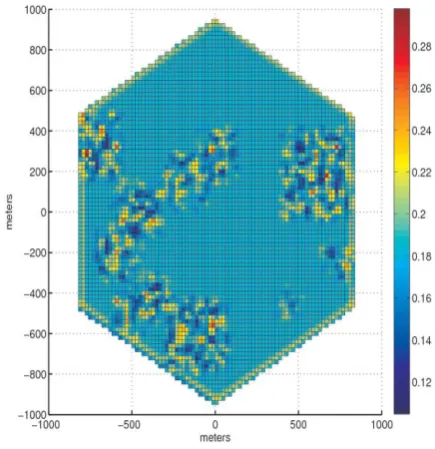
In figure 2 we illustrate the intensity of traffic of FAP in the cellular network. These are characterised by the network topology of FBSs movements within the cellular networks.
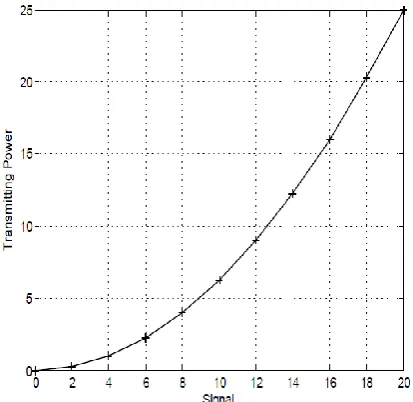
[image:3.595.313.531.453.678.2]Figure 3: Signal strength over transmitting power In Figure 3 we illustrate the overall signal strength of FBSs in the cellular environment. Thus, the signal strength increases due to the positioning of the indoor base station at the right placed in the home. However, the functionality of FBSs is boosting signal where poor reception of coverage is experienced. The placement of FBSs ensures optimal network coverage. As the distance increases, the network performance experienced an update and it improved the system capacity for uploading data at the indoor. The estimation of the signal strength illustrates the optimal system with the deployment of the femtocell. The FBS1,
FBS2, FBS3 and FBS4 values are considered in respect of
[image:4.595.51.309.450.664.2]their channel.
Figure 4: The network throughput
In Figure 4 we illustrate the network throughput of the cellular network vs position of femtocell base stations. The coverage is optimized with an improved gain of FBSs position within the regions. The optimized ratio increases along with others network parameters. As the FBSs is allocated in the regions to guarantee signal strength and enhance network capacity for the femto users. With the simulation results, an accuracy improvement was observed
concerning the proposed algorithm. It is proven that this result improves the deploying of femtocell into the cellular network.
VIII. CONCLUSION
The deployment of femtocell as proved has a promising solution for voice quality service, data uploading, and signal boosting in an indoor environment. The random position of FBSs comes with challenges of network performance and cross-tier interference. The wall penetration also suffers the effect of quality of service particularly FBSs at the edge of the cellular network.
In this paper, we proposed a positioning algorithm for deployment of femtocell technology within the context of the indoor environment. The deployment of proposed algorithm is to support the positioning FBSs for improved signal and avoiding interference/interruption. The system capacity performance was enhanced. It concluded from the simulation results that the proposed positioning algorithm stands for network’s improved performance for deployment of femtocell system in cellular systems. For the future scope, we can study the iterative method to ensure accurate location of FBSs in the mobile network for deployment of femtocell.
REFERENCES
[1] J. Zhang and G. de la Roche, Femtocells: Technologies and Deployment, 1st ed. Wiley, 2010.
[2] E. Elena, S. Park, and S. Bahk. "Deployment algorithm for femtocells in multi-tiered wireless cellular network", 2012 International Conference on ICT Convergence (ICTC), 2012.
[3] O. Akinlabi and M. K. Joseph, 2017, ICT4D: Femtocells Network Versus Wi-Fi network for Mobile Communication, IEEE WiSPNET 2017
[4] D. L. Perez, G. D. la Roche, A. Valcarce, A. Juttner, and J. Zhang, “Interference avoidance and dynamic frequency planning for WiMAX femtocells networks,” 11th IEEE Singapore International Conferenceon Communication Systems, pp. 1579–1584, 19-21 Nov. 2008.
[5] M. Yavuz, F. Meshkati, S. Nanda, A. Pokhariyal, N. Johnson, B. Roghothaman, and A. Richardson, “Interference management and performance analysis of UMTS/hspa+ femtocells,” IEEE Commun. Mag., vol. 47, no. 9, pp. 102–109, Sep. 2009.
[6] H. Claussen, “Performance of macro and co channel femtocells in a hierarchical cell structure,” IEEE 18th International Symposium on Personal, Indoor and Mobile Radio Communications, pp. 1–5, 3-7 Sep. 2007.
[7] R. Baines, “The need for WiMAX Picocell and femtocells,” WiMax London, pp. 1–36, 25-26 April 2007.
[8] D. Lopez-Perez, A. Valcarce, G. Roche, E. Liu, and J. Zhang, “Access methods to WiMAX femtocells: A downlink system-level case study,” 11th IEEE Singapore International Conference on CommunicationSystems, pp. 1657–1662, 19-21 Nov. 2008. [9] Presentations by ABI Research, Picochip, Airvana, IP access,
Gartner, Telefonica Espana, 2nd Intl. Conf. Home Access Points and
Femtocells: available online at
http://www.avrenevents.com/dallasfemto2007/purchase Accessed August 2016.
[10] V. Chandrasekhar and J. Andrews, “Femtocell networks: A survey,” IEEE Commun. Mag., vol. 46, no. 9, pp. 59–67, Sep. 2008
[11] R. Mathar and T. Niessen, “Optimum positioning of base stations for cellular radio networks,” Wireless Networks, vol. 6, pp. 421–428, Dec. 2000.
[12] M. E. Harby and L. Ibrahim, “Employing of clustering algorithm cwnpam in mobile network planning,” ICSNC ’08, pp. 44–49, Oct. 2008.
[14] Y. Liu, S. Gruhl, and E. Knightly, \WCFQ: an opportunistic wireless scheduler with statistical fairness bounds," IEEE Trans. of Wireless Comm., vol. 2, no. 5, pp. 1017-1028, 2003.
[15] O. A. Akinlabi, M. Joseph. "Signal behaviour in an indoor environment: Femtocell over Macrocell", 2016 IEEE 16th
International Conference on Environment and Electrical Engineering (EEEIC), 2016.
[16] Z. Ghayet El Mouna, S. Hamouda, P. Godlewski, and S. Tabbane. "A femtocells resources allocation scheme in OFDMA based networks", The Second International Conference on Communications and Networking, 2010.
[17] A. O. Akinlabi, M. K. Joseph, “Optimal deployment of femtocells using cost function” International Journal of Communication Systems Wiley online DOI 10.1002/DAC 3466