Ontology-driven Automatic Construction of
Bayesian Networks for Telecommunication
Network Management
Ann Devitt, Boris Danev and Katarina Matusikova
Network Management Research Centre
Ericsson, Ireland.
E-mail: {ann.devitt,boris.danev,katarina.matusikova}@ericsson.com
Abstract. Bayesian Networks are probabilistic structured representations of domains which have been applied to monitoring and manipulating cause and effects for mod-elled systems as disparate as the weather, disease and mobile telecommunications net-works. Although useful, Bayesian Networks are notoriously difficult to build accu-rately and efficiently which has somewhat limited their application to real world prob-lems. Ontologies are also a structured representation of knowledge, encoding facts and rules about a given domain. This paper outlines an approach to harness the knowledge and inference capabilities inherent in an ontology model to automate the construc-tion of Bayesian Networks to accurately represent a domain of interest. The approach was implemented in the context of an adaptive, self-configuring network management system in the telecommunications domain. In this system, the ontology model has the dual function of knowledge repository and facilitator of automated workflows and the generated BN serves to monitor effects of management activity, forming part of a feedback look for self-configuration decisions and tasks.
1 Introduction
for knowledge representation and manipulation have independently been used to facilitate machine reasoning and decision-making. This paper describes an approach to harness the knowledge representation and inference capabilities of ontologies in order to construct auto-matically a Bayesian Network which accurately represents a given domain and can then be used to support machine decision-making processes.
The research is being undertaken as part of a program to develop adaptive, self-configuring functionality for devices within the mobile telecommunications network management do-main. The research program is addressing the need for efficient management solutions and more automation of mobile networks. Recent advances in wired and wireless networking technology have resulted in an explosion in size, complexity and heterogeneity of such net-works. At the same time, network operators are struggling to keep their running costs to a minimum in a highly competitive market. More autonomy of networks, network devices and network management systems presents a means of resolving this conflict between the ever-increasing demands of running large, complex and heterogeneous networks and the ever-decreasing operational expenditure (OPEX) budgets of network operators. The adap-tive, self-configuring architecture proposed in [1] exploits emerging technologies such as ontology modelling and bayesian AI to attain the goal of autonomy for network devices. The machine-learning Bayesian Network component of the architecture is designed to provide the adaptive functionality, monitoring and learning the effects of configuration actions and closing the feedback loop on management activity. The ontology model component is de-signed to provide the self-configuring functionality, facilitating automation of configuration workflows. In addition to this primary function, the knowledge represented in the ontology model is leveraged in the construction of the Bayesian Network. Both components rely on expert knowledge for their content. Our approach means that this expert knowledge need only be elicited and modelled once as an ontology and can subsequently be manipulated au-tomatically to construct a second model with different properties and functions, the Bayesian Network.
Section 2 gives a brief introduction to Bayesian Networks and outlines current approaches to Bayesian Network construction and how ontologies have been exploited to date for this purpose. Section 3 sets out how in this research the structure and inference capabilities of on-tologies have been exploited to automate the construction of a Bayesian Network. Section 4 describes an implementation of this approach in the telecommunications network manage-ment domain. Finally, section 5 discusses some conclusions of this research and directions for future work.
2 Background
Korb and Nicholson state that the ultimate goal of Bayesian AI, of which Bayesian Networks are an integral part, is to:
create a thinking agent which does as well or better than humans in such [reasoning] tasks, which can adapt to stochastic and changing environments, recognize its own limited knowledge and cope sensibly with these varied sources of uncertainty.[2, p.21]
The ultimate goal of an autonomous thinking agent is not yet realised but BNs are currently the state-of-the-art for modelling, monitoring and adapting stochastic processes.
BNs consists of a Directed Acyclic Graph (DAG) structure. The nodes of this graph represent variables from an application domain,1 for example, performance counters in a
telecommunications network or weather indicators in the climate domain. The arcs represent the dependencies that hold between these variables, for example, a drop in parameter X trig-gers alarm Y or high atmospheric pressure is associated with warm weather. Additionally, there is an associated conditional probability distribution over these variables which encodes the probability that the variables assume their different values given the values of their parent variables in the BN graph structure. For example, the probability of alarm Y being triggered when parameter X is above a given threshold isp= 1or the probability of the weather being
good when the atmospheric pressure is high isp = 0.65. It should be noted that the arcs of
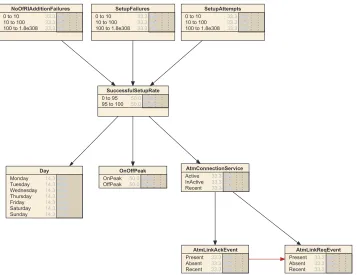
the Bayesian Network do not necessarily denote a causal relationship between two variables but only that the distribution of the child variable values is dependent on its parents value. In some instances, this may be a causal relationship but not in all cases. Figure 1 shows a sample Bayesian Network for a set of eight variables from the telecommunications network domain. It consists of a Key Performance Indicator (KPI) for a telecommunications device (SuccessfulSetupRate), the performance counters which contribute to that KPI
(NoOfRlAddi-tionalFailures, SetupFailures, SetupAttempts), a service workflow (ATMConnectionService)
which is triggered by degradation in the KPI levels and two temporal variables, day of the week and peak time. It is a structure such as this which the approach outline in this paper aims to build based on an ontology model of the telecommunications domain.
Day Monday Tuesday Wednesday Thursday Friday Saturday Sunday 14.3 14.3 14.3 14.3 14.3 14.3 14.3 NoOfRIAdditionFailures 0 to 10
10 to 100 100 to 1.8e308
33.3 33.3 33.3
SetupAttempts 0 to 10
10 to 100 100 to 1.8e308
33.3 33.3 33.3 OnOffPeak OnPeak OffPeak 50.0 50.0 SuccessfulSetupRate 0 to 95
95 to 100 50.0 50.0 SetupFailures 0 to 10
10 to 100 100 to 1.8e308
[image:3.595.121.478.383.658.2]33.3 33.3 33.3 AtmConnectionService Active InActive Recent 33.3 33.3 33.3 AtmLinkReqEvent Present Absent Recent 33.3 33.3 33.3 AtmLinkAckEvent Present Absent Recent 33.3 33.3 33.3
Figure 1: Sample Bayesian Network for Telecommunications Network Management Domain
1Terminology: Ontologies represent knowledge in terms of concepts and relations. Ontological concepts, in
The task of building the structure and assigning the probability distributions of a Bayesian Network is complex and knowledge-intensive. It requires the identification of relevant statis-tical variables in the application domain, the specification of dependency relations between these variables and assignment of initial probability distributions. Both the structure and pa-rameters, or probability distribution, of such a network can be assigned by an expert or learnt off-line from historical data. The parameters may also be learnt on-line incrementally from a live feed of data. Parameter estimation is a mature field of study and several algorithms exist to derive conditional probability tables for a fixed network structure efficiently and accurately from data [5, 6, 7]. In more recent years, structure learning for Bayesian Networks has be-come a hot topic in the data mining community. Initial BN applications involved defining the network structure and learning the parameters from data. There are a number of methodolo-gies proposed for facilitating building BNs by hand [8, 9] and indeed most BN software tools today include a GUI component for defining BN structures. However, in addition to expert knowledge in the application domain, the human may require some understanding of the sta-tistical principles and in particular the notion of conditional dependence and independence underlying a Bayesian Network in order to correctly specify relations between the variables in the domain. To address this knowledge bottleneck and the inherent difficulties of building BNs by hand, several algorithms have been developed to derive the structure of the network from data, such as the K2 algorithm [10], MDL (Minimum Description Length) [11] and CAMML [12]. While learning causal structure for Bayesian Networks can eradicate some of the bottlenecks which impede the application of BNs to real world problems, the learning algorithms are not without their own drawbacks such as making over-simplifying assump-tions about the input data or output structure, inability to deal with missing data, requirement for huge input datasets or intractability for complex multivariate input data. Furthermore, al-though there may exist a knowledge source representing the domain of interest, it can be a complex task to integrate these sources which in today’s data-rich world constitutes an un-necessary waste of resources.
Ontologies provide a potential knowledge source which could be exploited to build the BN structure. Helsper and Gaag [13] outline an approach which uses ontologies to facilitate the building of Bayesian Networks in the medical domain. However, the ontologies are used only as means of representing knowledge to facilitate the manual creation of the BN structure. The ontology constitutes shared and agreed domain knowledge to be used to derive the BN graph structure that is close to the ontological descriptions in the given domain. Due to the complexity of the medical domain and the high impact of misclassifications, the derivation of the graph structure is still done manually by expert analysis. The following sections outline how the BN–from–ontology building process in the telecommunications domain has been automated and enhanced using the inference capabilities offered by the formal ontological representation.
3 Automating Bayesian Network Construction
While this is not a trivial task, it is a more straightforward one. Furthermore, where there is an existing ontology knowledge source, little extra input is required to build a BN for this domain. In this implementation, the primary function of the ontology model is workflow automation and the BN construction algorithm is merely a side benefit of having this rich knowledge store.
The complex task of construction a BN for a given domain can be decomposed into four subtasks: 1) identifying the variables of interest; 2) specifying the values these variables can take; 3) defining the relations the hold between the variables and 4) assigning a conditional probability distribution to the variables. The following sections set out how the use of an ontology model facilitates each of these steps.
3.1 Identifying Variables of Interest
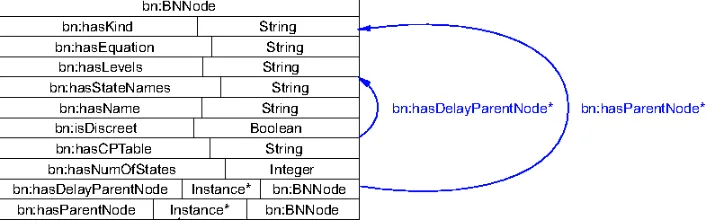
The approach described here assumes that an ontology of concepts for the domain of interest has been (as in this project) or can be built. Some of the concepts may be of interest to include in a BN which models causal relations in that domain and some may not. In order to distinguish between these, we have defined a new ontology of BN concepts and link this to the original domain ontology. All concepts of interest for the Bayesian Network then inherit from a node in this BN ontology. The root concept of the BN ontology is the BNnode. In order to create the Bayesian Network, an instance of each leaf class which inherits from the BNnode class is created. The description of the generic BNnode concept, its properties and relations are set out in figure 2. The concept has two types of relations:
• hasParentNode: BN nodes have a directed link from themselves to at least one parent
node;
• hasDelayParentNode: this is a directed time-delay link which can be used to generate a
[image:5.595.120.476.478.590.2]Dynamic Bayesian Network (a BN which includes a temporal dimension) [14].
Figure 2: Bayesian Network Node concept
The inheritance relation expresses that a class of the domain model is to be included as a node in the behaviour model. This combined ontology is enriched with facts which describe how a domain can be represented as a Bayesian Network.
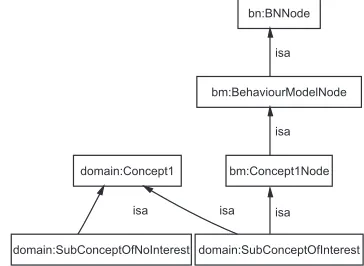
The combined domain and BN ontology can be further enriched to constrain BN cre-ation. In addition to the basic BNnode concept, the BN ontology may contain additional BN concepts which are more specific either to the BN application or to characteristics of the do-main ontology. Figure 3 illustrates a simple ontology for the telecommunications network management application for which this approach has been implemented. The root concept of the BN ontology remains the BNnode. The domain ontology in this figure consists of the concepts domain:SubConceptOfNoInterest and domain:SubConceptOfInterest and their parent concept domain:Concept1. The domain:SubConceptOfInterest concept inherits both from the domain ontology and the BN ontology and only this concept node will be included in an output BN for this domain. In this figure, however, between the root node and a
con-ceptOfInterest node, there are two additional, intermediate concepts: BehaviourModelNode
and bmConcept1Node. The BehaviourModelNode concept represents the characteristics of BN nodes required for a particular application, in this case the network management applica-tion.2This separation between pure BN and BN for an application allows the original generic BNnode ontology to be re-used for other applications which require a BN component by defining a different ApplicationNode concept. The Concept1Node concept defines character-istics of Concept1 instances which should be treated in a particular way. The ontology can define a hierarchy of more specific BNnode classes for any domain concepts which should be included in the output BN, if these concepts would benefit from additional processing. This additional level is not a requirement of this approach. However, the structure enables tailored processing of domain ontology concepts in the generation of the Bayesian Network, for example, setting ranges for continuous variables or default probability values.
domain:SubConceptOfInterest domain:Concept1
isa
domain:SubConceptOfNoInterest
bm:Concept1Node
isa
bm:BehaviourModelNode bn:BNNode
isa
isa
[image:6.595.203.385.432.565.2]isa
Figure 3: Generic Domain Ontology with BN concepts
3.2 Specifying the Attributes of the Bayesian Network Node
The properties of the BN nodes created at the previous step are derived from the combined BNnode and domain ontology. Properties, such as name, stateNames and kind of bayesian network node, are specified in the BNnode concept and their values are instantiated from the relevant domain concept using the constraints offered by ontology restrictions. The domain concepts specify restrictions on their properties and these are used to populate the BNnode properties of newly created BN nodes. In particular, the hasValue restriction specifies the
2See section 4 and Baliosian et al [15] for an outline of the application architecture and the BN
values which a property can assume. For example, the hasStateNames BNnode property, which all sub-concepts of BNnode inherit, can be constrained in the sub-concept class to a specific value of the domain ontology concept property using the hasValue restriction.
(1) <Restriction>
<onProperty hasStateNames/>
<hasValue "Present, Absent, Recent"/> </Restriction>
Other restrictions are used to control correct node notation. For example, the requirement that a node must have exactly one name is expressed by a cardinality restriction:
(2) hasN ame property= 1
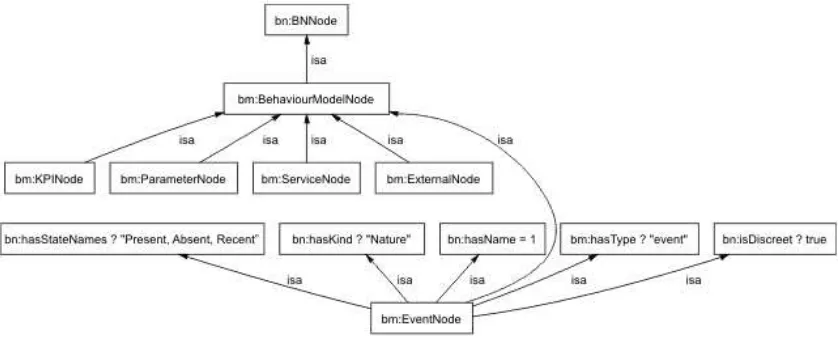
Figure 4 shows the restrictions on a sample EventNode for the telecommunications ontology, expressing for particular node properties what values this property can take for this class and its subclasses. For example, for all BN event nodes the stateNames property must have values
{P resent, Absent, Recent}. The ontology inheritance structure allows some restrictions to
[image:7.595.87.506.352.523.2]be specified at a very generic level (e.g. notational restrictions) and others at a lower level in the ontology (e.g. value specifications), thereby maximising the generalizability of the ontology. For each BNnode instance created, the ontology reasoner compiles all restrictions from the class and all its superclasses and the BNnode properties are generated from these.
Figure 4: Restrictions on Event Node in telecommunications ontology
3.3 Finding Parent Nodes
for the network management application. This rule-based approach over ontology classes provides a means of specifying generic BN relationships which are then generated automati-cally when the nodes are initialised. Finally, the reasoner is used to check that the generated Bayesian Network is valid by checking all BNnode instances and the domain ontology for consistency.
3.4 Conditional Probability Table (CPT) Estimation
As noted in section 2, estimation of Conditional Probability Tables for Bayesian Networks is and has been a field of intensive research for several decades. The approach set out in this paper does not delve into this area. Indeed the network management application for which this approach was designed exploits existing parameter learning algorithms and the Bayesian Network CPTs are learnt incrementally and on-line from a live feed of network event data. However, the knowledge resource of a domain ontology can be exploited to estimate initial probability distributions for some concepts that lend themselves to this interpretation. Some relations between parent and child nodes can be assigned an initial probability value based on the nature of the concepts involved. For example, a deterministic relation where the value of the parent entails the value of the child variable can be encoded directly in the CPT of the child variable. Like the arc construction method, this can be encoded as a rule in the ontology.
4 Application in Telecommunications Network Management domain
As noted in the introduction, the work described here was conducted as part of large-scale project to develop a self-adapting auto-configuration management functionality for network management systems in the mobile telecommunications domain. The ever-increasing size, complexity and heterogeneity of communications networks today is driving intense research activity in the area of adaptive, autonomous networks and network devices. One crucial ob-stacle to increased autonomy in today’s networks which must be overcome is that network management systems have only partial models of the networks they manage and these models are semantically empty. In deployed commercial systems, the Management Information Base (MIB) records device attributes and the current state of network parameters but it does not ex-plicitly represent constraints that hold for individual managed elements and even less between elements of the MIB. Recent approaches propose using ontologies to capture Management In-formation Base models [16], annotating, constraining and making machine-readable the Op-erations and Maintenance (O&M) descriptions of the network in order to enable automation of O&M activities, as in [17]. However, a system which allows automation of management decisions and tasks could be prey to instability. A viable autonomous management solution must include a feedback loop to observe and deal with the consequences of its activities. This can be provided using the machine learning capabilities offered by a Bayesian Network to monitor the effects of human, semi-automated or fully automated O&M activities and feed the derived knowledge back into the management system, as described in [15].
allows direct work with subclasses, definition of property ranges and domains and use of re-strictions. Furthermore, its guarantee of completeness and decidability is a requirement for any real world application. The debate remains open as to which modelling language will emerge as the true standard for telecommunications and more generally web services appli-cations. In the meantime, this solution provides more than adequate reasoning capabilities to illustrate the benefits of our approach.
4.1 Domain Ontology
The domain ontology model is a super-enhanced MIB for a single telecommunications net-work device. It stores the current configuration of the device, its relationships with other objects in the network and constraints on its possible configuration imposed by the hardware and software deployed on the network element. It also stores the service workflows associ-ated with configuration tasks, i.e., the sequence of actions affecting a network element that need to be completed in order to automatically fulfil a given service request, for example, a request to configure a port. In addition, it models the performance and fault metrics associ-ated with that node (i.e. alarm types, performance counters and KPIs) and any associations between these (e.g. KPI equations, alarm triggers). Figure 5 shows a subsection of this on-tology which is focused on the Service concept and other concepts connected with it. The relations between these concepts are expressed by directed links (blue arcs with arrows) rep-resenting object properties of concepts. Links lead from property domain to property range concepts. As noted previously, the primary goal of this model is to facilitate automation of management tasks by explicitly representing the events which trigger a service, the sequence of atomic tasks and complex processes that constitute the service and any events issued or expected while the service is active. The secondary function of the model is to generate an accurate BN representation of the domain to be used for monitoring effects of these manage-ment services.
node:NetworkElement node:isConnectedTo*
node:ManagedObject
node:hasMeContext
node:Process
task:Task
node:startTask*
task:directPre task:directPost
event:Event
event:hasTarget event:hasSubject
node:Service
node:relatedTo
node:State
node:initState
node:process node:inEvent node:outEvent
[image:9.595.120.470.458.657.2]node:directNext
Figure 5: Part of Telecommunications Network Management Domain Ontology
4.2 Behaviour Model Ontology
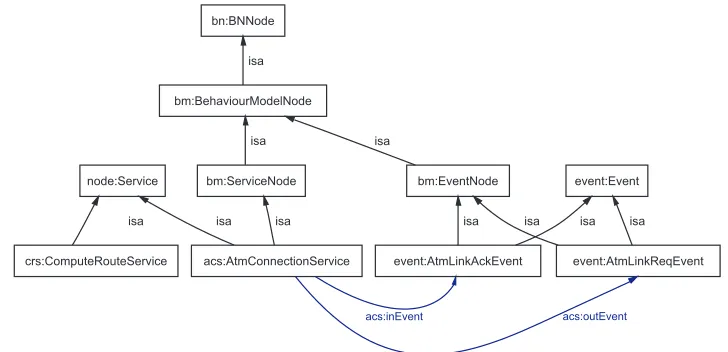
be included (KPI, Performance Parameter, Service, and Event) to allow custom processing of the various node types. A part of the combined Bayesian Network and Domain ontology for the application domain is shown in figure 6, where is-a links represent the inheritance hierar-chy. This ontology subsection defines two classes, ServiceNode and EventNode, as subclasses of BehaviourModelNode to describe properties of the service and event domain concepts which are specifically relevant to a Bayesian Network representation. For example, all ser-vice nodes in the Bayesian network share the same state names{Active, InActive, Recent}. This data and other shared property values are recorded using hasValue restrictions on the corresponding ServiceNode properties. Likewise, all event nodes share the same state names
{P resent, Absent, Recent}, different from service nodes state names. The EventNode
sub-class contains this information in the form of hasValue restrictions. Every service and event which is of interest to the Bayesian Network inherits from the ServiceNode subclass and the EventNode subclass respectively.
acs:AtmConnectionService node:Service
isa
crs:ComputeRouteService
isa bm:ServiceNode
isa
bm:EventNode
event:AtmLinkReqEvent isa
event:AtmLinkAckEvent isa bm:BehaviourModelNode
isa
event:Event
isa isa bn:BNNode
isa
isa
[image:10.595.113.477.253.429.2]acs:inEvent acs:outEvent
Figure 6: Domain plus Behaviour Model Ontologies
4.3 Rules for BN arc construction
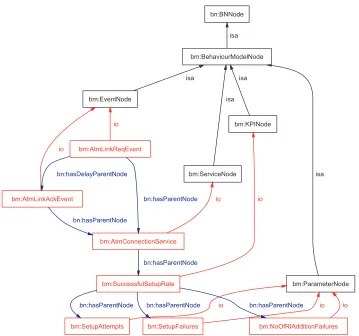
In order to generate arcs automatically from the domain ontology, rules are defined using the Jena rule language. Rules specify how to create arcs from relations between domain concepts. The reasoner infers hasParentNode and hasDelayParentNode relations from inter-concept relations such as those represented by the blue arcs in figure 6. After rule inference, the
hasParent relations appear in the behaviour model ontology as shown in figure 7. Example 3
shows a sample rule for generating arcs between the Event and Service concepts.
(3) [Service-Event_arc_rule:
(?s type Service) // if there is a service (?e type Event) // and an event
(?s ?p ?e) // that is related to this service
-> // then
(?e hasParent ?s) // the event has the service as a parent ]
bm:SetupAttempts
bm:ParameterNode
io
bm:NoOfRIAdditionFailures io
bm:SetupFailures
io
bm:BehaviourModelNode
isa bm:KPINode
isa
bm:ServiceNode isa bm:EventNode
isa
bm:SuccessfulSetupRate
io
bn:BNNode
isa
bm:AtmConnectionService
bn:hasParentNode io
bn:hasParentNode bn:hasParentNode bn:hasParentNode bm:AtmLinkAckEvent
io bm:AtmLinkReqEvent io
bn:hasParentNode
[image:11.595.118.477.50.386.2]bn:hasParentNode bn:hasDelayParentNode
Figure 7: Domain plus Behaviour Model Ontologies after Rule Applications
4.4 Sample Use Case: ATMCrossConnection Service
26 hasParent and 12 hasDelayParent relations. This is then mapped to a Bayesian network with 21 nodes, 26 arcs and 12 time-delay links, an extended version of the BN in figure 1.
5 Conclusions and Future Work
This paper has outlined an approach to building a Bayesian Network from an ontology model of a given domain. Bayesian Networks are notoriously difficult to hand-code and structure learning algorithms, while useful, can have significant drawbacks. The use of a domain on-tology coupled with the capabilities of an inference engine can automate the BN building task, reducing the knowledge bottleneck of expert knowledge to BN structure, while accu-rately representing the domain of interest. The approach was implemented in the context of an adaptive, self-configuring network management system in the telecommunications domain. In this system, the ontology model has the dual function of knowledge repository and au-tomation facilitator and the generated BN serves to monitor effects of management activity and forms part of a feedback look for self-configuration decisions and tasks.
This approach opens up several avenues for future work, the first of which is an evaluation of the current system. However, the evaluation of BN structures is a non-trivial task and estimation of the success of this ontology-based approach would require both a subjective and an objective evaluation. The subjective evaluation must compare how the task is perceived by the ontology or BN builders to assess whether there has been any saving in the time and effort of domain experts. The objective evaluation should assess the quality of the generated structure by performing a comparison of the ontology-built structure and other data-learnt models on the basis of a selected metric, such as predictive accuracy for an expert–annotated test data set.
Other technical extensions are also planned. To date, the implemented algorithm does not specify any values for the BN conditional probability tables. In future implementations, we aim to specify CPT priors on the basis of properties of the ontology model. For exam-ple, the service workflows which are composed of events imply that the service is active if at least one of its events is present, this could be encoded in the event CPT. Similarly, the triggering of services by KPI violations can be encoded in the service CPT as a determinis-tic relationship pservice = 1 whenKP I ≥ threshold. Another more complex direction for
future research involves modification of the ontology-built structure by supplementing addi-tional arcs or removing superfluous ones on the basis of learnt data. This is an area ripe for research as existing methodologies entail learning an entirely new structure from data using the original structure as a prior in the learning process. This research direction should also provide interesting insights into the primacy of expert knowledge, in the form of ontologies, over information learnt from data as the degree and kinds of modification required are an indicator of the (in)accuracies of the expert model.
References
[1] Javier Baliosian, Huw Oliver, Ann Devitt, Francoise Sailhan, Epifanio Salamanca, Boris Danev, and Gerard Parr. Self-configuration for radio access networks. In Proceedings
of 7th IEEE Workshop on Policies for Distributed Systems and Networks (Policy 2006),
London, Canada, June 5-7 2006.
[3] Colin Harris and Vinny Cahill. Power management for stationary machines in a perva-sive computing environment. In Proceedings of the Hawaii International Conference
on System Sciences, 2005.
[4] Gustavo Arroyo-Figueroa and Luis Sucar. A temporal bayesian network for diagnosis and prediction. In Proceedings of the 15th Annual Conference on Uncertainty in
Artifi-cial Intelligence (UAI-99), pages 13–20, San Francisco, CA, 1999. Morgan Kaufmann
Publishers.
[5] D. J. Spiegelhalter and S. L. Lauritzen. Sequential updating of conditional probabilities on directed graphical structures. Networks, 20:579–605, 1990.
[6] S. Geman and D. Geman. Stochastic relaxation, gibbs distributions and the bayesian restoration of images. IEEE Transactions on Pattern Analysis and Machine Intelligence, 6:721–741, 1984.
[7] A. Dempster, N. Laird, and D. Rubin. Maximum likelihood from incomplete data via the em algorithm. Journal of the Royal Statistics Society, B 39:1–38, 1977.
[8] K. B. Laskey and S. M. Mahoney. Network engineering for agile belief network models.
IEEE Transactions on Knowledge and Data Engineering, 12:487–498, 2000.
[9] M. Neil, M. Fenton, and L. Nielsen. Building large-scale bayesian networks. The
Knowledge Engineering Review, 15:257–284, 2000.
[10] G. Cooper and E. Herskovits. A bayesian method for constructing bayesian belief net-works from databases. In Proceedings of Uncertainty in Artificial Intelligence, San Fransisco, 1991.
[11] W. Lam and F. Bacchus. Learning bayesian belief networks: An approach based on the mdl principle. Computational Intelligence, 10:269–293, 1993.
[12] C. S. Wallace, K. Korb, and H. Dai. Causal discovery via mml. In Proceedings of the
13th International Conference on Machine Learning, pages 516–524, San Mateo, CA,
1996. Morgan Kaufman.
[13] E. Helsper and L. C. Van der Gaag. Building bayesian networks through ontologies. In
Proceedings of the 15th European Conference on Artificial Intelligence, pages 680–684,
Amsterdam, the Netherlands, 2002. IOS Press.
[14] Ann E. Nicholson. Monitoring Discrete Environments using Dynamic Belief Networks. PhD thesis, Department of Engineering, Oxford, 1992.
[15] Javier Baliosian and Ann Devitt. Forecasting unstable policy enforcement. In
Proceed-ings of the IEEE Internation Conference on Systems and Networks Communications,
Tahiti, French Polynesia, November 2006. to appear.
[16] Jorge E. López de Vergara, Víctor A. Villagrá, Juan I. Asensio, and Julio Berrocal. Ontologies: Giving semantics to network management models. IEEE Network, special
issue on Network Management, 17(3), May/June 2003.
[17] David Cleary and Boris Danev. Using ontologies to simplify wireless network con-figuration. In Proceedings of the 1st International Workshop Formal Ontologies Meet