Multiprocessing Suited Pace Size Proficiency for
Ciphering First Order ODEs
J. G. Oghonyon, Member, IAENG, S. A. Okunuga, O. A. Odetunmibi, H. I Okagbue
Abstract-Appraising computed error in forecasting-adjusting system is all essential for purposeful acquiring suited pace size. Diverse schemata for controlling/estimating error bank on forecasting-adjusting system. This study examines multiprocessing suited pace size (adaptive) proficiency for ciphering first order ordinary differential equations (ODEs). This involves compounding Newton’s back difference interpolating multinomial with numeral consolidation method. This is valuated at more or less preferred grid points to invent multiprocessing forecasting-adjusting system. Moreover, process progresses to produce main local truncation error (MLTE) of multiprocessing forecasting-adjusting system after showing degree of the system. Numeral resolutions manifest effectiveness of varying pace size in working out first order ODEs. Accomplished resolution rendered is aided using mathematical software program. Mathematical resolutions show-case adaptive proficiency is effectual and function better than subsisting systems with respect to the maximal computed errors in the least time-tested tolerance bounds.
Index Terms- Adaptive proficiency, forecasting-adjusting system, tolerance bound, maximal computed errors, main local truncation error.
1. INTRODUCTION
Pace length alternative operation formulates close together the main local truncation error that does not postulate calculation of higher derived function. Proficiencies defined as adaptive, requires modification of amount and positioning of grids utilized in estimating primary local truncation error tween specified bound. Nevertheless, approximate close relationship upholds inside problem of
Manuscript submitted March 30, 2018; revised for submission April 7, 2018. This work was supported by Covenant University Centre for Research, Innovation and Discovery (CUCRID, Ota, Ogun State, Nigeria.
J. G. Oghonyon, Department of Mathematics, College of Science and Technology, Covenant University, P.M.B. 1023, Ota, Ogun State, Nigeria (corresponding author phone no.: +234-8139724200; [email protected]).
S. A. Okunuga, Department of Mathematics, Department of Mathematics, University of Lagos, Akoka, Yaba, Lagos State, Nigeria. ([email protected]).
O. A. Odetunmibi, Department of Mathematics, Covenant University, College of Science and Technology, P. M. B. 1023, Ota, Ogun State, Nigeria. ([email protected]).
H. I. Okabue, Department of Mathematics, College of Science and Technology, Covenant University, P. M. B. 1023, Ota, Ogun State, Nigeria. ([email protected]).
calculating value of explicit integral and ciphering resolution to initial value-problem. Adaptive proficiencies are no surprising for computing resolutions to ODEs and these proficiencies are not exclusively effective but integrate maximal control error. See [1], [12].
Forecasting-adjusting system is a substituted method for meaningful estimating maximal control error thru worthy pace length. Paper concerned computing maximal control error of first order ODEs of the type [11]
, . (1) Computational resolution of (1.1) in general is given as
, (2)
where pace-size is , are unknown quantity specifying such pattern of degree r. See [4].
Assuming
z
R
to a sufficient degree possessing differential coefficient ont
[
c
,
d
]
and meets global Lipchitz consideration, i.e., there is invariable. (3) Underneath this presumptuousness, (1) insure existence and singularity fixed on
t
[
c
,
d
]
likewise looked at fulfilling Weierstrass theorem. See for example [15], [18], [26] for details.Where and are bounded, ,
and , spring-up in real-life application problems in scientific discipline and engineering science like mobile dynamical and motion of rocket as presented [5]-[6], [22].
Motivation of research paper propose adaptive proficiencies of forecasting-adjusting system for estimating nonstiff and mildly stiff ODEs implemented in
E
C
P
f
A
j
or
P
E
C
E
A
j f
style.
Proficiency possess some vantages alike designing/varying suited pace-size, specifying tolerance bound and controlling computed error besides dealing with shortcomings stated above. Look into [2]-[3], [7], [9], [16] for more items.
This paper structure is studied as complies: in Subdivision 2 Substance and Techniques. Subdivision 3 Numeric Examples. Subdivision 4 Effect and Discourse. Subdivision 5 Decision as mentioned [4], [24].
II. SUBSTANCE AND TECHNIQUES
This subdivision deploys Newton’s back difference formula to devise forecasting-adjusting system.
Presuppose possess uninterrupted differential coefficient, , and back differences represent
where then
,
(4)
where is the derived function of assessed at some point interval possessing . Presume
, , (2.1) gives
, .
Replacing supra in
,
to obtain
(5)
Every time conclusive term supra is dismissed, the left over will be called Adams-Bashforth formula
. (6)
Back differences show with regards to valuates at extend of proceeding degrees
(6) is penned
(7)
Proceeding with (2.4) produce multiprocessing -step Adams-Bashforth Formula [8].
Likewise, adjusting multiple stride systems-Adams-Moulton system is deduced setting into (4) and subbing
,
yields
Disregarding computed error term, yields method
(8)
Subbing in terms generates
. (9)
In continuance, (9), multiprocessing -1-stride Adams-Moulton system is generated. See [13].
Order of accuracy- Adopting [4], [18], consociated linear multiple strides system (2) and difference mathematical expression
. (10) Accepting
g
(
t
)
is sufficiently and endlessly possessing a derivative on time limit[
c
,
d
]
. This implies thatg(t)
owns numerous derived function demanded, composing terminus in (10) as Taylor series expression of and
and
(11)
Standing in (10), (11) into (2), succeeding formulation obtains
(12)
Concurring [4], [18], adaptive proficiencies (2) gives degree p, whenever establish
following:
yielded adopting:
.
Thusly, (2) gives degree
p
≥
1
and computed error constant quantity .,
. (13)
Therefore, is computed error constant quantity and main principal local truncation error
at .
Stableness Property- Properly stableness system is required in multiprocessing forecasting-adjusting system to anneal. This follows scripted multiprocessing system in establishing rectangle array of bounded difference. See [4], [17].
, (14) , , , .
Rectangular arrays determine
rectangular arrays having actual substantial. Altho
gives variable quantity stated supra.
Accordingly [17]-[18], boundary locus system fix region of absolute stability of multiprocessing system is carried out to generate root system of absolute stability. Exchanging test par
and =
into multiprocessing (14), resulting to
. (15)
Subbing
h
0
in (15), roots system generated . Hence, from definition [18]-[19], absolutely stability is gratified.Moreover, from [15], edge region of absolute stability is incurred interchanging (2) within
)
(
)
(
)
(
r
r
r
h
(16)and
r
e
i
cos
i
sin
simplified unitedly andvaluating (16) inside
[
0
0,
180
0]
. Therefore, bounds ofregion of absolute stability dwells on actual axis.
Practical Implementation of Adaptive Proficiencies Concurring with [13], [15]-[16], practical implementation of
E
C
P
f
A
j
or
P
E
C
E
A
j f
fashion gets
all-important in forecasting and adjusting systems assuming both are of ilk degree. Since this precondition is of essence for stride-number of forecasting unit higher than adjusting
system. Consequently, fashion of
P
E
C
A
j f
or
E
C
E
P
A
j f
is took apart as adopts,
j
1
,
2
,...
:
E
C
P
f
A
j
:
z
j
h
g
g
n im i i j i n m i i m n ] 1 -[ 1 -0 * ] [ 1 -0 ] 0 [
∑
∑
,
)
,
(
≡
[ ] ] [g
x
z
n m nsm sm
n
z
,
0,1,..., -1 , ] 1 -[ 1 -0 * ] [ * ] [ 1 -0 ] 1 [∑
∑
g
h
z
h
z
s jg
j i n m i i s m n m j i n m i i s mn
. (17)
E
C
E
P
fA
j
z
h
g
g
j i n m i i j i n m i i m n ] [ 1 -0 * ] [ 1 -0 ] 0 [∑
∑
,
)
,
(
≡
[ ] ] [g
x
z
n m nsm sm
n
z
,
0,1,..., -1, , ] [ 1 -0 ] [ * ] [ 1 -0 ] 1 [∑
∑
g
h
z
hz
s jg
j i n m i i s m n m j i n m i i s mn
)
,
(
≡
[ ] ] [g
x
z
n m njm jm
n
z
Mentioning as
j
, resolution of computing with alternatives supra fashion will gear towards adjusting to tolerance bound.What is more, forecasting and correcting system centered
on (2) is enforced.
P
E
C
A
j f
or
E
C
E
P
fA
j
is specified by (17),
h
* is pace sizewhich assumes that forecasting and adjusting system is of
alike degree
p
.
Incases,
C
Fp1,
C
Ap1yields workout error constantquantity of forecasting-adjusting system in given order. The complying consequence applies
Proposition- Presuppose forecasting system owns degree
p
F and adjusting system gets degreep
A
utilized in
E
C
P
f
A
j
or
P
E
C
E
A
j f
style,m
p
p
F,
A,
are whole numbers and1
,
1
,
1
p
m
p
p
F
A(orp
p
A F
,m
p
A
p
F
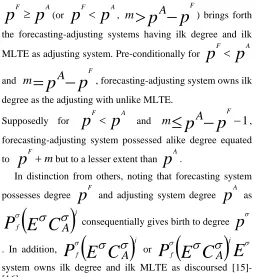
) brings forth the forecasting-adjusting systems having ilk degree and ilkMLTE as adjusting system. Pre-conditionally for
p
p
A F
and
m
p
A
p
F
, forecasting-adjusting system owns ilk degree as the adjusting with unlike MLTE.Supposedly for
p
p
A F
andm
p
A
p
1
F
,
forecasting-adjusting system possessed alike degree equated
to
p
F
m
but to a lesser extent thanp
A.In distinction from others, noting that forecasting system
possesses degree
p
F
and adjusting system degree
p
A
as
E
C
P
fA
j
consequentially gives birth to degree
p
. In addition,
P
E
C
A
j f
or
P
E
C
E
A
j f
system owns ilk degree and ilk MLTE as discoursed [15]-[16].
Mixing [9]-[10], [15]-[16], Milne’s device put forward viability to calculate MLTE of forecasting and adjusting systems in absence of higher differential coefficients,
g
(
t
)
. Settingp
A
p
F
,p
F
and
p
A
expresses degree of
forecasting and adjusting systems with ilk order. Forthwith,
degree
p
, MLTE is spelt infra
h
g
t
t
W
h
C
n n j n m pp p F
p
g
O
2 1
1
1
-
,(18)
h
g
t
t
C
h
C
p m
n m n n
p p
p
g
O
A
1 1 21
(19)
W
F
nm andC
A
m
n refers to forecasting and adjusting
approximates established by degree
p
,
C
Fp1 andC
A
p1 distinct ofh
.Pretermitting terminus of degree
P
2
supra and possibly make computational approximate of MLTE of the system as
W
C
C
C
t
g
h
C
A
F
A
A
A
m n m n p F p
p n
p p
p
-C
-
11 1 )
1 ( 1
1
(19)
Mentioning
C
1
1
A
pF p
C
andW
C
A
F
m n m
n
.All the same, evaluating MLTE (19) establishes acceptance and rejection of the output or ingeminating the pace with a lesser pace size. The pace permissible is founded on a try out prescribed by (19) as seen [8]. (19) yields tolerance bound of Milne’s estimate for adjusting to convergency.
III. NUMERIC EXAMPLES
Problem tested- Three tested problems have been adopted and carry out utilizing ATVS-SBP-CM on two distinct convergence criteria and as viewed [28]. Tested problem 1 , ,
.
Exact Solution:
Tested problem 2 , ,
.
Exact Solution:
Test problem 3 , ,
.
Exact Solution: .
IV. EFFECTS AND DISCOURSE
In subsection, computational resolutions show execution of adaptive proficiencies for figuring first-order ODEs. Finish resolution yielded is found employing computational software package. The language used is enlisted under:
[image:4.612.45.302.51.328.2]Table 1, Table 2 and Table 3 presents the numeric decisions of problems 1, 2, and 3 applying APVPSMF-AS in comparison to subsisting systems. Acronyms listed on table 1, table 2 and table 3 are enlisted infra.
Table 1 of Problem 1
Proficiency Maxcomputederror Tolb
GMBDF
BGMBDF
APVPSMF-AS
APVPSMF-AS
GMBDF
BGMBDF
APVPSMF-AS
[image:4.612.42.307.56.693.2]APVPSMF-AS
Table 2 of Problem 2
Proficiency Maxcomputederror Tolb
GMBDF
BGMBDF
APVPSMF-AS
APVPSMF-AS
GMBDF
BGMBDF
APVPSMF-AS
[image:4.612.312.533.493.742.2]Table 3 of Problem 3
Proficiency Maxcomputederror Tolb
GMBDF
BGMBDF
APVPSMF-AS
APVPSMF-AS
GMBDF
BGMBDF
APVPSMF-AS
APVPSMF-AS
APVPSMF-AS: adaptive proficiencies of suited pace size multiprocessing forecasting-adjusting system.
Tolb: tolerance bound. Prof: proficiency applied.
Maxcomputederror: magnitude of maximal computed errors in APVPSMF-AS.
GMBDF: computed error in GMBDF (Generalized Multistep Adams and Backward Differentiation Formulae) for tested problems 1 and 2 as seen [28]. BGMBDF: computed error in BGMBDF
(Block Method for Generalized Multistep Adams and Backward Differentiation Formulae) for test problem 3 as seen [28].
V. DECISION
Computational effects showed APVPSMF-AS is implemented utilizing tolerance bound. Tolerance bound settles acceptance or rejection of resolution. Computed effects similarly launch functioning APVPSMF-AS is remarked to bring forth improve maximal computed errors liken to BGMBDF and
GMBDF as cited [28]. Whence, deciding multiprocessing system invented having qualities for figuring out nonstiff and stiff ODEs as remarked supra.
ACKNOWLEDGMENT
Bookmen express gratitude to Covenant University for financial backing thru grants in the course of the period of time.
REFERENCE
[1] G. Adejumo, M. T. Abioye and T. A. Anake, “Adoption of computer assisted language learning software among Nigerian secondary school,” EDULEARN14 Proceedings. 950-955. [2] A. O. Adesanya, O. M. Udo and A. M. Alkali, “A new
block-predictor-corrector algorithm for the solution of y^'''= f(x,y,y^',y^''),” American Journal of Computational Mathematics. Vol. 2, No 4, pp. 341-344, December, 2012. [3] A. O. Adesanya, M. R. Odekunle, A. M. Adamu and A. A.
Binta, “Starting the five steps Stomer-Cowell method by Adams-Bashforth method for the solution of the first-order ordinary differential equations. African Journal of Mathematics and Computer Science Research. Vol.6, No. 5, pp. 89-93, May, 2013.
[4] A. O. Akinfenwa, A. O., Jator, S. N., Yao, N. M.: Continuous block backward Differentiation formula for solving stiff ordinary differential equations. Computers and Mathematics with Applications. Vol. 65, No. 7, pp. 996-1005, April, 2013. [5] T. A. Anake, D. O. Awoyemi and A. O. Adesanya, “One-step
implicit hybrid block method for the direct solution of general second order ODEs,” IAENG International Journal of Applied Mathematics. Vol 42, No. 4, pp. 224-228, November, 2012. [6] T. A. Anake and L. O. Adoghe, “A four-point integration
method for the solutions of IVP in ODE,” Australian Journal of Basic and Applied Sciences. Vol 7, No. 10, pp. 467-473, 2013. [7] T. A. Anake, A. O. Adesanya, J. G. Oghonyon and M. C.
Agarana, “Block algorithm for general third order ordinary differential equations,” ICASTOR Journal of Mathematical Sciences. Vol. 7, No. 2, pp. 127-136, 2013.
[8] U. M. Ascher and L. R. Petzold, “Computer methods for ordinary differential equations and differential algebraic equations. SIAM, USA, 1998.
[9] A. M. Bakoji, A. M. Bukar and M. I. Bello, “Formulation of predictor-corrector methods from 2-step hybrid Adams methods for the solution of initial value problems of ordinary differential equations. International Journal of Engineering and Applied Sciences. Vol. 5, No. 3, pp. 9-13, August, 2014.
[10] J. R. Cash and S. Semnani, “A new approach to solving nonstiff initial-value problems. Journal of Computational and Applied Mathematics. Vol. 45, No. 1, pp. 41-46, April, 1993.
[11] J. R. Dormand, “Numerical Methods for Differential Equations,”A Computational Approach, London, 1996. [12] J. D. Faires, R. L. Burden, “Initial-value problems for ODEs,”
Dublin City University, Brook Cole, 2012.
[13] C. W. Gear, “Numerical Initial Value Problems in ODEs,” Prentice-Hall, Inc., USA, 1971.
[14] Z. B. Ibrahim, K. I. Othman and M. Suleiman, “Implicit r-point block backward differentiation formula for solving first-order stiff ODEs. Applied Mathematics and Computation. Vol. 186, No. 1, pp. 558-565, March, 2007.
[15] M. K. Jain, S. R. K. Iyengar and R. K. Jain, “Numerical Methods for Scientific and Engineering,” New Age International (P) Ltd., India, 2007.
[16] A. A. James and A. O. Adesanya, “A note on the construction of constant order predictor-corrector algorithm for the solution of first order ODEs,” Br. J. Math. Comput. Sci. Vol. 4, No. 6, pp. 886-895, January, 2014.
[17] Y. L. Ken, I. F. Ismail and M. Suleiman, “Block methods for special second order odes,” Lambert Academic Publishing, Universiti Putra Malaysia, 2011.
[18] J. D. Lambert, “Computational Methods in Ordinary Differential Equations,” USA, 1973.
[19] J. D. Lambert, “Numerical Methods for Ordinary Differential Systems,” USA, 1991.
[20] Z. A. Majid and M. B. Suleiman, “Implementation of four- point fully implicit block method for solving ordinary differential equations,” Applied Mathematics and Computation. Vol. 184, No. 2, pp. 514-522, January, 2007.
[21] Z. A. Majid, M. Suleiman, “Parallel direct integration variable step block method for solving large system of higher Order odes,” World Academy of Science, Engineering and Technology. Vol. 40, No 2008, pp. 71-75, May, 2008.
[22] S. Mehrkanoon, Z. A. Majid and M. Suleiman, “A variable step implicit block multistep method for solving first-order ODEs,” Journal of Comp. and Appl. Math. Vol. 233, No. 2010, pp. 2387-2394, March, 2010.
[24] J. G. Oghonyon, S. A. Okunuga, S. A., Iyase, “Milne’s implementation on block predictor-corrector methods, ” Journal of Applied Sciences. Vol. 16, No. 5, pp. 236-241, April 2016. [25] D. Voss, D. and S. Abbas, “Block predictor-corrector schemes
for the parallel solution of ODEs,” Comp. Math. Appl. Vol. 33, No. 6, pp. 65-72, 1997.
[26] L. Xie and H. Tian, “Continuous parallel block methods and their applications,” Applied Mathematics and Computation. Vol. 241. 2014, pp. 356-370, August, 2014.
[27] B. I. Zarina, I. O. Khairil and M. Suleimann, “Variable step block backward differentiation formula for solving first-order stiff ODEs,” Proceedings of the World Congress on Engineering. Vol. 2, pp. 2-6, December, 2007.