684
©IJRASET: All Rights are Reserved
Detecting Parking Spaces using Deep Learning
Method: Solution for Parking in Smart Cities
Samiksha Chaudhar
PG Student, Department of Computer Engineering, VPKBIET, Baramati, Pune
Abstract: Car parking issue is a most important contributor in clog of traffic and has been, still a serious issue with growing vehicle size in the exclusive part as well as limits parking places in urban cities. Finding parking space is one of the
difficult issue at most of the metro cities, especially at the various public places such as shopping mall, cinema hall etc. It is difficult to search the available parking area. The ongoing important to have an efficient and smart parking system to save fuel and transportation time. This system use methodology for detection of parking vacancies that uses an image processing techniques and deep learning methods. This will save time, fuel and congestion on the roads.
Keywords: Smart Parking System, Parking Space Detection, Image Processing, Deep Learning, Convolutional Neural Network
I. INTRODUCTION
In developed countries, most of the people own a vehicle. This increases in number of vehicles on the road. Due to this Finding parking space in most populated regions like shopping center’s, colleges, and exhibitions is challenging. The difficulty increases from unknowing where the vacant place may be at the required time. Smart parking system(SPS) is a solution for metropolitan urban areas to decrease congestion and time by helping them in identifying a space to park. It helps to find satisfying parking spaces efficiently through information and communication technology. There are different features of Smart Parking System(SPS) including available parking space detection, identify inappropriate parking, display of vacant parking spaces as well as show the direction pointers toward empty parking spaces, payment services as well as various kinds of parking spaces(empty, busy and reserved).
Traffic congestion is a very big issue at a large area and it has been developing quickly. Car parking issue is a main part to it and a most important issue with growing vehicle numbers. Growing number of individual usages of vehicles for transportation had restricted parking places in metropolitan areas. Search a parking places is a daily schedule and continually disappointing action for some individuals in urban communities around the globe. Generally a person invest their time on finding parking spaces to park their vehicles and hence congestion occurs in the traffic .It creates a problem to find the parking space to park vehicle. The most traffic happens simply because of vehicle crowding in the metropolitan cities in this way individuals are wasting time in searching the parking area abnormally to park their vehicles.
A lot of research mechanism exist in the field of structure along with improvement of Smart Parking System(SPS). Most of the Smart Parking System(SPS) gives way out to the design of parking such as accessibility information system, parking booking system. The Smart parking system also gives vacancy finding, management of Parking lot, and real time navigation along with the parking facility etc. however small amount of work have focus on real time detection of inappropriate parking along with automatic collection of parking charges.
There are various methods are used for implementing the smart parking system.
1) Deep Learning (DL): It is a methodology for the finding of car parking vacancy. Deep Learning is a part of artificial Intelligence that goes for creating strategies that enables PCs to learn complex observation tasks, for example, seeing as well as hearing, at human level of exactness.
2) Convolutional Neural Network (CNN): A CNN is made from potentially huge number of invisible interlayers, every one of which executes scientific calculations on the information given by the earlier layer and creates a final result. A CNN is different from classical neural network.
685
©IJRASET: All Rights are Reserved
II. REVIEW OF LITERATURE
An In [2], the author sanjeeva reddy present an intelligent system for parking spot recognition dependent on image segmentation technique that catches and procedure the dark colored adjusted image drawn at parking area and produce the data of the vacant vehicle parking spots. It will be shown at the showcase unit that comprises of seven sections progressively. The seven sections show demonstrates the quantity of current accessible parking areas in the parking area. In [3], Thanh nam present a parking system in such a way that improves the accuracy by diminishing the number of clients that neglect to discover a parking spot and limits the expenses of going to the parking space. In this paper they present a novel calculations that increase the efficiency of the cloud-based smart-parking system.The researcher build a network architecture using Internet of Things(IOT). They proposed a system which helps clients to get a free parking spot. It is cost based on execution measurements metrics .This compute the clients parking cost by considering the distance along with the total free places in each car park. Kamal Jambi [4], develop a smart car parking system that helps users to find a parking spot and resolve the users issue .This system reduce the time spent in identifying nearby free parking space .It also gives users a streets traffic clog status. This system gathers the unprocessed information locally. This system extracts features by applying information filtering and fusion method to lessen the transmitted information over the network. From that, the transformed information is send to the server for the assessment. In [5], the author Pampa propose the model an E-parking system. This gives answer to different E-parking facility zones all through the city. This system empowers the drivers to get data on accessibility of parking spot .This system empowers the drivers to hold some parking area through a GUI . The E- parking system utilizes an integrated segment to address the issue of parking system. Sagar Rane [6], present a system that will help organization to enter just employees who is registered .A system deal with specific parking spot, efficiently .They used Image Processing(IP) algorithms. They used OCR (Optical Character Recognition) algorithm to check valid employee. After image processing , the number plate is extracted .This number is sent to server, for employee confirmation. In the comparative manner,the number of vehicles at parking lot will be received at server .They used Android application for their system. This Android App for the user to find the location for parking. In [7], proposed a system for real-time occupancy detection .This system used a Convolutional NN(CNN) technique running on-board of a smart camera with restricted assets. When training and testing are executed on various spots they shows robustness. The solution is compared with existing methods. In [8], Authors Hui Zhao, Li Lu, Chao Song, and YueWu proposes a novel method of IPARK. To decrease the previously mentioned cost, this paper proposed IPARK, which takes advantage of the unused assets (for example remote device, battery-powered , and storage capacity).It is offered by parked vehicles to perform parking guidance. In IPARK, the group created by parked vehicles creates the parking lot automatically. It records the availability status of each parking space in real time . In [9],proposed effective solution for visual parking lot occupancy detection. It is based on a DCNN .This system is used for smart cameras . This system is evaluated with other techniques with two datasets. The PKLot dataset is existing in state -of -art, and CNRPark-EXT. The accuracy of this method is compared with AlexNet architecture.
III.MATHEMATICAL MODEL
Let us assume, I={I1,I2,I3....In} as the image in the dataset.
1) Input Test Image(I):{I}
2) Preprocessing of Image P={A,B,C} where,
A=Input Images{A}
B=Methods for preprocessing{B1,B2}
where,
B1=Grey Scale Conversion
B2=Selecting the Region of Interest(ROI)
C=Output of Preprocessed image 3) Detecting Position(D)={E,F,G}
where
E=Rectangular blocks of image F=Count of parking spot
G=Output of detecting position image 4) Detection(M)={t1,t2...tn} images for CNN.
5) Output N={v1,v2,v3...vn}are the number of detected spaces in image I
686
©IJRASET: All Rights are Reserved
IV.SYSTEM ARCHITECTURE
The system architecture of our proposed system is shown in fig.1 .Basically, there are three modules of the system.
1) Data Acquisition: The first module , is responsible for taking input in the form of image with minimum resolution. The input is taken from dataset.
2) Data Processing: In the second module, we will process the image using image processing technique. The given input image is in form of RGB so it is converted into grey scale image. On that image applying the canny edge detection to get an edge image. On edge image did the hough line transform which draws out all lines. After that marked out each spot.
[image:3.612.154.467.471.723.2]3) Occupancy Detection: The last module ,is responsible to train the Convolutional neural network(CNN) model. A Convolutional Neural Network(CNN)consist of main three layers, input layer, output layer and hidden layer. The hidden layer consist one or more layers. The hidden layer of Convolutional Neural Network(CNN)is subset of convolutional layer, pooling layer, fully connected layers and normalization layer. This model gives the number of available parking space as output.
Fig. 1 System Architecture
V. RESULT AND DISCUSSIONS
687
©IJRASET: All Rights are Reserved
B. Output Image
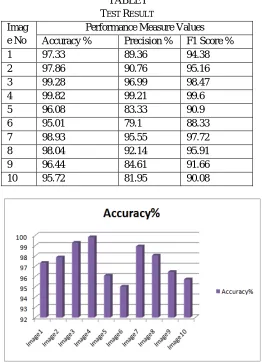
The experiment is conducted on 10 parking image samples for detection of parking spaces. Accuracy =(TP+TN)/(TP+TN+FP+FN) ...(1)
Precision =TP/(TP+FP) ...(2)
F1score=2*(Precision*Recall)/(Precision+Recall) ...(3)
TABLEI
TEST RESULT
Imag e No
Performance Measure Values
Accuracy % Precision % F1 Score %
1 97.33 89.36 94.38
2 97.86 90.76 95.16
3 99.28 96.99 98.47
4 99.82 99.21 99.6
5 96.08 83.33 90.9
6 95.01 79.1 88.33
7 98.93 95.55 97.72
8 98.04 92.14 95.91
9 96.44 84.61 91.66
[image:4.612.188.435.91.264.2]10 95.72 81.95 90.08
[image:4.612.179.441.352.715.2]688
[image:5.612.130.498.74.574.2]©IJRASET: All Rights are Reserved
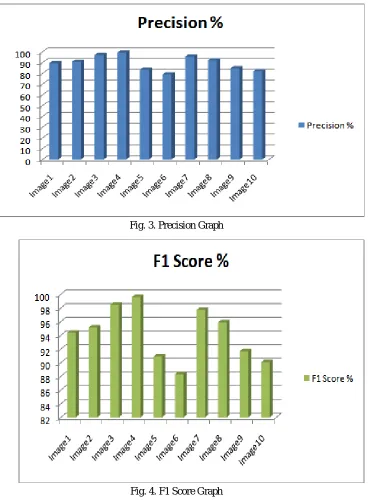
Fig. 3. Precision Graph
Fig. 4. F1 Score Graph
VI.CONCLUSIONS
The conclusion is that the system is proposed for detection of parking spaces using image processing and deep learning methods. Smart parking system is an answer to the current traffic congestion, to reduce drivers disturbance and saving fuel costs by giving data about the vacancy status of the parking places. We hereby goal to lessen the human pains required for parking of vehicle at open places.
VII. ACKNOWLEDGMENT
689
©IJRASET: All Rights are Reserved
REFERENCES
[1] Cristian Roman , Ruizhi Liao, Peter Ball," Detecting On-Street Parking Spaces in Smart Cities:Performance Evaluation of Fixed andMobile Sensing Systems."
1524-9050 © 2018 IEEE.
[2] P. Sanjeeva Reddy,G. S. Naveen Kumar, Bandi Ritish Reddy, Ch. SaiSwetha, K. Bhargava Abhilash ,"Intelligent Parking Space Detection System Based on
Image Segmentation,"IJSRD - International Journal for Scientific Research & Development Vol. 1, Issue 6, 2013.
[3] Thanh nam pham, Ming-fong tsai, Duc binh nguyen,chyi-ren dow, and Der-jiunn deng,"A Cloud-Based Smart-Parking System Based on Internet-of-Things
Technologies,"2169-3536 2015 IEEE
[4] Wael Alsafery,Badraddin Alturki,Stephan Reiff-Marganiec,Kamal Jambi,"Smart Car Parking System Solution for the Internet of Things in Smart
Cities,"978-1-5386-4427-0/18/ ©2018 IEEE
[5] Pampa Sadhukhan,"An IoT-based E-Parking System for Smart Cities,"978-1-5090-6367-3/17/ ©2017 IEEE.
[6] Sagar Rane,Aman Dubey, Tejisman Parida,Design of IoT Based Intelligent Parking System Using Image Processing Algorithms.978-1-5090-4890-8/17/
©2017 IEEE.
[7] Giuseppe Amato, Fabio Carrara, Fabrizio Falchi, Claudio Gennaro and Claudio Vairo,"Car Parking Occupancy Detection Using Smart Camera Networks and
Deep Learning,"2016 IEEE Symposium on Computers and Communication (ISCC).
[8] H. Zhao, L. Lu, C. Song, and Y. Wu, “IPARK: Location-awarebased intelligent parking guidance over infrastructureless VANETs,” International Journal of
Distributed Sensor Networks, vol. 2012.