II. PROBLEM STATEMENT
Mining rare itemsets via Apriori algorithm is the efforts to find frequent rare patterns which seem useful. However, in real applications which have multiple hierarchies with different tree structure and associated attributes, confront with difficult task to search useful rare patterns. I summarized the problems as following:
A. Structural problems
Several information domains are composed on a database and formed as hierarchies. They are different pattern and tree’s height that cause to hardly extract frequent itemsets both non-cross and cross level of abstraction itemsets.
B. Distribution of support value problems
According to Apriori algorithm, the extremely number of itemsets may be generated in primitive level, and it is more seriously when multiple conceptual levels have been included. The most popular tool to filter interesting itemsets is user minimum support; however it still has many concerns. In Table 2, I examine the extracted items which have 1 itemset size on 3 popular databases, Northwind (from www.microsoft.com), Adult and Census1990 (from www.ics.uci.edu). Obviously, I found that the 10% support values of each databases locate on very different percentile cause from dissimilar data characteristic. So, even if the minimum supports are the same, you cannot expect the number of results. It could be the strictly threshold as Adult database, or can be liberally threshold with a lot of itemsets return as Northwind and Census database. Or briefly say, at the same minimum support value, Adult database was resulted with the group of more interesting itemsets than averagely lower interesting itemsets of Northwind and Census database outcomes. This implies that you cannot use minimum support to clearly indicate the interestingness of itemsets. Moreover, from difference of statistic data, a little change of user minimum support may be trivial or crucial thing to interest on different databases. For example from Table 2, when changing from 10% to 11% minimum supports makes the increasing of percentile with 3.68%, 2.20% and 2.31% in Northwind, Adult and Census database respectively. This means, major effect is happened on Northwind database but little effect is occurred on Adult and Census database.
The distribution of support values among different size of itemsets is also the essential subject to be considered. Referring Table 1 and Fig. 1, focusing on Place of Birth and Occupation field, probability of {Horticulturist} and {Ohio} that can found on table are 1/4, when probability of {Horticulturist, Ohio} is the multiplication between probability of {Horticulturist} and {Ohio} or equal 1/16 (unfortunately, this itemset does not happen on Table 1). Similar with cross level itemsets: {Farm Operators, Ohio} and {Farm Operations, US} are 1/8 and 1/4 respectively. It means leaf-to-leaf 2-itemset has very low probability to occur; and definitely hardly to pass with user minimum support. In this point, you have to realize that the leaf-to-leaf itemsets which are neglected by user minimum support are not interesting, but they are neglected because they have high probability to be neglected. I called the interesting
itemsets which are neglected causes from their probability are “rare itemsets” which are our objective to evaluate them in this paper.
C. Effectiveness of existing thresholds problems
Continue from two previous problems, I doubt with the effectiveness of the popular threshold, minimum support. Can it help to evaluate interesting itemsets or rare itemsets for all levels effectively? Does it indicate the interestingness or only show about the confident degree of itemsets?
III. MINING RARE ITEMSET ON MULTI-LEVEL HIERARCHIES WITH SML-APRIORI ALGORITHM AND RARESUPP
INFORMATION
In this paper, I propose new way to solve 3 problems above by following:
A. Structural problems – Simplify it
Many researches [2], [4], [7]-[12], [17] proposed the solutions for this problems by complex coding hierarchy. In this paper, I use the simple solution by propagating the conceptual items in hierarchies to database and I tend them as same as primitive items. The example of propagation was shown in Table 3. This method will simplify the complexity of hierarchies’ problems. After propagating, I can apply the basic principle of Apriori for finding association rules. Note that, in the step of Apriori, I add candidate generating constraint that 2 items which have same root ancestor do not have to generate next size of candidate itemset. For example, {Chemical} and {Engineers} will not need for generating candidate {Chemical, Engineers} because they have same root {Professional Specialty}.
B. Distribution of support value problems – Solve by normal distribution curve
I found that statistic data of support values should be considered in frequent itemsets evaluation. Therefore I propose the new threshold, a percentile value (), for generating multiple minimum supports for every group of same itemset size. Each of minimum support values depends
TABLEII
PERCENTILE OF 10%SUPPORT ON VARIOUS DATABASES
Database #Record/
#Item Average SD
Percentile of 10%Sup Northwind
(Microsoft)
2,155
/202 85.35 154.31 80.05% Adult
(UCI)
32,561
/104 2,817.78 5,876.24 52.97% Census
1990 (UCI)
2,458,285
/2,170 27,252.45 171,994.75 89.81%
TABLEIII
EXAMPLE OF CENSUS DATABASE PROPAGATION
Sex Occupation Place of Birth
… M [Farmers], Farm Operators [Ohio], United States … … F [Chemical], Engineers,
Professional, Professional Specialty.
[Thailand], Asia …
… M [Petrolium], Engineers, Professional, Professional Specialty.
[New York], United States
…
… M [Horticulturist], Farm Operators
on statistic data of support values of itemsets which have same itemset size. Percentile value () is the statistic measurement for data positioning among their members, generally based on normal distribution curve. So, I propose to change the way from user specific minimum support (the old way) to selecting the significant itemsets by user specific percentile based on their statistic data, for example, changing from 10% user minimum support to 80% percentile value for “each groups of same size of itemsets”. From this point, all of significant itemsets in each size will be evaluated. That means rare itemsets will have more opportunity to be chosen and they can be used for next candidate generating. Note that, many of itemsets which have high support value will be dropped because that high value may seem too small when comparing with other itemsets on same itemset size, or it means they are no significance.
Definition 1: the minimum support of k-itemsets candidates: MSk is defined as below where MSSk is minimum support that calculates from user percentile value () and LS is user specific least support.
; ; Otherwise LS LS MSS If MSS
MS k k
k (1)
Definition 2: the minimum support of k-itemsets: MSSk is the generated support threshold which its value depends on statistic data of support values of all candidates in same itemset size, based on Normal Distribution Curve. MSSk is the support value which located on percentile, calculated from (2), and that percentile have to equal with user specific percentile (practically, Standard Curve Statistical Table is easier to use). Z-score getting from (2) will be used in (3) to find out MSSk. Remark that is Mean and is Standard Deviation.
z Z
dz e z Percentile 2 2 1 2 1 (2) z MSS (3)
Notice from Definition 1, least support (LS) is the one of two user specific values which refers to the lowest minimum support which should satisfy to become a frequent itemsets and prevents to create uninteresting concepts when standard deviation of its level nears zero. Least support is used together with user specific percentile () which illustrates in Definition 2. Percentile () is general statistic measurement that can reflect to significant position of data. In our opinion, percentile is clearly meaningful more than minimum support so much.
Integrating with the offering above, I propose Statistic Multi-Level Apriori (SML-Apriori) as shown in Fig. 2. First of all, database must be prepared by hierarchies propagating process, likes the example in Table 3. This database will be conducted together with the two user specific thresholds: percentile () and LS for our algorithm. Notice that, SML-Apriori modifies traditional SML-Apriori by adding step in line 9-12. I can explain that statistic values will be calculated in
each sizes of itemset, that shown in line 9-10. Then at line 11, MSSk will be returned from function get_MSS(), related
to Definition 2. Finally at line 12, the true minimum support gets from the largest value between MSSk and LS. After all
frequent itemsets are evaluated, all of them will be calculated for RareSupp information (it will be described next in definition 5), but I do not show in figure.
C. Effectiveness of existing thresholds problems – Offer new information values, rareness and RareSupp
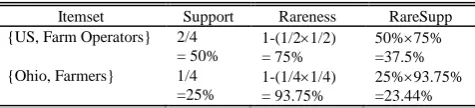
I found that minimum support is still the suitable indicator to measure confidential degree of itemsets, but confidential degree does not indicate the interestingness degree or measuring rareness of itemset. Root level itemsets which have high support value such as {US, Farm Operators} with 50% on Table 1 probably seem less interesting than {Ohio, Farmers} with 25%. So, {Ohio, Farmers} is the rare itemset which has more opportunity to drop by user minimum support. In this paper, I separated thresholds of confidence from interestingness. In aspect of confidence, I have proposed in Definition 1 and 2, but in term of interestingness and rareness, it shown in Definition 3 -5.
Definition 3: the rareness of k-itemsets is probability of occurrence that is defined below, where k is size of itemset, l is itemset and c is item contained in l.
[image:3.595.310.548.726.780.2]
} ) 15 ( ; ) 14 ( ; . ) 13 ( ; ; ) 12 ( ); , , ( _ ) 11 ( ); ) , 0 . ( _ ) 10 ( ); ) , 0 . ( _ ) 9 ( } ) 8 ( ; . ) 7 ( ) 6 ( ); , ( ) 5 ( { ) 4 ( ); ( _ ) 3 ( ){ ; ; 2 ( ) 2 ( ; 1 _ _ ) 1 ( ) , , ( 1 1 1 k k k k k k k k k k k k k k k t k t k k k L L return MS count c C c L Otherwise LS LS MSS If MSS MS MSS get MSS C c count c C mean get C c count c C ddev st get count c C c candidate each for t C subset C D t n transactio each for L Gen Candidate C k L k for D itemsets frequent find L LS D Apriori SML itemsets k of upport s Minimum MS itemsets k of t significan by upport s Minimum MSS items k with itemset Candidate C items k with itemset Frequent L pport su Least LS percentile specific User s hierarchie its by propagated which Database D Notation k k k k :Fig. 2. Psuedo code of SML-Apriori
TABLEIV
EXAMPLE OF RARESUPP CALCULATION
Itemset Support Rareness RareSupp {US, Farm Operators} 2/4
= 50%
1-(1/21/2) = 75%
50%75% =37.5% {Ohio, Farmers} 1/4
=25%
1-(1/41/4) = 93.75%
k
i
i
c Support l
Rareness 1 (4)
Definition 4: the minimum rareness of k-itemsets is the user specific value that used to choose rare itemsets.
Definition 5: the RareSupp of k-itemsets is support weighting information that is defined as below:
l Support
l Rareness
lRareSupp (5)
From definition 3, I propose the way to measure rareness of itemset and propose the choosing way for rare itemset in definition 4, but I realize that support of itemset must be considered as well. So, RareSupp in definition 5 was proposed for that point as additional information to user.
RareSupp calculation example was shown in Table 4. Remark that, RareSupp is merely additional information for sorting itemsets by interestingness. It does not apply for itemsets filtering.
IV. EXPERIMENTAL RESULTS
The experiments test on Census1990 database (U.S. Department of Commerce Bureau of Census) from (www.ics.uci.edu), by selecting 15 attributes which 5 hierarchies embedded, and random for 5% sample from original data or 122,914 records. This sample was propagated with abstract items contained in hierarchies, which consists of totally 1,885 items, 537 items are parent node in hierarchy trees. After running SML-Apriori with user percentile 60%-80%, I found that the outcomes
contained with leaf-to-leaf, leaf-to-other parent, or parent-to-other parent items that I expected.
Next, I roughly examine the rare itemsets by looking for average percentages of leaf-to-leaf itemsets to all of frequent itemsets in each sizes of itemset, and then comparing with traditional Apriori with minimum support 30%-50%. The results were shown in Fig. 3. Apparently, SML-Apriori can explore rare itemsets more efficient, almost all of itemset sizes with 30.39% average whereas performance of traditional Apriori declines at large sizes with 10.65% average.
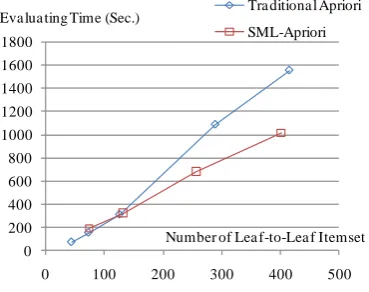
Evaluating time performances were shown in Fig. 4. Our experiments run on CPU Intel Core2 Duo 2.80GHz with 4G RAM. At the approximately same leaf-to-leaf itemsets, our algorithm, SML-Apriori, takes approximately equal evaluating time at the low number of leaf-to-leaf itemsets, but apparently faster about 26%-32% at high number of leaf-to-leaf itemsets.
Turning to interestingness measurement and rareness measurement, I make the experiment on knowledge representing between SML-Apriori with RareSupp information and support value on traditional Apriori that results in Table 5-6. The outcomes were sorted and only
0.00% 10.00% 20.00% 30.00% 40.00% 50.00% 60.00%
Size of Itemset Percenta ge of
Lea f-to-Lea f Itemsets
[image:4.595.58.227.459.579.2]Tra ditiona l Apriori SML-Apriori
Fig. 3. Rare itemset exploration performance at each itemset sizes
0 200 400 600 800 1000 1200 1400 1600 1800
0 100 200 300 400 500
Number of Lea f-to-Lea f Itemset Eva lua ting Time (Sec.) Tra ditiona l Apriori
SML-Apriori
Fig. 4. Evaluating time performance at various number of outcomes
TABLEV
TOP 5 OF ITEMSETS BY SML-APPRIORI, WITH RARESUPP
No Itemset Supp/
Rareness
RareSupp
1 Occupation: Group of Legislator Industry: Agricultural production Place of Birth: Group of Alabama Ability to Speak: Speaks Only Eng Year of Entry to US: Born in the US Place of Work: NA
Means of Transportation to Work: NA
35.01%/ 96.39%
33.74%
2 Occupation: Legislator (Others same as 1 excepted Occupation)
35.01%/ 96.39%
33.74%
3 Industry: Group of Agricultural production
(Others same as 1 excepted Industry)
35.01%/ 96.31%
33.71%
4 Occupation: Legislator Industry: Group of Agricultural production
(Others same as 1 excepted Occupation and Industry)
35.01%/ 96.31%
33.71%
5 Industry: Group of Agricalture, Forestry, and Fisheries
(Others same as 1 excepted Industry)
35.01%/ 96.21%
33.67%
Abstraction item is labeled prefix “Group of”. We neglect the item Language Spoken at Home: “Not in Universe” from the results.
TABLEVI
TOP 5 OF ITEMSETS BY TRADITIONAL APPRIORI
No Itemset Supp/
Rareness
RareSupp
1 Place of Birth: Group of Alabama Year of Entry to US: Born in the US
91.32%/ 16.60%
15.16%
2 Place of Birth: Group of Alabama Year of Entry to US: Born in the US Race: Group of American Indian
91.32%/ 16.60%
15.16%
3 Place of Birth: Group of Alabama Race: Group of American Indian
91.32%/ 8.68%
7.92%
4 Year of Entry to US: Born in the US Race: Group of American Indian
91.32%/ 8.68%
7.92%
5 Race: Group of American Indian Ability to Speak: Speaks Only Eng
87.62%/ 12.38%
10.84%
[image:4.595.64.249.624.770.2] [image:4.595.310.552.633.761.2]shown for top 5, most interesting to less. I found that even if the itemsets from traditional Apriori have very high support values, but they look like unuseful. In the opposite way of SML-Apriori with RareSupp information, RareSupp can help us to sort the interesting and rare itemsets more effective. In our some top of experimental results, from our approach, you can see the people who born in Alabama mostly are legislator in agricultural industry whereas you only get something that everyone known like the people born in Alabama are born in US, from traditional Apriori. So, our proposed information value will encourage user to realize it with real-world applications.
V. CONCLUSION
In this paper, I demonstrate the new algorithm, SML-Apriori, to mine multi-level rare itemsets with statistic technique. I also propose methods to serve multi-hierarchy which generally embedded in several attributes in real-world databases and raise the new information value, RareSupp, for measuring interestingness of itemsets. With our approach, I can explore non-cross and cross level rare itemsets in any sizes of itemset. Additionally, our chosen threshold, user percentile (), is bearable with the changing to any databases and it is the one of good meaningful thresholds. The experiments show that SML-Apriori and RareSupp have very good outcomes and seem more realize in real-world applications. Anyway, applying to other style of Apriori is one of my challenges in my future works.
REFERENCES
[1] B. Liu, W. Hsu and Y. Ma. “Integrating Classification and Assocoiation Rule Mining,” In Proc. KDD-98, 1998, pp80-86. [2] D. Xiangjun, Z. Zhiyun, N. Zhendong and J. Qiuting, “Mining
Infrequent Itemsets Based on Multiple Level Minimum Supports,”
Innovative Computing, Information and Control (ICICIC '07), 2007, pp.528.
[3] H. Xiong and P.-N. Vipin Kumar, “Mining strong affinity association patterns in data sets with skewed support distribution,” The Third IEEE International Conference on Data Mining (ICDM’ 03), 2003, pp. 387-394.
[4] J. Han and Y. Fu, “Discovery of multiple-level association rules from large databases,” In Proc. of the 21st International Conference on Very Large Databases (VLDB), Switzerland, 1995, pp. 420-431. [5] J. Han and Y. Fu, “Mining Multiple-level Association Rules in Large
Databases,” IEEE Transactions on Knowledge and Data Engineering, 1999 vol.11.
[6] K. Younghee and K. Ungmo, “Mining Multilevel Association Rules on RFID Data,” The 1st Asian Conference on Intelligent Information and Database Systems (ACIIDS’ 09), 2009, pp. 46-50.
[7] M. Pater, A. Bogan-Marta, C. GyĘrödi, R. GyĘrödi, “Multilevel frequent pattern mining from databases using AFOPT data structure,”
The 7th International Conference on Technical Informatics CONTI’2006, Romania, 2006, pp. 251-256.
[8] M. Pater and D.E. Popescu, “Market-basket problem solved with depth first multi-level apriori mining algorithm,” The 3rd International Workshop on Soft Computing Applications (SOFA '09), 2009, pp. 133-138.
[9] M. Pater and D.E. Popescu, “The Benefits of Using Prefix Tree Data Structure in Multi-Level Frequent Pattern Mining,” The 2nd International Workshop on Soft Computing Applications (SOFA ’07), 2007, pp.179-182.
[10] M. Runying, “Adaptive-FP: An Efficient and Effective Method for Multi-Level and Multi-Dimensional Frequent Pattern Mining,” Simon Fraser University, 2001.
[11] N. Rajkumar, M.R. Karthik and S.N. Sivanandam, “Fast Algorithm for Mining Multilevel Association Rules,” IEEE Web Technology and Data Mining, TENCON, 2003, pp. 687-692.
[12] R. Agrawal, C. Agrawal and V.V.V. Prasad, “Depth first generation of large itemsets for association rules,” IBM Tech. Report, RC21538, 1999.
[13] R. Agrawal and R. Srikant, “Fast algorithms for mining association rules in large databases,” In Proceeding of 20th International Conference on VLDB, 1994, pp.487-499.
[14] R. Agrawal, T. Imielinski and A. Swami, “Mining association rules between sets of items in large databases,” In Proceedings of the ACM SIGMOD Conference on Management of Data, 1993, pp. 207–216. [15] R. GyĘrödi, C. GyĘrödi, M. Pater, O. Boc and Z. David, “AFOPT
Algorithm for multi-level databases,” The 7th International Symposium on Symbolic and Numeric Algorithms for Scientific Computing (SYNASC 05), ISBN 0-7695-2453-2, Timisoara, 2005, pp. 135-139.
[16] R. GyĘrödi, C. GyĘrödi, M. Pater, O. Boc and Z. David, “FP-Growth algorithm for multi-level databases,” The 15th International Conference on Control Systems and Computer Science (CSCS-15), Bucuresti, 2005, pp. 847-952.
[17] R. Srikant and R. Agrawal, “Mining Generalized Association Rules,” In Research Report RJ 9963, IBM Almaden Research Center, San Jose, California, USA, 1995.
[18] W.J. Frawley, G. Piateetsky-Shapiro and C.J. Matheus, “Knowledge discovery in databases: An overview,” In G. Piateetsky-Shapiro and W.J.Frawley, eds. Knowledge Discovery in Databases, AAAI/MIT Press, 1991.
[19] M. Adda1, L. Wu and Y. Feng, “Rare Itemset Mining,” The 6th International Conference on Machine Learning and Applications, 2007.