FIRM BUSINESS STRATEGY AND IT STRATEGY ALIGNMENT:
*Aouatif Benkhayat and Abdellah El
ARTICLE INFO ABSTRACT
Business
alignment has been found to
and improved IS strategic planning. However mea economic growth in morocco in t
resource. Despite the increasing interest in Moroccan IS issues by researchers and practitioners, empirical
measure the alignment degree in 13 Moroccan firms, and to study the maturity levels’ of this alignment using SAMM model. Than we validated our model via a linear regression s
the results of
Copyright©2016, Aouatif Benkhayat. This is an open access article distributed under the Creative Commons Att distribution, and reproduction in any medium, provided the original work is properly cited.
INTRODUCTION
The matter of Business and IT alignment has been discussed since the 1980s. Nowadays, it is impossible to do business and maintain a strong market position without having an aligned IT strategy. Alignment results in a partnership between IT and Business managers in developing and achieving their strategies and goals. The IBM Global CEO Study of CEOs explains that many companies have to deal with a gap in the integration of business and technology, which could lead to lower customer satisfaction, adaptation speed and process flexibility. Literature proposes several models of strategic alignment, but just few studies focused on developing an instrument for measuring business-IT alignment. [Luftman, 2000] proposed a framework called strategic alignment maturity (SAMM) based on SAM model which was developed by [Henderson & Venkatraman, 1999]. Luftman’s SAMM framework includes five conceptual levels of strategic alignment maturity
Luftman, 2004). It consisted of six maturity factors:
communication, competency, governance, partnership,
technology scope, and skills. Each key area identifies a grouping of related mechanisms that, when performed collectively, are considered important for enhancing IT Business alignment capability.
*Corresponding author: Aouatif Benkhayat,
University Mohmed, Morocco.
ISSN: 0975-833X
Article History:
Received 14th September, 2016 Received in revised form 22nd October, 2016
Accepted 18th November, 2016 Published online 30th December,2016
Key words:
Business strategy;
Information technology strategy; Information technology strategic Alignment; Business performance; Strategic alignment model.
Citation: Aouatif Benkhayat, 2016. “Firm business strategy and it strategy alignment: validation of a proposal model Research, 8, (12), 44031-44035.
RESEARCH ARTICLE
FIRM BUSINESS STRATEGY AND IT STRATEGY ALIGNMENT: VALIDATION OF
A PROPOSAL MODEL
*Aouatif Benkhayat and Abdellah El Manouar
University MohmedV, Morocco
ABSTRACT
Business-It alignment is ranked the number one of IT and Business executives
alignment has been found to lead to stronger business performance, higher perceived value of IT improved IS strategic planning. However measuring this alignment is still
economic growth in morocco in the last decade has led to greater availability of IT as a critical resource. Despite the increasing interest in Moroccan IS issues by researchers and practitioners,
cal research focusing on Business-IT strategy alignment are limited. So, in this stud
measure the alignment degree in 13 Moroccan firms, and to study the maturity levels’ of this alignment using SAMM model. Than we validated our model via a linear regression s
the results of our model and those of SAMM.
is an open access article distributed under the Creative Commons Attribution License, which distribution, and reproduction in any medium, provided the original work is properly cited.
matter of Business and IT alignment has been discussed since the 1980s. Nowadays, it is impossible to do business and maintain a strong market position without having an aligned IT strategy. Alignment results in a partnership between IT and rs in developing and achieving their strategies and goals. The IBM Global CEO Study of CEOs explains that many companies have to deal with a gap in the integration of business and technology, which could lead to lower customer d and process flexibility. Literature proposes several models of strategic alignment, but just few studies focused on developing an instrument for measuring IT alignment. [Luftman, 2000] proposed a framework MM) based on SAM model which was developed by [Henderson & Venkatraman, 1999]. Luftman’s SAMM framework includes five conceptual levels of strategic alignment maturity (Luftman, 2000; . It consisted of six maturity factors:
petency, governance, partnership,
technology scope, and skills. Each key area identifies a grouping of related mechanisms that, when performed collectively, are considered important for enhancing
IT-In this paper we propose to validate our model based on Miles and snow’s (Meyer, 1978; Miles
(Henderson, 1988), using a questioner addressed to some of the most important firms in morocco, to define the type of IT and Business strategy, than measure the interdependence of these types to get the degree of alignment. The result of our analysis was than compared to the result of SAMM model. final objective of our study was to pr
orientation of strategic IT and strategic Business are similar, the strategic alignment is mature.
Theorical background
Business-IT alignement
A large number of researches have proposed various concepts related to IT-Business Alignment. Achieving alignment requires an ongoing effort of strategic planning, goal realignment and implementation of best practice in supporting and shaping business strategies. Through strategic alignment, the aim of IT now is not only to improve efficiency but also to improve business effectiveness and to manage organizations more strategically. The importance of alignment has been widely recognized and well documented
however, many companies are still misaligned. And this is due to the absence of practical model to identify the degree of alignment and how to maintain it. [Luftman and BRIER, 99] [Luftman, 1999], proposes a framework to measure the
International Journal of Current Research
Vol. 8, Issue, 12, pp.44031-44035, December, 2016
INTERNATIONAL
Firm business strategy and it strategy alignment: validation of a proposal model
VALIDATION OF
Business executives concern. Having lead to stronger business performance, higher perceived value of IT suring this alignment is still ambiguous. The he last decade has led to greater availability of IT as a critical resource. Despite the increasing interest in Moroccan IS issues by researchers and practitioners, IT strategy alignment are limited. So, in this study we tried to measure the alignment degree in 13 Moroccan firms, and to study the maturity levels’ of this alignment using SAMM model. Than we validated our model via a linear regression study applied to
ribution License, which permits unrestricted use,
In this paper we propose to validate our model based on Miles Miles, 1978) strategic frameworks , using a questioner addressed to some of in morocco, to define the type of IT and Business strategy, than measure the interdependence of these types to get the degree of alignment. The result of our analysis was than compared to the result of SAMM model. The final objective of our study was to prove that when the orientation of strategic IT and strategic Business are similar, the strategic alignment is mature.
A large number of researches have proposed various concepts Business Alignment. Achieving alignment requires an ongoing effort of strategic planning, goal realignment and implementation of best practice in supporting ategies. Through strategic alignment, the aim of IT now is not only to improve efficiency but also to improve business effectiveness and to manage organizations more strategically. The importance of alignment has been documented (Henderson, 1999); however, many companies are still misaligned. And this is due to the absence of practical model to identify the degree of alignment and how to maintain it. [Luftman and BRIER, 99] proposes a framework to measure the
INTERNATIONAL JOURNAL OF CURRENT RESEARCH
strategic alignment maturity, based on the model SAM [Henderson and Venkatraman, 93]. This model provides a tool to evaluate the maturity of their strategic choices and alignment activities and identify areas in which they can achieve a higher level of alignment. [Sledgianowski et al., 2004] created an instrument to measure maturity of IT-Business alignment based on SAM. They use the six categories in Table 1 for assessing alignment which contain 39 items. For each item, manager gives an answer on five choice scales, representing a different level of maturity.
Table 1. Criteria of alignment maturity [Luftman, 00]
Factor Components
Communication Com1: The degree of understanding Business by the IT functions
Com2: The degree of understanding IT by Business Com3: The degree of richness of the methods used for the organizational learning
Com4: The style of communication used in the organization
Com5: The degree of knowledge sharing throughout the organization
Com6: The use of IT Business liaisons
Competency Comp1: Focus of the metrics and processes used to measure the contribution of the IT
Comp2: Focus of the metrics and processes used to measure the Business contribution
Comp3: Degree and the orientation of integrated IT and Business measures
Comp4: Degree of service level agreements Comp5: Frequency and formality of benchmarking practices
Comp6: Frequency and formality of IT assessments and reviews
Comp7: Degree of continuous improvement practices
Comp8: Contribution of IT in strategic objectives. Governance
Gov1: The degree of business strategic planning with IT involvement
Gov2: The degree of IT strategic planning with business involvement
Gov3: Basis of budgeting IT resources Gov4: Basis of IT investment decision
Gov5: Frequency, formality and effectiveness of IT steering committees
Gov6: Integration of IT projects prioritization Gov7: responsiveness of IT functions to changing business needs
Partnership Part1: The Business’ perception of the role of IT Part2: The role of IT in strategic business planning Part3: Integrated shared risks and rewards
Part4: Formality and effectiveness of partnership program
Part5: Perception of trust and value
Part6: Reporting level of business sponsor/champion Technology scope
maturity (SCOPE)
SCOPE1: Technological and strategic sophistication of primary systems/ applications
SCOPE2: IT standards articulation and compliance SCOPE3: :Degree of architectural integration SCOPE4: Degree of infrastructure transparency SCOPE5: Degree of infrastructure flexibility Skills maturity Skills1: Degree of cultural innovation
Skills2: Degree of integrated locus of power in IT-based decisions
Skills3: Degree of a change readiness culture Skills4: Degree of opportunity for skills enrichment through job transfer
Skills5: Degree of opportunity for skills enrichment through cross-training or job rotation
Skills6: Degree of interpersonal interaction across IT and Business
Skills7: Ability to attract and retain IT staff with technical and business skills
An answer of one indicated the lowest level of maturity, and an answer of five indicated the highest level of maturity. Depending on how an organization scores the components of each factor, one of the five levels of strategic alignment maturity is assigned to the organization. The five process levels are:
Initial/Ad Hoc Process – business and IT are not aligned
or harmonized
Committed Process – the organization has committed to
becoming aligned
Established Focused Process – Strategic Alignment
Maturity established and focused on business objectives
Improved/Managed Process – Reinforcing the concept
of IT as a Value Centre
Optimized Process – Integrated and co-adaptive
business and IT strategic planning
Proposed model
The model proposed [Aouatif BENKHAYAT, 2015] is based on Miles and Snow typology that classify strategies in four types: Prospector, defender, analyzer and reactor. In our study we restricted to Prospector, Defender and Reactor typology, for whom we defined tree metrics [Aouatif BENKHAYAT, 2015]. These metrics are compared to each other using a questionnaire that was completed by IT and Business managers. We collected answers in the form of two matrix, one for IT and the other for Business, after standardized them using AHP method, we got a priority vector for each strategy. The degree of alignment corresponds to the degree of similarity of the two vectors [Fenwick, 2012].
Validation of the proposal model
To validate our model, we applied it on 13 Moroccan companies, on which we had already applied the SAMM [Luftman, 2000] model. Than we compare the two results using correlations and multiple regression analyses.
IT issues in Morocco
As Morocco’s economy continues to grow, companies made important investment in IT to boost the productivity of their employees. However, the management of IT still remains a new discipline and IT managers haven’t enough skills and experience. They lack awareness of IT, of the role of IS department and how to get added value from IT investment. Though, we noticed that in Moroccan companies, IT applications are starting to move away from traditional transaction processing systems. For example, many companies are getting ERP and supply chain management, and the success of these systems requires a developed coordination and collaboration between IT and business unit.
Instrument used
nine choice scale [Saaty and Vargas, 1991; Saaty and Vargas, 2000]. To ensure the validity of the questionnaire content, it was reviewed by two researchers in the area of the business-IT alignment. They were asked to suggest additions, deletions and modifications of the used items or to validate them. The feedback resulted in minor revisions. Then, the questionnaire was pilot tested to check if it is clear and understandable.
Data collection
[image:3.595.73.526.162.280.2]Thirteen Moroccan organizations participate in this study including the historical telecommunication operator, the railway company, the highway company, the post office, three manufacturers and six firms in the financial, insurance and service industry (Table 3).
Table 2. Business/It strategy matrix
Business Strategy Prospector Defender Reactor
P1 P 2 P 3 D1 D2 D3 R1 R2 R3
P 1 1 A12 A13 A14 A15 A16 A17 A18 A19
P 2 10-A12 1 A23 A24 A25 A26 A27 A28 A29
P 3 10- A13 10- A23 1 A34 A35 A36 A37 A38 A39
D1 10- A14 10- A24 10- A34 1 A45 A46 A47 A48 A49
D2 10- A15 10- A25 10- A35 10- A45 1 A56 A57 A58 A59
D3 10- A16 10- A26 10- A36 10- A46 10- A56 1 A67 A68 A69
R1 10- A17 10- A27 10- A37 10- A47 10- A57 10- A67 1 A78 A79
R2 10- A18 10- A28 10- A38 10- A48 10- A58 10- A68 10- A78 1 A89
R3 10- A19 10- A29 10- A39 10- A49 10- A59 10- A68 10- A79 10- A89 1
[image:3.595.102.499.308.443.2]Total X1 X2 X3 X4 X5 X6 X7 X8 X9
Table 3. Interviewed compagnies
Company Area of operation
Souriau Esterline Connection technology producer
IAM Telecommunication operator
ONCF Moroccan railway company
Sofac Credit institution
Capgemini IT service company
Barid Al Maghrib Letters and parcels delivery company
Nexans Manufacture of industrial wires and cables and fiber optic cables Anonymous Unknown company of metallurgy
SGMB Bank
RMA Assurance Insurance company GROUPE AFMA Insurance broker
ADM National company, in charge of building, maintaining and operating the motorway network a-SIS Publisher and integrator of complete solutions for logistics
Table 4. Alignment Degree Using Benkhayat Model
Compagnie Alignement degree Souriau Esterline 12%
IAM 21%
ONCF 4%
Sofac 5%
Capgemini 62%
Barid Al Maghrib 23%
Nexans 71%
Metallurgie 59%
SGMB 13%
RMA Assurance 76%
GROUPE AFMA 22%
ADM 77%
a-SIS 45%
Table 5. Companies' Maturity Assesments
Communication Competency/Value Governance Partnership Scope & Architecture Skills Overall Maturity
Souriau Esterline 2,2 2,1 2,3 1,5 2,4 2,7 Level 2
IAM 3,5 2,8 2,7 2,8 4,0 2,6 Level 3
ONCF 1,3 1,4 1,1 1,8 1,4 1,7 Level 1
Sofac 3,0 2,3 3,9 3,0 2,6 2,4 Level 2
Capgemini 3,5 4,4 5,0 4,5 4,8 4,1 Level 4
BaridAlMaghrib 3,5 3,3 3,6 2,8 2,2 2,3 Level 2
Nexans 4,0 4,3 4,4 4,3 4,0 4,7 Level 4
Metallurgy 3,8 3,5 2,9 3,2 2,6 2,3 Level 3
SGMB 3,5 3,1 2,3 2,5 2,8 2,6 Level 2
RMA Assurance 4,2 4,4 4,3 4,2 4,2 3,6 Level 4
GROUPEAFMA 2,0 2,1 2,0 1,7 2,8 2,3 Level 2
ADM 4,7 3,9 3,7 4,5 4,2 4,4 Level 4
[image:3.595.222.375.473.607.2] [image:3.595.55.547.637.772.2]The number of employees ranged from approximately 500 employees to over 9,000 employees. For the five publicly held companies, total revenue ranged from 6.5 Milliard to 1.2 Million Dirhams. The questionnaire was filled up by managers using google forms, than data was collected and formatted using AHP method. For every company, we calculated Business and IT orientation vector. The degree of alignment ranked between 4% and 77 % (Table 4), which means that alignment needs to be inserted in almost Moroccan companies. To determine whether our model demonstrated acceptable reliability and validity, and whether it was able to give an exact degree of alignment, we applied the SAMM assessment instruments, which are based on best practice for IT-business strategic alignment derived from literature reviews of academic researchers.
The companies’ maturity assessment results are listed in Table 5. The alignment maturity degree’ varies from level 2 to level 4, with an average of level 3 for each category of the SAMM model. Companies surveyed have almost an established alignment process that is focused on business objectives
For each level we calculate the percentage using this formula:
P=Level*100/5
Data Analysis
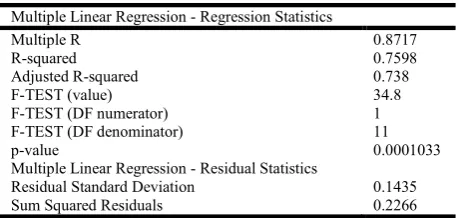
To cross validate the alignment degree, we used simple linear regression analysis. This allows quantifying the strength of the relationship between the two models. If there is a strong correlation between our model results and calculated P from SAMM model, then we can validate our instrument. The simple multiple linear regression model R²=0.787 was significant (p-value<0.01) (see Table 7). The estimated regression equation is as follow:
Benkhayat Model[t] = -0.460831 + 1.54919SAMM[t] + e[t]
The value of R is 0.8717. According to Pearson’s correlation, this is a strong positive correlation, which means that alignment degree from our model goes with high SAMM degree of alignment maturity (and vice versa). The value of R², the coefficient of determination is 0.7598.
This result provides further evidence that the degree of alignment calculated using our proposed model can be deduced using SAMM models. This strong correlation between the result of our model and the SAMM results’ proves the validity of our model.
DISCUSSION
Our study was designed to answer the following research question. Is the instrument we proposed for measuring Business/IT alignment reliable and valid? The instrument was evaluated using simple linear regression analysis in comparison to SAMM results’, the result was very significant and the correlation was very strong. We also realized that Moroccan companies have an important ware about IT-Business strategy alignment. We found that the average alignment maturity of these companies fell between level 2 and level 4 on the maturity scale. One Moroccan company even failed to achieve level 2 maturity,5 companies achieve claimed to achieve level 2 maturity to some extent, and only four organizations achieved level 4. The research instrument developed, validated, and tested in this study provides a tool that appears to be useful for practitioners and managers to measure their alignment degree. This will allow them to take actions for performing their business and IT strategy. Further the data from the 13 large companies not only provide a snapshot of the state of business-IT alignment of companies in Morocco but do serve as the starting point of a benchmark against which companies in morocco can improve their alignment maturity.
Limitations and directions for future studies
[image:4.595.126.473.76.120.2]Like any research, this study has several limitations, which should be mentioned, that can provide opportunity for future research. The primary limitation of this research study is the number of participated companies (n=13), which is relatively limited. Also this study was unable to examine any firms with extreme level of maturity, either low or high, and was therefore unable to provide any information about the effect of low or high maturity. Additionally work should be carried out to improve the questionnaire used in our model, to facilitate the data collection and to ensure more answers.
Table 6. Multiple Linear Regression - Ordinary Least Squares
Variable Parameter S.D. T-STAT 2-tail p-value 1-tail p-value H0: parameter = 0
(Intercept) -0.4608 0.1475 -3.1240e+00 0.009674 0.004837
SAMM +1.549 0.2626 +5.8990e+00 0.0001033 5.165e-05
Table 7. Multiple Linear Regression - Regression and residual Statistics
Multiple Linear Regression - Regression Statistics
Multiple R 0.8717
R-squared 0.7598
Adjusted R-squared 0.738
F-TEST (value) 34.8
F-TEST (DF numerator) 1
F-TEST (DF denominator) 11
p-value 0.0001033
Multiple Linear Regression - Residual Statistics
Residual Standard Deviation 0.1435
[image:4.595.185.415.146.255.2]REFERENCES
Aouatif BENKHAYAT, Abdellah El MANOUAR, Sadok Hicham Firm Business strategy and IT strategy Alignment: A Proposal of a new model, CSIT 2015
Fenwick, Nigel 2012. “Forget Alignment:HowToCo-Create A Business Strategy”, Information Week, Global CEO, April 05, 201209:15AM
Henderson, J.C., Sifonis, J.G. ThevalueofstrategicISplanning: Understandingconsistency, validity, and IS markets. MIS Quarterly, 1988, 12(2):187-200.
Henderson, J.C., Venkatraman N., "Strategic Alignment: Leveraging information technology for transformation
organizations". IBM Systems Journal, vol 38.N°S2&3.
AdamsRenner,1999.
Luftman, J. 2000. Addressing business-IT alignment maturity. Communications of the Association for Information Systems, 4(14), 1-50.
Luftman, J. N., Bullen, C. V., Liao, D., Nash, E., & Neumann, C. 2004. Managing the Information Technology Resource. Upper Saddle River, NJ: Prentice-Hall.
Luftman, J. N., Papp, R. and Brier, T. 1999. Enablers and inhibitors of business-IT alignment. Communications of the Association for Information Systems, 1(11), 1-33 Meyer A. Management and strategy. In: Miles RE, Snow CC,
eds. Organizational Strategy, Structure, and Process. NewYork:McGraw-Hill,1978:546-562.
Miles R E, Snow C C. Organizational Strategy, Structure, and Process. NewYork: McGraw-Hill,1978.
Saaty T.L., and Vargas, L.G. 2000. Models, Methods, Concepts and Applications of the Analytic Hierarchy Process, Boston:KluwerAcademicPublishers.
Saaty, T.L. and Vargas L.G. 1991. Prediction, Projection and Forecasting, Boston: KluwerAcademic.
Sledgianowski, D., Luftman J. N., Reilly R. R., Development and validation of an instrument to measure maturity of IT
business strategicalignment mechanisms, Information
Resources Management Journal, 19(3), 2006, pp.18–33.
![Table 1. Criteria of alignment maturity [Luftman, 00]](https://thumb-us.123doks.com/thumbv2/123dok_us/9246824.412500/2.595.39.289.191.760/table-criteria-alignment-maturity-luftman.webp)