ISSN Online: 1949-5005 ISSN Print: 1949-4998
DOI: 10.4236/health.2018.1012131 Dec. 21, 2018 1734 Health
Prediction of Adherence to a 9-Week Corporate
Wellness Walking Program
Megan Flynn
1, Eric E. Hall
2*1Department of Public Health Studies, Elon University, Elon, NC, USA 2Department of Exercise Science, Elon University, Elon, NC, USA
Abstract
The health and economic benefits of workplace wellness programs are well founded, but the favorable results only occur when employees choose to partici-pate and adhere to these programs. The objective of this study was to use the Theory of Planned Behavior and Self-Efficacy Theory to predict whether partic-ipants adhered to a corporate wellness walking program. The sample consisted of 110 faculty and staff at a private university who enrolled in a walking program through the university’s wellness center. Participants completed surveys at the beginning of the program. The surveys measured self-reported physical activity, as well as theoretical construct of self-efficacy and those related to the Theory of Planned Behavior—attitude, social norms, perceived behavioral control and in-tention. Sixty percent of participants were found to meet the program’s goals. Self-reported physical activity (p = 0.036), barrier self-efficacy (p = 0.016), walk-ing self-efficacy (p = 0.002), and intention (p < 0.001) were greater in those who met the goals than those who did not meet the goals of the program. Walking self-efficacy (p < 0.001), attitude (p < 0.001) and perceived behavioral control (p = 0.024) were all found to predict intention to walk and intention was a signifi-cant predictor of whether or not the participants met goals of the program (p = 0.022). This suggests behavioral interventions aimed at increasing participant self-efficacy and intentions could positively affect program adherence and the successfulness of a workplace wellness program.
Keywords
Physical Activity, Theory, Worksite Health, Self-Efficacy, Theory of Planned Behavior
1. Introduction
An objective of Healthy People 2020 is to increase the amount of employed How to cite this paper: Flynn, M. and
Hall, E.E. (2018) Prediction of Adherence to a 9-Week Corporate Wellness Walking Program. Health, 10, 1734-1748.
https://doi.org/10.4236/health.2018.1012131
Received: October 22, 2018 Accepted: December 18, 2018 Published: December 21, 2018
Copyright © 2018 by authors and Scientific Research Publishing Inc. This work is licensed under the Creative Commons Attribution International License (CC BY 4.0).
http://creativecommons.org/licenses/by/4.0/
DOI: 10.4236/health.2018.1012131 1735 Health adults who have access to and take advantage of employer-based exercise
facili-ties and exercise programs [1]. Employer-based wellness programs have recently
received an enormous amount of attention not only from Healthy People 2020, but also from the private and government sectors in an effort to increase the health of the populations targeted, but also to serve as a primary prevention strategy [2] [3] [4]. Employers can reap the financial benefits of wellness pro-grams. More than 60% of Americans receive their health insurance coverage
through an employment-based plan [5]. Wellness programs can lead to reduced
expenditure on health care [3][6] [7]. Many employees spend a large majority of their waking hours at the workplace and in a recent study it was found that for every dollar spent on wellness programs medical costs fall by $3.27 and absen-teeism costs fall by $2.73 [3]. Another study found that for every dollar spent there was a $2.53 return of investment on workplace health promotion programs
[8]. The former U.S. Surgeon General Regina Benjamin urged business
execu-tives to understand their role and to commit to changes that promote health and
wellness [1]. The percentage of firms offering wellness programs has increased
to 65% in 2011 from 58% in 2009, 14% of those employers offer incentives like gift cards or cash to increase participation in corporate wellness [9]. These fac-tors reaffirm why the workplace is the most reasonable setting to provide disease prevention and health promotion.
However, the implementation of these workplace health promotion programs warrants the use of best practices to obtain the desired results [10]. The two ma-jor threats to employer-based wellness program success involve employee par-ticipation and adherence to programs. Further research needs to be performed on effective recruitment and attrition prevention [11]. To properly analyze these factors the research should be based on best practices and theories relevant to health behavior [2]. Self-Efficacy Theory [12] and the Theory of Planned Beha-vior [13] [14] [15] are two commonly used theories of health behavior that could provide knowledge on the best predictors of participant adherence to workplace interventions.
Self-efficacy is the belief that one can successfully execute the behavior re-quired to produce the outcomes and has consistently presented itself as a
deter-minant of health behavior in adults [12]. Self-efficacy is a commonly studied
predictor of physical activity and a mediator of intervention effects on physical activity [16] [17] [18]. Not only are those with higher self-efficacy more likely to perform physical activity, they are also more likely to maintain exercise over a period of time. Self-efficacy may serve as a mediator between intention and be-havior change [19] [20].
In workplace interventions, self-efficacy has been found to be strongly asso-ciated with physical activity [17]. But, for adults, increasing self-efficacy has shown to be difficult, and interventions at the workplace have been only mod-erately successful in increasing self-efficacy to promote exercise. Yet, when self-efficacy is successfully improved throughout an intervention, attrition from
DOI: 10.4236/health.2018.1012131 1736 Health among middle-aged adults, the intervention group walked more frequently, for longer durations, and greater distances [22]. Surprisingly, the intervention had direct effects on adherence rather than through self-efficacy. Self-efficacy was only significantly predictive of walking adherence at early and middle stages, but not during the last month of the program.
The Theory of Planned Behavior is another commonly used theory to predict physical activity behaviors [13]. In this theory, intention is believed to be the most proximal predictor of behavior. The other constructs included in the model are attitude and subjective norms, which predict intention, and perceived beha-vior control, which is thought to have influence on intention and behabeha-vior. Overall, the Theory of Planned Behavior proposes that an individual will intend to engage in a behavior if he or she assigns a positive evaluation to it, believes that significant others think he or she should complete it, and perceives the be-havior to be under his or her control [14].
The Theory of Planned Behavior has been applied to the prediction of a ple-thora of behaviors, including physical activity [23]. In a study of college students engaging in exercise after a two-week follow-up period, intention and perceived behavioral control accounted for 43% of the variance in exercise behavior [20]. Attitude and perceived behavioral control were successfully predictive of inten-tion. Similarly, a study of participants enrolled in a gym membership found per-ceived behavioral control was significant predictor of intention and exercise
be-havior at a 12-week follow-up [24]. Another study by Godin, Valois and Lepage
found conflicting results [25]. Perceived behavioral control was not directly re-lated to behavior, but rather it influenced intention. This study suggested that perceived behavioral control was only useful in understanding exercise inten-tion, but not predictive of exercise behavior [25].
Walking as exercise has been highlighted as a free and relatively low-impact
form of exercise from which many health benefits can be accrued [26] [27]. A
recent meta-analysis found that the benefits from walking include significant decreases in systolic and diastolic blood pressure, resting heart rate, body fat, BMI, total cholesterol, 6-minute walk time and depression, while increases were seen in VO2 max and quality of life for physical functioning. These were im-provements were found despite about 75% of the participants were active at a level below moderate physical activity guidelines [28]. This demonstrates that even a minimal change in walking behavior can still have a significant impact on health. These findings are similarly to other studies that have found walking to
improve all-cause mortality, body composition and body composition [29] [30].
Similarly, a recent scoping review found that walking improved mental health
[31]. Pedometer-based walking programs can result in moderate weight loss,
with the longer the program the higher the weight loss [32]. A systematic review of pedometer-programs assessed that pedometers increased the mean steps by 2491 steps per day [33].
interven-DOI: 10.4236/health.2018.1012131 1737 Health tions to promote exercise and physical activity, and commonly the studies rely on the constructs of Self-efficacy theory and Theory of Planned Behavior, but few have used these theories to predict adherence to a walking program in cor-porate wellness setting [34] [35]. The purpose of this study was to use theoretical constructs to predict walking behavior in a pedometer-based, corporate wellness program.
2. Methods
2.1. Participants
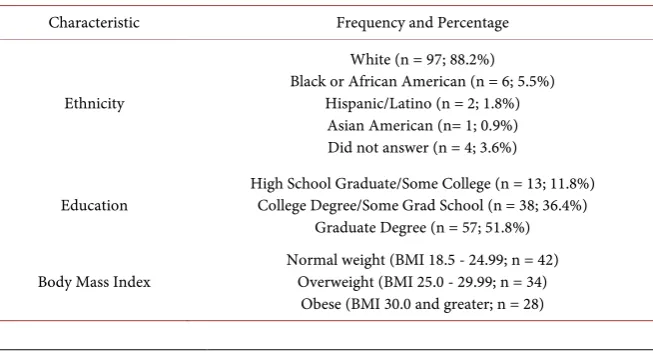
Participants were recruited from a private university in the Southeastern part of the United States in September 2015. All participants had at that time agreed to participate in a pedometer-based walking program put on by the university’s wellness program. After they had signed up for the program, the authors con-tacted all the participants in the program to see if they would be willing to par-ticipate in a study about the effectiveness of the walking program. The original sample consisted of 110 faculty and staff who were enrolled in the walking pro-gram through the university’s wellness center and agreed to participate in the study. There were 93 (84.5%) females (mean age = 42.0 ± 11.6 years; BMI = 27.2
± 6.0 kg/m2). Additionally, 88.2% of the participants classified themselves as
white and 89.2% had at least a college degree (see Table 1 for additional details about the sample). The research protocol was approved by the Institutional Re-view Board and all participants gave informed consent to participate in the study. Participants who completed the study were given a $10 gift card from the authors.
2.2. Measures
Physical Activity: The Godin Leisure-Time Exercise Questionnaire was used to
[image:4.595.210.537.563.742.2]assess physical activity habits over a 7-day period [36]. It asks how often indi-viduals engage in light, moderate, and strenuous activities for at least 15 minutes or more. They were asked which exercises they typically do throughout the week
Table 1. Demographic characteristics of sample.
Characteristic Frequency and Percentage
Ethnicity
White (n = 97; 88.2%) Black or African American (n = 6; 5.5%)
Hispanic/Latino (n = 2; 1.8%) Asian American (n= 1; 0.9%) Did not answer (n = 4; 3.6%)
Education High School Graduate/Some College (n = 13; 11.8%) College Degree/Some Grad School (n = 38; 36.4%) Graduate Degree (n = 57; 51.8%)
DOI: 10.4236/health.2018.1012131 1738 Health with three items divided into strenuous (heart beats rapidly), moderate (not ex-hausting), and mild (minimal effort). Those items were measured on an 8-point scale from (0) “none” to (8) “8 or more times a week”.
Barrier Self-Efficacy: The Barriers Specific Self-Efficacy Scale was used to
gauge subjects’ perceived capabilities to walk 5 miles a day for the next 9 weeks in the face of commonly identified barriers to participation [37]. Barrier Self-Efficacy was measured by 13 items such as boredom, poor weather, and pain. For each item, participants were instructed to indicate their confidence to adhere to walking on a 100-point percentage scale composed of 10-point increments, ranging from 0% “not at all confident” to 100% “highly confident”. The mean score of this scale was used to determine barriers self-efficacy. This scale has been used extensively in the literature and has been used in research evaluating walking programs in adults [38] [39].
Walking Self-Efficacy: Walking self-efficacy was assessed based on the
prin-ciples set forth by Bandura [12] to measure the level and strength of the beha-vior. This scale measured an individual’s beliefs in their ability to continue walking 5 miles a day in the future. There were 9 items from “I am able to con-tinue walking 5 miles per day for the next week” to “week nine”. For each item, participants were instructed to indicate their confidence to adhere to walking on a 100-point percentage scale composed of 10-point increments, ranging from 0% “not at all confident” to 100% “highly confident”. The mean score of this scale was used to determine barriers self-efficacy. This scale has been found to be a va-lid and reliable measure of self-efficacy [39] [40].
Theory of Planned Behavior: The Theory of Planned Behavior Questionnaire
was used to assess each of the Theory of Planned Behavior’s main constructs: perceived behavioral control, attitude, intention, and subjective norm [15]. The items were designed to be compatible with the behavioral criterion and to be
self-directed based on the goal of walking 5 miles per day [29]. The specific
measurement of each of the constructs of the Theory of Planned Behavior is discussed below. The sum of the items for the different constructs was used.
Perceived Behavioral Control: Items for perceived behavioral control meas-ured a participant’s perceived ease or difficulty assigned to walking. Four items measured this such as, “For me to walk 5 miles a day on a regular basis is … 1 (extremely difficult) to 7 (extremely easy).”
Attitude: Items for attitude measured the positive or negative evaluation of walking. Five items measured this such as, “For me to walk 5 miles a day on a regular basis is … 1 (extremely good) to 7 (extremely bad).”
Subjective Norm: Items for subjective norm measured the participant’s poten-tial perceived social pressures to perform or not to perform the particular beha-vior. Three items measured this such as, “Most of my colleagues in this program with whom I am acquainted with walk 5 miles a day on a regular basis … 1 (definitely true) to 7 (definitely false).”
DOI: 10.4236/health.2018.1012131 1739 Health basis. Three items measured this such as, “I plan to walk 5 miles a day on a reg-ular basis … 1 (extremely likely) to 7 (extremely unlikely).”
2.3. Procedures
Participants were recruited from a pedometer-based, corporate wellness walking program aimed to increase participants’ amount of daily walking. This was a pre-existing program that was being sponsored by our university’s wellness pro-gram. The overall goal of this program was to walk 225 miles over a 9-week pe-riod (5 miles a day for 5 days per week; an assumption of the program was that 10,000 steps was equivalent to 5 miles). It is important to note that the 9 weeks were during the fall season in the southeast of the US so the weather was rela-tively mild. Upon registration, participants were given a pedometer and asked to log their daily step count and electronically submit it each night. At the conclu-sion of the 9 weeks, if the participants walked at least 225 miles they were en-tered in a grand prize drawing by the program sponsors and the participants who met this goal were classified as adhering to the program goals.
During the first week of the program, those who chose to participate in the walking program were asked to participate in this study by completing surveys through a website. The participants’ survey answers were analyzed alongside how many miles each participant walked during the program to determine which factors were most effective in predicting adherence to the walking pro-gram.
2.4. Data Analysis
All statistical analyses were conducted using IBM SPSS, Version 23.0. Signific-ance was set a priori at an alpha level of <0.05. ANOVAs were initially per-formed to determine if demographic variables influenced the were run to deter-mine if there were significant differences in demographic and theoretical con-structs in those who met the goals of the program and those who did not meet.
A logistic regression equation was performed to determine which variables would successfully predict adherence to the walking program—225 miles over 9-week program. For this logistic regression, age, BMI and physical activity at baseline were entered as a first step. In the second step, all theoretical constructs from Theory of Planned Behavior and Self-Efficacy Theory were entered.
Additionally, a multiple linear regression analysis was performed to determine the impact of theoretical constructs on intention to perform physical activity. Once again, step 1 included age, BMI and self-reported physical activity and step two were all remaining theoretical constructs.
3. Results
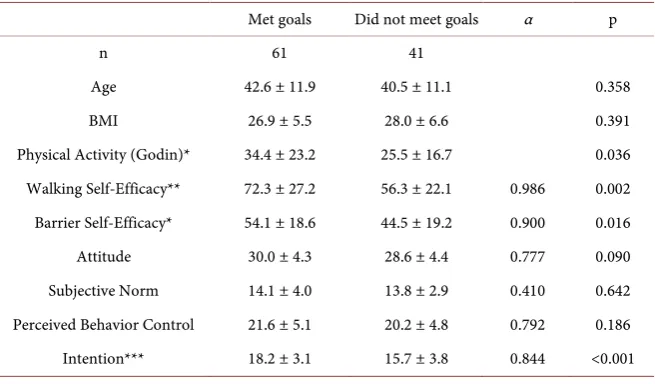
DOI: 10.4236/health.2018.1012131 1740 Health walking 225 miles over 9 weeks. Self-reported physical activity (p = 0.036), bar-rier self-efficacy (p = 0.016), walking self-efficacy (p = 0.002), and intention (p = 0.001) were greater at baseline in those who met the goals than those who did
not meet the goals of the program (see Table 2). There were no differences for
attitude (p = 0.090), subjective norms, perceived behavioral control, BMI or age (p > 0.10). All Cronbach α coefficients can be found in Table 2. All scales were deemed acceptable except for the social norms scale which had an α coefficient = 0.410.
Results of the binary logistic regression showed a significant association at Step 1 (χ2 (3) = 9.11, p = 0.028) which was attributable to physical activity (p = 0.017), being a significant predictor for meeting the program goals (see Table 3). However, in Step 2 when entering the theoretical constructs the variables at that step was significant (χ2 (6) = 15.41, p = 0.017) with intention being the only sig-nificant predictor (p = 0.022) of whether participants met the goals of the pro-gram. The overall model had a χ2 (9) = 24.52, p = 0.004. See Table 3 for addi-tional information concerning the logistic regression.
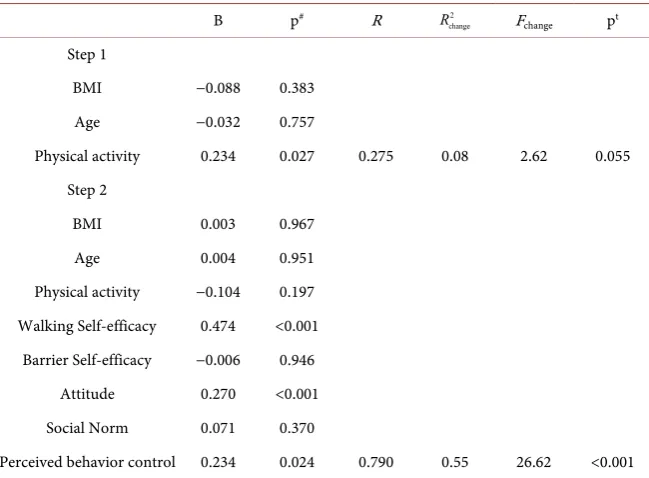
A multiple linear regression analysis was then performed to determine the theoretical constructs that were predictive of intention. The first step was not statistically significant (F (3, 96) = 2.623, p= 0.055, R2 = 0.08), see Table 4. However, when the other theoretical constructs were theoretical constructs were included in the regression there was a significant effect (F (5, 91) = 26.62, p < 0.001, R2 change = 0.55). This was due to walking self-efficacy (p < 0.001), atti-tude (p < 0.001) and perceived behavioral control (p = 0.024) all being signifi-cant predictors of intention. See Table 4 for a complete description of the re-gression analysis.
4. Discussion
[image:7.595.211.539.534.726.2]The purpose of this study was to examine if theoretical constructs from
Table 2. Means (±SD) of demographic and theoretical constructs for those who met their
goals and those who did not meet goals.
Met goals Did not meet goals α p
n 61 41
Age 42.6 ± 11.9 40.5 ± 11.1 0.358
BMI 26.9 ± 5.5 28.0 ± 6.6 0.391
DOI: 10.4236/health.2018.1012131 1741 Health
Table 3. Logistic regression to predict whether participant met goals of the program.
B SE B Wald χ2 p OR
Step 1
BMI −0.018 0.037 0.235 0.628 0.982
Age 0.037 0.021 3.260 0.071 1.038
Physical activity 0.031 0.013 5.742 0.017 1.032 Model χ2 = 9.12, p = 0.028 Pseudo R2 = 0.13
Step 2
BMI −0.021 0.042 0.261 0.610 0.979
Age 0.042 0.023 3.487 0.062 1.043
Physical activity 0.027 0.016 2.784 0.095 1.027 Walking Self-efficacy 0.019 0.017 1.248 0.264 1.019 Barrier Self-efficacy 0.006 0.018 0.126 0.723 1.006
Attitude −0.038 0.072 0.283 0.595 0.962
Social Norm −0.022 0.089 0.063 0.801 0.978 Perceived behavior control −0.151 0.086 3.068 0.080 0.860
Intention 0.294 0.129 5.224 0.022 1.342
Model χ2 = 24.52, p = 0.004 Pseudo R2 = 0.31; R2 change = 0.18
Table 4. Prediction of intention to walking program.
B p# R 2
change
R Fchange pt
Step 1
BMI −0.088 0.383
Age −0.032 0.757
Physical activity 0.234 0.027 0.275 0.08 2.62 0.055 Step 2
BMI 0.003 0.967
Age 0.004 0.951
Physical activity −0.104 0.197 Walking Self-efficacy 0.474 <0.001
Barrier Self-efficacy −0.006 0.946 Attitude 0.270 <0.001 Social Norm 0.071 0.370
Perceived behavior control 0.234 0.024 0.790 0.55 26.62 <0.001
[image:8.595.212.537.408.647.2]DOI: 10.4236/health.2018.1012131 1742 Health the program. Initial analyses found that at the beginning of the program, those who successfully completed the program had greater walking and barriers self-efficacy as well as intention to complete the walking program. The results of the logistic regression demonstrated that intention was the only significant pre-dictor of whether or not participants completed the goal of the walking program. The results of the current study supports a majority of studies on physical activ-ity behavior which suggests that intention is a strong predictor of such behavior based on the Theory of Planned Behavior [20] [23] [25] [34] [41] [42]. A recent study of walking behavior found the Theory of Planned Behavior to be a useful theory to predict behavior and for future interventions [43]. Therefore, interven-tions that could change a participant’s inteninterven-tions would be beneficial to increase physical activity behavior and adherence to exercise programs. In order to bol-ster one’s intention to exercise, interventions may focus on showing the benefits of physical activity and how to overcome the obstacles. Also, timeliness is im-portant in that interventions should focus on immediate behavior to help bridge the intention-behavior gap that is often problematic in exercise and other health interventions [19] [44] [45].
In the current study, it was also found that attitude, perceived behavioral con-trol and walking self-efficacy were significant predictors of intention, but they did not have a direct effect on walking behavior in this wellness program. This is consistent with previous research which has found constructs of Theory of Planned Behavior predicted intention, but not exercise behavior [46]. The find-ing in the current study that attitude and perceived behavioral control were sig-nificant predictors with intention to walk is similar to previous findings for walking and other physical activity [25] [41] [42], but contrary to one study on walking behavior that found attitude had no association with intention [34]. In order to improve attitude one would need to provide participants with enjoyable physical activities which allow them to have a positive evaluation of physical ac-tivity. Walking programs are an ideal intervention to initiate physical activity because most people will experience positive affect from acute bouts of walking [47] which likely influence attitudes to future exercise and exercise adherence [48].
The fact that perceived behavioral control predicted intention, but not adhe-rence to the walking program in the present study is consistent with other pre-vious studies [25] [41], but contrary to other findings which suggest perceived behavioral control to be directly related to exercise behavior [20] [24] [42]. The usefulness of perceived behavioral control on exercise behavior is often debated and some would suggest perceived behavioral control and self-efficacy are simi-lar constructs, so not surprising that both were predictors of exercise intention in the current study. However, in an effort to increase perceived behavioral con-trol to increase intention to exercise, practitioners should help those
participat-ing in the program develop skills to help overcome barriers such as time [18].
DOI: 10.4236/health.2018.1012131 1743 Health In previous research, self-efficacy, similar to perceived behavioral control, has been shown in as a mediator and a predictive factor that increases intention to exercise [18] [19]. Although previous studies have also shown exercise self-efficacy to be the best predictor of physical activity and the most significant predictor of adherence to exercise [40] [49] [50]. Surprisingly, in the current study walking self-efficacy was not a significant predictor of adherence, but did influence in-tention to exercise. In an effort to improve self-efficacy, it is known that a
pri-mary source of self-efficacy is past performance accomplishments [12]. Due to
the low intensity of walking programs, it should be relatively easy for practition-ers to progressively increase the volume of these programs and increase self-efficacy to complete. Another good source of self-efficacy is vicarious expe-riences [12]; therefore, providing group based programs could also be beneficial to increase self-efficacy and adherence to physical activity programs.
Barrier self-efficacy was not a significant predictor of intention or adherence to the walking program, which is inconsistent with previous research which has found barrier self-efficacy to be important in exercise behavior [37] [51] [52] [53]. In this study, participants’ belief in their ability to walk was more signifi-cant on intention than their belief to overcome barriers to walking. Additionally, subjective norm did not predict intention or adherence to the walking program in the current study. This may have been due to issues around measurement of this construct as can be seen by the low alpha coefficients for this variable. The inability of subjective norm to predict walking behavior is consistent with pre-vious research [41] [42].
A limitation of the study may have been the electronic reporting of daily walking and physical activity. Some participants may have felt overwhelmed by the need to report each day, which may have led to attrition from the program or results may have been less than accurate because of missed days of reporting. However, participants were offered various incentives throughout the program which hopefully limited this non-reporting behavior. Another limitation comes from the sample that we were able to obtain. Our sample size was modest in size, primarily female and fairly well educated which may make it hard to generalize the findings. However, this population is likely indicative of many corporate health promotion programs and all efforts were made to recruit as many partic-ipants as possible from those participating in the walking program. Additionally, in the current study it was not known whether the participant’s goals were the same or similar to the program goals. A recent systematic review suggests that physical activity interventions should consider integration of various goals on motivation to do physical activity [54]. A final limitation comes from the mea-surement of the subjective norm variable in the Theory of Planned Behavior which had a low alpha coefficient and may not be a strong predictor of physical activity behavior [42].
DOI: 10.4236/health.2018.1012131 1744 Health that tailoring materials to an individual’s stage of motivational readiness was po-sitively correlated to an increase in self-reported exercise behavior [55]. Those re-ceiving printed materials that related to their level of readiness, such as self-efficacy, self-reported (37% vs. 27%) increases in their exercise behavior as compared to
those receiving generic exercise promotion materials [55]. When promoting
walking, tailoring interventions to individuals’ levels, such as the most motivated or most sedentary, resulted in the greatest ability to encourage walking [56].
Additionally, future physical activity interventions could consider the inclu-sion of media or social media campaigns to help strengthen theoretical con-structs such as self-efficacy, perceived behavioral control and attitude. Previous studies have found media campaign messages based on constructs from the
Theory of Planned Behavior to be effective in increasing walking behavior [57]
[58] [59].
5. Conclusion
In conclusion, the current study examined theoretical constructs from Self-Efficacy Theory [12] and the Theory of Planned Behavior [13] [14] [15] to better understand adherence to a walking program implemented by a universi-ty’s wellness center. This study found that the only significant predictor of ad-herence to the walking program was intention. Attitude, perceived behavioral control and walking self-efficacy were significant predictors of intention. Some ways to intervene to improve physical activity behavior and adherence are dis-cussed in relation to these theoretical constructs used in the current study.
Conflicts of Interest
The authors declare no conflicts of interest regarding the publication of this pa-per.
References
[1] Office of Disease Prevention and Health Promotion (2017) Physical Activity |
Healthy People 2020.
https://www.healthypeople.gov/2020/topics-objectives/topic/physical-activity/object ives
[2] Cahalin, L.P., Kaminsky, L., Lavie, C.J., et al. (2015) Development and Implementa-tion of Worksite Health and Wellness Programs: A Focus on Non-Communicable Disease. Progress in Cardiovascular Diseases,58, 94-101.
https://doi.org/10.1016/j.pcad.2015.04.001
[3] Baicker, K., Cutler, D. and Song, Z. (2010) Workplace Wellness Programs Can
Generate Savings. Health Affairs,29, 304-311.
https://doi.org/10.1377/hlthaff.2009.0626
[4] Steinbrook, R. (2009) Health Care and the American Recovery and Reinvestment
Act. New England Journal of Medicine,360, 1057-1060.
https://doi.org/10.1056/NEJMp0900665
[5] Blumenthal, D. (2006) Employer-Sponsored Health Insurance in the United
DOI: 10.4236/health.2018.1012131 1745 Health https://doi.org/10.1056/NEJMhpr060703
[6] Berry, L.L., Mirabito, A.M. and Baun, W.B. (2010) What’s the Hard Return on
Em-ployee Wellness Programs? Harvard Business Review,88, 104-112, 142.
[7] Zivin, K., Sen, A., Plegue, M.A., et al. (2017) Comparative Effectiveness of Wellness Programs: Impact of Incentives on Healthcare Costs for Obese Enrollees. American Journal of Preventive Medicine, 252, 347-352.
https://doi.org/10.1016/j.amepre.2016.10.006
[8] Dement, J.M., Epling, C., Joyner, J. and Cavanaugh, K. (2015) Impacts of
Workplace Health Promotion and Wellness Programs on Health Care Utilization
and Costs: Results from an Academic Workplace. Journal of Occupational and
En-vironmental Medicine, 57, 1159.https://doi.org/10.1097/JOM.0000000000000555
[9] Klautzer, L., Mattke, S. and Greenberg, M. (2012) Can We Legally Pay People for
Being Good? A Review of Current Federal and State Law on Wellness Program In-centives. International Journal of Health Care Finance and Economics,49, 268-277. [10] Goetzel, R.Z., Henke, R.M., Tabrizi, M., et al. (2014) Do Workplace Health
Promo-tion (Wellness) Programs Work? Journal of Occupational and Environmental
Medicine, 56, 927.https://doi.org/10.1097/JOM.0000000000000276
[11] Marshall, A.L. (2004) Challenges and Opportunities for Promoting Physical Activity in the Workplace. Journal of Science and Medicine in Sport,7, 60-66.
https://doi.org/10.1016/S1440-2440(04)80279-2
[12] Bandura, A. (1977) Self-Efficacy: Toward a Unifying Theory of Behavioral Change.
Psychological Review, 84, 191-215. https://doi.org/10.1037/0033-295X.84.2.191
[13] Ajzen, I. (1985) From Intentions to Actions: A Theory of Planned Behavior. In: Ac-tion Control, SSSP Springer Series in Social Psychology, Springer, Berlin, Heidel-berg, 11-39.https://doi.org/10.1007/978-3-642-69746-3_2
[14] Ajzen, I. (2005) Attitudes, Personality, and Behavior. 2nd Edition, McGraw-Hill Education, UK.
[15] Fishbein, M. and Ajzen, I. (2011) Predicting and Changing Behavior: The Reasoned
Action Approach. Psychology Press, New York.
https://doi.org/10.4324/9780203838020
[16] Dishman, R.K., Motl, R.W., Saunders, R., et al. (2004) Self-Efficacy Partially Me-diates the Effect of a School-Based Physical-Activity Intervention among Adoles-cent Girls. Preventive Medicine, 38, 628-636.
https://doi.org/10.1016/j.ypmed.2003.12.007
[17] Prodaniuk, T.R., Plotnikoff, R.C., Spence, J.C. and Wilson, P.M. (2004) The
Influ-ence of Self-Efficacy and Outcome Expectations on the Relationship between
Per-ceived Environment and Physical Activity in the Workplace. International Journal
of Behavioral Nutrition and Physical Activity,1, 7. https://doi.org/10.1186/1479-5868-1-7
[18] Stutts, W.C. (2002) Physical Activity Determinants in Adults. Perceived Benefits, Barriers, and Self Efficacy. AAOHN Journal: Official Journal of the American Asso-ciation of Occupational Health Nurses,50, 499-507.
[19] Sniehotta, F.F., Scholz, U. and Schwarzer, R. (2005) Bridging the
Inten-tion-Behaviour Gap: Planning, Self-Efficacy, and Action Control in the Adoption and Maintenance of Physical Exercise. Psychology & Health, 20, 143-160.
https://doi.org/10.1080/08870440512331317670
[20] Norman, P. and Conner, M. (2005) The Theory of Planned Behavior and Exercise:
Inten-DOI: 10.4236/health.2018.1012131 1746 Health tion-Behavior Relationships. Journal of Sport and Exercise Psychology,27, 488-504. https://doi.org/10.1123/jsep.27.4.488
[21] McAuley, E., Jerome, G.J., Marquez, D.X., Elavsky, S. and Blissmer, B. (2003) Exer-cise Self-Efficacy in Older Adults: Social, Affective, and Behavioral Influences. An-nals of Behavioral Medicine, 25, 1-7.
https://doi.org/10.1207/S15324796ABM2501_01
[22] McAuley, E., Courneya, K.S., Rudolph, D.L. and Lox, C.L. (1994) Enhancing
Exer-cise Adherence in Middle-Aged Males and Females. Preventive Medicine, 23,
498-506. https://doi.org/10.1006/pmed.1994.1068
[23] Prapavessis, H., Gaston, A. and DeJesus, S. (2015) Theory of Planned Behavior as a
Model for Understanding Sedentary Behavior. Psychology of Sport and Exercise,
19, 23-32.https://doi.org/10.1016/j.psychsport.2015.02.001
[24] Armitage, C.J. (2005) Can the Theory of Planned Behavior Predict the Maintenance
of Physical Activity? Health Psychology,24, 235-245. https://doi.org/10.1037/0278-6133.24.3.235
[25] Godin, G., Valois, P. and Lepage, L. (1993) The Pattern of Influence of Perceived
Behavioral Control upon Exercising Behavior: An Application of Ajzen’s Theory of Planned Behavior. Journal of Behavioral Medicine, 16, 81-102.
https://doi.org/10.1007/BF00844756
[26] Lee, I.-M. and Buchner, D.M. (2008) The Importance of Walking to Public Health.
Medicine & Science in Sports & Exercise, 40, S512-S518. https://doi.org/10.1249/MSS.0b013e31817c65d0
[27] Korownyk, C. and Allan, G.M. (2010) Motivating Patients to Activity: A Light at the End of the Couch? Canadian Family Physician, 56, 887.
[28] Hanson, S. and Jones, A. (2015) Is There Evidence That Walking Groups Have
Health Benefits? A Systematic Review and Meta-Analysis. British Journal of Sports Medicine, 49, 710-715.https://doi.org/10.1136/bjsports-2014-094157
[29] Foulds, H.J.A., Bredin, S.S.D., Charlesworth, S.A., Ivey, A.C. and Warburton, D.E.R. (2014) Exercise Volume and Intensity: A Dose-Response Relationship with Health Benefits. European Journal of Applied Physiology, 114, 1563-1571.
https://doi.org/10.1007/s00421-014-2887-9
[30] Kelly, P., Kahlmeier, S., Götschi, T., et al. (2014) Systematic Review and Me-ta-Analysis of Reduction in All-Cause Mortality from Walking and Cycling and Shape of Dose Response Relationship. International Journal of Behavioral Nutrition and Physical Activity, 11, 132.https://doi.org/10.1186/s12966-014-0132-x
[31] Kelly, P., Williamson, C., Niven, A.G., Hunter, R., Mutrie, N. and Richards, J. (2018) Walking on Sunshine: Scoping Review of the Evidence for Walking and Mental Health. British Journal of Sports Medicine,52, 800-806.
https://doi.org/10.1136/bjsports-2017-098827
[32] Richardson, C.R., Newton, T.L., Abraham, J.J., Sen, A., Jimbo, M. and Swartz, A.M. (2008) A Meta-Analysis of Pedometer-Based Walking Interventions and Weight Loss. The Annals of Family Medicine, 6, 69-77.https://doi.org/10.1370/afm.761
[33] Bravata, D.M., Smith-Spangler, C., Sundaram, V., et al. (2007) Using Pedometers to
Increase Physical Activity and Improve Health: A Systematic Review. JAMA,298,
2296-2304. https://doi.org/10.1001/jama.298.19.2296
[34] Eves, F., Hoppéa, R. and McLaren, L. (2003) Prediction of Specific Types of Physical
Activity Using the Theory of Planned Behavior. Journal of Applied Biobehavioral
DOI: 10.4236/health.2018.1012131 1747 Health [35] Ogilvie, D., Foster, C.E., Rothnie, H., et al. (2007) Interventions to Promote
Walk-ing: Systematic Review. BMJ, 334, 1204. https://doi.org/10.1136/bmj.39198.722720.BE
[36] Godin, G. and Shephard, R.J. (1985) A Simple Method to Assess Exercise Behavior
in the Community. Canadian Journal of Applied Sport Sciences,10, 141-146.
[37] McAuley, E. (1992) The Role of Efficacy Cognitions in the Prediction of Exercise
Behavior in Middle-Aged Adults. Journal of Behavioral Medicine, 15, 65-88. https://doi.org/10.1007/BF00848378
[38] Monroe, C.M., Bassett Jr., D.R., Fitzhugh, E.C., Raynor, H.A. and Thompson, D.L.
(2017) Effect of Adding Online Social Support Tools to an Adult Walking Program: A Pilot Randomized Controlled Trial. Health Promotion Practice,18, 84-92. https://doi.org/10.1177/1524839915626674
[39] Olson, E.A. and McAuley, E. (2015) Impact of a Brief Intervention on
Self-Regulation, Self-Efficacy and Physical Activity in Older Adults with Type 2 Di-abetes. Journal of Behavioral Medicine,38, 886-898.
https://doi.org/10.1007/s10865-015-9660-3
[40] McAuley, E. (1993) Self-Efficacy and the Maintenance of Exercise Participation in
Older Adults. Journal of Behavioral Medicine, 16, 103-113. https://doi.org/10.1007/BF00844757
[41] Rhodes, R.E., Courneya, K.S., Blanchard, C.M. and Plotnikoff, R.C. (2007)
Predic-tion of Leisure-Time Walking: An IntegraPredic-tion of Social Cognitive, Perceived Envi-ronmental, and Personality Factors. International Journal of Behavioral Nutrition and Physical Activity, 4, 51.https://doi.org/10.1186/1479-5868-4-51
[42] Symons Downs, D. and Hausenblas, H.A. (2005) The Theories of Reasoned Action
and Planned Behavior Applied to Exercise: A Meta-Analytic Update. Journal of
Physical Activity & Health, 2, 76-97. https://doi.org/10.1123/jpah.2.1.76
[43] Sun, G., Acheampong, R.A., Lin, H. and Pun, V.C. (2015) Understanding Walking
Behavior among University Students Using Theory of Planned Behavior.
Interna-tional Journal of Environmental Research and Public Health,12, 13794-13806. https://doi.org/10.3390/ijerph121113794
[44] Rhodes, R.E. and de Bruijn, G.-J. (2013) How Big Is the Physical Activity
Inten-tion-Behaviour Gap? A Meta-Analysis Using the Action Control Framework.
Brit-ish Journal of Health Psychology, 18, 296-309. https://doi.org/10.1111/bjhp.12032
[45] Rhodes, R.E. and de Bruijn, G.-J. (2013) What Predicts Intention-Behavior
Discor-dance? A Review of the Action Control Framework. Exercise and Sport Sciences
Reviews, 41, 201-207.https://doi.org/10.1097/JES.0b013e3182a4e6ed
[46] Williams, S.L., Michie, S., Dale, J., Stallard, N. and French, D.P. (2015) The Effects of a Brief Intervention to Promote Walking on Theory of Planned Behavior Con-structs: A Cluster Randomized Controlled Trial in General Practice. Patient Educa-tion and Counseling, 98, 651-659.https://doi.org/10.1016/j.pec.2015.01.010
[47] Ekkekakis, P., Hall, E.E., VanLanduyt, L.M. and Petruzzello, S.J. (2000) Walking in
(Affective) Circles: Can Short Walks Enhance Affect? Journal of Behavioral
Medi-cine, 23, 245-275.https://doi.org/10.1023/A:1005558025163
[48] Williams, D.M. (2008) Exercise, Affect, and Adherence: An Integrated Model and a
Case for Self-Paced Exercise. Journal of Sport and Exercise Psychology, 30, 471-496. https://doi.org/10.1123/jsep.30.5.471
DOI: 10.4236/health.2018.1012131 1748 Health from a Qualitative Study. Preventive Medicine, 45, 62-65.
https://doi.org/10.1016/j.ypmed.2007.04.011
[50] Marcus, B.H., Selby, V.C., Niaura, R.S. and Rossi, J.S. (1992) Self-Efficacy and the Stages of Exercise Behavior Change. Research Quarterly for Exercise and Sport, 63,
60-66.https://doi.org/10.1080/02701367.1992.10607557
[51] Dawson, J., Hillsdon, M., Boller, I. and Foster, C. (2007) Perceived Barriers to Walking in the Neighborhood Environment: A Survey of Middle-Aged and Older Adults. Journal of Aging and Physical Activity, 15, 318-335.
https://doi.org/10.1123/japa.15.3.318
[52] Dunton, G.F. and Schneider, M. (2006) Perceived Barriers to Walking for Physical
Activity. Preventing Chronic Disease, 3, A116.
[53] Mailey, E.L., Phillips, S.M., Dlugonski, D. and Conroy, D.E. (2016) Overcoming Barriers to Exercise among Parents: A Social Cognitive Theory Perspective. Journal of Behavioral Medicine, 39, 599-609. https://doi.org/10.1007/s10865-016-9744-8
[54] Rhodes, R.E., Quinlan, A. and Mistry, C.D. (2016) Do Other Goals Influence
Physi-cal Activity? A Systematic Review Examining the Relationship between Other Goals and Physical Activity Behavior. Preventive Medicine,91, 306-317.
https://doi.org/10.1016/j.ypmed.2016.08.033
[55] Marcus, B.H., Emmons, K.M., Simkin-Silverman, L.R., et al. (1998) Evaluation of
Motivationally Tailored vs. Standard Self-Help Physical Activity Interventions at the Workplace. American Journal of Health Promotion, 12, 246-253.
https://doi.org/10.4278/0890-1171-12.4.246
[56] Mackey, M.G., Bohle, P., Taylor, P., Di Biase, T., McLoughlin, C. and Purnell, K.
(2011) Walking to Wellness in an Ageing Sedentary University Community: De-sign, Method and Protocol. Contemporary Clinical Trials, 32, 273-279.
https://doi.org/10.1016/j.cct.2010.12.001
[57] Reger-Nash, B., Bauman, A., Cooper, L., et al. (2008) WV Walks: Replication with Expanded Reach. Journal of Physical Activity & Health, 5, 19-27.
https://doi.org/10.1123/jpah.5.1.19
[58] Reger-Nash, B., Fell, P., Spicer, D., et al. (2006) BC Walks: Replication of a Com-munitywide Physical Activity Campaign. Preventing Chronic Disease, 3, A90.
https://www.ncbi.nlm.nih.gov/pmc/articles/PMC1637798/
[59] Reger-Nash, B., Bauman, A., Booth-Butterfield, S., et al. (2005) Wheeling Walks:
Evaluation of a Media-Based Community Intervention. Family & Community