An Objective Penalty Functions Algorithm for
Multiobjective Optimization Problem
Zhiqing Meng, Rui Shen, Min Jiang
College of Business and Administration, Zhejiang University of Technology, Hangzhou, China E-mail:{mengzhiqing, shenrui, jiangmin}@zjut.edu.cn
Received October 24, 2011; revised November 20, 2011; accepted December 7, 2011
Abstract
By using the penalty function method with objective parameters, the paper presents an interactive algorithm to solve the inequality constrained multi-objective programming (MP). The MP is transformed into a single objective optimal problem (SOOP) with inequality constrains; and it is proved that, under some conditions, an optimal solution to SOOP is a Pareto efficient solution to MP. Then, an interactive algorithm of MP is designed accordingly. Numerical examples show that the algorithm can find a satisfactory solution to MP with objective weight value adjusted by decision maker.
Keywords:Multiobjective Optimization Problem, Objective Penalty Function, Pareto Efficient Solution, Interactive Algorithm
1. Introduction
The interactive algorithm is very efficient in solving multi-objective optimization problems of many fields, while the penalty function is a very important method in solving optimization problems with constraints. Hence, based on objective penalty function, we propose an in-teractive algorithm which provides a versatile tool in finding solutions to multi-objective optimization prob-lems with constraints. In solving multi-objective optimi-zation problems, the interactive algorithm provides a way to adjust objective weight value between the deci-sion maker and computer, so that solution space is read-ily understood, which also makes it easier in use and more convenient in operation.
In this paper the following inequality constrained multi-objective programming is considered:
1 2
min , , ,
s.t. , 0, 1, 2, , ,
q i
f x f x f x f x
x X g x i m
(MP)
where : n 1
j
f R R , : n 1
i
g R R
1, 2, ,i I
for
, and X is a
sub-set of
.
1, 2, , q
n
R
j J m
It is good to find out a satisfactory solution to (MP) such that all objective values are optimal, but this is ob-viously difficult in general. Hence, lots of efforts have been devoted to this area to find an efficient method, and
up until now many algorithms are presented [1-11]. In 1971, Benayoun et al. firstly presented an interac-tive algorithm STEM for linear multiobjecinterac-tive program-ming [1]. Its idea is the first in finding out a solution of an ideal value to every objective, obtaining better solu-tion by improving unsatisfactory objectives value, and keeping within concession value of satisfactory objec-tives. With man-machine conversation, interactive algo-rithms provide a method to solve MP. There are many interactive approaches, as it is not possible for a decision maker to know all the objective values of MP. Then through interactive algorithms, he may gradually learn objective value changes and thus in the interactive pro-cedure may determine his preferences to objectives. As to the dissatisfactory objectives, he may get satisfactory solution by modifying some parameters he gives, e.g. the ideal objective values and the weights of objectives.
Z. Q. MENG ET AL. 230
cant freedom and ease for the decision-maker’s self-ex- pression, and requiring a minimal information on his local estimate of the steepest-ascent direction [4]. Zionts and Wallenius (1983) developed a method for interactive multiple objective linear programming by assuming an unknown pseudo concave utility function satisfying cer-tain general properties [5]. Sadagopan and Ravinderan (1986) developed several interactive procedures for solving multiple criteria nonlinear programming prob-lems based on the generalized reduced gradient method for solving single objective nonlinear programming prob-lems [6]. Siegfried (1990) presented an interactive algo-rithm for nonlinear vector optimization problems, after solving only two optimization problems [7]. Kassem (1995) dealt with an interactive stability of multiobjec-tive nonlinear programming problems with fuzzy pa-rameters in the constraints [8]. Aghezzaf and Ouaderh-man (2001) proposed an interactive interior point method for finding the best compromise solution to a multiple objective linear programming problem [9]. Abo-Sinna and Abou-El-Enien (2006) extended the technique of order preference by similarity ideal solution (TOPSIS) for solving large scale multiple objective programming problems involving fuzzy parameters [10]. Luque, Ruiz and Steuer pointed out that many interactive algorithms have two main features: 1) they help a decision maker (DM) learn about a problem while solving it, and 2) they put to work iteratively any new insights gained during the solution process to help the DM navigate to a final solution [11].
It is difficult to define an appropriate utility function for MP in the interactive algorithms. By using objective penalty functions as utility functions for MP, the paper obtains a satisfactory solution, when the decision maker is allowed, in the interactive algorithm, to choose another weight of objectives for some dissatisfactory objectives time and again. So our interactive algorithm has two ad-vantages: 1) it is able to find out an efficient solution to each new MP with better convergence, 2) it can control the change of objectives such that a more satisfactory solution is obtained. What needs to focus on for the deci-sion maker is the objective changes. Numerical examples show that the proposed interactive algorithm has faster convergence effect in Section 3.
The remainder of this paper is organized as follows. In Section 2, we provide results of the penalty problem of MP with penalty parameters. In Section 3, we present an interactive algorithm to solve the MP. Numerical exam-ples show that the proposed algorithm has good conver-gence and can control objective changes by changing objective weights.
2. An Objective Penalty Function
In this section, an objective penalty function of (MP) is introduced.
For (MP), let gi
x max
g xi
,0
for i I anddefine a function Q R: 1R1 as follows:
2,0 t
max
Q t t
. Then Q is increasing and dif-ferentiable at any R1.
A feasible set of (MP) is denoted as
0 i 0,
X x X g x i I . xX0 is called a Pareto efficient solution if there is no x X 0 such that
f x f x and f x
f x
. Let an objective weight valuebe a given positive vector, and
1 2
,q T 0
1
, ,
MR be objective parameters of
f x f x1
, 2 ,,f xq
. Then define
0 j j
j J
f x Q f x
M .Theorem 2.1 If x is an optimal solution to the fol-lowing problem:
0
minf x s.t. xX0, (Pλ)
and for all j J , M f xj
, then x is a Pareto efficient solution to (MP).Proof. Suppose that x is not a Pareto efficient solu-tion to (MP), then there is an xX0 such that
f x f x and f x
f x
. It follows from the assumption that
f x M f x M, j J, and there is at least such a j J that
f x M f x M . Hence, we have
0 0
f x f x , which results in a contradiction. From Theorem 2.1, we learn that a Pareto efficient solution to (MP) can be found out by solving the single objective problem (Pλ). Furthermore, the problem (Pλ)
can be transformed into an unconstrained optimization by using nonlinear penalty function, which is defined as:
2 0
2
, ,
.
i i I
j j i
j J i I
F x M f x M g x
Q f x M M g x
where M 0. Consider the following nonlinear penalty optimization problem:
0minF x, , M s.t. x X . Pλ(M)
Theorem 2.2 Suppose that M is constant, *
M
x is an optimal solution to Pλ(M), and for all j J ,
*j M
M f x . If *
M
x is a feasible solution to (MP), then
*
M
x is a Pareto efficient solution to (MP). Proof. Let x* be an optimal solution to P
λ(M). From
* *
*
0 M M, , , ,
* 0
f x F x M F x M f x . Since *
M
x is a feasible solution to (MP) and x* is an optimal solution to Pλ(M), 0
M 0
* *
f x f x . So,
*
M
x is an optimal solution to Pλ(M). From Theorem 2.1,
*
M
x is a Pareto efficient solution to (MP).
Theorem 2.1 and Theorem 2.2 give a good way to solve (MP). The objective parameter M required in Theorem 2.2 may exist, as shown in the following exam-ple.
Example 2.1 Consider the MP problem:
2 2
1 2 1 2 1 2
min , ,
s.t. 0, 0.
f x x x x
x x
(P2.1) It is clear that is a Pareto efficient solution to (P2.1) and the objective value is (0, 0). Let’s take M < 0, λ1 > 0 and λ2 > 0. Define the penalty func-tion:
* *
1, 2 0,x x 0
2
2 2
1 1 2 2
1 2
, , max , 0 max , 0
max 0, max 0, .
F x M x M x M
x x
It is clear that (x1, x2) = (0, 0) is an optimal solution to Pλ(M) [with M < 0].
It is proved in [13] that the stability of constrained penalty function can ensure exactness. So in this paper we define the stability of objective penalty function to ensure equivalence between Pλ(M) and (Pλ).
Let a perturbed problem of (Pλ) defined as
0min
s.t. , i i, 1, 2, ,
f x
x X g x s i m Pλ(s) where s
s s1, , ,2 sM
.Definition 2.1 For s R n, let x* be an optimal solu-tion to (Pλ) and x*s be an optimal solution to Pλ(s). If
* * 20 0 s
f x f x M s ,
where
1
m i i
s s
, s
s s1, , ,2 sM
, then problem (Pλ)is called stable for M.
Theorem 2.3 Let x* be an optimal solution to (P
λ).
Then, problem (Pλ) is stable for M if and only if x* is an
optimal solution to Pλ(M).
Proof. First, if problem (Pλ) is stable for M, it is
hereby proved that x* is an optimal solution to P
λ(M).
Assume that x* is not an optimal solution to P
λ(M), then,
there is some x′ such that
*
*0
, , , ,
F x M F x M f x . That is
*0 0 i 0
i I
f x f x M g x f x
.If x′ is a feasible solution to (Pλ), we will get a
contra-diction. Since x* be an optimal solution to (P
λ), we have
*
0 0
f x f x such that
*
0 0 0
f x f x f x , then x* is not an optimal solution to (Pλ). Hence, we have that x′ is not any
feasible solution to (Pλ) and i 0. Let i I
g
max , 0
i i
s g x for i1, 2, ,m. Let *
s
x be an optimal solution to Pλ(s′). So, it is clear to have
*
0 s 0
f x f x . We have
2
0 0
* 0
, ,
s i i
i I i I
* 2
f x M s f x M g x
F x M f x
and
* * 20 s
f x f x M s. Hence, the problem (Pλ) is not stable for M.
Next, let’s prove that the problem (Pλ) is stable for M,
under the condition that if x* is an optimal solution to Pλ(M). Let x*s be an optimal solution to (Pλ(s)). Since x*
is an optimal solution to Pλ(M), we have
*
* 2
0, , *
s i s
i I
F x M f x M g x
.That is
*
* 20 0 s i
i I
f x f x M s
.We have that problem (Pλ) is stable for M.
Example 2.2 Consider the problem (P2.1) and its (P2.1)(s):
2 2
1 2 1 2 1 1 2 2
min , ,
s.t. , .
f x x x x
x s x s
(P2.1)(s)
*
1
max 0,
s
x s , max{0, –s2} is a Pareto efficient solution to (P2.1)(s). Let’s take M < 0. Define the penalty function:
2 2
2 2
1 1 2 2
1 2
, , max ,0 max ,0
max 0, max 0, .
F x M x M x M
x x
We have that stable condition holds as follows:
2 2
* *
0 0 1 2 1 1
2
2 2
2
1 2
max 0,
max 0,
max 0, max{0, } .
s
f x f x s M
s M
M s s
Z. Q. MENG ET AL. 232
Function Algorithm of Multiobjective Optimization Problem (OPFAMOP for short).
OPFAMOP Algorithm: Step 1: Choose λ> 0, x1, M
1 < 0, N > 1 and k = 1. Step 2: Take the violation xk as the starting point for
solving the problem: minx X F x
, , Mk
. Let xk+1 be anoptimal solution.
Step 3: If xk+1 is a feasible solution to (MP) and M
k<
fj(xk+1) for all , stop and xk+1 is a Pareto efficient
solution to (MP). Otherwise, let Mk+1 = NMk, k: = k + 1
and go to Step 2. j J
The convergence of the OPFAMOP algorithm is proved in the following theorem. Let
, 0
0
,
k k
S L f x Lf x k1, 2 ,
which is called an L-level set. We say that S(L, f0) is bounded if, for any given L > 0, S(L, f0) is bounded.
Theorem 2.4 Suppose that fj(j J ) and gi(iI) are
continuous on Rn, and the L-level set S(L, f
0) is bounded. Let {xk} be the sequence generated by the OPFAMOP
algorithm.
1) If {xk} (k1, 2, , k) is a finite sequence (i.e., the
OPFAMOP algorithm stops at the k -th iteration), then
k
x is a Pareto efficient to (MP).
2) If {xk} is an infinite sequence and there is some k′ >
1 such that fj(xk+1) > Mk( ) for all k > k′, then {xk}
is bounded and any limit point of it is a Pareto efficient to (MP). Otherwise, for some jJ, as
.
j J
k jf x
k
Proof. 1) If the OPFAMOP Algorithm terminates at the k th iteration and the second situation of Step 3 occurs, by Theorem 2.1 and Theorem 2.2, xk is a
Pareto efficient to (MP).
2) Suppose that {xk} is an infinite sequence and there
is some k′ > 1 such that fj(xk+1) > Mk( ) for all k >
k′. Let x' be a feasible solution to (MP). j J
We first show that the sequence {xk} is bounded. Since
xk is an optimal solution to min
, ,
k x X F x M
,
1 1
0 , , 0
k k
k
f x F x M f x , k1, 2,. Hence, the L-level set S(f0(x′), f0) is bounded, then the sequence {xk} is bounded. Without loss of generality, we
assume xk x. And, for any
0
x X , we have
1 2
1
0 0
0 k k
k i i I
f x M g x f
x , k k.That is
1 2
1 1
1
2 ,
k j
i I k
k k
j j j j k
j J
g x
M
It is clear that k as . By letting
in the above equation, we obtain
M k
k
0j i I
g x
.
f x f x f x f x M k k
. Hence, x is a feasible solution of (MP) and f x0
f x0
. Therefore, x is Pareto efficient to(MP).
3. An Interactive Algorithm
In this section, we propose an interactive algorithm by the objective penalty function. There are many ap-proaches of the MP problem to be transformed into a single objective optimal problem, such as a non-explic- itly criterion function [2-4,9], nonlinear utility functions [5,6], weighting Tchebycheff function [8,9] and TOPSIS method [10]. So, our proposed approach is novel.
According to the OPFAMOP Algorithm, we can select to get an approximate Pareto effi-cient solution to (MP).
1 2, , , M T
Definition 3.1 A vector xX is ε-feasible if
i
g x , i I.
Now, we present the following interactive algorithm IOPFAMOP based on the OPFAMOP.
IOPFAMOP:
Step 1: Choose λ1, x1,ε > 0, N > 1, K > 1 and s = 1. Step 2: By using the OPFAMOP Algorithm, compute problem Pλs(M).
Step 2.1: Let M1, k = 1.
Step 2.2: Solve the problem: min
, s,
k x X F x M ,to
get an ε-feasible solution xk.
Step 2.3: If k < K, modify the penalty objective values Mk+1 = NMk.
Otherwise, k = K, let xs= xk and go to Step 3.
Step 2.4: Let k: = k + 1 and go to Step 2.1.
Step 3: The decision maker analyzes the objective ( 1
s , 2 s , ,
q s
f x f x f x ): if the solution xs is
satis-factory, then stop; otherwise, the decision maker will modify the weight values of objective, and go to Step 4.
Step 4: Deal with all the unsatisfactory objectives fj(xs)
as per the following procedure repeatedly: if the decision maker wants to increase jth objective value, then a
0
s j
should be given, then let s1: s s
j j
j, if the decision maker wants to decrease jth objective value, then a s 0
j
should be given, then let 1:
s s s
j j j
. Finally, let s: = s + 1 and go to Step 2. Remark: By Theorem 2.4, we may get an approxi-mate Pareto efficient solution to (MP) in Step 2. Hence, using the above interactive algorithm, we may, after many interactive steps, obtain satisfactory objective val-ues by modifying weight λi, as shown in Examples 3.1 to
3.3.
need solve constrained optimization problem in the ex-isted approach [1-11], but each interactive sub-problem in our approach only need solve unconstrained optimiza-tion problem.
We apply the above interactive algorithm IOPFAMOP to two examples programmed by Matlab6.5. The aim of numerical examples is to check the convergence of the interactive algorithm IOPFAMOP and control the changes of objective.
Example 3.1 Consider the following linear program-ming problem:
1 2
1 2 1 21 2 1 2
min , 2 , 4
s.t. 2 3 6 0, 0
f x x x x x x
x x
x x
(P4.1)
We wish to find out a solution such that every objec-tive function value is close to each other.
Let penalty function
1 2 1 1 2
2
2 1 2 1 2
2 2
1 2
, ; , 2
4 max 2 3 6,0
max ,0 max ,0 .
F x x M Q x x M
Q x x M M x x
M x M x
Let M1 = –10, N = 4, K = 3, error of an approximate solution (x1, x2):
s
*j s i I
e x g x
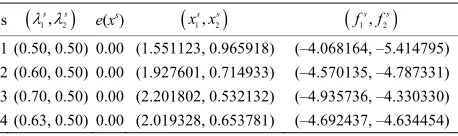
,then different approximate solutions (x1, x2) are obtained by selecting different (λ1, λ2) (as shown in Table 3.1).
Remarks for Table 3.1
Step 1: The decision maker (DM) first takes a weight value
1 1
.1, 2 0.5,0.5
T
By the interactive algorithm, the DM obtains the ob-jective function value
1 11, 2
f x x = (–4.068164, –5.414795) at approximate solution
1 11, 2
x x =
(1.551123, 0.965918). Because the second objective value f2 is less than the first objective value f1, the DM will improve weight value λ1 in the Step 2.
Step 2: Then, the DM takes a second weight value . By the interactive algorithm, the DM obtains the objective function value
2 2
1, 2 0.6,0.5
T
2 2
1, 2f x x = (–4.570135, –4.787331) at approximate solution
2 2 1, 2
[image:5.595.57.286.647.715.2]x x = (1.927601, 0.714933). In order to decrease the first objective value f1, the DM still need to improve
Table 3.1. Numerical results for (P4.1).
s
1, 2weight value λ1 in the next step.
Step 3: Then, the DM takes a third weight value
3 3
1, 2 0.7,0.5
T
. By the interactive algorithm, the DM obtains the objective function value
3 3
1, 2
f x x = (–4.935736, –4.330330) at approximate solution
3 3
1, 2x x = (2.201802, 0.532132). This time, the DM need to decrease weight value λ1 in the next step.
Step 4: Then, the DM take a forth weight value
4 4
1, 2 0.63,0.5
T
. By the interactive algorithm, the DM obtains the objective function value
4 4
1, 2
f x x = (–4.692437, –4.634454) at approximate solution
4 4
1, 2x x = (2.019328, 0.653781). Then, the DM is satis-fied with the approximate solution, and wishes to stop.
Example 3.2 Consider the problem:
1 2
1 2 1 2 1 2
4 3 2
2 1 1 1
4 3 2
2 1 1 1 1
1
2
min , 2 , 2 , ,
s.t. 2 8 8 2,
4 32 88 96 36, 0 3,
0 4.
f x x x x x x x x
x x x x
x x x x x
x x
(P4.2)
Let penalty function
2 1 2 1 1 2
2
2 1 2
2 3 1 2
2 4 3 2
2 1 1 1
2 4 3 2
2 1 1 1 1
2 2
1
, ; , max 2 ,0
max 2 2 ,0 max ,0
max 2 8 8 2,0
max 4 32 88 96 36,0
max ,0 m
F x x M x x M
x x M
x x M
M x x x x
M x x x x x
M x M
2
2 2
1 2
ax ,0 max 3,0 max 4,0
x
M x M x
Let M1 = –1, N = 2, K = 3, error of an approximate so-lution (x1, x2):
s
*
j s i I
e x g x
,then we get numerical results for s = 6 in Table 3.2. In Table 3.2, from s = 1 to s = 3, the second objective value f2s improves from –2.109783 to –2.555347. Now,
the DM wishes to find a solution such that three objec-tives are as small as possible with the second objective less than –2.4, and the first objective less than –2.5. Then, when s = 4, 5, 6, the first objective value 1
s
f improves from –2.111084 to –2.549624. So, the summing of ob-jective values from f1s to f3s improves from
–9.585379 to –9.920799. And finally, the DM gets a sat-isfactory solution
6 6
1,
s s
e(xs)
1, 2
s s
x x
1, 2
s s
f f
1 (0.50, 0.50) 0.00 (1.551123, 0.965918) (–4.068164, –5.414795) 2 (0.60, 0.50) 0.00 (1.927601, 0.714933) (–4.570135, –4.787331) 3 (0.70, 0.50) 0.00 (2.201802, 0.532132) (–4.935736, –4.330330) 4 (0.63, 0.50) 0.00 (2.019328, 0.653781) (–4.692437, –4.634454)
2
x x = (2.457059, 2.503341) . Example 3.3 Consider the problem: (Illustrative ex-mple in [11])
Z. Q. MENG ET AL. 234
Table 3.2. Numerical results for (P3.2).
s
1, ,2 3
s s s
e(xs)
1, 2
s s
x x
1, 2, 3
s s s
f f f
1 (0.50, 0.50, 0.50) 0.00 (2.417748, 2.725713) (–3.033678, –2.109783, –5.143461)
2 (0.50, 0.60, 0.50) 0.00 (2.443024, 2.583925) (–2.724826, –2.302124, –5.026949)
3 (0.50, 0.70, 0.50) 0.00 (2.475504, 2.395661) (–2.315818, –2.555347, –4.871165)
4 (0.55, 0.70, 0.50) 0.00 (2.491432, 2.301258) (–2.111084, –2.681605, –4.792690)
5 (0.60, 0.70, 0.50) 0.00 (2.475939, 2.393096) (–2.310252, –2.558783, –4.869035)
6 (0.65, 0.70, 0.50) 0.00 (2.457059, 2.503341) (–2.549624, –2.410776, –4.960400)
2 2 2 2
1 2 3
2 2 2
5 6 7
2 3 4 5
2 2
1 2
1 3
2 4
1 2 5 7 8
2 2
7 8
1 2 5 6
min 2 2 3 , 2 ,
2 5 1 ,3 ,
s.t. 2,
5, 0, 0,
2 0,
8, , , , 0,
2 2 2 2
7 8 1
2 2 2
2 5
2 2
3 8
max 8,0 max ,0
max ,0 max ,0 max ,0
max 1 ,0 max 0.5 ,0 .
M x x M x
M x M x M x
M x M x
4
8
f x x x x x
x x x x
x x x x
x x
x x
x x
x x x x x
x x
x x x x
3 8
x 1,x 0.5.
(P4.3)
6
Let M1 = –1, N = 4, K = 5, error of an approximate so-lution x:
s
*
j s i I
e x g x
,then we get numerical results for s = 6 in Table 3.3.
Let penalty function
2
2 2
1 1 2
2
2 2
2 3 4
2
2 2
3 5 6
2 2
4 7 8
2
2 3 4 5
2
2 3 4 5
2 2 2 2
1 2 1
; , max 2 2 3 ,0
max 2 ,0
max 2 5 1 ,0
max 3 ,0
max 2,0
max 2,0
max 5,0 max
F x M x x M
x x M
x x M
x x M
M x x x x
M x x x x
M x x M x
3 2
2 4
2
1 2 5 7 8
2
1 2 5 7 8
,0
max ,0
max 2 ,0
max 2 ,0
x
M x x
M x x x x x
M x x x x x
In Table 3.3, when s = 1, 2, the second objective value
2
s
f and the fourth objective value 4
s
f improves from
2
s
f = 9.808986 and 4
s
f = 8.310570 to 2
s
f = 7.674058 and 4
s
f = 4.762737. From s = 3 to s = 4, the first objective value 1
s
f and the second objective value
2
s
f improves from 1
s
f = 7.480056 and 2
s
f = 6.965056 to 1
s
f = 6.844538 and 2
s
f = 6.563474. The DM wishes to keep the four objective values
2, 1, 3, 4
s s s s
f f f f less than (7, 7, 13, 5).
For s = 6, the DM obtains the four objective values
2, 1, 3, 4
s s s s
f f f f = (6.292457, 6.723388, 12.731173, 4.799065), with the summing of the four objective values being 30.546081. In the iteration 3 of Mariano [11], they obtained four groups
2, 1, 3, 4
s s s s
f f f f : = {(7.06, 7.04, 12.75, 4.16); (6.74, 7.26, 12.13, 4.43); (6.72, 6.91, 13.12, 4.27); (6.61, 7.03, 12.76, 4.39)}
[image:6.595.59.538.629.720.2]with the sums of the four objective values being 31.01; 30.56; 31.02; 30.79 respectively, and the DM chooses (7.06, 7.04, 12.75, 4.16).
Table 3.3. Numerical results for (P3.3).
s
1, , ,2 3 4
s s s s
e(xs)
1, 2, 3, 4
s s s s
f f f f 1 2 3 4
s s s s
f f f f
1 (0.50, 0.50, 0.50, 0.50) 0.00 (4.110485, 9.808986, 5.093159, 8.310570) 27.323199
2 (0.50, 1.00, 0.50, 1.00) 0.00 (7.215821, 7.674058, 9.779637, 4.762737) 29.432253
3 (0.50, 1.50, 0.50, 1.00) 0.00 (7.480056, 6.965056, 11.862982, 4.244595) 30.552688
4 (0.60, 1.50, 0.50, 1.00) 0.00 (6.844538, 6.563474, 13.309395, 4.335055) 31.052463
5 (0.60, 1.50, 0.55, 1.00) 0.00 (6.774419, 7.179232, 11.202925, 4.755234) 29.911810
6 (0.60, 1.60, 0.55, 1.00) 0.00 (6.292457, 6.723388, 12.731173, 4.799065) 30.546081
4. Conclusions
In this paper, using the nonlinear penalty function method with objective parameters, we present an interactive al-gorithm to solve the multi-objective programming with inequality constraints. With this algorithm, we can read-ily find out a satisfactory solution. When objective pa-rameter M is increased, we may obtain a stable solution, but unsatisfactory. Then, by adopting different weights in the algorithm, we can go on interacting with computer and get many approximate different solutions, among which we can choose a satisfactory one. By the objective penalty function, new algorithms for multiobjective pro-gramming and bilevel multiobjective propro-gramming de- serve further study.
5. Acknowledgements
This research is supported by the National Natural Sci-ence Foundation of China under grunt 10971193 and the Natural Science Foundation of Zhejiang Province with grant Y6090063. We thank the referees for their helpful comments on a previous version of the paper.
6. References
[1] R. Benayoun, J. de Montgoler, J. Tergny and O. Larichev, “Linear Programming with Multiple Objective Functions: Stem Method (STEM),” Mathematical Programming, Vol. 1, No. 3, 1971, pp. 355-375.
doi:10.1007/BF01584098
[2] A. M. Geoffrion, J. S. Dyer and A. Feinberg, “An Inter-active Approach for Multi-Criterion Optimization, with an Application to the Operation of an Academic Depart-ment,” Management Science, Vol. 19, No. 4, 1972, pp. 457-368. doi:10.1287/mnsc.19.4.357
[3] S. Zionts and J. Wallenius, “An Interactive Programming Method for Solving the Multiple Criteria Problem,”
Management Science, Vol. 22, No. 6, 1976, pp. 652-663.
doi:10.1287/mnsc.22.6.652
[4] E. E. Rosinger, “Interactive Algorithm for Multiobjective
Optimization,” Journal of Optimization Theory and Ap-plications, Vol. 35, No. 3, 1981, pp. 339-365.
doi:10.1007/BF00934907
[5] S. Zionts and J. Wallenius, “An Interactive Multiple for a Class of Underlying Nonlinear Utility Functions,” Man-agement Science, Vol. 29, No. 5, 1983, pp. 519-529.
doi:10.1287/mnsc.29.5.519
[6] S. Sadagopan and A. Ravinderan, “An Interactive Algo-rithm for Multiple Citeria Nonlinear Programming Prob-lems,” European Journal of Operational Research, Vol. 25, No. 2, 1986, pp. 247-257.
doi:10.1016/0377-2217(86)90089-5
[7] S. Helbig, “An Interactive Algorithm for Nonlinear Vec-tor Optimization,” Applied Mathematics and Optimiza-tion, Vol. 22, No. 1, 1990, pp. 147-151.
doi:10.1007/BF01447324
[8] M. Abd El-Hady Kassem, “Interactive Stability of Mul-tiobjective Nonlinear Programming Problems with Fuzzy Parameters in the Constraints,” Fuzzy Sets and Systems, Vol. 73, No. 2, 1995, pp. 235-243.
doi:10.1016/0165-0114(94)00317-Z
[9] B. Aghezzaf and T. Ouaderhman, “An Interactive Interior Point Algorithm for Multiobjective Linear Programming Problems,” Operations Research Letters, Vol. 29, No. 4, 2001, pp. 163-170. doi:10.1016/S0167-6377(01)00089-X
[10] M. A. Abo-Sinna and T. H. M. Abou-El-Enien, “An In-teractive Algorithm for Large Scale Multiple Objective Programming Problems with Fuzzy Parameters through TOPSIS Approach,” Applied Mathematics and Computa-tion, Vol. 177, 2006, pp. 515-527.
doi:10.1016/j.amc.2005.11.030
[11] M. Luque, F. Ruiz and R. E. Steuer, “Modified Interac-tive Chebyshev Algorithm (MICA) for Convex Multiob-jective Programming,” European Journal of Operational Research, Vol. 204, No. 3, 2010, pp. 557-564.
doi:10.1016/j.ejor.2009.11.011
[12] Z. Q. Meng, Q. Y. Hu and C. Y. Dang. “A Penalty Func-tion Algorithm with Objective Parameters for Nonlinear Mathematical Programming,” Journal of Industrial and Management Optimization, Vol. 5, No. 3, 2009, pp. 585- 601. doi:10.3934/jimo.2009.5.585