A FRAME WORK ON BIG DATA
*,1
Aruna Sri, P. S. G.,
2Anusha
1
Department of ECM, K L University
2
Department of Computer Science & Engineering, K L University
Guntur District, Andhra Pradesh 522502
ARTICLE INFO ABSTRACT
Big data is the term for any gathering of information sets, so expensive and complex, that it gets to be hard to process for utilizing customary information handling applications. The difficulties incorporate investigation, catch, duration, inquiry, sharin
infringement. To reduce spot business patterns, anticipate diseases, conflict etc., we require bigger data sets when compared with the smaller data sets. Enormous information is hard to work with utilizing most social database administration frameworks and desktop measurements and perception bundles, needing rather enormously parallel programming running on tens, hundreds, or even a large number of servers. In this paper there was an observation on Hadoop
for big data and its security issues.
Copyright © 2016 Aruna Sri et al. This is an open access article distributed under the Creative Commons Att distribution, and reproduction in any medium, provided the original work is properly cited.
INTRODUCTION
Big data
We make 2.5 quintillion bytes of information
Chavan et al., 2014) — so much that 90% of the data on the planet today has been made in the last two years alone. This type of data originates from all around such as sensors which uses to collect atmosphere data, sending information from social/media web sites, digital images and audios/ videos, and mobiles GPS signals. This enormous quantity of the information is known as "Big data". Big data is a catchphrase which is used to illustrate a huge amount of both ordered and unordered information which is difficult to process us traditional database and software procedures. In general majority of the project circumstances the data is too big or it shifts the data as quickly as possible or it may betters existing processing ability. Big data have the capacity to assist associations to advance the operations and can make quicker by taking more bright choices. Nowadays, Big Data is the term which finds to be normal in IT businesses. As there was enormous information in the organizations although nothing comes into imagine before big data. Big data is really a buss
*Corresponding author: Aruna Sri, P. S. G.
1Department of ECM, K L University Greenfields, Vaddeswaram, Guntur
District, Andhra Pradesh 522502
ISSN: 0975-833X
Vol.
Article History:
Received 18th November, 2015 Received in revised form 15th December, 2015
Accepted 25th January, 2016
Published online 14th February,2016
Key words:
Big data, Hadoop, Software tools, Map Reduce.
Citation:Aruna Sri, P. S. G., Anusha, M., Sandeep Kumar, S.
Current Research, 8, (02), 26079-26084.
RESEARCH ARTICLE
A FRAME WORK ON BIG DATA-SURVEY
Anusha, M.,
2Sandeep Kumar, S.
and
2GunaSekhar
of ECM, K L University
Greenfields, Vaddeswaram, Guntur District, Andhra Pradesh 522502
Department of Computer Science & Engineering, K L University
Greenfields,
Guntur District, Andhra Pradesh 522502
ABSTRACT
Big data is the term for any gathering of information sets, so expensive and complex, that it gets to be hard to process for utilizing customary information handling applications. The difficulties incorporate investigation, catch, duration, inquiry, sharing, stockpiling, Exchange, perception, and protection infringement. To reduce spot business patterns, anticipate diseases, conflict etc., we require bigger data sets when compared with the smaller data sets. Enormous information is hard to work with ng most social database administration frameworks and desktop measurements and perception bundles, needing rather enormously parallel programming running on tens, hundreds, or even a large number of servers. In this paper there was an observation on Hadoop
for big data and its security issues.
is an open access article distributed under the Creative Commons Attribution License, which distribution, and reproduction in any medium, provided the original work is properly cited.
We make 2.5 quintillion bytes of information (Vibhavari
so much that 90% of the data on the planet today has been made in the last two years alone. This type of data originates from all around such as sensors which uses to collect atmosphere data, sending information from es and audios/ videos, and mobiles GPS signals. This enormous quantity of the information is known as "Big data". Big data is a catchphrase which is used to illustrate a huge amount of both ordered and unordered information which is difficult to process using traditional database and software procedures. In general majority of the project circumstances the data is too big or it shifts the data as quickly as possible or it may betters existing Big data have the capacity to assist ions to advance the operations and can make quicker by taking more bright choices. Nowadays, Big Data is the term which finds to be normal in IT businesses. As there was enormous information in the organizations although nothing
Big data is really a buss
Greenfields, Vaddeswaram, Guntur
word which explains any huge quantity of organized, unorganized information that can be probably extracted for data. Even though big data doesn't refer to any particular data, so this buss word is frequently utilized when talking about Petabytes and Exabyte’s of information. Big data is a sound used to expand the data sets, so it is large and difficult to identify be troublesome at work with conventional data processing applications. At the point when managing bigger datasets, organizations face challenges in c
managing big data. No standard tools and procedures for searching and analyzing large data sets in business analytics. If in a case, big data may be 1,024 Terabytes or Petabytes of data contains a billions to trillions of records of a huge amou individuals all from distinctive supplies for example agreements, net, and moveable data. The data is commonly approximately organized data that is frequently fragmented also, inaccessible. The problems faced by big data are analyzing, capturing, searching, sharing, storing, transferring, visualization and privacy abuse. Larger data sets is needed in order to prevent diseases, combat crime, spot business trends and so on. Because of large information sets in these area researchers identify limitations
their size due to collecting data from sensing portable tools, aerial sensory technology, software logs, dig cams, microphones, radio frequency recognition reader and wireless sensor networks. In 2001 industry expert Doug L
International Journal of Current Research Vol. 8, Issue, 02, pp.26079-26084, February, 2016
INTERNATIONAL
Aruna Sri, P. S. G., Anusha, M., Sandeep Kumar, S.and GunaSekhar, T. 2016. “A frame work on big data
GunaSekhar, T.
Guntur District, Andhra Pradesh 522502
Greenfields, Vaddeswaram,
Big data is the term for any gathering of information sets, so expensive and complex, that it gets to be hard to process for utilizing customary information handling applications. The difficulties incorporate g, stockpiling, Exchange, perception, and protection infringement. To reduce spot business patterns, anticipate diseases, conflict etc., we require bigger data sets when compared with the smaller data sets. Enormous information is hard to work with ng most social database administration frameworks and desktop measurements and perception bundles, needing rather enormously parallel programming running on tens, hundreds, or even a large number of servers. In this paper there was an observation on Hadoop architecture, different tools used
ribution License, which permits unrestricted use,
which explains any huge quantity of organized, unorganized information that can be probably extracted for data. Even though big data doesn't refer to any particular data, so this buss word is frequently utilized when talking about of information. Big data is a sound used to expand the data sets, so it is large and difficult to identify be troublesome at work with conventional data processing applications. At the point when managing bigger datasets, organizations face challenges in creating and managing big data. No standard tools and procedures for searching and analyzing large data sets in business analytics. If in a case, big data may be 1,024 Terabytes or Petabytes of data contains a billions to trillions of records of a huge amount of individuals all from distinctive supplies for example agreements, net, and moveable data. The data is commonly approximately organized data that is frequently fragmented also, inaccessible. The problems faced by big data are rching, sharing, storing, transferring, visualization and privacy abuse. Larger data sets is needed in order to prevent diseases, combat crime, spot business trends and so on. Because of large information sets in these area researchers identify limitations frequently. Data sets increased their size due to collecting data from sensing portable tools, aerial sensory technology, software logs, dig cams, microphones, radio frequency recognition reader and wireless In 2001 industry expert Doug Laney defined
INTERNATIONAL JOURNAL OF CURRENT RESEARCH
Big data is expressed a standard meaning of big data as the 5 V’s of big data: volume, velocity, variety, veracity and value.
VOLUME: At present big scale of systems are flooded with
constantly increasing information, simply growing terabytes or even petabytes of data.
VELOCITY: Information is flowing at unique speed and
should be deal with a sensible way. In real time for many organizations it is difficult to deal with RFID tag, sensors and smart metering data.
VARIETY: Organized and unorganized information are
producing a variety of data types by making it feasible to search novel approaches, while analyzing these information collectively, prediction might be attained as data flow into the organization.
VERACITY: Identifying and verifying inconsistent
information is significant, to accomplish faithful study. Creating faith in big data is a big challenge to manage even more variety of data is available.
VALUE: It is to be derived from big data. There is no reason
for building the capacity to store and manage, if unable to get the value from data.
Earlier, big data, analyzing of large amount of data has became a new approach. One of the capable remarks on the advances of the arrangement with the Big Data is Hadoop.
1.
HadoopIn 2005, Doug Cutting and Mike Cafarella has developed Hadoop. At first it was named as “Elephant” and used to support distribution of Nutch search project.
Hadoop is (Suman Arora et al., 2014):
RELIABLE: This software can handle both the failures of
hardware and software.
SCALABLE: Considered for gigantic size of processors,
buffers, and home appended capacity
DISTRIBUTED: Map reduce recommends parallel
programming model and provides concept of replication
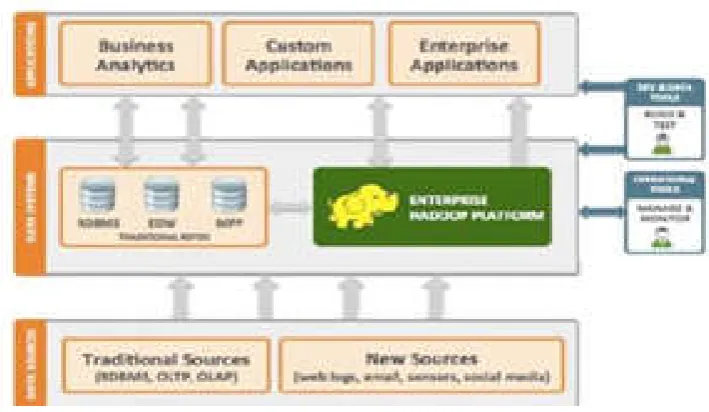
Hadoop is open-source programming that allows loyal, flexible, expressed figuring on groups of reserved servers. That utilizes Map-Reducing framework which is presented at Google by utilizing the ideas of map reduces functions that is significant for utilizing Functional Programming. In spite of the fact that the Hadoop structure is composed in Java, it permits designers for sending tradition composed projects which is in Java or some additional dialect to procedure information in a similar manner over hundred or a great many thing servers. It was streamlined for adjacent streaming reads, where transforming incorporates of checking every data. Reaction time can change from no. of hours to minutes by depending on the process complexity. So, Hadoop can forms information quick and its main advantage is adaptability. Earlier, Hadoop is utilized for catalog net searches, email spam identification, recommended motors, expectation in budgetary administrations, genome control in life sciences, furthermore, for investigation of unorganized information, for example, registers, content, click stream etc. The considered applications can be can be in implemented by using Relational DBMS Fig. 2, but the functionality of the framework Hadoop is totally different from Relational DBMS.
Hadoop can be helpful when:
For handling of Complex data.
Need of conversion of unstructured information to structured information
Usage of SQL queries
Recursive calculations are very large Complex algorithms can be used
Data-sets are so substantial it couldn't be possible to fit into database RAM, CD’s, or require an excess of centers Data cannot be acceptable cost of steady ongoing
accessibility Results are not required continuously Fault resistance is basic
Significant custom coding would be obliged to handle employment booking
Preferably, DFS will categorize the documents and registry administrations of individual servers into a worldwide catalog in such a way that remote information access is not area particular however is indistinguishable from any customer. All records are available to all clients of the worldwide record framework and association is progressive what's more, registry based. Since more than one customer may get to the same information all the while, the server must have a system in spot, (for example, keeping up data about the times of access) to arrange overhauls so that the customer dependably gets the most current adaptation of information and that information clashes don't emerge. Dispersed record frameworks ordinarily utilize record or database replication (conveying duplicates of information on different servers) to ensure against information access failures (Dhruba Borthakur, 2007). Sun Microsystems' Network File System (NFS), Novell NetWare, Microsoft's Distributed File Framework, and IBM/Transarc's DFS are a few samples of distributed file systems framework.
2.
HDFSHadoop frame work consists the Hadoop Distributed File System (HDFS) (Dhruba Borthakur, 2007). HDFS is planned and improved to store information more than a lot of ease equipment in an appropriated manner. The structure of HDFS is master/slave. HDFS cluster consists of one Name Node, a master server that manages the classification system namespace and regulates access to files by clients. In addition, there square measure variety of information nodes, sometimes one per node within the cluster, that manage storage hooked up to the nodes that they run on. HDFS exposes a classification system namespace and permits user knowledge to be hold on in files. Internally, a file is split into one or a lot of blocks and these blocks square measure hold on during a set of information Nodes. The Name Node executes classification system namespace operations like opening, closing, and renaming files and directories. It conjointly determines the mapping of blocks to knowledge Nodes. The info Nodes square measure to responsibility for serving scan and write requests from the file system’s clients. The info Nodes
conjointly performs block formation, deletion, and replication upon instruction from the Name Node.
The Name Node and knowledge Node square measure items of package designed to run on goods machines. These machines generally run a GNU/Linux software system (OS). HDFS is constructed exploitation the Java language; any machine that supports Java will run the Name Node or the Data Node package. Usage of the extremely moveable Java language implies that HDFS will be deployed on a large variety of machines. A typical readying includes a dedicated machine that runs solely the Name Node package. Every of the opposite machines within the cluster runs one instance of the Data Node package. The design doesn't preclude running multiple knowledge Nodes on an equivalent machine however during a real readying that's seldom the case. The existence of Name Node during a cluster greatly simplifies the design of the system. The Name Node is that the intermediary and repository for all HDFS data. The system is intended to flow the user knowledge through the Name Node. The base Apache Hadoop structure is made out of the taking after modules: Hadoop Common– contains libraries and utilities required by other Hadoop modules. Hadoop Distributed File System (HDFS) – a appropriated document framework that stores information on product machines, giving high total data transfer capacity over the group. Hadoop Map Reduce – a programming model for huge scale information preparing. All the modules in Hadoop are planned with a basic presumption that equipment disappointments (of individual machines, or racks of machines) are normal also, consequently ought to be naturally taken care of in programming by the structure. Apache Hadoop’s Map Reduce and HDFS parts initially got individually from Google's Map Reduce and Google File System (GFS) papers."Hadoop" frequently alludes not to simply the base Hadoop bundle yet rather to the Hadoop Ecosystem Fig.4 which incorporates the greater part of the extra programming bundles that can be introduced on top of or nearby Hadoop, for example, Apache Hive, Apache Pig and A HBase.
3.
Map reduce frameworkMap Reduce (Yaxiong Zhao et al., 2014) is a product system for appropriated transforming of Big data sets on PC groups. It is first grown by Google. Map Reduce is planned to encourage also, improve the preparing of incomprehensible measures of information in parallel on extensive bunches of merchandise equipment in a solid, issue tolerant way. Map Reduce is the key calculation that the Hadoop Map Reduce motor uses to circulate work around a bunch. Commonplace Hadoop bunch coordinates Map Reduce and HFDS layer. In Map Reduce layer job tracker assigns tasks to the task tracker. Master node job tracker also allots tasks to the slave node task tracker Fig.
Master node contains
Job tracker node (Map Reduce layer) Task tracker node (Map Reduce layer) Name node (HFDS layer)
Data node (HFDS layer)
Multiple slave nodes contain
Task tracker node (Map Reduce layer) Data node (HFDS layer)
Map Reduce layer has job and task tracker nodes HFDS layer has name and data nodes
A. Map Reduce core functionality (I):
Map &Reduce stage plays an significant role in map reduce core functionality.
Map stage: In Map step, master node takes consideration of large problem input and divided into smaller problems and allotted to worker nodes. These nodes process the smaller problems and return to the master node.
• Map (key1, value) list<key2, value2>
Reduce stage: In this Reduce stage, Master node takes the response from the sub problems and joins them in a predefined manner to get the output to original problem.
• Reduce (key2, list < value2 >) list
4.
PIGPigs (http://pig.apache.org) was at first shaped at Yahoo! to permit individuals utilizing Hadoop to concentrate all the more on examining substantial information sets and invest less moment of time is needed to compose mapper and reducer programs. Pig is comprised of two segments: the first is the is called Pig Latin and the second is a runtime situation where Pig Latin programs are executed.
5.
HIVEApache Hive (http://hive.apache.org) was initially developed by face book. it has data warehouse structure built on top of hadoop for analysis and inquiry of data. By default, Hive stores metadata in an installed Apache Derby Database and other
customer/server databases like MySQL can alternatively be used. Right now, there are four document configurations upheld in Hive, which are TEXTFILE SEQUENCEFILE, ORC and RCFILE.
6.
HBaseHBase (http://hbase.apache.org) is a section arranged database administration framework that keeps running on top of HDFS. HBase applications are composed in Java much like an average Map Reduce application. A HBase framework consists an arrangement of tables. Table Consists of rows and columns like a conventional database.
7.
IssuesAlthough a considerable measure of research is going on big data yet at the same time Several ideas are still to be investigated. Scientists would attempt to upgrade security stage to enhance capacity of programming to discover propelled dangers, respond in like manner and would create preventive measures for future. Specialists would attempt to enhance quality and dependability of security framework. A few analysts are wanting to taken up information accumulation, pretreatment, incorporation, Map Reduce and investigation utilizing machine learning strategies. They would utilize the outcomes for securing and actualizing preventive measures from dangers to big business information. Specialists would attempt to outline the meet the creation needs of endeavors for growing high caliber item by applying efforts to establish safety with the assistance of Big data Analytics with Hadoop. A few specialists are utilizing systems administration checking tools like Packet pig, Mahout and so on to Improve the security levels. Targeted threats will be analyzed by using hadoop cluster.
8.
ConclusionBig data is going to keep developing amid the following years, and every information researcher will need to oversee considerably more measure of information will be more different, bigger, and speedier. We talked about a few experiences about the theme, and what we consider are the fundamental concerns and primary issues for what’s to come. Big data is turning into new final boundary for experimental information research and for business applications. Everyone is warmly welcomed to take part in this fearless trip.
9.
REFERENCES
Apache HBase. Available at http://hbase.apache.org Apache Hive. Available at http://hive.apache.org Apache Pig. Available at http://pig.apache.org
Dhruba Borthakur, 2007. “The Hadoop Distributed File System: Architecture and Design”, The Apache Software Foundation.
Michael R. Lyu, 2013. “Service-generated Big Data and Big Data-as-a-Service” Internetware.
Suman Arora, et al. 2014. “Survey Paper on Scheduling in Hadoop” International Journal of Advanced Research in Computer Science and Software Engineering, Vol. 4.
Yaxiong Zhao, et al. 2014. “Dache: A Data AwareCaching for Big-Data Applications Using the MapReduce Framework”,
Tsinghua Science and Technology, Volume 19, Number 1, ISSN l1007-0214l.