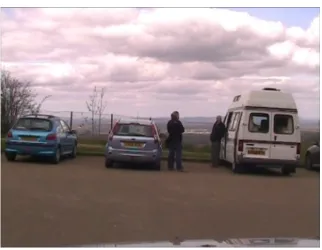
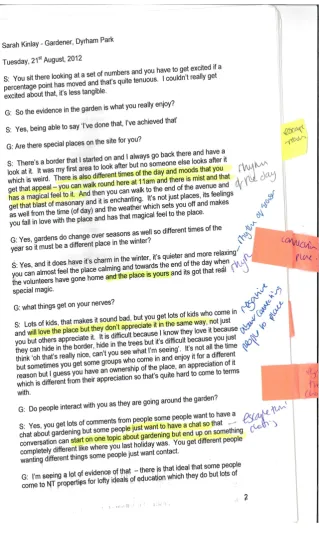
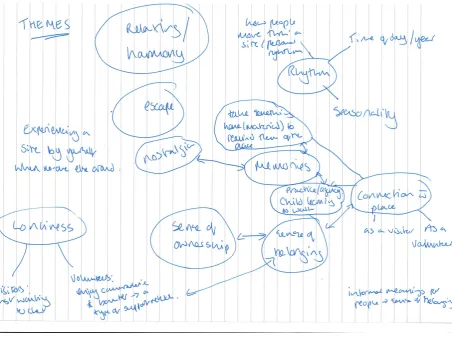
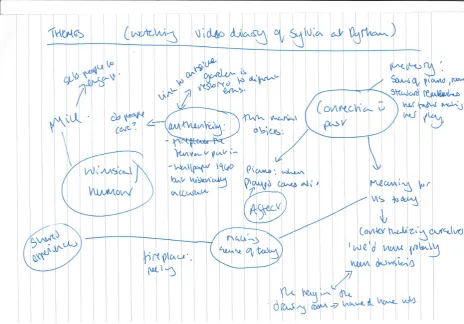
Thesis
Towards understandings of visitor experiences and practices that shape new meanings of place at National Trust sites.
Gillian Cope
A thesis submitted to the Faculty of Environment and Technology, in partial fulfilment of the requirement of the degree of Doctor of Philosophy
This research programme was carried out in collaboration with the National Trust
ii
Abstract
The National Trust face a new set of challenges in recent years; as one of the most influential heritage bodies in the UK, it is responsible for the preservation and protection of a large number of diverse sites from historic buildings to woodland. Yet this is set against a backdrop of complex set of challenges: creating an active dialogue with those who visit its sites and other stakeholders, such as the local community; ensuring their sites are preserved while, at the same time,
encouraging access; on-going climate change and environmental risks; changing cultural, social and economic frameworks. The aim for the National Trust is to better understand how places might be managed differently in the light of these challenges.
This research builds on existing quantitative research conducted by the National Trust by examining how the engagement, embodiment and practice of visitors, staff and volunteers at National Trust sites informs a sense of place. The research employs a mixed method approach using qualitative ethnographic techniques. The methods of video and audio capture were used to explore and engage with the highly complex processes practiced at the sites and capture the non-verbal, pre cognitive and emotive ways in which people engage with site. From this insight, the research makes a conceptual contribution to knowledge by examining how site based practice informs emotional engagement and affect of place and how this experience produces a sense of place for people within National Trust sites.
iii affects and how this sense of place gets carried over time and space. The
contribution that this research makes, therefore, is in extending the insights into how place can change people to how people change place within the context of National Trust sites.
iv
Acknowledgements
I have enjoyed both the content and process of this PhD enormously but the challenge of completing it has sometimes been overwhelming. The support from colleagues, friends and family has, for that reason, been invaluable.
I am indebted to the people who helped me with my fieldwork – Edward and Maureen, Barbara, Sylvia, Sally, Karen – and all the volunteers, staff and visitors who talked to me about their experiences at Hidcote, Dyrham, Lacock and
Woodchester. Thank you to the National Trust for sponsoring me to undertake such an interesting project and, in particular, to Tony Berry who was an
enthusiastic and engaged sponsor of my work.
I would like to thank my supervisors: Nigel Curry for his guidance on structure and for getting me to think analytically and Owain Jones for his creative thinking and input into the shape of my thesis. Taking over the supervision, Avril Maddrell provided extremely insightful and thoughtful feedback on my work that was instrumental in its completion and I would like to thank her for all her advice and support.
To my friends and colleagues at CCRI – thank you for your support, encouragement and humour throughout my PhD.
I would like to thank Karen Gallagher for her friendship and always making sure I was ‘getting on with it’!
Special thanks goes to Celly (Ceris) Bergen for her proof reading and getting me out to the pub when required.
I would like to thank my mother for her encouragement of my studies and for always taking an interest in my work. Special thanks goes to my sister, Jane, who gave me support, reassurance, and provided proof reading at critical times.
v
Contents
Abstract ... ii
Acknowledgements ... iv
Contents ... v
List of Figures ... viii
Chapter 1: People and places: an introduction and outline of the thesis ... 1
1.1 Introduction ... 1
1.2 Emerging approaches to people and place, space and landscape ... 7
1.3 The National Trust moving forward: changing understandings of heritage . 14 1.4 Emerging approaches to heritage ... 17
1.5 Project rationale ... 21
1.6 Aims and objectives ... 22
1.7 Conclusion ... 23
Chapter 2: A review of the literature concerning people’s engagement with place ... 25
2.1 Introduction ... 25
2.2 Aspects of Memory explored ... 26
2.2.1 Memory as experienced through material objects ... 27
2.2.2 The social and spatial nature of memory ... 29
2.2.3 Collective and individual memory ... 30
2.3 Rhythm ... 32
2.3.1 Rhythm ... Error! Bookmark not defined. 2.3.2 Temporality ... 34
2.3.3 Rhythms of mobility ... 36
2.4 Escape ... 37
2.4.1 Escape from outside pressures ... 38
2.4.2 Escape and nostalgia ... 39
2.4.3 Escape and place ... 43
2.5 Connection and belonging ... 47
2.5.1 Meanings of belonging to place ... 47
2.5.2 Meanings of belonging to people ... 49
2.5.3 Meanings of connection ... 50
2.6 The Senses ... 52
2.6.1 Sight ... 55
2.6.2 Vision and audiencing ... 57
2.6.3 Sound ... 58
2.7 Material objects ... 61
vi
2.7.2 Objects and identity ... 65
2.8 Conclusion ... 67
Chapter3: The methodological approach: the theory and practice ... 69
3.1 Introduction ... 69
3.2 First step of fieldwork process – National Trust workshop ... 71
3.2.1 The selection of the fieldwork sites ... 72
3.2.2 Initial site contact as start of fieldwork ... 77
3.3 Ethnography as a methodological approach ... 82
3.4 Methods Used ... 86
3.4.1 Participant observation ... 88
3.4.2 Visual methods ... 93
3.4.3 Interviews and the ‘practice of talking to people’ ... 104
3.5 Analysis, synthesis and reflections ... 111
3.5.1 Situating the analysis ... 111
3.5.2 Approach to the analysis ... 112
3.5.3 The analysis ... 114
3.5.4 The coding process ... 118
3.6 Reflections on methods ... 120
3.7 Conclusion ... 122
Chapter 4: Findings – analysis, evaluation and interpretation ... 123
4.1 Introduction ... 123
4.2 Memory ... 124
4.2.1 How memory is experienced through objects ... 125
4.2.2 Triggered memory ... 128
4.2.3 The social and spatial nature of memory ... 133
4.3 The nature of rhythm ... 136
4.3.1 Rhythm findings ... 136
4.3.2 Temporality findings ... 140
4.3.3 Mobilities’ findings ... 141
4.4 Escape ... 153
4.4.1 Escape from outside pressures ... 153
4.4.2 Escape and nostalgia ... 158
4.4.3 Escape and place ... 160
4.5 Conclusion ... 163
Chapter 5: Findings – analysis, evaluation and interpretation ... 165
5.1 Introduction ... 165
5.2 Belonging and connection ... 165
5.2.1 Belonging and connection to place ... 166
vii
5.2.3 Not always a comfortable connection ... 174
5.3 The Senses: as evident in people, place, performance ... 174
5.3.1 The sense of sight ... 175
5.3.2 The sense of hearing ... 177
5.3.3 The sense of touch ... 181
5.3.4 Senses of taste and smell ... 184
5.3.5 Disconnected senses ... 186
5.4 Material Objects ... 187
5.4.1 Objects and identity ... 188
5.4.2 Material objects out of time ... 196
5.5 Conclusion ... 197
Chapter 6: Conclusion and future research questions ... 199
6.1 Introduction ... 199
6.2 Summary of key findings in relation to the research aims and objectives . 199 6.3 Implications for the National Trust ... 209
6.4 Directions for future research ... 210
6.5 Concluding remarks ... 211
References ... 213
viii
List of Figures
Chapter 1
Figure 1.1 Map of four fieldwork sites 5
Figure 1.2 Lacock 5
Figure 1.3 Hidcote 5
Figure 1.4 Woodchester Park 6
Figure 1.5 Dyrham 6
Chapter 3
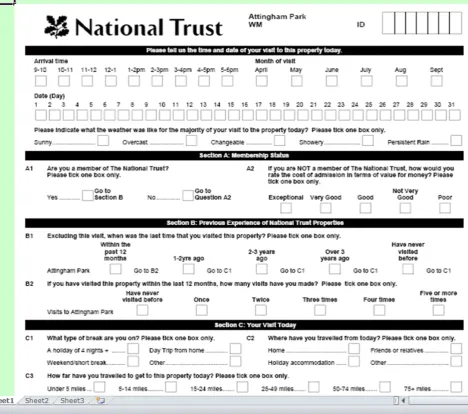
Figure 3.1 Example of National Trust Questionnaire (partial view) 73
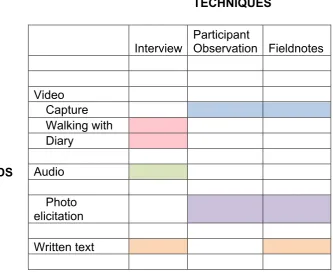
Figure 3.2 Methods and techniques 85
Figure 3.3 Woman plays with child 88
Figure 3.4 Woman turns away from child 88
Figure 3.5 Still from video of man leaning against his camper van 94
Figure 3.6 Driftwood on Brean Down 111
Figure 3.7 Example of transcribed interview with themes identified 114
Figure 3.8 Example of mind map from data from staff and volunteers 115
Figure 3.9 Example of mind map from data from visitor 116
Chapter 4
Figure 4.1: Camera recognised in Fox Talbot museum, LacocK 126
Figure 4.2 Mother and daughter Westbury Court gardens 138
Figure 4.3 Visitors at Hidcote 140
Chapter 5
ix
Figure 5.2 Visitors playing tennis 178
Figure 5.3 Child talking to fish 178
Figure 5.4 Sylvia touching the stone on the outside of Dyrham house 179
1
1
People and places: an introduction and outline of the thesis
1.1 Introduction
Recent interest within the social sciences in the interaction between people and place has seen developments in the methodological and conceptual debates within the discipline (Morton, 2005; Latham 2003, 2004; Simpson, 2008). This work has served to highlight the significance of practice of everyday life with the focus on how the ‘eventness’ of place (Cresswell, 2003) is made through practice. This focus has been paralleled by the development of innovative methodologies to capture people’s emotional and sensorial engagement with place (Pink, 2005, 2013; Rose, 2012).
The National Trust has also been cognizant of these issues and has fostered attempts to create an active dialogue with those who visit its sites, as well as other stakeholders, such as the local community, in order to promote a sense of
belonging in those who support its work. Within these contexts the National Trust has identified its need to develop deeper understandings of the changing
relationships between visitors and places (National Trust, 2007) and to better understand how places might be managed differently in the light of that knowledge and the other challenges outlined above. An example of a move towards this situated place approach can be seen in the following excerpt from the National Trust’s Strategy and Organisational Plan 2010-2013:
“We will also view our places as an integral part of the landscape and communities in which they sit. This is about blurring the dividing lines between engagement and conservation and between us, our supporters and our neighbours; seeing the National Trust as a movement of people that everyone can be a part of.”
2
This desire on the part of the National Trust to understand this connection between people and place has led to this PhD and collaboration between the University of the West of England and the Countryside and Community Research Institute (CCRI) and the National Trust. The aim of this joint project has been to add rigour, through academic research, and identify how the National Trust could “focus on ensuring inspiring, enjoyable and memorable experiences in our places” an aim articulated as part of the strategy in the Strategy and Organisational plan 2010-13.
The purpose of this research is to provide an understanding of people and place by examining the subtle emotional and sensorial aspects of how and why people interact with place. In particular, the research builds on previous studies that explore the nature of place (Tuan, 1977; Cresswell, 2004; Wylie, 2007) and how place is constructed. The aim of this thesis is to examine how people engage with place through a variety of physical activities such as walking, gardening, and sitting, in addition to the range of emotional experiences that form a sense of place and are articulated through affects and feelings.
It should be acknowledged that this thesis is exploratory both in terms of the nature of the research and its understanding of landscape. The thesis is also cognizant of, and acknowledges, the different influences on the understanding of
landscape, recognising that landscape “is both the phenomenon itself and our
perception of it” (Wylie, 2007:7 original emphasis). It should also be stressed that while this thesis sets out how these different aspects of the perception of
landscape and place influence the visitor engagement, and how these aspects are interrelated and in some cases have tensions, it does not seek to set these
aspects out in a hierarchical manner. Instead it includes these aspects in the fluid, chaotic and muddled nature of people’s individual interaction and relations with place and landscape and describes the overlaps and tensions found within.
Data has been collected by conducting fieldwork at four National Trust sites – Hidcote, Dyrham Park, Lacock Abbey, Fox Talbot Museum and Village and
3
meetings, workshops and presentations have been made at both the fieldwork sites and at the National Trust’s head office, Heelis, in Swindon to disseminate the findings to a wider audience.
The findings have been analysed through the lens of six themes – memory, rhythm, connection and belonging, escape, material objects, and the senses. In addition to these six themes the concepts of place, space, landscape and heritage have been discussed within this introduction as way of introducing these concepts as they run through the six themes.
In providing the insight into people and place in the context of four National Trust sites the aim of the research is to address some of the challenges that the
National Trust faces, as articulated in their strategy document (National Trust, 2010):
“So though the National Trust has always been about places, it has never been about places in isolation to the exclusion of those who enjoy them. What really matters is the delight each place can offer people: locations for inspiration, fun, physical and intellectual challenge, companionship, joy, consolation, and peace.”
(National Trust Strategy document: Going local - fresh tracks down old roads: Our strategy for the next decade, 2010)
The research comes at a time when more people are opting to take their holidays and leisure time within the UK, rather than travelling abroad, as the following excerpt from ONS report identifies:
4
In addition, tourism day visit expenditure by UK residents has risen steadily from £47 billion in 2009 to £57 billion in 2012 – a 17% increase. Tourism day visit
expenditure in 2012 accounted for 44% of all tourism expenditure in the UK. (ONS,
2013).
The National Trust is keen to capitalise on this increase in day visits, as well as building lasting relationships with a wider audience. In order to achieve both of these goals it is trying to move away from the ‘look but don’t touch’ visitor experience and ‘bring places to life’ (National Trust, 2010) by actively engaging people emotionally and sensorially in their sites. This has been achieved through some creative thinking by the National Trust which can be seen in initiatives such as encouraging people to play the piano (Dyrham), walking barefoot on lawns (Hidcote) or playing on the rope swings (Woodchester Park). Through this type of participation at National Trust sites visitors are co-producing place and, as part of this process, making places meaningful. The National Trust is facilitating this process by aiming to make places special for people by allowing them to touch, taste, smell, aurally and visually appreciate their sites; they balance this with the challenges of conserving the site and contents for future generations. The National Trust is attempting to nurture places “with those who loved it in the past or will do in the future, with neighbours and local communities, and with visitors for whom this special spot of earth can become like home, a vital part of their lives.”
(National Trust, 2010). This echoes the sentiments of the founders of the National Trust - Octavia Hill, Robert Hunter and Hardwicke Rawnsley – who, founded the organisation in 1895 to bring about social change through the acquisition of sites in danger of demolition and although the organisation was originally more
interested in open landscapes and medieval buildings in the 1930s they began to focus their resources on country houses and transforming them into a public symbol of national pride (Mandler, 1997) as families could not afford the 40%
inheritance tax and were forced to sell off or abandon country estates. The
5
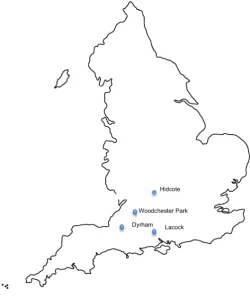
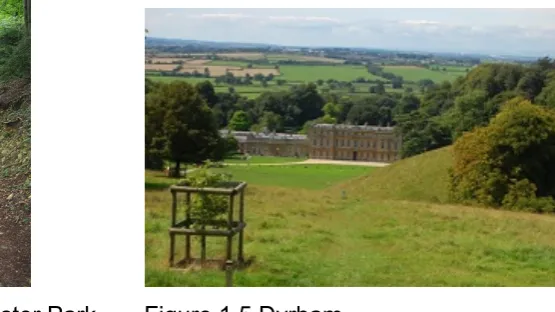
[image:14.595.112.363.132.431.2]The research for this project was carried out at four sites – Hidcote, Lacock, Dyrham and Woodchester – see figures 1.1, 1.2, 1.3, 1.4 and 1.5.
[image:14.595.115.448.474.596.2]Figure 1.1 Map of four fieldwork sites
Figure 1.2 Lacock Figure 1.3 Hidcote
Hidcote Woodchester Park
6
Figure 1.4 Woodchester Park Figure 1.5 Dyrham
The remainder of this chapter provides a brief context and outline of the main issues explored in the thesis. In order to introduce and contextualize aspects of the research, I start with a brief discussion of the key concepts that I use
throughout the thesis – place, space, landscape and heritage. This is limited in the sense that I only make some general points about these concepts in order to contextualize the research; the arguments outlined here will be discussed in more detail in subsequent chapters of this thesis.
[image:15.595.221.499.91.247.2]7
1.2 Emerging approaches to people and place, space and landscape
The development of the concept of place in human geography can be found in the
work of Yi-Fu Tuan whose books Topophilia (1974) and Space and Place (1977)
defined place, among others, in contrast to space. Tuan developed the concept of a sense of space as an open arena of action and movement while place was defined in terms of stopping and resting and becoming involved (Cresswell, 2004). More recently Casey (2001) describes the distinction between place and space in more practical terms:
“taking “space” to be the encompassing volumetric void in which things (including human beings) are positioned and “place” to be the immediate environment of my lived body – an arena of action that is at once physical
and historical, social and cultural” (ibid, 2001: 683)
The ‘spatial turn’ (Soja, 1996) emphasized, within geography and the humanities,
a focus on space and how space becomes place through materially embedded practices and the social production of lived space (Massey et al, 1999). This notion of social space can be considered to comprise of ‘stretched out’ social relations formed of networks and complexities of social interaction and
interconnections (Allen and Hammnett, 1995). Inherent in this concept of space and place are power and power relations as Sack (1986) comments:
“…territoriality is a primary geographical expression of social power. It is the means by which society and space are related.” (Sack, 1986:5)
8
a dynamic sense of place is formed from emotions, affect and rhythms through both human and non-human actors. These connections and attachments that people form with place enable us to identify meanings and experiences, as Casey (2001) notes: “place is regarded as constitutive of one’s sense of self.” (Casey, 2001: 684)
Place has also long been recognised as playing a major role in the on-going constitution of identity (Bondi et al, 2002; Cresswell, 2004; Pile and Thrift, 1995) which is grounded in Heidegger’s (1988) concept of ‘being-in-the-world’ and the exploration of perception through phenomenology (Merleu-Ponty, 1962). Casey (2001) takes this further by stating that the relationship between place and human identity is not just one of reciprocal influence but of co-production:
“constitutive coingredience: each is essential to the being of the other. In effect, there is no place without self and no self without place.”
(Casey, 2001: 684)
This idea that place is not just a ‘thing’ but a way of understanding and experiencing the world is extended by Cresswell (2004), who defines how meaning and experience can give rise to attachments and connections between people and place. As such, places are dynamic and never finished but always the result of processes and practices (Pred, 1984) and, in this way, places are
performed on a daily basis through our movements in what Seamon (1980) refers to as ‘place-ballet’.
Places, then, are not only a medium but also an outcome of action producing and being produced through human practice (Crouch, 2000). As Tilley (1994)
9
This reciprocity between people and place has become a topic of significant interest to human geographers and social scientists as recognition of how our senses of self are connected to particular places (Conradson and Mackay, 2007) whether through work, friendship or family – these relationships are thought of in spatialized terms. This theory is extended by Cresswell (2004) who describes how locations which people connect with, either physically or emotionally, are bound up in notions of belonging (or not belonging), ownership and consequently, identity. This concept of how identity is tied in with the notion of place and, in particular, how we feel connected and a sense of belonging, to a particular place underlies the way in which part of how we define ourselves is symbolised by certain qualities of that place (Rose, 1995:81).
Cresswell (1997) further examines the use of metaphors that describe people and actions as out of place, focusing on metaphors of displacement as rooted:
“in a belief that place is one of the primary factors in the creation and maintenance of ideological values (what is good, just and appropriate) and thus in the definition of appropriate and inappropriate actions and
practices.” (Cresswell, 1997: 33)
The notion that everything ‘has its place’ and that things (e.g. people, actions) can be ‘in place’ or ‘out of place’ is deeply engrained in the way we think and act (Cresswell, 1996). This concept underlies how place, and our perception of how people think they are supposed to act, influences what we do and do not do in place. When groups or individuals ignore this premise they are said to ‘out of place’ and defined as deviant. Cresswell (2004) uses the examples of graffiti artists in New York City, peace campers on Greenham Common (UK) and new age travellers in the British countryside as examples as ‘out of place’; in each case people and practices were considered (by the media and public) to have
10 appropriate and how people are able to subvert these given meanings of place. As a guardian of heritage places the National Trust has the authority to present a version of a site that, in turn, influences the meaning that a place has for people. In this way ‘places’ constitute significant sites which have been imbued with meaning often representing the ‘heritage’ of a particular individual, group or community (Kuusisto 1999).
Time is another factor in the construction of place; it can engender a feeling of being an ‘insider’ in a place, which Seamon (1980) notes is down to ‘time-space routine’ which describes the habits of a person as they follow a routine path through the day and suggests how places are performed on a daily basis through people living their everyday life. In this way we get to know a place and feel part of it, although it could still be possible to participate in a daily routine and not feel part of it, as shown by Geraladine Pratt’s (1997) work on the lives of Filipina contract workers in Vancouver, Canada who are not ‘at home’ in the homes in which they work. This ties into the National Trust as traditionally being perceived as pursuing a mantra of ‘don’t touch’ at their sites while at the same time aiming towards making their sites feel like a “special spot of earth….like home, a vital part of their lives” (National Trust, 2010).
Place can also be viewed as constantly in a state of becoming (Pred, 1984) and is informed by structuration theory associated with British sociologist Anthony
Giddens who describes the overarching structures that influence our lives from capitalism to national and local institutions and even language. Structurationists maintain that our actions depend on structures – not talking to ourselves in public – but that at the same time structures depend on our actions to exist and that at any given moment in time, place provides a geographically specific set of
structures.
This concept of structuration can be applied to place seen as a “cultural image a way of representing, structuring or symbolising surroundings” (Cosgrove and Daniels, 1988: 1) and the visual is “central to the cultural construction of life” (Rose, 2001: 6). National Trust places are highly visual and laden with
11 responses across time, space and cultures. The context of the symbols is
inherent in how they are interpreted and a wide range of economic, social and political factors influence how an audience receives a symbol (Rose, 2001). While National Trust audiences are given context – an historical narrative – as a
mechanism for interpreting the symbols within a site there is also an individual interpretation as an audience has the power to take meaning (Buckley, 1998) and to “reinvent signs and symbols and read them in different contexts, transforming their meaning” (McDowell, 2008: 40). Heritage site as places are, therefore, open to interpretation, and contestation, and tangible representations of the past and present that are found in visual features of cultural landscape are selective
representations of identity, which the heritage body has chosen to present to their audience. These visual features of a landscape are, therefore, selective
interpretations of the past and present onto public places; as such they articulate heritage and can be read as icons of identity and spatializations of history
(McDowell, 2008).
Finally, in an examination of place it is also necessary to look at the role of emotional geography. During the early 2000s there was a call for more
consideration of the emotional dynamics of everyday life and the spatial aspects (Anderson and Smith, 2001; Bondi, 2005; Thien 2005). This was a time when emotion in human geography was only considered in the cultural and often feminist corners of the discipline, which focussed on addressing the silencing or repressing of often gendered emotional experience (Anderson, 2009); instead feminist geographers shared a commitment “situating knowledge, the view that interpretations are context-bound and partial, rather than detached and universal” (Pratt, 2009). Good scholarship was considered to depend on keeping emotions under wraps, and thinking emotionally was deemed to be subjective, clouding vision and judgment.
12 such as music or theatre spaces may ‘usefully illustrate the way that social
relations are mediated by feeling and sensibility’ (Anderson and Smith, 2001:8). In this way human geography has provided an impetus towards engaging with emotional dimensions of people’s experiences of place and space which marked an ‘emotional turn’ (Bondi, Davidson and Smith, 2005). Rather than the focus being directly on emotions, where emotions are seen as things or objects to be studied and measured, emotional geographies highlight how emotions are produced between and among people as a relational flow and, in this way,
become part of the different relations that make up the lived geographies of place (Bondi, Davidson and Smith, 2005).
Furthermore, emotional geography offers an additional perspective on place: by focussing on the dynamic, recursive relation between emotions, place, space,
politics (Gregory et al, 2009) and acknowledging different ways in which emotions
emerge from, and re-produce, socio-spatial orders. In this way, emotions are a part of all geographies (Anderson and Smith, 2001) and, as such, are key drivers of the practices of everyday life that the social sciences and geography have tended to ignore (Anderson and Smith 2001; Bondi, 2005; and Davidson, Bondi and Smith, 2005). In particular, our emotional lives are shaped by wider relational contexts as the self is understood as emerging within and through its relations to other people and events (Conradson, 2005). In this way there is a significant material exchange between people and their environments and particular affective and emotional outcomes underlie how place is an evolving concept and should not be thought of as an abstract Cartesian space (Urry, 2005). Rather, place can be viewed in what Kevin Hetherington (1997:185-9) alludes to with his notion of ‘place as being like a ship’, where places are about relationships and are not in one location but move around within networks of agents, humans and non-humans that produce ‘an emotion of movement, of bodies, images, information’ (Urry, 2005).
13 visitors that asked about plants, or items bought in the shop or simply the verbal connections people make by relating an experience they encountered at a site - listening to a piano, for example - and connecting it to a childhood experience. In this way, an individual makes sense of a place through her/his own experiences and relates it back to their understanding of the world. This sense of place is not, then, confined to a physical location but carried over time and space.
A discussion on visitor experience has to acknowledge that tourist gaze is
structured around gender, age and ethnicity (Urry, 1990) and while these are not the focus of this research they are concepts that merit discussion here. Shurmer-Smith and Hannham (1994) suggest that inherent in this examination of space is the “emotional” geography (1991:6) that views places such as tourism sites, attractions, landmarks, destinations, and landscapes as spaces through which “power, identity, meaning and behaviour are constructed, negotiated, and renegotiated according to sociocultural dynamics”. Gender is critical to this
construction, and indeed spaces and places are “both shaped by, and a shaper of, gender in a gender-space dialectic” (Aitchison and Reeves 1998:51). Similarly, ethnicity affects how we consume sites and objects; referencing museum
artefacts, Merriman (1991) proposes that cultural identification is not necessarily attached to the same objects or artifacts, or experienced in the same manner universally. Age can also affect the relation with place or objects Csikszentmihalyi and Rochberg-Halton (1981) propose that:
“the young receive meaningful information from interacting with objects that are appropriate to their stage in life as defined in this culture: These are different objects and therefore different selves, from those that their parents and grandparents develop.” (Csikszentmihalyi and Rochberg-Halton, 1981:46)
Goulding (2000) suggests that this was similar to the way in which various ages have related to the past: they chose mediums which reflected their own age
14 Acknowledging that a sense of place is influenced by individual as well as
collective factors I now examine how the National Trust has responded to this challenge in their engagement of visitors to their sites.
1.3 The National Trust moving forward: changing understandings of heritage
The National Trust is one of the largest and most influential landowning
environmental/cultural and natural heritage nongovernmental organisations in the
UK. According to the 2010 annual report 1 the National Trust is responsible for the
preservation and protection of a large number of historic properties and
landscapes, including 215 houses and gardens, 40 castles, 76 nature reserves, 6 World Heritage Sites, 12 lighthouses, and 43 pubs and inns, 627,000 acres
(254,000 hectares) of countryside, moor land, beach and coastline 2. The
National Trust is charged with the complex, intersecting tasks of conserving both cultural and natural heritage, facilitating access to these assets by the public and raising awareness of the value of these assets and a range of associated issues within the public, the private sector, the state and other bodies.
The National Trust is having to deliver this complex set of priorities in
unprecedented and highly challenging set of contexts. These include the current economic crisis, climate change and other environmental risks which could well affect both landscapes and built heritage, and the changing cultural, social and economic make-up of post-globalisation society which now exists at local, regional, national and international scales.
As part of their response to these and other challenges in recent years, the
National Trust has become increasingly engaged with attempts to create an active dialogue with those who visit its sites, as well as other stakeholders, and to foster
1 http://www.nationalNational Trust.org.uk/main/w-National
Trust/w-thecharity/w-annualreport2010.htm
2 Taken from ‘facts about the National Trust’ http://www.nationalNational
15 a sense of belonging in those who support its work. Within these contexts the National Trust has acknowledged its need to develop yet deeper understandings of the changing relationships between visitors and places (National Trust, 2007) and to better understand how places might be managed differently in the light of that knowledge and the other challenges outlined above. An example of this can be seen in an excerpt from the National Trust’s Strategy and Organisational Plan 2010-2013:
“We will also view our places as an integral part of the landscape and communities in which they sit. This is about blurring the dividing lines between engagement and conservation and between us, our supporters and our neighbours; seeing the National Trust as a movement of people that everyone can be a part of.”
(Strategy and Organisational Plan, 2010-13:3)
The desire on the part of the National Trust to understand this connection between people and place has led to this PhD. The National Trust’s interest in the project came from a collaboration between the University of the West of England and the Countryside and Community Research Institute (CCRI) and the National Trust in which academic research in the form of this PhD was funded to add rigour to finding out how the National Trust could “focus on ensuring inspiring, enjoyable and memorable experiences in our places” an aim articulated as part of the strategy in the Strategy and Organisational plan 2010-13.
However, the National Trust is not without its critics as articulated by Guardian journalist, Jon Henley, who suggest it is “exclusive, elitist, samey, paternalistic,
look-but-don't-touch” in an article from the Guardian website entitled ‘How the
16
connection” 3 as described in its ‘Going Local’ campaign, which represents a
radical shift in the mindset of the National Trust in an effort to “foster a greater sense of shared pride and ownership” (National Trust, 2010: 5).
The National Trust’s ‘Going Local’ campaign can already be seen at Seaton Delaval, a National Trust stately home in Newcastle, the running of which the National Trust has given over to the local community who have been involved in all stages from raising money for its renovation to writing guide books as well as the local community using the site for different needs from parish meetings to school play rehearsals. Furthermore the locals are involved in how the site gets used by the visitors from camping in the grounds to dressing up in period costume in the East wing. This greater autonomy for National Trust sites marks a shift in the relationship between the National Trust and staff and volunteers at the individual sites moving away from a centralised organisation that dictates how sites are run and allowing the community – the staff and volunteers - at the site greater control over how the site is managed.
The National Trust has developed as an organisation, both in how it relates to its own internal communities of volunteers and staff and the broader community of visitors. This relationship between these groups of people and place has also been influenced by how the concept of heritage, in a wider context, has
developed. As a result, the National Trust (2006) is exploring new ways of valuing heritage where the “concept of ‘public value’ moves beyond simple measures of social and economic impact” (National Trust, 2006:6), and instead looks at the
“benefits to people both as consumers of heritage ‘goods’ and as citizens” (ibid).
This shift in how heritage is viewed and acted upon can be seen in other heritage stakeholders – English Heritage is attempting to connect heritage to the
communities of their sites by outreach programs described under a section of their website entitled ‘people and place’ (English Heritage, 2012). The intention of
3 ‘Going Local – fresh tracks down old roads, our strategy for the next decade’
taken from the National Trust website
17 English Heritage is to help the community groups ‘explore their history and
heritage often at a local level’ and, in achieving this aim, make heritage more relevant and accessible to more people.
These new challenges around connecting people marks a recognition on the part of heritage stakeholders of the need to be more cognizant of the community within which their heritage sites sit (Edwards 1987; Davies and Prentice 1995; Markwell, Bennett and Ravenscroft, 1997). It also signifies that by providing a framework “for demonstrating the contribution places rich in history and the processes of looking after them make to our collective quality of life” (National Trust, 2006:6), heritage can help enhance the richness and diversity of peoples’ engagements with different types of site.
Changing attitudes to heritage relies on this understanding of how people interact with, and are affected by, place (Cresswell, 2004). The approaches outlined in this thesis, aim to explore and interpret people’s interaction with place with the focus on embodiment, practice, performativity, and use the larger ‘emotional’, ‘affective’ and ‘non-representational’ themes within geography and related disciplines (Thrift, 2008) to bring more insight and open up new approaches to place.
1.4 Emerging approaches to heritage
Groote and Haartsen (2008) observe how heritage and its communication are in many senses plural concepts with different agents involved, communicating different discourses and using different historical narratives linked to different place identities to achieve different objectives. As such heritage meanings can be socially or culturally constructed and are therefore contestable. On an individual level, remembering the past is tied to the present and our sense of identity and it is the present needs and aspirations that influence how we remember the past which informs the heritage process (Walker, 1996). However this is not without
18 as an essentially conservative and nostalgic process (Lowenthal, 1985; Hewison, 1987) in which a romanticized and idealized view of the past is deployed to reinforce old certainties at times of significant change (Robertson, 2008) and the other view champions the ‘spirit of local places’ (Robertson, 2008) where heritage is made and maintained by local communities. This latter version of heritage most often draws on expressions of resistance or memory of resistance amongst the dominated. There is a tension, therefore, between the past being deployed at a local level versus at national level where supposed values, meanings, beliefs and character of ‘the nation’ are enshrined in ‘iconic’ landscapes (Edensor, 2002).
This duality, between local and national forms of heritage, demonstrates the multi-perceived and multi-consumed nature of heritage. It also serves to demonstrate how we are selective about what we remember and how we create and supress cultures and traditions in the same way that identities are validated as well as contested. The past, or a version of the past, serves to reinforce a sense of belonging, purpose and place (Lowenthal, 1985) and, in this way, identities and memories, like heritage, are inevitably selective in what purpose they serve.
Whilst acknowledging that issues of class and ethnicity are outside of the remit of this thesis it should be noted that sites are not uniformly read nor passively
accepted by visitors; as Urry (1996) comments, “different visitors can gaze upon the same set of objects and read and perform them in different ways” (Urry, 2002: 101). The contestation of ideals of heritage is further highlighted by the following
quote from a report commissioned by English Heritage and written by MORI4:
“The focus group participants make little or no use of traditional heritage sites, and among BME [black and minority ethnic] groups, this is because they feel that these sites did not adequately represent aspects of their culture and are not relevant to themselves, their children and the way they live their lives.” (MORI, 2003)
4 ‘
19 This recognition that sites are consumed differently has led to a number of
initiatives taken by the National Trust in the management of their sites and how they engage with different groups of user; this is more fully explored in the findings, chapter 4.
Given that heritage is bound up with constructions and deconstruction of memory and identity (Whelan, 2003) then there is a question of power in who decides what is heritage. Notions of power are therefore central to the construction of heritage and give weight to the argument that heritage “is not given; it is made” (Harvey, 2001). The National Trust, as a heritage organisation, decides on how to present a site and what to present not only in terms of the physical area but also in terms of what version of a site’s past to present.
On this aspect, Harvey (2008) challenges the work of the National Trust not as social campaigning but at “meeting and manipulating a public appetite for the ‘olden-time’” (Harvey, 2008: 28), going on to describe how:
“a carefully mediated past needs to be revered and conserved for the good of the nation, the achievement of this carefully mediated heritage product, however, has often meant that some bits have had to be left out of the
narrative.” (Harvey, 2008: 29)
This selection of the past for present consumption is something that Urry (1995) explores through the Wigan Pier Heritage Centre as an example of how the industrial past of Wigan has “unashamedly re-presented the industrial and social history of Wigan albeit in a way which is certainly sanitised.” (Urry, 1995: 160). Similarly, Hewison (1987) critiqued Wigan Pier and the way in which “the agenda of heritage promotes a mythical English idyll of harmony and community and a romanticised and glamorised industrial past” (Hewsion: 181). Aside from the question of authenticity, which Herbert (2001) frames as a subjective experience that is a “combination of the developers’ intention, the consumers’ interpretation and the interactions among them” (Herbert, 2001: 317), the effect of this
20 As such, visitors can seek some reassurance from a nostalgic view of the past as they use heritage sites as bases for reminiscence. This performance of
reminiscing often involves a mutual collaboration between the visitors to the sites and those people at the sites who are there to stimulate memories – an example of this can be found in the findings, chapter 4, when a gardener at Hidcote talks about planting sweet peas and Sweet Williams in response to visitors’ comments on how they remember these flowers from their childhood. Edensor (1998) notes how this performativity of reminiscence is by no means a passive process of visual consumption but is similar to other spatial practices which take place at tourist sites such as walking, talking, sitting and taking photos.
The issue of authenticity is significant in relation to the concept of heritage, as Herbert (2001) notes “memory changes and is historically conditioned” (Herbert, 2001:317). The role of memory is explored in more detail in sections 2.2 and 4.2 but it is worth noting here how, like history, memory is essentially revisionist (Samuel, 1994) and while a reinvented or reconciled past that combines myth and memory may not contain scientific historical evidence, this is not necessarily what visitors to heritage sites are looking for:
“They may even be only partly interested in the historical reality as such. Visitors to historic sites are looking for an experience, a new reality based on the tangible remains of the past. For them, this is the very essence of the heritage experience.” (Schouten, 1995:21)
21
1.5 Project rationale
This PhD focuses on the engaging processes with places which stress practice, embodiment and materiality articulated through a range of physical activities such as walking, sitting and doing voluntary work as well as a range of processes not articulated through language, such as affect and emotions.
These emerging approaches to people’s engagement with place (Thrift, 2001; Wylie, 2007; Lorimer, 2006; Crouch, 2000) are set out and linked to National Trust policies and practices in relation to visitor experience and researching visitor experiences and practice in four case study locations – Hidcote, Lacock, Dryham and Woodchester Park.
The aim of the approach to this project is to move away from notions of social construction (Berger and Luckman, 1991) and instead highlight the richness and import of human interaction with place and how this experience is articulated through a range of embodied processes and practices. By so doing I will show how interaction with people and place is a complex co-constitutive process where places are continually made rather than fixed (Pink, 2009). I will also demonstrate how this process enables not just an understanding of the world but plays a role in the on-going constitution of our identity and how this, in turn, acts back on the identity of place.
This ambition is set within changing definitions of heritage, and also the changing contexts of heritage and the work has wider implications for other agencies and academics working in areas of place and heritage. As the heritage sites that the National Trust manage evolve against a backdrop of changing economic
conditions and environmental risks such as climate change, so the Trust’s
22
1.6 Aims and objectives
The aim of this project is to investigate the meaning that places have for people by using the four fieldwork National Trust sites as a lens on place meaning. This aim has been achieved by examining how people engage with place through the practices and performances of National Trust staff, visitors and volunteers at the four sites. In order to respond to this engagement of place I have used emerging mixed, ethnographic approaches, including visual and audio methods, to explore and capture the emotional, sensorial and pre-cognitive aspects of engagement with place.
More specifically, the project has the following two research objectives:
1. How do the practices and performances conducted at sites affect people’s sense of place?
2. How does the reciprocal relationship between people and place influence people’s behaviour and how the National Trust manages its sites.
I use the term ‘people’ within these objectives to mean National Trust volunteers, staff and visitors and while I make the distinction between these three groups when I refer to specific participants, in general, I reference volunteers and visitors as one group although I make the distinction between volunteers and staff
employed by the National Trust.
To put the volunteer commitment at the National Trust into perspective, 70,494
volunteers and groups contribute 3.77 million hours5. Under the ‘volunteering’
section of the National Trust website it states that a volunteer is typically expected to commit to one shift a week, usually lasting a couple of hours, and this was borne out in the experience of the volunteers who participated in my research. The majority of the volunteers I interviewed had between three and nine years
experience and often wore a small badge which they were awarded on completion of five years volunteering, which they work as a totemic emblem.
23 I have used the term ‘place’ – in a physical sense - to refer to both the four
National Trust sites where I undertook my fieldwork and in a cultural/human geography sense as a “subjectively sensed and experienced phenomenon”
(Henderson, 2009: 539). This is further expanded by Henderson (2009) describing place:
“not only as the phenomenological ground for geography but also an irreducible component of human experience, without which human experience itself could not be constituted and interpreted” (Henderson, 2009: 539)
This acknowledges that people are affected by, and have an affect on, places and in this way there is an emotional involvement between people and the lived
geographies of place (Bondi, Davidson and Smith, 2005). This project has sought to recognise and capture this emotional involvement between people and places within National Trust sites by recognising how people have made place meaningful through practice and performance including gardening, sitting and reading,
walking, among others.
1.7 Conclusion
24 The following chapters of the thesis can be summerised as follows: chapter 2 is an examination of the literature concerning the meaning that place has for people and how people engage with place. The chapter is structured around the
theoretical framework using six themes – memory, rhythm, escape, connection and belonging, the senses and material objects.
I then examine the methodological approach – the theory and practice – and how the methods used in this research open up new ways of exploring how people interact and are affected by place through practice, embodiment, emotions, performance and affect.
Following an examination of the methods I then detail the analysis, evaluation and interpretation of the data gathered, using these methods, from the four fieldwork sites. I use a brief outline of some of the main concepts from the literature to introduce each theme in this chapter which reinforces the relation between theory and empirical research (Massey, 2003).
25
2
A review of the literature concerning people’s engagement with
place
2.1 Introduction
The structure of themes in this chapter reflects the themes in the findings, chapters 4 and 5. The choice of these themes was determined by the data
collected during my fieldwork and involved a systematic formal analysis procedure based upon ideas of grounded theory. This process of data gathering and
analysis is described in detail in chapter 3 but, in order to contextualise the themes it is worth noting that in conducting the research from a grounded theory
perspective my six themes were not pre-planned and then tested, but rather the themes were ‘discovered’ in the field and were, in turn, informed and validated by further data gathering (Blaikie, 2010). The themes emerged as key ways in which understanding of people’s engagement with place and the sequence of the
themes, which mirrors their sequence in chapters 4 and 5, reflects the weighting of the findings although, it should be stressed however that this is not a definitive order but for the sake of imposing an order for the purpose of structure.
The themes – memory, rhythm, escape, connection and belonging, the senses and material objects - have multiple meanings leading to some overlap and, in some cases, tensions among the themes in the literature review. Within this complexity the concepts of emotion and place run through the themes, as the role of emotions is spatially articulated and is key to both the construction and
26
2.2 Aspects of Memory explored
Memories are complex experiences that are built and affected over time, and memory acts in more ways than just recollecting information encountered at some previous time. It covers not just one process but a whole set of complex,
interrelating processes (Foster, 2009) and operates in multiple ways informing different facets of our lives, from being able to speak, read, identify objects to navigating our environment to maintaining personal objects.
One way of interpreting this complex set of processes is to break them down into three main types of interacting memory – short-term, term and sensory: long-term can be further divided into episodic and semantic memory, each of which is considered to represent a different type of consciously accessible long-term memory (Foster, 2008). Episodic is believed to deal with specific events such as the time, place and emotions at the time of the event and semantic memory, which is concerned with general knowledge (Foster, 2008).
Memory does not occur in a linear fashion but is spatially and temporally complex and multidimensional. The fluid aspect to memory is emphasised by Foster, who describes how the mechanism underlying memory is best characterized “as a dynamic activity or process rather than as a static entity or thing” (Foster, 2008:8).
Furthermore, while memory is a process that can occur both voluntarily and involuntarily it is overwhelmingly the latter, as memories well up “out of the depths of the unconscious and/or work away as dis/enabling background.” (Jones, 2011: 877)
27 remembering which aligns this type of memory closely with episodic memory, as defined above. Memory, in all its forms, is a nuanced and uncertain process over which we are not completely in control of (Damasio, 1994). Memory is, therefore, not simply a retrieval system from the past or of the past but, rather, memory can occur involuntarily.
The role of emotions is inherent within the memory process(es) and one way to think of emotional geography is to think of the connections between memory and our geographical imaginations (Jones, 2005). This recognises the role of emotion in our construction and interpretation of the world as well confronting the non cognitive knowledges of the unconscious (Thrift, 2001).
Having introduced the complexity of memory, I will now examine the literature on memory in and through the following concepts:
• how memory is experienced through objects
• the social and spatial nature of memory
• collective versus individual memory
2.2.1 Memory as experienced through material objects
In this section I examine the nuanced ways that memory is experienced through material objects. The importance of material objects within social science study (Latour 2000) has focussed on the constitution of memory and emotions attached to specific objects (Horton and Kraftl 2012). As such, memories can be built from absent objects and people, but the memories are freely interpreted to an
individualistic perspective and the responses often speak of a particularly lived experience, both positive and negative, and can be material manifestations of absence. Through objects and the associations people make with them, they are what Avery Gordon (1997), as noted by DeSilvey (2007), calls ‘complex
28 as they are interpreted by people revealing different levels of consumption and meaning. So we encounter other people’s lives through objects in numerous ways – objects that people leave behind or purposely place in certain locations - and we weave our own memories into these objects, as memory and affect merge in place as well as objects, and through this people “encounter their own lives, in places and in moments sensory experience [is] interwoven with memories of past events” (Bull and Leyshon, 2010: 126-127). Philo (2003) referred to the effect of objects on visitors to heritage sites as the ‘lines of connection’ (2003:15), although in this context the author was referring to the impact of material objects from childhood to adulthood, the same concept of the complex way in which objects affect and shape the development of identities across the life course is still relevant.
Furthermore, the relationship between memory and objects can be defined as either the object being the subject of a memory – the memory of the place itself in the form of a souvenir – or an object that acts as a trigger to recall an absent place or person. Different types of memory engender different emotional responses; evidence of this can be found in the careful management of objects at National Trust sites and the response engendered in terms of evocation and nostalgia is explored in the findings section 4.1. The selection of what we see and what we do not see, and thus the memories those objects could engender in us, is created by the National Trust and other heritage bodies which Connerton (1989:1) describes as a “control of a society’s memory [which] largely conditions the hierarchy of power”. In this way recollection of the past is not for its own sake but as a tool to bolster different aims and agendas (Fentress and Wickham, 1992).
29 2.2.2 The social and spatial nature of memory
Kathleen Stewart in her book Ordinary Affects (2007) describes how memories
‘pick up density and texture’. Memories are, therefore, not something that are formed and remain fixed but rather are fluid as Caitlin DeSilvey, making reference to Stewart, describes:
“Memories do not emerge as discrete entities, but as bundles of potential connections, linked by associative pathway.”
(DeSilvey, 2012:55)
Anderson (2004) uses music - playing and listening – to describe how memory is enabled through a set of corporeal skills that incorporate particular practices but do not produce either a representation of the past or a defined memory. Rather it is the ‘habit memory’ (Bergson 1983) where the body experiences what Casey (1987) describes as pre-reflexive, tacit and pre-articulate dimension of experience. It is through such practices that place is generated and the mechanism through which “we invest ourselves in the immediate surroundings that we inhabit” (Hetherington 2003: 1941). While these ‘registers of memory’ (Lorimer 2006) describe memory through different formats and from different triggers, the workings of involuntary memory are obscure and reference what Duff (2010) describes as the “affective atmospheres [that] capture the emotional feel of place, as well as the store of action-potential” (2010: 881).
The literature on how memories are made through social and spatial experiences describe how memories not only enable and inform the performative moment (Jones, 2011) but how there is an interplay between the two as memories come into our conscious, often unprompted, and inform the present performative
30 constitute a sense of belonging and understanding for many people who
participate in their making. This production and reproduction of place (Lefebvre, 1991), through practices such as Irish music playing, produces emotions and affects or, as Thrift frames it, bodies are inevitably affected by place such that place “seems to be a vital element in the constitution of affect'' (Thrift, 2004: 60).
Another aspect of social and spatial memory is what psychologist Bartlett (1997) refers to as a ‘reconstructive’ as opposed to a ‘reproductive’ characteristic of memory where something is remembered derived from “our existing
presuppositions, expectations and our ‘mental state’” (Foster, 2009). People impose meaning on what they observe and in this social constructionist way this influences a memory of events. There is an inter-relational process where past experiences, including spatial textures and affective registers, inform our being in the present (Jones, 2011):
“the trajectories of the past-into-present which are always in place through various interconnecting ecological, corporeal, material, cultural, economic and memorial flows” (Jones, 2011: 876)
I have stressed the importance of capturing the present, through the taking place of practice and performance, in my methodological approach in chapter 3, as a way of accessing spaces in the ‘now’ (Morton 2010). This approach has given me access to the embodied and expressive ways of knowing, being and
communicating within a space; however, this is not at the expense of ignoring and not recognising what makes up this present which carries “syntheses of all the past within itself at various levels of contraction” (Dodgshon 2008: 304).
2.2.3 Collective and individual memory
Memories operate at both a personal and collective level and these two processes overlap and inter-relate. On an individual level memory is rarely, if at all, a
31 expectations (Foster, 2009). Our personal values, thoughts, goals, feelings,
expectations, moods and past experiences contribute to how we select and construct our memories of events.
Hoelscher and Alderman (2004) use the example of Robben Island, South Africa, a high-security prison exemplifying the inhumanity of apartheid, turned into a world heritage site as a symbol of peace and reconciliation in the post-apartheid era. The authors note how the transformation from political prison to tourist attraction taps into ‘the shared dimension of remembering and the equally social nature of how space is produced’ (Hoelscher and Alderman, 2006). Robben Island has now become a place of remembrance symbolising reconciliation and forgiveness and, as such, underlies the notion of how a place can be both a material entity and symbolic and, crucially, how the sense of the place can be fluid.
As Schein (2006) notes discussing monuments, memories do not exist in a static state with a fixed and established meaning, but rather they are ‘momentarily realised in a nexus of social relations’ (Schein 2006). This change in the meaning we give to monuments reflects a wider social attitude and also shows how memory raises the question of power as individuals and groups recall the past to bolster different aims and agendas (Fentress and Wickham 1992; Le Goff 1992; Trouillot 1995). Furthermore, this utilization of the past is often an activity anchored to a
place; French historian Pierre Nora’s (1989) concept of lieux de memoire gave
prominence to the way in which the act of collective memory is attached to sites that are concrete and physical such as burial places, battlefields, prisons – to show how memory is spatially constituted - as well as non-material sites such as celebrations, rituals that ‘provide an aura of the past’ (Hoelscher and Alderman, 2006).
32
2.3 Rhythm
Rhythms exist in multiple forms such as calendrical, diurnal, lunar, lifecycle, seasonal and mechanical. In addition to rhythms there are also pulsing flows and movement of people around place that make up the practice and patterns evident in both the daily round of the urban environment (Natter, 1994), as well as
movement of visitors around heritage sites (du Cros, 2008). In this way places evolve through circulation, combination and recombination of people and things (Crang, 2001). This is explored in more detail in section 4.3 which examines the rhythms of people around and within the fieldwork sites.
These different rhythms, flows and movements interconnect and overlap in different ways. Some of the rhythms exist in the form of daily, weekly and yearly cycles and these overlap with linear rhythms of time (Crang,2001). As with the previous theme, memory, rhythms exist at a collective level such as the days of the week and months of the year, and are accepted as a fixed entity within our society; they also exist at a personal level such as a birthday or anniversary.
Lefebvre’s book rhythmanalysis is a way of exploring how these everyday
temporal structures and processes (re)produce connections between individuals and the social (Edensor, 2010). Within this focus on multiple rhythms there is also power which is “instantiated in unreflexive, normative practices but also
side-stepped, resisted and supplemented by other dimensions of everyday experience.” (Edensor, 2010: 2)
Lefebvre’s rhythmanalysis focuses on the music made by diverse beats forming
33 the connection of future and past, where the attention to cycles, to flux and
repetition in and through places is a more useful view of time-space.
This section begins by examining the literature on rhythm focussing on (but not
limited to) Lefebvre’s (2004) seminal book Rhythmanalysis as a touchstone for
current thinking about timespace, place and everyday life. I then move on to
examine two further aspects of rhythm – temporality and mobility - which provide a framework for investigating how rhythm shapes human experience and pervades life and place (Edensor, 2010).
In his book Rhythmanalysis (first published in English in 2004) Lefebvre describes
rhythm as existing “everywhere there is interaction between a place, a time and an expenditure of energy” (Lefebvre, 2004: 15). Lefebvre expands by describing how the differences within repetition constitutes rhythm, and the two types of rhythm – cyclical and linear - where the former describes repetition of a cosmic origin, as Lefebvre frames it, such as days and nights, hours and months, season and years with each cyclical rhythm having a predetermined period of recurrence. Whereas the linear, by contrast, defines itself through “the consecution and reproduction of
the same phenomenon…at regular similar intervals” (ibid: 90). Additionally,
rhythms may be nested within each other: for example, music played from a program on television at regular intervals throughout the day, or week, is an example of a nested rhythm.
Although rhythms exist at different levels in the everyday, and are a production of everyday life, they cannot, as Lefebvre identifies, exist without “repetition in time and space, without reprises, without returns, in short, without measure” (Lefebvre 2004:6). A measure is part of a social order (Cresswell, 2010) and it is the social - this interaction between people in rhythmic conventions - often embedded and embodied, that shape the lives and spaces of individuals and groups. As Ingold describes it, “rhythm, then, is not a movement but a dynamic coupling of
34 experience of place” (Crang, 2010) and I use this dynamic, rather than inert, sense of place throughout this literature review.
Rhythms other than Lefevbre’s cyclical and linear exist, and while I do not intend to list every one of these here exhaustively I will examine those rhythms that are pertinent to my aim of investigating how people engage with place. I start by examining temporality and temporal flows and then examine mobility.
2.3.1 Temporality
Temporality can be described as the “routine, daily flows of people through space and place” (Edensor, 2010) and operates within seasonal and annual rhythms creating a sense of place. Rhythms of people contribute to this sense of place through depicting, performing and sensing rhythm in an ensemble of normative and counter rhythms (Lefebvre, 2004).
Temporality and rhythm are inextricably linked. Crang (2001) describes
temporality by examining time and space not simply as containers of action, but as a sense of becoming: “a sense of temporality as action, as performance and
practice, of difference as well as repetition” (Crang, 2001: 187). May and Thrift (2001) expand on this definition of temporality by describing how the nature and experience of social time is both multiple and heterogeneous and that the manner of its construction, which they define as “the means by which a particular sense of time comes into being and moves forward to frame our understandings and
35 “We do not consult these cycles, as we might consult a wrist-watch, in order to time our own activities, for the cycles are inherent in the rhythmic
structure of the activities themselves.” (Ingold, 1993: 68)
In addition, woven within this concept of place-temporality is a “sense of time that results from immediate sensual experiences” (Wunderlich, 2010: 46) and involves feelings that define a relationship to place and is a temporal experience that has sensual values and is affectively remembered. The very act of perception gives meaning to a place, enables us to experience a place and to discover the
temporal, sensual and affective qualities of a place. This is supported by Simpson (2012) who notes how time-space can be rethought as produced in practice rather than as a vessel in which practices play out.
Flow, as opposed to rhythm, describes a quality of temporal experience characterised by the “experiential consciousness of order and tempo”
(Csikszentmihalyi, 1988: 30) and is often tied in with the activity being performed. As such, flow often occurs when people sense and practice time whilst they are engaged and absorbed in their everyday life practices and are not consciously thinking about time but apprehending it as a flow of experience (Wunderlich, 2010). People loose themselves in a sensuous and affective involvement and enjoy being in the flow and enjoy losing a sense of time; this was evident in my fieldwork and detailed in section 4.3. The sense of flow generated through the sites engendered a sense of place-temporality and through the practices of people observed at the fieldwork sites a sense of flow was evident. Although it should be stressed that temporal flow is a certain experience of time for people, but not limited to people as flow can also include a flow of a tidal river which also has a rhythm to it, in the form of tides.
There has been increased interest in practice within the social sciences (Simpson, 2010) where the focus is to take everyday practices seriously and rather than viewing them as static, attention is given to the ways practices are “contextualized and given a frame” (Cresswell, 2003:280). Given this emerging interest in