Ground Truth for Grammatical Error Correction Metrics
Courtney Napoles1 and Keisuke Sakaguchi1 and Matt Post2 and Joel Tetreault3
1Center for Language and Speech Processing, Johns Hopkins University 2Human Language Technology Center of Excellence, Johns Hopkins University
3Yahoo Labs
Abstract
How do we know which grammatical error correction (GEC) system is best? A num-ber of metrics have been proposed over the years, each motivated by weaknesses of previous metrics; however, the metrics themselves have not been compared to an empirical gold standard grounded in hu-man judgments. We conducted the first human evaluationof GEC system outputs, and show that the rankings produced by metrics such as MaxMatch and I-measure do not correlate well with this ground truth. As a step towards better metrics, we also propose GLEU, a simple variant of BLEU, modified to account for both the source and the reference, and show that it hews much more closely to human judg-ments.
1 Introduction
Automatic metrics are a critical component for all tasks in natural language processing. For many tasks, such as parsing and part-of-speech tagging, there is a single correct answer, and thus a sin-gle metric to compute it. For other tasks, such as machine translation or summarization, there is no effective limit to the size of the set of correct answers. For such tasks, metrics proliferate and compete with each other for the role of the domi-nant metric. In such cases, an important question to answer is by what means such metrics should be compared. That is, what is themetricmetric?
The answer is that it should be rooted in the end-use case for the task under consideration. This could be some other metric further downstream of the task, or something simpler like direct human evaluation. This latter approach is the one often taken in machine translation; for example, the or-ganizers of the Workshop on Statistical Machine
Translation have long argued that human evalua-tion is the ultimate ground truth, and have there-fore conducted an extensive human evaluation to produce a system ranking, which is then used to compare metrics (Bojar et al., 2014).
Unfortunately, for the subjective task of gram-matical error correction (GEC), no such ground truth has ever been established. Instead, the rank-ings produced by new metrics are justified by their correlation with explicitly-corrected errors in one or more references, and by appeals to intuition for the resulting rankings. However, arguably even more so than for machine translation, the use case for grammatical error correction is human con-sumption, and therefore, the ground truth ranking should be rooted in human judgments.
We establish a ground truth for GEC by con-ducting a human evaluation and producing a hu-man ranking of the systems entered into the CoNLL-2014 Shared Task on GEC. We find that existing GEC metrics correlate very poorly with the ranking produced by this human evaluation. As a step in the direction of better metrics, we de-velop the Generalized Language Evaluation Un-derstanding metric (GLEU) inspired by BLEU, which correlates much better with the human rank-ing than current GEC metrics.1
2 Grammatical error correction metrics GEC is often viewed as a matter of correcting iso-lated grammatical errors, but is much more com-plicated, nuanced, and subjective than that. As dis-cussed in Chodorow et al. (2012), there is often no single correction for an error (e.g., whether to correct a subject-verb agreement error by chang-ing the number of the subject or the verb), and er-rors cover a range of factors including style, reg-ister, venue, audience, and usage questions, about 1Our code and rankings of the CoNLL-2014 Shared Task system outputs can be downloaded from github.com/
cnap/gec-ranking/.
which there can be much disagreement. In addi-tion, errors are not always errors, as can be seen from the existence of different style manuals at newspapers, and questions about the legitimacy of prescriptivist grammar conventions.
Several automatic metrics have been used for evaluating GEC systems. F-score, the harmonic mean of precision and recall, is one of the most commonly used metrics. It was used as an official evaluation metric for several shared tasks (Dale et al., 2012; Dale and Kilgarriff, 2011), where par-ticipants were asked to detect and correct closed-class errors (i.e., determiners and prepositions).
One of the issues with F-score is that it fails to capture phrase-level edits. Thus Dahlmeier and Ng (2012) proposed the MaxMatch (M2) scorer,
which calculates the F-score over an edit lattice that captures phrase-level edits. For GEC, M2
is the standard, having been used to rank error correction systems in the 2013 and 2014 CoNLL shared tasks, where the error types to be corrected were not limited to closed-class errors. (Ng et al., 2013; Ng et al., 2014). M2 was assessed by
com-paring its output against that of the official Help-ing Our Own (HOO) scorer (Dale and Kilgarriff, 2011), itself based on the GNUwdiffutility.2 In other words, it was evaluated under the assump-tion that evaluating GEC can be reduced to check-ing whether a set of predefined errors have been changed into a set of associated corrections.
M2 is not without its own issues. First,
phrase-level edits can be gamed because the lattice treats a long phrase deletion as one edit.3 Second, the F-score does not capture the difference between “no change” and “wrong edits” made by systems. Chodorow et al. (2012) also list other complica-tions arising from using F-score or M2, depending
on the application of GEC.
Considering these problems, Felice and Briscoe (2015) proposed a new metric, I-measure, which is based on accuracy computed by edit distance between the source, reference, and system output. Their results are striking: there is a negative corre-lation between the M2and I-measure scores
(Pear-son’sr=−0.694).
A difficulty with all these metrics is that they require detailed annotations of the location and
er-2http://www.gnu.org/s/wdiff/
3For example, when we put a single character ‘X’ as sys-tem output for each sentence, we obtainP = 0.27, R = 0.29,M2 = 0.28, which would be ranked 6/13 systems in
the 2014 CoNLL shared task.
-6 -5 -4 -3 -2 -1 0 1 2
81 82 83 84 85 86 87
0 10 20 30 40 50
[image:2.595.317.515.66.223.2]M2 Score BLEU I-Measure
Figure 1: Correlation among M2, I-measure, and
BLEU scores: M2 score shows negative
correla-tions to other metrics.
ror type of each correction in response to an ex-plicit error annotation scheme. Due to the inherent subjectivity and poor definition of the task, men-tioned above, it is difficult for annotators to reli-ably produce these annotations (Bryant and Ng, 2015). However, this requirement can be relin-quished by treating GEC as a text-to-text rewriting task and borrowing metrics from machine trans-lation, as Park and Levy (2011) did with BLEU (Papineni et al., 2002) and METEOR (Lavie and Agarwal, 2007).
As we will show in more detail in Section 5, taking the twelve publicly released system out-puts from the CoNLL-2014 Shared Task,4 we ac-tually find a negative correlation between the M2
and BLEU scores (r = −0.772) and positive correlation between I-measure and BLEU scores (r = 0.949) (Figure 1). With the earlier-reported negative correlation between I-measure and M2,
we have a troubling picture: which of these met-rics is best? Which one actually captures and re-wards the behaviors we would like our systems to report? Despite these many proposed metrics, no prior work has attempted to answer these ques-tions by comparing them to human judgments. We propose to answer these questions by producing a definitive human ranking, against which the rank-ings of different metrics can be compared.
3 The human ranking
The Workshop on Statistical Machine Translation (WMT) faces the same question each year as part
4www.comp.nus.edu.sg/˜nlp/conll14st.
Figure 2: The Appraise evaluation system.
of its metrics shared task. Arguing that humans are the ultimate judge of quality, they gather hu-man judgments and use them to produce a ranking of the systems for each task. Machine translation metrics are then evaluated based on how closely they match this ranking, using Pearson’s r (prior to 2014) or Spearman’sρ(2014).
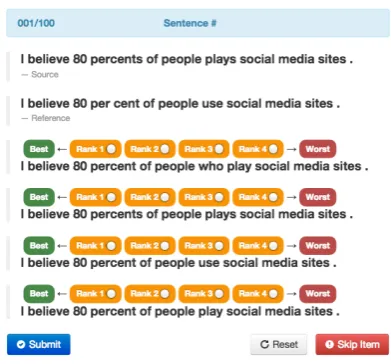
We borrow their approach to conduct a human evaluation. We used Appraise (Federmann, 2012)5 to collect pairwise judgments among 14 systems: the output of 12 systems entered in the CoNLL-14 Shared Task, plus the source and a reference sen-tence. Appraise presents the judge with the source and reference sentence6 and asks her to rank four randomly selected systems from best to worst, ties allowed (Figure 2). The four-way ranking is trans-formed into a set of pairwise judgments.
We collected data from three native English speakers, resulting in 28,146 pairwise system judgements. Each system’s quality was estimated and the total ranking was produced on this dataset using the TrueSkill model (Sakaguchi et al., 2014), as done in WMT 2014. The annotators had strong correlations in terms of the total system ranking and estimated quality, with the reference being ranked at the top (Table 1).
4 Generalized BLEU
Current metrics for GEC rely on references with explicitly labeled error annotations, the type and form of which vary from task to task and can
5github.com/cfedermann/Appraise
6CoNLL-14 has two references. For each sentence, we randomly chose one to present as the answer and one to be among the systems to be ranked.
Judges r ρ
1 and 2 0.80 0.69 1 and 3 0.73 0.80 2 and 3 0.81 0.71
Table 1: Pearson’sr and Spearman’s ρ correla-tions among judges (excluding the reference).
be difficult to convert. Recognizing the inher-ent ambiguity in the error-correction task, a better metric might be independent of such an annota-tion scheme and only require corrected references. This is the view of GEC as a generic text-rewriting task, and it is natural to apply standard metrics from machine translation. However, applied off-the-shelf, these metrics yield unintuitive results. For example, BLEU ranks thesourcesentence as second place in the CoNLL-2014 shared task.7
The problem is partially due to the subtle but important difference between machine translation and monolingual text-rewriting tasks. In MT, an untranslated word or phrase is almost always an error, but in grammatical error correction, this is not the case. Some, but not all, regions of the source sentence should be changed. This obser-vation motivates a small change to BLEU that computes n-gram precisions over the reference but assigns more weight to n-grams that have been correctly changed from the source. This revised metric, Generalized Language Evaluation Under-standing (GLEU), rewards corrections while also correctly crediting unchanged source text.
Recall that BLEU(C, R) (Papineni et al., 2002) is computed as the geometric mean of the modified precision scores of the test sentencesCrelative to the referencesR, multiplied by a brevity penalty to control for recall. The precisions are computed over bags of n-grams derived from the candidate translation and the references. Each n-gram in the candidate sentence is “clipped” to the maximum count of that n-gram in any of the references, en-suring that no precision is greater than 1.
[image:3.595.366.468.63.116.2]p0
n=
P
n-gram∈CCountR\S(n-gram)−λ CountS\R(n-gram)
+Count
R(n-gram)
P
n-gram0∈C0CountS(n-gram
0) + P
n-gram∈R\SCountR\S(n-gram)
(1)
ized by a weighted count of n-grams in the can-didate that are in the source but not the reference (false negatives,S\R). For a correction candidate
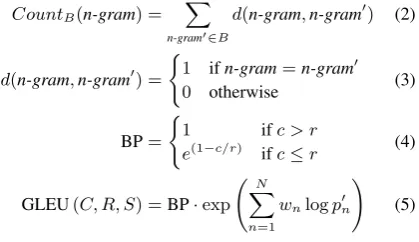
Cwith a corresponding sourceSand referenceR, the modified n-gram precision for GLEU(C,R,S) is shown in Equation 1. The weightλdetermines by how much incorrectly changed n-grams are pe-nalized. Equations 2–3 describe how the counts are collected given a bag of n-gramsB.
CountB(n-gram) = X n-gram0∈B
d(n-gram,n-gram0) (2)
d(n-gram,n-gram0) = (
1 ifn-gram=n-gram0
0 otherwise (3)
BP= (
1 ifc > r
e(1−c/r) ifc≤r (4)
GLEU(C, R, S) =BP·exp XN
n=1
wnlogp0n
!
(5)
In our experiments, we usedN = 4andwn =
1
N, which are standard parameters for MT, the same brevity penalty as BLEU (Equation 4), and report results on λ = {0.1,0} (GLEU0.1 and
GLEU0, respectively). For this task, not
penal-izing false negatives correlates best with human judgments, but the weight can be tuned for dif-ferent tasks and datasets. GLEU can be easily ex-tended to additionally punish false positives (in-correctly editing grammatical text) as well.
5 Results
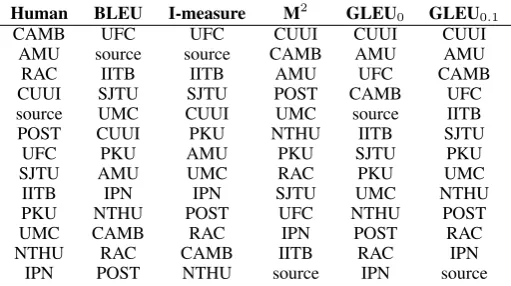
The respective system rankings of each metric are presented in Table 2. The human ranking is con-siderably different from those of most of the met-rics, a fact that is also captured in correlation co-efficients (Table 3).8 From the human evaluation, we learn that the source falls near the middle of the rankings, even though the BLEU, I-measure and M2rank it among the best or worst systems.
M2, the metric that has been used for the
CoNLL shared tasks, only correlates moderately with human rankings, suggesting that it is not an ideal metric for judging the results of a competi-tion. Even though I-measure perceptively aims to 8Pearson’s measure assumes the scores are normally dis-tributed, which may not be true here.
Metric r ρ
GLEU0 0.542 0.555
M2 0.358 0.429
GLEU0.1 0.200 0.412
[image:4.595.82.292.265.386.2]I-measure -0.051 -0.005 BLEU -0.125 -0.225
Table 3: Correlation of metrics with the human ranking (excluding the reference), as calculated with Pearson’srand Spearman’sρ.
predict whether an output is better or worse than the input, it actually has a slight negative correla-tion with human rankings. GLEU0is the only
met-ric that strongly correlates with the human ranks, and performs closest to the range of human-to-human correlation (0.73 ≤ r ≤ 0.81) GLEU0
correctly ranks four out of five of the top human-ranked systems at the top of its list, while the other metrics rank at most three of these systems in the top five.
All metrics deviate from the human rankings, which may in part be because automatic metrics equally weight all error types, when some errors may be more tolerable to human judges than oth-ers. For example, inserting a missing token is re-warded the same by automatic metrics, whether it is a comma or a verb, while a human would much more strongly prefer the insertion of the latter. An example of system outputs with their automatic scores and human rankings is included in Table 4. This example illustrates some challenges faced when using automatic metrics to evaluate GEC. The automatic metrics weight all corrections equally and are limited to the gold-standard refer-ences provided. Both automatic metrics, M2 and
GLEU, prefer the AMU output in this example, even though it corrects one error and introduces another. The human judges rank the UMC out-put as the best for correcting the main verb even though it ignored the spelling error. The UMC and NTHU sentences both receive M2 = 0 because
they make none of the gold-standard edits, even though UMC correctly insertsbeinto the sentence. M2 does not recognize this since it is in a
Human BLEU I-measure M2 GLEU
0 GLEU0.1
CAMB UFC UFC CUUI CUUI CUUI
AMU source source CAMB AMU AMU
RAC IITB IITB AMU UFC CAMB
CUUI SJTU SJTU POST CAMB UFC
source UMC CUUI UMC source IITB
POST CUUI PKU NTHU IITB SJTU
UFC PKU AMU PKU SJTU PKU
SJTU AMU UMC RAC PKU UMC
IITB IPN IPN SJTU UMC NTHU
PKU NTHU POST UFC NTHU POST
UMC CAMB RAC IPN POST RAC
NTHU RAC CAMB IITB RAC IPN
IPN POST NTHU source IPN source
Table 2: System outputs scored by different metrics, ranked best to worst.
System Sentence Scores
Original
sentence We may in actual fact communicating with a hoax Facebook acccount of a cyberfriend , which we assume to be real but in reality , it is a fake account . – Reference 1 We may in actual factbecommunicating with a hoax Facebook acccount of a
cyber friend , which we assume to be real but in reality , it is a fake account . – Reference 2 We may in actual factbecommunicating with afakeFacebookaccountofan
onlinefriend , which we assume to be real but , in reality , it is a fake account . – UMC We maybein actual fact communicating with a hoax Facebook acccount of a
cyber friend , we assume to be real but in reality , it is a fake account . GLEUM2= 0= 0..6200
Human rank= 1
AMU We may in actual fact communicating with a hoax Facebookaccountof a cyber
friend , which we assume to be real but in reality , it is a fakeaccounts. GLEUM2= 0= 0..6439
Human rank= 2
NTHU We may of actual fact communicating with a hoax Facebook acccount of a cyber
friend , which weassumedto be real but in reality , it is a fake account . GLEUM2= 0= 0..6000
[image:5.595.171.427.61.204.2]Human rank= 4
Table 4: Examples of system output (changes are in bold) and the sentence-level scores assigned by different metrics.
However, GLEU awards UMC partial credit for adding the correct unigram, and further assigns all sentences a real score.
6 Summary
As with other metrics used in natural language processing tasks, grammatical error correction metrics must be evaluated against ground truth. The inherent subjectivity in what constitutes a grammatical correction, together with the fact that the use case for grammatically-corrected output is human readers, argue for grounding metric evalu-ations in a human evaluation, which we produced following procedures established by the Workshop on Statistical Machine Translation. This human ranking shows us that the metric commonly used for GEC is not appropriate, since it does not cor-relate strongly; newly proposed alternatives fare little better.
Attending to how humans perceive the quality of the sentences, we developed GLEU by making a simple variation to an existing metric. GLEU more closely models human judgments than
previ-ous metrics because it rewards correct edits while penalizing ungrammatical edits, while capturing fluency and grammatical constraints by virtue of using n-grams. While this simple modification to BLEU accounts for crucial differences in a mono-lingual setting, fares well, and could take the place of existing metrics, especially for rapid system de-velopment as in machine translation, there is still room for further work as there is a gap in how well it correlates with human judgments.
Most importantly, the results and data from this paper establish a method for objectively evaluating future metric proposals, which is crucial to yearly incremental improvements to the GEC task.
Acknowledgments
References
Ondrej Bojar, Christian Buck, Christian Federmann, Barry Haddow, Philipp Koehn, Johannes Leveling, Christof Monz, Pavel Pecina, Matt Post, Herve Saint-Amand, Radu Soricut, Lucia Specia, and Aleˇs Tamchyna. 2014. Findings of the 2014 Workshop
on Statistical Machine Translation. InProceedings
of the Ninth Workshop on Statistical Machine Trans-lation, pages 12–58, Baltimore, Maryland, USA, June. Association for Computational Linguistics.
Christopher Bryant and Hwee Tou Ng. 2015. How far are we from fully automatic high quality
gram-matical error correction? In Proceedings of the
53rd Annual Meeting of the Association for Com-putational Linguistics, Beijing, China, July. Associ-ation for ComputAssoci-ational Linguistics.
Martin Chodorow, Markus Dickinson, Ross Israel, and Joel Tetreault. 2012. Problems in evaluating
gram-matical error detection systems. In Proceedings of
COLING 2012, pages 611–628, Mumbai, India, De-cember. The COLING 2012 Organizing Committee.
Daniel Dahlmeier and Hwee Tou Ng. 2012. Bet-ter evaluation for grammatical error correction. In
Proceedings of the 2012 Conference of the North American Chapter of the Association for Computa-tional Linguistics: Human Language Technologies, pages 568–572. Association for Computational Lin-guistics, June.
Robert Dale and Adam Kilgarriff. 2011. Helping our own: The HOO 2011 pilot shared task. In
Proceedings of the Generation Challenges Session at the 13th European Workshop on Natural Lan-guage Generation, pages 242–249, Nancy, France, September. Association for Computational Linguis-tics.
Robert Dale, Ilya Anisimoff, and George Narroway. 2012. HOO 2012: A report on the preposition and
determiner error correction shared task. In
Pro-ceedings of the Seventh Workshop on Building Ed-ucational Applications Using NLP, pages 54–62, Montr´eal, Canada, June. Association for Computa-tional Linguistics.
Christian Federmann. 2012. Appraise: An open-source toolkit for manual evaluation of machine
translation output. The Prague Bulletin of
Mathe-matical Linguistics, 98:25–35, September.
Mariano Felice and Ted Briscoe. 2015. Towards a standard evaluation method for grammatical error
detection and correction. InProceedings of the 2015
Conference of the North American Chapter of the Association for Computational Linguistics, Denver, CO, June. Association for Computational Linguis-tics.
Alon Lavie and Abhaya Agarwal. 2007. METEOR: An automatic metric for MT evaluation with high
levels of correlation with human judgments. In
Pro-ceedings of the Second Workshop on Statistical Ma-chine Translation, pages 228–231, Prague, Czech Republic, June. Association for Computational Lin-guistics.
Hwee Tou Ng, Siew Mei Wu, Yuanbin Wu, Christian Hadiwinoto, and Joel Tetreault. 2013. The CoNLL-2013 shared task on grammatical error correction. In Proceedings of the Seventeenth Conference on Computational Natural Language Learning: Shared
Task, pages 1–12, Sofia, Bulgaria, August.
Associa-tion for ComputaAssocia-tional Linguistics.
Hwee Tou Ng, Siew Mei Wu, Ted Briscoe, Christian Hadiwinoto, Raymond Hendy Susanto, and Christo-pher Bryant. 2014. The CoNLL-2014 shared task
on grammatical error correction. InProceedings of
the Eighteenth Conference on Computational Natu-ral Language Learning: Shared Task, pages 1–14, Baltimore, Maryland, June. Association for Compu-tational Linguistics.
Kishore Papineni, Salim Roukos, Todd Ward, and Wei-Jing Zhu. 2002. BLEU: A method for automatic
evaluation of machine translation. In Proceedings
of 40th Annual Meeting of the Association for Com-putational Linguistics, pages 311–318, Philadelphia, Pennsylvania, USA, July. Association for Computa-tional Linguistics.
Y. Albert Park and Roger Levy. 2011. Automated whole sentence grammar correction using a noisy
channel model. In Proceedings of the 49th
An-nual Meeting of the Association for Computational Linguistics: Human Language Technologies, pages 934–944, Portland, Oregon, USA, June. Association for Computational Linguistics.