Non-Linear Text Regression with a Deep Convolutional Neural Network
Zsolt Bitvai
University of Sheffield, UK
Trevor Cohn
University of Melbourne, Australia
Abstract
Text regression has traditionally been tackled using linear models. Here we present a non-linear method based on a deep convolutional neural network. We show that despite having millions of pa-rameters, this model can be trained on only a thousand documents, resulting in a 40% relative improvement over sparse lin-ear models, the previous state of the art. Further, this method is flexible allowing for easy incorporation of side information such as document meta-data. Finally we present a novel technique for interpreting the effect of different text inputs on this complex non-linear model.
1 Introduction
Text regression involves predicting a real world phenomenon from textual inputs, and has been shown to be effective in domains including elec-tion results (Lampos et al., 2013), financial risk (Kogan et al., 2009) and public health (Lampos and Cristianini, 2010). Almost universally, the text regression problem has been framed as lin-ear regression, with the modelling innovation fo-cussed on effective regression, e.g., using Lasso penalties to promote feature sparsity (Tibshirani, 1996).1 Despite their successes, linear models are
limiting: text regression problems will often in-volve complex interactions between textual inputs, thus requiring a non-linear approach to properly capture such phenomena. For instance, in mod-elling movie revenue conjunctions of features are likely to be important, e.g., a movie described as ‘scary’ is likely to have different effects for chil-dren’s versus adult movies. While these kinds of
1Some preliminary work has shown strong results for non-linear text regression using Gaussian Process models (Lam-pos et al., 2014), however this approach has not been shown to scale to high dimensional inputs.
features can be captured using explicit feature en-gineering, this process is tedious, limited in scope (e.g., to conjunctions) and – as we show here – can be dramatically improved by representational learning as part of a non-linear model.
In this paper, we propose an artificial neu-ral network (ANN) for modelling text regression. In language processing, ANNs were first pro-posed for probabilistic language modelling (Ben-gio et al., 2003), followed by models of sentences (Kalchbrenner et al., 2014) and parsing (Socher et al., 2013) inter alia. These approaches have shown strong results through automatic learning dense low-dimensional distributed representations for words and other linguistic units, which have been shown to encode important aspects of lan-guage syntax and semantics. In this paper we develop a convolutional neural network, inspired by their breakthrough results in image process-ing (Krizhevsky et al., 2012) and recent applica-tions to language processing (Kalchbrenner et al., 2014; Kim, 2014). These works have mainly fo-cused on ‘big data’ problems with plentiful train-ing examples. Given their large numbers of pa-rameters, often in the millions, one would expect that such models can only be effectively learned on very large datasets. However we show here that a complex deep convolution network can be trained on about a thousand training examples, al-though careful model design and regularisation is paramount.
We consider the problem of predicting the fu-ture box-office takings of movies based on reviews by movie critics and movie attributes. Our ap-proach is based on the method and dataset of Joshi et al. (2010), who presented a linear regression model over uni-, bi-, and tri-gram term frequency counts extracted from reviews, as well as movie and reviewer metadata. This problem is especially interesting, as comparatively few instances are available for training (see Table 1) while each
train dev test total
# movies 1147 317 254 1718
[image:2.595.317.513.60.386.2]# reviews per movie 4.2 4.0 4.1 4.1 # sentences per movie 95 84 82 91 # words per movie 2879 2640 2605 2794
Table 1: Movie review dataset (Joshi et al., 2010).
stance (movie) includes a rich array of data includ-ing the text of several critic reviews from various review sites, as well as structured data (genre, rat-ing, actors, etc.) Joshi et al. found that regression purely from movie meta-data gave strong predic-tive accuracy, while text had a weaker but comple-mentary signal. Their best results were achieved by domain adaptation whereby text features were conjoined with a review site identifier. Inspired by Joshi et al. (2010) our model also operates over n-grams, 1 ≤ n ≤ 3, and movie metadata, albeit using an ANN in place of their linear model. We use word embeddings to represent words in a low dimensional space, a convolutional network with max-pooling to represent documents in terms of n-grams, and several fully connected hidden lay-ers to allow for learning of complex non-linear in-teractions. We show that including non-linearities in the model is crucial for accurate modelling, pro-viding a relative error reduction of 40% (MAE) over their best linear model. Our final contribu-tion is a novel means of model interpretacontribu-tion. Al-though it is notoriously difficult to interpret the pa-rameters of an ANN, we show a simple method of quantifying the effect of textn-grams on the pre-diction output. This allows for identification of the most important textual inputs, and investigation of non-linear interactions between these words and phrases in different data instances.
2 Model
The outline of the convolutional network is shown in Figure 1. We haventraining examples of the form{bi,ri, yi}ni=1, wherebi is the meta data as-sociated with moviei,yi is the target gross week-end revenue, andriis a collection ofuinumber of reviews,ri = {xj, tj}uj=1i where each review has
review textxj and a site idtj. We concatenate all the review textsdi = (x1,x2, ...,xu) to form our
text input (see partIof Figure 1).
To acquire a distributed representation of the text, we look up the input tokens in a pretrained word embedding matrixEwith size|V|×e, where
Embeddings, E
• • • •
This movie is the best one of the century, the actors are exceptional ...
Boston Globe, r1= {x1,t1} New York Timesru
m u |V| This movie is the best one ... • • • • ... e concatenate • • • • • • • • • • • • • • • • (I) lookup
Site ids, t
Document matrix, D e
0 1 1 0 0
This movie is the best one ... m ReLu g ReLu ReLu W(1) W(2) W(3)
h h h
g g (II) m m-1 m-2 max pool (III)
p(1) p(2) p(3)
Meta data genre, rating, famous actors ... b ReLu g h ReLu g h ReLu g h g
prediction $ Revenue convolution fully connected error J f y W1 W2 W3 w4 a1
o1=a2
o2=a3
o3=a4 (IV)
(V)
uni-grams
C(1)
bi-grams tri-grams
C(2) C (3) • • • • • • • • ... • • • • • • • • • • • • • • • • fully connected fully connected fully connected
Figure 1: Outline of the network architecture.
|V|is the size of our vocabulary andeis the em-bedding dimensionality. This gives us a dense document matrix Di,j = Edi,j with dimensions m ×e where m is the number of tokens in the document.
Since the length of text documents vary, in part
IIwe apply convolutions with width one, two and three over the document matrix to obtain a fixed length representation of the text. The n-gram con-volutions help identify local context and map that to a new higher level feature space. For each fea-ture map, the convolution takes adjacent word em-beddings and performs a feed forward computa-tion with shared weights over the convolucomputa-tion win-dow. For a convolution with width1≤q ≤mthis is
S(i,·q)= (Di,·,Di+1,·, ...,Di+q−1,·)
Ci,·(q)=hSi,·(q),W(q)i
where S(i,·q) is q adjacent word embeddings con-catenated, andC(q) is the convolution output
transformation, we make use of rectified linear ac-tivation units, H(q) = max(C(q),0), which are
universal function approximators. Finally, to com-press the representation of text to a fixed dimen-sional vector while ensuring that important infor-mation is preserved and propagated throughout the network, we apply max pooling over time, i.e. the sequence of words, for each dimension, as shown in partIII,
p(jq) = maxH(·,jq)
wherep(jq)is dimensionjof the pooling layer for convolution q, and p is the concatenation of all pooling layers,p= (p(1),p(2), ...,p(q)).
Next, we perform a series of non-linear trans-formations to the document vector in order to pro-gressively acquire higher level representations of the text and approximate a linear relationship in the final output prediction layer. Applying multi-ple hidden layers in succession can require expo-nentially less data than mapping through a single hidden layer (Bengio, 2009). Therefore, in part
IV, we apply densely connected neural net layers of the formok = h(g(ak,Wk))whereak is the input andok=ak+1is the output vector for layer
k,gis a linear transformation functionhak,Wki, andhis the activation function, i.e. rectified linear seen above. l = 3 hidden layers are applied be-fore the final regression layer to produce the out-putf =g(ol,wl+1)in partV.
The mean absolute error is measured between the predictionsf and the targetsy, which is more permissible to outliers than the squared error. The costJ is defined as
J = n1 Xn v=1
|fv−yv|.
The network is trained with stochastic gradient de-scent and the Ada Delta (Zeiler, 2012) update rule using random restarts. Stochastic gradient descent is noisier than batch training due to a local esti-mation of the gradient, but it can start converging much faster. Ada Delta keeps an exponentially de-caying history of gradients and updates in order to adapt the learning rate for each parameter, which partially smooths out the training noise. Regulari-sation and hyperparmeter selection are performed by early stopping on the development set. The size of the vocabulary is 90K words. Note that 10% of our lexicon is not found in the embeddings
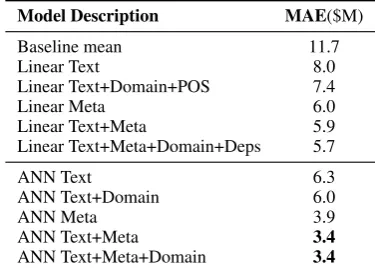
Model Description MAE($M)
Baseline mean 11.7
Linear Text 8.0
Linear Text+Domain+POS 7.4
Linear Meta 6.0
Linear Text+Meta 5.9
Linear Text+Meta+Domain+Deps 5.7
ANN Text 6.3
ANN Text+Domain 6.0
ANN Meta 3.9
ANN Text+Meta 3.4
[image:3.595.321.509.63.199.2]ANN Text+Meta+Domain 3.4
Table 2: Experiment results on test set. Linear models by (Joshi et al., 2010).
pretrained on Google News. Those terms are ini-tialised with random small weights. The model has around 4 million weights plus 27 million tun-able word embedding parameters.
Structured data Besides text, injecting meta data and domain information into the model likely provides additional predictive power. Combin-ing text with structured data early in the network fosters joint non-linear interaction in subsequent hidden layers. Hence, if meta data b is present, we concatenate that with the max pooling layer
a1 = (p,b) in part III. Domain specific
infor-mationtis appended to each n-gram convolution input(S(i,·q),t)in partII, wheretz =1z indicates whether domainzhas reviewed the movie.2 This
helps the network bias the convolutions, and thus change which features get propagated in the pool-ing layer.
3 Results
The results in Table 2 show that the neural net-work performs very well, with around 40% im-provement over the previous best results (Joshi et al., 2010). Our dataset splits are identical, and we have accurately reproduced the results of their lin-ear model. Non-linlin-earities are cllin-early helpful as evidenced by the ANN Text model beating the bag of words Linear Text model with a mean absolute test error of 6.0 vs 8.0. Moreover, simply using structured data in the ANN Meta beats all the Lin-ear models by a sizeable margin. Further improve-ments are realised through the inclusion of text, giving the lowest error of 3.4. Note that Joshi et al. (2010) preprocessed the text by stemming,
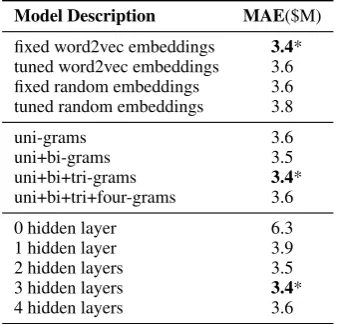
Model Description MAE($M) fixed word2vec embeddings 3.4* tuned word2vec embeddings 3.6 fixed random embeddings 3.6 tuned random embeddings 3.8
uni-grams 3.6
uni+bi-grams 3.5
uni+bi+tri-grams 3.4* uni+bi+tri+four-grams 3.6
0 hidden layer 6.3
1 hidden layer 3.9
2 hidden layers 3.5
3 hidden layers 3.4*
[image:4.595.97.266.63.225.2]4 hidden layers 3.6
Table 3: Various alternative configurations, based on the ANN Text+Meta model. The asterisk (∗) denotes the settings in the ANN Text+Meta model.
casing, and discarding feature instances that oc-curred in fewer than five reviews. In contrast, we did not perform any processing of the text or fea-ture engineering, apart from tokenization, instead learning this automatically.3
We find that both text and meta data con-tain complementary signals with some informa-tion overlap between them. This confirms the find-ing of Bitvai and Cohn (2015) on another text re-gression problem. The meta features alone almost achieve the best results whereas text alone per-forms worse but still well above the baseline. For the combined model, the performance improves slightly. In Table 3 we can see that contrary to ex-pectations, fine tuning the word embeddings does not help significantly compared to keeping them fixed. Moreover, randomly initialising the embed-dings and fixing them performs quite well. Fine tuning may be a challenging optimisation due to the high dimensional embedding space and the loss of monolingual information. This is further exacerbated due to the limited supervision signal.
One of the main sources of improvement ap-pears to come from the non-linearity applied to the neural network activations. To test this, we try us-ing linear activation units in partsIIandIVof the network. Composition of linear functions yields a linear function, and therefore we recover the lin-ear model results. This is much worse than the model with non-linear activations. Changing the network depth, we find that the model performs much better with a single hidden layer than
with-3Although we do make use of pretrained word embed-dings in our text features.
out any, while three hidden layers are optimal. For the weight dimensions we find square 1058 dimen-sional weights to perform the best. The ideal num-ber of convolutions are three with uni, bi and tri-grams, but unigrams alone perform only slightly worse, while taking a larger n-gram windown >3 does not help. Average and sum pooling perform comparatively well, while max pooling achieves the best result. Note that sum pooling recovers a non-linear bag-of-words model. With respect to activation functions, both ReLU and sigmoid work well.
Model extensions Multi task learning with task identifiers, ANN Text+Domain, does improve the ANN Text model. This suggests that the tendency by certain sites to review specific movies is in it-self indicative of the revenue. However this im-provement is more difficult to discern with the ANN Text+Meta+Domain model, possibly due to redundancy with the meta data. An alternative ap-proach for multi-task learning is to have a sepa-rate convolutional weight matrix for each review site, which can learn site specific characteristics of the text. This can also be achieved with site specific word embedding dimensions. However neither of these methods resulted in performance improvements. In addition, we experimented with applying a hierarchical convolution over reviews in two steps with k-max pooling (Kalchbrenner et al., 2014), as well as parsing sentences recursively (Socher et al., 2013), but did not observe any im-provements.
For optimisation, both Ada Grad and Steepest Gradient Descent had occasional problems with local minima, which Ada Delta was able to es-cape more often. In contrast to earlier work (Kim, 2014), applying dropout on the final layer did not improve the validation error. The optimiser mostly found good parameters after around 40 epochs which took around 30 minutes on a NVidia Kepler Tesla K40m GPU.
Model interpretation Next we perform
transformers2
pinkpanther2
objective
mylifeinruins
inglouriousbasterds
informersgreatbuckhoward
grace
fastandfurious4
bobfunk
budget > $15M budget < $15M
$0 $3.6K $140K $5.2M $200M
[image:5.595.306.529.68.375.2]Revenue
Figure 2: Projection of the last hidden layer of test movies using t-SNE. Red means high and blue means low revenue. The cross vs dot symbols in-dicate a production budget above or below $15M.
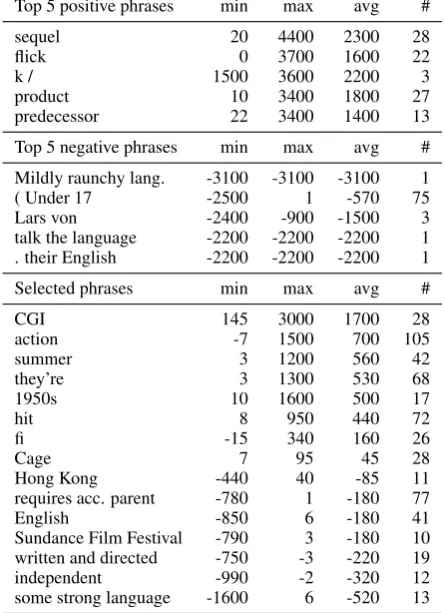
i.e. we process “Hong Kong” without zeroing “Hong” or “Kong”. About 95% of phrases re-sult in no output change, including common sen-timent words, which shows that text regression is a different problem to sentiment analysis. We see that words related to series “# 2”, effects, awards “praise”, positive sentiment “intense”, locations, references “Batman”, body parts “chest”, and oth-ers such as “plot twist”, “evil”, and “cameo” re-sult in increased revenue by up to $5 million. On the other hand, words related to independent films “v´erit´e”, documentaries “the period”, for-eign film “English subtitles” and negative senti-ment decrease revenue. Note that the model has identified structured data in the unstructured text, such as related to revenue of prequels “39 mil-lion”, crew members, duration “15 minutes in”, genre “[sci] fi”, ratings, sexuality, profanity, re-lease periods “late 2008 rere-lease”, availability “In selected theaters” and themes. Phrases can be composed, such as “action unfolds” amplifies “ac-tion”, and “cautioned” is amplified by “strongly cautioned”. “functional” is neutral, but “func-tional at best” is strongly negative. Some words exhibit both positive and negative impacts depend-ing on the context. This highlights the limitation of a linear model which is unable to discover these non-linear relationships. “13 - year [old]” is posi-tive in New in Town, a romantic comedy and nega-tive in Zombieland, a horror. The character strings “k /” (mannerism of reviewer), “they’re” (unique apostrophe), “'” (encoding error) are high im-pact and unique to specific review sites, showing that the model indirectly uncovers domain infor-mation. This can explain the limited gain that can be achieved via multi task learning. Last, we have
Top 5 positive phrases min max avg #
sequel 20 4400 2300 28
flick 0 3700 1600 22
k / 1500 3600 2200 3
product 10 3400 1800 27
predecessor 22 3400 1400 13
Top 5 negative phrases min max avg # Mildly raunchy lang. -3100 -3100 -3100 1
( Under 17 -2500 1 -570 75
Lars von -2400 -900 -1500 3
talk the language -2200 -2200 -2200 1 . their English -2200 -2200 -2200 1
Selected phrases min max avg #
CGI 145 3000 1700 28
action -7 1500 700 105
summer 3 1200 560 42
they’re 3 1300 530 68
1950s 10 1600 500 17
hit 8 950 440 72
fi -15 340 160 26
Cage 7 95 45 28
Hong Kong -440 40 -85 11
requires acc. parent -780 1 -180 77
English -850 6 -180 41
Sundance Film Festival -790 3 -180 10 written and directed -750 -3 -220 19
independent -990 -2 -320 12
some strong language -1600 6 -520 13
Table 4: Selected phrase impacts on the predic-tions in $ USD(K) in the test set, showing min, max and avg change in prediction value and num-ber of occurrences (denoted #). Periods denote ab-breviations (language, accompanying).
plotted the last hidden layer of each test set movie with t-SNE (Van der Maaten and Hinton, 2008). This gives a high level representation of a movie. In Figure 2 it is visible that the test set movies can be discriminated into high and low revenue groups and this also correlates closely with their produc-tion budget.
4 Conclusions
[image:5.595.81.293.68.190.2]References
Yoshua Bengio, R´ejean Ducharme, Pascal Vincent, and Christian Janvin. 2003. A neural probabilistic lan-guage model. The Journal of Machine Learning Re-search, 3:1137–1155.
Yoshua Bengio. 2009. Learning deep architectures for AI. Foundations and Trends in Machine Learning, 2(1):1–127.
Zsolt Bitvai and Trevor Cohn. 2015. Predicting peer-to-peer loan rates using Bayesian non-linear regres-sion. In Proceedings of the 29th AAAI conference on Artificial Intelligence, pages 2203–2210.
Mahesh Joshi, Dipanjan Das, Kevin Gimpel, and Noah A Smith. 2010. Movie reviews and revenues: An experiment in text regression. In Human Lan-guage Technologies: The 2010 Annual Conference of the North American Chapter of the Association for Computational Linguistics, pages 293–296.
Nal Kalchbrenner, Edward Grefenstette, and Phil Blun-som. 2014. A convolutional neural network for modelling sentences. Proceedings of the 52nd An-nual Meeting of the Association for Computational Linguistics.
Yoon Kim. 2014. Convolutional neural networks for sentence classification. InProceedings of the Con-ference on Empirical Methods in Natural Language Processing.
Shimon Kogan, Dimitry Levin, Bryan R Routledge, Jacob S Sagi, and Noah A Smith. 2009. Pre-dicting risk from financial reports with regression. In Proceedings of Human Language Technologies: The 2009 Annual Conference of the North American Chapter of the Association for Computational Lin-guistics, pages 272–280.
Alex Krizhevsky, Ilya Sutskever, and Geoffrey E Hin-ton. 2012. ImageNet classification with deep con-volutional neural networks. InAdvances in Neural Information Processing Systems, pages 1097–1105.
Vasileios Lampos and Nello Cristianini. 2010. Track-ing the flu pandemic by monitorTrack-ing the social web. In Cognitive Information Processing, pages 411– 416.
Vasileios Lampos, Daniel Preotiuc-Pietro, and Trevor Cohn. 2013. A user-centric model of voting inten-tion from social media. InProc 51st Annual Meet-ing of the Association for Computational LMeet-inguis- Linguis-tics, pages 993–1003.
Vasileios Lampos, Nikolaos Aletras, D Preot¸iuc-Pietro, and Trevor Cohn. 2014. Predicting and characteris-ing user impact on twitter. In Proceedings of the 14th Conference of the European Chapter of the As-sociation for Computational Linguistics, pages 405– –413.
Jasper Snoek, Hugo Larochelle, and Ryan P Adams. 2012. Practical Bayesian optimization of machine learning algorithms. In Advances in Neural Infor-mation Processing Systems, pages 2951–2959. Richard Socher, Alex Perelygin, Jean Y Wu, Jason
Chuang, Christopher D Manning, Andrew Y Ng, and Christopher Potts. 2013. Recursive deep mod-els for semantic compositionality over a sentiment treebank. InProceedings of the Conference on Em-pirical Methods in Natural Language Processing, pages 1631–1642.
Robert Tibshirani. 1996. Regression shrinkage and se-lection via the lasso. Journal of the Royal Statistical Society. Series B (Methodological), pages 267–288. Laurens Van der Maaten and Geoffrey Hinton. 2008. Visualizing data using t-SNE. Journal of Machine Learning Research, 9(2579-2605):85.