Evaluating Evaluation Metrics for Ontology-Based Applications: Infinite
Reflection
Diana Maynard, Wim Peters, Yaoyong Li
Dept of Computer Science, University of Sheffield, Sheffield, UK{diana,wim,y.li}@dcs.shef.ac.uk
Abstract
In this paper, we discuss methods of measuring the performance of ontology-based information extraction systems. We focus particularly on the Balanced Distance Metric (BDM), a new metric we have proposed which aims to take into account the more flexible nature of ontologically-based applications. We first examine why traditional Precision and Recall metrics, as used for flat information extraction tasks, are inadequate when dealing with ontologies. We then describe the Balanced Distance Metric (BDM) which takes ontological similarity into account. Finally, we discuss a range of experiments designed to test the accuracy and usefulness of the BDM when compared with traditional metrics and with a standard distance-based metric.
1.
Introduction
Traditionally, applications such as information extraction (IE) are evaluated using Precision, Recall and F-Measure. These metrics give us a binary decision of correctness for each entity in the text, i.e. by comparing the key (gold standard) and system responses, they classify the result as either right or wrong in each case. Ontology-based infor-mation extraction systems attempt to classify entities in a more scalar fashion, as there are many different categories to which an entity can be assigned, and the distinction be-tween these categories is much less clearcut. Traditional entity classes do not subsume each other, whereas in an on-tology, there are subclass and superclass categories to con-sider, so the distinction between right and wrong is more blurred. In traditional IE, an element identified as a Person is either correct or incorrect (measured by Precision), and elements which should be identified as Person are either identified or not (measured by Recall). When making an ontological classification, however, the distinction is more fuzzy. For example if we misclassify an instance of a Re-searcher as a Lecturer, we are clearly less wrong than miss-ing the identification (and classification) altogether, and we are also somehow less wrong than if we had misclassi-fied the instance as a Location. Credit should therefore be given for partial correctness. Traditionally, this is some-times achieved by allocating a half weight to something deemed partially correct, but this is still insufficient to give a proper distinction between degrees of correctness. We therefore adopt an approach based on similarity between Key (the gold standard) and Response (the output of the system), known as BDM (Maynard, 2005; Maynard et al., 2006).
In this paper, we aim to evaluate how useful the BDM is as a measure of the performance of an ontology-based Infor-mation Extraction (OBIE) system. Of course, how to eval-uate an evaluation metric is not obvious, but there are some general guidelines proposed by (King, 2003) for evaluation metrics that we try to follow. A metric should:
• reach its highest value for perfect quality;
• reach its lowest value for worst possible quality;
• be monotonic;
• be clear and intuitive;
• correlate well with human judgement;
• be reliable and exhibit as little variance as possible;
• be cheap to set up and apply;
• be automatic.
We aim in this paper to show how the BDM fulfils these criteria, describing some experiments we have carried out to investigate its validity.
2.
A Distance-Based Metric for Evaluation
As discussed in Section 1., a metric which classifies the correctness of an answer based on its semantic proximity to the real answer should give us a fairer indication of the performance of the system. Other existing cost-based or distance-based metrics, such as Learning Accuracy (LA) (Hahn and Schnattinger, 1998), have some flaws such as not taking into account the density of the hierarchy, and in the case of LA, being asymmetrical. By this we mean that comparing two concepts in the ontology gives different results depending on which one is the Key and which is the Result. Given that we trying to compute the similarity between two concepts, it seems rather odd and unintuitive that this should be the case.
The BDM computes semantic similarity between two an-notations of the same token in a document. The metric has been designed to replace the traditional ”exact match or fail” metrics with a method which yields a graded cor-rectness score by taking into account the semantic distance in the ontological hierarchy between the compared nodes (Key and Response). The final version of the BDM is an improved version of the original BDM described in (May-nard, 2005), which did not take the branching factor into account (as described below).
The BDM is computed on the basis of the following mea-surements:
their performance. For this purpose, semantic homogeneity does not play a role.
For each experiment we computed threeF1values to
mea-sure the overall performance of the learning algorithm. One was the conventional micro-averagedF1in which a binary
reward was assigned to each prediction of instance — the reward was 1 if the prediction was correct, and 0 otherwise. We call this flat F1since it does not consider the structure
of concepts in the ontology. The other two measures were based on the BDM and LA values, respectively, which both take into account the structure of the ontology.
flatF1 BDM F1 LAF1
SVM 73.5 74.5 74.5
Hieron 74.7 79.2 80.0
Table 1: Comparison of Hieron and SVM for OBIE
Table 1 presents the experimental results for comparing the two learning algorithms SVM and Hieron. We used three measures: conventional micro-averaged flat F1 (%), and
the two ontology-sensitive augmentedF1(%) based
respec-tively on the BDM and LA, BDM F1 and LAF1. In this
experiment, the International-Politics part of the OntoNews corpus was used as the test set, and the other two parts as the training set.
Both the BDM F1and LA F1are higher than the flat F1
for the two algorithms, reflecting the fact that the latter only counts the correct classifications, while the former two not only count the correct classifications but also the incorrect ones. However, the difference for Hieron is more signifi-cant than that for SVM, demonstrating an important differ-ence between the two methods — the SVM based method just tried to learn a classifier for one concept as well as possible, while the Hieron based method not only learned a good classifier for each individual concept but also took into account the relations between the concepts in the on-tology during the learning.
In terms of the conventional flat F1, the Hieron algorithm
performed slightly better than the SVM. However, if the re-sults are measured by using the ontology-sensitive measure BDM F1or LAF1, we can see that Hieron performed
sig-nificantly better than SVM. Clearly, the ontology-sensitive measures such as the BDM F1and LA F1are more
suit-able than the conventional flat F1 to measure the
perfor-mance of an ontology-dependent learning algorithm such as Hieron.
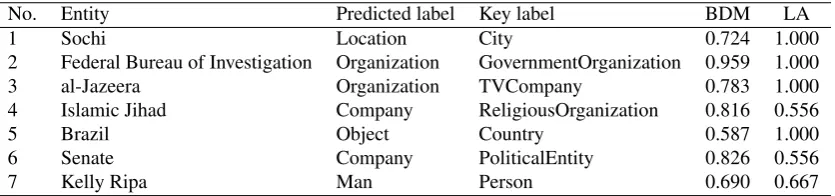
In order to analyse the difference between the three mea-sures, Table 2 presents some examples of entities predicted incorrectly by the Hieron based learning system, their key labels, and the similarity between the key label and pre-dicted label measured respectively by the BDM and the LA. Note that in all cases, the flat measure produces a score of 0, since it is not an exact match.
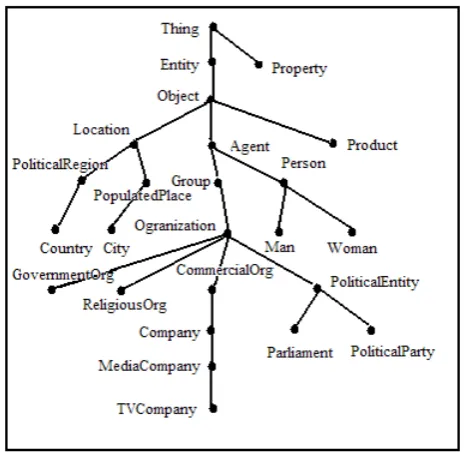
All the concepts and their relations involved in Table 2 are illustrated in Figure 1, which presents a part of the PRO-TON ontology. This ontology section starts with the root
node Thing, and has 10 levels of concepts with
TVCom-panyas the lowest level concept. Note that the graph does
Figure 1: Subset of the PROTON ontology
not show all the child concepts for most of the nodes pre-sented.
The conventional flat measure assigned each case a zero similarity because the examples were misclassified and the measure does not consider the structure of labels. On the other hand, both the LA and BDM take into account the structure of labels and measure the degree of a misclassi-fication based on its position in the ontology. Hence they assign a non-zero value to a misclassification in most cases. Note that zero would be assigned in the case where the MSCA is the root node. In our experiments, all the con-cepts used were below the node ”Entity” and so we used its immediate upper node ”Thing” as root3. This meant that CP (the depth of the MSCA) was always at least 1, and hence there is no zero value for BDM or LA in our ex-periments. This is because we consider that if an entity’s instance is recognised but with the wrong type, the system should have a non-zero reward because it at least recog-nised the instance in the first place. However, this could be changed according to the user’s preference.
However, BDM and LA adopt different mechanisms in con-sideration of the ontology structure. In particular, the LA assigns the maximal value 1 if the predicted label is an ancestor concept of the key label, regardless of how far apart the two labels are within the ontological chain. In contrast, the BDM takes into account the similarity of two concepts in the ontology and assigns a distance-dependent value. The difference is demonstrated by the examples in the table. For example, in the Proton ontology, the pre-dicted label Organizationis the parent concept of the key labelGovernmentOrganizationin the second example, and in the third example the same predicted labelOrganization
is 4 concepts away from the key labelTVCompany. Hence, the BDM value of the second example is higher than the
3
(a) F-measures (b) AF-measures
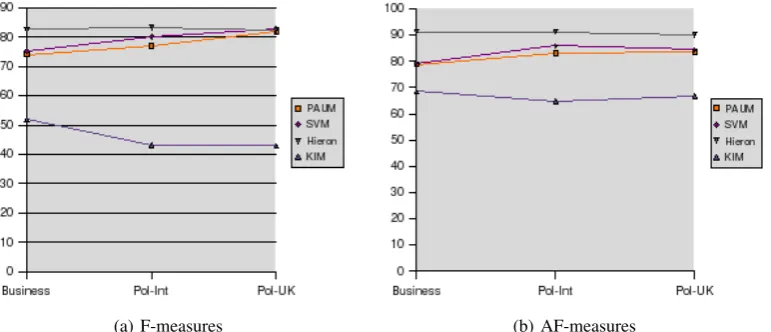
Figure 2: Comparison of GATE and KIM
ity, the more important the choice of metric is. Of course, shallowness of the ontology is not the only factor related to its size: properties, labels, or other ontology components also play a part. However, since they are not used for the ontology-based information extraction component, we are not interested here in evaluating these factors separately.
4.
Discussion and Future work
The initial observation from our experiments is that bi-nary decisions are not good enough for ontology evalua-tion, when hierarchies are involved. Both the BDM and LA metrics are more useful than a distance-based or flat metric when evaluating information extraction based on a hierarchical rather than a flat structure. From a human per-spective, the BDM appears to perform better than the LA in that it reflects a better error analysis in certain situations. In terms of scalability, we see that the BDM appears robust when dealing with different sizes and densities of ontology, although we have only conducted a small-scale experiment so far. In contrast to other metrics, it reflects ontology den-sity as well as size.
We also found an interesting feature of the BDM over a traditional flat metric, in that it enabled better distinction of some kinds of IE system. By penalising minor mis-classifications less heavily than than completely undiscov-ered or unclassified entities, it reflects better the distinction between systems which find many entities but make mi-nor mistakes in their classification, and systems which fail to actually find many entities or make major classification mistakes.
This paper has shown the usefulness of evaluation metrics like the BDM in ontology population. The BDM is solely based on the structure of the ontology to measure the simi-larity of concepts in the ontology. However, since the ontol-ogy can have semantic interpretation based on description logic, we could also measure concept similarity in the on-tology using the underlying description logic. This kind of semantic similarity would make more sense than the structure-based measure, for a complex ontology contain-ing different type-of relations. Future work will investigate
this approach.
5.
References
N. Cristianini and J. Shawe-Taylor. 2000. An introduc-tion to Support Vector Machines and other kernel-based
learning methods. Cambridge University Press.
O. Dekel, J. Keshet, and Y. Singer. 2004. Large Margin Hierarchical Classification. In Proceedings of the 21st International Conference on Machine Learning (ICML-2004), Canada.
U. Hahn and K. Schnattinger. 1998. Towards text knowl-edge engineering. In Proc. of 15th National
Confer-ence on Artificial IntelligConfer-ence (AAAI-98), pages 524–
531, Menlo Park, CA. MIT Press.
M. King. 2003. Living up to standards. In Proceedings of the EACL 2003 Workshop on Evaluation Initiatives in
Natural Language Processing, Budapest, Hungary.
A. Kiryakov, B. Popov, D. Ognyanoff, D. Manov, A. Kir-ilov, and M. Goranov. 2004. Semantic annotation, in-dexing and retrieval. Journal of Web Semantics, ISWC 2003 Special Issue, 1(2):671–680.
Y. Li, K. Bontcheva, and H. Cunningham. 2005. SVM Based Learning System For Information Extraction. In M. Niranjan J. Winkler and N. Lawerence, editors, De-terministic and Statistical Methods in Machine Learning, LNAI 3635, pages 319–339. Springer Verlag.
Y. Li, K. Bontcheva, and H. Cunningham. 2006. Perceptron-like learning for ontology based information extraction. Technical report, University of Sheffield, Sheffield, UK.
D. Maynard, W. Peters, and Y. Li. 2006. Metrics for evaluation of ontology-based information extraction. In
WWW 2006 Workshop on ”Evaluation of Ontologies for
the Web” (EON), Edinburgh, Scotland.
D. Maynard. 2005. Benchmarking ontology-based anno-tation tools for the semantic web. InUK e-Science Pro-gramme All Hands Meeting (AHM2005) Workshop ”Text Mining, e-Research and Grid-enabled Language
W. Peters, N. Aswani, K. Bontcheva, and H. Cunningham. 2005. Quantitative Evaluation Tools and Corpora v1. Technical report, SEKT project deliverable D2.5.1. B. Popov, A. Kiryakov, A. Kirilov, D. Manov,
D. Ognyanoff, and M. Goranov. 2004. KIM – A semantic platform for information extraction and retrieval.Natural Language Engineering, 10:375–392. F. Rosenblatt. 1958. The perceptron: A probabilistic