181
Flamb´e: A Customizable Framework for
Machine Learning Experiments
Jeremy Wohlwend ASAPP Inc. [email protected]
Nicholas Matthews ASAPP Inc. [email protected]
Ivan Itzcovich ASAPP Inc. [email protected]
Abstract
Flamb´e is a machine learning experimenta-tion framework built to accelerate the entire research life cycle. Flamb´e’s main objective is to provide a unified interface for prototyp-ing models, runnprototyp-ing experiments containprototyp-ing complex pipelines, monitoring those experi-ments in real-time, reporting results, and de-ploying a final model for inference. Flamb´e achieves both flexibility and simplicity by al-lowing users to write custom code but instantly include that code as a component in a larger system which is represented by a concise con-figuration file format. We demonstrate the ap-plication of the framework through a cutting-edge multistage use case: fine-tuning and dis-tillation of a state of the art pretrained lan-guage model used for text classification.1
1 Introduction
Scientists and engineers in the machine learning community dedicate many hours and resouces to-wards preprocessing data, iterating on model ar-chitectures, tuning hyperparameters, aggregating results and ultimately deploying their most per-formant model. While frameworks like PyTorch (Paszke et al.,2017) and Tensorflow (et al.,2016) abstract away the details of operations like back-progpagation and make building models possible in a few lines of code, they do not explicitly aim to solve these other parts of the research cycle.
The explosion of available resources in the ma-chine learning community (Dean et al.,2018) has included many tools that address one or more of these other phases of research, but these iso-lated tools do not always work harmoniously with one another, trading off customizability to provide high-level interfaces. Understanding that machine
1The code and documentation can be found at
https://flambe.ai
learning research particularly in the field of Natu-ral Language Processing might require innovation at any level of abstraction and across any stage in the research process, we’ve built Flamb´e to include standardized implementations of model-ing components, hyperparameter optimization and distributed execution that can all be effortlessly re-placed with custom user-developed code.
By facilitating customization and iteration on a particular data pipeline and model architecture, we aim for Flamb´e users to spend the majority of their time doing research, not re-implementing tools for training, tuning, reporting and deploying.
Flamb´e’s contributions are:
1. Modular machine learning components to de-velop replicable, state of the art research results. This includes: neural network components (pretrained or not), benchmark datasets, and standardized training and eval-uation modules.
2. A configuration format that natively enables searching over hyperparameters and running remote multistage experiments at scale.
3. Smooth reporting and exporting, to facilitate sharing models and results with collaborators and the larger community.
4. An open source framework for both the aca-demic community and teams in industry.
We demonstrate the application of our frame-work through a cutting-edge use case, namely knowledge distillation of a state of the art language model, the BERT model (Devlin et al.,2019), on a downstream text classification task.
2 Related work
systems from different angles. Frameworks like PyTorch and Tensorflow (et al., 2016) provide the building blocks of models as simple modules e.g. various linear and recurrent layers, losses, optimizers etc. Many model implementations have been built on top of these modules, with some proposing new standardizations of specific architectures like sequence-to-sequence modeling (et al,2019).
Libraries such as Keras (Chollet et al., 2015) offer a high-level API for building and training models. Others including AllenNLP (Gardner et al., 2018), FastAI (Howard et al., 2018) and Texar (et al,2018) focus on some specific domains or tasks like reading comprehension or text style transfer. These types of frameworks tend to focus on training a single model at a time, but many re-search experiments consist of complex multistage pipelines, with hyperparameter tuning and dis-tributed computation required at each stage. With Flamb´e, users can write their custom code inde-pendent from these concerns, and then easily start using algorithms like Hyperband (Li et al.,2016) and Bayesian Optimization (Bergstra et al.,2013), link components across stages, and run everything on a cluster without any modifications.
MLFlow (Zaharia et al., 2018) focuses on ex-periment tracking, metric reporting, and contains powerful features aimed at production deploy-ment. However, it does not have a natural way to run hyperparameter tuning, or advanced trial sam-pling and scheduling.
Ray (Moritz et al.,2017) implements infrastruc-ture for distributing computational tasks on a clus-ter, and it also provides a higher level extension, Tune (Liaw et al.,2018), that handles hyperparam-eter optimization.
Flamb´e leverages and builds upon existing tools, connecting the dots between frameworks like PyTorch and Ray, and providing a smooth in-tegration between them with a powerful layer of abstraction on top. By not trying to re-implement solved problems like back-propagation and dis-tributed task execution, we can focus our attention on usability and efficiency.
3 The Flamb´e Framework
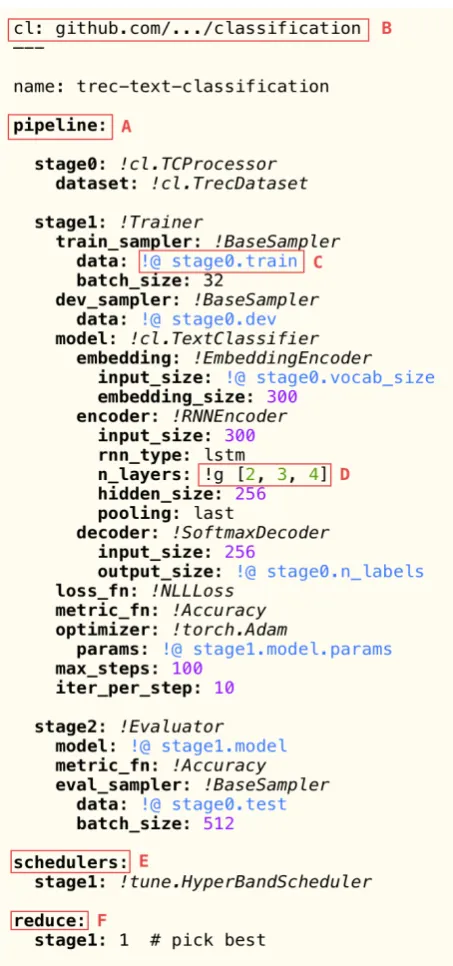
[image:2.595.307.534.59.543.2]Flamb´e executes experiments which are com-posed of a pipeline of modeling and processing stages (Subsection A), extensions that import user-supplied code (Subsection B), links to existing
Figure 1: Example YAML config for text classification on the TREC dataset. The highlighted and labeled sec-tions refer to the subsecsec-tions in3.1. There are a number of different objects that could be used in any place of this config e.g. the optimizer could be!torch.SGD
and the schedulertune.HyperOpt(Bayesian opti-mization). Note the pipeline stage names “stage0”, etc. are arbitrary.
Each tag in the YAML (Oren Ben-Kiki,2009) config (anything beginning with ‘!’) corresponds to a python object that will be initialized with the keyword arguments following the tag. These tags are not hardcoded into the system, and users can use their own classes in the config just as easily as the ones we’ve already built. After we explain all the aforementioned features, we introduce how Flamb´e saves object state, enables simple metric logging, and deploys models for production.
3.1 Walkthrough
In this section we present an example driven ex-planation of the core features as they’re used in Figure1.
A. Pipeline
The most important section of the YAML file is the pipeline section. This section contains a series of stages which each implement a step method. The example shown in Figure1contains 3 stages: (1) dataset loading and processing, (2) training of each model variant, and (3) evaluating the best model fromstage1.
A stage in the pipeline can be any Python ob-ject. Users need only add a parent class to their class definition if they intend to use it in the YAML config. All objects will receive the keyword argu-ments given inline in the configuration file. For example, in Figure1theTextClassifier ob-ject receives an embedding, encoder and decoder, matching its definition in code:
All subclasses of Flamb´e classes like Model are automatically registered with YAML
B. Extending Flamb´e with Custom Code
Flamb´e is flexible because of its ability to use cus-tom Flamb´e objectsin the experiment configura-tion file. By default, only classes in the main Flamb´e library and PyTorch can be referenced, but by using theextensionsfeature users can in-clude their own classes and functions, from either local or remote source code repositories.
To create an extension, users need only organize their code into one or more pip-installable pack-ages. After declaring the extensions and including them at the top of the config file, they are useable anywhere in the YAML configuration file.
In the example, the TRECDataset object is defined in an external extension hosted in GitHub. By adding its URL at the top of the YAML con-figuration file, thecl.TrecDatasetobject and any other Flamb´e class can be used. If you can-not or do can-not want to inherit from one of our pipeline classes (Model, Trainer, etc.) you can inherit from flambe.nn.Module which will supply the minimum needed functionality to sup-port use in the config file and automatic hierarchi-cal serialization (See later sections).
C. Referencing Earlier Objects
A core feature of Flamb´e is the ability to connect (or “link”) different components with the !@ no-tation, a custom YAML tag we’ve implemented. Any value anywhere in the pipeline can be a ref-erence to an earlier value that has already been defined. Each link consists of the identifier of a stage, e.g. “stage1” which in this case is the Trainerobject, followed by the rest of the ob-ject attributes. In the highlighted example (C), the link stage0.train means that the data key-word argument for BaseSamplershould point to thetrainattribute of theTCProcessor.
D. Hyperparameter Search
In addition to referencing other values via links, the value for any parameter in the config can be replaced with either a list of possible options to try (for grid search) or a distribution for sampling possible options. Grid search options are defined with the !gtag followed by the list of candidate values; Flamb´e will automatically duplicate the stage, choosing a single value for each variant of the stage. In the example we use this mechanism to search over different numbers of layers.
If distributions are used instead of lists of can-didate values, Flamb´e performs a simple random search. Users can also specify a search field that maps stage names to the hyperparameter search algorithm, e.g. Bayesian optimization, which changes the distributions used to sample the tun-able hyperparameters.
E. Trial Scheduling
Regardless of the strategy used to choose hyper-parameters, some variants will start to clearly out-perform others and scheduling algorithms like Hy-perband (Li et al., 2016) use that information to intelligently allocate resources to the variants that are performing the best. Flamb´e surfaces an in-terface to these schedulers in the same way as the search algorithms: “schedulers” maps pipeline stage names to the desired scheduling algorithms, as shown in the example configuration.
F. Selecting the Best Variants
After trying many different combinations of hy-perparameters, only the best will propagate to the next stages if thereduceoperation is used. For ex-ample, withreducemappingstage1to1in the example, only the single best configuration, with the optimal number of layers, will be evaluated in the final stage. In order to use this feature, the stages need to supply ametric fnthat can be used to rank the variants.
3.2 Hierarchical Serialization
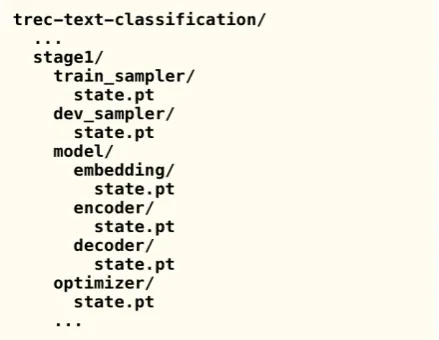
While PyTorch already provides a clear and robust saving mechanism, we augment this functionality with a generic serialization protocol for all objects that includes opt-in versioning and a directory based file format that anyone can inspect. Rather than dumping all of the model weights and other state into a single file, the directory based struc-ture mirrors the object hierarchy and enables the possibility of referencing a specific component. Rather than having to load the save file to inspect the contents, it can be navigated like any other di-rectory. By default, only what PyTorch normally saves is included in the save file; users can add ad-ditional state by overridingcustom stateand load custom state
3.3 Using a cluster
To run experiments on a cluster, an additional piece of YAML is needed to define the remote manager. As shown below in Figure 3 one can indicate the instance types and a timeout flag for both the orchestrator and the factories. We use this feature to keep our experiment tracking web-site running on the orchestrator once an experi-ment is over, but also to keep factories alive when rapidly experimenting or debugging. The orches-trator will communicate with workers in the clus-ter via Ray and Tune to execute and checkpoint
Figure 2: Save file directory structure for the
Experimentin Figure1 .
[image:4.595.307.527.63.233.2]progress at each step. If an experiment fails or is interrupted, it can be quickly resumed with an additional flagresume: True. Crucially, this remote functionality allows to distribute the exe-cution of the variants across a cluster of machines by only adding a few lines to the configuration.
Figure 3: Example remote config for AWS cluster.
3.4 Deploying
Typically after experimentation, machine learning projects require packaging a model together with some preprocessing and post-processing functions into a single inference-ready interface, e.g. a text classifier that actually takes raw string(s) as input. Flamb´e facilitates this use-case with the Exporter object, wherein users can define a new version of the model from the best variants tested, and with the right interface for later use.
3.5 Library usage
software we plan to support creating full exper-iments and deploying models via code (instead of YAML) to enable dynamic experiment creation and model exporting.
3.6 Logging
Flamb´e provides full integration with Python’s logging module and Tensorboard ((et al.,
[image:5.595.308.527.63.120.2]2016)). Users are able to visualize their results by simply includinglogstatements in their code (See Figure4).
Figure 4: Example log statement. Logging can be done anywhere inside a custom object.
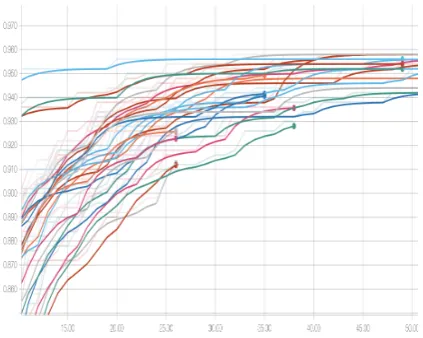
All variants will appear under the same plot for easy analysis (see Figure5).
4 Case study: BERT Distillation
In this section we showcase Flamb´e’s ability to transform a existing codebase with no pre-existing support for hyperparameter optimization into a complex multi-stage pipeline with a YAML config less than 80 lines long. Furthermore, We were able to find the optimal set of parameters in roughly half the time otherwise needed by adding Hyperband scheduling (Li et al., 2016), and run-ning the experiment over a large cluster.
BERT (Devlin et al.,2019) is a popular model which performs competitively across several NLP tasks by leveraging language model pre-training over a very large corpus. Two crucial issues with the BERT model are the size of the model, and its inference speed, which generally inhibits its use in production environments. To address this issue, recent efforts have shown that most of BERT’s performance on a downstream task can be con-served, while dramatically reducing its memory footprint (Chia et al.,2018).
In this experiment, we fine-tune the BERT model on two standard text classification bench-marks: TREC (Li and Roth,2002) and Sentiment Treebank (Socher et al., 2013). We then apply knowledge distillation to reduce the BERT model to a simple 4 layer, 256 units, SRU network (Lei et al., 2018). This is a typical multistage experi-ment with preprossessing, fine tuning, and distil-lation stages. All of this can be expressed in a
sin-Model TREC SST2 # Parameters
SRU 94.8 86.2 ≈5M
BERT 96.8 91.0 ≈110M
DISTILLED 95.5 87.8 ≈5M
Table 1: Accuracy on benchmark text classification datasets: TREC and SST2 (Binary Sentiment Tree-bank). Distilling BERT improves the accuracy of the base SRU model, while reducing the number of param-eters by more than 95%. All models were trained or fine-tuned using Flamb´e. The SRU and DISTILLED model have the same architecture, the SRU model be-ing trained from scratch and the DISTILLED model benefiting from the BERT model’s improved perfor-mance.
Figure 5: Some runs are pruned early by the Hyberband scheduling algorithm. The x-axis is training steps, and the y-axis is accuracy.
gle, concise configuration. Results are provided in Table1. The full configuration, containing all three stages and their respective hyperparameters, is provided as supplementary material.
Not only can Flamb´e express the above experi-ment in a concise configuration, but using a state of the art trial scheduling algorithm such as Hyper-band (Li et al.,2016) can be accomplished with a single additional line in the configuration. Figure
5shows Hyperband allocating more training steps to the best-performing models. In this example, defining grid searches, running over a cluster, and using a scheduling algorithm on an existing code-base required little to no effort.
5 Future work
[image:5.595.313.525.266.435.2]pursue this goal by developing a large collection of machine learning components including state of the art models, benchmark datasets, and novel training strategies. Real, working, and repro-ducible experiment configurations will showcase these components alongside their performance in task-based leaderboards. In parallel, we will con-tinue to develop user-friendly abstractions like the ability to auto-scale clusters based on the size of each stage in the pipeline, and to monitor or even alter experiment execution in real-time from a website.
References
Martin Abadi et al. 2016. Tensorflow: A system for large-scale machine learning. In12th USENIX Sym-posium on Operating Systems Design and
Imple-mentation (OSDI 16), pages 265–283.
Myle Ott et al. 2019. fairseq: A fast, extensible toolkit for sequence modeling. InProceedings of the 2019 Conference of the North American Chapter of the Association for Computational Linguistics
(Demon-strations), pages 48–53, Minneapolis, Minnesota.
Association for Computational Linguistics.
Zhiting Hu et al. 2018. Texar: A modularized, versatile, and extensible toolbox for text
genera-tion. In Proceedings of Workshop for NLP Open
Source Software (NLP-OSS), pages 13–22,
Mel-bourne, Australia. Association for Computational Linguistics.
James Bergstra, Dan Yamins, and David D Cox. 2013. Hyperopt: A python library for optimizing the hy-perparameters of machine learning algorithms. In
Proceedings of the 12th Python in science confer-ence, pages 13–20. Citeseer.
Yew Ken Chia, Sam Witteveen, and Martin Andrews. 2018. Transformer to cnn: Label-scarce distillation for efficient text classification.
Franc¸ois Chollet et al. 2015. Keras. https:// keras.io.
Jeff Dean, David Patterson, and Cliff Young. 2018. A new golden age in computer architecture: Empow-ering the machine-learning revolution. IEEE Micro, 38(2):21–29.
Jacob Devlin, Ming-Wei Chang, Kenton Lee, and Kristina Toutanova. 2019. BERT: Pre-training of deep bidirectional transformers for language under-standing. In Proceedings of the 2019 Conference of the North American Chapter of the Association for Computational Linguistics: Human Language
Technologies, Volume 1 (Long and Short Papers),
pages 4171–4186, Minneapolis, Minnesota. Associ-ation for ComputAssoci-ational Linguistics.
Matt Gardner, Joel Grus, Mark Neumann, Oyvind Tafjord, Pradeep Dasigi, Nelson F. Liu, Matthew Pe-ters, Michael Schmitz, and Luke Zettlemoyer. 2018. AllenNLP: A deep semantic natural language pro-cessing platform. InProceedings of Workshop for
NLP Open Source Software (NLP-OSS), pages 1–
6, Melbourne, Australia. Association for Computa-tional Linguistics.
Sepp Hochreiter and J¨urgen Schmidhuber. 1997. Long short-term memory. Neural computation, 9(8):1735–1780.
Jeremy Howard et al. 2018. fastai. https:// github.com/fastai/fastai.
Tao Lei, Yu Zhang, Sida I Wang, Hui Dai, and Yoav Artzi. 2018. Simple recurrent units for highly par-allelizable recurrence. In Proceedings of the 2018 Conference on Empirical Methods in Natural
Lan-guage Processing, pages 4470–4481.
Lisha Li, Kevin Jamieson, Giulia DeSalvo, Afshin Ros-tamizadeh, and Ameet Talwalkar. 2016. Hyperband: A novel bandit-based approach to hyperparameter optimization. arXiv preprint arXiv:1603.06560.
Xin Li and Dan Roth. 2002. Learning question clas-sifiers. In COLING 2002: The 19th International Conference on Computational Linguistics.
Richard Liaw, Eric Liang, Robert Nishihara, Philipp Moritz, Joseph E Gonzalez, and Ion Stoica. 2018. Tune: A research platform for distributed model selection and training. arXiv preprint
arXiv:1807.05118.
Philipp Moritz, Robert Nishihara, Stephanie Wang, Alexey Tumanov, Richard Liaw, Eric Liang, William Paul, Michael I. Jordan, and Ion Stoica. 2017. Ray: A distributed framework for emerging AI applications.CoRR, abs/1712.05889.
Ingy d¨ot Net Oren Ben-Kiki, Clark Evans. 2009.
Yaml. https://yaml.org/spec/1.2/
spec.html.
Adam Paszke, Sam Gross, Soumith Chintala, Gre-gory Chanan, Edward Yang, Zachary DeVito, Zem-ing Lin, Alban Desmaison, Luca Antiga, and Adam Lerer. 2017. Automatic differentiation in pytorch.
InNIPS-W.
Richard Socher, Alex Perelygin, Jean Wu, Jason Chuang, Christopher D Manning, Andrew Ng, and Christopher Potts. 2013. Recursive deep models for semantic compositionality over a sentiment tree-bank. In Proceedings of the 2013 conference on
empirical methods in natural language processing,
pages 1631–1642.
A Screenshots
Below is a screenshot of the reporting site that includes a progress bar, links to see the console output and Tensorboard, and a download link for the model weights: