J. Range Manage.
55:604-611 November 2002
Broom snakeweed control and seed damage after herbicide applications
KIRK C. MCDANIEL, BALLARD L. WOOD, AND LEIGH MURRAY
Authors are Professor, Dept. Animal and Range Sci., New Mexico State Univ., Las Cruces, N.M. 88003, Res. Asst., Dept. Animal and Range Sci., New Mexico State Univ., Las Cruces, N.M. 88003, and Professor, Experimental Statistics Dept., New Mexico State Univ., Las Cruces, N.M. 88003.
Abstract
Broom snakeweed (Gutierrezia sarothrae [Pursh] Britt. &
Rusby) is a major weed problem in the southwestern U.S.
because it is toxic to livestock and suppresses forage productivity.
In this study, broom snakeweed control, seed production and via- bility were determined after broadcast spraying in 1997 and 1998 with metsulfuron ({2-[[[[(4-methoxy-6-methyl-1,3,5-triazin-2-yl) amino] carbonyl] amino] sulfonyl]benzoic acid}; 0.03 kg a.i. ha-') and picloram ((4-amino-3, 4, 6-trichloro-2-pyridine-carboxylic acid); 0.28 kg a.i. ha-'). In 1997, plants were sprayed every 2 weeks beginning 1 October when snakeweed was in mid-flower and seed fill and continued until 15 December when seeds were being dispersed. Broom snakeweed control was not different by spray date and averaged 98% with picloram and 77% with met- sulfuron. Only plants sprayed on 1 October 1997 with either her- bicide had significantly less seed viability than nonsprayed plants, but seed production was not different. In 1998, herbicide applications were repeated at 2 week intervals for 6 weeks begin- ning on 1 September when snakeweed was in early-flower and seed development. Broom snakeweed control with picloram (average 88%) was consistently high across all spray dates, whereas, control with metsulfuron (average 25%) was always poor. Both herbicides reduced seed production by an average of 99, 95, and 38% when applied on 1 and 15 September 1998 and 1
October 1998, respectively, but seed production was not different among sprayed and nonsprayed plants after these dates. In the spring of 1999, broom snakeweed seedlings were common in all areas previously sprayed in 1997, but few seedlings established in plots sprayed in 1998. In the spring of 2001, the number of newly emerged broom snakeweed seedlings observed in nonsprayed and herbicide-treated areas was the same, irrespective of spray year, herbicide type or date applied. Data indicate that herbicide applications made at flower when seed is in early fill can provide satisfactory plant control and lower seed production. Spraying after seed has reached physiological maturity does not affect seed production or viability. In this study, results were inconclusive for determining if timed herbicide applications in autumn can be used to minimize later broom snakeweed establishment.
Key Words: Gutierrezia sarothrae, reproduction, seed produc- tion, seed dispersal, seedling emergence, seed viability, herbicide control, metsulfuron, picloram
Resumen
La escobilla de bruja (Gutierrezia sarothrae [Pursh] Britt &
Rusby) es un problema mayor de maleza en el sureste de EU dado que es toxica para el ganado y porque suprime la production de forraje. En este estudio, control de la escobilla de bruja, la pro- duccion y viabilidad de la semilla se determinaron despues de aspersiones en 1997 y 1998 con metsulfuron ({2-[[[[(4-methoxy-6- metilo-1,3,5-triazin-2-yl) amino] carbonilo] amino] sulfonyl] acido benzoico}; 0.03 Kg i.a ha') y picloram (4-amino-3,4,6-tricloro-2- piridina-acido carboxilico); 0.28 Kg i.a ha-'). En 1997, las plantas fueron asperjadas cada 2 semanas empezando en Octubre 1 cuan- do la escobilla de bruja estaba en media floracion y en el llenado de la semilla y continuo hasta Diciembre 15 cuando las semillas fueron dispersadas. El control de la escobilla de bruja no fue diferente por fecha de aspersion y promedio 98% con picloram y 77% con metsulfuron. Solamente las plantas asperjadas con cualquiera de los herbicidal en Octubre 1 en 1997 tuvo significan- temente menos viabilidad de la semilla que las plantas que no fueron asperjadas, pero la produccion de semilla no fue diferente.
En 1998, aplicaciones de herbicida fueron repetidas a intervalos de 2 semanas por 6 semanas, empezando en Septiembre 1 cuando la escobilla de bruja estaba en floracion temprana y en desarrollo de la semilla. El control de la escobilla de bruja con picloram (promedio 25%) fue consistentemente alto a traves de todas las fechas de aspersion, mientras que el control con metsulforon (promedio 25%) fue siempre pobre. Ambos herbicidas redujeron la produccion de semilla para un promedio de 99, 95, y 38%
cuando se aplicaron en Septiembre 1 y 15 en 1998 y en Octubre 1 en 1998, respectivamente, pero la produccion de semilla no fue diferente entre plantas asperjadas y plantas no asperjadas despues de esas fechas. En la primavera de 1999, plantulas de escobilla de bruja fueron comunes en todas las areas previamente asperjadas en 1997, pero pocas plantulas se establecieron en los cuadros asperjados en 1998. En la primavera del 2001, el numero de plantulas de escobilla de bruja recien emergidas observado en areas sin asperjar y en areas tratadas con herbicida fue el mismo, indistinto del ano de aspersion, del tipo de herbicida o de la fecha de aplicacion. Los datos indican que las aplicaciones de herbicida hechas en la for cuando la semilla esta en llenado temprano puede proveer un control de planta satisfactorio y disminuir la produccion de semilla. El asperjado despues que la semilla ha alcanzado su madurez fisiologica no afecta la produccion o la via- bilidad de la semilla. En este estudio, los resultados fueron incon- clusos en determinar si las aplicaciones de herbicida programadas en otono pueden ser usadas para minimizar el establecimiento posterior de la escobilla de bruja.
Manuscript accepted 28 Jan. 02.
604 JOURNAL OF RANGE MANAGEMENT 55(6) November 2002
Southwestern U.S. rangelands with dense infestations of broom snakeweed (Gutierrezia sarothrae [Pursh] Britt. &
Rusby) are often commercially sprayed by aircraft to promote desired grass growth and to prevent potential livestock health problems from this poisonous plant (McDaniel and Duncan 1987, Strickland et al. 1998). The general commercial spray period for broom snakeweed control in New Mexico and west Texas is October through December (Duncan and McDaniel 1991). In the 1980's, about 600,000 ha were sprayed in this region (McDaniel 1989). In the 1990's, partly because of the success of previous broom snakeweed control activities and partly because the plant population naturally declined in many areas, less than half this area was treated. The majority of treated rangeland was aerially sprayed with picloram (4- amino-3, 4, 6-trichloro-2-pyridine-car- boxylic acid) at a rate of 0.28 kg a.i. ha'
whereas less area was treated with metsul- furon ({2-[[[[(4-methoxy-6-methyl-1,3,5- triazin-2-yl) amino]carbonyl]amino]sul- fonyl]benzoic acid}) at 0.03 kg a.i. ha'
.These herbicides are typically mixed with water and applied at 140 to 240 liters ha'
total spray volume. According to Sosebee
(1985, 2000) and Sosebee and Dahl (1991), broom snakeweed increases total nonstructural carbohydrate storage in autumn and this allows herbicides to be more readily translocated to the perennat- ing organs and tissues resulting in opti- mum plant control.
In New Mexico, commercial aerial applicators usually wait until broom snakeweed completes flowering before spraying (Williams 1990). In its native range from Mexico to Canada, broom snakeweed flowering is photoperiod-sensi- tive with plants in full bloom earlier and for a shorter duration in northern latitudes (near mid-July) than in southern regions (early September) (Sterling et al. 1999). In New Mexico, broom snakeweed typically begins to flower about 2 weeks earlier in northern portions of the state than south- ern parts. A study by Wood et al. (1997) closely followed broom snakeweed flower and seed production in central New Mexico and reported that most plants were in full bloom by mid-August and that seed required 6 to 8 weeks to ripen within the inflorescence before dispersal com- menced, roughly in mid-October. In the Wood et al. (1997) study, about half the seed dropped to the surface before January and the remainder disseminated by early spring except for a few seeds that were retained within the inflorescence until the next season.
Broom snakeweed relies on seed pro- duction for propagation and the number of seeds produced per plant is highly variable depending on plant age, interspecific com- petition, and seasonal growing conditions
(Solbrig 1960, Sterling et al. 1999).
Broom snakeweed germination is erratic from year to year, but when specific envi- ronmental conditions are met, then prolific propagation occurs, usually in the spring (McDaniel et al. 2000). Broom snakeweed seedling mortality is often high the first year, but surviving propagules generally live for 7 years or longer (Pieper and McDaniel 1989).
Economic returns from broom snake- weed control depend partially on adult plant mortality and the length of time the sprayed area remains weed free (Torell et al. 1989). Uncertainty about future broom snakeweed establishment limits the poten- tial for economic control (Torell et al.
1992). A survey of 65 New Mexico landowners who paid to spray broom snakeweed in the 1980's indicated that 91% of the treatments provided satisfacto- ry initial control (Williams 1990).
However, because broom snakeweed reestablished on many areas within 5 years of spraying, only half of those surveyed indicated they would use chemical treat- ments again (Townsend 1995). Commercial spraying in New Mexico in the 1980's was always conducted when broom snakeweed was in the post-bloom stage (mainly in November and December). Evidence from the rancher surveys (Williams 1990, Townsend 1995) suggested that while her- bicide spraying is usually effective in eliminating the current crop of mature broom snakeweed plants, there remains uncertainty regarding treatment effects on later seed germination and plant establish- ment. Thus, in this study, our objectives were to determine: (1) if picloram and metsulfuron treatments provide consistent broom snakeweed control throughout the autumn spray season, (2) if herbicide treat- ments damage seed production or seed viability, and (3) if herbicide applications can be timed so as to eliminate parent plants and potential seed progeny.
Materials and Methods Study Area
Field experiments were initiated in 1997 and 1998 on the New Mexico State University Chihuahuan Desert Rangeland Research Center (CDRRC) about 35 km north of Las Cruces, N.M. (32°34'N, 106°56'). The CDRRC is located on the
west mesa of the Rio Grande valley at an elevation of 1,219 m. The experimental site was located on level terrain within a pasture that was lightly grazed with cattle in late winter both years of this study.
Rainfall is most common from July through September and averages 236 mm.
Low precipitation, warm summers, and mild winters characterize the arid conti- nental climate.
Soils, to a depth of 1.5 m, have sandy loam to sandy texture and are grouped in
the Berino-Dona Ana Association
(USDA-SCS 1980). Because of eolian ori- gins, these soils are vulnerable to wind erosion leading to constantly shifting cop- pice dunes throughout the area. Vegetation on the experimental area was once domi- nated by black grama [Bouteloua eriopoda (Torr.) Torr.], but is now predominantly broom snakeweed with occasional mesquite (Prosopis glandulosa Torr.).
Common grass and forb species include black grama, dropseeds (Sporobolus spp.), three-awns (Aristida spp.), fluff grass [Dasyochloa pulchella (Kunth) Steudel], globe mallow (Sphaeralcea spp.), leather- weed croton (Croton corymbulosus Engelm.), spectaclepod [Dimorphocarpa wislizenii (Engelm.) Rollins], and plains
cryptantha [Cryptantha crassisepala
(Torr. and Gray) Greene]. Mature broom snakeweed were estimated to be at least 3
years old and plant density across the study area ranged from 3 to 7 plants m-Z.
Experimental Design and Herbicide Applications
The experimental design was a random- ized complete block with an augmented factorial arrangement of treatments repli- cated 3 times. Experiments conducted in 1997 and 1998 were evaluated separately.
Factor A consisted of picloram at a rate of 0.28 kg a.i. ha' and metsulfuron at a rate of 0.03 kg a.i. ha'. Picloram was selected because it is the predominant chemical used by commercial aerial applicators for broom snakeweed control in New Mexico.
Metsulfuron is presently more expensive than picloram, but is used as an alternative herbicide choice. Factor B included the picloram or metsulfuron application dates presented in Table 1. In 1997, herbicide applications were made 1 and 15 October, November, and December when broom snakeweed phenology ranged from mid flower and seed fill to post flower and seed dispersal. Partially because of treat- ment effects noted from the 1997 experi- ment, the herbicide application schedule was moved ahead I month for the 1998 experiment. Thus, in 1998, herbicide
JOURNAL OF RANGE MANAGEMENT 55(6) November 605
Table 1. Application date, timing, and spray conditions for 2 herbicide experiments conducted to control broom snakeweed at the Chihuahuan Desert Rangeland Research Center, Las Cruces, N.M.
Application Date Application Timing
Air
Temp Temp Humidity Speed
(°C) (°C) (%) sec 1)
1997
l Oct. Mid flower - mid seed fill 23 0
15 Oct. Late flower - late seed fill 21 0
1 Nov. Late flower - seed mature 20 0
15 Nov. Post flower - seed dispersal 14 4 3
1
Dec. Post flower - seed dispersal 8 8 3
15 Dec. Post flower - seed dispersal 6 2 0
1998
1 Sep. Early flower - initial seed set 21 0
15 Sep. Mid flower - early seed fill 22 3
l Oct. Mid flower - mid seed fill 21 0
15 Oct. Late flower - late seed fill 17 3
1 Nov. Post flower - seed mature 16 2
15 Nov. Post flower - seed dispersal 17 8 2
applications began on 1 September when broom snakeweed was in early flower and initial seed set and continued, as presented in Table 1, every 2 weeks for 6 weeks when seeds were being dispersed. A nontreated control was included for comparison.
The potassium salt of picloram and the dry flowable formulation of metsulfuron were applied with a CO2 pressurized hand held sprayer (3.3-m boom) delivering 200 liters ha
1at 400 kPa to 30- by 30-m plots.
The rates were consistent with the recom- mended commercial application rates of 0.28 kg a.i. ha
1for picloram and 0.03 kg a.i. ha-1 for metsulfuron (Duncan and McDaniel 1991). Application dates,
broom snakeweed flower and seed devel- opment stages, and environmental condi- tions during spraying in 1997 and 1998 are given in Table 1. Broom snakeweed con- trol was visually estimated by 3 observers comparing treated plots to non-treated rangeland approximately 12 months after treatment (MAT). The data were analyzed separately by experimental year to com- pare 3 treatments, 3 replications, and 6 spray dates using the GLM procedure of SAS (1989). Data for both experiments were subjected to analysis of variance and means were separated using Fisher's Protected L.S.D. test at the 0.05 level of probability. When significant herbicide by application timing interactions were not detected, data were averaged across herbi- cide type.
Seed Production
Before experiments commenced in 1997 and 1998, relatively uniform sized mature broom snakeweed plants in each experi- mental plot were randomly selected and marked with different colored pin flags for
later seed harvest from the inflorescence.
Pin flags in each plot marked 2 plants (3 replications; 6 total) that were scheduled for seed collection as follows: at spraying and 2, 4, 6, 8, and 10 weeks after spraying.
On each collection date, non sprayed plants (6 total) from untreated plots were also harvested. To facilitate seed cleaning, the outer perimeter of each plants canopy containing mostly flower material was clipped and placed separately in paper bags and transported to the laboratory to be oven dried for 24 hours at 50°C. The
dried flower material was first hand threshed to shatter achenes (seed) from capitula and to detach the inflorescence from stems. The sample was then sieved with a No. 7 Clipper screen and the remaining sample (fine litter, capitula, and seed) was pulsed twice in a seed scarifier to break apart capitula and to continue dis- lodging seed. Seeds were separated from litter using 1.18 and 0.6 mm mesh screens, respectively. Finally, remaining chaff was separated from seed using a No. 120 Seedburo. The number of seeds in a 0.2 g subsample of the seed fraction was count- ed and extrapolated to estimate total seed
obtained from the inflorescence.
Differences in seed number per plant over the various collection dates and herbicide treatments were analyzed as a completely randomized design with rep by sample date by plant as the error term.
To monitor seed dispersal throughout the duration of each experiment, 2 mature broom snakeweed plants were randomly selected in every experimental plot and a 5- by 25- by 51-cm plastic collection tray (trap) was placed in each plant's seed shadow. Trays were covered with stucco wire to retain seed in the trap and small holes were perforated in the tray bottom to
allow rain water to escape using a proce- dure similar to that described by Wood et al. (1997). Collection of dispersed seed coincided with collections from the inflo- rescence. All flower material in each trap was emptied into separately labeled paper bags and returned to the lab to be oven- dried and cleaned using the procedure described above. Seeds were counted to determine the number in each trap, and then stored for viability testing.
Seed Viability
Viability tests were conducted shortly after mature seeds were collected from the inflorescences and traps using tetrazolium (TZ) analysis procedures similar to those described by Thill et al. (1985). A subsam- ple of 40 (1997) or 50 seeds (1998) per plant (24 plants per spray date plus con- trols) were removed from collected mater- ial using forceps. If the seed collapsed under normal pressure necessary to pick it up, it was considered immature or deterio- rated (fruitless) and not included in the subsample. Seeds were placed in a 5-cm petri dish on double filters saturated with deionized water and imbibed for a mini- mum of 4 hours. With a dissecting scope, seeds were examined and those with an embryo were dissected near the apical end, below the pappus, and placed in a 1%
aqueous solution of TTC (2,3,5-triphenyl
tetrazolium chloride) for 8 hours (Tetrazolium Committee of Association of Official Seed Analysts 1970). Following the soaking period, seed with acceptable red-stained embryos were used to calcu- late percentage net viability (viable
seed/total in TZ test X 100). According to analysis of variance, there was no signifi- cant difference in the viability of seed col- lected from either the inflorescence or dis- persed in traps by sample date within an experimental year. Therefore, data from both collection procedures were combined by experiment to compare treatment dif- ferences for final analysis. Analysis of variance and L.S.D. procedures in SAS (1989) were used to determine viability differences among spray dates and herbi- cide treatments by experimental year.
Seedling Numbers
Broom snakeweed seedlings were counted in June 1998, 1999, 2000, and 2001 using five, 31.5 by 61 cm perma- nently marked quadrats located in each experimental plot. These quadrats were placed along 2 diagonal lines across each plot from corner to opposite corner. This allowed a comparison of seedling density after autumn spraying with picloram or
606 JOURNAL OF RANGE MANAGEMENT 55(6) November 2002
Table 2. Broom snakeweed control, average seed production, and seedlings established in experimental plots sprayed with 2 herbicides in 1997 at the Chihuahuan Desert Rangeland Research Center, Las Cruces, N.M.
Spray
Date Application Timing
l Oct. Mid flower - mid seed fill 100 a4 15 Oct. Late flower - late seed fill 94 ab
1 Nov. Post flower - seed mature 97 a 15 Nov Post flower - seed dispersal 99 a
1 Dec. Post flower - seed dispersal 100 a 15 Dec. Post flower - seed dispersal 100 a Control
81b 5034 5172 11.1 a 9.3a
84b 4623 4368 40.2c
93 ab 3112 4546 34.8 be
79 be 6326 4309 25. l b
62c 4177 5724 37.3c
65c 3735 3627 21.5b
Od 5421 n/s 14.7 a
'Plant control evaluated
1Oct. 1998.
3Seed1ings counted on
1July 1999.
Seedlings counted on
1May 2001.
4Means within a category with the same letter are not different (P < 0.05); nls, not significantly different.
metsulfuron in 1997 or 1998. No seedlings emerged in 1998 and 2000; thus, only 1999 and 2001 data are reported. Analysis of variance and L.S.D. mean separation tests were used to determine seedling dif- ferences among spray dates, herbicide treatments, experimental years, and collec- tion times.
Results and Discussion Broom Snakeweed Control
It is difficult to determine precisely when broom snakeweed succumbs to a herbicide after autumn spraying because the plant naturally dies back to its woody base when winter dormant. Typically, broom snakeweed shows epinasty and other effects from picloram within 10 days of herbicide application, but recognizable metsulfuron symptoms may take a month or more (McDaniel and Duncan 1987). An accurate evaluation of broom snakeweed control is best made 9 or more months after herbicide application (Sosebee 1985).
Our evaluations of broom snakeweed con- trol were made near the end of the next growing season (about 12 months after treatment) and indicated that picloram was
consistently more effective in killing broom snakeweed, irrespective of treat- ment year or spray date, than was metsul- furon (Tables 2 and 3). Broom snakeweed mortality was less, though not always sig- nificantly, when picloram was sprayed near the same dates in 1998 (average 88%
control) compared to 1997 (average 98%
control). Control with metsulfuron was also higher in 1997 (average 77%) than 1998 (average 24%). McDaniel and Duncan (1987) reported in an experiment conducted in central New Mexico that aer- ial applications of picloram and metsul- furon gave nearly 100% broom snakeweed control when applied in autumn at the same rates used in this study.
There was little efficacy advantage to application of picloram on earlier spray dates relative to later dates within a treat- ment year (Tables 2 and 3). Consistent broom snakeweed control with picloram throughout a spray season is an important expectation by aerial applicators and other users of this chemical. Metsulfuron pro- vided relatively higher broom snakeweed control on earlier spray dates than later dates in 1997. However, control with met- sulfuron was always poor in 1998 (less than 50%) and this is a major concern
---(no. m 2)---
4.3 3.6
16.5 a 2.9 2.2
35.9 be 2.5 5.7
49.9 cd 1.1 4.7
61.O d 2.5 5.0
24.O b 4.3 3.2
4.2 n/s
because even a minor presence of broom snakeweed can result in significant grass suppression (McDaniel et al. 1993). In general, broom snakeweed control strate- gies that eliminate less than 85% of the mature plants are regarded as unacceptable (Sterling et al. 1999).
Seed Production and Dispersal In southern New Mexico, occasional blooms can be found on broom snakeweed throughout the year, but peak flowering generally extends for about 6 to 8 weeks from late summer until a killing frost in autumn (Briede 1990). Broom snakeweed heads usually contain 2 to 7 ray and disk flowers, but only 1 to 3 seeds typically mature from ray florets (Lane 1985).
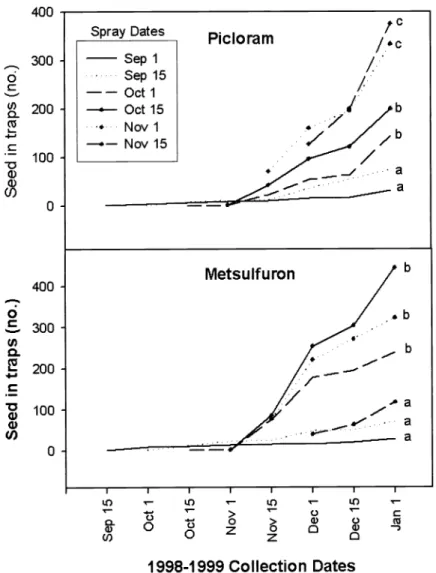
During these experiments, broom snake- weed commenced flowering in early September and ceased flowering by early November when night time air tempera- tures dropped below freezing (data not shown). A relatively consistent seed sup- ply was collected in traps beneath non- sprayed plants from December through February (Fig. 1). Weather events, such as wind and precipitation, dictated the rate and amount of seed recovered during each 2 week collection period. In this study, we
Table 3. Broom snakeweed control, average seed production, and seedlings established in experimental plots sprayed with 2 herbicides in 1998 at the Chihuahuan Desert Rangeland Research Center, Las Cruces, N.M.
Spray Plant Control' Seed Production
Date Application Timing Picloram Metsulfuron Picloram Metsulfuron
1 Sep. Early flower - initial seed set 87 ab4 15 Sep. Mid flower - early seed fill 96 a
1 Oct. Mid flower - mid seed fill 87 ab 15 Oct. Late flower - late seed fill 89 ab
1
Nov. Post flower - seed mature 82 b 15 Nov. Post flower - seed dispersal 84 ab
Control
---(%)--- ---(no. plant')---
1999 Seedlings2 2001 Seedlings3 Picloram Metsulfuron Picloram Metsulfuron ---(no. m2)--- ---(no. m 2)---
8e 12a 3a
lOe 125a 154a a
7e 1763b 1776b
49c 2897 cd 146l b a
46c 2258 be 3658d a a
27d 2680c 3166d
Oe 2861 cd
Plant control evaluated
1Oct. 1998.
3Seedlings counted on
1July 1999.
Seedlings counted on
1May 2001.
4Means within a category with the same letter are not different (P < 0.05); n/s, not significantly different.
Plant Control' Seed Production 1999 Seedlings2 2001 Seedlings3 Picloram Metsulfuron Picloram Metsulfuron Picloram Metsulfuron Picloram Metsulfuron
---(%)--- ---(no. plant')--- ---(no. m 2)---
14.7b 4.3 n/s
JOURNAL OF RANGE MANAGEMENT 55(6) November 607
17500 15000 o. 12500
E c 10000
= 7500 5000
U,
2500
0
C 0
L, r tj) r 10 r Ln - In r r> r U r C r.0 r L
z
1000 1998 was about 30% below the 30 yr aver- age of 260 mm. A similar yearly differ- 800 Cl) - E ence in because broom snakeweed of rainfall differences during seed production the 600 "-' tg, growing season was reported by Wood et N al. (1997) for plants in central New
400. o Mexico.
a) 0 Irrespective of date sprayed in 1997, 200 11 E there was no significant difference in the average number of mature seed in the inflorescence after applying either piclo- ram or metsulfuron compared to non- sprayed plants (Table 2). Also, the cumu- lative number of seed dispersed through time from plants sprayed with either piclo- ram or metsulfuron was similar to non- sprayed plants (Fig. 2). In contrast, in 1998, broom snakeweed plants sprayed
1 997- 1 998
4000 C
.' 3000 C
U)
;
1000 U,
' '3) 2000
0
500 wit ' h elt er ' h p ' lc 1 oram or metsu if uron on 1 and 15 September produced 99 and 95%
l() r U) r lt') r t - L() - I
r> r U r C r . L
z z 00 ED-, CULL ID
1998- 1 999
1750 ,
1500 1250 1000 750 500 250
d
Fig, 1. Average number of broom snakeweed seed recovered from the inflorescence (bar graphs) and from seed traps (line graphs) placed beneath the canopy of nonsprayed plants growing at the Chihuahuan Desert Rangeland Research Center, Las Cruces, N.M. in 1997-1998 and 1998-1999.
stopped collecting seed in March after the majority were dispersed. However, we still found a few seeds on plants until flower parts completely deteriorated in June.
Broom snakeweed seed production can vary greatly from year to year, primarily in response to available soil moisture dur- ing flowering (Ragsdale 1969). Under very dry conditions, broom snakeweed typically will not flower, whereas in wet- ter years, the plant flowers profusely (Pieper and McDaniel 1989). During our study, the average number of seeds per plant counted from the inflorescence of nonsprayed plants was approximately twice as high in 1997 (5,421 seeds per plant) compared to 1998 (2,861 seeds per plant). This difference in seed production between years can largely be attributed to rainfall received during the growing sea- son (April-September) each year. In 1997, growing season rainfall was about 64%
above average whereas precipitation in
0-s-i_*
400 0." fewer mature seeds per plant, respectively,
2 E compared to nonsprayed plants. Plants 300 C sprayed with picloram on 1 October pro-
.- o duced about 38% fewer mature seed than 200 . o nonsprayed plants, whereas plants treated with metsulfuron on 1 and 15 October pro- 100 t1 duced about 43% less mature seed.
Several studies have reported that herbi- 0 cide applications made at or near anthesis
r
0 U
r
z 0
r
0 ci)
can inhibit seed development and reduce germination (Fawcett and Slice 1978, Anderson 1995, Clay and Griffin 2000).
How broom snakeweed seed are damaged by picloram or metsulfuron was not inves- tigated in this study, but research is need- ed to define how these chemicals impede early seed development. Our examination of seed from nonsprayed plants revealed that the seed coat (testa) was generally soft
r
cci
r
LL a)
r L
cci
1887-1888 Collection Date
r L
0.
Fig. 2. Cumulative number of seed dispersed into 5- by 25- by 51-cm traps for 22 weeks after spray- ing on 1 Oct.1997. Traps were placed beneath 6 broom snakeweed plants per treatment.
0 r L r
608 JOURNAL OF RANGE MANAGEMENT 55(6) November 2002
400
300
200
100
0
400
E 0 300
0
Sep 1
Sep 1 5
- - Oct 1
- Oct 15 ., Nov 1
-- Nov 15
T 0 r
0 T
z O
T
z
higher for the 1997 (67%) than the 1998 seedlot (49%) (Fig. 4). Wood et al. (1997) also reported annual differences in net via- bility between broom snakeweed seedlots and indicated that seedlot quality was highly influenced by available soil mois- ture during flowering. In this study, the number of mature seed needed for viabili- ty testing was generally not available from the inflorescence until October, and suffi- cient mature seed from traps was not available until November. Tetrazolium tests indicated little difference in the via- bility of seed collected from the inflores- cence or recovered in traps beneath sprayed and nonsprayed plants after 1 November 1997 (Fig. 5) or 1998 (data not shown). These data agree with Wood et al.
(1997) who reported that mature seed retained within the inflorescence or dropped to the surface remained equally viable after seed matured in autumn through the next spring.
In the 1997 experiment, there was no difference in average net seed viability from plants sprayed with picloram or met- sulfuron compared to nonsprayed plants on any date except for those sprayed on 1
October (Fig. 6). On 1 October, only mature seed were tested, but the majority of seed taken from inflorescences were actually in the mid or earlier fill stages.
Tetrazolium tests revealed net viability to be low (average 22%) for all seed tested at the time of spraying on 1 October. Two weeks after spraying on 1 October and for the next 20 weeks, seed from metsulfuron treatments had consistently lower net via- bility (average 26%) than nonsprayed and
r
O
T 0 ci)
1998-1999 Collection Dates
Fig. 3. Cumulative number of seed dispersed into 5- by 25- by 51-cm traps after spraying on 6 dates in 1998. Lines by herbicide type followed by a different letter indicate a difference in the total number of seed collected by 1 Jan. 1999.
(doughy) and embryos remained undevel- oped through most of September. We noted that seed in early anthesis remains in a dough stage for 3 to 4 weeks until the testa builds a waxy inner and outer cuticle layer of thickened protective cells that harden around the encased embryo.
Because most plants sprayed in early flower with initial to early seed set failed to produce a large quantity of mature seeds, we speculate that a hardened testa provides the protection needed to be impermeable to picloram and metsulfuron.
As expected, seed dispersed through time in 1998 was less for plants sprayed on early dates compared to later dates, irre- spective of herbicide applied (Fig. 3).
Seed Viability
The average net viability of seed obtained from the inflorescence of non- sprayed broom snakeweed plants was
.