Two classes of weighted values for
coalition structures with extensions to
level structures
Besner, Manfred
HFT Stuttgart, University of Applied Sciences, Department of
Geomatics, Computer Science and Mathematics
25 July 2018
Online at
https://mpra.ub.uni-muenchen.de/88191/
with extensions to level structures
Manfred Besner
∗July 25, 2018
Abstract
In this paper we introduce two new classes of weighted values for coalition structures with related extensions to level structures. The values of both classes coincide on given player sets with Harsanyi payoffs and match therefore adapted standard axioms for TU-values which are satisfied by these values.
Characterizing elements of the values from the new classes are a new weighted pro-portionality within components property and a null player out property, but on different reduced games for each class. The values from the first class, we call them weighted Shap-ley alliance coalition structure values (weighted ShapShap-ley alliance levels values), satisfy the null player out property on usual reduced games. By contrast, the values from the sec-ond class, named as weighted Shapley collaboration coalition structure values (weighted Shapley collaboration levels values) have this property on new reduced games where a component decomposes in the components of the next lower level if one player of this component is removed from the game. The first class contains as a special case the Owen value (Shapley levels value) and the second class includes a new extension of the Shapley value to coalition structures (level structures) as a special case.
Keywords
Cooperative game·Weighted Shapley coalition structure values·Weighted Shapley levels values · Dividends · Null player out1 Introduction
Whereas e. g. governments, firms or political organizations are mostly structured strong hierarchical and in a statical manner supply chains or electricity and other networks have often a more dynamical and not so strong top down frame work. For hierarchical organized structures Winter (1989) developed a model, called level structure, that is an extension of a coalition structure (Aumann and Dr`eze, 1974). Therefore Winter (1989) introduced his value, we name it Shapley levels value, in accordance, e. g., with Alvarez-Mozos et al.´ (2017). This value is an extension of the Owen value (Owen, 1977), itselves an extension
*
M. Besner
Department of Geomatics, Computer Science and Mathematics, HFT Stuttgart, University of Applied Sciences, Schellingstr. 24 D-70174 Stuttgart, Germany
Tel.: +49 (0)711 8926 2791
of the Shapley value (Shapley, 1953b). A level structure consists of ordered partitions (the levels) of the original player set. Each partition consists of disjoint coalitions of players (the components) such that each component of a level higher that contains a player from a component of the lower level must contain all players of this component. So in a level structure the lowest level contains all the singletons as components and the highest level contains the grand coalition as the only component.
Vidal-Puga (2012) introduced a weighted value for coalition structures, extended by
G´omez-R´ua and Vidal-Puga (2011) to level structures. There the weights are given by the size of the coalitions. The size of coalitions may be a considerable magnitude that is to take into account by sharing the payoff in a cooperative game. But often also other factors, e. g. in the context of cost allocation, play a decisive role: the size of firms or departments, political influence, fixed costs of the units, spent time of working members and so on. RecentlyBesner (2018b)extended their value to a class of values with arbitrary exogenously given weights, called weighted Shapley hierarchy levels values which extend the weighted Shapley values (Shapley, 1953a). These values don’t satisfy the null player property in general.
Also Levy and McLean (1989) and McLean (1991) extended the weighted Shapley values to coalition structures for arbitrary weights which not depend on the coalition function. The main class of these values, in Dragan (1992) called McLean weighted coalition structure values, is inBesner (2018a)extended to level structures, called weighted Shapley support levels values. There the hierarchy of the level structure is treated more statically. If a sub-coalition of a component deals with other coalitions outside of this component the sub-coalition is supported by the weight of the whole component. In general, without further statement, it is not clear how to go on if a player is removed from the player set meaning what are the weights of the new components in the new game. In this respect, the Shapley levels value has an exceptional character within this class of values. It can be easily be treated also dynamically since the used weights are in a game where some players are removed the same as before, they are always equal.
To handle also weighted values for level structures in the same manner we introduce the class of weighted Shapley alliance levels values (weighted Shapley alliance coalition structure values). There weights, similar as by the weighted Shapley hierarchy levels values, are assigned not only to components, each subset of a component owns a weight too. If a player is removed from a component the remaining players build a new component with the original weight of the coalition of these players. Thus here the coalitions within a component can act more independently in the corset of a level structure. They can act with players outside of the component without consultation of the whole component but all involved players of a component form always an alliance. The weighted Shapley alliance levels values coincide with payoff vectors, called Harsanyi payoffs, from the Harsanyi set (Hammer, 1977;Vasil’ev, 1978) and inherit so for fixed player sets all properties of these payoff vectors adapted to level structures. Interestingly, the Shapley levels value (Owen value) is also a special case of the Shapley alliance levels values and our axiomatization gives so deeper insight into this value too. A characterizing element of the weighted Shapley alliance levels values is a null player out property. If we delete a null player this doesn’t influence the payoff to the other players.
Shapley collaboration levels values (weighted Shapley collaboration coalition structure values) are recommended. Especially if a null player is removed from a component and the coalition of the remaining players of this component is smashed in the next smaller components. Then the payoff to all players is the same as before in the game with the complete player set. If some players of a component B are involved in a bargaining situation with players from outside of B all players which form the next largest sub-component of B collaborate together. So also here the players of a component can act more independently. Here, similar as by the weighted Shapley support levels values, only the components need a weight. As a special case of these values we single out a new extension of the Shapley value to level structures and name it Shapley collaboration levels value (Shapley collaboration caolition structure value).
Whereas the Shapley levels value, the weighted Shapley support levels values and the weighted Shapley hierarchy levels values satisfy the level game property (the payoff to all players of a component sum up to the payoff to the component in a game where components are the players) the values from our new classes don’t satisfy this property in general. The absence of this characteristic reveals that in our new classes the players are more independent from a nesting component.
A level structure with only two levels coincides with a coalition structure. Thus all presented axioms and so the given axiomatizations coincide with related axioms and axiomatizations formulated for coalition structures. Therefore we deal in this paper with coalition structures only marginally and concentrate on level structures so that in this respect the reader has to transform adequate results by his own.
After the introduction section2 provides some preliminaries. In the main part of the paper we introduce in section3 the weighted Shapley alliance levels values, in section4
the weighted Shapley collaboration levels values and, as a special case, in section 5 the Shapley collaboration levels value. An example in section6compares the proposed values, section7 gives the conclusion and an appendix (section8) provides all the proofs.
2 Preliminaries
In this paper some definitions and notations will follow with Besner (2018a). Let a countably infinite set U of all potential players be given and let N the set of all finite
subsets of U which are non-empty. A TU-game can be defined as a pair (N, v) where
N ∈ N is a player set and v a coalition function from the power set 2N into the real
numbersRsuch thatv(∅) = 0. We call subsetsS ⊆N coalitionswith aworthv(S); ΩS
denotes the set of all nonempty subsets of S ⊆ N. If we regard only a restricted player set S ∈ ΩN we denote by (S, v) the restriction of (N, v). We denote by VN the set of
all TU-games with player set N.
A player i ∈N is called a null player in v if v(S∪ {i}) = v(S), S ⊆ N\{i}; we call two different players i, j ∈ N (mutually) dependent (Nowak and Radzik, 1995) in v if
v(S∪ {k}) = v(S) for allS ⊆N\{i, j}and k ∈ {i, j}. For allS⊆N and T ∈ΩN a game
(N, uT)∈VN with uT(S) = 1 if T ⊆S and uT(S) = 0 otherwise is called an unanimity
game. We define the dividends ∆v(S) (Harsanyi, 1959) by
∆v(S) :=
(
v(S)−P
R(S∆v(R), if S ∈ΩN, and
It is well-known that any coalition function v on N can be uniquely presented by
v = X
T∈ΩN
∆v(T)uT. (2)
Coalitions S ⊆N are called activein v if ∆v(S)6= 0.
Acoalition structureonN is a partitionB:={B1, ..., Bm}of the player setN where
Bk 6= ∅, 1 ≤ k ≤ m, Bk∩Bℓ = ∅, 1 ≤ k < ℓ ≤ m, and Smk=1Bk = N. Each B ∈ B is
called a componentand B(i) denotes the component that contains a player i∈N. ByWinter (1989), each finite sequenceB :={B0, ...,Bh+1}of coalition structuresBr, 0≤
r ≤h+ 1,onN is called a level structure onN if B0 =
{i}:i∈N , Bh+1 ={N}and
eachBr is a refinement ofBr+1 for allr, 0≤r ≤h, that means thatBr(i)⊆ Br+1(i) for all
i ∈N. We denote by LN the set of all level structures with player set N; we call Br the
r-th level of B; for a component Bk ∈ Bk, 0≤ k ≤r ≤h+ 1, Br(Bk) is the component
of the r-th level that contains Bk and by B we denote the set of all components B ∈ Br
of all levels Br∈ B, 0≤r≤h.
An LS-game is a triple (N, v,B) where (N, v) ∈ VN and B ∈ LN. We denote by
VLN the set of all LS-games on N. Please note that we have for each (N, v,B
0)∈ VLN
with a trivial level structure B0 :={B0,B1} a corresponding TU-game (N, v) and for
each (N, v,B1)∈VLN, B1:={B0,B1,B2}, a corresponding game with coalition structure
(Aumann and Dr`eze, 1974; Owen, 1977).
Let (N, v,B) ∈ VLN,B = {B0, ...,Bh+1}, and T ∈ ΩN. From a level structure on N
follows a level structure onT by eliminating the players inN\T. With coalition structures Br|
T := {B ∩T : B∈ Br, B ∩T 6= ∅}, 0 ≤ r ≤ h+ 1, the new level structure on T is
given by B|T := {B0|T, ...,Bh+1|T} ∈LT and (T, v,B|T)∈ VLT is called the restriction
of (N, v,B) to player set T.
A TU-value φ is a map that assigns to any (N, v) ∈ VN a vector φ(N, v) ∈ RN, an
LS-value ϕ is a map that assigns to any (N, v,B)∈VLN a vector ϕ(N, v, B)∈RN.
Let R++ the set of all positive real numbers. We define WN:= {f: N → R++} with
wi:= w(i) for all w ∈WN andi∈N as the set of all positive weight systems on the player
set N, we define W2N
:= {f: 2N\∅ → R
++} with wS:= w(S) for all w ∈ W2
N
, S ∈ ΩN,
as the set of all positive weight systems on all non-empty coalitionsS ⊆N and we define WB:={f:B →R
++}1 with wB:=w(B) for all w∈ WB, B ∈ B, as the set of all positive
weight systems on the components of all levels r, 0≤r≤h, of a level structure B. For all (N, v)∈VN and w∈W the (simply)weighted Shapley values2Shw(Shapley, 1953a) are defined by
Shwi (N, v) := X
S⊆N, S∋i
wi
P
j∈Swj
∆v(S) for all i∈N.
If all weights are equal we obtain as a special case of a weighted Shapley value theShapley value Sh(Shapley, 1953b), given by
Shi(N, v) :=
X
S⊆N, S∋i
∆v(S)
|S| for all i∈N.
1
Note thatWB is a subset of W2N
.
2
We introduce the Shapley levels value with a formula (Calvo, Lasaga and Winter, 1996, eq. (1)). Let (N, v, B)∈VLN, B={B0, ...,Bh+1}, and for all T ∈ΩN, T ∋i,
KT(i) := h
Y
r=0
KTr(i), whereKTr(i) := 1
|{B ∈ Br:B⊆ Br+1(i), B ∩T 6=∅}|.
Then the Shapley Levels value ShL (Winter, 1989) is defined by
ShLi(N, v,B) := X
T⊆N, T∋i
KT(i)∆v(T) for all i∈N. (3)
Remark 2.1. If B =B0, ShL coincides with Sh.
Hammer (1977) and Vasil’ev (1978) presented a family of TU-values called Harsanyi set also known as selectope (Derks, Haller and Peters, 2000). For the definition of the TU-values in this set, called Harsanyi payoffs, we need a dividend share system
p= (pS
i)S∈ΩN, i∈S where Pi∈SpiS = 1 and pSi ≥0 for all S ∈ ΩN and all i∈ S. The set of all dividend share systemspis denoted by PN. Then for eachp∈PN we have a Harsanyi
payoff φp∈VN,given by
φpi(N, v) := X
S⊆N, S∋i
pSi∆v(S), i∈N.
The following axioms are simple adaptions of standard-axioms for TU-values:
Efficiency, E. For all (N, v,B)∈VLN, we have P
i∈Nϕi(N, v,B) = v(N).
Null player, N. For all (N, v,B) ∈ VLN
and i ∈ N a null player in v, we have
ϕi(N, v,B) = 0.
Null player out, NO3. For all (N, v,B) ∈ VLN
and j ∈ N a null player in v, we have
ϕi(N, v,B) =ϕi(N\{j}, v,B|N\{j}) for all i∈N\{j}.
Additivity, A. For all (N, v,B),(N, v′,B)∈VLN, we have
ϕ(N, v,B) +ϕ(N, v′,B) =ϕ(N, v+v′,B).
Winter (1989) introduced a symmetry between components axiom to characterize his value. There the sum of the payoffs to all players of a component equals the sum of the payoffs to all players of another component if both components are in the same level, are subsets of the same component one level higher and both components are symmetric players in a game where the components are the players. Besner (2018a) used a related axiom, called weighted proportionality between components, to characterize the weighted Shapley support levels values. Unlike as before there the components must be dependent in the game where the components are the players. Then the sums of the payoffs to all players of both components are in the same proportion as the weights of the components. Here we present a new similar axiom. The only difference as before: now all players of the components must be dependent in the originally game instead of the components in the game with the components as players.
3
Weighted proportionality within components, WPWC4. For all (N, v,B) ∈
VLN
, B ={B0, ...,Bh+1}, w ∈ WB, B
k, Bℓ ∈ Br, 0 ≤r ≤ h, such that Bℓ ⊆ Br+1(Bk) and
all i∈Bk∪Bℓ are dependent inv, we have
X
i∈Bk
ϕi(N, v,B)
wBk
=X
i∈Bℓ
ϕi(N, v,B)
wBℓ
.
The following axiom is a special case of the previous one.
Dependency within components, DWC.For all (N, v,B)∈VLN, B
={B0, ...,Bh+1},
Bk, Bℓ ∈ Br, 0≤r ≤h, such that Bℓ ⊆ Br+1(Bk) and all i∈Bk∪Bℓ are dependent in v,
we have
X
i∈Bk
ϕi(N, v,B) =
X
i∈Bℓ
ϕi(N, v,B).
3 Weighted Shapley alliance levels values
The Shapley levels value, the weighted Shapley support levels values and the weighted Shapley hierarchy levels values satisfy the level game property. That means that the total payoff to all players of a component coincides with the payoff to the component if we would play a game where the components are the players itselves. But this is not the case5 for our two new classes of weighted values. The values in these classes allow the players, within the hierarchy of the level structure, to act more independent. So in the following class they can form subgroups with an own weight within the components containing them.
E. g., looking at a game where the whole world is the grand coalition. The world splits up in political unions like the European Union (EU) and countries which remain fully autonomous. Within the EU many countries are organized as a federal state or a comparable system and so on. But within the EU are also powerful subgroups possible like the euro area. Assume that we have found a weight system for the political influence and power of all countries, states and so on and all possible cooperations of these units. Using a weighted Shapley support levels value the euro area throws, outside of the EU, the same weight as the whole EU into the balance! Instead, the following class of values assigns the euro area exactly the weight it has itself. The structure of the level structure determines here that always the involved players within a component act together as a single unit outside of the component.
Definition 3.1. Let (N, v, B)∈VLN, B ={B0, ...,Bh+1}, w∈ W2N6
and for all T ⊆N, T ∋i,
Aw,T(i) := h
Y
r=0
Arw,T(i), where Arw,T(i) := P wBr(i)∩T
B∈Br:B⊆Br+1(i),
B∩T6=∅
wB∩T
. (4)
The weighted Shapley alliance levels value ShwAL is given by
ShwALi (N, v,B) :=
X
T⊆N, T∋i
Aw,T(i)∆v(T) for all i∈N. (5)
4
InNowak and Radzik (1995)the basic version of this axiom for TU-values is calledω-mutual dependence.
5
We show that this property is not satisfied in our example in section6.
6
In fact, we need only weights for coalitionsS∈ΩBh
for allBh
Of particular interest in the next theorem are the null player out and the weighted pro-portionality within components property. In many cases it seems naturally that if a null player, obtaining a payoff of zero, should not affect the payoff to the other players if he leaves the game. If all players of two components are dependent means that no one outside of these components is interested to join a coalition of these players if not all players of these components are contained in the coalition and inside of both components all players must act together to obtain anything at all. Then the property that the sum of the payoffs to players of the first component in proportion to the weight of the first component equals the sum of the payoffs to players of the second component in proportion to the weight of the second component cannot be too bad for a weighted value for level structures.
Theorem 3.2. Let w∈ W2N
. The weighted Shapley alliance levels value ShwAL satisfies
E, N, NO, A and WPWC.
For the proof, see appendix 8.1. We obtain an axiomatization of the weighted Shapley alliance levels values which corresponds in case of a trivial level structure to an axioma-tization of the weighted Shapley values.
Theorem 3.3. Let w ∈ W2N
. ShwAL is the unique LS-value that satisfies E, NO,
WPWC and A.
For the proof, see appendix8.2. We have an interesting special case if the weights are the size of the components.
Proposition 3.4. Let (N, v, B) ∈ VLN, B = {B0, ...,Bh+1} and w ∈ W2N
such that
wS =|S| for all S ∈ΩB
h
, Bh∈ Bh, w
S ∈w. Then we have
ShwiAL(N, v,B) =Shi(N, v) for all i∈N.
For the proof, see appendix 8.3.
3.1 A new characterization of the Shapley levels value and the Owen value
If all weights are equal, the coefficients Aw,T(i) from def.3.1 equal the KT(i) in
defini-tion (3) of the Shapley levels value. Thus the Shapley levels value (Owen value) is a special case of a weighted Shapley alliance levels value (weighted Shapley alliance coali-tion structure value). We obtain, if we replace in the proof of theorem3.3 WPWC by
DWC the following corollary.
Corollary 3.5. ShL is the unique LS-value that satisfies E, NO, DWC and A.
Remark 3.6. Since a level structure (N, v,B1)∈VLN, B1:={B0,B1,B2}, coincides with
a coalition structure on N we obtain a new axiomatization of the Owen value (Owen, 1977) if we adapt E, NO, DWC and A to games with a coalition structure.
4 Weighted Shapley collaboration levels values
component form a new component and so the structure of the level structure remains largely intact. In the preliminaries we called the new level structure a restriction of the old one. But sometimes it is thinkable that the component loses its cohesion. We will not go so far that the whole level structure breaks apart completely. The cohesion from components outside of the broken one and all complete components which are subsets of the remaining player set of the broken component remains unchanged. So we introduce an internally, by the remaining components, induced restriction of the old level structure.
Definition 4.1. Let (N, v, B) ∈ VLN, B = {B0, ...,Bh+1} and T ∈ ΩN: We denote by
Br
I|T, 0≤r ≤h+ 1, the coalition structure onT, namedinternally induced r-th level
of (N, v,B) to player set T, given by
Br
I|T :=
(
{T}, if r=h+ 1,
B ∈ B : B ⊆(Br∩T), Br∈ Br, B *B′∈ B, B′⊆(Br∩T) , else.
With the level structure BI|T ={B0I|T, ...,BIh+1|T} ∈LT the LS-game (T, v,BI|T) ∈ VLT
is called the internally induced restriction of (N, v,B) to player set T.
The internally induced r-th levelBr
I|T of a level structure to a player setT consists always
of all largest components of the original level structure which are subsets ofT and subsets of a component of the r-th level of the original level structure.
Now we can formulate a new null player out axiom that uses internally restrictions.
Internal (induced restriction) null player out, INO.For all (N, v,B)∈VLN
,j ∈N a null player in v, we have ϕi(N, v,B) = ϕi(N\{j}, v,BI|N\{j}) for all i∈N\{j}.
In the following class of weighted Shapley levels values subgroups of a component which are a component of a lower level are the actors in the new game if some players leave the original component, they don’t form a new alliance as by the weighted Shapley alliance levels values. For instance, let’s have a game where the whole world is the grand coalition in 1990-91. In a highly simplified scheme and not always historically correct we look at the Warsaw Pact, formally also known as the ”Treaty of Friendship, Cooperation and Mutual Assistance” as a component of the second highest level. In 1990 the former German Democratic Republic withdraw the Warsaw Pact and left the game by an accession to West Germany. The truncated Warsaw Pact was splitted up completely in different countries as independent components shortly thereafter. Within the Soviet Union (USSR) itself a similar scenario occurred: The withdraw of Lithuania and then also of Estonia and Latvia from the USSR ended with the dissolution of the USSR.
So we have, greatly simplified, nearly a situation where the following class of values can be recommended. If a component that is part of a component C one level higher leaves the game, the cohesion of the remaining components B within C is deleted and each such component is bargaining with its own weight. The structure and the power of components outside of C and within a component B remain unconcerned.
Definition 4.2. Let (N, v,B) ∈ VLN, B
= {B0, ...,Bh+1}, w ∈ WB and for all T ⊆ N,
T ∋i,
Cw,T(i) := h
Y
r=0
Cw,Tr (i), with Cw,Tr (i) := wBTr(i) P
B∈B\r+1 T (i)
wB
where Br
T(i) is the largest component of all components Bℓ(i), 0≤ ℓ ≤r, with Bℓ(i)⊆ T,
Bh+1
T (i) :=T and
\
Br+1 T (i) :=
(
Br
T(i) , if BrT(i) = B r+1 T (i),
B ∈ B: B (Br+1
T (i), B *B′ ∈ B, B′ (B r+1
T (i) , else,
is the set of all largest components which are subsets of Br+1
T (i). The weighted Shapley
collaboration levels value ShwCL is given by
ShwCLi (N, v,B) := X
T⊆N, T∋i
Cw,T(i)∆v(T) for all i∈N.
A difference between the weighted Shapley alliance levels values and the weighted Shapley collaboration levels values lies in satisfying a different null player out property.
Theorem 4.3. Let w ∈ WB. The weighted Shapley collaboration levels value ShwCL
satisfies E, N, INO, Aand WPWC.
The proof is omitted because it is completely analogous to the proof of theorem3.2. Also the following axiomatization extends an axiomatization of the weighted Shapley values and resembles theorem3.3 of the weighted Shapley alliance levels values.
Theorem 4.4. Let w ∈ WB. ShwCL is the unique LS-value that satisfies E, INO,
WPWC and A.
The proof is omitted because it is completely analogous to the proof of theorem3.3. Also here we obtain an interesting special case if the weights are the size of the components.
Proposition 4.5. Let N ∈ N, (N, v,B)∈VLN
and w∈ WB such that w
B =|B| for all
B ∈ B, wB ∈w. Then we have
Shwi CL(N, v,B) =Shi(N, v) for all i∈N.
Again the proof is omitted because it is completely analogous to the proof of proposi-tion3.4.
5 The Shapley collaboration levels value
As a special case of the weighted Shapley collaboration levels values we present an exten-sion of the Shapley value to level structures.
Definition 5.1. Let N ∈ N, B = {B0, ...,Bh+1} ∈ LN, v ∈ VLN
, and for all T ⊆ N, T ∋i,
CT(i) := h
Y
r=0
CTr(i), with CTr(i) := 1
B\Tr+1(i)
,
where Br
T(i) is the largest component Bℓ(i), 0 ≤ ℓ ≤ r, Bℓ(i) ⊆ T, B h+1
T (i) := T and
\
Br+1 T (i) :=
B ∈ B: B ⊆ Br+1
T (i), B * B′ ∈ B, B′ ( B r+1
T (i) is the set of all largest
components which are subsets of Br+1
T (i). The Shapley collaboration levels value
ShCL is given by
ShCLi (N, v,B) := X
T⊆N, T∋i
Def. 5.1 coincides with def.4.2 if all weights are equal. If we replace WPWC by DWC
in theorem4.4, we obtain, similar to corollary3.5 the following corollary.
Corollary 5.2. ShCL is the unique LS-value that satisfies E, INO, DWC and A.
6 Example
In this section we give a numerical example to compare the sharings for different values. We recall the level game property Winter (1989) that means that the sum of the payoffs to all players of a component equals the payoff to this component in a game where the components are the players. For this we need the definition of an induced level game where components are the players.
Definition 6.1. Let(N, v,B)∈VLN, B={B0, ...,Bh+1}andT∈ΩN. We define for each
level r, 0 ≤ r ≤h, the level structure Br :=
Br0, ...,Brh+1−r ∈LBr
as the induced r-th
level structure from B by considering the components B ∈ Br as players. There all
levels from the original level structure lower then r are dropped and we haveBrk:={{B ∈
Br: B ⊆ Br+k} for all Br+k∈ Br+k}, 0 ≤k ≤ h+ 1−r. The induced r-th level game
Br, vr,Br
∈VLBr
, where Br is the player set with B ∈ Br as players, is given by
vr(T) := v [
B∈T
B for all T ⊆ Br.
Remark 6.2. For a level structure B = {B0, ...,Bh+1} ∈ LN and an induced r-th level
structure Brrelated components have the same weights. So we have for all r, k, 0 ≤r ≤
k ≤h, Brk−r
∈ Brk−r
, Brk−r
∈ Br
, Bk∈ Bk, Bk∈ B,
wBrk−r =wBk with B
rk−r:={B ∈ Br:B ⊆Bk} and w
Brk−r ∈ W
Br
, wBk ∈ WB.
It follows the desired property.
Level game property, LG (Winter, 1989). For all (N, v, B) ∈ VLN,B
= {B0, ...,Bh+1}, B∈ Br, 0≤r ≤h+ 1, we have
X
i∈B
ϕi(N, v,B) =ϕB(Br, vr,Br).
Let now (N, uS, B) ∈ VLN, w ∈ W2
N
and w′ ∈ WB, where N := {1,2,3,4,5}, and
B = {B0,B1,B2,B3}, with B1:= {{1,2},{3,4},{5}}, B2:= {{1,2,3,4},{5}} and u S the
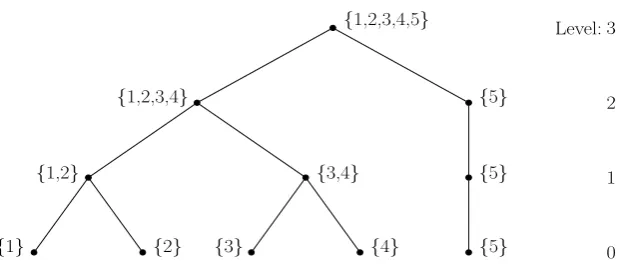
unanimity game with carrier S:={1,2,3,5}(see Figure1). Assume that the weights are exogenously given as shown in Table1 and reflect, e. g., the political or market power or something else of the coalitions. For the weight system w′ we use the same weights for the components as given in the weight system w so that we havew′B =wB for allB ∈ B;
[image:11.595.67.527.725.753.2]for calculating the weighted Shapley value Shw we use the weight system w ∈ W, given by wi:=w{i} for all i∈N.
Table 1: Weights of the coalitions
S {1} {2} {3} {4} {5} {1,2} {1,3} {1,4} {2,3} {2,4} {3,4} {1,2,3} {1,2,4} {1,3,4} {2,3,4} {1,2,3,4}
{1} {2} {3} {4} {5}
{1,2} {3,4} {5}
{1,2,3,4} {5}
{1,2,3,4,5} Level: 3
2
1
[image:12.595.144.456.86.218.2]0
Figure 1: Structure of the components in different levels
We obtain Table2 where ShwHL is the weighted Shapley hierarchy levels value, pre-sented in Besner (2018b) and ShwSL is the weighted Shapley support levels value,
pre-sented in Besner (2018a).
Table 2: Comparison of different values
Value Payoff to player 1,2,3,4,5 ϕ{1,2,3,4}(B2, v2,B2) Pi∈{1,2,3,4}ϕi(N, v,B)
Sh(N, v) 14,14,14,0,14 -
-Shw(N, v) 1 8,
1 8,
1 8,0,
5
8 -
-ShL(N, v,B) 1
8,18,14,0,12 12 12
ShwHL(N, v,B) 7 48,
7 48,
5 24,
1 12,
5 12
7 12
7 12
ShwSL(N, v,B) 7 48,
7 48,
7 24,0,
5 12
7 12
7 12
ShwAL(N, v,B) 3
16,163,18,0,12 127 12
ShwCL(N, v,B) 1 6,
1 6,
1 9,0,
5 9
7 12
4 9
ShCL(N, v,B) 1 6,
1 6,
1 3,0,
1 3
1 2
2 3
Discussion: The third column gives the payoff to coalition {1,2,3,4} in the second level game where coalition {1,2,3,4} is a player. We see, in difference to the other presented values for level structures,ShwAL, ShwCL andShCLdon’t match the level game
property. ShwHL is the only value that doesn’t satisfy the null player property. Player 3 is
supported by player 4 in the weight w{3,4}. Whereas by ShwHL player 3 passes a share on
to player 4, by ShwSL player 3 takes it all. All weights of coalitions which contain player
4 do not play a role for computingShwAL and ShwCL. So it is no surprise that the payoff
to all other players wouldn’t change by these values if player 4 would leave the game. In addition, we see that all presented values are different, especially ShwHL, ShwSL and
ShwAL don’t coincide although they all contain the Shapley levels value! Also of interest
[image:12.595.68.528.341.501.2]7 Conclusion
In an increasingly networked world where sharing of information, data, knowledge, expen-sive ressources and so on is a matter of fact it is increasingly important for all stakeholders to share in the benefits. To distribute generated surpluses the presented two new classes of LS-values, together with the weighted Shapley hierarchy levels values and the weighted Shapley support levels values, contain alternatives to the Shapley levels value if there exist exogenously given weights for some coalitions.
The weighted Shapley hierarchy levels values and the weighted Shapley support levels values meet the level game property but subcoalitions of a component always depend on the weight of the whole component. An detailed examination of the weighted Shapley hierarchy levels values shows that by these values, and so also for the Shapley levels value, the worth of many coalitions, e. g. coalitions which are the union of proper subsets of pairwise disjoint components, is not relevant for the payoff to all players!
In this regard by the values of our two new classes (the Shapley levels value is here an exception) the players are more independent from the nesting components. The new classes offer also an alternative if it is desired that if a null player is removed from the game there is no change in the payoff to the other players.
The weighted Shapley alliance levels values contain the Shapley levels value as a special case. So we have three different classes, the weighted Shapley hierarchy levels values, the weighted Shapley support levels values and the weighted Shapley alliance levels values which contain all the Shapley levels values. Thus the different axiomatizations by these classes open different perspectives on the Shapley levels value too.
But a level structure is more then just a sequence of coalition structures, the coalition structures are ordered in a certain way. Thus we could present a new internally induced restriction, which should be used for example in the case that a component splits in the components next in size if one player quits the component. The weighted Shapley collabo-ration levels values satisfy the null player out property for internally induced restrictions. So we have found a situation where the Shapley levels value fails and a new extension of the Shapley value, called Shapley collaboration levels value, is recommended if all weights are equal or there aren’t any weights at all respectively.
8 Appendix
The following lemma is used in the proofs of theorem 3.2 and theorem3.3.
Lemma 8.1. Besner (2018a, lemma 7.3) Players i, j ∈ N, i 6= j, are dependent in v ∈
VN, iff ∆
v(S∪ {k}) = 0, k∈ {i, j}, for all S⊆N\{i, j}.
8.1 Proof of theorem 3.2
Let (N, v, B)∈VLN, B
={B0, ...,Bh+1}, w ∈ W2N
and Ar
w,T the expressions according to
def.3.1.
• E, N, A: Let T ∈ΩN, j ∈T.It is clear, by induction on r, that
X
i∈Br+1(j), i∈T
r
Y
ℓ=0
By P
i∈T Aw,T(i) = 1 and Aw,T(i) > 0, i ∈ T, the Aw,T(i) form a dividend share system
p∈ PN. ThusShwAL coincides with a Harsanyi payoff. It is well-known that a Harsanyi
payoff satisfies efficiency, additivity and the null player property for TU-values. Thus it is obvious that ShwAL matches E, Aand N.
• NO: It is well-known that each coalition S ∈ ΩN, containing a null player j ∈
N in v, is not active in v. In eq. (5) we have only to consider active coalitions. But for these coalitions there is no change in the weights. Thus we have ShwAL
i (N, v,B) =
ShwAL
i (N\{j}, v,B|N\{j}) for all i∈N\{j}.
• WPWC: Letk, ℓ ∈ N, 0≤ r ≤h, Br(ℓ)⊆ Br+1(k) and all players i ∈ Br(k)∪ Br(ℓ)
be dependent in v. We obtain
X
i∈Br(k)
ShwALi (N, v,B)
wBr(k)
= Def.
3.1 1
wBr(k) X
i∈Br(k) X
T⊆N, T∋i
h Y
j=0
wBj(i)∩T P
B∈Bj:B⊆Bj+1(i),
B∩T6=∅
wB∩T
∆v(T)
= Lem.
8.1 1
wBr(k) X
i∈Br(k)
X
T⊆N, (Br(k)∪Br(ℓ))⊆T
h Y
j=0
wBj(i)∩T P
B∈Bj:B⊆Bj+1
(i), B∩T6=∅
wB∩T
∆v(T)
= 1
wBr(k)
X
T⊆N, (Br(k)∪Br(ℓ))⊆T
X
i∈Br(k) h
Y
j=0
wBj(i)∩T P
B∈Bj:B⊆Bj+1(i),
B∩T6=∅
wB∩T
∆v(T)
= 1
wBr(k)
X
T⊆N, (Br(k)∪Br(ℓ))⊆T
∆v(T)
" h Y
j=r
wBj(k)∩T P
B∈Bj:B⊆Bj+1(k),
B∩T6=∅
wB∩T
· X
i∈Br(k)
r−1 Y
j=0
wBj(i)∩T P
B∈Bj:B⊆Bj+1(i),
B∩T6=∅
wB∩T
7
#
= 1
wBr(k)
X
T⊆N, (Br(k)∪Br(ℓ))⊆T
∆v(T) h
Y
j=r
wBj(k)∩T P
B∈Bj:B⊆Bj+1(k),
B∩T6=∅
wB∩T
= X
T⊆N, (Br(k)∪Br(ℓ))⊆T
∆v(T) h
Y
j=r+1
wBj(k)∩T P
B∈Bj:B⊆Bj+1
(k), B∩T6=∅
wB∩T
= X
T⊆N, (Br(k)∪Br(ℓ))⊆T
∆v(T) h
Y
j=r+1
wBj(ℓ)∩T P
B∈Bj:B⊆Bj+1(ℓ),
B∩T6=∅
wB∩T
= X
i∈Br(ℓ)
ShwALi (N, v,B)
wBr(ℓ)
.
Convention 8.2. To avoid cumbersome case distinctions in the proof of theorem3.3
using WPWC, if there is only one single player assessed in isolation, she is defined as dependent by herself. Then WPWC is trivially satisfied.
8.2 Proof of theorem 3.3
Let (N, v, B)∈VLN,B
={B0, ...,Bh+1}, w ∈ W2N
, S ∈ΩN arbitrary and ϕ an LS-value
that satisfies all axioms of theorem 3.3and N, becauseE and NOimply obvious N. Due
7
The last sum always equals 1, ifr= 0, we have an empty product, which is equal, by convention, to the
to theorem3.2, property (2) and A, it is sufficient to show that ϕ is uniquely defined on the game vS := ∆v(S)·uS.
All playersj ∈N\S are null players in vS and so ϕ is unique onvS for allj ∈N\S by
N. By lemma8.1, all playersi∈S, possibly using conv.8.2, are dependent invS and, by
NO, we obtain
ϕi(N, vS,B) = ϕi(S, vS,B|S) for all i∈S.
So we can use an induction on the restriction to the player setS on the sizem, 0≤m ≤h,
for all levels r, 0≤r ≤h, with m:=h−r.
Initialisation: Let m= 0 and so r=h. We get for an arbitrary i∈S
X
B∈Bh| S,
B∩S6=∅
X
j∈B
ϕj(N, vS,B|S) = (WPBC)
X
B∈Bh| S,
B∩S6=∅ wB
wBh| S(i)
X
j∈Bh| S(i)
ϕj(N, vS,B|S) =
(E)∆v(S)
⇔ X
j∈Br| S(i)
ϕj(N, vS,B|S) =
h
Y
k=h−m
wBk| S(i) P
B∈Bk|
S:B⊆Bk+1|S(i),
B∩S6=∅
wB
∆v(S). (6)
Induction step: Assume that eq. (6) holds toϕwith an arbitrarym−1, 0≤m−1≤h−1 (IH). It follows for an arbitrary i∈S
X
B∈Br|
S, B∩S6=∅,
B⊆Br+1| S(i)
X
j∈B
ϕj(N, vS,B|S) = (WPBC)
X
B∈Br|
S, B∩S6=∅,
B⊆Br+1| S(i)
wB
wBr| S(i)
X
j∈Br| S(i)
ϕj(N, vS,B|S)
=
(IH)
h
Y
k=h−m+1
wBk| S(i) P
B∈Bk|
S:B⊆Bk+1|S(i),
B∩S6=∅
wB
∆v(S)
⇔ X
j∈Br| S(i)
ϕj(N, vS,B|S) =
h
Y
k=h−m
wBk| S(i) P
B∈Bk|
S:B⊆Bk+1|S(i),
B∩S6=∅
wB
∆v(S).
So ϕ is uniquely defined on vS (take m=h and so r= 0).
8.3 Proof of proposition 3.4
Let (N, v, B)∈VLN, B={B0, ...,Bh+1},andw∈ W2N
such thatwS =|S|for allS ∈ΩB
h
, Bh∈ Bh, w
S ∈w. We have only to show that
Aw,T(i) =
1
|T| for all T ⊆N, T ∋i.
For all T ⊆ N, T ∋ i, and 0 ≤ r ≤ h the set B^r+1
T (i) := {B ∩ T : B ∈ Br, B ⊆
Br+1(i), B∩T 6=∅} is a partition ofBr+1(i)∩T. So we have
X
B∈B^r+1 T (i)
wB∩T =
X
B∈Br:B⊆Br+1
(i), B∩T6=∅
wB∩T =|Br+1(i)∩T|.
By line (4) we getAw,T(i) =
1
8.4 Logical independence
Let B = B0. All our axioms coincide in this case with axioms for TU-values which
characterize the weighted Shapley values or the Shapley values. There it is well-known or easy to prove that the axioms are logical independent. Thus it is clear that the axioms, used in our axiomatizations, must be logical independent too.
References
´
Alvarez-Mozos, M., van den Brink, R., van der Laan, G., & Tejada, O. (2017). From hierarchies to lev-els: new solutions for games with hierarchical structure.International Journal of Game Theory,1–25. Aumann, R.J., Dr`eze, J., 1974. Cooperative games with coalition structures. International Journal of
Game Theory 3,217–237.
Besner, M. (2018a). The weighted Shapley support levels values. Working paper. Besner, M. (2018b). Weighted Shapley hierarchy levels values. Working paper.
Calvo, E., Lasaga, J. J., & Winter, E. (1996). The principle of balanced contributions and hierarchies of cooperation,Mathematical Social Sciences, 31(3), 171–182.
Derks, J. J., & Haller, H. H. (1999). Null players out? Linear values for games with variable supports. International Game Theory Review, 1(3–4), 301–314.
Derks, J., Haller, H., & Peters, H. (2000). The selectope for cooperative games.International Journal of Game Theory, 29(1), 23–38.
Dragan, I. C. (1992). Multiweighted Shapley values and random order values. University of Texas at Arlington.
G´omez-R´ua, M., & Vidal-Puga, J. (2011). Balanced per capita contributions and level structure of co-operation.Top, 19(1), 167–176.
Hammer, P. L., Peled, U. N., & Sorensen, S. (1977). Pseudo-boolean functions and game theory.I. Core elements and Shapley value. Cahiers du CERO, 19,159–176.
Harsanyi, J. C. (1959). A bargaining model for cooperative n-person games. In: A. W. Tucker & R. D. Luce (Eds.), Contributions to the theory of games IV (325–355). Princeton NJ: Princeton University Press.
Kalai, E., & Samet, D. (1987). On weighted Shapley values. International Journal of Game Theory 16(3), 205–222.
Levy, A., & Mclean, R. P. (1989). Weighted coalition structure values. Games and Economic Behavior, 1(3), 234–249.
McLean, R. P. (1991). Random order coalition structure values.International Journal of Game Theory, 20(2), 109–127.
Nowak, A. S., & Radzik, T. (1995). On axiomatizations of the weighted Shapley values.Games and Eco-nomic Behavior, 8(2), 389–405.
Owen, G. (1977). Values of games with a priori unions. InEssays in Mathematical Economics and Game Theory, Springer, Berlin Heidelberg,76–88.
Shapley, L. S. (1953a). Additive and non-additive set functions.Princeton University.
Shapley, L. S. (1953b). A value for n-person games. H. W. Kuhn/A. W. Tucker (eds.), Contributions to the Theory of Games,Vol. 2, Princeton University Press, Princeton, pp. 307–317.
Vasil’ev, V. A. (1978). Support function of the core of a convex game.Optimizacija Vyp, 21,30-35. Vidal-Puga, J. (2012). The Harsanyi paradox and the ”right to talk” in bargaining among coalitions.
Mathematical Social Sciences, 64(3), 214–224.