5926
Interpolated Spectral NGram Language Models
Ariadna Quattoni and Xavier Carreras
dMetrics Brooklyn, NY 11211
{ariadna.quattoni,xavier.carreras}@dmetrics.com
Abstract
Spectral models for learning weighted non-deterministic automata have nice theoretical and algorithmic properties. Despite this, it has been challenging to obtain competitive results in language modeling tasks, for two main rea-sons. First, in order to capture long-range de-pendencies of the data, the method must use statistics from long substrings, which results in very large matrices that are difficult to de-compose. The second is that the loss func-tion behind spectral learning, based on mo-ment matching, differs from the probabilis-tic metrics used to evaluate language mod-els. In this work we employ a technique for scaling up spectral learning, and use in-terpolated predictions that are optimized to maximize perplexity. Our experiments in character-based language modeling show that our method matches the performance of state-of-the-art ngram models, while being very fast to train.
1 Introduction
In the recent years we have witnessed the develop-ment of spectral methods based on matrix decom-positions to learn Probabilistic Non-deterministic Finite Automata (PNFA) and related models (Hsu et al.,2009,2012;Bailly et al.,2009;Balle et al., 2011;Cohen et al.,2012;Balle et al., 2014). Es-sentially, PNFA can be regarded as recurrent neu-ral networks where the function that predicts the dynamic state representation from previous states is linear. Despite the expressiveness of PNFA and the strong theoretical properties of spectral learn-ing algorithms, it has been challenglearn-ing to get com-petitive results on language modeling tasks. We argue and confirm with our experiments that there are two main reasons why using spectral meth-ods for language modeling is challenging. The first reason is a scalability problem to handle long range dependencies. The spectral method is based
on computing a Hankel matrix that contains statis-tics of expectations over substrings generated by the target language. If we want to incorporate long-range dependencies we need to consider long substrings. A consequence of this is that the Han-kel matrix can become too large to make it prac-tical to perform algebraic decompositions. To ad-dress this problem we use the basis selection tech-nique by Quattoni et al. (2017) to scale spectral learning and model long range dependencies. Our experiments confirm that modeling long range de-pendencies is essential to obtain competitive lan-guage models.
The second limitation of classical spectral methods when applied to language modeling is that the loss function that the learning algorithm attempts to minimize is not aligned with the loss function that is used to evaluate model perfor-mance. Spectral methods minimize the `2 dis-tance on the prediction of expectations of sub-strings up to a certain length (see Balle et al. (2012) for a formulation of spectral learning in terms of loss minimization), while language mod-els are usually evaluated using conditional per-plexity. There have been some proposals on gen-eralizing the fundamental ideas of spectral learn-ing to other loss functions (Parikh et al., 2014; Quattoni et al., 2014). However, while these ap-proaches are promising they have the downside that they lead to relatively expensive iterative con-vex optimizations and it is still a challenge to scale them to model long-range dependencies.
interpo-lation step is iterative, but it is a simple and very efficient convex optimization: the weights of the interpolation can be trained in a few seconds or minutes at most. The refinement step allows us to leverage all the moments computed by the learned PNFA and to align the spectral method with the perplexity evaluation metric.
Our experiments on character-level language model show that: (1) modeling long range depen-dencies is important; and (2) with the simple in-terpolation step we can obtain competitive results. Our perplexity results are significantly better than feed-forward NNs, as good or better than sophisti-cated interpolation techniques such as Kneser-Ney estimation, and close to the performance of RNNs on two datasets.
The main contribution of our work consists on combining two simple ideas, i.e. incorporat-ing long-range dependencies via basis selection of long substring moments (Section 2), and re-fining the predictions of the PNFA with an iter-ative interpolation step (Section 3). Our experi-ments show that these two simple ideas bring us one step closer to making spectral methods for PNFA reach state-of-the-art performance on lan-guage modeling tasks (Section 4). The advantage of these methods over other popular approaches to language modeling is their simplicity and the fact that they rely on efficient convex optimiza-tions for training the model parameters. Further-more, PNFA are probabilistic models for which efficient inference methods can be easily derived for computing all sorts of expectations. These ex-pectations could then be used as features to learn predictive interpolation models. In this paper we present experiments with one type of expectation and interpolation model that illustrates the poten-tial of this approach.
2 Spectral Language Models
2.1 Probabilistic Non-Deterministic Finite Automata
We start describing the general class of Weighted Automata over strings. Let x = x1· · ·xn be a
sequence of lengthnover some finite alphabetΣ. We denote asΣ?the set of all finite sequences, and we use it as a domain of our functions. We use
x·x0to denote the concatenation of two stringsx
andx0.
A Non-Deterministic Weighted Automaton (WA) with k states is defined as a tuple: A =
hα0,α∞,{Aσ}σ∈Σiwith: α0,α∞ ∈ Rk are the
initial and final weight vectors; and Aσ ∈ Rk×k
are the transition matrices associated to each sym-bolσ∈Σ. The functionfA: Σ? →Rrealized by
an WAAis defined as:
fA(x) =α>0Ax1· · ·Axnα∞ . (1)
Probabilistic Non-Deterministic Finite Au-tomata (PNFA) are WA that compute a probabilis-tic distribution over strings. One can easily trans-form a PNFA into another automata that computes substring expectations via simple transformations of the model parameters, and the reverse is also true, seeBalle et al.(2014) for details. In this pa-per we will directly learn and use automata that compute expectations. With these expectations we will calculate the conditional probabilities of a lan-guage model1:
Pr[σ|x1:n] = P fA(x1:n·σ)
σ0∈ΣfA(x1:n·σ0)
(2)
Here,nis the length of the left context, analogous to the order of an NGram model, but we compute the expectations not from counts but from a PNFA.
2.2 The Spectral Method
We now give a brief description of the spectral method for estimating a PNFA that computes ex-pectations over substrings. We only provide a higher-level description of the method; for a com-plete derivation and the theory justifying the algo-rithm we refer the reader to the works byHsu et al. (2009) andBalle et al.(2014).
Assume a distribution of strings over some dis-crete alphabet, our target functionf(x)is the ex-pected number of times that x appears as a sub-string of a sub-string sampled from the distribution. At training, we are given strings T from the dis-tribution and we want to estimatef. We denote asfT(x)the empirical substring expectation ofx
inT.2 UsingfT, the spectral method estimates a WAAwithkstates, wherekis a parameter of the algorithm, such that fA is a good approximation of f. The method reduces the learning problem to computing an SVD decomposition of a special type of matrix called the Hankel matrix, that col-lects the observed expectationsfT. The method is described by the following steps:
1For language models, we assume thatΣincludes a
spe-cial symbol for end of sentence.
2This corresponds to the number of times thatxis
(1) Select a set of prefixesPand suffixesS, that will serve as indices of the Hankel matrix for rows and columns respectively. A typi-cal choice is to select all substrings up to a certain size n, but this quickly grows, and in practice prior work uses a small n. In-stead we use the basis selection technique presented by Quattoni et al. (2017), which allows to capture long-range dependencies (analogous to having a largen) but keeping the number of prefixes and suffixes manage-able.
(2) Compute Hankel matrices for(P,S).
(a) Compute H ∈ RP×S, with entries H(p, s) =fT(p·s).
(b) ComputehP ∈RPwithhP(p) =fT(p)
andhS∈RSwithhS(s) =fT(s). (c) For eachσ ∈ Σ, computeHσ ∈ RP×S
with entriesHσ(p, s) =fT(p·σ·s).
(3) Compute ak-rank factorization ofH. Com-pute the truncated SVD of H, i.e. H ≈
UΣV> resulting in a matrix F = UΣ ∈
RP×k and a matrix B = V ∈ RS×k. Thus H≈FB>is ank-rank factorization ofH.
(4) Recover the WAA ofk states. LetM+ de-note the Moore-Penrose pseudo-inverse of a matrixM. The elements ofA are recovered as follows. Initial vector: α>0 =h>SB. Final vector: α∞ = F+hP. Transition Matrices: Aσ =F+HσB, forσ∈Σ.
The computation is dominated by step (3), the SVD of the Hankel matrix, which is at most cubic in the size of the matrix. In practice, this method is scalable and fast to train.
3 Interpolated Predictions
One limitation of the spectral method is that the loss that it minimizes is not aligned with the prob-abilistic metrics used in language modeling, such as perplexity. Instead the spectral method mini-mized the`2loss over the observed empirical mo-ments, i.e. those substrings collected in the Han-kel matrix. To align the loss function with a per-plexity measure we propose a simple refinement step, where we use the expected counts computed by the learned PNFA as features of a log-linear model, and learn interpolation weights. In con-trast to Equation2, which uses the longest context
x of length n to compute the conditional proba-bility, the interpolated model leverages the ability of the PNFA to model substring expectations of all lengths up ton. This is similar to classic interpola-tion of language models (Rosenfeld,1994;Chen, 2009).
Given a functionf computing substring expec-tations, the interpolation is:
g(x1:n, σ) = exp
n−1
X
j=0
wσ,jlogf(xn−j:n·σ)
(3) where x1:n is a context of size n, σ is the
out-put symbol, andwσ,jare the interpolation weights, with one parameter per output symbolσand con-text lengthj, with0≤j < n.
As it is standard with interpolation models, we train the weights by maximizing the conditional log-likelihood of the development set. We assume thatf is fixed, which results in a convex optimiza-tion, and we solve with L-BFGS.
4 Experiments
We present experiments in character-based lan-guage modeling. Our spectral ngram models work with a fixed context length, and we show results varying this length up to relatively large values.
Following the standard, the goal is to learn a language model that predicts the next symbol given a sentence prefix, including the prediction of sentence ends. As datasets we use the Penn Tree-bank (PTB) prepared by Mikolov et al. (2012)3, and “War and Peace” (WP) dataset prepared by Karpathy et al. (2016)4. We use two probabilis-tic evaluation metrics that are standard in language modeling tasks:Cross EntropyandBits per Char-acter (BpC). Depending on the dataset, we use one or the other such that we can directly compare to published results.
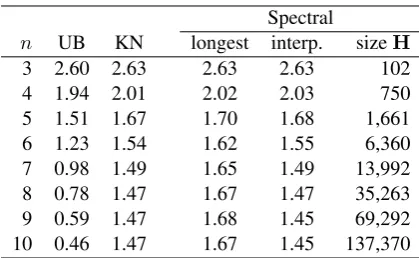
Tables 1 and 2 present results in terms of the context size (n) for the PTB and WP tests re-spectively. The column “UB” shows an upper-bound on the performance metric using a context of sizen. This is computed directly using the ex-pected counts on the test set to compute the con-ditional distribution. If we were able to estimate these expectations perfectly, we would achieve the
3
49 characters; 5017k / 393k / 442k characters in the train / dev / test portions.
484 symbols; 2658k / 300k / 300k characters in the train /
Spectral
n UB KN longest interp. sizeH 3 2.60 2.63 2.63 2.63 102 4 1.94 2.01 2.02 2.03 750 5 1.51 1.67 1.70 1.68 1,661 6 1.23 1.54 1.62 1.55 6,360 7 0.98 1.49 1.65 1.49 13,992 8 0.78 1.47 1.67 1.47 35,263 9 0.59 1.47 1.68 1.45 69,292 10 0.46 1.47 1.67 1.45 137,370
Table 1: Bits-per-character on the PTB test set.
Spectral
n UB KN FNN ME long. int. sizeH
[image:4.595.74.284.60.189.2]3 1.86 1.93 1.93 1.95 1.95 1.95 174 4 1.38 1.52 1.55 1.59 1.57 1.55 1,258 5 1.06 1.31 1.45 1.43 1.41 1.36 3,278 6 0.82 1.23 1.34 1.36 1.39 1.29 11,859 7 0.62 1.20 1.32 1.33 1.42 1.25 26,848 8 0.46 1.19 - 1.30 1.46 1.24 62,628 9 0.32 1.19 - 1.30 1.47 1.24 121,534 10 0.22 1.19 - 1.30 1.47 1.24 224,159
Table 2: Cross-entropy on the WP test set.
reported performance. As the two tables show, a context of size 10 already gives a high upbound, suggesting that we can achieve good per-formance using a fixed but large horizon.
The tables show results of the spectral language model for different context sizes, using expecta-tions from the “longest” context or “interpolated” expectations. A clear trend is that the results im-prove with the context length, achieving a stable performance forn= 10. It is also clear that the in-terpolated predictions work much better than sim-ply using the longest context. Table2 also com-pares to a MaxEnt model (labeled “ME”), which is an interpolation model of Eq.3 but uses em-pirical expectations fT(x) computed from train-ing counts instead of those given by the spec-tral PNFA. Clearly, the expectations given by the PNFA generalize better and lead to improvements. The last column of the two tables shows the number of rows (and columns) of the (square) Hankel matrix we factorize for each context size. This gives an idea of the cost of the estimation al-gorithm, which goes from a few seconds to a few hours, depending on the matrix size.5 Following
5
Note that without the scalability trick, the Hankel matri-ces would be simply too big (in the order of millions of rows and columns) to practically run any experiment. It should be clear, though, that this is the contribution inQuattoni et al.
(2017), not of this paper.
the theory behindQuattoni et al.(2017), this num-ber is an upper bound on the size of the minimal PNFA that reproduces exactly the expected counts of training substrings.
The tables include a column “KN” with the re-sults of an ngram language model estimated with Kneser-Ney interpolation (Kneser and Ney,1995; Chen and Goodman, 1999). Looking at the re-sults on the PTB data in Table1, our interpolated model performs equally well, and sometimes bet-ter, than the KN models using the same context length. Mikolov et al. (2012) reports the perfor-mance of other models: a feed-forward neural net-work6 obtains 1.57, which our model improves with contexts ofn = 6 or larger; an RNN works at 1.41, slightly better than our best result of 1.45. Their best result is of 1.37 for a MaxEnt model with context length ofn= 14engineered for scal-ability.
For the WP test in Table 2, our model and the KN model perform similarly, with some slight im-provements by the KN model. The table also in-cludes the results of a feed-forward neural network (FNN) for increasing orders, by Karpathy et al. (2016). We observe that our interpolated model works better, with our best result at 1.24. They also report the results of an RNN obtaining 1.24, and of LSTM and GRU which both obtain 1.08.
5 Conclusions
In this paper we presented experiments using character-based spectral ngram language models. We combine two key ideas: a) modeling of long-range dependencies via the basis selection of long substring moments byQuattoni et al.(2017); and b) efficient optimization of arbitrary prediction losses (e.g. cross-entropy) via a loss refinement step. With these two ideas, we can improve the performance of spectral learning for PNFA, and bring the results of spectral models closer to the state-of-the-art.
The ability of the spectral method for PNFA to estimate substring expectations can be exploited in other contexts. For example, we are inter-ested in word-level language models that make use of character-level PNFA to compute expectations, which is useful to make predictions on words and substrings which do not appear in training.
It is also interesting to consider a PNFA as a special case of an RNN which uses linear
tions. Given that we obtain similar results than feed-forward NN and some RNN, this suggests that some forms of non-linearities can be approx-imated by linear models, with the advantage that some computations (mainly, expectations) can be done exactly.
Acknowledgments
We are grateful to Matthias Gall´e for the discus-sions around this work, as well as to the anony-mous reviewers for their useful feedback.
References
Rapha¨el Bailly, Franc¸ois Denis, and Liva Ralaivola. 2009. Grammatical inference as a principal com-ponent analysis problem. In Proceedings of the 26th Annual International Conference on Machine Learning, ICML ’09, pages 33–40, New York, NY, USA. ACM.
Borja Balle, Xavier Carreras, Franco M. Luque, and Ariadna Quattoni. 2014. Spectral Learning of Weighted Automata: A Forward-Backward Perspec-tive.Machine Learning, 96(1):33–63.
Borja Balle, Ariadna Quattoni, and Xavier Carreras. 2011. A spectral learning algorithm for finite state transducers. In Proceedings of the 2011th European Conference on Machine Learning and Knowledge Discovery in Databases - Volume Part I, ECMLPKDD’11, pages 156–171, Berlin, Heidel-berg. Springer-Verlag.
Borja Balle, Ariadna Quattoni, and Xavier Carreras. 2012. Local loss optimization in operator models: A new insight into spectral learning. InProceedings of the 29th International Coference on International Conference on Machine Learning, ICML’12, pages 1819–1826, USA. Omnipress.
Stanley Chen. 2009. Performance prediction for expo-nential language models. InProceedings of Human Language Technologies: The 2009 Annual Confer-ence of the North American Chapter of the Associa-tion for ComputaAssocia-tional Linguistics, pages 450–458. Association for Computational Linguistics.
Stanley F. Chen and Joshua Goodman. 1999. An empirical study of smoothing techniques for lan-guage modeling. Computer Speech & Language, 13(4):359 – 394.
Shay B. Cohen, Karl Stratos, Michael Collins, Dean P. Foster, and Lyle Ungar. 2012. Spectral learning of latent-variable pcfgs. InProceedings of the 50th An-nual Meeting of the Association for Computational Linguistics (Volume 1: Long Papers), pages 223– 231, Jeju Island, Korea. Association for Computa-tional Linguistics.
Daniel Hsu, Sham M Kakade, and Tong Zhang. 2012. A spectral algorithm for learning hidden markov models. Journal of Computer and System Sciences, 78(5):1460–1480.
Daniel J. Hsu, Sham M. Kakade, and Tong Zhang. 2009. A spectral algorithm for learning hidden markov models. In COLT 2009 - The 22nd Con-ference on Learning Theory, Montreal, Quebec, Canada, June 18-21, 2009.
Andrej Karpathy, Justin Johnson, and Fei-Fei Li. 2016. Visualizing and understanding recurrent networks. InICLR Workshop Track.
Reinhard Kneser and Hermann Ney. 1995. Improved backing-off for m-gram language modeling. In In Proceedings of the IEEE International Conference on Acoustics, Speech and Signal Processing, vol-ume I, pages 181–184.
Tom´aˇs Mikolov, Ilya Sutskever, Anoop Deoras, Hai-Son Le, Stefan Kombrink, and Jan Cernocky. 2012. Subword language modeling with neu-ral networks. preprint (http://www. fit. vutbr. cz/imikolov/rnnlm/char. pdf).
Ankur P. Parikh, Avneesh Saluja, Chris Dyer, and Eric Xing. 2014. Language modeling with power low rank ensembles. InProceedings of the 2014 Con-ference on Empirical Methods in Natural Language Processing (EMNLP), pages 1487–1498, Doha, Qatar. Association for Computational Linguistics.
Ariadna Quattoni, Borja Balle, Xavier Carreras, and Amir Globerson. 2014. Spectral regularization for max-margin sequence tagging. InProceedings of the 31st International Conference on Machine Learning (ICML-14), pages 1710–1718. JMLR Workshop and Conference Proceedings.
Ariadna Quattoni, Xavier Carreras, and Matthias Gall´e. 2017. A Maximum Matching Algorithm for Basis Selection in Spectral Learning. In Proceedings of the 20th International Conference on Artificial In-telligence and Statistics, volume 54 ofProceedings of Machine Learning Research, pages 1477–1485, Fort Lauderdale, FL, USA. PMLR.